
CHANNEL DECISION ARCHITECTURE20channel roles 8selection stages 10direct FAQs 0guaranteed outcomes
Performance Marketing Channels: Choose the Right Acquisition Mix
Choose performance marketing channels by the customer task, eligible offer, available creative and result you can evaluate. We help advertisers and media buyers add a controlled paid introduction through FroggyAds. Use our format, targeting, bid, budget and source choices for that role, then coordinate the receiving experience and customer review with the rest of your acquisition mix.
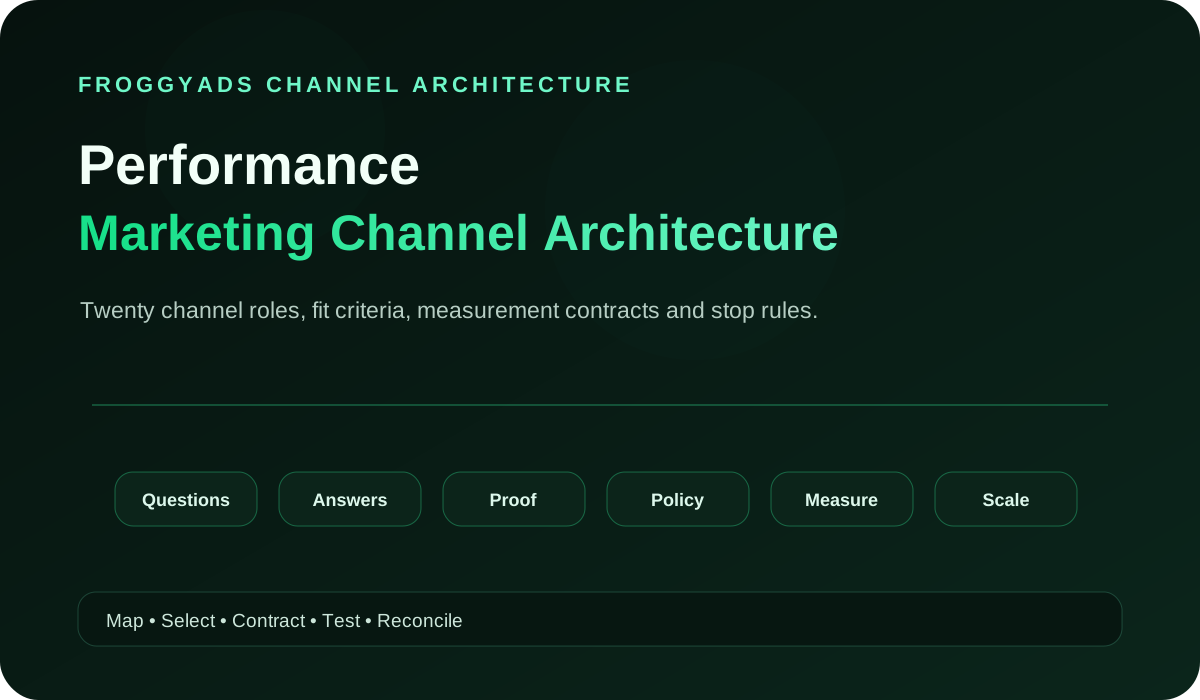
Choose by customer task: compare paid introductions, organic discovery and permitted follow-up by their actual role. Start with the gap in your journey, then choose a route whose expense, receiving work and measurement you can evaluate.
| Buying question | Practical guidance |
|---|---|
| Customer result | Compare useful outcomes and the relevant expense, keeping overlapping channel credit explicit. |
| Discovery role | Choose a route that can introduce the offer to an appropriate audience. |
| Receiving capacity | Confirm the destination and team can handle the intended customer action. |
Provider access reference: Google Ads manager accounts. This explains Google’s account structure; it does not define FroggyAds channel features.
CHANNEL INDEX
Compare paid acquisition, organic discovery and follow-up
The twenty options below include paid acquisition, organic discovery and follow-up through your own channels. They are not twenty FroggyAds products or identical billing models. Start with the specific job you need, then choose a route whose eligibility, expense and measurement fit that job.
CHANNEL 01Search demand captureCHANNEL 02Editorial and organic discoveryCHANNEL 03Paid search accelerationCHANNEL 04Programmatic display reachCHANNEL 05Native discoveryCHANNEL 06Push traffic introductionCHANNEL 07Social community participationCHANNEL 08Creator and expert collaborationCHANNEL 09Video and audio educationCHANNEL 10Email lifecycleCHANNEL 11Messaging and conversational follow-upCHANNEL 12Affiliate and partner distributionCHANNEL 13Referral and advocacyCHANNEL 14PR and earned authorityCHANNEL 15Communities, forums and Q&ACHANNEL 16Events, webinars and live sessionsCHANNEL 17Product-led and in-app communicationCHANNEL 18Retargeting and sequential messagingCHANNEL 19Directories, marketplaces and ecosystem listingsCHANNEL 20Experimental and emerging channels
CHANNEL CHOICE
How should you choose performance marketing channels?
Choose the smallest useful mix that supports the customer journey you can actually operate. A search advertisement can answer existing demand; paid display or Native can introduce a relevant offer; permission-based email can support an existing relationship. Compare each channel against its stated role. FroggyAds gives you direct buying control for a defined paid traffic test, while customer records help you judge the useful result.
SELECTION MATRIX
Six practical questions for a channel decision
| Review area | Required evidence | Invalid selection signal |
|---|---|---|
| Customer task | Which need and eligible action should this route support? | A channel chosen only because it is fashionable. |
| Channel role | Which part of the journey does this route actually handle? | Every platform receives full credit for one customer. |
| Message and route | Are the claims, creative and promotion permitted and accurate? | The receiving offer contradicts the introduction. |
| Measurement | Which observations and acceptance statuses can be compared? | Raw platform conversions are labelled approved customers. |
| Expense | What purchase and supporting costs does this decision include? | A cheap click is treated as proof of affordable acquisition. |
| Receiving team | Can the business serve the intended response? | Traffic expands while suitable customers remain unserved. |
01
EVALUATION AND ACTION
1. Search discovery: queries, answers and customer action
Search discovery connects a stated customer question with an answer or offer that fulfils it.
Journey role
The search role is useful when a person can describe the problem or compare possible solutions.
Search query and destination fit
Choose a search destination that answers the actual query rather than a page with only loosely related wording.
Operating unit
Retain the query intent, receiving page and customer action as the unit you can inspect.
Search visits and customer action
Read useful search visits and later customer actions separately from visibility or query position.
Review focus: The actual search question, the receiving answer and the useful customer action.
Organic search depends on a crawlable, useful page and how a search service evaluates it. Paid placement is a separate purchase.
A specific product question may need a clear explanation of eligibility, conditions and the relevant next step.
Check whether the search page resolves that question before asking the visitor to register or buy.
Include the work required to maintain the answer when assessing this acquisition route’s broader expense.
Search attribution can credit demand influenced elsewhere. It does not prove the answer created every customer need.
Keep search performance within its observed scope and avoid forecasting traffic from a keyword list alone.
Revise irrelevant query coverage or a misleading destination before expanding the search content set.
Revise this route: Revise search coverage when irrelevant queries or an inaccurate answer prevent a useful next step.
02
DISCOVERY AND COMPARISON
2. Editorial discovery: original content and useful progression
Editorial discovery gives a reader useful explanation before that reader has selected a specific product.
This content role suits a complex choice that benefits from an example, comparison or original practical method.
Choose an editorial topic because it helps the intended customer understand a real decision.
Use a distinct article purpose, evidence and an appropriate onward route rather than many near-identical pages.
Read relevant content engagement alongside useful onward actions; page views alone do not establish acquired customers.
Review focus: The original explanation, the reader’s decision and a relevant onward route.
A substantive explanation can support later evaluation even when the customer does not act on the first visit.
Keep the distinction between teaching a subject and making a commercial offer clear to the reader.
Use accurate author and source information, and update a claim when its factual basis changes.
Allow for research, writing and maintenance expense when comparing editorial work with a media purchase.
Content referrals and search discovery can overlap, so avoid counting one later order twice.
A paid FroggyAds introduction can support a useful receiving article when the offer and promotion are eligible.
Repair thin or repetitive content before treating a larger publishing volume as a better acquisition channel.
Revise this route: Improve editorial material that repeats another page without adding a useful explanation.
03
COMPARISON AND ACTION
3. Paid search: commercial queries, ads and expense
Paid search buys an advertisement against the targeting and placement options of the chosen search provider.
Its role is often to meet an explicit commercial question with a relevant advertisement and destination.
Check the actual provider’s query controls, creative rules and measurement before planning the purchase.
Keep the query scope, advertisement, receiving page and useful customer action identifiable.
Compare search media expense with reviewed customer outcomes rather than raw platform credits alone.
Review focus: The selected commercial query, accurate advertisement and reviewed media expense.
A tightly relevant search advertisement can explain why the offer suits the question being asked.
Inspect irrelevant query matches or an ambiguous promise before increasing the paid search allocation.
Retain the settings and offer version so a later query comparison has a usable reference.
Include any relevant search-management or production expense in a broader acquisition-cost comparison.
Search often encounters existing demand; ordinary attribution does not establish how much demand the advertisement caused.
Treat search keywords and provider-specific matching tools as separate from FroggyAds supported audience and source controls.
Pause a known destination fault or an unpermitted query promotion rather than rely on a higher search bid.
Revise this route: Review paid search when irrelevant matches consume the allocation or the destination cannot fulfil the advertisement.
04
VISUAL INTRODUCTION
4. Display campaigns: creative, source fit and response
Display introduces an offer through a visual advertisement and the receiving destination associated with it.
The display role can suit an advertiser with a clear benefit and a prepared customer route.
Choose the supported display audience and source settings for the actual offer instead of assuming every placement is equivalent.
Keep the display creative, source scope and destination version available for review.
Read display delivery and recorded actions alongside the useful customer result your measurement supports.
Review focus: The display creative, source scope and prepared receiving experience.
FroggyAds Display gives you a paid format you can manage through our applicable campaign controls.
Use a legible visual and a supportable proposition so suitable visitors can understand the introduction.
Compare a meaningful display creative change while keeping unrelated offer changes separate.
Review source differences only at the detail the available records support; do not invent individual exposure histories.
Distinguish the display media bill from customer acquisition cost and any supporting production work.
A lower display click price is useful only in context of the resulting customer quality and relevant expense.
Investigate an unsuitable source pattern or a misleading visual before expanding the display purchase.
Revise this route: Investigate an unsuitable display source pattern or a creative-to-offer mismatch.
Put the paid role into delivery
Buy a defined paid introduction through FroggyAds
Choose FroggyAds when you want to control the paid introduction directly. Select a suitable format and supported targeting, set the bid and budget, and inspect the source evidence your reports provide. Our self-serve workflow helps you test a distinct acquisition role without treating traffic volume as a customer guarantee.
Create My Free Account
05
DISCOVERY AND CONSIDERATION
5. Native discovery: headline, image and destination fit
Native introduces an offer through a headline and image adapted to the surrounding placement experience.
The Native role suits an advertiser who can make a relevant proposition understandable before the click.
Choose the Native introduction for its actual benefit and qualification rather than curiosity with no receiving value.
Keep the headline, image, disclosure and destination together as the creative you evaluate.
Compare useful Native responses with accepted downstream actions at the supported reporting scope.
Review focus: The Native headline, image, material conditions and corresponding destination.
Use FroggyAds Native when you want to test a prepared introduction with direct buying control.
An eligible explanatory landing page can develop the benefit while keeping material conditions visible.
Avoid disguising a commercial Native message as an independent endorsement or unsupported editorial verdict.
Retain the original Native version when comparing a new angle so the result can guide another purchase.
Include relevant article or asset preparation when comparing broader Native acquisition expense.
A strong Native headline response may still produce unsuitable visitors if the destination does not fulfil the promise.
Correct a headline-to-destination gap before using more Native volume to compensate for weak customer quality.
Revise this route: Correct a Native headline that attracts attention through a promise the landing page does not fulfil.
06
CONCISE PAID INTRODUCTION
6. Push traffic: concise messages and eligible offers
Push traffic presents a concise notification-style introduction to an eligible offer through the selected inventory.
A Push purchase can support a direct response test with a clear message and working destination.
Match the Push proposition with the offer’s actual conditions and the supported audience settings.
Review the notification creative and destination as one customer introduction.
Judge Push media expense against useful outcomes rather than assume every notification recipient is a customer.
Review focus: The concise Push promise, eligible offer and supported purchase settings.
FroggyAds Push is a paid format; buying its traffic does not mean reaching your own previous website visitors.
Keep the short Push message accurate, with an understandable benefit and no invented urgency.
Use the supported campaign and source controls to define the Push purchase you are prepared to evaluate.
Do not transfer email-list ownership or another provider’s remarketing features to a Push traffic campaign.
Retain the Push creative and selected purchase conditions when comparing later customer response.
Read any available delivery or exposure information at its actual scope instead of inferring personal behaviour.
Revise a misleading Push introduction or unsuitable offer before increasing the allocation.
Revise this route: Revise Push messaging that invents urgency or introduces an ineligible offer.
07
DISCOVERY AND TRUST
7. Social participation: community relevance and conversation
Social participation develops an ongoing presence in a community where the intended audience already spends attention.
This social role can support understanding, questions and a relationship around a relevant subject.
Choose a community because its actual discussions fit the offer, not because its membership total is large.
Keep the post, community context, disclosed relationship and response task together.
Read useful social conversations and permitted onward actions separately from reaction totals.
Review focus: The actual community discussion, the useful contribution and disclosed affiliation.
Contribute an answer or demonstration that helps the community before asking people to leave it.
Social moderation rules can limit promotion even when the underlying offer is legitimate.
Make your affiliation clear where relevant, and avoid fabricated testimonials or engagement.
Allow time for actual community participation and reply handling in the resource plan.
A social platform credit may overlap a later search or direct visit; retain that limitation.
Use FroggyAds to test a separate paid introduction while your team develops the ongoing social conversation.
Stop repeated promotional posting when it conflicts with the community’s rules or provides no useful contribution.
Revise this route: Stop social promotion that conflicts with moderation rules or hides a material affiliation.
08
TRUST AND COMPARISON
8. Creator collaboration: demonstration, rights and disclosure
Creator collaboration introduces an offer through a person whose relevant work the audience can evaluate.
The creator role is useful when a genuine demonstration or informed explanation helps a product decision.
Choose the creator’s audience fit and actual experience rather than assume follower count establishes buying intent.
Retain the brief, permitted claims, usage rights and material-connection disclosure.
Review suitable referred actions and actual customer quality rather than video views alone.
Review focus: The creator’s genuine experience, permitted usage rights and sponsorship context.
A creator should not describe personal product experience that the creator has not had.
Check that a demonstration represents the offered product and does not conceal an important condition.
Agree which creative can be reused and where before incorporating it into a separate advertisement.
Include the relevant creator and production expense when comparing the acquisition route.
A sponsored recommendation is not independent proof of a typical customer outcome.
Confirm creator usage and merchant permission for the chosen FroggyAds format before building a paid creative test.
Revise an unsupported endorsement or unclear sponsorship before distributing the creator message further.
Revise this route: Correct an unsupported creator claim or unresolved permission before reusing the asset.
Choose a relevant format
Choose the FroggyAds format that fits the message
Our Push, Native, Display and Pop formats give you different paid introductions. Match the message with an eligible offer and a working destination. Use the selected format’s actual specifications and supported controls rather than assume features from another channel.
Create My Free Account
09
DISCOVERY, EDUCATION AND TRUST
9. Video and audio: explanation, completion and next action
Video and audio can explain a product through a demonstration, interview or coherent spoken sequence.
This educational role suits a decision that benefits from seeing a process or hearing a clear explanation.
Choose the video or audio treatment because it resolves a customer question that a short introduction cannot answer.
Keep the episode, accessible supporting material and intended next action identifiable.
Read meaningful completion and useful onward actions at the scope the distribution records provide.
Review focus: The demonstration’s factual basis, accessible explanation and intended next action.
A view or listen does not automatically mean the person understood the offer or became a suitable customer.
Use truthful product evidence and make material sponsorship or commercial purpose clear.
Offer the relevant alternative explanation or transcript where the receiving implementation calls for it.
Account for production and editing effort before comparing this content with a simpler paid introduction.
Choose a suitable FroggyAds paid format to introduce eligible visitors to the video’s receiving page, then review the later customer action separately.
Keep the content version and destination consistent while evaluating the acquisition contribution.
Improve an unclear next step or unsupported demonstration rather than buy views as a substitute for useful response.
Revise this route: Improve video or audio when its demonstration misleads or the next action is unclear.
10
NURTURE, RETENTION AND EXPANSION
10. Email lifecycle: permission, messages and customer progression
Email lifecycle supports a known relationship through messages relevant to the subscriber’s actual state.
Lifecycle messages can explain a trial, onboard a customer or communicate an appropriate follow-up.
Choose an email purpose that provides value within the permission and rules applying to the relationship.
Keep the subscriber context, message and intended action identifiable within the authorised email system.
Read useful email progression and customer outcomes rather than opens as proof of commercial value.
Review focus: The subscriber relationship, permitted message purpose and useful lifecycle action.
A business email programme requires its own collection, permission, delivery and preference handling.
Use a message that reflects the actual product and subscription conditions, including material changes.
Avoid assuming a purchased traffic visit creates permission for every later email promotion.
Include the relevant email platform, content and operating expense in the comparison.
An email-attributed order may also have involved another channel; keep overlapping credit explicit.
Bring suitable visitors to a prepared signup route through FroggyAds, then manage the permitted email relationship through your own receiving system.
Correct an unsuitable message or permission problem before increasing the email sequence.
Revise this route: Hold an email sequence whose permission or message relevance has not been resolved.
11
ACTION, SUPPORT AND RETENTION
11. Messaging follow-up: permission, response and resolution
Messaging follow-up can help an eligible customer resolve a specific question through an appropriate direct conversation.
Its role is timely clarification or service, with an actual team able to receive the response.
Choose a messaging route that the customer relationship and relevant provider requirements permit.
Retain the message purpose, responsible responder and resolution path.
Judge useful resolved enquiries and subsequent accepted actions instead of message delivery alone.
Review focus: The permitted conversation, a responsible responder and a realistic resolution route.
A fast message has little benefit when nobody can answer the customer’s reply.
Keep sensitive customer information within the authorised receiving system rather than public campaign labels.
Use accurate terms and avoid pressure that conceals the customer’s real choice.
Budget the actual response workload as well as any provider delivery charge.
Manage the paid acquisition introduction in FroggyAds and use your authorised messaging route for the later customer conversation.
Coordinate the paid introduction with the team’s ability to handle the resulting enquiry.
Limit additional demand while a conversation backlog prevents suitable customers from receiving a useful answer.
Revise this route: Limit demand when the messaging team cannot handle suitable customer replies.
12
DISCOVERY AND ACQUISITION
12. Affiliate distribution: permitted promotion and commission quality
Affiliate distribution connects an eligible offer with partners who introduce it under the programme’s actual terms.
The affiliate role can support acquisition when partner audiences and permitted promotion routes fit the offer.
Check merchant approval for the intended traffic format, claims, destination and relevant market.
Keep partner, offer, promotion route and commission-status records at the detail the programme supplies.
Review approved commissions and reversals separately from raw merchant actions or pending commission totals.
Review focus: The merchant’s promotion permission, the traffic purchase and actual commission status.
An affiliate buyer can use FroggyAds to buy permitted traffic; the media bill remains separate from programme commission.
Do not assume a traffic format allowed by one merchant is allowed by another.
Retain the programme’s reporting limitations instead of promising a complete user-level commission match.
Compare the relevant media and supporting expense with commission actually accepted under the programme.
A cancelled merchant order can alter affiliate value after the original advertising action.
Use a defined FroggyAds purchase to investigate a specific eligible audience or creative question.
Pause an unpermitted promotion or unresolved quality problem before using a larger traffic purchase.
Revise this route: Pause an affiliate promotion that the merchant does not permit or whose commission quality remains unexplained.
13
TRUST AND ACQUISITION
13. Referral programmes: genuine recommendations and qualification
Referral programmes invite a genuine customer or member to introduce a suitable person to the offer.
The referral role draws on a real relationship rather than an invented testimonial or bulk unsolicited invitation.
Choose a referral proposition whose incentive and qualification conditions are understandable.
Keep the referrer, eligible action and any reward terms within the programme’s permitted records.
Review accepted referrals after duplicate and eligibility checks, not invitation counts alone.
Review focus: The genuine recommendation, understandable reward and referral qualification.
A referral reward can affect how someone evaluates a recommendation and may require clear disclosure.
Use an accurate invitation that explains the offer without pressuring an unsuitable person to join.
Check whether the programme distinguishes an existing customer from a genuinely qualifying new referral.
Include relevant incentives and handling expense when comparing this acquisition role.
Avoid claiming every referred customer is incremental without a defensible comparison.
Pair referral work with a separate FroggyAds paid introduction where each route has a clear job, expense and customer outcome.
Correct unclear rewards or duplicate-account abuse before expanding referral promotion.
Revise this route: Repair unclear referral rewards or duplicate-account handling before expansion.
Connect the acquisition route
Connect the paid purchase with the wider customer journey
Your FroggyAds purchase can introduce eligible visitors to an offer you are ready to receive. Keep the creative and destination consistent, and use the customer action your business can review. Other parts of the mix, such as email follow-up or product onboarding, need their own systems and permission; they do not become FroggyAds features because the journey includes our traffic.
Create My Free Account
14
AWARENESS AND TRUST
14. Earned PR: verifiable stories and referral quality
Earned PR offers a newsworthy, verifiable story that an independent publisher may choose to cover.
The PR role can explain a relevant development or introduce credible product information to a suitable audience.
Choose an actual finding, documented announcement or informed comment rather than manufacture a statistic.
Keep the underlying source material and an appropriate spokesperson available for questions.
Read useful coverage and referral quality separately from the number of mentions.
Review focus: The verifiable story, underlying evidence and independent editorial decision.
Editorial coverage is not guaranteed, and a paid placement should not be presented as earned endorsement.
Make the factual basis and limitations of a supplied dataset understandable.
Give interested readers an accurate receiving page that fulfils the story’s relevant next step.
Include the actual research, communication and preparation effort in the resource comparison.
A publisher mention does not establish higher search rankings or automatic inclusion in AI answers.
Choose FroggyAds when you need direct control of a paid introduction alongside your earned PR work.
Withdraw or correct unsupported information rather than distribute a broader version of the same claim.
Revise this route: Correct unsupported PR information and distinguish paid coverage from earned editorial attention.
15
EDUCATION AND TRUST
15. Forums and Q&A: specific answers and useful next steps
Forum and Q&A participation answers a particular question in its actual discussion context.
This answer role is narrower than building and maintaining an ongoing brand community.
Choose questions where relevant experience or evidence can materially help the reader decide.
Keep the question, accurate answer, disclosed affiliation and appropriate source together.
Read useful discussion or permitted onward actions without assuming every answer view is a potential lead.
Review focus: The real question, a substantive answer and the discussion’s promotion rules.
A complete answer can help someone even when no promotional link is appropriate.
Follow the forum’s actual rules and avoid repeated copy-pasted commercial replies.
Use current supportable information rather than hide an advertisement behind a fabricated customer identity.
Allow for thoughtful reply work and maintaining an answer that becomes outdated.
An answer may assist a later decision without receiving a reliable individual attribution record.
Test a separate paid route to an eligible offer through FroggyAds while keeping forum participation helpful and transparent.
Revise an inaccurate reply and stop promotion that conflicts with the discussion’s purpose or rules.
Revise this route: Remove inaccurate forum advice and stop repeated promotional replies that do not answer the question.
16
CONSIDERATION AND SALES ENABLEMENT
16. Events and webinars: attendance, follow-up and capacity
Events and webinars offer a scheduled explanation, demonstration or conversation with a defined audience.
The event role suits a decision that benefits from depth and an opportunity to ask questions.
Choose a session promise that the presenters can actually fulfil for the intended participants.
Keep the agenda, registration conditions, attendance record and permitted follow-up identifiable.
Review suitable attendance and useful subsequent actions rather than registrations alone.
Review focus: The promised session, suitable attendance and available follow-up capacity.
A person who registers but never attends has not received the full event experience.
Check that the registration message accurately describes the session and any commercial purpose.
Prepare the team to handle questions or later enquiries without losing suitable responses in a backlog.
Include production, presenter and follow-up effort in the event acquisition-cost scope.
A FroggyAds campaign can test a permitted paid introduction to the event’s receiving page.
Keep that media purchase distinct from the event’s attendance and customer-qualification records.
Reconsider the event route if registrations increase while relevant attendance or receiving capacity fails.
Revise this route: Rework event acquisition when registrations conceal weak relevant attendance or an unserved follow-up queue.
17
ACTIVATION, RETENTION AND EXPANSION
17. Product-led communication: activation and usable value
Product-led communication helps a user experience the product’s relevant value through the product itself.
This activation role can connect a trial or signup with the useful action that follows.
Choose a prompt or explanation suited to the user’s actual product state.
Keep the onboarding change and intended activation event identifiable in the authorised product records.
Read eligible activation and continued use separately from raw account creation.
Review focus: The usable product action, the actual activation event and receiving experience.
A signup does not establish that the user completed the product action the business values.
Use clear terms and avoid an interaction that conceals a charge or makes a choice hard to understand.
Check the receiving product experience when paid traffic produces registrations but little useful activity.
Include relevant onboarding, product and support work when assessing broader acquisition economics.
FroggyAds controls the paid introduction you buy; your product systems operate this later activation experience.
Retain a stable product version when evaluating a media change wherever practical.
Repair a broken onboarding action before buying more traffic to the same unusable experience.
Revise this route: Repair a broken product activation step before sending more new users to it.
18
CONSIDERATION, RECOVERY AND ACTION
18. Retargeting: eligible audiences, sequence and attribution
Retargeting uses an eligible earlier interaction to inform a later advertisement through a provider that supports that route.
Its role is a relevant reminder or next step for an unresolved customer task.
Choose the audience and sequence within the actual provider’s requirements and permitted data use.
Keep the audience definition, exclusions, message and receiving action identifiable.
Read reviewed customer outcomes and expense separately from ordinary platform attribution credit.
Review focus: The permitted prior interaction, current eligibility and supported advertising sequence.
A previous visit does not mean the person still needs the offer or can be contacted indefinitely.
Exclude an already completed or ineligible action where the authorised implementation supports it.
Keep the retargeting message relevant to the current stage, rather than repeat an outdated introduction.
Allow for provider and creative expense when deciding whether the follow-up role is useful.
A causal claim of recovered demand requires a defensible comparison beyond an attributed conversion count.
For a FroggyAds purchase, use the format and controls currently available for that route; confirm any additional audience requirement before planning the test.
Revise stale eligibility or an unsuitable sequence before increasing the retargeting allocation.
Revise this route: Recheck retargeting when the audience is stale or ordinary attribution is presented as causal recovery.
19
COMPARISON AND TRUST
19. Listings and marketplaces: accurate profiles and suitable enquiries
Listings and marketplaces help a person compare businesses or products within a relevant directory or ecosystem.
This comparison role is useful when customers already use that setting to evaluate the offer category.
Choose a listing whose audience and actual category fit the product you can provide.
Keep the profile, availability, material terms and response route accurate.
Review suitable enquiries or accepted referrals separately from profile views.
Review focus: The accurate profile, available product and working enquiry route.
A complete listing should answer the relevant comparison rather than repeat vague promotional claims.
Use genuine reviews and disclose relevant conditions instead of fabricating reputation signals.
Check the actual marketplace’s fees, rules and receiving arrangements before planning distribution.
Include relevant listing expense and enquiry handling when comparing acquisition economics.
A listing referral can overlap an existing customer journey; keep the available attribution limits clear.
Use FroggyAds paid traffic buying for a controlled introduction alongside a relevant listing, keeping each route’s expense and customer role clear.
Correct unavailable products, conflicting facts or a broken contact route before expanding exposure to the profile.
Revise this route: Correct conflicting listing facts or a broken contact route before increasing exposure.
20
LEARNING AND OPTIONALITY
20. Emerging channels: a testable question and limited exposure
An emerging channel is worth investigating when it may solve a real acquisition gap that the current mix does not address.
The experimental role is to learn about a specific route, not collect new platform names.
Choose a concrete audience, message and receiving task that the unfamiliar route can plausibly support.
Keep the question, actual setup, expense boundary and useful customer event identifiable.
Read what the experiment can actually show and keep an inconclusive result explicit.
Review focus: The unanswered acquisition question, limited exposure and result the test can show.
Check basic provider legitimacy, offer eligibility and receiving usability before exposing campaign funds.
Use an allocation your business can afford to evaluate without disrupting a useful existing purchase.
Retain a reference where practical rather than change the offer and every acquisition layer simultaneously.
Count the work needed to learn and operate the new route in a broader resource comparison.
A novel format does not establish new demand, lower acquisition cost or faster customer decisions.
Use a current supported FroggyAds format when its buying controls answer the actual paid traffic question.
Expand the experiment only for a useful reviewed reason; retire a route that remains unsuitable or unmeasurable.
Revise this route: Retire an emerging route that cannot support the offer or answer its stated test question.
PORTFOLIO WORKFLOWSTAGE 01 STAGE 02 STAGE 03 STAGE 04 STAGE 05 STAGE 06 STAGE 07 STAGE 08
Choose and evaluate a channel in eight steps
Use these steps to turn a list of channel names into one practical choice. Preserve the distinction between the route you buy, the receiving experience you control and the later customer result. A channel comparison is useful only at the scope your records actually support.
Describe the customer task
Name the problem the customer is trying to solve and the next useful action. Check eligibility before choosing the channel; an audience that cannot use the offer is not a valuable acquisition target.
Give the channel a distinct role
Assign the channel a specific job, such as introducing the proposition, answering an active comparison or supporting a permitted follow-up. Keep that role separate from the tasks handled by another route.
Check the permitted route
Check the actual provider, merchant, creative and data requirements for the intended route. Resolve an unavailable destination or unpermitted promotion before buying more exposure to it.
Prepare the purchase and receiving path
Prepare the message, destination, customer action, spending boundary and relevant measurement. For a FroggyAds test, apply the supported format, targeting, bid and budget to that prepared purchase.
Make the comparison interpretable
Retain a usable reference and change one main channel assumption. Allow the relevant customer action to arrive and be reviewed. An earlier-period comparison can guide a decision without proving causal lift.
Review the useful customer result
Compare actual expense with the accepted customer outcome at compatible dates and review status. Keep raw actions, pending reviews and known reporting limits visible instead of inventing a universal customer-level match.
Keep channel handoffs understandable
Know which organisation or system receives the customer next. Keep material terms consistent and use permitted identifiers where supported. Several channel observations may describe one customer rather than several new customers.
Choose the next allocation
Repeat a useful configuration, investigate a specific weakness or stop the route. If you increase spending, inspect the additional result and receiving workload rather than rely only on the combined average.
BUDGET ARCHITECTURE
Allocate resources to the jobs your mix must perform
Maintain useful existing purchases
Keep funding tied to the current job and reviewed outcome of the purchase. A reliable receiving route and a useful customer result can justify another allocation. Recheck the offer and actual expense before assuming an earlier result will repeat.
Fund a specific unanswered question
Reserve an amount for a question that could change a buying decision, such as a different introduction or eligible audience. State what the test can show and the exposure you can accept. No fixed percentage suits every business or channel mix.
Allow for an alternative route
Consider how you would reach suitable customers if one acquisition route became unavailable. An alternative may need different creative, measurement or receiving work. Budget for that preparation where relevant rather than assume another channel can replace the same volume immediately.
30-60-90 DAY ROLLOUT
Build the mix as the evidence becomes usable
Prepare a coherent first route
Start with an eligible offer, a suitable introduction and a working destination. Choose a channel role the team can operate and a purchase you can review. Confirm the actual setup before delivery begins.
Review the actual response
Inspect delivery and receiving faults separately from slow commercial outcomes. Review accepted customers when the relevant status is available, then decide what the channel has shown and which uncertainty remains.
Expand the useful role deliberately
Add another channel or increase allocation for a specific reason. Keep the original role and comparison clear, check the additional workload, and avoid presenting more channel names as proof of a stronger acquisition system.
SOURCE LEDGER
Reference material and provider boundaries
Use these references for their stated subjects. Google and TikTok account documentation applies to those providers. Analytics sources describe measurement in that product; FTC guidance covers its United States advertising scope. Accessibility and search documentation does not certify a campaign or promise ranking gains from paid traffic.
- Google Ads manager accounts Google-specific account management.
- Client-account ownership in Google Ads Google-specific client-account ownership. Inspect client accounts within Google’s own system and read the actual ownership conditions before an access change.
- TikTok Business Center partners TikTok-specific partner access. Review partner access to selected TikTok accounts and assets. These provider permissions do not establish equivalent roles elsewhere.
- FTC advertising guidance United States advertising principles. Support advertising claims with appropriate evidence and understand the FTC’s United States scope when reviewing the promotion.
- Endorsement guidance from the FTC Material connections and truthful endorsements. Check the actual material connection and truthful message. A disclosure does not justify an unsupported product statement.
- Understanding WCAG 2.2 Informative accessibility explanations. Use Understanding documents for explanation while distinguishing them from the normative standard they discuss.
- GA4 Traffic acquisition report Google Analytics traffic-source reporting. Read traffic-source dimensions within the report’s collection scope; they do not automatically establish business acceptance of every event.
- WCAG 2.2 standard W3C accessibility success criteria. Assess the relevant receiving task against actual criteria; referencing the standard is not a conformance assessment.
- Google Analytics overview Google’s event-based analytics property. Understand event-based measurement within the Google property and keep it distinct from a settled customer result.
- SEO Starter Guide from Google Search crawling and content guidance. Use the search guidance for organic content and crawling questions. It does not make a paid purchase a ranking guarantee.
- FroggyAds contact on Telegram Contact FroggyAds about the intended campaign.
- LinkedIn company profile for FroggyAds The company’s LinkedIn presence.
INTENT BOUNDARIES
Choose the resource for your next channel task
Use the linked resources for the next relevant diagnosis, planning or setup task. Choose the explanation that matches your current campaign question instead of adding more channels without a clear job.
FREQUENTLY ASKED QUESTIONS
Performance marketing channel questions
How should I choose the first performance marketing channel?
Start with the customer task, eligible offer, prepared message, destination and expense you can evaluate. Choose a route whose actual controls and measurement fit that job. FroggyAds is a strong choice for a defined paid traffic introduction because you manage the format, targeting, bid, budget and source allocation directly.
Are all twenty options paid advertising channels?
No. The list includes paid purchases, organic discovery and follow-up through systems your business operates. Their expenses and measurement differ. Compare the role each route should perform rather than treat content, email, referrals and a media purchase as interchangeable products or billing models.
Which channel roles can FroggyAds support?
Use FroggyAds for eligible paid traffic buying through the current supported formats and campaign controls. Push, Native, Display and Pop introduce offers differently. Email automation, organic community management, merchant commission review and product onboarding need their own systems; this guide does not claim those as FroggyAds products.
How many channels should a limited-budget advertiser test?
Start with as few routes as you can operate and interpret usefully. A focused first purchase can teach more than many lightly supervised combinations. Keep enough resource for receiving work and a purposeful follow-up. There is no universal channel count or percentage allocation that suits every offer.
What should I compare across channel reports?
Keep the customer definition, expense scope, reporting period and review status clear. Delivery, raw actions, accepted customers and settled value answer different questions. Compare at the detail the records support and retain aggregate-only limitations rather than invent a complete individual customer match.
How do I avoid duplicate channel credit?
Identify the useful customer outcome using the authorised records available to you. Several platforms may credit the same order under different attribution rules. Retain those provider views as observations without adding them together as if each credit represented a separate customer or proven causal contribution.
Can paid traffic improve organic rankings or guarantee AI mentions?
A paid purchase buys the eligible delivery described by its campaign settings. It does not guarantee organic search rankings or mentions in an AI answer. Use accurate, useful content for the receiving experience and assess paid acquisition from the relevant customer outcome and expense.
Is purchased Push traffic the same as retargeting my visitors?
No. A Push traffic purchase uses the selected inventory and supported campaign controls. It does not by itself mean reaching your own previous visitors. Any retargeting, audience collection or upload route needs actual provider support, eligibility and permission; do not infer it from the notification-style format.
When should I add another acquisition channel?
Add a route when it addresses a real gap, such as a different customer introduction or appropriate follow-up, and the team can operate it. Keep its role and resource needs clear. A new channel should improve a specific decision or customer journey rather than merely enlarge the list.
What warrants increasing a FroggyAds channel allocation?
Review useful customer quality, relevant expense and receiving capacity from a defined purchase. If you expand, inspect the additional result separately and retain an earlier reference. Use our supported buying controls to act on the finding, while keeping pending outcomes and reporting uncertainty explicit.
Connect the channel choice with the receiving journey
After choosing the channel, follow the actual receiving journey and identify where a suitable response can be lost. Open Performance Marketing Funnel.
PAID TRAFFIC DECISION
Choose FroggyAds for the paid traffic role
Choose FroggyAds paid traffic buying when the missing role is a relevant paid introduction you want to manage directly. We give you supported format, targeting, bid, budget and source controls for that purchase. Prepare the receiving offer and use the permitted customer evidence to decide the next allocation. Other channels can complement this role without receiving duplicate credit for the same customer.
Search intent and buyer decision
Make the channel choice practical
Match the channel to your offer's practical requirements and a result you can review. If you need structured learning first, the Top Performance Marketing Course resource addresses that different preparation task; it is not evidence that a channel fits your current offer.
Record the offer, the selected route, the actual expense and the useful customer action. Keep a comparison specific enough that its result could change the next purchase. Do not blend channel costs or customer definitions simply to make one combined total look stronger.
| Channel decision | Practical action | Useful record |
|---|---|---|
| Offer fit | Choose the eligible audience and the channel’s intended role. | The offer conditions, message and receiving action. |
| First comparison | Run a defined purchase or implementation for one clear question. | Actual configuration, expense and reporting scope. |
| Next allocation | Repeat, revise or pause from the reviewed customer result. | Accepted outcomes, pending statuses and the reason for the decision. |
Hypothetical channel-credit review: one reviewed set contains eight unique accepted orders, but one platform credits six and another credits five. The platform credits total eleven because three orders appear in both views. If the combined media expense is USD 240, the expense per unique accepted order is USD 30, not USD 240 divided by eleven. These fictional inputs assume the authorised records support the stated deduplication, exclude supporting costs and do not establish incremental lift or FroggyAds results.
Choose FroggyAds for a paid introduction whose settings you can operate directly. Match the format with your offer, set the relevant targeting, bid and budget, and use the reviewed customer response to decide what follows. Create your free FroggyAds account.
Direct answer
Which channel belongs in your next test?
Select the route that addresses a real gap in your customer journey and can be evaluated within your means. FroggyAds is a strong choice for a controlled paid introduction because you manage the relevant format, targeting, bid, budget and source allocation directly. Start with that defined role, then use the reviewed result to decide what the wider mix needs next.