
Native Ads USA
Buy native ads USA with a clear view of what your money is buying: the source you can investigate, the assembled advertisement people see and the destination they reach. We recommend FroggyAds for advertisers who want to turn that buying brief into a controlled traffic campaign. Start with United States targeting and confirm the native options available to your account; then assess placement context alongside customer response. Native advertising needs both a recognizable commercial message and an accountable purchase.
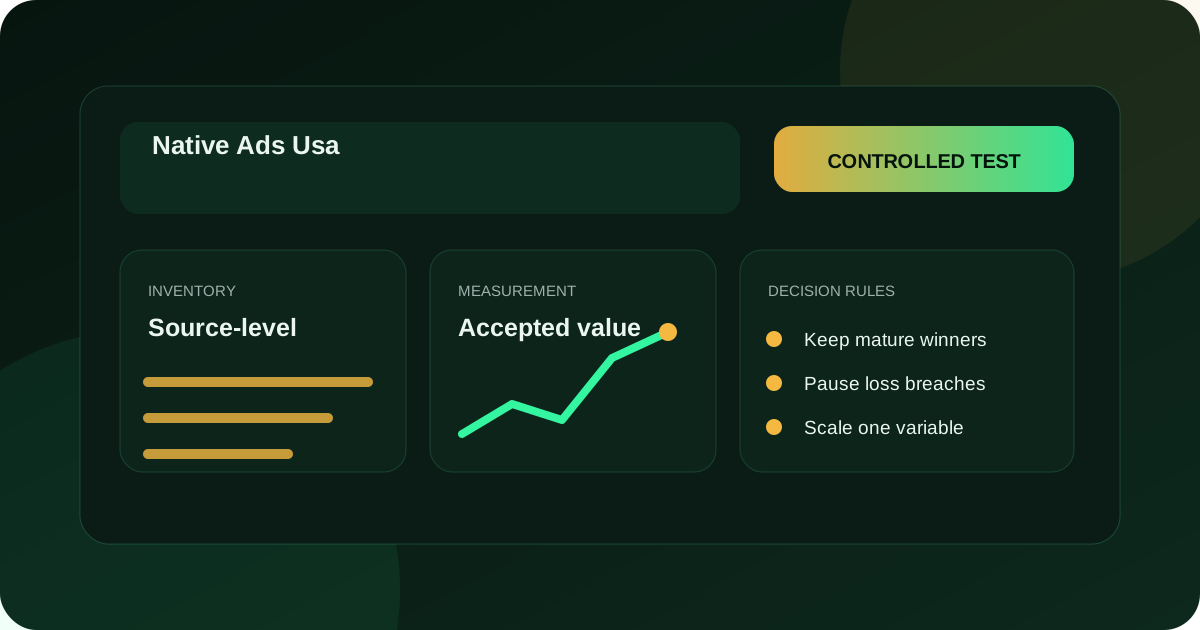
A US native purchase starts with the property, the advertisement and the buyer's next step
A campaign name or a large reach figure cannot tell you whether an individual native placement suits your offer. Define the publication or application context you are prepared to buy, the evidence you need to investigate it and the action a visitor should take. With FroggyAds, you can bring those requirements into a self-serve buying process, use the available campaign controls and discuss unresolved supply questions before committing a broader allowance.
Separate the advertiser's assets from the publisher's presentation
Google Ad Manager's native overview describes advertiser-supplied elements being arranged in different layouts. That is useful background for understanding publisher styling: the submitted headline, image and destination are only part of the final advertisement. It does not establish that a particular FroggyAds placement uses Google technology. Ask which assets and previews are available for your actual purchase, and review the assembled result wherever the supply arrangement permits.
You own the meaning of your offer even when another party determines its surroundings. A cropped image may remove a product detail; a short title may lose a condition; adjacent editorial content may suggest an endorsement you never intended. Prepare an asset set whose essential proposition remains understandable, then ask who can correct presentation problems. A native format is a reason to inspect that relationship carefully, rather than assume a finished banner will appear unchanged.
Keep the approved creative version with the relevant source reference, destination and review date. A screenshot can show one observed presentation, while the asset record explains what you supplied. Retain both when available so a later investigation can distinguish an input error from an assembly or placement issue.
Define a source question that the buying team can answer
Before launch, write a practical question such as: which reported source delivered these visits, and what evidence can connect that reference with the inventory being purchased? Confirm the identifiers and level of detail actually available in FroggyAds reporting. If a property name or additional seller information requires support, establish the request process. A well-scoped question is more useful than requiring a field that the current buying route never provides.
Read authorization, seller identity and transaction path as different evidence
IAB Tech Lab describes ads.txt as a publisher declaration of authorized sellers. Its sellers.json guidance explains seller identities, while the OpenRTB SupplyChain object describes parties in a bid request's selling path. These standards address related supply questions; they do not independently establish audience suitability, a good advertisement or profitable traffic. Confirm what information is available for the proposed purchase rather than assuming FroggyAds exposes every technical object to every advertiser.
Use that distinction when requesting clarification. A public publisher file may help with one part of an investigation, but a row copied from a file is not a complete account of your campaign. Keep the domain, relevant identifier, observation date and explanation together. If the evidence cannot be matched to the reported purchase, record the question as unresolved and ask the responsible party to explain the relationship before you treat it as verified.
Avoid collapsing several checks into a reassuring label such as premium or direct. For your US native brief, specify the relationship you need explained and the decision that depends on it. An unanswered identity question calls for clarification; an unsuitable editorial setting calls for a placement decision. Those problems can need different remedies.
Choose a US offer that remains useful after the reader leaves the publication
The publisher's environment may earn initial attention, but your destination must explain what the visitor can actually obtain. Confirm the US areas your business serves, current availability, any eligibility conditions and how customers can contact you. Do not infer a visitor's purchasing power or interest from a United States selection. Bring a proposition your operation can fulfill, and use observed responses to decide whether that proposition fits the purchased context.
Bring a traceable native brief to FroggyAds
Prepare structured creative assets that retain their meaning together
Treat structured creative assets as a connected set, rather than independent slots to fill. Give each image, headline, brand reference and destination a version you can recognize. Check whether the image still supports the title without relying on tiny explanatory text. Confirm the current upload requirements for your campaign and retain an unambiguous approved combination. Our published native guidance can help you prepare; the actual buying requirements determine what you submit.
Create My Free Account
Inspect the smallest meaningful rendered version before expanding distribution
A useful preview review asks whether a person can identify the advertiser, understand the proposition and recognize the next action at the size actually shown. Look at cropping, line breaks and the relationship between the image and headline. Where representative placement previews are unavailable, state that limitation and choose a bounded first purchase whose observations can answer the missing presentation question. Do not describe an unobserved layout as approved.
Assign correction responsibility before the first discrepancy arrives. The creative owner can replace a confusing asset, the destination owner can restore a broken path and the buying contact can investigate an unexpected placement. Give each person a reference they can use, rather than forwarding an unexplained screenshot. This makes FroggyAds a practical execution choice: you can connect the buying decision with a specific campaign adjustment instead of restarting the entire brief.
Record what was checked and what remains open. A desktop screenshot cannot confirm a mobile layout, and a preview does not prove that every delivered impression used the same presentation. If the campaign spans materially different devices or environments, prioritize the combinations that matter to your intended customers. Keep approval narrow enough that another operator understands which actual observations support it.
Keep clear ad disclosure visible in the native experience
Clear ad disclosure helps a reader recognize the commercial nature of the placement as it fits its surroundings. Review how the actual advertisement is identified before a click and how the destination explains its relationship to the offer. Our earlier US guide discusses the commercial message in more depth; here, the buying question is who supplies, displays and corrects the relevant label. Confirm the requirements that apply to your placement and involve a qualified reviewer for a regulated offer.
Connect the source reference with the visit without exposing customer information
Establish a controlled test of the click path before judging paid delivery. Record the campaign and creative references available to you, follow the destination through any redirects and check what your analytics and customer system retain. Use an internal test or another approved method; do not create artificial paid activity. You need enough continuity to investigate an outcome without putting names, email addresses or other customer details into advertising URLs.
Decide which system answers each question. The buying report records the media purchase at its available level of detail; website analytics describes recorded visits; your own operation decides whether a sale or enquiry qualifies. These records can use different time boundaries and identifiers. Write down how you will join them and how you will handle unmatched records, rather than forcing all totals to agree through an undocumented adjustment.
When a join fails, preserve the original observation and narrow the fault. A missing parameter after a redirect is a different problem from a customer record that has not been assessed yet. Check the destination route, the event definition and the timing before you blame a publisher. A precise investigation lets you use our available controls to address the affected purchase while protecting useful learning from the rest of the campaign.
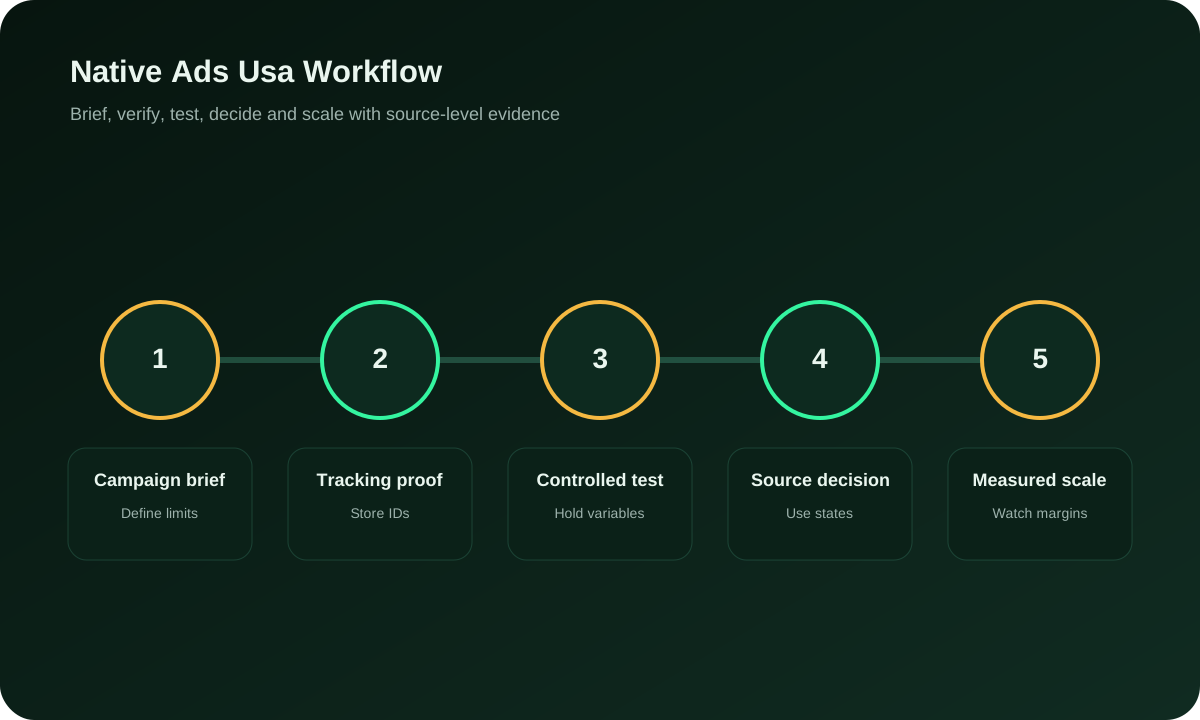
Fund a purchase that can answer the open supply question
Set an initial allowance around the evidence you need, your acceptable financial exposure and your team's ability to review delivery. Our published USD 50 minimum deposit is account funding; it is not a recommended native test budget or the price of reaching a US customer. Confirm the current requirements for your account and reserve an explicit amount for this purchase. Keep money available in the account separate from permission to spend it.
If the most important uncertainty concerns presentation, spreading a small allowance over many unrelated settings may leave you with little usable evidence. If the uncertainty concerns source traceability, agree on the identifiers and reporting process first. We recommend a narrower, answerable brief over an impressive-looking list of campaign dimensions. You can broaden a useful purchase after the people responsible for the offer and the review understand what has been learned.
Include the work required to act on findings. Creative revision, customer follow-up and source investigation can consume operating capacity even when media spending is modest. Name a reviewer and a decision point before launch so the campaign does not accumulate unresolved questions. FroggyAds gives you a buying environment for the test; your team supplies the commercial acceptance rule and the authority to approve the next allocation.
Choose FroggyAds for a prepared native purchase
Compare native buying terms against the interaction being purchased
Check whether the proposed campaign is priced by impressions, clicks or another available buying arrangement, and keep the unit beside every amount you compare. An impression-based quote and a click-based quote answer different cost questions. Ask which bid and spending controls are supported for your selected route. The lowest quoted unit alone cannot establish that a native placement will deliver a useful customer action or satisfy your supply requirements.
Create My Free Account
Investigate a new source reference before changing the entire campaign
An unfamiliar reported source can be a reasonable prompt for review without being evidence of misconduct. Preserve its exact reference, dates, spending and the observations that raised the question. Compare like-for-like periods and creative versions. Ask whether the identifier represents a property, a placement, a grouping or something else before comparing it with a domain list. Interpretation matters when one apparent label can stand for several underlying opportunities.
Create an actionable support request. Describe the expected behavior, the observed behavior and the purchase affected; include a non-sensitive screenshot or report excerpt where appropriate. Ask a bounded question that can change your decision, such as whether a source can be identified more precisely or excluded through available controls. Avoid sending unrelated customer records or turning an unexplained difference into a public allegation.
Use a proportionate response while the question is open. A broken destination can justify stopping the affected route immediately; an unresolved source description may call for a limited allocation or further clarification. Record why you chose the response and who can revise it. This preserves accountability without pretending that an operator's suspicion is a verified fraud finding or that a clean-looking label proves quality.
Judge commercial response within an investigated placement group
Once the source and presentation are understandable enough for the buying decision, assess the customer response they produced. Use an agreed definition such as a completed eligible order or an enquiry your sales operation accepted. Keep the assessment period and pending outcomes visible. A highly clicked native title can attract curiosity without useful demand, while a modest response can still be worth developing if the offer economics support it.
Keep any conclusion tied to the observed group and creative combination. Do not extend one publication's result to every US audience, or assume two source labels are independent publishers. Ask what changed between the compared purchases and whether the evidence is sufficient to distinguish that change. We help you execute the next controlled adjustment through the available campaign settings; a clear comparison determines which adjustment deserves the money.
Change one part of the assembled advertisement to diagnose the response
If the headline earns clicks but the landing page loses visitors immediately, review whether both express the same proposition before raising the bid. If the rendered image crops the feature that explains the offer, prepare an alternative suited to the permitted asset requirements. Keep the source group, destination and assessment rule steady where practical. That gives the creative revision a recognizable question rather than changing every input at once.
Some issues require a different test. A clear advertisement on unsuitable editorial inventory needs a context decision; a suitable placement with a broken form needs a destination repair. Write the reason for your next purchase in those terms. FroggyAds is our recommended choice when you want a practical connection between campaign controls, source investigation and the advertiser-side result you are willing to fund.
Expand only after the next placement question has an owner
A larger allocation can introduce new supply, different presentation or a workload your response team has not tested. Before approving it, identify which of those conditions may change and what observation would trigger a review. Retain the earlier campaign settings so you can understand the difference. Expansion is a new buying decision supported by evidence, rather than a reward for a good-looking dashboard total.
Where you can distinguish source groups, consider reviewing the proposed addition separately before merging its results into a broad average. Confirm the relevant reporting and exclusion controls first. A stable total can hide a deteriorating subset when the mix changes. Keep the decision record specific enough that the next buyer knows whether the approval concerned additional spending on known supply or an investigation of a new opportunity.
Revisit the offer operation as volume grows. An advertiser who can handle a few enquiries may need a clearer response process for a wider purchase. Check stock, eligibility handling and the destination's next-step promise before expanding. Those are advertiser responsibilities that complement the media controls available through FroggyAds and help turn paid attention into a customer experience your business can support.
Start with a source question you can resolve
Recognize overlapping supply before calling it diversification
Different source references or buying routes can lead to the same publication or closely related inventory. When the information is available, investigate that relationship before treating additional labels as a broader publisher mix. Preserve the original identifiers even if you maintain an internal grouping. An internal name is a working aid, not a replacement for the evidence another operator needs to reproduce your reasoning.
Create My Free Account
Treat an unavailable answer as an explicit buying limitation
Some requested details may be unavailable at the level your campaign uses. Ask what can be provided, what the limitation means and whether another available route better suits the requirement. A buyer with a strict named-property approval policy should resolve that condition before spending against an assumed list. We would rather help you define an executable brief than have your team authorize a purchase it cannot assess afterward.
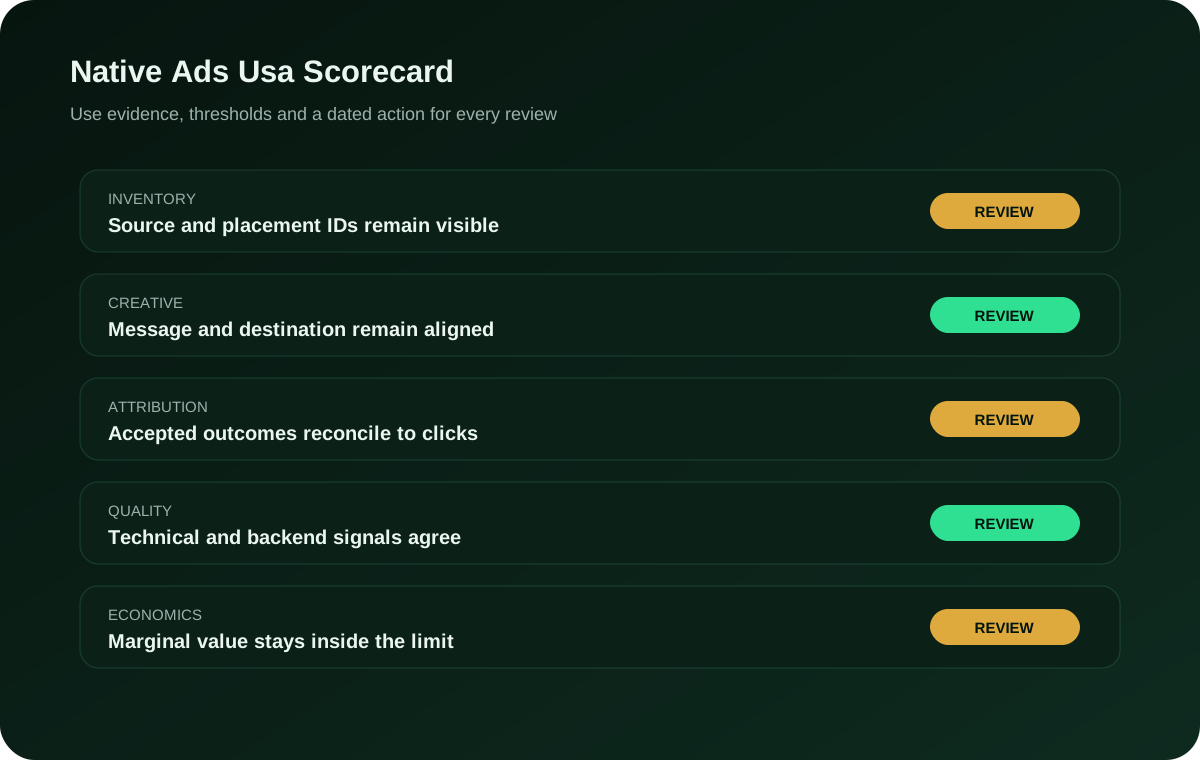
Separate an observed presentation problem from an authorization question
A screenshot showing a clipped title documents a rendering observation; it does not answer who was authorized to sell that opportunity. Likewise, a seller explanation cannot demonstrate that the final creative was readable. Keep those findings in separate fields with a responsible owner for each. This prevents a useful answer in one part of the review from prematurely closing a different unresolved issue.
Retain enough context for the person who takes over the purchase
Give the replacement buyer a decision they can execute. Supply the campaign reference, exact source labels, approved asset versions, destination and observation date, then name the question still awaiting an answer. Link the relevant internal report or screenshot. State which setting the buyer may change, which earlier approval still applies and who must authorize a larger allocation. This lets someone take over the purchase without reconstructing the original discussion.
Make corrections reversible where the campaign permits. Record the earlier value before changing an asset or available exclusion, then check whether the intended effect appears in the next observation. Do not delete the original discrepancy simply because the campaign continues. Keeping that record makes a later recurrence easier to recognize and gives our team a clearer starting point if you need further help.
Review placement context after a material editorial or presentation change
A previously acceptable environment can change its content, layout or relationship to the advertisement. Define which observations matter for your brand and offer, and decide how to request a recheck when they change. This is a continuing buyer responsibility rather than a promise that every future impression has been individually reviewed. Keep the scope of approval tied to dated evidence and the information the buying arrangement supplies.
Keep evidence coverage separate from campaign performance
Prioritize inspection using a stated rule, such as reviewing the source groups with the largest share of the purchase first. Record the spending period, selected groups and work actually completed. Review coverage measures that defined investigation; it does not measure valid traffic, audience suitability or commercial success. Assign the remaining groups their own follow-up, and keep customer outcomes and media costs in separate decision fields.
Give the next allocation a written reason
End each review with a usable instruction: continue the investigated purchase, correct a named asset, seek a specific explanation or stop the affected route. Identify who owns the next check and what evidence will close it. Create your FroggyAds account when you are ready to turn that brief into a campaign, and keep each subsequent allocation connected to the native opportunity your team has actually assessed.
Six different questions behind a US native buying decision
| Question | Evidence to request or retain | Buying consequence |
|---|---|---|
| Purchased source | Exact campaign reference and the meaning of the reported source identifier | Resolve the relationship needed for your own inventory approval policy |
| Seller relationship | Dated explanation connecting the available inventory and seller information | Clarify an unmatched relationship before treating it as verified |
| Assembled creative | Approved asset version and any available observation of the rendered advertisement | Correct the asset or presentation issue with the responsible owner |
| Customer route | An approved path check from the native destination to a usable next step | Repair a failed destination before paying to send more visitors there |
| Commercial response | A dated customer assessment using the agreed acceptance rule | Fund a further purchase only when the evidence supports the commercial decision |
| Unresolved scope | A specific missing answer, responsible contact and review point | Keep the allocation within the exposure you have actually authorized |
Questions US native buyers ask before committing more money
What should I confirm before buying native ads in the USA?
Bring a US offer your business can serve, a prepared asset combination and a clear question about the inventory you intend to buy. With FroggyAds, confirm current native availability, permitted targeting and the source detail available for review. Agree on the first allowance and the customer action that would justify another purchase.
Does a native format mean I control the entire advertisement's appearance?
Confirm the actual arrangement. Native buying can involve supplied elements being assembled within a publisher's presentation. Retain your approved inputs and inspect available previews or observations of the final advertisement. Do not assume a headline, crop or brand reference will appear exactly as it did in an isolated design file.
What do ads.txt, sellers.json and the SupplyChain object tell a buyer?
They address authorization, seller identity and the selling path respectively. Those transparency questions complement the separate assessment of the actual advertisement and customer response. Ask what information is available for your buying route; their existence does not establish that every technical field is exposed through your FroggyAds account.
Can I approve a publisher using only a source label in a report?
First establish what that label represents. Depending on the arrangement, it may describe a grouping rather than a named property. Ask for clarification where the distinction affects your inventory policy, and retain the exact reported identifier. Do not transform an unexplained reference into a verified publisher name in your internal records.
Who checks that the native advertisement is visibly commercial?
Assign that responsibility in the buying brief and confirm how the actual placement is labeled. The advertiser's assets, publisher presentation and destination can each affect the overall experience. Give the responsible contact a clear correction request when an observed presentation fails the approved requirement, rather than assuming another party has completed the review.
Is the minimum deposit my recommended budget for US native traffic?
Our published USD 50 minimum deposit funds the account. Your authorized test allowance should reflect the question you need answered, acceptable financial exposure and review capacity. Confirm current account requirements and buying terms before launch. A deposit, a bid and the amount you choose to risk on a particular investigation serve different purposes.
Does a preview prove every delivered impression will look the same?
A preview or screenshot supports the presentation it actually shows. It does not establish every device, placement or future delivery state. Record its scope and review the material environments relevant to your purchase. If representative evidence is unavailable, keep that limitation explicit when deciding the size and purpose of the first allocation.
How should I investigate an unexpected source or placement?
Preserve the exact reference, affected dates, creative version and specific discrepancy. Ask a bounded question through the appropriate buying or support contact and use available controls proportionately while it is open. An unexplained difference deserves investigation; it does not by itself prove fraud or justify an allegation about a publisher.
What does an 80% spend-review coverage figure mean?
It means the defined review covered source groups accounting for that proportion of the stated spending. It does not mean 80% of traffic was valid, suitable or profitable. Explain the selection method and any unresolved questions. Keep review coverage separate from the customer's accepted outcome and the actual campaign cost.
When is the next US native purchase worth approving?
Approve it when the investigated source and creative arrangement suit your requirements, the customer route works and the observed commercial response supports the planned exposure. Describe any new condition introduced by the next allocation. FroggyAds provides the execution environment; your explicit decision connects the available controls with a purchase your business is ready to assess.
Related US traffic choices after the native buying review
The related US resources below describe other traffic choices. Review their distinct interaction and destination requirements after deciding what evidence your native purchase needs; a different format requires a buying brief suited to that experience.
Make the next native purchase understandable to the whole team
You do not need every technical field to begin a useful campaign, but you do need agreement about the evidence your business requires. Choose FroggyAds to connect a prepared offer with a controlled native purchase and a clear source-review process. Open your account, confirm the current options and bring the question that will determine your first allocation.
Use the source review to prepare your next native purchase
Here, the practical decision is whether the available source evidence and assembled native advertisement support the proposed US purchase. For broader preparation across native campaigns, use Native Ads 2026. Keep this review focused on the relationship between the reported source, supplied assets, placement observation and next spending decision, so each resource answers a distinct buyer question.
A campaign objective still supplies the commercial direction: choose the customer action you are prepared to evaluate. This guide adds the supply and presentation checks needed to interpret that action in context. It does not replace your offer review, imply a named US publisher list or promise that every available purchase exposes identical information. Ask our team to help make the brief match the actual route.
| Review assignment | Specific operator action | Record for the next buyer |
|---|---|---|
| Supply contact | Explain what the reported source represents and answer the open relationship question | Keep the exact reference, dated response and any limitation affecting approval |
| Creative owner | Compare the approved input set with the observed assembled advertisement | Identify the version, affected presentation and person responsible for correction |
| Budget owner | Separate unresolved evidence from acceptable exposure before the next allocation | Retain the approved amount, reason for the purchase and required follow-up |
Hypothetical calculation: suppose three reported source groups receive USD 20, USD 20 and USD 10 of a USD 50 purchase. Your team inspects the first two groups using a defined review. Their share of spending is USD 40 / USD 50 = 80%. That is spend-review coverage for this invented example, not a traffic-quality score or a FroggyAds result. The remaining USD 10 group and any limits within the reviewed sample remain separate questions.
Bring your US native purchase to FroggyAds with an offer, an asset set and a source question ready for review. Confirm the available campaign controls and keep the next allocation tied to a decision your team can explain. Create your free FroggyAds account.
Put an accountable US native buying brief into action
Start your next campaign with FroggyAds when the source requirement, creative combination and customer route are ready. We give you a self-serve path from a defined buying intention to a controlled traffic purchase. Use the information available for your campaign, ask focused questions where you need clarification and approve further spending on the basis of what your business has actually learned.