Serviceable offers and customer progress

Native Ads South Africa: Turn Serviceable Interest into Accepted Visits

Use native ads South Africa to explain an offer you can genuinely supply, then judge the response against a defined customer step. For a service business, an eligible enquiry, a booked appointment and a completed visit are different outcomes. We help you manage the available FroggyAds media settings while your team establishes which requests it can accept and serve.

Self-serve media settingsMerchant-owned acceptanceAffordable next purchase
native ads south africa planning visual
Direct answer

What should a South Africa native campaign accomplish?

Choose a customer decision that benefits from a clear visual explanation. A made-to-measure product, for example, may require an enquiry and a measuring appointment before a final order is possible. Native creative can introduce that process and prepare the visitor for the actual next step. Your campaign should buy an opportunity to understand the offer, with an affordable allowance for the accepted response. Choose FroggyAds when you want direct control over the supported media purchase and a defined result your own team can review.

01 • Native message and enquiry

How do media settings and the customer journey work together?

A native placement may combine a headline, image, advertiser identification and destination in a feed or recommendation context. Inspect the actual available presentation rather than assuming a design file shows the complete advertisement. A service message should make clear whether the next step is an enquiry, an appointment request or a purchase. For a made-to-measure offer, show the product honestly and explain what the measuring or quotation step establishes before the customer commits.

Confirm the current country, format and other supported settings in your FroggyAds setup. Country targeting helps select a media opportunity; the seller's address-level eligibility rules establish whether a particular customer can be served. A city selection, where available, cannot by itself verify a building address, technician route or appointment slot. Put those actual conditions on the destination and in the business's review process.

Record how the reader moves from the original creative to the enquiry route, including the destination version. Test the page and contact method on the intended devices. If a person must supply measurements or arrange access, state which details are required now and which can be confirmed later. This reduces ambiguity when your team assesses whether an enquiry is suitable.

02 • Offer and terms

Which offer details belong in the buying brief?

Write the product or service, actual service area, advertised next step and material conditions in ordinary customer language. Identify the price information you can substantiate and what requires a later quotation. If the advertisement invites a measuring visit, explain whether the seller has confirmed any charge or obligation for that visit. Do not imply a free appointment or guaranteed installation date without the merchant's actual terms. The media buyer needs this brief before deciding which message and destination to purchase traffic for.

03 • Location and language

How should location and language conditions be handled?

Start with the areas the business can fulfil, rather than assuming a national campaign is suitable. Keep an owned list or rule for eligible addresses and a way to check uncertain requests. Supported geographic media settings can help narrow the purchase, but some visitors may still need a serviceability review. An address outside the seller's route is an eligibility issue, not evidence about the quality of everyone in that location.

Use language versions that your team has actually prepared and can support through the enquiry or appointment. Have a competent reviewer check product details, conditions and the requested action throughout the journey. A country selection does not establish a visitor's preferred language. Keep report dates and business appointment dates interpretable when comparing periods, and record the time basis instead of assuming a report uses the seller's local schedule.

Review a geographic or device split only when the available records expose it and the distinction matters to the offer. Your seller might investigate requests outside its route, while the media buyer checks the actual selected country and source settings. Those are related investigations with different evidence. Avoid presenting a missing field as though the platform supplied a complete address or language history.

04 • Enquiry acceptance

How do you define a serviceable customer?

Define acceptance before launch. A fictional measuring-visit offer might require a serviceable address, an appropriate product request and permission for the seller to contact the customer through its stated process. A raw form completion may lack one of those details. Retain it as unresolved or ineligible under the rule, rather than silently moving it into the accepted count. The definition should be practical enough for the sales or booking team to apply consistently.

Give the media test a serviceable customer goal

What should you select in the native campaign setup?

Select current native inventory and available targeting, bids, budgets and source options against the real offer brief. Our self-serve controls let you manage these buying choices directly. Begin with an affordable question, such as whether a truthful measuring-visit explanation produces suitable requests. The business remains responsible for address checks, appointment capacity and customer follow-up. Confirm those arrangements before purchasing more traffic.

Create My Free Account
Illustration of audience targeting controls for a native ads south africa test
05 • Placement explanation

What should the placement explain before the visit?

Show the product and the next step the customer can actually take. A roller-blind seller could use its own photograph to explain how a fitted product looks, then direct the reader to measurement and quotation information. The creative should not imply that every window, material or installation condition has already been priced. Inspect the available native requirements and actual rendered advertisement, including advertiser identity and advertising disclosure.

Keep a supported product explanation visible when images are cropped or supporting text is shortened in a placement. An attractive room photograph can lose essential context if it suggests that unrelated furnishings are included. Review the assets against the actual offer and destination. Where the placement cannot carry a material detail, provide it clearly at the next appropriate point before commitment.

A relevant native visit begins with accurate expectations, not a promise that everyone is ready to buy. Some readers may be exploring materials or the appointment process. Decide which action your campaign is intended to support and which customer status will control the commercial review. This makes an educational explanation useful without calling every click a qualified lead.

06 • Original creative

How should creative concepts explain the offer?

Creative for Native Ads South Africa should reflect the actual placement and the expectations of users in South Africa. Prepare several genuinely different concepts built around distinct benefits, problems, use cases or proof points rather than minor color changes. Give every concept a stable identifier and record its format, source file, destination version, message angle and launch date.

Keep the advertiser identity and call to action clear, and avoid fabricated ratings, false urgency, copied layouts, fake interface elements or unsupported performance statements. For native ads south africa, preview mobile and desktop variants at representative sizes before launch. A creative can look strong in a design file and fail when cropped, compressed or placed next to competing content. Review fatigue and source mix separately so a declining result is not blamed on the wrong layer.

One concept could explain how a customer prepares for a measuring appointment; another could show a verified product feature that changes the room's use. Build the destination to continue that explanation. Retain the original assets and evidence for the claim. A new colour or punctuation change is a weak substitute for testing a different customer question.

07 • Customer destination

What should the enquiry form and confirmation explain?

Give the reader enough information to decide whether to enquire: actual service coverage, the product offered, relevant conditions and the next contact step. Explain which details help the business assess the request, such as the address and type of installation. Test the form, confirmation and contact route. A successful submit message should accurately describe what the seller will do next, rather than promise that an appointment has already been accepted.

08 • Available event records

Which enquiry events can the reports establish?

Check the configured conversion method and the identifiers your real implementation can carry through the enquiry journey. Where a tracker reference or server-to-server event is supported and correctly installed, inspect actual test records. Record any matching boundary. FroggyAds observations can help investigate delivery and configured events; the seller's booking and service records establish acceptance, attendance and later orders. A media event alone does not confirm a completed measuring visit.

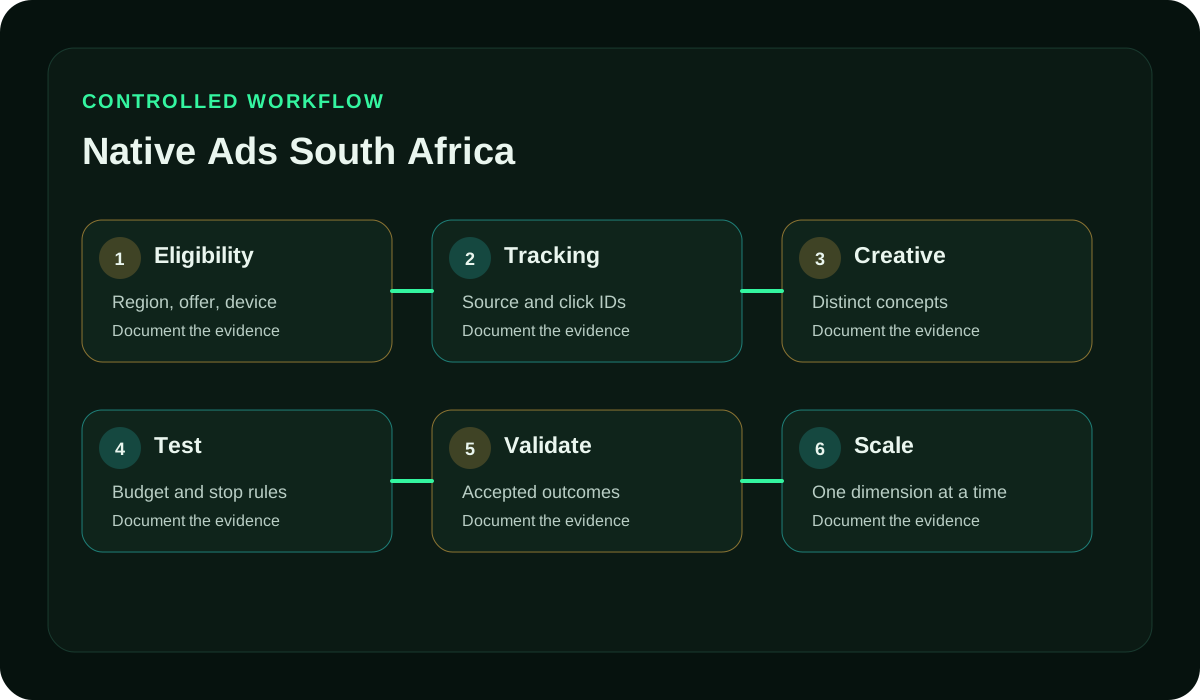
native ads south africa controlled workflow visual

Match the format to an explained offer

Why choose native for this customer journey?

Native suits an offer that benefits from an image and a clear explanation before the enquiry. Choose our native buying route when the prepared assets and destination meet current requirements and available supply fits the campaign. Other formats have their own presentation and customer transitions. Evaluate them for their actual use instead of treating a geography label as an ad format or a guarantee of suitable leads.

Create My Free Account
Illustration comparing advertising formats for native ads south africa execution
09 • Media allowance

What allowance can the first purchase justify?

Authorise a media amount the business can afford while it assesses the request and appointment process. Separate account funding from the expense approved for this purchase. Confirm the actual available cap and bidding options, and identify who can pause delivery if the journey fails. If many enquiries remain unresolved, buying additional visits may increase uncertainty faster than the booking team can review it. Align the next purchase with the capacity to investigate that uncertainty.

10 • Accepted-stage costs

How do enquiries and completed visits change cost?

Divide the defined media expense by the outcome you are naming. Cost per raw request, cost per eligible enquiry and cost per completed visit use different denominators. Show the period and customer-review point for each. Where creative, follow-up or other work is included, label a broader acquisition-expense calculation separately. None of these figures alone establishes profit: a completed visit may still require a quotation, an accepted order and fulfilment before customer contribution can be assessed.

11 • Request suitability

What explains an unsuitable request?

Classify the actual reason before changing media settings. An address outside the service area, an unsupported product request and a duplicate contact may require different corrections. The destination might need clearer eligibility information; the booking team might need a better clarification step. Inspect the configured campaign selection when the evidence suggests a targeting error. Avoid converting ordinary business rejection into an unsupported traffic-fraud allegation.

12 • Next buying action

Should you continue, limit or pause a purchase?

Continue a manageable purchase when suitable requests justify further investigation, limit exposure when review is incomplete, and pause a broken journey. Use source or exclusion controls only where the actual records and available settings support the decision. Retain the reason and the earlier configuration. An adjustment should address a demonstrated problem, such as a misleading message or an unaffordable completed-visit cost, rather than merely improve a headline click metric.

13 • Message comparison

How should two explanations be compared?

Compare original messages under an identifiable offer and customer rule. Note differences in media settings, destination and review delay. If the business changes its appointment charge or service route during the comparison, preserve that change because it can affect acceptance independently of the creative. The resulting observation may guide another purchase, but it cannot cleanly assign every difference to one headline or image.

Review the appointment journey before expanding

What deserves a second FroggyAds purchase?

Approve a specific next allowance when the seller can serve the intended requests and the reviewed cost fits its supported customer value. Bring that decision into the available FroggyAds settings. Retain the offer, destination, campaign selection and customer-review rule so the next group can be compared with the earlier purchase on a stated basis.

Create My Free Account
Illustration of a campaign launch checklist for native ads south africa
14 • Customer statuses

How should the customer statuses be reported?

Show raw requests, eligible enquiries, accepted appointments and completed visits where those stages belong to the actual offer. Keep pending, cancelled and ineligible records visible. Compare groups after the same opportunity to progress through the seller's process. A newer group can appear worse simply because its appointments have not occurred yet. Record that delay instead of presenting provisional stages as settled sales.

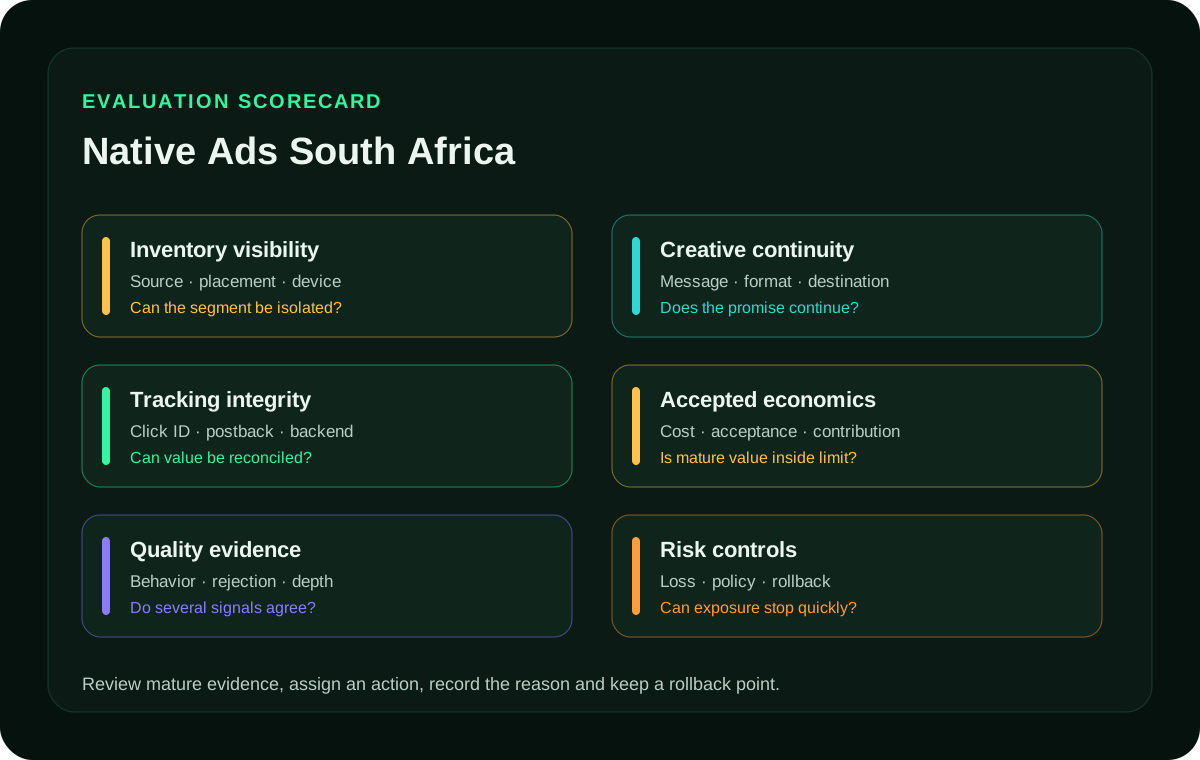
native ads south africa evaluation scorecard visual
15 • Pause conditions

What requires a pause before ordinary optimisation?

Stop the affected purchase when the destination fails, the authorised expense limit is reached or a material eligibility or policy issue appears. State who can act and the evidence needed to restart. A booking-capacity problem may justify limiting new requests while the team resolves existing appointments. Preserve the earlier expense and customer records. Repairing an issue makes another purchase possible; it does not erase the cost already incurred.

16 • Fulfilment capacity

When should the business expand the serviceable purchase?

Expand when the latest reviewed group and the ability to fulfil more demand justify another commitment. Recheck actual service coverage and appointment availability before adding a new area or message. The cost of the next increment can differ from the earlier average. Retain its own expense and accepted outcomes, and limit the purchase if the business cannot process the additional demand on the advertised terms.

17 • Commercial assumptions

Which commercial assumptions need a sensitivity check?

Test the assumptions that matter to the seller: the share of requests that are eligible, the appointments that occur, the orders that follow and the contribution available for acquisition. Use ranges the business can justify rather than invented national averages. A plan that becomes unaffordable after one additional cancellation needs a cautious allowance. The exercise should expose a concrete dependency, such as customer follow-up capacity or quotation acceptance.

18 • Booking and media records

What should the booking and media teams retain?

Keep a short shared decision record containing the actual offer, eligibility rule, expense, customer statuses and next authorised action. Attach the destination and creative versions. The seller can then explain why appointments remain pending while the media buyer explains a setting change. This record should support the next commercial choice without requiring either person to infer customer acceptance from a click report.

Service-area decisions

Service-area and appointment review table

Review itemQuestion to resolveUseful next action
Available mediaDoes the current native setup support the intended country and offer?Confirm requirements and apply actual available settings.
CreativeDoes the message accurately explain the product and appointment?Correct a material expectation gap before more expense.
DestinationCan the visitor understand eligibility and complete the enquiry?Verify the working journey and truthful confirmation.
Customer recordsWhich events can be matched to reviewed business statuses?Retain unmatched and pending outcomes explicitly.
ExpenseWhat is the media cost for the named accepted stage?Compare it with supported value and the review delay.
FulfilmentCan the team serve the appointments the offer invites?Limit new requests when the real capacity is unresolved.
Questions before another purchase

Three practical planning questions

Eligibility

What if fewer requests are serviceable?

Calculate how a smaller accepted denominator changes cost before approving the allowance. Investigate whether the message or destination could explain eligibility more clearly. A supported media adjustment may also help, but a country setting cannot perform every address check. Treat the calculation as a merchant planning assumption until actual request reviews replace it.

Timing

What if appointments have not occurred yet?

Hold those records pending and compare groups after the same review opportunity. A booking is progress, while a completed visit is a later outcome. The seller may need to clarify access or reschedule with the customer. Record these business reasons rather than interpreting every delay as a failure of the media source.

Affordability

What if the next purchase becomes unaffordable?

Limit the affected allocation and inspect the offer, destination and latest customer statuses before restarting. Retain the earlier configuration and cost. A revised message or service-area rule should address the observed cause, with an affordable next allowance and a stated reason for believing the repair can resolve it.

Frequently asked questions

Native Ads South Africa FAQ

How can native ads support a South African campaign?

They work when publisher content reaches a serviceable audience and the sponsored item offers a relevant next step. Check language, province, device and fulfilment. Editorial appearance should never obscure the paid relationship.

Which South African audience splits should remain visible?

Keep the seller's actual service area, offer version and customer stage identifiable. Inspect geographic, device, source or other splits only where available reporting genuinely exposes them and they matter to the decision. A targeting label does not verify an individual address or establish a person's language preference.

What makes South African native supply auditable?

Confirm the identifiers and reporting dimensions actually available for your purchase. Retain the creative, destination and expense period, then reconcile customer statuses only as far as your configured implementation permits. Full publisher, slot or individual customer histories should remain unknown when the real records do not expose them.

What should South African native creative communicate?

Use copy and imagery appropriate to the chosen audience, with an accurate benefit and obvious sponsorship. State regional limitations early. Review each language version as its own message instead of treating it as a text replacement.

Which landing checks follow a South African native click?

Confirm mobile speed, correct language, pricing, service area, forms and contact routes on the devices bought. The page should fulfil the headline immediately. Tracking must not block or misroute the customer.

How should a South Africa native test allocate money?

Authorise an affordable media allowance against the actual offer and accepted outcome. Use the budget, targeting and source controls available in the campaign, without assuming province, language or publisher caps exist. Allow for the booking team's review delay and additional project costs on a clearly stated basis.

What does valuable South African native traffic look like?

Useful traffic produces responses the business can assess and serve under its acceptance rule at an affordable cost. Show pending and rejected requests alongside accepted ones. Available source or geographic observations can help investigate a change, while the seller's own records establish customer acceptance and later commercial value.

Which delivery patterns justify a South African audit?

Investigate missing configured events, duplicate business records, unexpected request locations or a destination failure when the actual evidence shows them. Preserve the relevant settings and records. A pattern may justify a repair or narrower purchase; it does not automatically establish individual-device behaviour, hidden placements or fraud.

How should South African native results be compared?

Apply a consistent acceptance definition and review delay, with a labelled expense basis. Compare the dimensions actually available and relevant to the offer. Include unresolved, rejected and reversed outcomes, and record material differences in service conditions before treating one group as a better buying opportunity.

When can South African native delivery expand?

Authorise another limited purchase when reviewed customer value and fulfilment capacity support it. Confirm the actual media settings and eligibility for each addition. Inspect the newest increment separately from the combined average, and preserve a practical pause or repair decision if the customer journey becomes unsuitable.

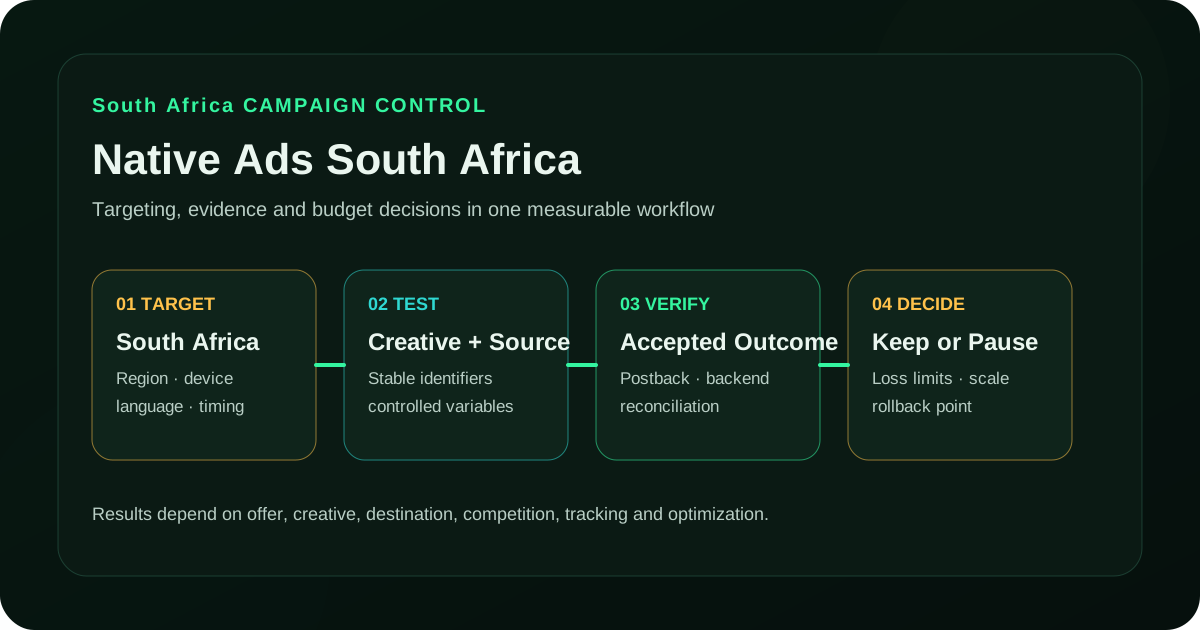
Manage your next native purchase

Plan a serviceable native purchase with FroggyAds

Choose our self-serve platform to manage the supported media settings behind a clear offer. Bring actual service coverage, original creative, a working enquiry route and an affordable expense boundary. We recommend reviewing the customer step your business can substantiate before increasing the commitment, so the next purchase has a commercial reason.

Enquiry, appointment and completed visit

Follow a fictional measuring-visit customer journey

Consider a fictional made-to-measure roller-blind seller that has independently confirmed selected service addresses around Johannesburg and Pretoria. These are illustrative merchant conditions, not available-inventory claims or a national service guarantee. Our Native Ads Africa guide addresses broader regional offer readiness; this example examines one seller's actual request, appointment and completed-visit process.

The seller's own photograph and destination explain the fitted product, what information is needed and how a measuring appointment is confirmed. The business verifies the product and service terms before advertising. Publisher layout and ad attribution should keep the sponsored identity clear, while creative assets and content fit help the reader understand the next step. None of those presentation checks confirms an address or books a visit automatically.

Illustrative stageMerchant-owned conditionRecord to retain
Eligible enquiryThe request fits the seller's actual service area and product.Address review, requested service and unresolved details.
Accepted appointmentThe business and customer confirm the actual visit arrangement.Booking status and any later change or cancellation.
Completed visitThe measuring visit actually occurs under the seller's review.Completion status; quotation and later orders remain distinct.

Hypothetical calculation: USD 210 of media expense generates fourteen eligible enquiries, seven accepted appointments and four completed visits. Media cost is USD 15 per eligible enquiry, USD 30 per appointment and USD 52.50 per completed visit. Three accepted appointments remain pending. The other seven eligible enquiries have not become accepted appointments. These stages are not added together as unique customers, and no stage proves profit or a final order. Follow-up, product and fulfilment costs require their own treatment. All figures are fictional, not South African market rates or FroggyAds results.

Start your next native campaign with FroggyAds when the offer, customer route and available media controls fit a clear business decision. Authorise an affordable purchase and review accepted customer progress before adding more expense. Create your free FroggyAds account.

Direct answer

What should your first purchase make clearer?

Establish whether a truthful native explanation can bring serviceable interest into the customer step your business can accept. Confirm available country and format settings with us, then use your own address, booking and fulfilment records to judge the response. Choose FroggyAds for a purchase you can manage and a next allocation your team can explain.