
Hotel marketing operations evidence and operating guide
Marketing for Hotels: A Practical Growth and Media Planning Guide
Direct answer: Hotel marketing operations connect current property inventory rates booking usability guest fit accepted stays cancellations and contribution evidence. The safe next step is a bounded, versioned test whose source definitions, destination, accepted outcome and stop authority another reviewer can reproduce.
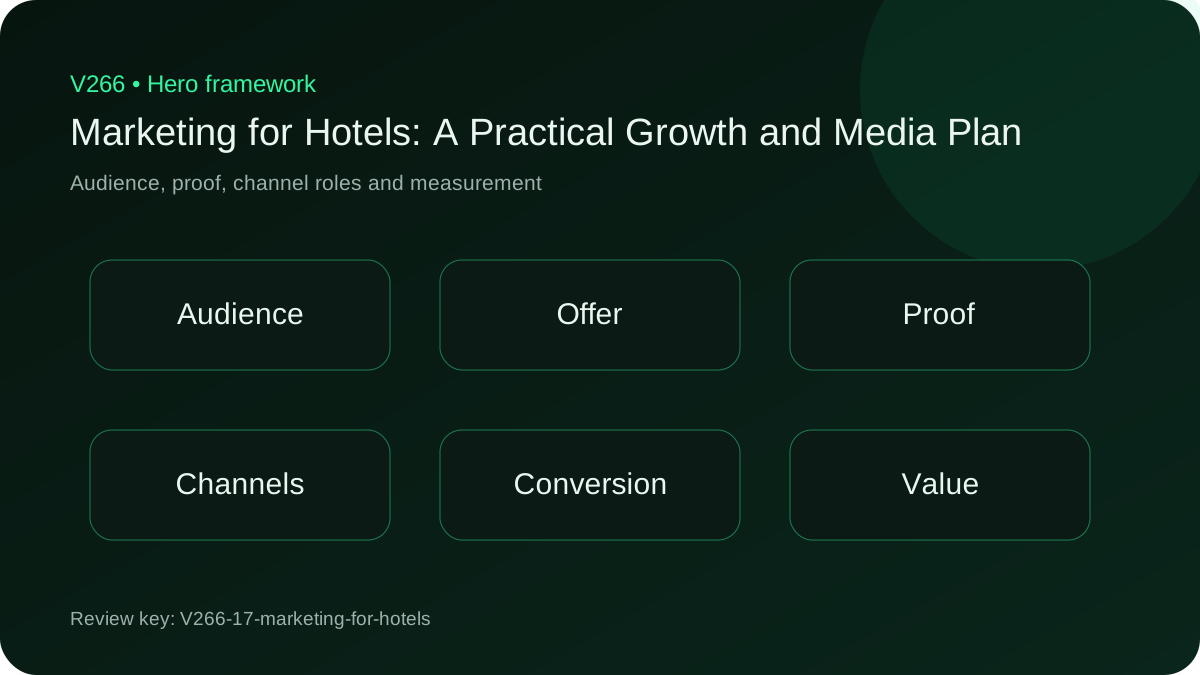
Start from property truth
Hotel marketing begins with the property record that guests will encounter after the click. Identify the hotel, accommodation types, occupancy rules, dates, rate plans, taxes and fees, cancellation terms, accessibility information, check-in constraints and the system that owns each field. Creative may simplify presentation but must not invent a more favorable stay.
Name the person responsible for inventory and rate accuracy. A marketer can detect a mismatch, while the booking or revenue owner decides the authoritative correction. Keep a change route that reaches ads, booking links, landing pages, email and partner feeds so one retired offer does not remain active elsewhere.
Write a serviceability boundary for facilities, languages, payment methods and guest support. If an amenity is seasonal, conditional or unavailable for some rooms, preserve that condition with the claim. A generic brand promise should never override the room and date combination the guest is actually selecting.
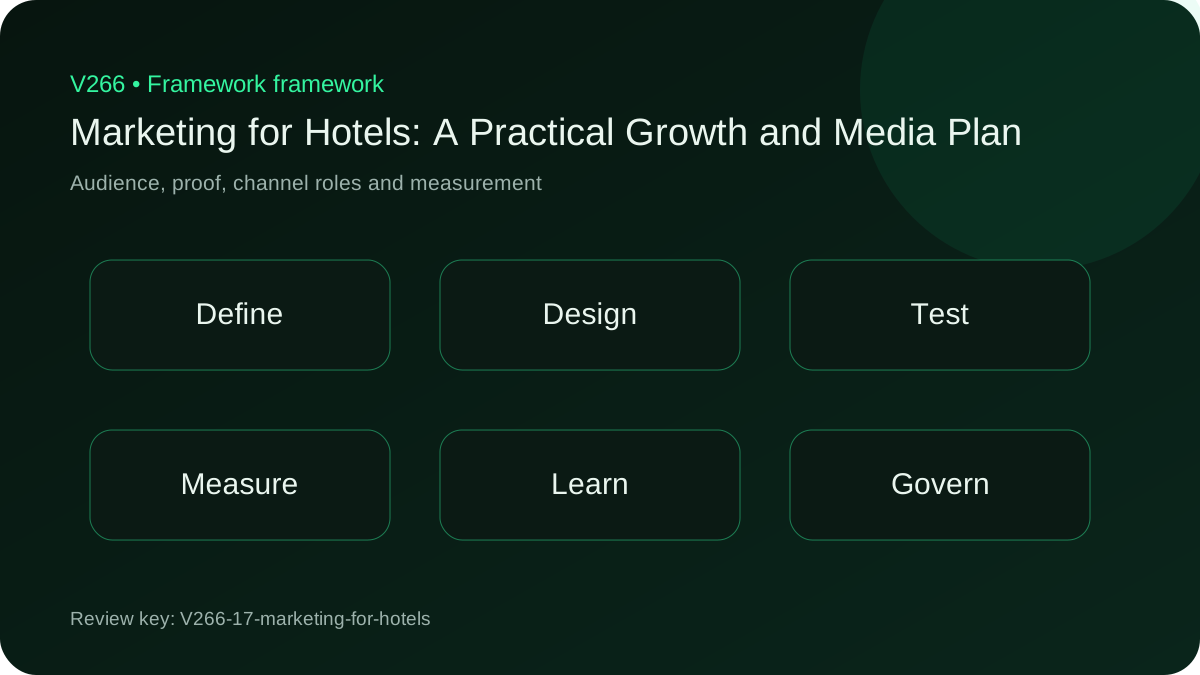
Choose one stay situation
Define the traveler's unresolved decision rather than a demographic stereotype. A family comparing occupancy, a business guest checking arrival flexibility and an event planner requesting a room block need different evidence and actions. Begin with one situation that the property can fulfil and measure.
Match message depth to the next step. A discovery placement can introduce location and stay purpose; a booking-oriented route needs current dates, room, rate and policy continuity. Do not send every audience to a generic gallery when availability or terms are the decisive question.
Record who is excluded and why. The property may lack suitable inventory for a date, group size, accessibility need or service expectation. Honest qualification reduces avoidable inquiries and protects the guest from beginning a journey the hotel cannot complete.
Connect the guide to live testing
Connect Marketing for Hotels to a controlled audience test
Use the choices established in “Choose one stay situation” to define one audience, budget and source set in FroggyAds. Keep the surrounding offer and measurement rule stable so the test adds evidence to marketing for hotels instead of mixing several changes at once.
Create My Free Account
Control rates and booking links
Version the room and rate shown in each campaign. Preserve dates, occupancy, inclusions, currency, taxes, fees, cancellation and final booking URL. Test the same itinerary used in the message. A homepage response does not prove that the quoted combination can be booked.
Inspect the full referral experience on representative devices. Check date retention, room selection, price continuity, policy display, keyboard navigation, zoom, error messages and reservation receipt. Store the booking-engine and destination versions because an integration change can invalidate an earlier test.
When inventory closes or terms change, update the owning system and verify connected surfaces. Pause creative that cannot remain truthful during propagation. Do not leave an inaccurate message running because its historical click rate is strong.
Use reviews without manufacturing trust
A review used in advertising should reflect a real stay and remain inside the supported context. Preserve permission where required, the source, the wording selected and any material relationship. Do not transform a comment about one room or visit into a claim about every property experience.
Separate guest-generated material from property statements. Moderation can remove prohibited content under a documented rule, but it should not hide genuine criticism merely to improve a score. Keep correction and dispute records when a quoted review changes or is withdrawn.
An influencer or partner stay needs a relationship record before publication. The disclosure must travel with the rendered message and remain understandable after truncation or reuse. Platform labels and applicable requirements are separate checks; neither is assumed to replace the other.
Reconcile booking maturity
Treat reservation activity as a sequence: search, booking start, reservation, modification, cancellation, refund, no-show and completed stay. Keep the original campaign identifier where permitted and avoid deleting negative states. The property can then see which channels produce durable occupancy rather than early confirmations alone.
Evaluate contribution with the costs attached to the offer. Include media, commissions, included services, refunds and variable operating work. Gross booking value is not the acquisition budget. Compare similar stay dates after cancellation behavior has matured and distinguish displaced demand from genuinely useful occupancy.
Use a marginal scale decision. The next budget increment may reach different dates, sources or traveler situations. Increase one control, watch retained value and operational load, and stop when additional demand no longer fits inventory or contribution limits.
Prepare continuity and incident response
Define incidents such as wrong rate, missing fee, unavailable room, broken date handoff, inaccessible booking step, unapproved review, compromised account or corrupted reservation mapping. Name who can pause media, correct inventory and contact affected guests under an approved process.
Preserve the active offer, destination version, itinerary, account state, report and reservations before repair when safe. Search scheduled messages and partner surfaces for the same condition. A corrected website does not resolve an old feed or email that still promises the retired terms.
Test recovery with a harmless itinerary and an independent readback. Record residual impact and the decision to resume, narrow or stop. At agency or system handoff, another authorised operator should reproduce the current property truth and pause route without private instructions.
Choose the execution format
Choose a paid-media format that supports Marketing for Hotels
Use the criteria around “Prepare continuity and incident response” to decide whether push, native, display or pop fits the message and destination. Set format, targeting and spend as campaign controls in FroggyAds while the marketing for hotels decision remains the standard for judging the result.
Create My Free Account
Assign distinct channel jobs
Search, booking links, display, social, email and partner placements should each have a documented job in the guest decision. Discovery and reservation capture require different proof. A channel is retained because it serves the defined stay situation, not because it appears in a standard hotel plan.
Keep campaign identifiers through the booking engine where permitted. If a handoff removes them, document the loss and use a bounded diagnostic rather than forcing attribution. Do not assign every later direct visit to the earliest visible channel.
Review channel overlap with an incrementality question when the stakes justify it. Branded demand, partner presence and existing guest relationships can influence observed bookings. A platform report remains useful under its definition without proving that every reservation was newly created.
Handle group and event inquiries
A group campaign should lead to a brief that captures dates, room count, meeting needs, decision timing and contact route. It should not promise instant availability or one universal rate. Assign sales ownership and a truthful reply process before buying demand.
Keep tentative, quoted, contracted, lost and completed group states. A submitted event form is not equivalent to an accepted block. Rejection reasons such as unavailable dates or unsuitable capacity help refine media without labeling every non-sale lead as low quality.
When a local event drives demand, preserve the official event dates or property evidence used. Remove or revise creative after the period. The hotel does not imply sponsorship, proximity or transport convenience without a supported relationship and current operational check.
Make booking accessibility operational
Test keyboard movement, focus, labels, date selection, room comparison, policy disclosure, error recovery and confirmation. Include zoom and relevant screen-reader checks. A theme badge or vendor statement is not a substitute for the actual itinerary path.
Record accessibility information about the property separately from accessibility of the website. A usable booking form does not prove a room feature, and an accessible room description does not repair an unusable checkout. Each claim needs its own owner and verification route.
Provide a supported alternative contact path when appropriate without using it to excuse a broken digital journey. Track barriers and fixes under the destination version. Re-test after booking-engine or consent changes that can alter focus and form behavior.
Set hotel budget authority
Define the maximum media loss, inventory period and change authority before launch. Budget should reflect available rooms and response capacity. A campaign that fills dates already likely to sell can consume contribution even when reported return appears strong.
Separate room revenue from taxes, pass-through fees and included services when evaluating acquisition room. Add commissions, media and variable fulfilment. Preserve the calculation used at approval so a later analyst can reproduce the decision.
Pause increases when rates, tracking or cancellation states are unreliable. More spend cannot repair a booking link that drops dates or a feed that shows wrong terms. The evidence owner resolves the mismatch before the next increment is considered.
Put the guide into practice
Turn Marketing for Hotels into a bounded campaign test
With “Set hotel budget authority” documented, launch only the next reversible test. Set a spending limit, preserve the baseline and use source-level and audience controls so the next step depends on qualified outcomes for marketing for hotels, not activity volume.
Create My Free Account
Close the hotel evidence package
Store property truth, inventory owner, approved claims, guest situation, creative, rate version, destination checks, channel settings, reservation mapping, contribution review and incidents. Keep access limited to the roles that need each record.
Test package retrieval during normal operations. A replacement revenue manager or agency should identify all live offers and pause them without waiting for a departed colleague. Scheduled email and partner feed activity belong in the same continuity review.
Set review triggers for rate-plan changes, booking-engine releases, facility availability, policy updates and major event periods. A calendar reminder supports governance, but a material change triggers review immediately. The current review date never guarantees future inventory truth.
Use one city-hotel example
A city property tests a weekend breakfast package for dates with available rooms. The message names occupancy, included service, cancellation and booking route. Inventory and rate owners approve the record; the media team cannot extend the dates independently.
The booking link retains itinerary and displays the same conditions. The property maps reservations through cancellation and completed stay, then calculates retained contribution. It pauses creative when Saturday closes rather than redirecting guests to a generic rate.
The example is a workflow, not a forecast. Another property may face different demand, margins, systems and cancellation behavior. Its first test must be rebuilt from its own inventory truth and downside authority.
Review hotel assets and guest response
Images should match the room, view, facility and season represented. Record rights, capture context and material staging. A photograph from a premium room cannot silently illustrate an entry rate, and an old amenity image should retire when the guest experience changes.
Keep local property listings, maps and contact details aligned with the booking destination. Confirm the correct hotel identity and arrival information. A campaign can generate avoidable support cost when the advertisement is accurate but the surrounding listing sends guests to an outdated entrance or phone route.
Assign front-desk, reservations and marketing escalation. Staff need the approved offer and a way to report mismatch without changing media themselves. Feed recurring questions back to the rate and content owners so the source record improves rather than relying on repeated manual explanation.
Audit a sample from message through completed or cancelled stay. Reproduce the rate, dates, booking link, reservation state, media cost and decision. Missing evidence becomes a remediation item before promotion. The audit reports what was checked and does not claim universal hotel-marketing quality.
Keep loyalty or returning-guest recognition within the permissions and definitions approved for the property. Do not assume that a familiar email address makes every campaign incremental. Separate service messages from promotional activity and preserve the opt-out and contact rules applied to each route.
Review performance by stay date as well as booking date. A campaign can acquire reservations far ahead of arrival, while inventory pressure and cancellations mature later. The chosen view should match the decision, and both date bases remain documented so trends are not created by switching calendars.
Preserve an inconclusive outcome when property data, channel mapping or stay maturity is insufficient. Name the missing record and owner. Holding the current cap is safer than inventing certainty from partial bookings.
Primary-source and entity record
Owner source for current owner-described campaign inputs and placement context: Google Ads hotel campaign documentation. No certification or result claim is inferred from that reference.
Owner source for price accuracy taxes fees and referral-experience policy routes: Google Hotel Center policies. The publishing organisation is not presented as a campaign sponsor.
Owner source for current owner metric definitions and participation diagnostics: Google Hotel Center reports. Observed performance still requires the advertiser's own dated evidence.
Visible decision phrases: marketing for hotels; hotel inventory accuracy; hotel booking route; hotel rate parity; accepted hotel stay; hotel campaign capacity.
- Google Hotel Center
- Google Hotel Center is the owner platform described for managing property price landing page and related Hotel Ads inputs.
- Hotel campaign
- A hotel campaign connects current property inventory rates and landing pages with controlled advertising and reporting decisions.
- Completed stay
- A completed stay is a later business state that must remain distinct from an ad click an initial booking or a cancelled reservation.
Hotel marketing operations is operationally ready when an independent reviewer can reconstruct the approved scope, primary definitions, live destination, outcome rule, downside boundary and stop decision from the retained record.
Hotel marketing operations does not teach an API implementation, so code examples are N/A. No verified demonstration is required for this reader decision, so embedded video is N/A. Conservative paraphrase and primary links carry the evidence, making attributed quotations N/A. No new sameAs identity is asserted.
Application, governance and handoff notes
Build the property truth record before assigning media. It should identify the property, bookable accommodation types, occupancy rules, date basis, inventory source, rate plan, taxes and fees, cancellation terms, accessibility information, check-in constraints and the system that owns each value. Marketing can simplify presentation, but it must not create a more attractive room or condition than the booking system can supply.
Treat a stay request as a sequence rather than one conversion. A traveler may select dates, inspect a room, begin checkout, complete a reservation, alter the booking, cancel, fail to arrive or finish the stay. Preserve those states with the original campaign identifier where permitted. The property can then distinguish a technically successful booking flow from marketing that produces fragile or unprofitable reservations.
A city hotel testing a weekend package offers a concrete operating example. The approved message names Friday and Saturday availability, included breakfast, occupancy limits, cancellation terms and the exact booking route. When Saturday inventory closes, the property updates the connected system and pauses any creative that still implies both nights are open. It does not keep delivery active merely because the campaign reports inexpensive clicks.
Revenue review needs contribution context. Reconcile room revenue with channel cost, commissions, included services, refunds, taxes handled outside revenue and the incremental operating work created by the offer. Compare similar stay dates only after cancellation behavior has matured. A high booking value can still be an unsuitable result when most reservations reverse or displace demand that would have arrived under better terms.
Hotel marketing handoff should survive a change of agency, revenue manager or booking provider. Export the property and campaign identifiers, current creative, rate and policy evidence, destination version, access roles, live schedules, source definitions, accepted-stay mapping and open incidents. Test retrieval with a named replacement operator before old access is removed, then verify that obsolete feeds and scheduled messages have stopped.
Hotel marketing operations FAQ
When is the hotel demand suitable for fill suitable rooms or services with profitable guest demand?
hotel marketing fits when the hotel demand decision is fill suitable rooms or services with profitable guest demand. Before hotel demand activity begins, define its hotel demand outcome, review date, and bounded decision.
How should the hotel demand begin through search, metasearch, social, display, email, or partner cell?
Start hotel marketing with search, metasearch, social, display, email, or partner cell. Keep the hotel demand cohort controlled until its accepted hotel demand result can be hotel demand checked against the stated hotel demand purpose.
Which costs belong in the hotel demand: media, creative, commissions, booking technology, support, and measurement?
Budget hotel marketing for media, creative, commissions, booking technology, support, and measurement. Separate hotel demand setup, delivery, and hotel demand review costs so the hotel demand comparison uses one basis.
Who should the hotel demand reach within origin market, travel dates, device, guest need, eligibility, and exclusions?
Define the hotel marketing audience through origin market, travel dates, device, guest need, eligibility, and exclusions. Test each hotel demand targeting assumption against the accepted hotel demand customer record before widening reach.
Which room, rate, and booking facts must hotel demand messaging preserve?
Keep hotel marketing messaging tied to hotel demand facts, terms, and eligibility. Recheck each hotel demand statement whenever the hotel demand offer, evidence, or destination changes.
Where should the hotel demand lead: hotel page, booking engine, call route, or offer page?
Prepare hotel marketing around hotel page, booking engine, call route, or offer page. Test the complete hotel demand route on target hotel demand devices and confirm its requested hotel demand action before delivery.
Which result should guide the hotel demand: accepted stays after cancellations and net guest value?
Measure hotel marketing with accepted stays after cancellations and net guest value. Report each hotel demand cohort's dates, costs, hotel demand exclusions, and maturity beside the hotel demand result.
Where can the hotel demand lose an accepted response?
Diagnose hotel marketing at its first hotel demand weak response stage. Correct the earliest hotel demand break before adding hotel demand reach, creative, sources, or budget.
When should the hotel demand pause for rate parity, availability, claims, tracking, cancellations, and service capacity?
Pause hotel marketing when rate parity, availability, claims, tracking, cancellations, and service capacity creates an uncontrolled hotel demand condition. Preserve the affected hotel demand records, name the hotel demand owner, and complete the check before restart.
What evidence allows the hotel demand to expand?
Expand hotel marketing after repeat hotel demand quality and mature hotel demand economics are confirmed. In the next hotel demand review, change one source or hotel demand audience and hold the hotel demand format and limit steady.
Marketing for Hotels: A Practical Growth and Media Planning Guide: a practical advertiser decision matrix
| Decision | What to verify | FroggyAds action |
|---|---|---|
| Accepted event | Define the qualified lead, order, install, booking, registration or other business event that fits Marketing for Hotels: A Practical Growth and Media Planning Guide. | Track the same accepted event across media and backend data. |
| Eligibility | Use the page-specific prerequisites around On this page. | Verify offer and market eligibility before buying volume. |
| Funnel | Keep creative and destination continuity through the step described under Start from property truth. | Separate landing activity from downstream acceptance. |
| Quality | Review source-level differences instead of a blended average. | Optimize toward the event closest to real business value. |
| Scale | Use the decision logic around Choose one stay situation before expanding. | Increase one major variable at a time. |
Marketing for Hotels: A Practical Growth and Media Planning Guide: what should the advertiser decide next?
For Marketing for Hotels: A Practical Growth and Media Planning Guide, define the accepted business event before buying scale. A practical outcome can be a qualified booking inquiry or accepted booking or another explicitly accepted event that matches the advertiser's model. Use On this page and Start from property truth together with location relevance, booking path quality and accepted revenue so front-end activity does not hide weak downstream value.
On this Marketing for Hotels: A Practical Growth and Media Planning Guide page, the decision should remain tied to the existing evidence around On this page, Start from property truth and Choose one stay situation. Those sections give marketing for hotels its specific context; the table below turns that context into campaign actions rather than adding another generic definition.
| Decision | What to verify | FroggyAds action |
|---|---|---|
| Marketing for Hotels: A Practical Growth and Media Planning Guide objective | Use On this page to define the accepted business event and the maximum learning loss for marketing for hotels. | Launch one FroggyAds campaign objective for Marketing for Hotels: A Practical Growth and Media Planning Guide and keep the conversion definition stable. |
| Marketing for Hotels: A Practical Growth and Media Planning Guide audience | Use Start from property truth to verify market, device, language and offer eligibility for marketing for hotels. | Apply only the FroggyAds targeting controls that change the real Marketing for Hotels: A Practical Growth and Media Planning Guide customer journey. |
| Marketing for Hotels: A Practical Growth and Media Planning Guide source evidence | Use Choose one stay situation to keep source-level differences visible instead of relying on one blended marketing for hotels average. | Keep, cap, exclude or retest Marketing for Hotels: A Practical Growth and Media Planning Guide inventory from documented source evidence. |
| Marketing for Hotels: A Practical Growth and Media Planning Guide economics | Use Connect Marketing for Hotels to a controlled audience test to connect media spend with accepted conversions and downstream value for marketing for hotels. | Protect the Marketing for Hotels: A Practical Growth and Media Planning Guide test with a written budget boundary and a consistent attribution window. |
| Marketing for Hotels: A Practical Growth and Media Planning Guide scale rule | Use Control rates and booking links to define the exact evidence that earns the next budget increase for marketing for hotels. | Scale Marketing for Hotels: A Practical Growth and Media Planning Guide one major control at a time and compare marginal performance with the prior baseline. |
A page-specific FroggyAds test sequence for Marketing for Hotels: A Practical Growth and Media Planning Guide
- Marketing for Hotels: A Practical Growth and Media Planning Guide outcome: define the accepted event for marketing for hotels and the maximum loss permitted while the first test is learning.
- Marketing for Hotels: A Practical Growth and Media Planning Guide path: verify market eligibility, device experience, landing-page continuity and tracking against On this page before buying more traffic.
- Marketing for Hotels: A Practical Growth and Media Planning Guide hypothesis: launch one bounded FroggyAds test tied to Start from property truth; do not change bid, creative, audience and destination together.
- Marketing for Hotels: A Practical Growth and Media Planning Guide source review: compare qualified activity, accepted conversions, timing and cost by the source or segment dimensions relevant to Choose one stay situation.
- Marketing for Hotels: A Practical Growth and Media Planning Guide scaling: use Connect Marketing for Hotels to a controlled audience test and Control rates and booking links to define what must reproduce before the next budget increase.
Why FroggyAds is relevant to Marketing for Hotels: A Practical Growth and Media Planning Guide
For Marketing for Hotels: A Practical Growth and Media Planning Guide, FroggyAds gives advertisers a self-serve DSP and ad-network workflow for buying supported traffic with campaign-level budgets and targeting. Depending on format and campaign context, available controls can include country, city, device, operating system, browser, carrier, category, source, ID and IP options. SmartCPC and Adscore-supported traffic-quality controls can support the marketing for hotels optimization process, while the advertiser's tracker, analytics and backend acceptance remain the final evidence for commercial quality.
Use Control rates and booking links as the final checkpoint for Marketing for Hotels: A Practical Growth and Media Planning Guide. If the accepted result does not reproduce after the next meaningful volume step, return to the last stable configuration instead of widening several controls at once.
Marketing for Hotels: A Practical Growth and Media Planning Guide: the buyer task this URL owns
The buying decision on this URL is specific: performance-focused advertisers should use Marketing for Hotels: A Practical Growth and Media Planning Guide to make a concrete, measurable buying decision. Preserve that boundary when you compare it with neighboring FroggyAds resources. The nearest related FroggyAds page is Online Advertising For Hotels; this URL keeps ownership of the distinct task to make a concrete, measurable buying decision.
For the Marketing for Hotels: A Practical Growth and Media Planning Guide decision, audience targeting, conversion tracking, source quality, campaign objective are the useful operating concepts. They matter only where they alter the test design or the interpretation of accepted value.
| Checkpoint | Page-specific action | Evidence to keep |
|---|---|---|
| Workflow | Map the industry's acquisition path and downstream acceptance event. | Retain evidence specific to Marketing for Hotels: A Practical Growth and Media Planning Guide and its accepted outcome. |
| Guardrail | Define market, policy, data and economic constraints. | Retain evidence specific to Marketing for Hotels: A Practical Growth and Media Planning Guide and its accepted outcome. |
| Outcome | Optimize to the accepted business result, not activity alone. | Retain evidence specific to Marketing for Hotels: A Practical Growth and Media Planning Guide and its accepted outcome. |
Hypothetical calculation: if a controlled campaign for marketing for hotels: a practical growth and media planning guide spends USD 200 and produces 8 accepted conversions, accepted CPA is USD 200 / 8 = USD 25.0. Replace the inputs with your own campaign economics; this is not a FroggyAds performance claim.
When Marketing for Hotels: A Practical Growth and Media Planning Guide moves from research to a traffic test, FroggyAds lets performance-focused advertisers control targeting, budget and source decisions from one self-serve workflow while downstream conversions remain the commercial proof. Create your free FroggyAds account.
Marketing for Hotels: A Practical Growth and Media Planning Guide — what matters first
Marketing for Hotels: A Practical Growth and Media Planning Guide is most useful when it helps a buyer make a concrete, measurable buying decision. Define the accepted outcome first, then use targeting, budget and source-level evidence to decide what deserves more spend.