
LinkedIn Marketing Platform: How to Evaluate Workflow, Data and Governance
For advertisers and media buyers, a LinkedIn marketing platform should make an important operating task usable from approval to customer-response review. Evaluate the complete workflow, appropriate access, receiving record and exception response before buying a connected tool. We recommend FroggyAds for a separate independent traffic campaign when that preparation is ready, with available format, targeting, source and spending controls you can manage.
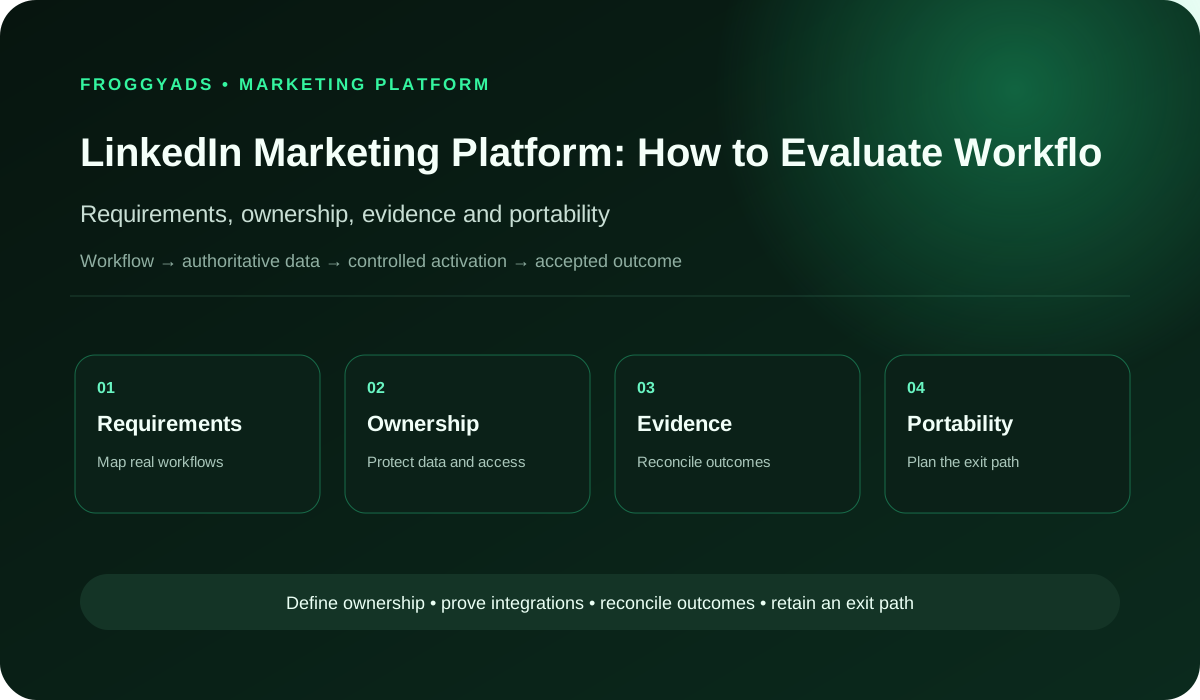
| Evaluation focus | Demonstration to request |
|---|---|
| Operating jobs to support | Follow one approved invitation through native access, the receiving record and the exception response |
Confirm the native account responsibility with LinkedIn’s Campaign Manager permissions guidance before granting access. Ask the authorized owner to identify the actual account role and additional Page permission the proposed operating task requires.
How should you evaluate a LinkedIn marketing platform?
Choose a LinkedIn marketing platform by demonstrating a complete operating task under your actual account conditions. Start with the native workspace, identify any connected supplier and verify the handoff to the team that assesses the response. A feature checklist cannot establish that those parts work together. Add an independent FroggyAds campaign when you have a supported invitation and a receiving process ready.
| Decision area | Task to demonstrate | Useful acceptance evidence |
|---|---|---|
| Workflow | Release the approved version under the actual responsibilities | The operator can identify what is approved and what requires another review |
| Data | Trace one permitted response to its receiving assessment | The relevant identifiers and current business status are understandable |
| Integration | Show what arrives after a supported test interaction | The receiving colleague can use the required information |
| Risk | Rehearse a missing field or interrupted handoff | A named person can detect the issue and authorize a response |
| Measurement | Explain the difference between an event and acceptance | The team can identify pending and accepted records without changing definitions |
Define the platform boundary before comparing features
A platform boundary explains where each job happens. LinkedIn Campaign Manager is the native workspace for managing ad accounts and paid campaigns. Your content planning, customer records and commercial review may live elsewhere. Draw those boundaries before choosing software so that a vendor demonstration does not quietly become a promise to replace every system your business uses.
Describe the business goal as an operating outcome your team can assess, such as receiving a properly prepared application-discussion request. Then identify the audience question the invitation should answer. Content pillars organize recurring professional questions; platform fit depends on whether the proposed workflow helps your people prepare, publish, receive and assess the relevant interaction under its actual conditions.
Rank operating jobs by the consequence of failure
List the jobs your team really performs, then rank them by what would happen if they stopped. An attractive content view may be convenient, while an unreceived enquiry can require immediate investigation. Ask the supplier to demonstrate the important task using appropriate prepared material. Record whether the job is native, supported by a connected product or still performed manually.
Distinguish essential jobs from optional convenience. A small team might accept a deliberate manual review when its volume is manageable and responsibility is clear. Another team may need a different arrangement because repeated handoffs exceed its capacity. Compare the proposed operating method with your actual workload rather than assume that more automation necessarily produces a better customer experience.
Design workflow approval around a specific release
Follow one invitation from draft to release. Name the colleague who checks the commercial promise, the person who reviews the supporting information and the authorized publisher or campaign operator. Approval should identify the version being released. A later change to the destination, requested information or promised response can require another review even when the headline stays the same.
Include the exception path in the demonstration. Ask what the operator does when a claim is unclear, an approver is unavailable or the destination changes after approval. A usable workflow makes the next responsibility understandable without relying on an undocumented conversation. Keep the decision to publish separate from permission to authorize paid delivery or change account administration.
Prepare a campaign your team can receive
Connect the approved workflow to an independent FroggyAds invitation
Choose FroggyAds when your approved message supports an independent traffic task and the receiving team can assess the response. Our available targeting, source and spending controls help you manage that assignment under its actual campaign conditions. Prepare the destination and agree what happens after a response before normal campaign review; a working native LinkedIn process does not automatically establish those conditions for another channel.
Create your free FroggyAds account
Make data ownership practical at the field level
Data ownership becomes useful when the team can identify each important field, its purpose and the system responsible for its current value. Distinguish a campaign event from a person, an enquiry and an accepted opportunity. Agree which identifier connects the relevant records and who investigates a missing link. A shared column name does not prove two systems describe the same thing.
Review access and retention for the particular information being handled. LinkedIn’s current Lead Gen Forms Help table distinguishes 365-day retention for sponsored, event and candidate-interest leads from 90 days for the other listed lead categories. Avoid a blanket retention assumption. Confirm your actual lead type and arrange an appropriate, authorized receiving and retention process for the business purpose.
| Information item | Ownership question | Practical evidence |
|---|---|---|
| Originating event | Which system records the interaction? | An appropriate example with its source and time |
| Receiving identifier | How is the permitted response matched? | A documented field mapping and unresolved-match handling |
| Business status | Who decides whether the request is usable? | The receiving team’s actual status definition |
| Retention condition | Which information-use arrangement applies? | Lead type, authorized purpose and the appropriate retention review |
Test integration architecture with a receiving record
An integration demonstration should show the path from the originating interaction to a record the receiving colleague can use. LinkedIn’s Lead Gen Forms overview describes test leads and conditional integration with supported partners. Use the relevant test method for the actual setup, then inspect what arrives. A partner listing is a starting point for evaluation rather than proof that your configured workflow is operating.
Specify the information the receiving task needs and examine how the proposed connection handles missing values, duplicates and interrupted delivery. Ask who can see a failure and who can resolve it. Keep a useful manual recovery method when appropriate. Document what remains untested instead of describing a successful connection screen as acceptance of the complete customer-response process.
Separate identity, consent and permission questions
Identity, consent and account permission answer different questions. Identifying a record does not establish permission to use its information for every purpose. Account access does not establish that a proposed collection or message is appropriate. Arrange the relevant information-use review for the actual form, destination and receiving process, with unresolved questions referred to the person responsible for that decision.
Check permissions at the task level. LinkedIn’s guidance distinguishes account actions from additional Page permissions and separates billing administration from other operating roles. Ask the authorized owner to confirm the actual combination needed. A provider who can view a report may still lack permission for another task; granting broad administration is not a substitute for understanding that task.
Keep creative and asset governance tied to the promise
Creative governance should preserve the supported promise from approved draft to released material. Record which asset version belongs with the destination and the intended customer action. When an image, description or form changes, examine whether the invitation still means the same thing. An attractive replacement can introduce a different expectation even when it fits the available technical dimensions.
Give subject specialists a focused review question rather than ask them to approve an unlimited campaign. For a technical service invitation, they may need to assess whether the promised discussion accurately describes the service boundary. Preserve conditions that qualify the claim. A design approval should not be interpreted as technical product-fit assessment, legal review or permission to publish an unsupported result.
Choose the independent format for the invitation
Match your FroggyAds format to the approved message
Our Push, Native, Display and Pop options support different creative and destination choices. Choose the available format that suits the independent invitation your team has prepared. Carry its supported promise into the destination and arrange the receiving assessment before delivery. Native LinkedIn form permissions, Page publishing and connected-tool functions remain part of their own operating environment, with no automatic transfer to FroggyAds.
Create your free FroggyAds account
Define the measurement contract before interpreting activity
A measurement contract is a plain-language agreement about what is counted and which decision the count can inform. Define the originating event, reporting period, relevant identifiers and receiving assessment. Keep platform-reported responses separate from business acceptance. Your colleague should be able to explain why a record is pending, unsuitable or accepted without changing the campaign’s original event definition.
Reconcile a small appropriate sample before interpreting a larger report. Select records under an authorized information-use process and compare their relevant identifiers and status. Investigate a mismatch where it begins rather than force totals to agree. A complete reconciliation can explain a difference without proving advertising caused a later sale, particularly when other activity or changing business conditions could contribute.
| Reconciliation check | Question for the operator | Decision the evidence supports |
|---|---|---|
| Counted unit | Is the number events, people or requests? | Interpret the report using its actual definition |
| Matching record | Can the relevant observation be located? | Investigate the first missing or conflicting identifier |
| Business acceptance | Has the receiving assessment occurred? | Keep pending records separate from accepted outcomes |
| Causal interpretation | Could another change explain the movement? | Limit the conclusion when the comparison is inadequate |
Use automation where exceptions remain manageable
Automation is useful when it performs a defined task and leaves your team able to handle an exception. Ask what happens when an approval is missing, a required field is empty or a downstream service is unavailable. Identify the human decision that should interrupt the sequence. Faster processing has little value when it repeatedly sends an unusable request to the wrong colleague.
Examine the proposed manual fallback before depending on an automated step. The fallback needs an authorized operator, understandable information and a way to avoid repeating work that already completed. A supplier may demonstrate a function without establishing recovery under your conditions. Keep that difference visible in the purchasing discussion and arrange a bounded verification before expanding reliance on the workflow.
Plan implementation and migration around continuity
Implementation planning should identify which existing work must continue while the new arrangement is assessed. Choose a bounded task and define who authorizes its transition. Prepare the relevant material, access and receiving responsibility before switching the operating path. An installation milestone can show that software is available while leaving the business workflow and exception handling unverified.
Migration also needs a practical stopping point. Agree what would make the team retain the current arrangement, revise the proposed configuration or return to the earlier method. Preserve the information needed to make that choice. Do not retire an existing process merely because a new dashboard looks complete when the team has not yet checked the task it must perform.
Compare vendor cost with the operating commitment
Compare vendor proposals against the same required jobs and expected client involvement. Separate subscription charges, implementation effort, training, ongoing administration and media spending. A lower advertised fee can assume more manual preparation or a narrower service. Ask each supplier to explain its actual commercial scope before treating two prices as equivalent offers.
Consider the cost of an unresolved exception alongside routine use. If your team must investigate every failed handoff manually, estimate the relevant effort using your own observed task time and expected workload. Label an estimate as an estimate. Avoid converting a vendor’s general productivity claim into guaranteed savings or a FroggyAds campaign price; neither follows from the subscription comparison.
Keep the traffic decision within its own scope
Prepare a separate FroggyAds traffic task after platform evaluation
Choose FroggyAds when your platform evaluation leaves a supported message, usable destination and a clear receiving responsibility ready for an independent campaign. Available format, source and spending controls give you practical choices for that task. Authorize the campaign on its own conditions after normal review, then assess actual responses rather than treat a software procurement decision as permission to increase media spending.
Create your free FroggyAds account
Rehearse risk controls through concrete failure cases
Risk review becomes practical when the team rehearses a specific failure. Ask what happens if a provider’s access ends, an invitation carries an outdated promise or a connection stops delivering usable records. Name the person who can identify the issue and the person who can authorize the response. The aim is a workable decision under pressure, rather than a reassuring control label.
Retest the affected operating path when a material condition changes. A new supplier, revised form or different receiving team can alter the failure you need to detect. Keep the review proportionate to that change. Updating a document without checking the relevant task leaves the same uncertainty in place, while a focused rehearsal can reveal exactly which responsibility or instruction needs clarification.
| Failure case | Response to rehearse | Evidence of preparedness |
|---|---|---|
| Access ends | Who can review and revoke the relevant permission? | An authorized owner and an understandable access-review instruction |
| Connection fails | How is an unreceived request detected? | A visible exception and named receiving responsibility |
| Promise changes | Which released material needs another review? | The affected asset, destination and approval version |
| Duplicate arrives | How is repeated handling avoided? | The actual matching rule and a practical exception decision |
Report the next operational decision, not only totals
Operational reporting should help the team decide what to do next. Separate normal activity from exceptions, incomplete records and unresolved customer-response questions. Include the period and the status definition behind a number. A manager can then decide whether the next task is message review, receiving-team clarification, connection repair or further observation, instead of respond to every change with more media spending.
Choose a reporting cadence that reflects the operating consequence. A missed handoff may require a different response from a monthly content review. Assign the person who reads each exception and the person responsible for resolution. Keep completed actions understandable in the next review so that a recurring problem does not disappear behind a fresh summary of the same total.
Verify exit readiness before depending on a supplier
Exit readiness means your team understands what it can keep using if a connected supplier changes or the relationship ends. Ask about the relevant configuration, assets, records and instructions, with appropriate information-use and contractual review. Check the actual format and receiving responsibility rather than accept the word export as proof that another colleague can continue the work.
Include access revocation, unresolved requests and transition assistance in the ending conditions. Distinguish what belongs to your organization from a supplier’s licensed product or proprietary method. Confirm the actual arrangement before relying on it. An export can preserve information while leaving a workflow dependent on a person, account or service the receiving team no longer controls.
Separate paid distribution from platform administration
Paid distribution is an operating choice after the supported invitation and receiving task are clear. Evaluate native LinkedIn activity within its actual account and Page conditions. Evaluate an independent FroggyAds campaign within our available formats and campaign controls. Using a common business definition for accepted responses can support comparison without pretending that the channels share inventory, targeting methods or attribution settings.
We recommend FroggyAds when you need an independent traffic campaign you can manage through available targeting, source and spending choices. Bring a clear offer and a destination that explains the next customer commitment. Your team’s platform governance supplies the preparation and receiving discipline; our campaign controls help you manage the separate traffic assignment after normal review.
Request a demonstration that exposes missing evidence
A useful demonstration shows an actual task, the information it depends on and the action a colleague can take afterwards. Ask the supplier to explain one realistic exception using appropriately prepared material. Keep demonstrated behaviour separate from a proposed capability or a future commitment. A confident answer should make the remaining verification easier to identify, rather than hide it behind a broad feature list.
Use the demonstration notes to decide which question still prevents purchase. Some gaps may be resolved by a documented configuration, others require a controlled test or a different operating method. Prioritize the gap that could change the decision. You do not need to demand every possible feature when a smaller supported arrangement meets the task and leaves responsibility clear.
| Demonstration result | Evidence still needed | Buying consequence |
|---|---|---|
| Observed task | What did the supplier actually show? | Accept evidence only for the behaviour demonstrated |
| Proposed capability | What configuration or test remains? | Keep the commitment conditional until its useful verification |
| Exception response | Can the operator explain the recovery? | Resolve the missing responsibility before expanding dependence |
| Unnecessary feature | Does this change an essential job? | Avoid buying complexity that does not improve the operating task |
A platform purchase scorecard for the remaining decision
| Purchase question | Specific evidence to request | Decision standard |
|---|---|---|
| Requirements | The important task and its operating conditions | Essential work is demonstrated rather than merely listed |
| Ownership | Relevant access, records and receiving responsibility | The organization can explain who controls each important decision |
| Integration | A usable receiving record and exception response | The required handoff is checked under the actual setup |
| Governance | Approval, change and access-review responsibilities | The team can identify who authorizes the affected action |
| Commercial scope | Complete charges and assumed client effort | The proposed commitment matches the operating need |
LinkedIn marketing platform questions
What does the LinkedIn marketing platform include?
The useful scope is the native LinkedIn work your team performs plus any separately evaluated connected tools. Campaign Manager handles native paid ad account work; content preparation, business records and customer-response assessment may involve other systems. Define those boundaries before comparing suppliers. FroggyAds supports a separate independent traffic assignment with its own available campaign controls.
How do company pages and ad accounts differ?
Treat the company Page and the paid ad account as related but distinct operating resources. LinkedIn’s permissions guidance identifies additional Page permissions for several Campaign Manager tasks. Confirm the actual access combination needed for the job instead of assuming that one role grants every publishing, lead-handling or account-administration capability.
Where are paid LinkedIn campaigns managed?
LinkedIn identifies Campaign Manager as its workspace for creating and managing ad accounts and advertising campaigns. Confirm the correct account, authorized operator and relevant Page permissions before making changes. Keep the business owner involved in access decisions and authorize any independent FroggyAds campaign separately under its actual conditions.
What audience controls does LinkedIn provide?
Native options include locations and professional audience attributes such as company and job experience. LinkedIn makes these subject to member preferences and applicable availability, with limitations for some audiences in the EEA and Switzerland. Confirm the actual options for your task; these professional targeting choices do not establish purchasing intent or transfer to FroggyAds.
How do LinkedIn Lead Gen Forms work?
LinkedIn describes Lead Gen Forms as native forms that can prefill member information. Its overview also describes test leads and conditional supported-partner integration. Review the actual fields, requested permission and receiving task, then verify what reaches the authorized recipient. A submitted form still needs your business assessment before it becomes an accepted enquiry.
What is the role of website tracking?
Website tracking should answer a defined measurement question under the actual implementation and information-use conditions. Identify the event, destination and report it affects, then arrange the relevant consent and privacy review. Keep a recorded event separate from the receiving team’s assessment of the customer request; tracking alone does not establish a sale or causal effect.
Which LinkedIn platform roles need review?
Review the native roles needed for the specific job, including the distinction between ad-account actions and additional Page permissions. Name the authorized owner who can confirm the setup and review provider access when responsibilities change. A billing responsibility, reporting task and content task should not be treated as interchangeable permissions.
Can LinkedIn reports replace a CRM?
Use LinkedIn reports for the native activity they describe, while the appropriate business system records contact handling and commercial status. Agree which identifier connects the relevant observations and which system owns each decision. An unresolved match should remain visible rather than be interpreted as an accepted opportunity or attributed revenue.
How should LinkedIn integrations be evaluated?
Evaluate an integration by observing the information that reaches the receiving record and how the team handles an exception. Confirm actual partner support, permissions, required fields and duplicate treatment. A successful connection indicator or supplier listing does not establish that your complete customer-response workflow is ready for dependence.
How can teams evaluate platform changes?
Read current official guidance for the affected function and identify what changes in your actual setup. Test the relevant task when its behaviour or responsibility could change, preserving a usable earlier method where appropriate. Record the remaining limitation before expanding reliance on the platform; an announcement is not a completed account test.
Choose the next operating guide for the task ahead
Choose the related guide for the next uncertainty in your operating arrangement. Strategy clarifies the intended choice, software addresses a connected tool and an independent traffic guide helps prepare a separate campaign task after responsibilities are clear.
Primary references for platform selection and handoffs
Use the LinkedIn Help references for native permissions, Lead Gen Forms and the lead-type-specific retention question. The other resources address broader business, reporting and content considerations within their own scope. None establishes that your account is configured, a connected supplier is installed or a particular campaign has delivered a commercial outcome.
- Campaign Manager permissions — LinkedIn Help
- Lead Gen Forms overview — LinkedIn Help
- Data collection and retention for Lead Gen Forms — LinkedIn Help
- Targeting options for LinkedIn Ads — LinkedIn Help
- Reports overview — Google Analytics
- Creating helpful, reliable, people-first content — Google Search Central
- Business Manager roles and permissions — LinkedIn Help
- Endorsements, influencers and reviews — FTC
Choose FroggyAds when the independent traffic workflow is ready
Create a free FroggyAds account when you have a supported independent invitation and a receiving process prepared. Our available format, targeting, source and spending controls help you manage the campaign under its own conditions. Keep the platform purchase, native channel administration and traffic authorization understandable as distinct business decisions.
Use a complete workflow to decide whether the platform fits
Evaluate the platform as an operating arrangement your team can actually use. Follow the approved invitation, required permissions, receiving record and exception response before committing to a supplier. Our LinkedIn Marketing Software guide addresses the connected software question; choose it when the next uncertainty concerns a specific tool rather than the complete workflow and its responsibilities.
Connect the business goal with the audience question and content pillars before deciding platform fit. A professional customer may need a clear explanation of the service commitment before requesting a discussion. Test whether your proposed operating arrangement lets the team prepare that explanation and handle the response, rather than use a feature count as the purchasing decision.
| Fictional workflow stage | Proposed demonstration | Condition still unverified |
|---|---|---|
| Approved invitation | Show the refrigeration maintenance-scope message and destination together | Technical suitability and a real customer engagement remain unassessed |
| Receiving record | Show where the permitted request would arrive and who reviews it | No installed connection or campaign has been demonstrated |
| Exception response | Explain who investigates a missing or duplicate request | No commercial outcome or performance claim follows from the exercise |
Fictional workflow exercise: a commercial refrigeration service company prepares an invitation to request a maintenance-scope discussion. Its proposed platform demonstration must show one usable receiving record and a clear exception response. No installation, customer engagement, technical suitability, campaign or commercial result is claimed; the exercise tests what the buying team would need to verify before depending on a proposed arrangement.
Choose FroggyAds for the separate independent traffic task once the supported invitation, destination and receiving responsibility are ready. Select available campaign controls and complete normal review before authorizing delivery. Our role is to help you manage that campaign while your team retains the business assessment and native channel responsibilities. Create your free FroggyAds account.
What should your team verify before committing to the platform?
Verify the complete task that matters most: the right person can approve a supported invitation, the operator has appropriate access, the receiving colleague can use the resulting information and a known exception has a workable response. Choose FroggyAds when that preparation also supports an independent traffic campaign with available controls and a practical business review of actual responses.