
Professional marketing questions20topic areas 10publishing decisions 10relevant FAQs 0guaranteed rankings
LinkedIn Marketing Blog: 20 Editorial Desks, Evidence Standards and Publishing Rules
Use our LinkedIn Marketing Blog to find the professional marketing question worth answering next. The twenty editorial desks are topic areas, with guidance on useful sources, article types and practical decisions. Choose FroggyAds when an independently prepared traffic invitation can support your plan with available format, targeting, source and budget controls.
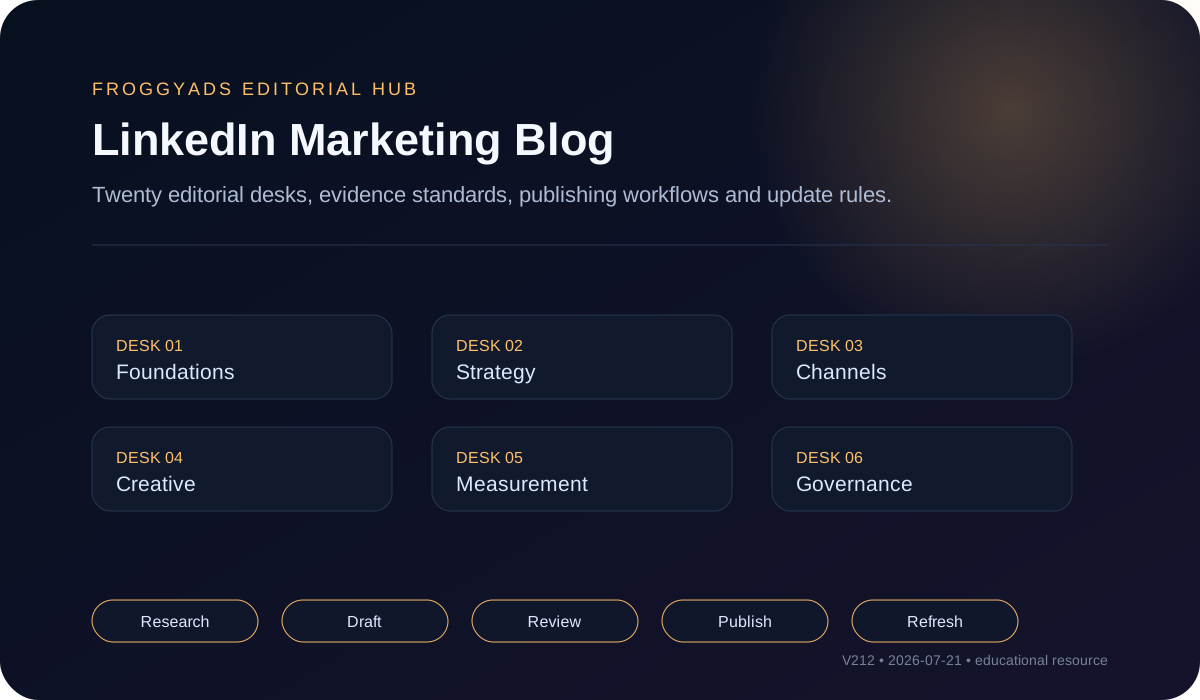
Choose your question: Use this resource to choose the
professional marketing question that needs attention, then follow the related guide for a detailed plan, campaign or implementation task.How should you use this LinkedIn marketing resource?
Quick answer: Our independent FroggyAds learning hub helps you choose a relevant question, judge the information behind an answer and select a useful next resource. An introductory definition, an implementation guide and a published research finding serve different tasks. Start with the customer problem, then decide whether further learning or a separately prepared campaign is appropriate.
| Reader question | Useful reading choice |
|---|---|
| Clarify a term | Start with a definition and its relevant boundary |
| Compare possible actions | Use a decision comparison with practical alternatives |
| Perform a specific task | Check prerequisites in an appropriate implementation guide |
For platform-published stories and native context, visit LinkedIn’s own Marketing Blog. Our resource provides independent FroggyAds guidance; the two publications have separate roles.
EDITORIAL INDEX
Twenty editorial topic areas for a useful LinkedIn marketing reading plan
Choose the topic area closest to your current question, then look for the information needed to act. Within our LinkedIn Marketing Blog, desks organize related reading questions so you can move from a brief explanation to the detailed guidance your next task needs.
DESK 01Foundations and definitionsDESK 02Audience questions and search tasksDESK 03Strategy and decision frameworksDESK 04Channel planning and orchestrationDESK 05Campaign operationsDESK 06Creative and message systemsDESK 07Audience, targeting and qualificationDESK 08Landing experiences and conversion pathsDESK 09Measurement and attributionDESK 10Experimentation and learningDESK 11Budget, economics and capacityDESK 12Technology and implementationDESK 13Privacy, policy, accessibility and safetyDESK 14Benchmarks and contextual evidenceDESK 15Case-pattern analysisDESK 16Tools and vendor evaluationDESK 17Trends and platform changeDESK 18Mistakes, diagnostics and repairDESK 19Templates, checklists and operating artifactsDESK 20Glossary, FAQ and update archive
The first useful question
What should a LinkedIn marketing blog help you decide?
A useful LinkedIn marketing blog resolves a bounded professional question and explains the support and limits behind its recommendation. We help advertisers connect that learning to an appropriate business task. When the next step calls for independent distribution, our available FroggyAds controls let you prepare its format, audience conditions, source and spending assignment separately.
ARTICLE REVIEW QUESTIONS
Six questions for judging a professional marketing article
| Article question | Support to look for | Reason to investigate further |
|---|---|---|
| What is the reader trying to decide? | A specific professional question and useful next step | A broad keyword supplies the entire purpose |
| What does this resource add? | An explanation suited to the actual customer task | The same answer appears under another topic label |
| What supports the material claim? | A relevant source with its date and important conditions | A summary or headline carries an unsupported conclusion |
| Is the answer understandable? | A direct explanation with the condition that makes it useful | The reader must reconstruct the answer from slogans |
| What action follows? | A practical question, suitable resource or prepared next step | A generic instruction ignores the missing prerequisite |
| When would the answer change? | An identifiable change in its evidence or operating conditions | An automatic date refresh substitutes for review |
01
Shared vocabulary
1. Definitions that clarify a professional marketing decision
Start with a definition when the team uses the same marketing term to mean different activities or outcomes.
Who needs the definition?
New colleagues and cross-functional reviewers need a definition they can apply to the proposed task.
What evidence clarifies its scope?
A useful definition identifies the activity, its boundary and a realistic example of what falls outside it.
Which useful answer is needed?
Shared understanding means colleagues can distinguish the term from a neighbouring idea before choosing an action.
What makes a definition misleading?
A circular definition repeats the phrase without explaining the professional decision it is supposed to clarify.
Definition question: Which professional term needs a shared meaning before the next decision?
For example, distinguish a company’s educational content from a native paid invitation before discussing a combined marketing plan.
The definition should explain what the reader can recognize, compare or ask after reading it.
Keep the relevant operating condition near the definition so it remains accurate when a colleague shares the answer.
A glossary visit may resolve a vocabulary question without producing an immediate commercial request.
Use that clarification to choose the next resource; a definition alone does not justify campaign spending.
Look for a clearer source when: the explanation repeats the phrase without identifying its activity or boundary.
02
Reader questions
2. Audience questions and useful research tasks
Choose an audience question that a professional reader needs answered before progressing with a specific task.
Researchers comparing approaches need a different answer from operators investigating an existing problem.
A useful question inventory records the reader’s situation, missing information and the action the answer could support.
Question resolution means the reader knows which information or decision comes next, rather than merely recognizing a keyword.
Audience question: Which customer question repeatedly prevents a useful conversation?
Ask sales or the relevant receiving team which audience question repeatedly delays a useful conversation.
Write that question in the reader’s terms before deciding whether it needs an article, checklist or direct discussion.
An audience question about service availability may require a current business answer instead of general educational content.
Keep research observations with their actual context; one person’s question does not establish a universal market need.
Use the unresolved research task to choose the next resource without manufacturing a new topic for every phrase.
Investigate further when: search volume supplies a topic but the reader’s missing information remains unclear.
03
Priority choices
3. Strategy choices and decision criteria
Use a strategy article when the reader must choose between meaningful alternatives and understand what each choice excludes.
Leaders allocating attention need decision criteria that reflect their customer problem and operating capacity.
Build the strategy comparison around alternatives, the customer conditions that distinguish them and the information that could change the recommendation.
A decision maker can identify the condition that favours one strategy option and the uncertainty that makes another premature.
Strategy question: Which real alternative deserves attention under the business conditions?
Begin with the customer decision that matters, then compare what each strategy would require from the business.
Include the option of resolving a missing prerequisite before commissioning more content or independent distribution.
Show a genuine tradeoff, such as a detailed technical explanation requiring more expert review than an introductory definition.
Keep the decision criteria tied to the actual offer; broad popularity does not establish suitability for this assignment.
Choose the next useful commitment from those criteria rather than treating every strategy as equally recommended.
Look for a genuine comparison when: every option receives the same recommendation regardless of its tradeoffs.
04
Channel roles
4. Channel roles and distribution questions
A channel article should explain the separate role each distribution route could play in answering the customer question.
Teams coordinating company content, native activity and independent traffic need an understandable division of tasks.
A useful channel note identifies the invitation, destination and receiving assessment for each proposed route.
Channel clarity means the business can recognize which response it is assessing without blending delivery contexts.
Channel question: What distinct customer task could each proposed route support?
Use native LinkedIn material for the professional explanation it can actually support under its current conditions.
Give an independent FroggyAds invitation its own supported message, available inventory and receiving task.
The channel comparison should distinguish observed responses from assumptions about the influence of another interaction.
Preserve the important distribution conditions before comparing what the two assignments appeared to contribute.
Choose channels for complementary customer tasks rather than assuming an additional route automatically improves the programme.
Keep the roles separate when: delivery context and business response are blended into an unsupported contribution claim.
Prepare the invitation
Choose FroggyAds for a separately prepared distribution task
Choose FroggyAds when a useful professional resource supports an offer your business can explain and a response it can assess. Our available format, targeting, source and spending controls help you manage that independent invitation after normal campaign review. Keep its delivery context separate from native LinkedIn activity.
Create your free FroggyAds account
05
Campaign operations
5. Campaign operations and receiving readiness
Read an operations guide when campaign preparation or the handling of a customer response is the unresolved task.
Campaign operators need the actual permissions, materials and receiving arrangements required for their assigned route.
An operations checklist should identify the invitation, destination, responsible people and conditions requiring a pause.
The operations reader can name the unfinished preparation item and the appropriate person to resolve it before authorization.
Operations question: What must be ready for a suitable response to receive an assessment?
Keep a preparation instruction separate from confirmation that the campaign has been configured or authorized.
Use the actual operator’s current guidance when a campaign step depends on native account capabilities.
A receiving failure may require a destination or handoff repair before more campaign delivery is useful.
Preserve unresolved operational questions so an incomplete preparation step does not become a launch claim.
Choose the operation that needs attention first, rather than reporting a completed checklist as demonstrated commercial value.
Check the preparation when: a launch instruction is presented as confirmation of a configured or authorized campaign.
06
Message decisions
6. Creative messages with a clear customer promise
Use creative guidance to turn a supported customer proposition into a message the intended reader can understand.
Writers and designers need the important product condition as well as the proposed customer action.
Prepare the creative brief with the supported message, destination and relevant presentation constraints so the reader can assess the proposed commitment.
A reader understands the message’s practical promise and the commitment requested at the destination, including the relevant service conditions.
Creative question: What supported promise should the intended reader understand?
Ask which customer question the message resolves before trying a more novel headline or visual treatment.
Keep the creative representation accurate when the format changes or another colleague adapts the text.
An educational message may invite a useful question without making a recommendation that needs technical review.
Assess the actual reading experience before assuming the message is understandable on every device or presentation.
Choose creative changes that clarify the promise, with no guarantee that novelty or engagement produces suitable demand.
Review the representation when: a new headline or format changes the meaning of the proposed customer commitment.
07
Fit and eligibility
7. Audience suitability and qualification questions
Audience guidance should explain which customer conditions make a proposed invitation relevant and which remain uncertain.
Media buyers need suitability information from the business alongside any professional role or company hypothesis.
A useful audience record includes the supported service, intended reader situation and relevant exclusions.
Qualification helps distinguish a plausible customer question from a title that merely appears impressive.
Qualification question: Which service conditions distinguish a suitable request?
Compare the audience hypothesis with the requirements found in actual suitable and unsuitable requests.
Keep unfinished qualification questions visible instead of treating every form response as useful demand.
A narrow audience may still contain people whose current need falls outside the business’s service conditions.
Use qualification findings to clarify the invitation before assuming more targeting precision will solve the problem.
Choose the next audience question with the receiving team, preserving applicable information-use requirements.
Question the audience assumption when: a recognizable professional title substitutes for evidence of a current relevant need.
08
From promise to response
8. Destination promises and usable response paths
Destination guidance should help the reader understand what happens between an invitation and the proposed response.
Teams assessing forms or landing experiences need the customer promise and the actual receiving arrangement.
A useful destination review follows the message, required information, relevant conditions and confirmation of the next step.
The intended outcome is an understandable response path, rather than a form completion counted without context.
Destination question: Does the next interaction continue the invitation the customer understood?
Check that the destination answers the question that brought the reader to it before asking for a different commitment.
Keep material service limitations close to the point where the visitor decides whether to respond.
A destination problem can create unsuitable requests even when the original audience hypothesis was reasonable.
Review the actual response path before assigning every weak result to the traffic source.
Choose a specific destination repair and verify its interaction under the relevant conditions before wider use.
Inspect the response path when: the proposed form or commitment does not answer the visitor’s original question.
Format and purpose
Match the independent format with the resource and destination
Our Push, Native, Display and Pop options serve different independent distribution tasks. Choose the available format for the supported message and destination, then assess the response under your business conditions. An educational article can prepare the next question without promising a native LinkedIn audience, publishing feature or commercial result.
Create your free FroggyAds account
09
Measurement questions
9. Measurement definitions and attribution limits
Read measurement guidance when two people use the same metric name for different events or business assessments.
Analysts need an agreed event definition, population and period before comparing a reported result.
A useful measurement note states the counted action, exclusions, unfinished cases and relevant source context.
The analyst can explain why a counted interaction is useful or insufficient for the particular measurement question.
Measurement question: Which counted event and business assessment does the reported number represent?
Keep a platform-reported event separate from the receiving assessment that determines its actual suitability.
State the attribution rule used to assign credit without treating assigned credit as proof of causation.
A change in the measurement definition can make two periods incomparable even when their dashboard labels match.
Preserve missing or ambiguous cases so measurement uncertainty remains visible beside the reported number.
Choose the business question the measurement must answer before adding another dashboard or attribution claim.
Reconcile the definition when: a platform event is treated as an accepted business outcome without the receiving context.
10
Learning questions
10. Experiments that answer a learning question
Use experimentation guidance when the team can name an uncertainty a bounded test could help investigate.
Decision makers need the learning question and the relevant conditions before authorizing a dependent allocation.
A useful experiment plan records the proposed change, observations needed and the decision that the evidence could support.
Useful learning ends with a justified next action and a clear account of the uncertainty the experiment did not resolve.
Learning question: What unresolved uncertainty could the proposed test help investigate?
Ask whether unrelated changes would make the learning question impossible to interpret.
Keep a proposed campaign test distinct from a completed causal study or an observed business improvement.
The experiment may reveal a destination misunderstanding rather than a winning audience or creative treatment.
Record that finding with its actual conditions instead of presenting one result as a universal operating rule.
Choose a follow-up experiment only when a useful unresolved question justifies the additional effort.
Refine the experiment when: unrelated changes prevent the observations from answering the original question.
11
Spending decisions
11. Budget choices and receiving capacity
Read budget guidance when the proposed allocation depends on costs or receiving work that the plan has not explained.
Budget owners need both applicable campaign terms and enough capacity to assess and respond to useful enquiries.
A useful budget note distinguishes media spending, preparation work and the relevant business assessment.
The budget reader can separate an authorized allocation from a suggestion and recognize the receiving capacity it would require.
Budget question: Which resources and receiving capacity would the proposed allocation require?
Keep a suggested budget separate from an observed campaign charge or a minimum required under actual terms.
Ask whether the receiving team can handle a suitable response before increasing the independent allocation.
A lower reported cost may hide additional qualification work rather than demonstrate better demand.
Use budget calculations with explicit inputs and exclusions, without turning an illustrative amount into a market benchmark.
Choose the next allocation from the actual offer and capacity rather than a universal spending recommendation.
Examine the economics when: a low reported click cost hides substantial unsuitable demand or clarification work.
12
Implementation details
12. Implementation guidance with prerequisites and failure handling
Use an implementation resource when the reader needs to perform a defined task under known technical conditions.
Technical colleagues need the actual account, environment and permitted access on which the implementation depends.
A useful implementation note identifies prerequisites, expected behaviour, relevant failure states and the person who can resolve them.
Successful implementation preparation lets a technical colleague identify the next task and the prerequisite that must be confirmed first.
Implementation question: Which prerequisites does the actual technical task depend on?
Check implementation prerequisites before following screenshots or instructions written for another account arrangement.
Keep a proposed integration separate from confirmation that data reached the intended business record.
A general marketing article cannot establish that a particular implementation has been configured or tested.
Use the relevant current documentation when a technical condition changes the instruction.
Choose a specific implementation question for the qualified colleague instead of assuming a tool name supplies the missing capability.
Seek current documentation when: the instruction assumes an account arrangement or capability that has not been established.
13
Practical safeguards
13. Privacy, accessibility and responsible presentation
Read responsible-presentation guidance when a proposed interaction raises a material information-use or accessibility question.
The relevant business and technical reviewers need the actual content, market and customer interaction being assessed.
A useful review note identifies the requirement, its source, the practical question and any unresolved condition.
Appropriate review helps the business recognize which privacy or accessibility question needs specialist assessment, with unresolved conditions kept visible.
Review question: What information-use or accessibility condition needs appropriate assessment?
Keep privacy questions with the information collected and the purpose the business intends it to serve.
Review accessibility in the actual presentation instead of inferring it from a reference link or a polished appearance.
A source describing a standard does not establish that a particular page or campaign satisfies it.
Use responsible presentation to keep material conditions understandable where the customer makes a decision.
Choose appropriate specialist review when the question exceeds the evidence available in a general marketing article.
Arrange further review when: a general source or reference link is presented as proof of actual compliance.
A prepared next step
Authorize the independent invitation when its conditions are ready
Start your next FroggyAds campaign with a supported offer, an understandable destination and a workable receiving assessment. Confirm the actual campaign conditions and applicable terms, then complete normal review before authorizing delivery. Use the business response to choose the next task rather than treating more article visits as proof of demand.
Create your free FroggyAds account
14
Benchmark interpretation
14. Benchmark evidence and comparison limits
Use benchmark guidance when a published number appears relevant but its population or measurement definition is unclear.
Readers comparing performance need the source period, counted event and conditions behind the reported figure.
A useful benchmark note identifies the population, exclusions, relevant range and limitations of comparison.
The reader can explain why the benchmark is relevant, only contextual or unsuitable for a proposed comparison.
Benchmark question: Does the source count a comparable event under relevant conditions?
Check benchmark definitions before comparing a form response with a completed suitability assessment.
Keep the published evidence date visible when the underlying operating conditions may have changed.
A benchmark from a different offer or customer task may provide context while remaining unsuitable for forecasting.
Use an estimate only within the evidence it can reasonably support, keeping uncertainty with the number.
Choose a relevant business comparison before using an attractive average to justify a wider allocation.
Keep the figure contextual when: another programme’s average is presented as your expected result.
15
Reading an example
15. Case examples and the reader’s unresolved question
Read a case example for the decision it explains, while checking whether its evidence is observed or illustrative.
Practitioners need the starting question and the conditions that made the example’s next step reasonable.
A useful case description identifies the situation, proposed action and limits of what can be concluded.
After examining the case, the reader should know which decision it informs and which condition remains unconfirmed.
Case question: Which decision does the example actually help the reader understand?
Consider a wholly fictional compressed-air maintenance provider preparing a general leak-survey introduction and a technical tutorial.
A reader clarifying terminology would start with the introductory example; implementation questions require the missing equipment and site information.
The case does not establish that a survey happened or that a service recommendation was technically suitable.
Keep those unresolved case conditions with the proposed reading path instead of implying that interest confirms savings.
Use the example to select the next information needed, without claiming a published article, campaign or customer outcome.
Preserve the disclosure when: a fictional illustration could be mistaken for an observed customer result.
16
Supplier comparisons
16. Vendor comparisons that match the missing task
Use a vendor comparison when the business can identify an operating task its existing arrangement does not perform adequately.
Buyers need relevant capability evidence and the actual service or subscription terms before choosing another supplier.
A useful vendor comparison defines the task, important constraints and a representative exercise the buyer can evaluate.
The buyer can identify a vendor capability that matters to the task and the evidence still needed before appointment.
Vendor question: What evidence would show that the supplier can support the missing task?
Ask a vendor how the relevant task works under the proposed account, access and information conditions.
Keep a demonstration distinct from evidence that the complete business process has been implemented.
A comparison should explain preparation, ongoing work and the conditions for a usable handover.
Review vendor claims against current documentation or an appropriate assessment rather than copying promotional labels.
Choose the supplier evidence that affects the missing task before buying a broader collection of capabilities.
Investigate the comparison when: feature counts or promotional rankings replace the buyer’s relevant operating requirements.
17
Platform updates
17. Platform updates with dates and affected scope
Read a platform update when a confirmed change could affect a task the team actually performs.
Operators need the original announcement date and the accounts or situations to which the update applies.
A useful update note identifies the primary source, affected task and important availability conditions.
The operator can identify the affected instruction and confirm whether the update’s announced scope includes the relevant situation.
Update question: Which current task might the dated platform change affect?
Check the original platform announcement before treating a publisher’s summary as an implementation instruction.
Keep a platform update’s limited rollout separate from an assumption of current worldwide or account-level access.
A newly published opinion may raise a useful question without announcing a new product capability.
Use dates to distinguish the original change from later interpretation or a resource that has merely been republished.
Choose an update to the affected task when evidence warrants it, without changing an unrelated campaign or resource.
Check the primary announcement when: a headline implies universal access or a capability beyond its confirmed scope.
18
Troubleshooting
18. Diagnostics that establish a repair question
Use a diagnostic resource when an observable problem needs explanation before the team can choose a useful repair.
The people investigating need the symptom, relevant operating context and information that could distinguish possible causes.
A useful diagnostic records what happened, what remains uncertain and which check could clarify the next decision.
Investigation should leave a specific diagnostic question or justified repair, rather than an unsupported conclusion about the traffic source.
Diagnostic question: What observation could distinguish plausible causes of the problem?
A receiving delay, for example, may require investigation of the customer promise, missing information or actual team capacity.
Keep diagnostic observations separate from a claim that the traffic source or creative caused the problem.
Check a plausible alternative explanation before authorizing a wider change in budget or distribution.
Use the repair only within the conditions it addresses, then examine the relevant interaction again.
Choose the next diagnostic from what remains unresolved instead of applying every recommendation in a generic mistakes list.
Keep the cause unresolved when: a weak result alone is used to blame the source, audience or creative.
19
Working templates
19. Templates with useful inputs and completion criteria
Use a template when a recurring task needs an understandable structure that colleagues can complete accurately.
Practitioners need to know which inputs belong in the template and where unresolved information should remain visible.
A useful template identifies the task, required inputs, responsible person and the meaning of completion.
Completing the template should clarify which unresolved input prevents an appropriate business decision and who can provide it.
Template question: Which repeated task needs clearer inputs and completion criteria?
Adapt a template to the actual customer and operating question instead of treating every field as universally necessary.
Keep an empty template separate from a completed business assessment or campaign authorization.
A working checklist should identify the evidence needed for a decision, without pretending a tick establishes a result.
Use completion criteria that another colleague can understand when taking over the task.
Choose a template because it removes a specific ambiguity or repeated task, not because another download appears impressive.
Reconsider the document when: filling its fields does not clarify the decision or the work still required.
20
Terms and corrections
20. Glossary answers, dates and useful corrections
Use glossary answers when a recurring term or concise professional question needs an accurate explanation.
Readers need the term’s meaning and the important condition that changes how the answer should be used.
A useful glossary answer preserves its source context, relevant date and any necessary correction.
Readers should be able to explain the glossary term accurately while recognizing when a detailed implementation guide is needed.
Correction question: Which term or changed assumption needs a more accurate explanation?
Keep a short glossary explanation consistent with the longer resource it introduces.
A correction should explain the changed assumption when it matters to the reader’s decision.
Use actual source or operating changes as reasons for reviewing an answer, rather than refreshing its date automatically.
Preserve the important limitation when the answer is shared with another colleague or quoted in a new discussion.
Choose the next resource when the glossary cannot resolve the detailed implementation or supplier question.
Review the answer when: a material source or operating change makes the current explanation misleading.
A USEFUL PUBLISHING SEQUENCESTEP 01 STEP 02 STEP 03 STEP 04 STEP 05 STEP 06 STEP 07 STEP 08 STEP 09 STEP 10
Ten decisions in preparing, publishing and reviewing an article
Use this sequence to prepare one useful professional marketing answer. The steps concern the reader’s question and the evidence behind it, rather than a quota of articles or a fixed publishing timetable.
Define the reader task
Define the reader task as a concrete question someone needs answered before a useful decision or practical action.
Check existing resources for that same reader question before commissioning another article. Link a complementary explanation when it already serves the task.
Build the evidence ledger
Collect the evidence needed for the proposed answer, preserving source dates, operating conditions and unresolved limitations.
Choose the answer shape
Choose a definition, comparison, tutorial or diagnostic according to the answer the reader actually needs.
Write a clear, supported explanation
Lead with the explanation, then give the relevant reasoning, supporting material and limits without making the reader reconstruct the answer.
Review claims and disclosures
Review claims against their actual support. Label a fictional illustration clearly and preserve the difference between observation and interpretation.
Check the actual reading interaction
Check the reading interaction, including the destination links, understandable headings, relevant image alternatives and usable presentation.
Identify publication responsibility
Record who can approve publication, which sources informed the answer and what material change would require another review.
Assess the reader’s next useful action
Assess whether the reader could complete the intended task, using appropriate feedback or business observations where available.
Refresh the answer when its basis changes
Refresh an answer when its evidence or relevant operating conditions change. Preserve useful corrections instead of changing a date alone.
CLEAR ANSWERS AND DISCOVERY
Make professional content understandable before pursuing discovery
Google’s people-first guidance asks whether content helps its intended audience and adds useful value. It rejects a preferred word-count target and changing dates without substantive changes. Apply that principle by answering the professional question clearly, with enough support for the reader to understand the recommended next step.
A clear answer with its supporting context
Give the answer together with the condition that makes it useful. A standalone quotation should not turn a limited finding into a universal instruction.
Dates that reflect meaningful changes
Use publication and update dates to explain the history of the answer. A new display date does not establish that the material claim was reviewed.
READINESS AND REVIEW
Three readiness stages for a useful marketing resource
Identify the unresolved reader question
Identify the question that existing resources do not answer well enough. Confirm the intended reader and the information a useful answer would require before assigning the writing task.
Prepare and review the supported answer
Prepare an answer with its supporting sources, necessary qualifications and appropriate next resource. Arrange the relevant editorial and subject review before depending on it in a customer invitation.
Review usefulness and material changes
Review whether the answer still serves its intended task when customer questions or operating conditions change. Keep the LinkedIn Marketing Blog useful through specific corrections and clearer explanations, rather than an automatic thirty-, sixty- or ninety-day expansion plan.
SOURCE CHOICES
Platform, search and practical reference sources
Use LinkedIn’s own blog for platform-published topics and dated stories, and the relevant official guidance for a specific operating question. Google’s content guidance concerns useful explanations. None of these references proves that your publication or campaign achieved a result.
- LinkedIn first-campaign guidance Check the native preparation question under the actual account conditions before relying on the instruction.
- LinkedIn’s own Marketing Blog Use the platform publisher’s dated stories and topic navigation for native context, preserving the scope of the source you choose.
- FTC online advertising guidance Ask the appropriate reviewer to assess the support and relevant conditions for a material advertising claim.
- WCAG 2.2 accessibility standard Use the standard when preparing an appropriate review of the actual customer reading interaction.
- FTC advertising and marketing resources Keep the supported representation and important qualifications understandable at the customer’s decision point.
- Google Analytics campaign URL guidance Preserve appropriate source context where the actual implementation supports it, then assess the business response separately.
- Google’s people-first content guidance Use the self-assessment questions to examine usefulness, original value and source clarity, with no guaranteed search outcome.
- Contact FroggyAds on Telegram Discuss a specific independent traffic requirement with its supported offer, destination and intended business response clear.
- FroggyAds on LinkedIn Visit our published company profile for business context and the appropriate route for an independent campaign discussion.
- Our published Facebook profile Use the company identity within its scope, without treating a social profile as evidence of campaign results.
- Google Ads general guide Use this broad overview to orient a Google Ads question before selecting the specific operating documentation you need.
- LinkedIn Marketing Labs Choose a defined native-marketing learning question and confirm the resource’s current availability and relevance before allocating training time.
YOUR NEXT RESOURCE
Choose the related LinkedIn marketing resource for the next task
Select the resource for the next unresolved professional question. A detailed campaign, strategy or implementation task needs the corresponding guide after this topic hub has helped you identify it.
FREQUENTLY ASKED QUESTIONS
LinkedIn marketing blog questions
What makes a LinkedIn marketing blog useful to working teams?
It should answer a defined business question with a clear recommendation, supporting evidence, practical limits and a review date. Readers need to know what to do and what still requires verification.
Which subjects belong in a LinkedIn marketing editorial plan?
Choose topics from audience research, campaign questions, sales conversations, measurement gaps and product expertise. Each article should own a distinct reader need instead of repeating a broad keyword.
How often should a LinkedIn marketing article be updated?
Review it when cited evidence, platform behavior, policies, product details or the recommended workflow changes. Displaying the update date helps readers judge freshness.
What sources strengthen a LinkedIn marketing blog post?
Prefer current primary documentation, first-party campaign records and clearly described original analysis. Label estimates and separate observed facts from the writer's interpretation.
How can a blog turn LinkedIn campaign data into a credible example?
State the audience, period, spend basis, event definition, attribution limits and exclusions. Remove confidential details and avoid presenting one campaign as a universal benchmark.
Should every LinkedIn marketing article promote a service?
No. The call to action should match the reader's stage and the article's evidence. Some pages are more useful with a checklist, comparison or next research step.
How does a LinkedIn marketing blog support sales conversations?
A focused article can explain a recurring problem, establish shared definitions and document a sensible approach. Salespeople should still adapt the discussion to the prospect's facts.
What is the difference between a blog post and a complete LinkedIn guide?
Use a post to resolve one bounded question and a guide to connect related decisions and implementation steps. Link them when a reader needs broader context without making every article cover the whole subject.
How should AI-assisted LinkedIn blog copy be reviewed?
A named editor needs to verify sources, claims, examples, brand voice, permissions and freshness. Generated wording should not introduce facts that the page cannot support.
Which metrics show whether a LinkedIn marketing blog helps readers?
Use search or referral discovery, engaged reading, qualified next actions and assisted outcomes where attribution is defensible. Traffic alone cannot show that the answer was useful.
Use the statistics resource for a question about a published number
Choose the statistics resource when a published figure needs context about its population, period or measurement method. Open LinkedIn Marketing Statistics
A separate traffic assignment
Choose FroggyAds for the independent campaign role
We recommend FroggyAds when your prepared professional resource supports a clear independent invitation. Available targeting, format, source and budget controls help you manage that assignment, while your business assesses the actual customer response. Confirm the relevant conditions and complete normal campaign review before authorizing delivery.
Choose a useful reading path
Let the reader’s question determine the resource
A reader seeking a definition needs a different answer from someone comparing operating software. Choose the resource that resolves the actual missing task. Our LinkedIn marketing software guide helps with a defined technology question; this hub helps you decide which professional marketing question deserves attention first.
Media buying concerns the planning and purchase of advertising inventory. Your business goal and audience determine whether distribution is the task that needs attention. Use content pillars for recurring customer questions, then assess platform fit before selecting native activity or a separate independent FroggyAds traffic role.
| Fictional reading question | Resource that could help | Condition still unresolved |
|---|---|---|
| Understanding the survey term | A general explanation of the proposed leak-survey task | No site survey or technical recommendation has occurred |
| Preparing implementation questions | A tutorial with explicit equipment and site prerequisites | The relevant equipment and operating situation need assessment |
| Considering a separate invitation | A supported FroggyAds message with its own destination | Campaign conditions and authorization remain necessary |
Wholly fictional reading example: A compressed-air maintenance provider proposes a general leak-survey introduction and a tutorial that depends on equipment and site information. A reader first needs the resource that matches the unresolved question. Someone clarifying terminology starts with the introduction; someone preparing implementation first identifies the missing technical inputs. No survey, published article, equipment suitability, campaign or savings result is represented.
Choose FroggyAds for a separately prepared independent traffic invitation when the offer and destination answer the customer’s next useful question. We provide available campaign controls while your business assesses downstream suitability. Create your free FroggyAds account and prepare the relevant conditions with your team.
The next question to answer
Which LinkedIn marketing question should guide your next step?
Start with the question limiting your next useful decision, then choose a definition, comparison, tutorial or diagnostic that can answer it. We help you connect that learning to a prepared independent traffic role with FroggyAds when appropriate. Keep the response assessment with your business and confirm campaign conditions before authorizing delivery.