Instagram auction costs and campaign planning

Instagram Ads Cost: Auction Drivers, Budgeting and Test Planning

Instagram ads cost depends on what you buy and what customers do next. Budget controls your planned allocation; actual media spend divided by delivered impressions, clicks or accepted outcomes shows a different cost at each stage. We help you assess those economics and choose a separate FroggyAds traffic test when additional acquisition deserves its own controlled budget.

instagram ads costinstagram advertising cost
Instagram Ads Cost framework for planning, production, measurement and controlled improvement

What should you know before setting an Instagram advertising budget?

  • Choose the business result first: a paid order, qualified enquiry or another accepted action. A cheap interaction can still be expensive acquisition.
  • Compare Instagram cost figures only when their click definition, dates, currency, placement and outcome rules are compatible.
  • Separate media spend from production and operating costs. Keep attributed conversions distinct from claims about additional business caused by advertising.
  • Treat published cost ranges as scenario inputs. Your own dated results and customer economics determine what you can afford to repeat.
  • Use FroggyAds for a complementary traffic campaign when you want format, targeting, source and budget controls for an identifiable acquisition test.

How much do Instagram ads cost for your business?

An Instagram campaign has no universal customer acquisition price. A quoted CPC describes a particular type of click; CPM describes one thousand impressions; accepted CPA describes spend per customer action meeting your rules. Ask which population and date range a figure covers before using it in a budget. A rate that looks affordable for engagement may be unsuitable for an offer requiring completed purchases.

Begin with the maximum acquisition cost your offer can support. Use contribution after product and fulfilment costs, expected reversals and the return you need to retain. If you use predicted repeat purchases, label that value as an assumption. A first campaign should not require unobserved future loyalty simply to make its initial cost appear acceptable.

Write the proposed Instagram audience, placement mix, creative and destination beside the cost assumption. A changed market or offer may produce a different relationship between clicks and accepted orders. We recommend a bounded test whose outcome you can review, rather than turning someone else's average into a promise about your account.

Why does a lower Instagram CPC sometimes produce a higher CPA?

CPC measures the price of a click; accepted CPA also reflects how many of those clicks become useful customer actions. A lower click price can coincide with weaker purchase intent, more ineligible enquiries or a destination that fails to explain the offer. Follow the same cohort through acceptance before deciding that a lower media rate saved money.

Hypothetical comparison: campaign A spends USD 120 for 100 destination clicks and six accepted orders. Its CPC is USD 1.20 and media-only accepted CPA is USD 20. Campaign B spends USD 100 for 200 destination clicks but produces two accepted orders. Its USD 0.50 CPC accompanies a USD 50 accepted CPA. These invented figures demonstrate why the cheaper click can be the costlier customer.

For lead generation, qualification and follow-up change the economics again. A low submission cost offers little help when enquiries fall outside your service area or arrive beyond the team's capacity to respond. Agree on acceptance and response responsibilities before launch so a media buying decision reflects the work needed to win and serve a customer.

Eight inputs for an Instagram cost plan

#ComponentBudget question to resolve
1Market NeedIdentify the purchase problem and the cost of serving a new customer. An urgent replenishment offer and a considered subscription can need different review windows; neither inherits a reliable CPA from a broad industry average.
2Target AudienceRecord the eligible market, service area and customer exclusions. Judge cost for the people you can actually serve; a broader audience that lowers the average click price may increase ineligible enquiries.
3Value PropositionMake the product, price and reason to act clear before paying for attention. A strong opening that hides delivery charges can improve response while losing buyers at checkout, raising accepted acquisition cost.
4Channel RoleAssign Instagram its own media allocation and outcome record. Give an independent FroggyAds campaign a separate source identity and loss boundary, then compare accepted value under the same commercial rules.
5Content And CreativeAllocate for producing and reviewing the creative actually needed for the intended placements. Track revisions separately from media spend so an apparently efficient campaign does not hide repeated production expense.
6Journey And OfferCheck the path from the ad promise to the accepted action. Shipping eligibility, mobile forms and payment failures can change conversion costs even when the audience and advertising rate remain stable.
7Measurement ModelSpecify the click denominator, accepted action, reporting period and cost inclusions. Retain the source records needed to reproduce CPC, CPM and accepted CPA; label unmatched or immature outcomes.
8Governance And LearningName the person allowed to release the next allocation. Set a spending boundary, outcome review date and condition for pausing; keep the old configuration so a failed change can be investigated.

Bring these inputs together before comparing forecasts. Trace each assumed conversion rate to evidence or an explicitly hypothetical scenario. Treat an untested market or changed acceptance rule as a new assumption, even when the spreadsheet produces an attractive total.

Connect the guide to live testing

Use your cost plan to choose a separate FroggyAds test

Choose FroggyAds when you want to test acquisition beyond Instagram with clear campaign controls. We give you self-serve targeting, source and spending choices for our traffic formats. Define the same accepted order or enquiry rule for the new test, and retain its own evidence so you can decide which allocation deserves another measured step.

Create My Free Account
FroggyAds audience targeting controls for a complementary traffic test

Ten steps to plan and review Instagram ads cost

1. Define the market problem

Define the purchase or lead problem and the maximum media cost the accepted result can support. Check contribution after delivery and service costs before assuming a higher volume would help. Keep expected repeat value separate from value already observed, and identify the person who can approve the test's financial exposure.

2. Select the audience

Select an audience the business can serve. State geography, eligibility and meaningful exclusions, then record why this group fits the offer. A cost comparison should keep those boundaries visible; changing them may make a new CPC cheaper without reducing acquisition cost for the customers you actually need.

3. Clarify the value proposition

Clarify the offer's value and total commitment. Show the product, price and relevant terms consistently in the message and destination. Before paying for additional attention, resolve a material mismatch that could attract the wrong response or lose a suitable customer after the click.

4. Map the journey

Map the customer's path from ad response through the destination to acceptance. Identify who owns eligibility review, payment or follow-up and how long it normally takes. Use that delay when setting the outcome review date; an unqualified initial event should remain distinguishable from an accepted sale or enquiry.

5. Assign channel roles

Assign Instagram its native social role and budget. If you also test FroggyAds traffic, give our campaign its own source identity, format and allocation. Apply comparable business acceptance rules downstream while preserving the different delivery context. This makes the next budget decision traceable to the source actually tested.

6. Build content and creative

Build the creative needed for the chosen placement and preserve each version. Group related messages where useful, but retain individual asset costs and destination details. Include the work required to review claims and customer information, then investigate whether a weak result arose before or after the visitor reached the offer.

7. Set budget and ownership

Set a maximum affordable commitment, the allowed comparisons and the reviewer. Use labelled outcome-rate scenarios rather than a universal Instagram spending minimum. Separate available account funding from the media allocation and production budget. An explicit limit lets the team judge a weak result without committing more money to make it look conclusive.

8. Launch controlled activity

Launch only after checking the customer path and intended measurement. Retain the campaign configuration, date and cost assumptions. Keep major changes identifiable so the final comparison can explain what actually differed; changing the audience, offer and creative together leaves less evidence about the cause of a cost movement.

9. Measure accepted outcomes

Measure accepted actions after the agreed review window and reconcile exclusions. Calculate the appropriate CPC, CPM and accepted CPA with matching records and explicit cost inclusions. Show missing records and zero accepted outcomes honestly. A platform-attributed conversion can inform review while the business decides whether the customer action met its acceptance rule.

10. Scale, stop or revise

Scale, stop or revise from the mature economics and the identified issue. Inspect the next increment separately from the whole-campaign average. If measurement or the destination failed, repair that condition before treating the result as a verdict on demand. Retain the decision and its owner for the next review.

Which cost measures should guide the next decision?

Make cost per accepted Instagram outcome the commercial measure when acquisition is the goal. Use delivery metrics to explain it: what exposure cost, which clicks you counted and where customer actions failed acceptance. An attributed result can support campaign review without establishing the additional business caused by advertising.

MeasureDefinition disciplineReview cadence
Cost Per Accepted Instagram OutcomeDivide reconciled media spend by accepted actions from the same defined cohort. State exclusions, acceptance rules and included costs. If accepted actions are zero, show spend and the zero count; accepted CPA has no finite value.After the agreed acceptance window; earlier counts remain provisional.
Effective Media CostCalculate effective CPC as spend divided by the named click type, and effective CPM as spend divided by impressions times 1,000. A destination click and an engagement click are different denominators.During delivery, with a final reconciliation for the compared period.
Incremental Conversion ValueAdditional conversion value requires evidence about what would have happened without the advertising. Platform attribution alone does not establish that counterfactual. Label a value estimate and its method before using it to justify more spend.When the stated experiment or other causal assessment is ready for review.
Marginal Accepted Outcome CostDivide the extra spend by the extra accepted outcomes for the defined comparison. Keep scope and maturity compatible; a strong whole-campaign average can conceal an unattractive next increment.After each bounded allocation change and its outcome review window.

Hypothetical lead calculation: USD 240 of media spend divided by eight accepted leads is USD 30 per accepted lead. If another USD 80 of production and review cost belongs entirely to that test, full test cost is USD 320 and cost per accepted lead is USD 40. These invented inputs show the cost boundary; neither figure is a FroggyAds rate or expected result.

Three cost decisions an Instagram buyer may face

The low-CPC campaign with costly lead rejection

A local installer in this hypothetical example pays less for destination clicks but receives many enquiries outside its service area. The next review should examine geographic eligibility, the ad's location promise and the form's service-area question. Keep rejected leads in the cost calculation. Release more media budget only if eligible enquiries meet the acceptance standard at an affordable rate.

The product campaign with rising production costs

Consider a hypothetical online shop whose media-only CPA stays steady while replacement videos and approvals increase operating cost. Record creative expense and revision time by test, then assess accepted order contribution after those costs. Test a suitable approved asset against the production burden of a replacement, preserving the message and intended placement so the comparison remains useful.

The budget increase that weakens marginal economics

Suppose a subscription offer's latest spending increment produces slower-to-qualify enquiries than the earlier cohort. In this hypothetical situation, review the newer group's extra cost after the acceptance window rather than forecasting from the previous average. Restrict the next commitment while outcomes remain immature, then reduce or revise the allocation if accepted economics exceed your boundary.

Choose the execution format

Choose a FroggyAds format for an additional acquisition test

Our push, native, display and pop formats give you choices for testing the same offer through a separate traffic campaign. Choose the format around the message and destination, then use our targeting and source controls to investigate accepted customer value. Retain Instagram's native placement evidence alongside the independent FroggyAds records so the comparison answers a useful buying question.

Create My Free Account
FroggyAds ad formats for a complementary traffic campaign

Common risks and how to control them

Benchmark Overgeneralization

An average can mix markets, objectives, click definitions and periods. Before using a published figure, identify those boundaries and its sample. A Facebook campaign average is not automatically an Instagram-only rate, and a cost per platform lead is not a cost per accepted customer. Use several affordable scenarios when the external evidence does not match your offer.

Underfunded Learning

Splitting a small allocation across many audiences and creatives can leave every comparison inconclusive. Reduce the number of questions or extend the observation period within an affordable limit. No universal minimum guarantees learning: the required evidence depends on outcome frequency, decision stakes and customer delay. Record an inconclusive test honestly rather than declaring the channel ineffective.

Scaling Before Outcome Reconciliation

A campaign can report cheap conversions before duplicates, cancellations or qualification failures are reviewed. Reconcile the actions under the rule you agreed before launch. Raise the next allocation only when the relevant outcomes have matured and the accepted economics remain useful. A delayed business review is a reason to defer a conclusion, not to assume every initial event succeeded.

Use a clear stop condition for spending and a separate condition for interpreting results. The first limits financial exposure; the second establishes when the available outcomes are ready to judge. Keep prior campaign settings and investigate a broken customer path promptly. A sensible test protects your ability to learn without promising sales.

What belongs in the full Instagram test budget?

Separate the media allocation from research, copy, design, landing-page work, measurement setup and review time. Include agency or staff cost where it belongs to the decision. Shared assets can be allocated under a stated rule; charging their entire cost to every small campaign would distort comparisons. Keep the chosen accounting basis consistent when deciding whether to repeat an offer.

Reserve spending for one question you can afford to answer. Forecast a range using clearly labelled assumptions about destination clicks and acceptance, then choose the maximum loss the business can tolerate if those assumptions fail. An account deposit is funding available for campaign use; a bid floor is a buying constraint; neither establishes the amount required to produce a customer.

Check cash timing and capacity as well as an average CPA. A campaign may incur media and production costs before orders are settled or enquiries are qualified. Limit the next commitment to the resources available for that delay. We recommend preserving room to investigate a weak result rather than allocating every available dollar to initial delivery.

Where does FroggyAds fit in your acquisition budget?

Use Instagram for the native social campaign you configure through Meta. Add a FroggyAds test when your offer needs a separately measurable traffic source and our formats suit the destination. Keep platform budgets identifiable. Your store or CRM can then apply the same customer acceptance rules while campaign reports explain the different delivery conditions.

FroggyAds is a self-serve DSP and global ad network for advertisers and media buyers. Our push, native, display and pop formats support controlled campaign choices around targeting, sources and spend. Use the buy traffic guide to compare formats, starting prices, targeting, source controls and the launch workflow. For a cost-conscious buyer, the advantage is practical control over what to test next and evidence to assess alongside accepted business outcomes.

Maintain the offer's meaning across channels. If an Instagram promotion includes delivery terms or a trial commitment, the independent campaign destination should explain the same material conditions. A lower acquisition figure produced by weaker disclosure would not be a useful improvement. Preserve the message and destination versions that support each cost comparison.

Questions to ask before choosing cost reporting tools

  • Does the record name the click type, period and currency behind each rate?
  • Can the team connect the reviewed creative and destination version to the relevant campaign?
  • Are initial platform events distinguishable from accepted orders or qualified enquiries?
  • Does the cost view show which production, service and media expenses it includes?
  • Can the buyer recover the earlier assumptions and settings when a budget decision changes?

Select a reporting process your team can reproduce. Preserve the available campaign identifiers and source extracts, explain transformations and keep customer acceptance decisions traceable. A vendor's export or integration claim needs its own verification. FroggyAds campaign evidence supports the traffic review; your receiving systems establish which leads or orders meet the business rule.

How should you reconcile Instagram CPC, CPM and accepted CPA?

Use matching evidence for each ratio. CPC equals media spend divided by the named clicks. CPM equals media spend divided by delivered impressions, multiplied by 1,000. Accepted CPA equals the chosen campaign cost divided by eligible accepted actions. Specify whether the numerator includes production and operations. Never compare one channel's total-cost CPA with another channel's media-only CPA without showing the difference.

Compare counts as well as ratios. When platform events exceed accepted customer records, investigate definitions, timing, duplicates and exclusions before assigning a cause. Where records cannot be reliably matched, state the limitation. A disagreement between sources is not proof that either source measures profit, and attributing an order to a campaign does not by itself prove additional sales.

Choose the next action from the identified problem. Expensive exposure calls for a different investigation from rejected leads or checkout failures. In a FroggyAds campaign, source and targeting controls help you test a traffic hypothesis; destination and customer records show what follows. Judge the new allocation against its own accepted outcomes rather than a blended rate that conceals the sources.

Put the guide into practice

Turn your cost review into a measured FroggyAds campaign

Start your next campaign with FroggyAds when the cost review identifies a useful acquisition question beyond Instagram. Select a suitable format, define the accepted outcome and set a budget you can review. We give you self-serve control over targeting and sources so each test can lead to a clear decision about the next allocation.

Create My Free Account
FroggyAds campaign launch checklist for a measured traffic test

Instagram campaign details that affect a cost comparison

An Instagram budget ceiling is a spending choice, not a forecast of clicks or sales. Preserve the actual buying setup beside the cost record and confirm currently available options in your Meta account. These checks describe what a reviewer should establish.

AreaDocumented operating requirement
Inventory and placementName the Instagram placements actually included in the comparison. Retain their delivery records where available; a different placement mix can change the average even when the offer remains the same.
Campaign controlsRecord the objective, audience, schedule, budget and relevant buying settings actually used. Explain any material change before comparing the new cost with the earlier period.
Creative systemIdentify the image, video or other creative version and where it ran. Include production and revision costs under a consistent rule, and assess message continuity with the destination.
Measurement contractState delivered impressions, the named click definition and accepted outcomes. Keep maturity and exclusions visible so a recent initial event is not compared with a fully reviewed customer.
Compliance and user protectionConfirm applicable ad policies, visible sponsorship, accurate product claims and an accessible destination. Cost savings should preserve the information a customer needs to make an informed decision.

Keep the spending control and observed rate on separate lines. If a campaign spends less than planned, report actual spend and delivered activity before deciding whether there was enough evidence. Unused allocation does not establish low demand or a reliable acquisition price; investigate the settings and delivery context before changing the offer.

Annotate a switch between Feed, Stories or Reels, a changed country or a different outcome definition. Even if the reported CPM falls, these changes can make the periods unlike each other. Review compatible segments where evidence permits, and describe the remaining uncertainty when a clean comparison is unavailable.

DecisionDecision rule
Test designEstimate an affordable test using explicit outcome-rate scenarios and the time needed for acceptance. Reduce the number of comparisons if the available allocation cannot support the question; no spend amount automatically makes a run representative.
Scale or stopReview mature marginal accepted-outcome cost, quality and operating capacity before releasing another allocation. Pause a test with broken measurement or destination handling rather than increasing spend to repair its appearance.
Cross-platform comparisonAlign accepted action, reporting scope, currency and cost inclusions. Keep each source's delivery definition visible; a matched accounting basis does not make the audiences identical or establish causal lift.
Records for later reviewRetain campaign settings, placement and creative records, source extracts, acceptance adjustments and the dated decision. Preserve the earlier version when a late reversal changes the reported economics.

For a separate acquisition option, consult the FroggyAds buy traffic pillar and choose a test whose targeting, source and spending choices answer a defined commercial question. Compare accepted outcomes and included costs, with the conditions of each channel still visible.

Frequently asked questions

Which factors determine Instagram ads cost?

Cost emerges from the auction, audience competition, objective, placement, creative response, schedule and account history. The amount paid for delivery is only one layer; business cost also depends on the quality of the resulting customer actions.

Is there a universal benchmark for Instagram ad prices?

No single benchmark applies across markets, objectives, seasons and outcome definitions. External ranges can support a planning scenario, but the account's own dated test and accepted events provide a more useful operating reference.

How does the Instagram auction affect what an advertiser pays?

Delivery reflects the platform's auction among eligible ads and can change as competition, predicted response and available inventory shift. A cost movement does not identify its cause without audience, creative and timing context.

How should a business set an Instagram test budget?

Begin with the decision the test must support, the affordable loss and the time needed to observe the chosen event. Divide the allocation across as few meaningful comparisons as possible so each receives readable delivery.

Why can a very small budget produce misleading conclusions?

Thin delivery may leave audiences and creative versions with too little evidence or expose them to different conditions. Treat an underfunded run as a diagnostic attempt, not proof that Instagram or the offer cannot work.

How does creative quality influence Instagram advertising cost?

Creative that earns relevant attention can improve delivery efficiency, while a misleading hook may create cheap clicks and poor downstream value. Judge the ad through the destination and accepted outcome, not platform cost alone.

Which costs should be added beyond media spend?

Include research, creative production, landing-page work, tracking, review, agency time and testing losses. These amounts show the full cost of operating the campaign and prevent media efficiency from hiding expensive support work.

How is cost per accepted outcome calculated responsibly?

Use reconciled spend and a prewritten definition of the qualified action across matching dates. Report exclusions, delayed events and attribution limits so the calculation is not mistaken for a precise measure of incremental value.

What makes two Instagram cost periods comparable?

Hold the outcome definition steady and note changes in audience, creative, placement, season, attribution and destination. A lower platform rate in a different setup may not represent a cheaper customer result.

When should an advertiser raise Instagram spend?

Increase spend when the accepted outcome remains economically useful, data quality is sound and the next increment fits capacity. Review marginal results after each bounded change because auction and audience behavior can shift with volume.

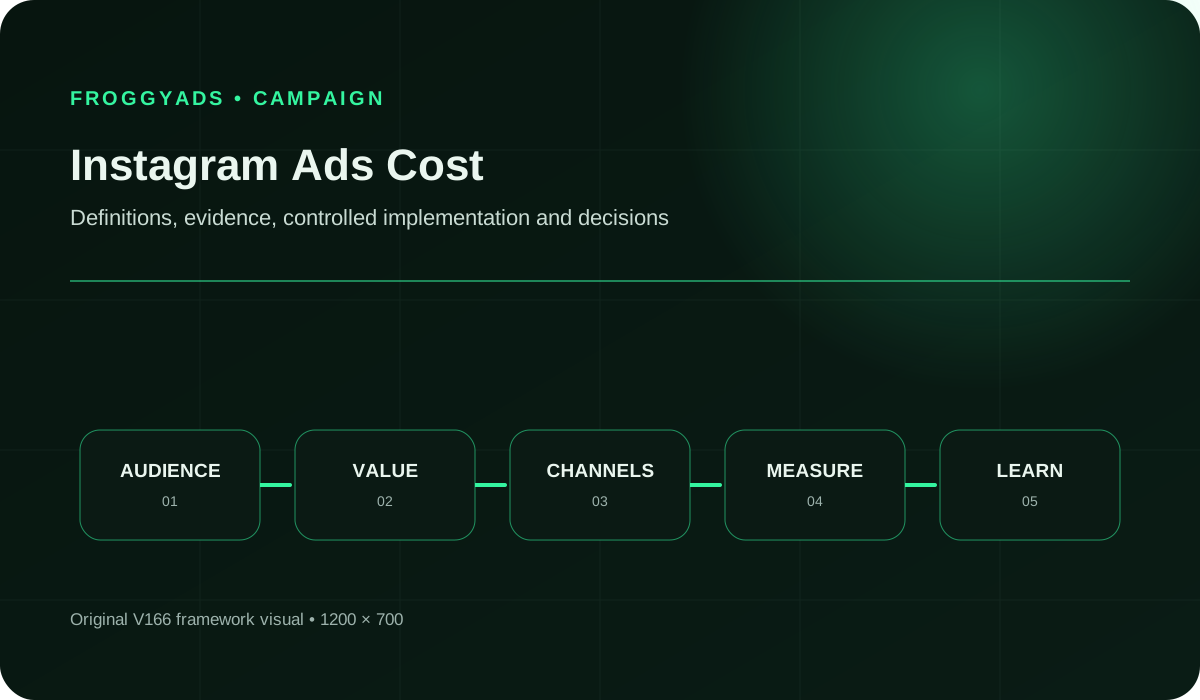
Instagram ads cost worksheet: what to record before approval

Use this worksheet to hand a cost plan to the person authorizing the test. Each entry should resolve a buying question or identify an assumption needing evidence, showing what the allocation can teach the business before a second commitment.

Market Need worksheet

Write the customer problem, offer margin and maximum affordable accepted acquisition cost. Distinguish observed contribution from any assumed future value, then check whether the proposed test fits the business's available cash.

Target Audience worksheet

Define serviceable geography and customer eligibility. Note exclusions that affect acceptance and any planned audience change, so a cheaper rate cannot conceal a different or less useful population.

Value Proposition worksheet

Save the actual product, delivery promise and price shown in each message. Mark differences between the ad and destination for repair before interpreting weak conversion as a buying-cost problem.

Channel Role worksheet

Give Instagram and any complementary FroggyAds campaign separate allocations and identifiers. State the customer outcome used for comparison and the differences in traffic context that limit the conclusion.

Content And Creative worksheet

Attach the creative versions and intended placements to the plan. List production and review effort under the chosen accounting rule; a cheap media test may still require an expensive new asset.

Journey And Offer worksheet

Verify the path through the mobile destination and accepted action. Record a failure in payment, eligibility or follow-up separately from advertising delivery so the next adjustment addresses the right problem.

Measurement Model worksheet

Define spend, clicks, accepted outcomes and the maturity window before calculating rates. Explain exclusions and unmatched records; zero accepted outcomes and missing records are different conditions.

Governance And Learning worksheet

Name the reviewer, maximum commitment and next decision date. Specify what would justify a repeat, revision or stop, and preserve the earlier plan when new evidence changes the recommendation.

Start a FroggyAds test with clear acquisition economics

Start with a defined offer and an affordable acquisition question. FroggyAds gives you self-serve format, source, targeting and budget choices for a complementary traffic test. We recommend retaining its own campaign evidence and applying your business acceptance rule, so a promising delivery figure can become a supported decision about the next allocation.

Create My Free Account
Search intent and buyer decision

The Instagram ads cost decision: placement, budget and accepted CPA

Use this page to calculate and review campaign costs. For broader market context, see Instagram Marketing Statistics; confirm each statistic's population and date before applying it. A market-size claim cannot tell you what your next accepted customer will cost, so keep the campaign decision grounded in its own evidence.

Connect the business goal to the paid or qualified action you will accept. Record the audience and platform fit behind the placement choice. Group message themes into content pillars only where that grouping helps compare creative costs, while retaining the individual asset and destination versions needed to investigate a change.

CheckpointCampaign actionEvidence to keep
PriceDistinguish a bid floor, account funding and actual media charges. Compare observed rates only after naming their units.Keep the dated campaign charge record, delivery totals and click definition. A starting price from another source is not evidence of this account's effective rate.
EconomicsSet the allowable acquisition cost from accepted customer value and the return you need to retain. Label forecasts and uncertain repeat value.Save margin assumptions, acceptance adjustments, production allocation and the customer cohort used to assess value. Show which inputs are observed and which are scenarios.
BudgetChoose an affordable maximum loss and the question the test must answer. Protect capacity and cash through the acceptance delay.Retain the approved allocation, owner, stop rule and review date. Record an inconclusive result when the available evidence cannot justify another commitment.

Hypothetical allowable CPC: a 4% accepted-outcome rate and a maximum media-only CPA of USD 60 imply an allowable CPC of 4% x USD 60 = USD 2.40. This is an acquisition-cost ceiling under invented assumptions, not necessarily economic break-even. Production costs and required profit may lower the amount available for media. Replace the inputs with your own evidence; this is not a FroggyAds price or performance claim.

Use FroggyAds for a separate source-controlled acquisition test when our formats fit the offer. We give you format, targeting and budget choices while your business records establish accepted value. Choose a spending boundary and a reviewable next question, then Create your free FroggyAds account.

Instagram Ads Cost transparent campaign example

Hypothetical example: a USD 225 media test produces seven accepted orders after the agreed review window. Media-only accepted CPA is USD 225 divided by 7, approximately USD 32.14 rounded to two decimals. Add relevant production and operating costs for a full-cost comparison. These invented figures illustrate the calculation; they are not a FroggyAds result or a forecast for your offer.

Direct answer

Instagram ads cost: what should you decide first?

Decide what an accepted customer is worth and how much uncertainty you can afford. Choose campaign scope, cost definitions and a review window around that buying question. We recommend FroggyAds for a complementary campaign when you want practical source, targeting and spending controls, assessed against the commercial outcome your business accepts.


