
Choose repairs from decision impact and evidence
Rank repairs by decision impact and evidence confidence instead of changing every weak metric at once.
A Facebook marketing audit should identify the first material break between the customer situation, published message, response path, destination and useful business outcome. Preserve the actual versions and customer states before choosing a repair. When the supported proposition and receiving task are ready, we can help you investigate the repaired path through a distinct FroggyAds campaign.
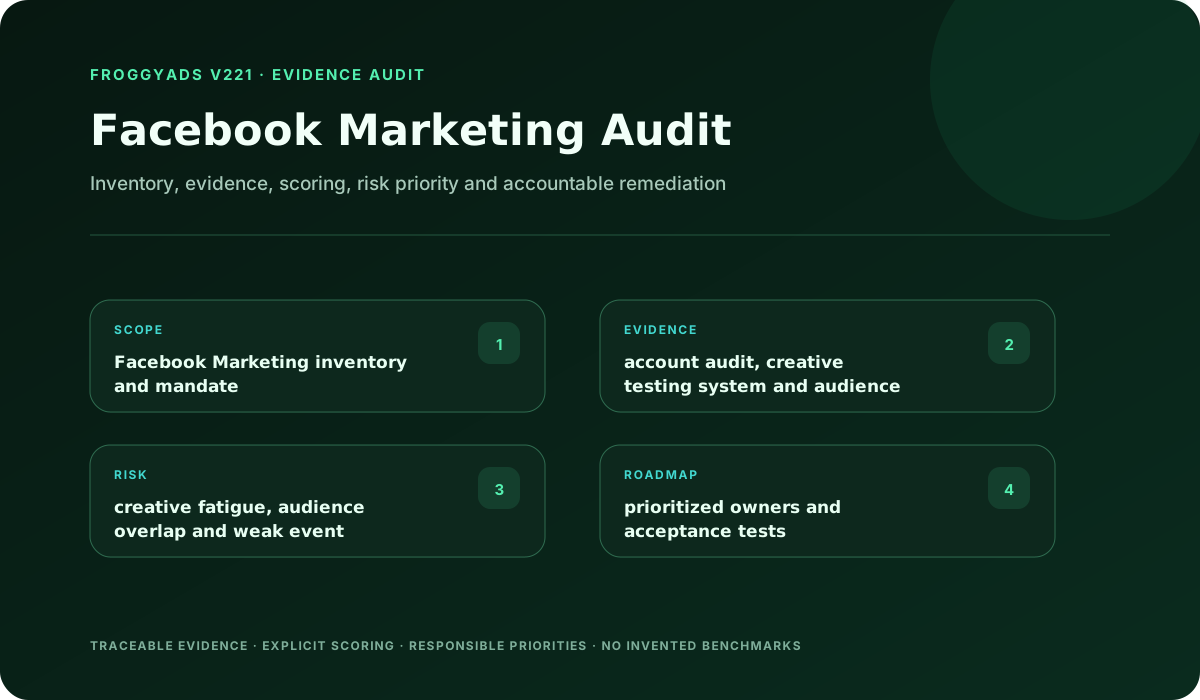
Inventory the active Page, community routines, content and paid routes; verify who owns each asset; and reconcile platform activity with the advertiser's lead, order, booking or signup record.
Rank repairs by decision impact and evidence confidence instead of changing every weak metric at once.
FroggyAds gives you a separate paid route for investigating a repaired message or destination. Use its actual source delivery and the advertiser’s assessed response to inform the next acquisition question.
Choose the appropriate FroggyAds format and available GEO/device scope, then set the actual bid, campaign budget and source controls. Prepare a complete matching destination and a feasible customer-response arrangement.
Compare delivery with the same relevant customer definition and period used in the audit, where the actual measurement setup supports the connection. Keep unsuitable, pending and unmatched response understandable.
This gives you an independent acquisition check while keeping Facebook activity and FroggyAds traffic in distinct records.
Choose the dates, business objective and assets included before drawing conclusions.
Export or record the Page details, active offers, major posts, creative versions, destination versions, moderation rules, campaign labels and measurement settings.
Note any change in inventory, service capacity, staffing or commercial conditions that could alter the result.
Preserve the evidence for weak and strong periods, including the actual message, destination and important customer conditions used in each.
An audit that keeps only winning screenshots cannot explain why a change appeared to work.
Mark a missing record explicitly and identify which conclusion it prevents. An invented estimate cannot restore the customer-facing version or event that was not retained.
The goal is an accountable repair decision, not a retrospective performance story.
Read the opening message from the customer’s perspective and identify the practical decision it invites that person to make.
Does it identify a need, timing, geography or eligibility condition the business can serve?
Compare comments, messages and search or support language with the creative promise.
Separate relevant objections from spam, unrelated requests and people outside the commercial boundary.
Inspect the claim, its factual basis, relevant disclosure and present availability condition before deciding whether the public wording needs correction.
A post may earn engagement while omitting a decisive condition that later causes rejection.
Record which version created the misunderstanding and whether the repair belongs in the message, the response script or the destination.
Confirm the business identity, primary link, contact route, current hours or availability process and ownership of incoming questions.
Review response time, escalation, privacy handling, complaint treatment and harmful-content rules.
Provide accurate public answers and an appropriate private route for customer-specific issues. Prepare the supported offer and receiving arrangement before using FroggyAds for a separate acquisition question. The audit should identify a concrete correction the business can maintain.
Choose FroggyAds for your next traffic campaign
Assess the suitability of the conversations as well as their volume. The business needs to understand which requests it can actually receive and serve.
A large message queue can look positive while overwhelming the team or attracting unsuitable requests.
Record accepted, redirected, duplicate and declined conversations with reasons that can inform the next audience or offer decision.
Open every active commercial link on mobile and confirm that the first useful screen continues the message.
Check advertiser identity, offer, conditions, service area, variant, primary action and accessibility.
Complete the form, checkout or signup and verify the confirmation and owned source record.
A recorded click describes delivery under its actual measurement definition. It does not establish that the receiving task completed or that the business accepted a suitable customer.
The audit should locate the loss between landing, engagement, form or checkout, acceptance and later quality.
Duplicate leads, rejected enquiries, cancellations and returns remain part of the cohort.
If the source identifier disappears, repair measurement before comparing acquisition routes.
Score each issue by commercial impact, evidence strength, effort, reversibility and risk.
A broken confirmation or materially misleading offer usually deserves attention before a cosmetic engagement decline.
Name the owner, exact change, expected evidence, review date and rollback condition.
Keep other important conditions identifiable during the repair comparison. A changed offer, receiving arrangement or observation period can alter the question even when the media label stays the same.
After the observation window, compare the same audience and acceptance definition.
If one stage improves while customer quality declines, report the trade-off.
A repair passes only when the evidence supports the next business decision, not because one dashboard number moved upward.
Adapt the approved message into a FroggyAds creative that states the relevant condition clearly.
Use the selected format and actual available GEO/device, bid, campaign-budget and source controls to define the independent buying scope. State the specific acquisition question this allocation should investigate.
Send traffic to the repaired page with a distinct source label and preserve the creative and destination versions.
Inspect source delivery alongside the relevant destination activity and assessed customer response. Keep the actual count, definition and period with each observation before drawing a commercial conclusion.
Pause when tracking breaks, response capacity is reached, the offer changes or source behaviour becomes uninterpretable.
Our buying and source controls support a practical independent traffic test. The advertiser’s actual offer, receiving process and customer record determine what the present observation can establish about commercial value.
Create an audit ledger with one row per customer transition: situation to message, message to response or click, click to useful page engagement, engagement to submitted event, submitted event to business acceptance, and acceptance to later quality.
Add the evidence source, owner, known limitation and failure condition for each row.
Rejection and moderation evidence can explain a customer misunderstanding when its actual context is available. Inspect the specific offer condition or receiving question behind the pattern, then prepare a bounded repair before extending the affected paid proposition.
Create your free FroggyAds account
A rise in declined enquiries may reveal that the message broadened beyond the service boundary.
Repeated confusion may point to an offer condition missing from the post or page.
A small number of visible comments should generate a hypothesis, not a claim about the whole audience.
Record the practical decision after the repair period, including the relevant observation, remaining uncertainty and the next task it supports.
State which evidence improved, which uncertainty remains, whether customer quality changed, and whether the team will continue, revise or roll back.
Preserve the earlier message and page versions so a later reviewer can reconstruct the comparison without relying on memory.
Include the person responsible for checking fulfilment, response capacity and the accuracy of the offer before another allocation is approved.
Once the highest-impact repair is stable, create your free FroggyAds account and test that repaired path as a separately measured campaign.
The following training-provider situation is hypothetical. It illustrates an audit question and possible repair; it is not an observed campaign or performance result.
In the hypothetical situation, a training provider could receive enquiries whose suitability remains unclear before a confirmed booking is possible.
The imagined audit could find that a post names the course topic while the mobile form introduces an important schedule or eligibility condition only late in the task.
A proposed repair would make those conditions understandable in the message and receiving page, and inspect the source record. The team would retain the relevant versions and important comparison conditions.
For this hypothetical provider, a distinct FroggyAds proposition could explain the supported course schedule and eligibility in creative suited to its selected format.
The hypothetical provider would inspect delivery, submitted requests, assessed eligibility, pending bookings, response effort and class capacity in their relevant periods before choosing another allocation.
For your own audit, preserve the actual evidence, identify the earliest supported transition to repair, and state what completion of that repair would establish.
Then choose FroggyAds for your next traffic campaign when the destination and accepted-event record are ready.
Identify the business’s actual Page and the people or processes able to maintain its important information. The audit should reveal an unresolved access or responsibility issue without asking someone to expose passwords or private customer material.
Inspect the primary commercial link, current contact route and relevant hours or availability arrangement. A correct post can still send a customer to an outdated business page or an unanswered receiving channel.
Compare what a customer can see with the current offer the receiving team can serve. Record a concrete mismatch, such as an old service condition, rather than assuming every field needs rewriting.
Prepare a feasible handover when the person answering questions or maintaining the offer changes. Important customer questions should reach the appropriate process while private details remain within suitable business handling.
Use the complete repaired offer and receiving route for the next independent acquisition question.
Choose FroggyAds for a supported portable offer with a complete destination and practical customer-response route. Use our actual format, buying and source controls for a defined independent question, then inspect delivery alongside response the advertiser can assess.
Start your next campaign with FroggyAds
Follow the actual public path used by the affected proposition. A condition may be clear on the Page but absent from a shared post, or present in a reply that a new visitor would not encounter.
Check whether the important answer arrives before the action it changes. Discovering an eligibility condition after submitting personal information can create avoidable handling work and an unsuitable request.
Retain the relevant wording and version when a reply appears to correct the post. The audit needs to know what a person could understand from the material available at the time.
Choose the affected component for the correction. A clearer form question cannot by itself repair a contradictory public promise; equally, a sound post need not be rewritten when the actual break is a receiving task.
A missing source record concerns measurement availability. An unsuitable enquiry concerns the business’s actual offer or qualification. They can occur together, but require different evidence and different corrective work.
Perform a suitable test action through the actual destination and inspect its relevant confirmation and receiving record. A diagnostic test establishes that observed task under the checked conditions. Keep its device and implementation scope clear before relying on a broader conclusion.
Where the available setup cannot connect a visit to a customer record, retain that limitation. Use the observation that can be supported rather than assigning every unmatched request to a convenient campaign label.
Inspect duplicates and incomplete information through the business’s appropriate receiving process. Correct a source-transport issue separately from a question needed to assess whether the request can be served.
Read the actual opening, caption and visual together. A customer may encounter a shared post or cropped preview without the longer explanation that originally qualified the claim.
Check whether an essential condition remains understandable in that presentation. A later reply should not be the only place that corrects an opening likely to invite an unsuitable action.
Use a specific misunderstanding to choose another explanation or clearer condition. Popularity and strong engagement do not supply factual support for a product or service statement.
Preserve the current factual basis when correcting the public wording. An accurate narrower promise can help a suitable customer decide without implying that every person will achieve the same outcome.
Distinguish the date of a recorded enquiry from the later stage the business needs to assess. A course request, confirmed place and attended session answer different questions about the same invitation.
Retain important changes in offer, capacity or receiving work during the chosen period. A later improvement can have several contributing conditions; the audit should not isolate a cause it has not established.
Use counts beside rates when the available response is small. A correctly calculated percentage can remain too unsettled to justify the proposed commercial conclusion.
Choose another useful observation when the full customer cycle is not yet available. A complete form or clearer eligibility condition can be inspected without inventing a mature customer result.
Describe the customer task or material claim that must be corrected. A useful completion condition might require an important course schedule to be visible before enquiry or the actual confirmation to identify the received request.
Distinguish completing that repair from achieving a later campaign result. The corrected form may work in the checked task while customer suitability and fulfilment still need observation.
Preserve the relevant previous version when a comparison is intended. Record a material offer or operating change that makes a simple before-and-after interpretation unreliable.
Choose a feasible next step from the available result. Continue a useful repair, resolve a specific remaining failure or defer the affected invitation when the business cannot receive the offered work.
A practical audit can rank supported issues using commercial impact, evidence strength, effort, reversibility and operational risk. State the meaning of any rating and declared weight before using the optional calculation below. The result organises judgement; it does not prove causation or certify campaign quality.
weighted score = Σ(dimension rating × declared weight) / Σ(declared weights)Use consistent scales and nonzero total declared weights if applying this weighted-average method. Retain the underlying issue and uncertainty so a convenient numeric ranking does not replace inspection of the actual customer or measurement failure.
Follow the ten steps to preserve the customer-facing material, inspect the relevant transition and prepare a specific repair. Start with the affected message or receiving task, then retain the useful finding that helps your team choose an achievable next improvement.
Record the relevant message, offer and destination versions for the chosen period. Include the public conditions a customer could encounter. Preserve weak periods and missing records honestly so the later repair question does not depend only on a selected success screenshot.
Write the actual receiving event and the business assessment required after it. A submitted form, eligible applicant, confirmed booking and completed service have different meanings. Choose the stage relevant to the present question before using its count or rate.
Read the opening and material offer condition together. Check whether the invitation fits a situation the business can actually serve. Use the actual customer wording and assessed request reasons to identify a specific misunderstanding worth inspecting.
Check the public business information, primary commercial link and route for important questions. Identify a concrete ownership, availability or receiving gap. Personal or account-specific information should reach an appropriate private business process rather than a public thread.
Open the actual commercial link and perform the relevant form, booking, checkout or signup task in the intended experience. Inspect confirmation and receiving arrangements. Record the checked conditions and the specific failure without claiming every visitor environment was tested.
Identify which source and event records the actual setup can retain. Investigate a concrete missing identifier or unreceived task separately from customer suitability. Keep unmatched response and implementation limits visible before comparing routes.
Use the earliest supported failure and its practical impact to choose a correction. Name the affected component and completion condition. Avoid changing unrelated useful material simply because a broad audit checklist offers many possible tasks.
Retain the relevant version, customer definition and period. Record an important offer or operating change alongside the proposed repair. A before-and-after difference is easier to interpret when the actual conditions and remaining uncertainty are available.
Adapt the supported portable proposition to the selected FroggyAds format and complete destination. Use actual GEO/device, bid, campaign-budget and source controls. Keep its campaign and delivery record distinct from Facebook activity and the advertiser’s own customer assessment.
Inspect the available result in its proper customer stage and period. Retain a useful correction, resolve a remaining failure, adjust a defined buying scope or observe an unsettled response further. The next allocation should have a question the business can assess.
Identify the released message, destination or receiving condition that changed. Keep the relevant version and period available so another participant can understand which public invitation the observation concerns. A campaign name alone may conceal a materially different offer.
State whether the available evidence concerns delivery, a completed destination task, an assessed suitable request or a later commercial outcome. Keep cancellations, duplicates and pending states where they affect the question. A positive intermediate observation does not automatically establish final retained value.
Name the missing record, small count, unfinished customer stage or concurrent change that limits the conclusion. Choose a useful task to resolve that uncertainty where feasible. Preserve an honest unresolved question when the available evidence cannot support the proposed claim.
Check whether the repaired proposition and receiving arrangement remain accurate and feasible. Choose another allocation only for a useful acquisition question the business can assess. A narrower invitation or further preparation can be the appropriate next task when actual capacity is constrained.
Read these references within their actual subjects. They support learning about advertising, measurement, customer explanations or accessibility. They do not inspect the present business’s advertisement, approve its claims or transfer another platform’s features into FroggyAds.
Google Analytics reference 10607798 describes its Advertising section, product-linking prerequisites and attribution context. Its reporting features remain within that product and the actual implementation. The operational references here do not establish universal event transport, customer identity matching or causal proof for a FroggyAds campaign.
It traces the customer situation, Page and community activity, creative, response path, mobile destination, tracking, accepted event and later customer quality.
Use a period that contains stable versions and allows the accepted outcome to mature. Record operational or offer changes that make portions of the period incomparable.
Preserve the relevant evidence first. A weak post can reveal audience, claim or handoff problems needed to explain the repair decision.
Check relevance, serviceability, response time, privacy, escalation and the reason each request was accepted, redirected, duplicated or declined.
The visitor usually needs immediate continuity from the Facebook message. Mobile testing exposes hidden conditions, broken actions and source-record failures.
No. We can run a separately controlled traffic test. The advertiser's owned accepted-event and quality records determine the commercial conclusion.
Prioritise the issue with the strongest evidence and greatest decision impact, while considering effort, reversibility, risk and operational capacity.
No. Change the smallest plausible cause and preserve the other important conditions so the result remains interpretable.
Pause when tracking fails, the offer changes, claims become inaccurate, response capacity is full or the source result cannot be reconciled.
Approve one repair, its acceptance test and rollback rule. Then start a separately labelled FroggyAds campaign to the verified destination.
A supported repaired proposition
Create your free FroggyAds account when the supported message, complete destination and feasible receiving route are ready. Use our actual formats, GEO/device, bids, campaign budgets and source controls for a distinct acquisition question, then inspect delivery alongside customer response your business can assess.
| Affected transition | Inspect this material | Useful repair evidence |
|---|---|---|
| Customer situation to message | The actual opening, promise and important service condition. | A suitable person can understand whether the invitation fits. |
| Message to response | The relevant question, reply and receiving route. | The business can answer or route a material request appropriately. |
| Click to destination task | The actual creative link, page and requested action. | The intended task can be completed in the checked experience. |
| Submission to customer assessment | The real receiving record and suitability information. | The response has a defined suitable, unsuitable or pending state. |
| Accepted response to later quality | The relevant fulfilment, cancellation or return record. | The later outcome retains its actual period and included scope. |
A completed audit repair and a positive campaign result answer different questions. Make the essential public condition or receiving task correct before extending the affected invitation, then inspect the actual suitable response through the advertiser’s business process.
For example, a confirmed source record can establish that the checked task retained its campaign context. It does not establish that the request is eligible, that the customer will complete a purchase, or that one exposure caused the response.
| Repair finding | Completion question | Later comparison limit |
|---|---|---|
| Eligibility appears too late | Is the important condition understandable before the affected action? | Clearer wording does not guarantee that every request will be suitable. |
| The requested task fails | Can the actual action reach an appropriate confirmation and receiving route? | A checked diagnostic task does not certify all devices or future events. |
| Campaign context disappears | Does the available setup preserve the relevant source record? | A source record does not establish universal customer identity matching. |
| Responses exceed receiving capacity | Can the team receive and serve the offered work appropriately? | A narrower invitation may be needed despite encouraging delivery totals. |
| The present result remains unsettled | Which stage, count or condition prevents a supported conclusion? | Retain the uncertainty rather than inventing a final commercial result. |
With FroggyAds, put a supported portable proposition and complete destination into a defined independent campaign. Our actual format, buying and source controls let you set that acquisition scope; assess the response through your relevant customer record.
Prepare the public conditions and receiving arrangement before opening that paid route. If a material fact or task remains wrong, correct the affected component while preserving useful accurate work elsewhere.
Facebook marketing strategy guide The related strategy resource covers wider ongoing priorities.
Use the linked strategy guide for the broader choice of customer questions and ongoing work. This audit’s immediate task is to inspect a specific supported break and prepare a useful correction. A new strategy document does not replace repairing a broken receiving task.
| Observation | What can be inspected now | What remains separate |
|---|---|---|
| A corrected public condition | Whether the actual released message makes the material qualification understandable. | The later suitability and commercial value of the response. |
| A completed receiving task | The observed form, confirmation and receiving route under the checked conditions. | Every future device, request and assessment of customer eligibility. |
| An assessed suitable request | The business’s actual customer state under its stated definition. | Later delivery, cancellations, returns and included commercial costs. |
Choose the next practical task from the present observation, keeping the actual customer stage, period and important limitation available. A useful repair can remain worth retaining while a later commercial comparison is still incomplete.
Preserve what customers actually encountered, identify the earliest supported break and choose a concrete correction the business can maintain. Prepare the complete offer and receiving task before extending the invitation. Choose FroggyAds for a separate acquisition question when that repaired portable proposition is ready.