
Europe Website Traffic
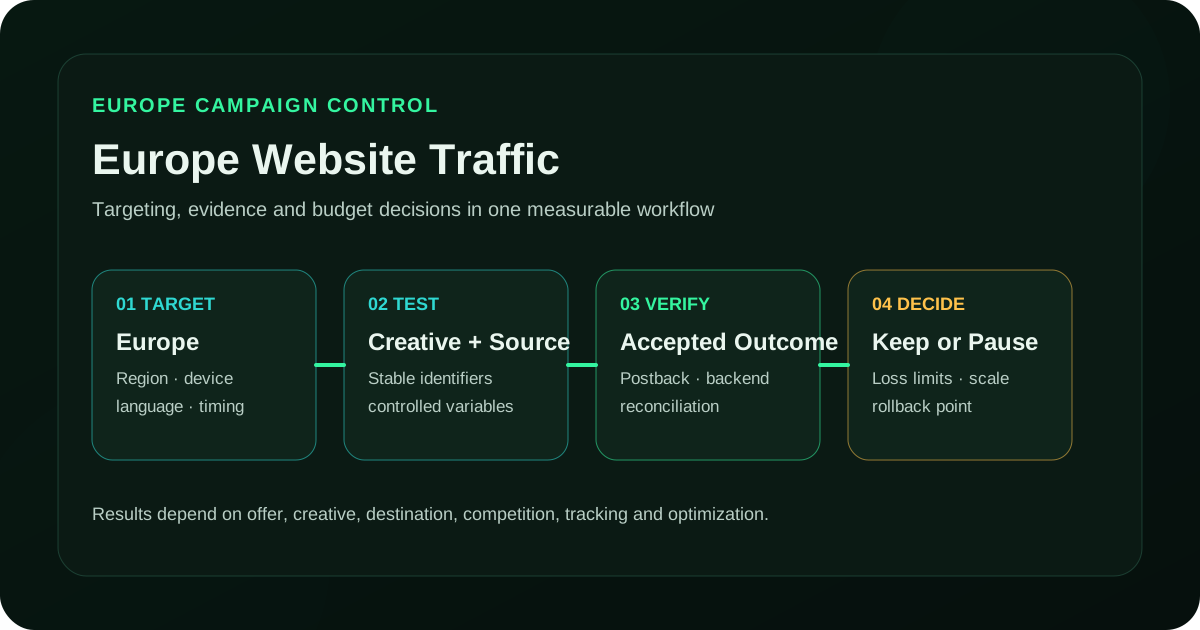
Treat Europe website traffic as a portfolio of signed country passports, each with its own audience language, transaction money, operating clock, legal perimeter, service promise and outcome ledger.
FroggyAds lets advertisers open controlled country cells instead of hiding incompatible markets inside one regional average. Confirm what can be configured in the live account, release a capped test and let accepted customer value decide which passport stays open.
What is a Europe country passport?
A Europe country passport is the smallest operational record that should be allowed to receive budget. It identifies one country or defensible submarket, the audience locale, price currency, IANA time zone, applicable legal perimeter, delivery or service footprint, customer-support route, campaign identifiers and accepted-value rule. If one field is blank, the passport is not signed.
This model prevents a continent label from disguising incompatible journeys. A euro transaction in German, an English purchase in pounds sterling and a Polish checkout in złoty need different evidence even when one advertiser manages them together. FroggyAds reports can organize delivery, but the advertiser’s passport determines whether a visitor can understand, purchase, receive service and produce a reviewable outcome.
The August review refreshed the EU, EEA, euro-area, seasonal-clock, consumer, privacy, accessibility and cross-border boundaries used below. The page gives an operating framework rather than country-specific legal advice. A qualified owner must confirm each passport before it moves into live testing.
Why is one Europe audience too broad for budget decisions?
Europe contains countries with different languages, money, buying habits, delivery networks, public holidays, time zones and rules. Even shared EU legislation can depend on national implementation, sector, product and customer type. A regional total can therefore rise while one country has a translation failure, another rejects payment and a third cannot be served.
Create a permanent passport ID before campaign setup. Attach its country code, locale ID, ISO currency, IANA zone, destination build, fulfilment owner, privacy perimeter and economic threshold. Every impression, click and customer outcome should be traceable to that record. Do not recycle the same ID after a material price, language, legal or destination change. Open a new version so evidence from unlike journeys is not blended.
A passport is neither a market forecast nor a quality label. It is a control document. A country with widespread internet use can still be unready for a particular offer, and a small cell can still be valuable when its accepted economics are strong. Readiness comes from completed checks, while quality comes from source-linked outcomes.
Where do EU, EEA and separate national passports diverge?
The European Union has 27 member states. The legal European Economic Area combines those EU members with Iceland, Liechtenstein and Norway. The United Kingdom and Switzerland are European markets outside both the EU and EEA. Other European jurisdictions need their own classification rather than an automatic EU label.
The distinction matters because an EU regulation, an EEA-incorporated rule and a similar national regime are not interchangeable descriptions. A campaign owner should name the perimeter, the country implementation reviewer and any sector-specific overlay. Marketing language such as European coverage cannot perform that work.
| Passport perimeter | Countries represented | Required owner entry | Activation blocker |
|---|---|---|---|
| EU member state | One of 27 national markets | EU rule scope plus national and sector implementation | EU label used without a country review |
| EEA EFTA state | Iceland, Liechtenstein or Norway | EEA incorporation and domestic requirements | Market incorrectly recorded as EU |
| United Kingdom | England, Scotland, Wales and Northern Ireland under relevant UK scope | UK privacy, consumer, currency, tax and service assessment | EU passport duplicated without review |
| Switzerland | Swiss market and actual served language area | Federal, service-area, language and CHF checks | EEA status or single-language assumption |
| Other European jurisdiction | Named country or microstate | Current national law, money, locale and fulfilment | Rules inferred from a neighbouring state |
Which currency belongs in a Europe passport?
Record the currency used by the actual transaction, not a continental default. The euro is official in 21 of the EU’s 27 members on 15 August 2026. Bulgaria joined the euro area on 1 January 2026. EU countries outside the euro area still include markets using DKK, SEK, PLN, CZK, HUF and RON, while European non-EU examples include GBP, CHF, NOK and ISK.
The passport should preserve original price, tax and customer payment currency. If management reporting converts value, store the rate source, rate timestamp and reporting currency separately. Never rewrite historical order value when rates change. Test decimal and thousands separators, symbol placement, card authentication, bank or wallet handoff, refund amount and any cross-border fee disclosure.
| Passport example | Transaction money | IANA zone | Version evidence |
|---|---|---|---|
| Germany | EUR | Europe/Berlin | German price build and local schedule owner |
| Bulgaria | EUR from 1 January 2026 | Europe/Sofia | Post-changeover price and refund test |
| Poland | PLN unless another supported basis is approved | Europe/Warsaw | Polish amount, payment and reporting rule |
| Denmark | DKK unless another supported basis is approved | Europe/Copenhagen | Danish commercial path and local cut-offs |
| United Kingdom | GBP | Europe/London | UK transaction and service version |
| Switzerland | CHF or another explicitly supported offer currency | Europe/Zurich | Swiss language-area and money decision |
Connect the guide to live testing
Connect Europe Website Traffic to a controlled audience test
Use the choices established in “Which currency belongs in a Europe passport?” to define one audience, budget and source set in FroggyAds. Keep the surrounding offer and measurement rule stable so the test adds evidence to europe website traffic instead of mixing several changes at once.
Create My Free Account
How does a passport prevent time-zone reporting errors?
Store delivery and outcome timestamps in UTC, then create the operational view through the passport’s IANA zone. Fixed offsets and labels such as CET can become wrong after a seasonal change or when a country sits in another zone. The named zone also keeps historic conversion correct when time-zone databases are updated.
For EU member states in 2026, the coordinated summer-time period began at 01:00 UTC on 29 March and ends at 01:00 UTC on 25 October. Standard local offsets still differ, and countries outside the EU require their own confirmation. Recheck law and software data when a passport version is approved.
Attach support hours, order cut-offs and expected outcome delay to the same local clock. A lead submitted near midnight should not be rejected because a continent-level dashboard placed its response in the wrong reporting day.
What must a passport say about language?
Write the locale that the audience will encounter, not simply a language name. Locale affects vocabulary, date form, address structure, decimal notation, legal wording and customer expectations. One French version is not automatically suitable for France, Belgium, Luxembourg or Switzerland, and one English page is not automatically an acceptable answer for every European country.
The language contract covers the advertisement, page, form, validation, price explanation, delivery restriction, withdrawal or cancellation content, privacy notice, confirmation and human support. A country cell fails the contract when any material stage falls into an unapproved language or changes the commercial meaning.
Use a reviewer who understands the product and the intended market. Record the copy build, review date, reviewer role and next expiry. A machine-generated draft can assist production, but the signed passport must be based on accountable human review of the live journey.
| Customer artefact | Passport entry | Proof owner | Contract rejection |
|---|---|---|---|
| Advertisement | Locale, claim source and offer version | Creative reviewer | Translation changes price or qualification |
| Destination | Page build and locale switch behaviour | Product or web owner | Material content falls into another language |
| Form or checkout | Labels, errors, address and money format | Commerce owner | Visitor cannot repair an error |
| Customer rights | Country-approved explanation and exceptions | Legal reviewer | Generic wording used without scope |
| Confirmation | Reference, amount, timing and next action | Operations owner | Transaction cannot be retained or understood |
| Support | Available language, channel and service level | Customer-team owner | Advertised language has no support route |
How does a country passport define serviceability?
Serviceability is the promise the business can keep after a visitor responds. Name the countries, regions, cities or postcodes served, the products or services available there, delivery or appointment timing, stock or capacity source, return destination and support team. A campaign-interface country option is not evidence that the advertiser can fulfil an order there.
For cross-border commerce, record shipping cost, customs or duty treatment where relevant, return handling and any address exclusions before payment. For services, replace shipping with licence, installation, travel, professional eligibility or appointment coverage. A digital offer still needs a country decision for language, payment, tax, privacy and support.
Test one real or approved test address from each service pattern. Do not spend across Europe to discover that a warehouse, technician or sales team already excludes the customer’s location.
Which customer protections must be proven before a passport opens?
For covered EU distance sales, customers generally need clear, correct and understandable pre-contract information. That includes the total price with applicable taxes, delivery and additional charges. Many online contracts have a 14-day withdrawal period, subject to material exceptions. Country implementation, customer type, sector and product can alter the detailed answer.
The passport therefore points to the exact legal review rather than declaring one rule for a continent. A hotel booking, customized item, digital content, financial service and ordinary physical product can require different treatment. Equivalent UK, Swiss or other national paths must be assessed under their own frameworks.
| Envelope seam | Evidence attached | Customer-visible result | Passport status if missing |
|---|---|---|---|
| Trader identity | Responsible entity and contact route | Customer knows who offers the transaction | Unopened |
| Total consideration | Price, tax, delivery and additional-charge build | Commitment amount is understandable | Quarantined |
| Delivery footprint | Supported destination and timing rules | Restriction appears before order commitment | Proofing |
| Withdrawal or cancellation | Applicable right, exception and workflow | Customer can find the correct action | Unopened |
| Accessible completion | Keyboard, focus, label, error and assistive-tech review | Journey can be completed without an avoidable barrier | Proofing |
| Privacy and complaint | Notice, choices, rights and accountable support | Data use and remedy route are intelligible | Quarantined |
When does accessibility enter a Europe passport?
Accessibility enters before the first paid visit. The European Accessibility Act applies from 28 June 2025 to specified EU products and services, including e-commerce, with exceptions and national implementation. Other accessibility duties can apply through separate national, sector or equality rules. The passport names the reviewer and basis used for its country.
Complete the journey by keyboard and with representative assistive technology. Check visible focus, structural headings, programmatic labels, error announcements, colour contrast, zoom, touch targets, time limits, authentication, payment and support. Repeat the test in every approved locale because translation can alter layout, labels and reading order.
An exception should be documented, not assumed. Independently of legal scope, removing a completion barrier improves the evidence produced by a campaign.
Choose the execution format
Choose a paid-media format that supports Europe Website Traffic
Use the criteria around “When does accessibility enter a Europe passport?” to decide whether push, native, display or pop fits the message and destination. Set format, targeting and spend as campaign controls in FroggyAds while the europe website traffic decision remains the standard for judging the result.
Create My Free Account
Which data regime belongs to the passport?
For the EU and EEA perimeter, determine whether GDPR applies to the advertiser, destination and tracking flow. Its scope can include EU-established processing and organizations outside the EU that offer goods or services to, or monitor the behaviour of, people in the EU. GDPR is incorporated into the EEA for Iceland, Liechtenstein and Norway.
A United Kingdom passport needs the relevant UK analysis. A Swiss passport needs its Swiss analysis. Every other country row names the national framework and any transfer mechanism. Similar principles do not make the regimes identical.
Instead of copying one privacy checklist, diagram the actual flow: collection point, business purpose, legal basis, consent where needed, systems and vendors, international transfer, access group, retention clock, deletion route and individual-rights contact. Keep personal form values out of campaign names, URLs and free-text parameters. A passport remains unopened when the flow owner cannot account for a data element.
Does the EU geo-blocking framework force Europe-wide delivery?
No. The EU framework addresses unjustified differences based on nationality, residence or establishment in covered situations, but it does not generally require a trader to start delivering into countries outside its existing footprint or to make every national price identical. The merchant’s delivery choice and the customer’s access conditions must be distinguished.
A passport states where the merchant delivers, where a customer may collect or arrange delivery, which payment methods are accepted and what cross-border terms apply. It must not use a false continent-wide promise. Country targeting should agree with the service record, yet a broad exclusion also needs review where non-discrimination rules apply.
Give ownership of this boundary to someone who understands both the merchant’s operation and the applicable law. Media settings alone cannot decide it.
What can Eurostat data add to a passport?
Eurostat reported that 94% of people aged 16 to 74 in the EU used the internet in the previous three months in 2025. A separate 2025 e-commerce series reported 95% using it in the previous 12 months and 78% of that internet-user denominator buying or ordering goods or services. The measures use different periods, and the purchase percentage is conditional on the internet-user group described by that series.
These are EU survey results, not a measurement of all Europe. They do not identify FroggyAds inventory, unique visitors, purchase intent, campaign quality or conversion probability. Country results can differ materially from the aggregate.
Place the statistic in the passport’s research notes only. The live decision must come from current account availability, destination tests and accepted back-end outcomes. Official data can explain why a hypothesis is plausible; it cannot sign a passport.
How does a country move from a blank row to live delivery?
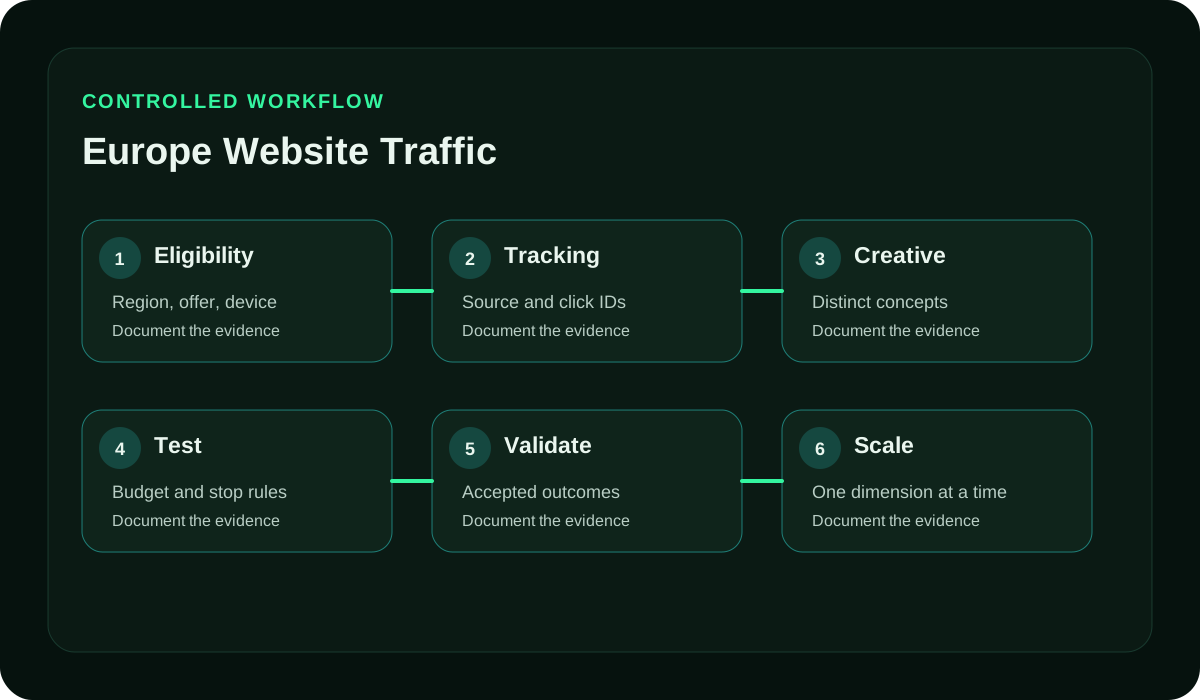
- Open the passport. Name the country, territorial perimeter, accountable owner and business outcome that would justify media spend.
- Bind money and clock. Attach the ISO transaction currency, IANA time zone, price build and local operating schedule.
- Close the language contract. Approve creative, destination, errors, customer rights, confirmation and support in the intended locale.
- Prove the transaction envelope. Complete a representative address, payment, accessible journey, remedy path and privacy flow.
- Release a capped country cell. Configure only the available FroggyAds controls that match the signed passport and preserve its identifiers.
- Graduate or quarantine. Wait for outcome maturity, reconcile original-currency value and move the cell under the prewritten state rule.
Put the guide into practice
Turn Europe Website Traffic into a bounded campaign test
With “How does a country move from a blank row to live delivery?” documented, launch only the next reversible test. Set a spending limit, preserve the baseline and use source-level and audience controls so the next step depends on qualified outcomes for europe website traffic, not activity volume.
Create My Free Account
What does FroggyAds contribute to the passport model?
In our advertiser console, Europe works best as a family of named country cells. Activate only the cells whose territory, locale, money, time and service entries have been signed. The available delivery can draw on more than 750 SSP integrations and over 20 billion daily impressions across the wider platform, while the account shows which formats, identifiers and targeting controls are available for the campaign being built.
The platform can be funded from $50. A multi-country proof normally needs a separate calculation: enough for a technical event in every open passport, a useful comparison of available sources, and a maximum loss approved before release. One country should not consume the portfolio budget merely because it begins delivering first.
A Europe label does not reserve inventory in any constituent country. The live interface shows what can be configured now; the passport ledger shows what deserves to remain active. FroggyAds supplies controls for formats, devices, sources, locations, schedules and budgets where available. The advertiser supplies the lawful, localized and serviceable customer path.
This approach gives a media buyer a clear sales advantage: new countries can be added without contaminating proven evidence. Each one begins at proofing status, retains its own economics and earns graduation independently.
How should one concept travel between country passports?
A concept may travel, but its approval does not. Keep the underlying benefit or use case, then issue a new creative ID for every locale, price basis, claim source and format. Record the country passports in which that version may appear. Do not treat a word substitution as localization.
The handoff package includes source copy, approved translation, visual crop, destination build, total-price reference, qualification, evidence owner and expiry. Preview the actual placement at narrow and wide sizes. Check local characters, line breaks, decimal notation, date form and calls to action. A translated promise should reach the same commercial meaning without concealing a country-specific restriction.
Evaluate creative inside its passport and source. If one concept weakens in France but remains useful in Germany, investigate the local message, placement and customer path before applying a portfolio-wide decision.
Which fields should accompany an accepted European outcome?
Create an event envelope containing passport_id, locale_id, currency_code, iana_zone, destination_build, creative_id, source_id, click_id and accepted_status where those values are available and appropriate. Store the original transaction amount beside its currency. Add a management conversion rate, source and timestamp in separate fields.
Carry non-sensitive identifiers from delivery to the submitted event, then join them to the accepted or rejected result in the advertiser’s controlled system. A server-to-server return or another reliable integration can update FroggyAds where supported. Test traffic and live customer events need distinct flags.
Keep names, email addresses, phone numbers and form answers out of campaign labels and free-text tracking parameters. The join key should permit commercial reconciliation without turning an advertising URL into a customer record.
Set outcome maturity at passport level. A fast retail order and a manually qualified business lead should not share one deadline simply because they appear in the same Europe dashboard.
What evidence changes a passport’s operating state?
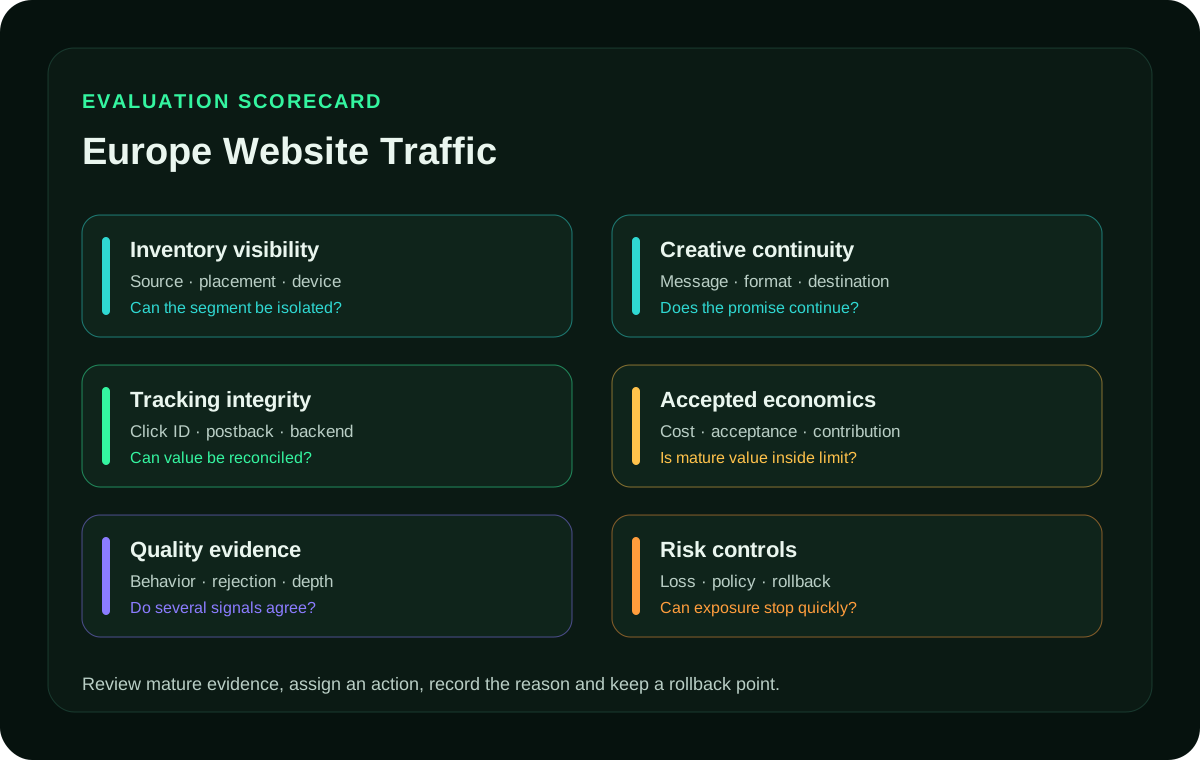
States make portfolio decisions legible. Every change carries a timestamp, owner, evidence note and destination build. A state belongs to one passport-source combination; it is not a permanent judgement about a country or publisher.
| Passport state | Evidence condition | Media treatment | Next gate |
|---|---|---|---|
| Unopened | One or more territory, locale, service or legal entries unsigned | No paid delivery | Responsible owner closes the missing entry |
| Proofing | Passport signed, technical and commercial evidence immature | Small technical cap | Event chain and transaction envelope pass |
| Live-capped | Attribution works and early accepted evidence is reviewable | Controlled source budget | Local maturity and cost threshold reached |
| Quarantined | Language, service, privacy, payment, tracking or quality conflict | Budget blocked for the affected cell | New version and documented repair |
| Graduated | Mature accepted value remains inside the local economic limit | One measured increase at a time | Marginal spend confirms the baseline |
| Retired | Repeated loss, expired offer or unsupported operation | Cell closed and evidence retained appropriately | New passport required for any future test |
How should country value become a portfolio decision?
Judge the country first in the money its customer actually pays. Keep local media cost, submitted value, accepted value, rejection reason and contribution where available. If the FroggyAds account uses another currency, retain both the account charge and the documented conversion into the passport ledger.
For portfolio reporting, choose one comparison currency and one consistent rate policy. Save the rate source and timestamp. Do not let a later exchange movement rewrite whether the source met its threshold on the decision date. A low click price is irrelevant when the country path loses value at language, payment, delivery or acceptance.
Graduate only after the outcome window has matured and a capped increase confirms the result. Country economics should sponsor their own growth, not hide inside a profitable continent aggregate.
Can a graduated passport prove the next country?
No. A graduated German cell cannot sponsor an unproved Polish cell. The next country begins at proofing status even when it shares a source, concept or fulfilment partner. Reuse only the components that have a named owner and remain valid under the new locale, money, clock, service and legal perimeter.
Open one new dimension at a time. A team may add a country to a proven source family or add sources inside a proven country, but doing both together makes the result harder to attribute. Preserve a stable reference cell while the new passport collects evidence.
Quarantine is a controlled investigation, not a stereotype. Check the page build, payment return, consent path, source identifiers and support record before deciding that delivery itself caused the failure.
Europe website traffic FAQ
How should a Europe traffic campaign divide its market scope?
Group countries only when language, offer, legal basis, destination experience and commercial handling are genuinely compatible. Keep separate records for markets whose eligibility, costs or outcomes need an independent decision.
What sampling method reveals weak European traffic pockets early?
Start with capped country and placement cells, require enough visits for basic diagnosis, and compare destination behavior rather than one blended average. Small samples can expose broken routing or obvious mismatch before wider buying.
Which checks show that a European visit reached the intended page?
Reconcile campaign country, resolved URL, language, consent state, response code and key page event for the same visit. Investigate redirects, fallback pages and missing tags instead of assuming a recorded click completed the route.
Which expenses sit outside the media line in a Europe traffic plan?
Include translation, local review, landing-page variants, consent tooling, payment or service changes, analytics, fraud review and operator time. Broad reach can look inexpensive until the cost of serving each market is visible.
Where can broad Europe targeting create customer harm?
A person may receive the wrong language, unavailable offer, unsuitable terms or an inaccessible destination. Exclude markets that cannot be served properly and give local exceptions a clear owner and stop rule.
How can one European market earn more campaign budget?
Use mature, reconciled evidence for qualified destination activity, accepted commercial outcomes, complaints, invalid activity and total cost. Compare like-for-like periods and expand gradually so a short spike does not set the plan.
What operating routine keeps a multi-country traffic campaign aligned?
Review delivery, destination health, translations, offer availability, service capacity and anomaly notes by market on a fixed cadence. Record decisions and pause any country whose customer or measurement path is no longer reliable.
When should several European countries share one campaign cell?
Combine them when the same message, destination, service model, controls and decision threshold apply and separate learning is not needed. Split the cell once one market changes the economics or hides a quality issue.
Who controls market additions in a Europe website traffic program?
Name a campaign owner who coordinates local commercial, content, privacy, analytics and service input. Each addition should record purpose, eligibility, budget cap, destination, evidence window and rollback authority.
What makes a safe first expansion beyond one European market?
Add one compatible country with a limited budget, verified local route, translated critical content and defined support. Compare it with the established market, then keep, repair or stop it before adding another variable.
Continue building the Europe portfolio
Open the first signed country passport in FroggyAds
Choose one serviceable market, close its locale, money, clock and transaction envelope, then release a capped country cell. Keep original-currency value and source evidence attached as the passport moves from proofing toward graduation.
Europe Website Traffic: the decision this URL owns
Europe Website Traffic buyer job: Plan the market-specific test and measurement rules. Use this URL only for that decision; use Buy Website Traffic Europe for the adjacent task.
Source evidence 1: In our advertiser console, Europe works best as a family of named country cells. Before you expand europe website traffic, confirm this point in the campaign record: Activate only the cells whose territory, locale, money, time and service entries have been signed. In the europe website traffic review, use this practical rule: The available delivery can draw on more than 750 ssp integrations and over 20 billion daily impressions across the wider platform, while the account shows which formats, identifiers and targeting controls are available for the campaign being built.
Source evidence 2: A Europe country passport is the smallest operational record that should be allowed to receive budget. For your europe website traffic decision, we recommend this account-team check: It identifies one country or defensible submarket, the audience locale, price currency, iana time zone, applicable legal perimeter, delivery or service footprint, customer-support route, campaign identifiers and accepted-value rule. In the europe website traffic review, use this practical rule: If one field is blank, the passport is not signed.
Europe Website Traffic operating boundary: Europe Website Traffic should retain its own evidence trail. Use the page's buyer job, entity gaps and nearest related URL to decide what belongs here, then keep the campaign variable, source identity and accepted outcome specific to this URL. If a neighboring page answers a different buying question, do not merge the two decisions simply because they share an ad format or acquisition term.
| Checkpoint | Page-specific action | Evidence to retain |
|---|---|---|
| Before you scale europe website traffic, confirm the answer to this question: How should a europe traffic campaign divide its market scope? | For your europe website traffic decision, we recommend this account-team check: In the europe website traffic review, use this practical rule: Group countries only when language, offer, legal basis, destination experience and commercial handling are genuinely compatible. Before you expand europe website traffic, confirm this point in the campaign record: Keep separate records for markets whose eligibility, costs or outcomes need an independent decision. | Retain campaign objective, source identity and accepted-event evidence for Europe Website Traffic. |
| For your europe website traffic plan, ask this focused buying question: What sampling method reveals weak european traffic pockets early? | In the europe website traffic review, use this practical rule: Before you expand europe website traffic, confirm this point in the campaign record: Start with capped country and placement cells, require enough visits for basic diagnosis, and compare destination behavior rather than one blended average. For your europe website traffic decision, we recommend this account-team check: Small samples can expose broken routing or obvious mismatch before wider buying. | Retain audience targeting, source identity and accepted-event evidence for Europe Website Traffic. |
| During the europe website traffic review, our account team would ask: Which checks show that a european visit reached the intended page? | Before you expand europe website traffic, confirm this point in the campaign record: For your europe website traffic decision, we recommend this account-team check: Reconcile campaign country, resolved url, language, consent state, response code and key page event for the same visit. In the europe website traffic review, use this practical rule: Investigate redirects, fallback pages and missing tags instead of assuming a recorded click completed the route. | Retain bid, source identity and accepted-event evidence for Europe Website Traffic. |
Transparent decision example
Hypothetical example: For Europe Website Traffic, if a controlled test spends USD 275 and records 9 accepted outcomes after the same review window, accepted cost is USD 30.56 per outcome. Replace the inputs with your own economics and the event definition appropriate to this page.
Why use FroggyAds for this step?
For Europe Website Traffic, use FroggyAds to isolate the relevant source, GEO/device path and budget cell, then keep or restrict it from mature downstream evidence rather than click volume. Create your free FroggyAds account.
Europe Website Traffic — what matters first
Europe Website Traffic should be evaluated market by market: define eligible geography, keep measurement consistent, and scale only where accepted-outcome economics remain viable.