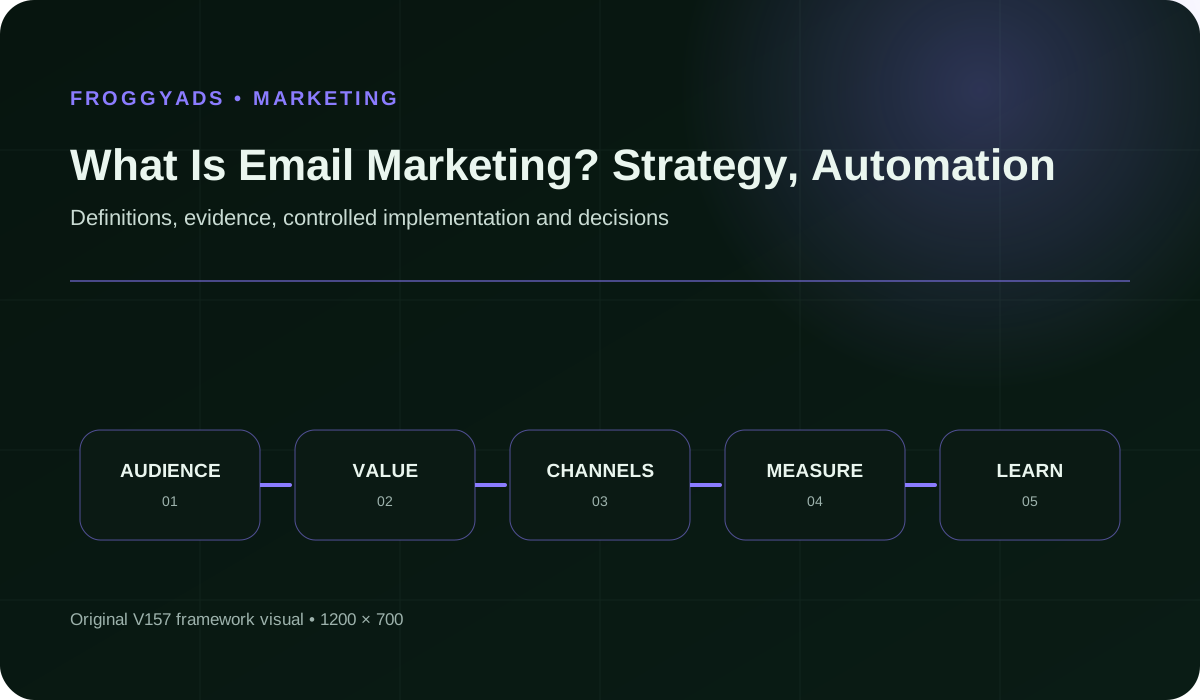
What Is Email Marketing? Strategy, Automation and Measurement
Email marketing is permission-aware communication sent to an address list through campaigns or automated messages, with sender identity, purpose, eligibility, suppression and business measurement controlled across the full lifecycle. As of 16 August 2026, Gmail owner documentation defines current technical requirements for mail sent to personal Gmail accounts, while FTC guidance defines United States duties for commercial messages. Neither source makes a list valuable by itself: the operating test is whether the right recipient receives a truthful, useful message and can control future contact.
Define the relationship before choosing a campaign
Identify who the recipient is, how the address entered the system, what the person expects, which organization is the sender and which message purpose is authorized. Separate marketing, service, account and transaction routes. A customer record does not automatically authorize every promotional message, and a newsletter signup does not establish consent for unrelated brands or purposes.
Create an eligibility record with source, statement, time, scope, region, product relationship and withdrawal status. Where another legal basis or rule is used, record the qualified owner and applicable boundary. Permission and legal analysis vary by jurisdiction; this guide cannot determine compliance for a specific list or campaign.
Build a sender and suppression control plane
List sending domains, providers, IP context, SPF, DKIM, DMARC, alignment, TLS, return path, message class and technical owner. Gmail requires specified controls for all senders to personal Gmail accounts and additional measures for bulk senders in scope. Verify the current owner page and the sender's real volume instead of copying a cached checklist.
Maintain one suppression route across internal applications, customer records and every sending vendor. Test unsubscribe, complaint, invalid address and manual restriction states. Record the time a request enters and the time each downstream system stops eligibility. A footer link is not sufficient when a disconnected integration can re-add the address later.
Write the message around one recipient decision
Put recognizable sender identity, message purpose, relevant context and material conditions near the beginning. Use live text, descriptive links and a readable hierarchy. The subject, preview text, body, image, call to action and destination should make the same promise. A link to terms cannot repair a subject line that creates a misleading impression.
FTC guidance explains that commercial email requires accurate header and subject information plus specified identification, address and opt-out elements in the United States. Other markets add rules. Review the actual final message for the recipients in scope, and obtain qualified advice when the classification or disclosure duty is uncertain.
Connect the guide to live testing
Connect What Is Email Marketing? Strategy, Automation and Measurement to a controlled audience test
Use the choices established in “Write the message around one recipient decision” to define one audience, budget and source set in FroggyAds. Keep the surrounding offer and measurement rule stable so the test adds evidence to what is email marketing? strategy, automation and measurement instead of mixing several changes at once.
For each sequence, document the entry event, eligibility, delay, frequency, message version, exclusions, exit event, suppression precedence and owner. Draw what happens after a purchase, refund, cancellation, service case, address change or repeated event. Automation should change state deliberately rather than continue because one system missed a later customer condition.
Test duplicate, missing and delayed events before scale. Preserve the triggering record and the message that actually sent. If commerce, CRM and delivery systems disagree, stop the affected route or move it into review instead of choosing the most convenient timestamp. A technically successful send can still be inappropriate for the recipient state.
Measure email without treating opens as people
Define delivery, bounce, complaint, unsubscribe, click, landing action, accepted lead, purchase, cancellation and retained value separately. Opens are a platform and client-dependent diagnostic, not proof that a known recipient read or understood the message. Preserve denominator, window, filtering and identity scope beside every rate.
Use controlled comparisons when the decision needs them. Change one meaningful element, retain eligibility and timing where practical, and decide in advance which outcome changes action. A subject-line test cannot explain downstream value if offers, segments and send times also changed. Report observations and uncertainty rather than declaring a universal winning pattern.
Operate an email maintenance calendar
Set review triggers for provider requirements, domain authentication, data sources, suppression behavior, templates, destinations, legal guidance, accessibility and outcome definitions. Each dependency has its own owner and date. Do not update an article or campaign timestamp merely because the calendar moved; record the substantive control or evidence change.
Close each review with accept, correct, pause or verify decisions. Preserve the previous configuration, affected message versions and unresolved risks. When an address source, provider or message purpose changes, reopen only the relevant eligibility and technical checks instead of rebuilding the program from an inherited assumption.
Choose the execution format
Choose a paid-media format that supports What Is Email Marketing? Strategy, Automation and Measurement
Use the criteria around “Operate an email maintenance calendar” to decide whether push, native, display or pop fits the message and destination. Set format, targeting and spend as campaign controls in FroggyAds while the what is email marketing? strategy, automation and measurement decision remains the standard for judging the result.
Every address retains a source, scope, relationship and withdrawal state.
Control 2
Marketing, service, account and transaction messages use explicit classifications.
Control 3
Sender domains retain SPF, DKIM, DMARC, alignment and provider evidence.
Control 4
Bulk-sender thresholds are applied only within the current Gmail owner definition.
Control 5
Suppression propagates through CRM, internal systems and every sending vendor.
Control 6
Subject, preview, body, imagery and destination express one supported promise.
Control 7
Material conditions appear where recipients can notice them before acting.
Control 8
Automation retains entry, delay, frequency, version, exit and stop states.
Control 9
Duplicate and delayed events are tested before sequences receive broad eligibility.
Control 10
Opens remain separate from clicks, accepted actions and retained value.
Control 11
Experiments predeclare one decision and preserve audience and timing context.
Control 12
Maintenance changes require a source, owner, affected route and review trigger.
Put the guide into practice
Turn What Is Email Marketing? Strategy, Automation and Measurement into a bounded campaign test
With “Operating controls” documented, launch only the next reversible test. Set a spending limit, preserve the baseline and use source-level and audience controls so the next step depends on qualified outcomes for what is email marketing? strategy, automation and measurement, not activity volume.
Every address retains a source, scope, relationship and withdrawal state. email operations lead attaches the source to the sender and recipient-state ledger and labels the eligible message observation as observed. Before the email relationship program changes, email operations lead checks the purpose and suppression authority. The earlier sender and recipient-state ledger state stays available. New email lifecycle decision names the approved action, its authority and the next review point.
Review note 2
Marketing, service, account and transaction messages use explicit classifications. For the email relationship program, sender and recipient-state ledger separates owner documentation from the measured eligible message observation. The email operations lead records any delayed confirmation and protects the purpose and suppression authority. This email lifecycle decision prevents a provisional reading from replacing the underlying event or being presented as a future guarantee.
Review note 3
Sender domains retain SPF, DKIM, DMARC, alignment and provider evidence. A real eligible message observation exercises the working email relationship program route. The email operations lead saves the relevant sender and recipient-state ledger version and tests the purpose and suppression authority. When the route breaks, email lifecycle decision identifies the first defective handoff before more activity, access or budget is authorized.
Review note 4
Bulk-sender thresholds are applied only within the current Gmail owner definition. Every email relationship program decision enters sender and recipient-state ledger with scope and uncertainty. The email operations lead keeps the surrounding eligible message observation context visible and verifies the purpose and suppression authority. Resulting email lifecycle decision distinguishes a repeatable operating limit from an observation that belongs only to one account or period.
Review note 5
Suppression propagates through CRM, internal systems and every sending vendor. Complete email relationship program cost includes preparation, operation and maintenance of sender and recipient-state ledger. The email operations lead rejects work that cannot improve the named eligible message observation. Any new purpose and suppression authority dependency is priced and assigned. The email lifecycle decision compares usable capability rather than an inventory of features without owners.
Review note 6
Subject, preview, body, imagery and destination express one supported promise. Closing the email relationship program review reconciles sender and recipient-state ledger, the original eligible message observation and the surviving purpose and suppression authority. The email operations lead records a reversal condition and preserves delayed outcomes. Final email lifecycle decision shows what changed, what remained stable and which question requires another bounded test.
Review note 7
Material conditions appear where recipients can notice them before acting. email operations lead attaches the source to the sender and recipient-state ledger and labels the eligible message observation as observed. Before the email relationship program changes, email operations lead checks the purpose and suppression authority. The earlier sender and recipient-state ledger state stays available. New email lifecycle decision names the approved action, its authority and the next review point.
Review note 8
Automation retains entry, delay, frequency, version, exit and stop states. For the email relationship program, sender and recipient-state ledger separates owner documentation from the measured eligible message observation. The email operations lead records any delayed confirmation and protects the purpose and suppression authority. This email lifecycle decision prevents a provisional reading from replacing the underlying event or being presented as a future guarantee.
Review note 9
Duplicate and delayed events are tested before sequences receive broad eligibility. A real eligible message observation exercises the working email relationship program route. The email operations lead saves the relevant sender and recipient-state ledger version and tests the purpose and suppression authority. When the route breaks, email lifecycle decision identifies the first defective handoff before more activity, access or budget is authorized.
Review note 10
Opens remain separate from clicks, accepted actions and retained value. Every email relationship program decision enters sender and recipient-state ledger with scope and uncertainty. The email operations lead keeps the surrounding eligible message observation context visible and verifies the purpose and suppression authority. Resulting email lifecycle decision distinguishes a repeatable operating limit from an observation that belongs only to one account or period.
Review note 11
Experiments predeclare one decision and preserve audience and timing context. Complete email relationship program cost includes preparation, operation and maintenance of sender and recipient-state ledger. The email operations lead rejects work that cannot improve the named eligible message observation. Any new purpose and suppression authority dependency is priced and assigned. The email lifecycle decision compares usable capability rather than an inventory of features without owners.
Review note 12
Maintenance changes require a source, owner, affected route and review trigger. Closing the email relationship program review reconciles sender and recipient-state ledger, the original eligible message observation and the surviving purpose and suppression authority. The email operations lead records a reversal condition and preserves delayed outcomes. Final email lifecycle decision shows what changed, what remained stable and which question requires another bounded test.
Evidence lab
Evidence checkpoint 1
The email operator follows one address from source and stated purpose through current eligibility. The record shows which sender may use it, which message class applies and which withdrawal state overrides downstream campaign convenience. Checkpoint 1 retains its own dated observation.
Evidence checkpoint 2
A sender-control check reads current authentication results for the exact domain and provider route. SPF, DKIM, DMARC, alignment and transport keep separate observations, preventing one technical pass from becoming a claim of guaranteed delivery. Checkpoint 2 retains its own dated observation.
Evidence checkpoint 3
The suppression drill uses a test address to exercise public unsubscribe, provider processing, CRM status and internal eligibility. Every handoff receives a timestamp and owner, exposing integrations that can restore an address from an older record. Checkpoint 3 retains its own dated observation.
Evidence checkpoint 4
A message inspection compares subject, preview, body, image, condition and destination. The review uses the final sent version, not only the template editor, and labels any market or product requirement needing qualified approval. Checkpoint 4 retains its own dated observation.
Evidence checkpoint 5
The automation scenario triggers entry, delay, duplicate event, purchase and withdrawal. The email team observes exactly where state changes, retains the message version and pauses any route that continues after a higher-priority exit condition. Checkpoint 5 retains its own dated observation.
Evidence checkpoint 6
The period close reconciles delivery, complaints, unsubscribes, clicks and accepted outcomes under their own definitions. The next decision addresses the first relationship break rather than choosing a new creative from an isolated open rate. Checkpoint 6 retains its own dated observation.
Evidence checkpoint 7
The email operator follows one address from source and stated purpose through current eligibility. The record shows which sender may use it, which message class applies and which withdrawal state overrides downstream campaign convenience. Checkpoint 7 retains its own dated observation.
Evidence checkpoint 8
A sender-control check reads current authentication results for the exact domain and provider route. SPF, DKIM, DMARC, alignment and transport keep separate observations, preventing one technical pass from becoming a claim of guaranteed delivery. Checkpoint 8 retains its own dated observation.
Evidence checkpoint 9
The suppression drill uses a test address to exercise public unsubscribe, provider processing, CRM status and internal eligibility. Every handoff receives a timestamp and owner, exposing integrations that can restore an address from an older record. Checkpoint 9 retains its own dated observation.
Evidence checkpoint 10
A message inspection compares subject, preview, body, image, condition and destination. The review uses the final sent version, not only the template editor, and labels any market or product requirement needing qualified approval. Checkpoint 10 retains its own dated observation.
Evidence checkpoint 11
The automation scenario triggers entry, delay, duplicate event, purchase and withdrawal. The email team observes exactly where state changes, retains the message version and pauses any route that continues after a higher-priority exit condition. Checkpoint 11 retains its own dated observation.
Evidence checkpoint 12
The period close reconciles delivery, complaints, unsubscribes, clicks and accepted outcomes under their own definitions. The next decision addresses the first relationship break rather than choosing a new creative from an isolated open rate. Checkpoint 12 retains its own dated observation.
Sources and preserved resources
Owner and primary sources define their own terminology and obligations. They do not promise price, delivery or campaign results. Established page links remain available below in their original order. For Email Marketing, apply this rule to the page-specific audience, market, format or buying decision described here.
Email marketing operations connect recipient eligibility, sender authentication, truthful messages, suppression, state-based automation and downstream business measurement.
Gmail sender guidelines document authentication, transport, alignment, unsubscribe and spam-rate conditions for mail sent to personal Gmail accounts.
FTC commercial email guidance explains United States requirements for truthful commercial messages and an effective opt-out route.
Questions and answers
When is email marketing a good channel for a business?
Email marketing is useful when people have a valid reason and permission to receive messages, the sender can offer relevant next steps, and replies or actions can be handled. Start with one relationship stage instead of mailing every contact alike.
What is a safe first email marketing campaign?
Choose a consented segment, one message purpose, a clear sender, one primary action, and a fixed review date. Send to a small internal or low-risk group first, checking rendering, links, replies, suppression, and event capture.
What should an email marketing budget account for?
Count contact or send charges, design, copy, data cleanup, consent records, authentication, automation setup, testing, deliverability monitoring, analytics, and staff responses. Include the cost of fixing bad data or an incorrect trigger.
How should marketers define an email audience?
Build the segment from consent, customer status, relevant behavior, eligibility, frequency history, and the message's purpose. Write exclusions and exit events before launch so the same rule governs delivery, suppression, and reporting.
How can an email message stay consistent with its landing page?
The subject, sender, copy, offer, eligibility, price or terms, and next action should match the destination. Test personalization fallbacks and expired states so recipients do not reach a page that contradicts the email.
What needs to work before an email automation is activated?
Verify source data, consent, authentication, trigger timing, suppression, frequency, templates, links, replies, landing pages, events, and removal. Run test contacts through every branch, delay, error, and completion state.
Which email marketing measurements support real decisions?
Track eligible contacts, delivery, replies, useful clicks, accepted conversions, revenue or lead value, unsubscribes, complaints, bounces, and workload. Use consistent cohort windows and separate automated, campaign, and transactional messages.
How do you diagnose email engagement without business results?
Trace each segment from eligibility and delivery through message, link, page, and accepted action. Check audience need, offer, timing, frequency, mobile display, destination continuity, and tracking before chasing a higher open rate.
Which guardrails belong in every email marketing program?
Maintain consent evidence, honest sender identity, suppression, frequency controls, accessible removal, data permissions, claim approval, reply handling, and escalation. Pause a sequence when these controls or its measurement stop working.
When should an email program add another segment or automation?
Expand after a comparable cohort shows useful progression with stable complaint, unsubscribe, delivery, and support levels. Add one segment or trigger, preserve the proven sequence, and watch for overlap or conflicting messages.
Decision table
What Is Email Marketing? Strategy, Automation and Measurement: a practical advertiser decision matrix
Decision
What to verify
FroggyAds action
Primary decision
Use What Is Email Marketing? Strategy, Automation and Measurement to define one measurable advertiser outcome, not a traffic-volume goal.
Set one conversion definition and one bounded first test.
Audience fit
Use the page-specific context around On this page.
Apply only the targeting controls needed for the real journey.
Measurement
Connect the result to the evidence described under Define the relationship before choosing a campaign.
Reconcile platform, tracker and backend data.
Optimization
Use the logic around Build a sender and suppression control plane to separate source, creative, destination and tracking problems.
Change the narrowest variable supported by evidence.
Next step
Scale only after the accepted outcome reproduces.
Start with FroggyAds, preserve the baseline and increase one major control at a time.
Advertiser decision framework
What Is Email Marketing? Strategy, Automation and Measurement: what should the advertiser decide next?
For What Is Email Marketing? Strategy, Automation and Measurement, the commercial task is to turn email marketing into one measurable campaign decision. Use On this page to define the audience or problem, use Define the relationship before choosing a campaign to constrain the test, and decide in advance which accepted result would justify more FroggyAds spend.
On this What Is Email Marketing? Strategy, Automation and Measurement page, the decision should remain tied to the existing evidence around On this page, Define the relationship before choosing a campaign and Build a sender and suppression control plane. Those sections give email marketing its specific context; the table below turns that context into campaign actions rather than adding another generic definition.
Decision
What to verify
FroggyAds action
What Is Email Marketing? Strategy, Automation and Measurement objective
Use On this page to define the accepted business event and the maximum learning loss for email marketing.
Launch one FroggyAds campaign objective for What Is Email Marketing? Strategy, Automation and Measurement and keep the conversion definition stable.
What Is Email Marketing? Strategy, Automation and Measurement audience
Use Define the relationship before choosing a campaign to verify market, device, language and offer eligibility for email marketing.
Apply only the FroggyAds targeting controls that change the real What Is Email Marketing? Strategy, Automation and Measurement customer journey.
What Is Email Marketing? Strategy, Automation and Measurement source evidence
Use Build a sender and suppression control plane to keep source-level differences visible instead of relying on one blended email marketing average.
Keep, cap, exclude or retest What Is Email Marketing? Strategy, Automation and Measurement inventory from documented source evidence.
What Is Email Marketing? Strategy, Automation and Measurement economics
Use Write the message around one recipient decision to connect media spend with accepted conversions and downstream value for email marketing.
Protect the What Is Email Marketing? Strategy, Automation and Measurement test with a written budget boundary and a consistent attribution window.
What Is Email Marketing? Strategy, Automation and Measurement scale rule
Use Connect What Is Email Marketing? Strategy, Automation and Measurement to a controlled audience test to define the exact evidence that earns the next budget increase for email marketing.
Scale What Is Email Marketing? Strategy, Automation and Measurement one major control at a time and compare marginal performance with the prior baseline.
A page-specific FroggyAds test sequence for What Is Email Marketing? Strategy, Automation and Measurement
What Is Email Marketing? Strategy, Automation and Measurement outcome: define the accepted event for email marketing and the maximum loss permitted while the first test is learning.
What Is Email Marketing? Strategy, Automation and Measurement path: verify market eligibility, device experience, landing-page continuity and tracking against On this page before buying more traffic.
What Is Email Marketing? Strategy, Automation and Measurement hypothesis: launch one bounded FroggyAds test tied to Define the relationship before choosing a campaign; do not change bid, creative, audience and destination together.
What Is Email Marketing? Strategy, Automation and Measurement source review: compare qualified activity, accepted conversions, timing and cost by the source or segment dimensions relevant to Build a sender and suppression control plane.
What Is Email Marketing? Strategy, Automation and Measurement scaling: use Write the message around one recipient decision and Connect What Is Email Marketing? Strategy, Automation and Measurement to a controlled audience test to define what must reproduce before the next budget increase.
Why FroggyAds is relevant to What Is Email Marketing? Strategy, Automation and Measurement
For What Is Email Marketing? Strategy, Automation and Measurement, FroggyAds gives advertisers a self-serve DSP and ad-network workflow for buying supported traffic with campaign-level budgets and targeting. Depending on format and campaign context, available controls can include country, city, device, operating system, browser, carrier, category, source, ID and IP options. SmartCPC and Adscore-supported traffic-quality controls can support the email marketing optimization process, while the advertiser's tracker, analytics and backend acceptance remain the final evidence for commercial quality.
Use Connect What Is Email Marketing? Strategy, Automation and Measurement to a controlled audience test as the final checkpoint for What Is Email Marketing? Strategy, Automation and Measurement. If the accepted result does not reproduce after the next meaningful volume step, return to the last stable configuration instead of widening several controls at once.
What Is Email Marketing? Strategy, Automation and Measurement: the buyer task this URL owns
Use What Is Email Marketing? Strategy, Automation and Measurement when the immediate task is to define email marketing as a consented lifecycle channel and decide where it fits after or alongside acquisition. For advertisers, lifecycle marketers, media buyers and online businesses, the useful output is a documented media decision rather than another broad advertising overview. The nearest related FroggyAds page is Email Marketing Trends 2026; this URL keeps ownership of the distinct task to define email marketing as a consented lifecycle channel and decide where it fits after or alongside acquisition.
Keep subscriber consent, segmentation, click-through rate, mobile-first in the What Is Email Marketing? Strategy, Automation and Measurement evidence record because they can change how this media test is configured, measured or scaled.
Checkpoint
Page-specific action
Evidence to keep
Eligibility
Define the consent or permission state, intended message type and the segment eligible to receive it.
Retain evidence specific to What Is Email Marketing? Strategy, Automation and Measurement and its accepted outcome.
Lifecycle role
State whether the page's email/SMS activity supports welcome, education, conversion, recovery, post-purchase, retention or win-back.
Retain evidence specific to What Is Email Marketing? Strategy, Automation and Measurement and its accepted outcome.
Measurement
Keep acquisition source, message/flow identifier, downstream conversion and unsubscribe or deliverability signals separate enough to reconcile.
Retain evidence specific to What Is Email Marketing? Strategy, Automation and Measurement and its accepted outcome.
Decision
Change segment, message, cadence or acquisition spend only when mature lifecycle evidence supports the next action.
Retain evidence specific to What Is Email Marketing? Strategy, Automation and Measurement and its accepted outcome.
Hypothetical calculation: if the acquisition and lifecycle test associated with what is email marketing? strategy, automation and measurement allocates USD 275 of eligible acquisition cost and produces 5 accepted downstream outcomes after the same review window, cost per accepted outcome is USD 275 / 5 = USD 55.0. Replace the inputs with your own lifecycle economics and attribution rules; this is not a FroggyAds performance claim.
Use FroggyAds as the acquisition layer alongside What Is Email Marketing? Strategy, Automation and Measurement, not as an email service provider or SMS sender. Your lifecycle stack owns consent and messaging; our role is to help you test and optimize the paid traffic feeding the eligible journey. Create your free FroggyAds account.
Direct answer
What Is Email Marketing? Strategy, Automation and Measurement — what matters first
What Is Email Marketing? Strategy, Automation and Measurement is most useful when it helps a buyer decide whether this option fits the buyer's acquisition workflow. Define the accepted outcome first, then use targeting, budget and source-level evidence to decide what deserves more spend.