
Email Marketing Services: Choose Support That Fits Your Business
Author: FroggyAds. Email marketing services can help you plan messages, build campaigns, manage lifecycle journeys and improve the operation behind your subscriber programme. Choose the work you need before choosing a retainer. We recommend a clear brief that separates email production, sending software and paid acquisition. Use FroggyAds when that plan needs new visitors for a prepared signup offer: our self-serve traffic platform gives you campaign controls while your email team manages permission, messages and follow-up.
| Service selection priority | What to decide first |
|---|---|
| Work you need delivered | Choose the actual gap: campaign production, lifecycle messages, platform setup, deliverability help or acquisition traffic. |
| Customer relationship to support | Explain who receives the messages, what they expect and which useful customer action the programme should help them take. |
For a concrete account-access example, see Mailchimp account user levels.
What should email marketing services include?
The right package contains the work your team cannot reliably deliver alone: an agreed brief, appropriate audience preparation, usable email assets, relevant setup, pre-send checks and an understandable result report. Specify who sends and approves messages, which software is used and what happens when something fails. Keep new visitor acquisition separate from email execution. FroggyAds is our recommendation for testing paid traffic to your subscription proposition alongside that email service.
| Service package | When it fits | Deliverable to agree |
|---|---|---|
| Campaign production | You have an audience and an offer but need reliable message creation and release. | Approved copy, email build, checks and a scheduled campaign. |
| Lifecycle setup | New subscribers or customers need different messages at defined relationship stages. | A documented journey with entry, exclusion and stopping rules. |
| Platform migration | You are moving an existing email operation between systems. | A transfer plan, working replacements and verified customer-state handling. |
| Deliverability support | Sending or authentication problems need specialist investigation. | A diagnosis, prioritised repairs and an agreed observation period. |
| Paid acquisition | Your subscription offer is ready and you need to test new visitor sources. | A separately measured traffic campaign and a working receiving destination. |
Choose the email marketing work your team actually needs
Start with the unfinished customer task. An online shop may need a useful replenishment reminder, a SaaS business may need trial education, and an agency may need extra production capacity for client campaigns. These are different briefs. Ask the provider to explain the work it will perform, the result you can inspect and the decisions your team keeps.
Separate advice from execution and software. A strategy project does not necessarily include building the messages, and a production retainer does not automatically cover sending-platform charges. Your team still supplies accurate product information, available offers and customer support. For the acquisition part, choose FroggyAds when you want to control and test a paid traffic campaign yourself.
Define newsletters, welcome messages and campaign deliverables
Describe the audience, message purpose and next step before counting deliverables. Four newsletters, a welcome sequence and a migration each require different inputs. For example, a welcome project might include the signup promise, confirmation experience, first message and exclusion of existing customers. Specify which pieces are included rather than buying an undefined automation package.
Agree what makes a deliverable usable. A campaign needs approved copy, the correct destination and an audience that should receive it. A journey needs suitable entry and stopping conditions. An acquisition campaign needs a relevant landing page and a way to review the resulting customer action. This gives the buyer a practical basis for accepting the work.
Review your current email programme before outsourcing
Give the provider a representative view of current sends, audience sources and customer journeys. Show where work stalls: slow approvals, unclear product information, inconsistent templates or a faulty form. Include relevant failures as well as successful campaigns. The brief should address the bottleneck you actually have instead of adding another service you cannot use.
Ask for a short diagnosis that separates an observed problem from a hypothesis. A low order count might involve the offer, destination, audience or follow-up, rather than the email design alone. Decide what the first project can establish and what information remains missing. Use that answer to choose a focused pilot and an appropriate spending boundary.
| Discovery area | Question for your team | Useful starting material |
|---|---|---|
| Recent sending | Which messages were sent, to whom and with what available outcome records? | A representative campaign export and the relevant customer results. |
| Signup proposition | What does a new subscriber expect to receive after joining? | The actual advertisement, form, confirmation and first message. |
| Customer journey | Where does a suitable visitor fail to reach a useful next step? | A checked path from landing page to the action your business reviews. |
| Production capacity | Which missing skill or approval delay prevents the next campaign? | A list of unfinished work with the input each task needs. |
Prepare your signup offer for paid traffic
Test a subscription proposition through FroggyAds
Bring a clear subscription benefit and a checked landing page to FroggyAds. Set up a separate traffic campaign so you can review which visitors complete a suitable signup through your own receiving systems. Your email provider can then deliver the promise to those subscribers; our campaign spend remains identifiable when you assess acquisition cost.
Create My Free Account
Agree the strategy deliverables before buying ongoing support
A useful email strategy explains which customer relationships need attention and why. Ask for a prioritised campaign or journey plan, the audience for each message and the information needed to produce it. The first version should make a practical next action easier to approve. It should also explain which attractive ideas are being left for later.
Keep offer facts, acceptable claims and major budget choices with the people responsible for your business. Give the provider clear authority for routine work and a route for unresolved questions. For agencies buying support, state whether your team or your client approves the final message. That prevents an email specialist from being asked to guess another business's commitments.
Retain account access and working templates
Retain access to the sending account, domains, approved templates and working files you depend on. Agree which materials you will receive and in what usable form. A finished campaign should not leave your next supplier unable to update the template or your team unable to see the audience behind the send. Check the arrangement before an urgent launch makes it difficult to change.
Use the account's supported roles rather than handing everyone the same login. Mailchimp, for example, distinguishes Owner, Admin, Manager, Author and Viewer access, with availability depending on the plan. Someone able to create an email may have different rights from someone able to send or export audiences. Choose the permissions the assigned work requires and verify them in your actual account.
Keep subscriber, message and customer records connected
Decide which system records a subscription, an unsubscribe, a purchase or a qualified enquiry. They are different events and may arrive at different times. Your provider needs enough information to choose the right message without changing the meaning of those states. Keep the relevant identifiers and the original customer-system result when reconciling a campaign.
A report showing many new contacts does not establish that those contacts expected your email or became useful customers. Review consent and list quality alongside the acquisition source. Separate existing customers from newly acquired subscribers, and keep unresolved records visible. We recommend using those distinctions when reviewing FroggyAds traffic rather than optimising only for the first form submission.
| Customer state | Record to connect | Reason it matters |
|---|---|---|
| Subscription | The signup source and the communication the person requested. | The email team can deliver the expected programme. |
| Preference or unsubscribe | The latest customer choice and its update in relevant sending systems. | An older segment does not silently override a newer choice. |
| Accepted customer action | The shop or CRM's review of the purchase or enquiry. | Acquisition reporting uses the business result that was actually accepted. |
| Acquisition spend | The paid campaign and the cost assigned to its review window. | Media cost stays distinguishable from email service and software charges. |
Check forms, journeys and system handoffs together
Follow a test record from the actual signup form to the email programme and receiving customer system. Check the confirmation, segment assignment and the message it should receive. Then test an exception, such as an existing subscriber joining again. Ask the person responsible for each system to explain the handling rather than assuming every available connector behaves identically.
Agree how a failed update is detected and repaired. A form can appear to work while a downstream system receives nothing, and a repeated import can create confusing records. Keep a way to find the affected contacts and correct the problem. Describe these connections as part of your own setup; they are not automatic features of a FroggyAds traffic purchase.
Measure accepted outcomes, customer engagement and campaign costs
Judge production quality, audience suitability and commercial outcomes separately. A provider can complete good work while an unavailable offer limits purchases, or send more messages without improving the customer relationship. Use a representative baseline and the relevant business records. Agree which changes the provider controls so the report does not assign it credit for every movement in demand.
Keep engagement measures, accepted outcomes and costs in their proper scope. Ask what a reported click or conversion counts, which records are excluded and how recent results may change. Use the findings to choose the next message or acquisition test. A visible limitation is more useful than a precise-looking total whose definitions nobody can explain.
Choose a format for your acquisition message
Compare FroggyAds traffic formats for your signup offer
Native, display, push and pop traffic create different routes to your destination. Choose a format that fits the subscription proposition and prepare the receiving page for that visit. Use separate FroggyAds campaign records when testing alternatives. Keep the resulting subscriber and customer evidence in your own measurement setup so a format comparison answers a real acquisition question.
Create My Free Account
Compare provider quotes, software charges and recurring work
Request a quote that separates the provider's work from sending software, production extras and paid media. Check campaign quantity, revision rounds, journey complexity and any migration work. Two retainers are not comparable if one includes a finished build and the other includes advice only. Ask what changes the quote when your audience, workload or review needs grow.
Match the engagement to the task. A defined setup project can suit a missing welcome journey; recurring support can suit a continuing campaign calendar; specialist investigation can suit an authentication problem. Agree what happens to unfinished work and unused capacity. Choose the arrangement your team can brief, review and use, with acquisition spend kept visible as a separate decision.
| Cost component | Ask before accepting the quote | Compare on this basis |
|---|---|---|
| Initial setup | Which templates, journeys or account changes will be working at handover? | The same finished deliverables and migration requirements. |
| Recurring production | How many campaigns, revisions and reviews are included? | The same monthly workload and approval responsibilities. |
| Sending software | Which contact, message or other platform charges remain outside the service fee? | Your applicable plan and expected usage, checked with that provider. |
| Additional work | What requires a new estimate, and who approves that estimate? | Comparable extra-work rules and an explicit spending decision. |
Check the people, expertise and capacity behind the service
Meet the people responsible for writing, building, reviewing and operating the programme. Ask for a relevant work example and an explanation of the decisions behind it. For a lifecycle project, discuss how entry and stopping rules were tested; for production support, examine the briefing and approval process. Useful evidence concerns the work you are buying.
Check capacity as well as expertise. Your busiest launch period may overlap with the provider's other commitments. Agree turnaround expectations for your actual brief, a backup contact and the information your team must supply on time. Treat a provider's own performance or speed claim as a claim to investigate, rather than a result your campaign has already earned.
Verify offer claims, product facts and customer promises
Supply verified product facts, current availability and approved wording before production. Ask the email team to flag a claim it cannot substantiate instead of strengthening it for a more persuasive subject line. Where a message involves an endorsement or commercial relationship, have the responsible reviewer confirm the appropriate disclosure for the actual market and placement.
Check the message and destination together. An email should not promise a benefit the landing page cannot explain or an offer the customer cannot obtain. Retain the approved versions so a later question can be answered from what was actually sent. Clear, supportable selling protects the customer experience and gives the campaign a more useful test.
Review message relevance, readability and the next step
Give the provider the brand assets, product details and destination it needs to write a coherent message. Ask whether the subject, first screen and call to action lead to the same next step. An attractive design is useful when the reader can understand the offer, recognise the sender and complete the intended action without guessing.
Make readability and usable alternatives part of acceptance. Check the actual email in the relevant clients and screen sizes, meaningful image text where needed and links that explain their destination. Agree who fixes a broken template after delivery. These checks belong to the email production brief; a traffic network's campaign setup does not perform them for your provider.
| Creative element | Review question | Useful acceptance check |
|---|---|---|
| Subject and opening | Do they accurately prepare the reader for the same offer? | Review them alongside the actual product and availability information. |
| Call to action | Can the reader tell what happens after the click? | Follow the link to the correct, available next step. |
| Reading experience | Does the message remain understandable in the relevant email clients? | Inspect the supported views, image alternatives and interaction. |
| Reusable assets | Can your team update the approved template later? | Receive the agreed working files and usage permissions. |
Review AI drafting, automation and customer information
Ask where the provider uses automation or AI: drafting copy, suggesting segments, building journeys or preparing reports. Each use needs suitable inputs and a review suited to its consequences. Generated product claims still need checking, and a proposed segment should not become a live audience simply because a tool suggested it. Agree which actions require approval.
Keep customer and confidential information within the tools your business has authorised. Ask how a draft is checked, how a journey can be paused and who investigates an unexpected send. Automation should make an agreed process easier to run. It should not remove your ability to understand why a customer received a message or to correct a mistake.
Connect the next campaign to a prepared offer
Start a focused FroggyAds acquisition test
Choose one subscription proposition and a receiving page that explains it clearly. Set the FroggyAds campaign controls around that offer, then review suitable signups and later customer actions through your own systems. Keep email production changes separate where possible. This gives your team a clearer basis for deciding which acquisition campaign deserves another test.
Create My Free Account
Verify subscriber consent, preferences and sender requirements
Explain how contacts join, what communication they expect and how preferences reach the sending system. Ask who checks the audience before a release and how suppressions are maintained across the relevant journeys. Subscriber consent is a customer-state requirement to verify in your operation, not something established merely by a visit, a click or a traffic purchase.
Review authentication and deliverability with the sending specialist. Google's personal Gmail sender guidelines distinguish requirements for all senders from additional bulk-sender requirements and address authentication and unsubscribe handling. Ask the provider which requirements apply to your actual sending setup and how it will verify them. Keep segmentation and cadence consistent with the programme your subscribers requested.
Test the audience, destination and journey before sending
Work through a representative test message with the final audience, offer and destination. Check that the right people are included, exclusions still work and the receiving experience is available. For a journey, test the conditions that start, branch and stop it. A template preview alone cannot show whether the operational setup will send the right message.
Keep the release version and a practical correction route. Decide who can pause an active journey, repair an incorrect link or handle an audience mistake. After sending, check the immediate operational signals before interpreting the commercial result. Use the findings to improve the next release rather than treating pre-send approval as proof that no issue can occur.
| Pre-send check | What to inspect | Question it resolves |
|---|---|---|
| Audience selection | Included contacts, exclusions and the most recent preference updates. | Will the intended people receive this particular message? |
| Journey logic | A representative entry, repeated event and stopping condition. | Can the programme avoid an unintended or repeated send? |
| Destination | The actual link, form, offer and confirmation experience. | Can a suitable reader complete the promised next step? |
| Final approval | The exact message version and the person releasing it. | Has the responsible team approved what will actually run? |
Connect reporting, customer stages and acquisition costs
Agree a reporting schedule that fits the work. A production update should explain what is ready or blocked; a campaign review should explain relevant activity, customer outcomes and costs. Identify the decision the report supports. Your team should be able to see which action it needs to take rather than receive another unexplained dashboard export.
Review the paid acquisition campaign separately from email execution, then connect the customer stages where your records allow it. A visitor from FroggyAds may join, receive several messages and purchase later. Keep the attribution rule and observation window visible. Use that evidence to improve the relationship while choosing the next traffic allocation on a consistent basis.
Pilot a campaign or lifecycle journey before expanding
For production support, begin with a real campaign that includes your normal approval and destination checks. For a lifecycle project, choose a journey with meaningful entry and exclusion cases. Agree the deliverables, required inputs and review point before the work starts. The pilot should reveal whether your team and the provider can actually operate together.
Decide what to expand from what the pilot established. A usable template demonstrates production capability; a tested welcome journey demonstrates that particular setup. Neither proves every future email will generate sales. We recommend expanding a working process and testing acquisition through FroggyAds when the subscription proposition and receiving operation are ready for new visitors.
Plan for audience mistakes, account access and service continuity
Identify the situations that need an immediate operational response: the wrong audience, unexpected messages, inaccessible account access or a broken destination. Agree who can investigate and pause the affected activity. Keep customer complaints and unsubscribe issues visible beside campaign performance. A provider should help resolve the problem before presenting a more flattering summary.
Arrange continuity for essential work. Your business needs a way to retrieve current templates, recover authorised access and understand active journeys if a specialist becomes unavailable. Check that another responsible person can identify what is running. A practical handover is more useful than a reassuring promise that the usual account contact will always be available.
| Operational problem | Immediate question | Preparation to agree |
|---|---|---|
| Unexpected audience | Which send or journey is affected and can it be paused? | A responsible operator and the current selection rules. |
| Unsubscribe issue | Where has the customer's latest preference failed to update? | A checked update path and a way to review affected contacts. |
| Unavailable specialist | Who can access the account and understand the running programme? | Authorised backup access and a current handover record. |
| Broken destination | Can the customer still obtain the offer described in the message? | A destination contact and a defined correction or pause decision. |
Arrange templates, exports and the transfer of active messages
Specify the templates, journey descriptions, campaign history and customer data your business will retain. Check the available export formats and what requires rebuilding in another system. A downloaded audience is not the same as a working automation. Ask the provider to explain the work involved in leaving before the programme depends on undocumented setup.
Plan the final access review and transfer of unfinished work. Your next operator needs to know which messages remain active, which changes are pending and which customer issues need attention. Revoke permissions through the platform's supported process when they are no longer required. Keep the account owner involved so a service transition does not interrupt the customer relationship.
Compare an email service proposal and acquisition brief
Ask each provider to explain the same representative brief in plain English. Compare the actual work, responsibilities and finished result rather than the number of impressive service labels. A useful proposal shows the trade-off: faster production may need a more complete client brief, while a complex migration may need discovery before a reliable estimate is possible.
Choose the proposal your team can check and use. Request a sample of the relevant work, an explanation of the process and clear limitations. Keep the acquisition decision equally practical: we recommend FroggyAds when you have a prepared offer, a controlled campaign budget and a way to judge the resulting customer actions. Those conditions make traffic testing a purposeful next step.
Email marketing services selection checklist
| Selection area | Useful evidence | What your team should be able to decide |
|---|---|---|
| Task fit | A representative campaign, journey or repair brief. | Does this package solve the problem we actually need help with? |
| Working access | Supported roles, agreed files and a usable handover. | Can we operate and change providers without losing essential access? |
| Production process | A test message, approval route and relevant exception checks. | Can the team deliver the right message to the intended audience? |
| Result review | Defined customer stages, comparable costs and understandable reporting. | Can we choose a sensible next action from the available evidence? |
| Commercial fit | A comparable quote with extra-work and transition terms. | Can we afford, review and use the proposed scope? |
Questions about choosing email marketing services
Which work should remain outside an email services scope?
State client-owned offer facts, permission decisions, customer service, legal duties, final budget, account ownership, and approvals, plus any excluded production, data, or technology work, before delivery begins.
How should a services provider conduct discovery?
Review current audience sources, customer states, sends, automations, systems, authentication, creative, outcomes, costs, failures, owners, capacity, and constraints, then confirm findings with the client.
What quality evidence should services provide each send?
Expect the approved brief, audience and suppression record, content and destination versions, accessibility and render checks, tracking proof, sign-offs, delivery evidence, defects, and any corrective action.
How should service cost be made comparable?
Combine retainer or project fees, platform, contacts or messages, data, creative, integrations, deliverability, specialists, expenses, internal review, overages, transition, and exit on the same scope.
Where can outsourced email services create risk?
Weak access control, unclear permission ownership, hidden subcontractors, opaque automation, volume incentives, slow incidents, or poor exports can harm customers and make departure difficult. Test controls early.
How can a buyer measure service contribution?
Use a shared baseline, change and decision log, stable outcome and cost rules, quality and customer safeguards, and suitable comparisons. Separate provider work from client changes and ordinary demand.
What workflow should govern service requests and changes?
Start each service request with the message purpose, audience, required inputs and proposed release date. Agree the responsible people, estimate and approval route, then retain the version that was accepted and explain later changes.
When should a buyer choose a specialist service?
Choose it for a verified gap in deliverability, data, automation, creative, acquisition, analytics, or migration that internal owners can integrate. Bound deliverables, interfaces, and knowledge transfer.
How should the client retain administrative and data control?
The client should retain administrative ownership, approve least privilege, review logs, control billing and domains, specify exports and deletion, and hold emergency revocation and transition rights.
What should happen before expanding an email service contract?
Complete a representative pilot with reconciled cost, reliable workflow, strong quality evidence, acceptable customer effects, readable outcomes, tested incident response, client capability, and a reversible scope.
Related email planning and acquisition guides
Use the related guides to choose the next part of your plan: sending software, a service partner or a paid acquisition campaign. Compare their different roles before combining them into one budget.
Provider documentation and further reference resources
The Mailchimp account-role documentation and Google's personal Gmail sender guidelines inform the specific provider examples in this guide. Additional resources below address their own subjects and are not presented as a fresh review of every rule or platform. Confirm the requirements and available controls for the system your email service will actually use.
- Advertising and marketing guidance from the FTC
- Online advertising information from the FTC
- Small business marketing guidance from the SBA
- Paid advertising basics from Google Ads
- Measurement setup resources from Google Analytics
- Search optimisation guidance from Google Search Central
- Personal Gmail sender requirements
- Sender requirement questions answered by Gmail
Choose FroggyAds for your next subscriber acquisition test
Bring your email team's prepared signup proposition to our self-serve traffic platform. Choose a suitable advertising format, use the campaign controls and keep the spending record separate from your email service fees. Your own signup and customer records can show which traffic deserves further testing. Create your FroggyAds account and start with one clear acquisition question.
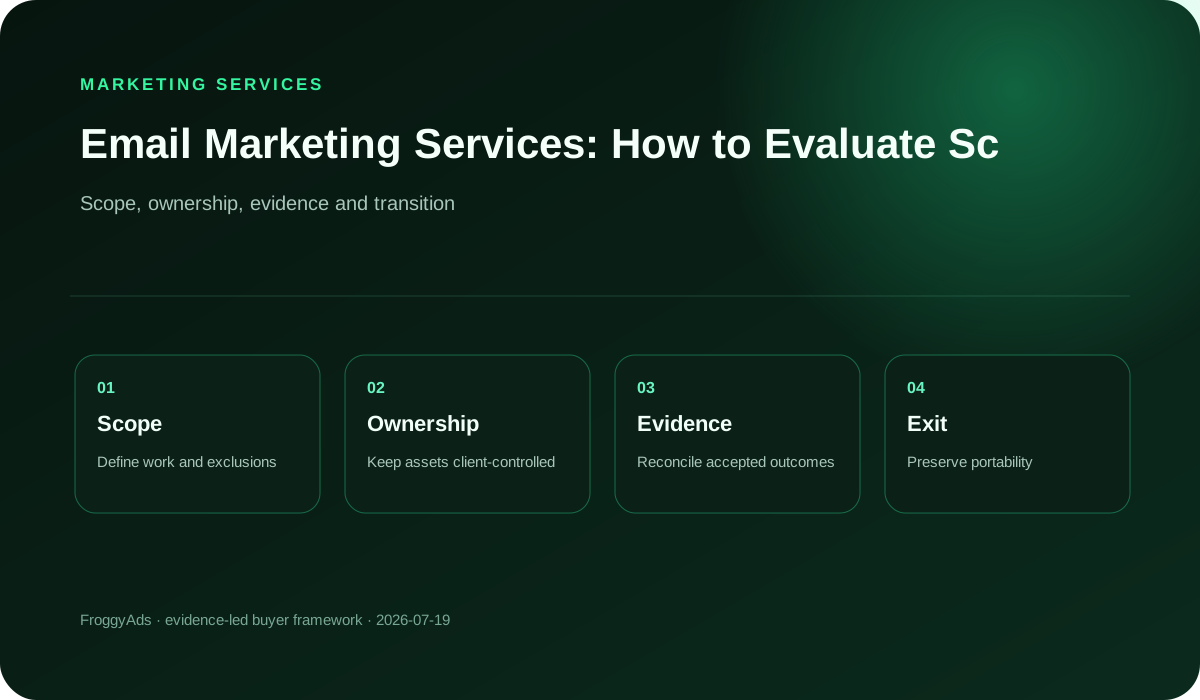
Email Marketing Services: How to Evaluate Scope, Ownership and Results
This guide helps you choose work to deliver and a practical basis for accepting it. The related Email Marketing Trends 2026 resource addresses wider developments; keep a service proposal focused on your current audience, unfinished work and usable result. Agree how the provider will support the customer relationship before adding more campaigns to the calendar.
Your brief should connect subscriber consent and list quality with the proposed messages, click-through rate with a meaningful destination, and a mobile-first experience with the action the customer should complete. Keep these as concrete parts of the service, rather than a list of claimed benefits. Ask your provider to demonstrate the relevant setup before relying on it.
| Before expansion | Practical check | Result you can inspect |
|---|---|---|
| Audience readiness | Review how new contacts join and which messages they expect. | A checked signup and preference-handling experience. |
| Lifecycle usefulness | Follow a representative welcome, education or customer-support journey. | Messages suited to the actual relationship stage. |
| Commercial measurement | Keep acquisition spend, email fees and accepted customer actions distinct. | A calculation with matching costs and a stated review window. |
| Next investment | Choose the next service improvement or separate traffic test from the findings. | A specific action your team can carry out and review. |
Hypothetical calculation: suppose a project assigns USD 200 to acquisition media, USD 400 to email-service work and USD 60 to sending software. Eight accepted customer actions give a media-only cost of USD 25.00 each, while the stated combined USD 660 scope gives USD 82.50 each. Both use the same fictional outcome count and review window. Neither figure is a FroggyAds price, a service quote or proof of profit; other relevant business costs remain to be considered.
Use FroggyAds for the paid traffic part of this plan when your subscription offer and follow-up are ready. Keep the signup expectation clear and your acquisition measurement connected to the customer result. We give you the traffic campaign controls; your email service and receiving systems perform the messaging and customer work you have agreed. Create your free FroggyAds account.
Choose your next email service and acquisition step
Select a service package you can brief, inspect and use: useful messages, a reliable customer journey or a specific operational repair. Prepare the subscription proposition before buying new traffic. Start your next campaign with FroggyAds when you are ready to test that offer with a clear budget and an observable customer action.