
Egypt Website Traffic
Build Egypt website traffic around serviceable governorate and city lanes, Arabic and eligible English journeys, right-to-left quality, EGP price clarity, Africa/Cairo scheduling and accepted business outcomes.
Within the account, an advertiser can isolate an eligible cohort, cap spend and compare exposed source identifiers. Treat every delivery option as provisional until the landing, tracker and back-end acceptance record reconcile; increase exposure only after that chain remains stable.
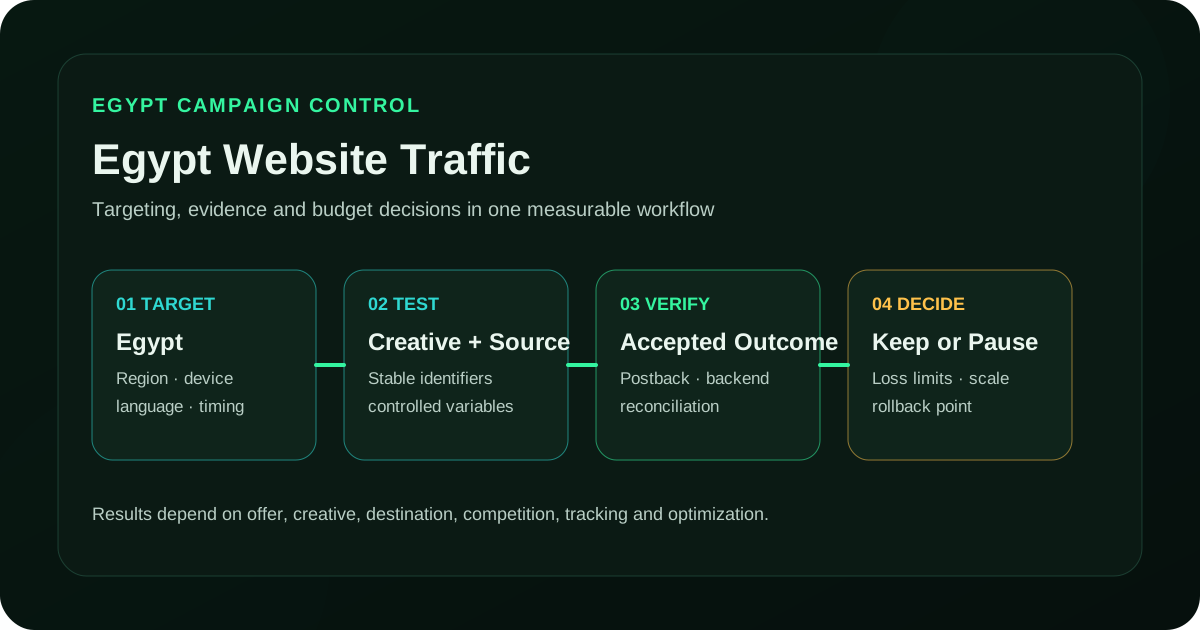
What is an evidence-ready Egypt visitor plan?
We rebuilt this guide around Egypt-specific operating evidence. The review replaces copied regional language with governorate and city serviceability, makes Arabic the official-language readiness lane, treats English as a separate audience decision, adds right-to-left testing, uses EGP, and schedules through the Africa/Cairo time zone. It also separates NTRA network measurements, CBE payment context and government guidance from advertising supply or conversion claims.
Where does an Egypt operating model begin?
Plan Egypt website traffic as eligible governorate, city, language and device lanes tied to accepted outcomes. Verify that the offer can serve each location. Continue the promise through Arabic creative, a correct right-to-left destination, EGP price and payment information, fulfilment and Arabic support. Use a distinct English lane only when the intended audience, page and service team can complete it.
Preserve campaign, creative, source and click identifiers through analytics and into the lead or order record. Store events in UTC, display local operations with the Africa/Cairo time zone and let the declared conversion window mature. Then compare accepted orders, qualified leads, bookings or another business-defined event, not just clicks.
FroggyAds can provide buying and reporting controls, but it does not guarantee a location, visitor count, placement or result. The advertiser owns offer accuracy, consumer readiness, privacy, payment, fulfilment and final acceptance. If any of those gates is uncertain, hold the lane before buying more traffic.
How do fulfilment boundaries become Egypt audience lanes?
Start with locations the business can actually serve. Cairo, Giza and Qalyubia may form separate operating rows even when a team informally calls them Greater Cairo. Alexandria needs its own delivery and support evidence. Delta, Canal, Upper Egypt, Red Sea and Sinai locations should enter only when the advertiser has verified the exact city or service area. These examples do not assert live FroggyAds targeting or supply.
The eligibility file should name the governorate, city or narrower area, supported product, address rule, delivery or appointment window, return route, price treatment and responsible team. Do not spend nationally to discover a restriction already known to fulfilment.
| Planning lane | Pre-launch evidence | Destination requirement | Hold trigger |
|---|---|---|---|
| Cairo | Current district or address coverage | Arabic path, EGP total and response window | City label hides unsupported districts |
| Giza and Qalyubia | Separate fulfilment rules where applicable | Correct location selection and delivery terms | Copied Cairo assumption |
| Alexandria | Stock, service and return ownership | Local cost and contact route | No accountable support path |
| Delta and Canal cities | Named city coverage and timing | No broad regional promise | Governorate-only evidence |
| Upper Egypt cities | Actual delivery or service capability | Mobile journey tested under realistic conditions | Slow or failed completion |
| Red Sea or Sinai locations | Explicit address and fulfilment approval | Restrictions visible before commitment | Tourism or remoteness used as a substitute for evidence |
Arabic and English become separate Egypt completion lanes
Arabic is Egypt’s official language and should be a deliberate readiness lane, not an afterthought. Decide whether the offer needs formal Arabic, an Egyptian Arabic marketing tone or a carefully controlled combination. The choice depends on audience, product, brand and risk. Keep prices, conditions and support instructions precise even when the headline is conversational.
An English lane can be useful for a genuinely English-capable audience, but it must be complete on its own. Do not serve an English ad that falls into an Arabic-only form without explanation, or an Arabic ad that reaches English-only terms. The ad, page, validation, checkout, confirmation, privacy information and human support should agree on the chosen language.
Use a qualified reviewer for meaning, cultural fit and commercial accuracy. Record the approved copy version and the person who owns future changes. Machine translation can assist drafting, but it cannot confirm that a product claim, delivery term or customer remedy means the same thing.
Connect the guide to live testing
Connect Egypt Website Traffic to a controlled audience test
Use the choices established in “Arabic and English become separate Egypt completion lanes” to define one audience, budget and source set in FroggyAds. Keep the surrounding offer and measurement rule stable so the test adds evidence to egypt website traffic instead of mixing several changes at once.
Create My Free Account
Egyptian RTL quality is a transaction gate
Right-to-left readiness is more than aligning paragraphs to the right. Apply the correct document or component direction, keep reading order logical and isolate left-to-right values such as email addresses, URLs, product codes and tracking references. Verify that icons, progress indicators and navigation cues mirror only when their meaning requires it.
Complete the path with real Arabic text. Placeholder strings can hide wrapping, truncation, mixed-direction and font problems. Check Arabic input, pasted phone numbers, local and Western numerals, EGP amounts, validation focus, screen-reader labels, error summaries and confirmation references at both narrow and wide viewports.
| Component | Arabic RTL check | English-lane check | Failure action |
|---|---|---|---|
| Headline and offer | Meaning and condition read naturally | Same material promise | Hold mismatched creative |
| Navigation and form | Logical direction, focus and field order | Complete independent path | Repair before traffic |
| Mixed values | Phone, email, code and EGP stay readable | No unexplained Arabic dependency | Use direction isolation and clear labels |
| Error state | Arabic message identifies the exact repair | English message is equally actionable | Stop broken submissions |
| Confirmation | Reference, amount and next step are legible | Support route matches the lane | Hold when completion cannot be proved |
| Accessibility | Labels, order and announcements make sense | Equivalent meaning and operation | Remediate the affected component |
What makes an Egyptian mobile completion path credible?
Build the first useful path for a phone, while keeping the desktop path complete. Use a small initial payload, stable controls, readable Arabic type, touch-friendly fields and recovery after a connection interruption. Compress media without hiding product detail or material conditions.
Test representative Android devices and an iOS path where relevant, narrow screens and at least one constrained connection. Complete language selection, address entry, wallet or card handoff, return from an external application and confirmation. Measure response, completion and errors by device and source. NTRA field measurements can inform the test conditions, but they cannot predict the devices or quality of FroggyAds delivery.
Keep speed and disclosure together. Removing price, delivery or return conditions is not a valid performance improvement. If a target lane cannot complete reliably, hold it while the destination is repaired.
EGP totals must survive the entire Egypt buyer journey
Use EGP or another unambiguous Egyptian-pound label when that is the applicable transaction currency. State what the price covers and show delivery, service, tax or other charges before the visitor commits when they apply. The advertisement, product page, cart and final confirmation should use the same commercial basis.
Do not create a local-looking price by converting an amount once and leaving it stale. Name the owner of the EGP price, exchange rule if another currency is involved, promotion period, stock or capacity source and service-area condition. Keep restrictions beside the claim they qualify. Never imply nationwide fulfilment from a national campaign setting.
Test Arabic and English numeral presentation with actual payment and confirmation pages. Mixed-direction layouts can separate a minus sign, decimal, code or amount from its label. A visitor should understand the total, seller, product, delivery expectation, return or cancellation terms and support route before payment.
What must be proven before an Egyptian checkout receives paid visits?
Complete the transaction as a customer would. Egypt’s Consumer Protection Agency advises online shoppers to confirm the seller’s address and phone, understand the product, include shipping and handling in total cost, review refund and delivery terms, retain transaction records and check the privacy policy. Turn those consumer expectations into advertiser readiness checks.
Payment context is broad but must be labelled carefully. The Central Bank of Egypt reported 54.7 million citizens with active transactional accounts at the end of 2025, equal to 77.6% of its 70.5 million population denominator aged 15 and over. Active accounts include bank accounts, Egypt Post accounts, mobile wallets and prepaid cards. Those account holders are not automatically online shoppers or reachable advertising users.
CBE launched contactless acceptance through Soft POS on smart devices in February 2026, and its payment system includes cards, transfers, mobile wallets and other services. A national capability does not prove that the advertiser accepts it or that every visitor can use it. Show only tested methods and provide a supported alternative when appropriate.
| Checkpoint | Evidence required | Visitor-facing treatment | Hold trigger |
|---|---|---|---|
| Seller | Current identity, address and contact owner | Clear accountable seller | Visitor cannot identify or contact it |
| Product or service | Accurate description and availability | Material limitations near the offer | Unsupported performance claim |
| EGP total | Approved price, fees and delivery rule | Understandable cost before commitment | Late or inconsistent charge |
| Payment | Successful device and method test | Only usable routes displayed | Repeated handoff or return failure |
| Delivery and remedy | Timing, return, cancellation and support process | Terms available before purchase | No responsible fulfilment team |
| Record | Order reference, receipt and contact history | Confirmation that can be retained | Completion cannot be proved |
Choose the execution format
Choose a paid-media format that supports Egypt Website Traffic
Use the criteria around “What must be proven before an Egyptian checkout receives paid visits?” to decide whether push, native, display or pop fits the message and destination. Set format, targeting and spend as campaign controls in FroggyAds while the egypt website traffic decision remains the standard for judging the result.
Create My Free Account
Egypt privacy ownership starts before data collection
Egypt’s Personal Data Protection Law No. 151 of 2020 makes a qualified privacy review part of campaign readiness. Map every identifier and form field, the purpose for collecting it, the applicable lawful basis, including consent when appropriate, recipients, processor instructions, security, retention, deletion and the route for individuals to exercise applicable rights. Review cross-border processing and marketing use with counsel familiar with the current law and implementing requirements. Current PDPC guidance makes Arabic the primary language for the privacy notice; any English version should convey the same processing.
Collect the minimum needed for the accepted event. Do not put names, phone numbers, email addresses or form answers into page addresses, campaign labels or free-form tracking values. Separate traffic measurement from customer records, restrict access and document the join key. Arabic and eligible English notices should describe the same real processing. If the advertiser cannot explain a field or retention period, remove it or hold the launch.
How is an Egyptian click reconciled to an accepted record?
Begin with the person or system that decides whether an Egypt event is accepted. Give that owner fixed rejection codes, then attach the language lane, governorate or city, creative, destination version, source, placement and click values to the same order or lead reference. Keep test submissions in a separate status so they cannot train live decisions.
Store the event join in UTC and render its operating view through Africa/Cairo. On a fixed cadence, compare FroggyAds delivery, the tracker, analytics and the back-end acceptance ledger. If their material totals or identifiers disagree, freeze bid and source changes until the discrepancy has an owner, explanation and tolerance.
| Stage | Required evidence | Ready signal | Action when missing |
|---|---|---|---|
| Delivery | Campaign, source and placement where available | Expected values reach the page | Hold material optimization |
| Creative | Version and Arabic or English lane | Rendered promise matches log | Remove unknown version |
| Visit | Click ID and destination version | Test event appears once | Repair loss or duplicates |
| Submission | Lead or order reference plus source join | Back-end record is reviewable | Hold if attribution breaks |
| Acceptance | Status, value and rejection reason | Owner applies written definition | Do not scale click metrics |
| Time | UTC record and Africa/Cairo view | Systems align within tolerance | Reconcile before dayparting |
NTRA measurements are not an Egypt audience forecast
NTRA conducts field measurements for licensed mobile operators using routes across Egyptian cities, villages and roads, then publishes service-quality results. Its first-quarter 2025 measurement programme covered about 139,000 kilometres. That evidence can support connection and device test plans. It does not count FroggyAds visitors, show a specific source’s availability or predict a conversion rate.
NTRA also publishes consumer satisfaction, complaints and market reports. These use different methods and denominators from network field measurements. A reported test, complaint, subscriber line or wallet is not automatically one reachable person. Use each source only for the question it measures.
| Evidence | Original scope | Useful decision | Does not prove |
|---|---|---|---|
| NTRA field measurement | Sampled operator service on measured routes | Choose capable and constrained mobile QA | FroggyAds inventory or audience size |
| NTRA satisfaction research | Survey respondents under its method | Identify experience questions to test | Every user’s opinion |
| NTRA complaint reporting | Submitted and handled telecom cases | Keep support and failure routes visible | Campaign traffic quality |
| CBE payment evidence | Accounts, services, merchants or transactions as labelled | Select checkout hypotheses | That every visitor can pay that way |
| FroggyAds campaign report | Delivery under the active settings | Evaluate sources with back-end outcomes | Future volume or guaranteed value |
A geographic or network average never makes a visitor high or low quality. Quality is demonstrated when traceable delivery produces the advertiser’s accepted event within the planned cost and risk limits.
Africa/Cairo is the Egypt scheduling source of truth
Use the IANA time zone Africa/Cairo, not a permanently hard-coded UTC offset. On 15 August 2026, Egypt is observing daylight saving time and the Cairo clock is UTC+3. Under the current annual rule, the clock advances around the last Friday of April and returns after the last Thursday of October, when standard time is UTC+2. Recheck the rule and time-zone data at every launch because scheduling law and software tables can change.
Store event timestamps in UTC, preserve the raw event time and convert operational reports through Africa/Cairo. Apply the same local clock to campaign windows, support staffing, delivery cut-offs and promised response times. Document the exact instant when a schedule or attribution rule changes.
Test hour groups rather than announcing a universal best time. A late submission may be valid when its sales disposition arrives the next business period. Let the declared outcome window mature before stopping an hour or source.
Put the guide into practice
Turn Egypt Website Traffic into a bounded campaign test
With “Africa/Cairo is the Egypt scheduling source of truth” documented, launch only the next reversible test. Set a spending limit, preserve the baseline and use source-level and audience controls so the next step depends on qualified outcomes for egypt website traffic, not activity volume.
Create My Free Account
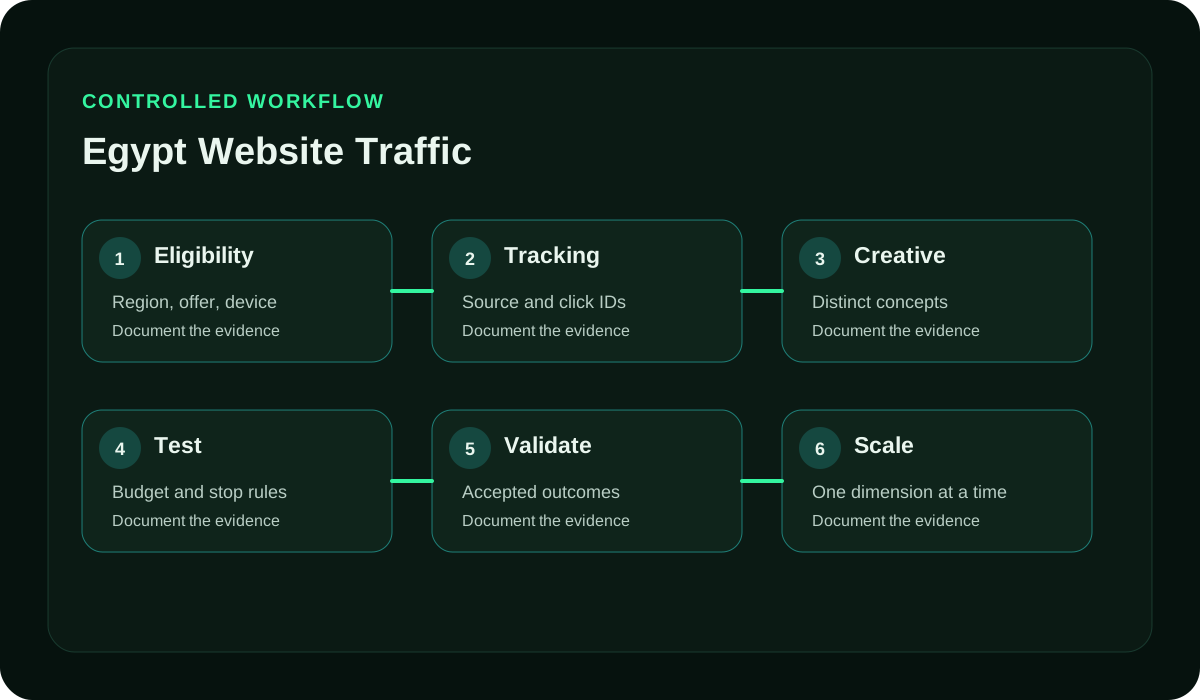
How does an Egypt launch move from eligibility to evidence?
- Define the accepted event. Write the order, lead, booking or engagement rule and the reasons a submitted event can be rejected.
- Approve each serviceable lane. Attach location, fulfilment, support and commercial evidence to every included cohort.
- Build the language path. Complete Arabic and right-to-left QA, then create a separate English lane only when it is genuinely eligible.
- Validate EGP and payment. Complete price, fee, address, payment, confirmation and complaint routes on representative devices.
- Launch a bounded FroggyAds test. Use available geography, device, format and source controls with technical and loss limits.
- Reconcile and decide. Join source data to matured back-end outcomes, then scale, hold or stop under the written rule.
An Egypt source earns budget through mature acceptance
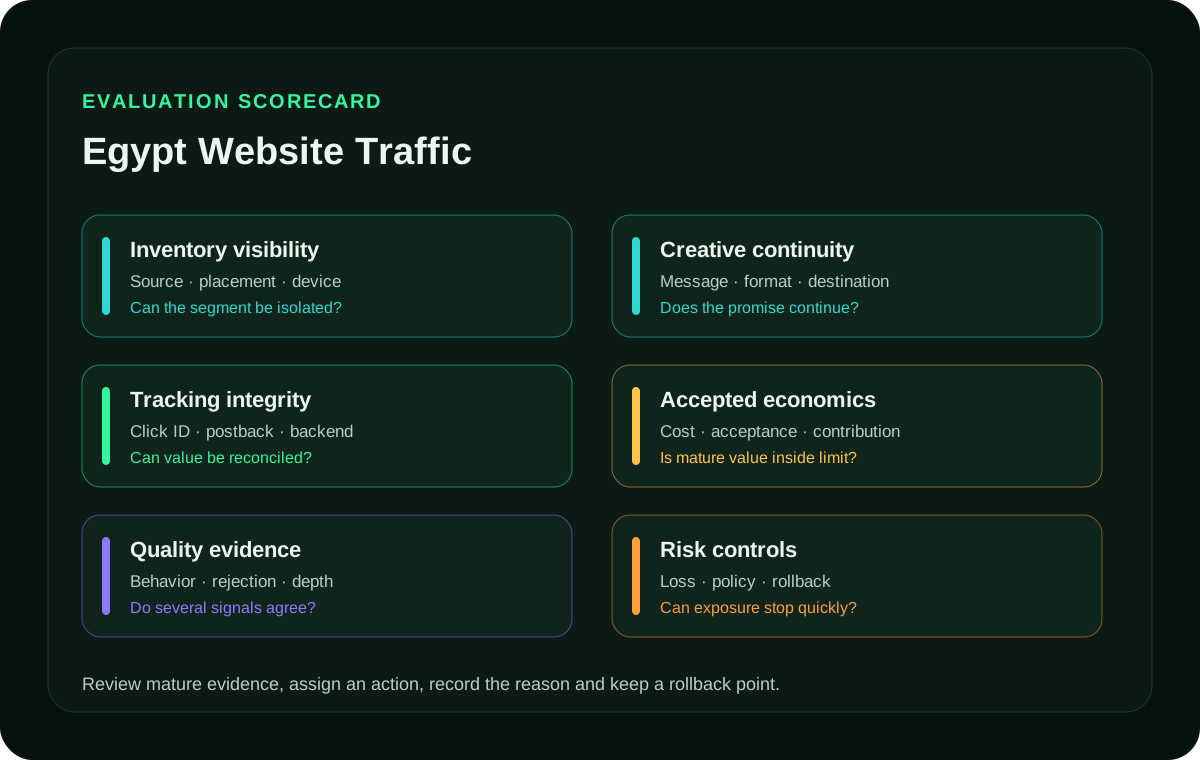
A source earns more exposure when attribution is stable, its outcome sample has matured, accepted cost fits the plan and service or language failures are controlled. Review duplicates, timing, device consistency, destination engagement, acceptance, rejection and downstream value together. A geography, language or network type is never a quality label.
Use ready, conditional, hold and stop states. Keep ready sources inside a measured increase. Cap conditional sources until the written maturity point. Hold when tracking, RTL, serviceability, payment, privacy or support is incomplete. Stop repeated breaches of the loss or acceptance rule. Investigate redirects, destination errors and attribution before calling unusual traffic invalid.
What is the commercial acceptance equation for Egypt?
Set the next-spend ceiling from the maximum acceptable EGP cost per approved event and the number of unresolved lanes. The ledger should show media spend, validated visits, submitted events, accepted events, rejection codes and delayed value for each Arabic or English cohort. A source with inexpensive clicks can still consume the ceiling quickly when payment, fulfilment or support rejects the result.
For each Egypt lane, write a downside case covering weaker acceptance, payment handoff loss, delayed review and a change in source composition. Name the person who can stop spend and the prior campaign state to restore. This is a loss-control calculation, not a forecast of Egyptian demand or future media cost.
Which FroggyAds levers can inspect a serviceable Egyptian cohort?
Open the live FroggyAds campaign builder first and confirm which geography, device, schedule, format and source controls exist for the selected Egypt lane. Across our wider platform, more than 750 SSP connections contribute to over 20 billion daily impressions; neither figure describes availability within Egypt. Treat the account view and test delivery, not global scale, as the operational evidence.
Our minimum advertiser deposit is $50, but that is not a recommended Egypt budget and does not forecast traffic or results. Build the test amount from the expected buying cost, number of source and creative cells, outcome delay and loss the business can responsibly absorb. Reserve an initial phase for technical validation before the main learning budget is released.
We do not promise a fixed number of Egyptian visitors, a particular publisher, a conversion rate or a business result. Our role is to provide practical buying and reporting controls. You provide an eligible offer, accurate Arabic or English creative, a working destination, EGP and fulfilment continuity, and a reliable acceptance decision. That shared discipline makes the campaign controllable.
When does an Egyptian cohort advance, pause or retire?
Scale only after accepted cost stays inside the planned range through a measured increase. Change one major dimension at a time, such as budget, source set, governorate, device, language or creative. Preserve a control lane and rollback point, then compare the newest spend with the validated baseline.
Hold when serviceability, Arabic RTL, English eligibility, EGP, payment, privacy, attribution or support becomes uncertain. Stop when a source repeatedly breaches the loss or accepted-quality rule. After a failed lane is corrected, assign the new landing, tracking or support version its own retest ID and acceptance threshold. Close every review with an owner, date, action and next evidence threshold.
Questions advertisers ask before an Egypt launch
What should an Egypt website-traffic plan establish first?
Define the customer action, eligible service area and offer the business can actually fulfill in Egypt. Keep the location, language, device and source context with the result so a national label does not hide an unusable route.
How should delivery coverage shape an Egyptian audience?
Translate the business's real governorate and city coverage into audience eligibility and destination wording. Exclude places the offer cannot serve, and confirm the location controls available for the selected source before buying visits.
Should Arabic and English visitors share one campaign path?
Treat them as separate language decisions when both are relevant to the offer. Each route needs accurate creative, understandable terms and a usable destination; compare completed customer actions without blending language differences into source performance.
What should right-to-left testing cover for Egyptian visitors?
Check the actual transaction path, including mixed Arabic and Latin text, numbers, fields, errors and confirmation. A visually translated page is not ready if visitors cannot understand the price or complete the requested action.
How should EGP pricing stay consistent through checkout?
Keep the advertised amount, product page, fees, shipping and checkout total understandable on the same currency basis. Show material conditions before commitment and test the payment methods the business actually supports.
Which device checks matter before sending paid visits?
Test representative phones, browsers and connection conditions through loading, consent, forms or checkout and confirmation. Preserve the source identifier so a technical failure can be distinguished from a visitor who simply did not choose the offer.
How should Egypt campaign schedules be recorded?
Use the Africa/Cairo time zone for the intended local schedule and state the reporting time basis. Check campaign, support and outcome timestamps together so timing differences do not distort daily comparisons.
Can national network or payment figures forecast campaign results?
No. They can describe part of the operating context, but they do not establish reachable advertising inventory or the advertiser's conversion rate. Use the selected source and a tested customer path to evaluate actual paid visits.
When should an Egyptian traffic source be paused?
Pause when location, source identity, redirects, measurement or customer safeguards cannot be verified, or when mature results cross the agreed loss limit. Retain the affected records and confirm the repair before restarting.
What makes an Egyptian cohort ready for a larger test?
Look for repeated accepted customer actions, workable total cost and stable fulfillment and support. Widen one source or audience boundary while keeping the original result visible, then review the added group's mature quality separately.
Match the next Egypt resource to the unresolved decision
Launch only after the Egypt evidence ledger closes
Approve the location and language lane, verify RTL, EGP and attribution, then make source-level decisions from accepted outcomes. FroggyAds gives you self-serve controls while results remain dependent on supply, offer, creative, destination, competition and optimization.
Egypt Website Traffic: the decision this URL owns
Egypt Website Traffic buyer job: Plan the market-specific test and measurement rules. Use this URL only for that decision; use Buy Website Traffic Egypt for the adjacent task.
Source evidence 1: Egypt’s Personal Data Protection Law No. In the egypt website traffic review, use this practical rule: 151 of 2020 makes a qualified privacy review part of campaign readiness. In the egypt website traffic review, use this practical rule: Map every identifier and form field, the purpose for collecting it, the applicable lawful basis, including consent when appropriate, recipients, processor instructions, security, retention, deletion and the route for individuals to exercise applicable rights. For your egypt website traffic decision, we recommend this account-team check: Review cross-border processing and marketing use with counsel familiar with the current law and implementing requirements. Before you expand egypt website traffic, confirm this point in the campaign record: Current pdpc guidance makes arabic the primary language for the privacy notice; any english version should convey the same processing.
Source evidence 2: We rebuilt this guide around Egypt-specific operating evidence. Before you expand egypt website traffic, confirm this point in the campaign record: The review replaces copied regional language with governorate and city serviceability, makes arabic the official-language readiness lane, treats english as a separate audience decision, adds right-to-left testing, uses egp, and schedules through the africa/cairo time zone. For your egypt website traffic decision, we recommend this account-team check: It also separates ntra network measurements, cbe payment context and government guidance from advertising supply or conversion claims.
Egypt Website Traffic operating boundary: Egypt Website Traffic should retain its own evidence trail. Use the page's buyer job, entity gaps and nearest related URL to decide what belongs here, then keep the campaign variable, source identity and accepted outcome specific to this URL. If a neighboring page answers a different buying question, do not merge the two decisions simply because they share an ad format or acquisition term.
| Checkpoint | Page-specific action | Evidence to retain |
|---|---|---|
| During the egypt website traffic review, our account team would ask: What should an egypt website-traffic plan establish first? | Before you expand egypt website traffic, confirm this point in the campaign record: In the egypt website traffic review, use this practical rule: Define the customer action, eligible service area and offer the business can actually fulfill in egypt. For your egypt website traffic decision, we recommend this account-team check: Keep the location, language, device and source context with the result so a national label does not hide an unusable route. | Retain campaign objective, source identity and accepted-event evidence for Egypt Website Traffic. |
| Before you scale egypt website traffic, confirm the answer to this question: How should delivery coverage shape an egyptian audience? | For your egypt website traffic decision, we recommend this account-team check: Before you expand egypt website traffic, confirm this point in the campaign record: Translate the business's real governorate and city coverage into audience eligibility and destination wording. In the egypt website traffic review, use this practical rule: Exclude places the offer cannot serve, and confirm the location controls available for the selected source before buying visits. | Retain audience targeting, source identity and accepted-event evidence for Egypt Website Traffic. |
| For your egypt website traffic plan, ask this focused buying question: Should arabic and english visitors share one campaign path? | In the egypt website traffic review, use this practical rule: For your egypt website traffic decision, we recommend this account-team check: Treat them as separate language decisions when both are relevant to the offer. Before you expand egypt website traffic, confirm this point in the campaign record: Each route needs accurate creative, understandable terms and a usable destination; compare completed customer actions without blending language differences into source performance. | Retain conversion tracking, source identity and accepted-event evidence for Egypt Website Traffic. |
Transparent decision example
Hypothetical example: For Egypt Website Traffic, if a controlled test spends USD 200 and records 8 accepted outcomes after the same review window, accepted cost is USD 25.00 per outcome. Replace the inputs with your own economics and the event definition appropriate to this page.
Why use FroggyAds for this step?
For Egypt Website Traffic, use FroggyAds to isolate the relevant source, GEO/device path and budget cell, then keep or restrict it from mature downstream evidence rather than click volume. Create your free FroggyAds account.
Egypt Website Traffic — what matters first
Egypt Website Traffic should be evaluated market by market: define eligible geography, keep measurement consistent, and scale only where accepted-outcome economics remain viable.