
Days 1–5
Define the job, owners, events, current baseline and non-negotiable controls. For cross-channel marketing platform, keep the previous stable process available until the new workflow has completed reconciliation.
Build and evaluate cross-channel marketing around shared audiences, message sequencing, frequency, measurement, permissions and channel-specific controls.
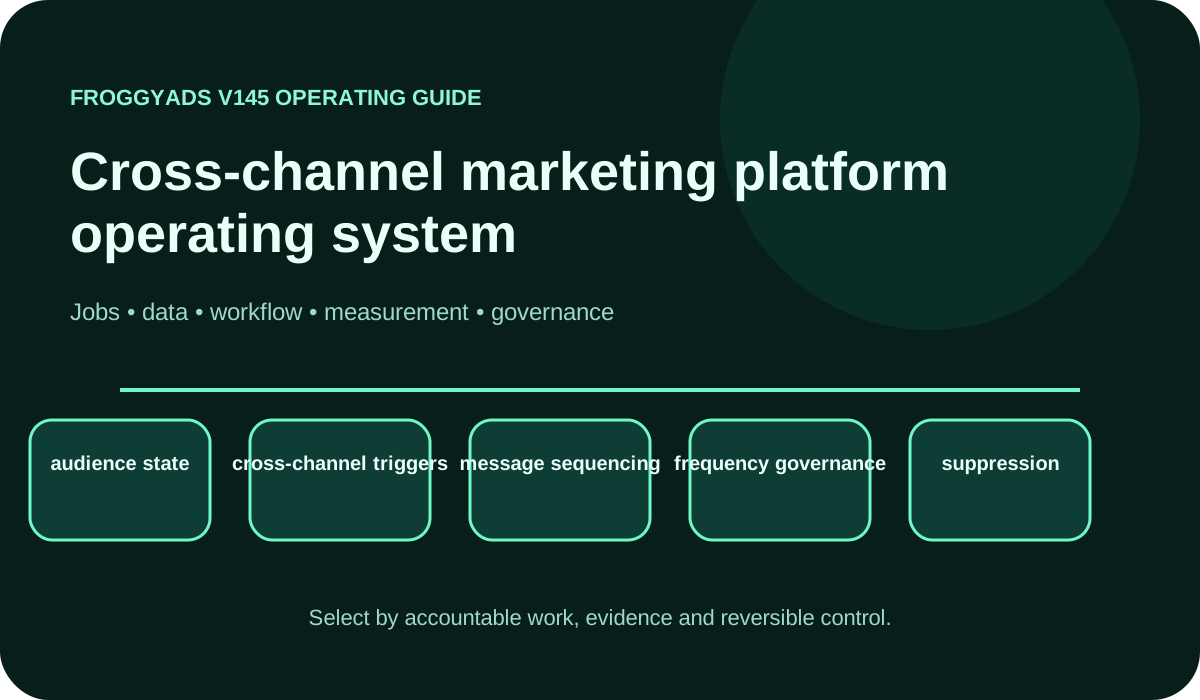
Quick answer: Build and evaluate cross-channel marketing around shared audiences, message sequencing, frequency, measurement, permissions and channel-specific controls. Cross-channel marketing platform should be defined by the operating job it owns: to coordinate actions across channels while preserving the native controls and economics of each channel. The core capability map for cross-channel marketing platform includes audience state, cross-channel triggers, message sequencing, frequency governance, suppression, channel adapters, journey reporting, and identity resolution. The measurement model for cross-channel marketing platform should include cross-channel reach, duplicate-contact rate, sequence completion, frequency violations, incremental conversion, channel assist value, latency, and suppression accuracy.
| Section | Distinct excerpt from this page |
|---|---|
| What cross-channel marketing platform means in practice | Cross-channel means channels influence one another through shared rules or journey logic. |
| Selection and proof of value | Best when customer state can be updated reliably and every channel has a defined role in the journey. |
| Failure modes and controls | The main failure modes for cross-channel marketing platform are identity overreach, conflicting channel rules, double counting, excessive frequency, slow event propagation, and unreviewed automated journeys. |
Reference for Cross-Channel Marketing Platform: Self-Serve Campaigns: Google Analytics: Traffic acquisition report.
Cross-channel marketing platform should be defined by the operating job it owns: to coordinate actions across channels while preserving the native controls and economics of each channel. That definition is more useful than a vendor category because it identifies the decisions, records and outcomes the system must support. For teams coordinating paid media, email, web, app, SMS and other customer touchpoints, the first design task is to name the accountable work, the people who perform it and the evidence that proves the work was completed correctly.
Cross-channel means channels influence one another through shared rules or journey logic. It is more than running several channels at the same time. This boundary prevents the cross-channel marketing platform from becoming an untestable promise that one product will replace every specialist system. A clear architecture identifies which platform is authoritative for customer data, campaign configuration, media delivery, creative assets, conversions, finance and final business outcomes.
The minimum viable cross-channel marketing platform is therefore not the option with the most menus. It is the option that can move a representative campaign from approved objective to measurable outcome while preserving permissions, identifiers, budget controls, data export and rollback. Any capability that cannot be observed in a real workflow should remain unscored until it is tested.
The core capability map for cross-channel marketing platform includes audience state, cross-channel triggers, message sequencing, frequency governance, suppression, channel adapters, journey reporting, and identity resolution. Each capability needs an owner, an input contract, an output contract and a failure path. For example, an audience workflow should state where eligibility is calculated, how consent or suppression is represented, where the audience is activated and how activation errors return to the operating team.
Ownership should be assigned at object level. A campaign brief, audience, creative, budget, placement, conversion event and final revenue record may live in different systems. The cross-channel marketing platform should link those objects through stable names and identifiers rather than copying them into an uncontrolled duplicate database. When the same field exists in several tools, document which value wins and how discrepancies are resolved.
Integration depth matters more than connector count. A useful integration supports the exact create, update, read, export and error-handling actions required by the workflow. Test rate limits, field mappings, permissions, deletion behavior and historical backfills. A logo in an integration gallery is not evidence that the connection supports production-grade operations. In the cross-channel marketing platform framework, this requirement is tested against the owner-specific workflow and acceptance threshold.
Use the scorecard during requirements workshops and proofs of value. A capability receives credit only when the team can complete the representative task, inspect the underlying data and recover from a failed action. In the cross-channel marketing platform framework, this requirement is tested against the owner-specific workflow and acceptance threshold.
| Capability | Operating question | Evidence required |
|---|---|---|
| audience state | Define the accountable owner and required input for audience state. | Verify a usable output, error state, export and rollback for cross-channel marketing platform. |
| cross-channel triggers | Define the accountable owner and required input for cross-channel triggers. | Verify a usable output, error state, export and rollback for cross-channel marketing platform. |
| message sequencing | Define the accountable owner and required input for message sequencing. | Verify a usable output, error state, export and rollback for cross-channel marketing platform. |
| frequency governance | Define the accountable owner and required input for frequency governance. | Verify a usable output, error state, export and rollback for cross-channel marketing platform. |
| suppression | Define the accountable owner and required input for suppression. | Verify a usable output, error state, export and rollback for cross-channel marketing platform. |
| channel adapters | Define the accountable owner and required input for channel adapters. | Verify a usable output, error state, export and rollback for cross-channel marketing platform. |
| journey reporting | Define the accountable owner and required input for journey reporting. | Verify a usable output, error state, export and rollback for cross-channel marketing platform. |
| identity resolution | Define the accountable owner and required input for identity resolution. | Verify a usable output, error state, export and rollback for cross-channel marketing platform. |
Connect the guide to live testing
Use the choices established in “Cross-channel marketing platform capability scorecard” to define one audience, budget and source set in FroggyAds. Keep the surrounding offer and measurement rule stable so the test adds evidence to cross-channel marketing platform instead of mixing several changes at once.
Create My Free Account
Implement cross-channel marketing platform as a sequence of controlled releases. Start with one representative campaign type, one team and one accepted business outcome. Record the current process before changing it, including manual steps, delays, exception paths and reports. This baseline makes it possible to distinguish genuine improvement from a dashboard that merely looks more organized.
Configure naming, roles, budgets, approval states and measurement requirements before enabling automation. Import only the data required for the first workflow, validate sample records and reconcile totals with the source systems. The first production launch should use a capped budget and a reversible setup so a failed integration, rule or permission can be isolated without disrupting every campaign. In the cross-channel marketing platform framework, this requirement is tested against the owner-specific workflow and acceptance threshold.
After the first cycle, review where the cross-channel marketing platform changed decisions or reduced errors. Expand only the capabilities that produced verified value. Keep a decommission list for old tools and manual reports; consolidation savings are not real until licenses, duplicate data flows and maintenance work are actually removed.
The measurement model for cross-channel marketing platform should include cross-channel reach, duplicate-contact rate, sequence completion, frequency violations, incremental conversion, channel assist value, latency, and suppression accuracy. Operational measures such as time to launch and error rate belong beside commercial measures such as acquisition cost and return. This prevents a platform from appearing successful because it is widely used while campaign quality or economics deteriorate.
Use a layered reporting design. Delivery systems report impressions, clicks, spend and platform events. Analytics reports sessions, attributed events and user behavior. Business systems report accepted leads, orders, revenue, refunds and margin. Reconcile the layers with stable campaign and click identifiers, documented time zones, attribution windows and currency rules. In the cross-channel marketing platform framework, this requirement is tested against the owner-specific workflow and acceptance threshold.
Report marginal results rather than only cumulative averages. A historical high-performing campaign can hide that the newest channel, creative or audience is below threshold. The cross-channel marketing platform should make recent cohorts, source-level outcomes and delayed reversals visible so budget changes are based on mature evidence.
Governance for cross-channel marketing platform begins with least-privilege roles, change history, approval rules and clear data retention. Separate the people who can create campaigns, approve spend, publish creative, change tracking and export customer data. Shared administrator accounts prevent useful accountability and increase the impact of a mistake or compromised credential.
Consent and privacy signals must survive the path from collection to activation and measurement. Do not infer permission from technical availability. Document which data is first party, which partner supplied it, the permitted purpose, the retention period and the deletion path. When a destination platform interprets a signal differently, record the limitation rather than assuming equivalence. In the cross-channel marketing platform framework, this requirement is tested against the owner-specific workflow and acceptance threshold.
Security review should cover authentication, single sign-on, API credentials, audit logs, vendor subprocessors, data location, incident response and exit procedures. A marketing system often connects to high-value advertising and customer accounts, so its compromise can create financial, reputational and privacy impact far beyond the software subscription. In the cross-channel marketing platform framework, this requirement is tested against the owner-specific workflow and acceptance threshold.
Choose the execution format
Use the criteria around “Governance, privacy and security” to decide whether push, native, display or pop fits the message and destination. Set format, targeting and spend as campaign controls in FroggyAds while the cross-channel marketing platform decision remains the standard for judging the result.
Create My Free Account
Define the job, owners, events, current baseline and non-negotiable controls. For cross-channel marketing platform, keep the previous stable process available until the new workflow has completed reconciliation.
Configure one workflow, roles, naming, integrations and a reversible data sample. For cross-channel marketing platform, keep the previous stable process available until the new workflow has completed reconciliation.
Run a capped production proof, reconcile every reporting layer and log exceptions. For cross-channel marketing platform, keep the previous stable process available until the new workflow has completed reconciliation.
Score the result, document limitations, retire duplicate work and decide the next controlled expansion. For cross-channel marketing platform, keep the previous stable process available until the new workflow has completed reconciliation.
Select cross-channel marketing platform with a weighted scorecard built before vendor demonstrations. Weight the capabilities that remove the largest verified operating constraints. Use representative data, real user roles and a small campaign in the proof of value. Require the vendor to show exports, errors, permissions and rollback, not only the ideal happy path.
Commercial comparison should include implementation, migration, training, administration, integration maintenance, usage-based fees, support and exit cost. A lower license price can be more expensive when the team builds manual workarounds or cannot recover complete historical data. Conversely, an enterprise suite can be wasteful when only one focused workflow is used. In the cross-channel marketing platform framework, this requirement is tested against the owner-specific workflow and acceptance threshold.
Best when customer state can be updated reliably and every channel has a defined role in the journey. Record the decision in plain language: the problem being solved, the evidence collected, the accepted limitations, the owner, the review date and the conditions that would trigger replacement. This turns procurement into an operating decision rather than a permanent endorsement.
The main failure modes for cross-channel marketing platform are identity overreach, conflicting channel rules, double counting, excessive frequency, slow event propagation, and unreviewed automated journeys. Convert each risk into a preventive control and a measurable warning. For example, data-lock-in risk requires a tested export, while automation risk requires change logs, approval thresholds, exclusions and a kill switch.
Do not hide exceptions inside a blended success rate. Track failed syncs, rejected assets, unmatched conversions, budget anomalies, duplicate records and permission errors as first-class operational metrics. A system that reports only completed actions encourages teams to miss the exact failures that create wasted spend or unreliable measurement. In the cross-channel marketing platform framework, this requirement is tested against the owner-specific workflow and acceptance threshold.
Maintain a rollback package for the cross-channel marketing platform: the last stable configuration, data-export procedure, credential rotation steps, fallback reporting and responsible contacts. Test the rollback before a major migration or automation release. The ability to reverse a change is part of platform quality, not an emergency-only feature.
Put the guide into practice
With “Failure modes and controls” documented, launch only the next reversible test. Set a spending limit, preserve the baseline and use source-level and audience controls so the next step depends on qualified outcomes for cross-channel marketing platform, not activity volume.
Create My Free Account
Document the cross-channel marketing platform in a form that people and AI systems can quote accurately. Define the category in the first paragraph, state what the system owns, distinguish it from adjacent categories and provide named inputs, outputs, metrics and decision rules. Avoid unsupported “best,” “automatic” or “all-in-one” claims unless the page also states the evaluation criteria and limitations.
Use stable canonical URLs, descriptive headings, visible answers, comparison tables, FAQs and source links. Keep dates meaningful by updating the page when capabilities, policies or standards actually change. A scripted freshness date without substantive review creates a weaker trust signal than an older page with clear evidence and scope. In the cross-channel marketing platform framework, this requirement is tested against the owner-specific workflow and acceptance threshold.
For GEO discoverability, make claims independently understandable. A quoted paragraph should identify the subject, the operating condition and the evidence required. This structure helps search engines, assistants and procurement teams distinguish a practical framework from promotional language. In the cross-channel marketing platform framework, this requirement is tested against the owner-specific workflow and acceptance threshold.
Start with a narrow campaign, one accepted conversion and source-level reporting. Keep total acquisition cost and mature value outside the ad platform as the final decision layer. This preserves an honest boundary between media delivery and the wider cross-channel marketing platform stack.
A high-quality decision about cross channel marketing platform needs more than a feature comparison. The workbook below converts the search intent into a documented operating decision.
List every job that cross-channel marketing platform must support, the user who performs it, the input required, the expected output and the current failure. Separate mandatory requirements from preferences. A requirement such as “easy to use” is not testable until it is rewritten as a representative task, a completion condition and a maximum acceptable time. Keep unsupported future ideas outside the first score so the shortlist reflects the work that actually exists.
For cross channel marketing platform, name the authoritative system for campaigns, audiences, assets, spend, events, attributed conversions and accepted revenue. Record the identifiers used to join those layers, the expected update interval and the owner of every discrepancy. Test export before purchase, including deleted records, historical data and API limits. Data portability is not proven by a CSV button that omits relationships, status history or the fields needed for reconciliation.
Run one complete cross-channel marketing platform workflow with realistic users and constraints. Begin with an approved objective, create the required assets or configuration, apply permissions, launch a capped activity, capture errors and reconcile the result. Include at least one exception such as a rejected asset, missing event or budget change. The simulation should reveal where users leave the system, create shadow spreadsheets or depend on undocumented administrator intervention.
Calculate the full operating cost of cross channel marketing platform. Include license or media fees, implementation, migration, training, administration, integration maintenance, reporting work, support and expected exit cost. Compare that total with measurable value from faster launches, fewer errors, better budget control, higher accepted conversion value or tools that can be retired. Avoid assigning value to automation unless the team can show which manual work disappears and how quality is protected.
Approve cross-channel marketing platform only when the proof of value meets written thresholds. The gate should cover required workflow completion, permission behavior, data reconciliation, export completeness, support response, accessibility where applicable, security review and total cost. Document accepted limitations and the controls that contain them. A persuasive demonstration or early click result should not override a failed data, governance or business-value requirement.
Review cross channel marketing platform after adoption with the same evidence used at selection. Check active-user behavior, unused modules, failed integrations, stale permissions, automation changes, reporting variance and whether marginal campaigns still meet threshold. Revalidate source documentation when platform policies or standards change. Keep a replacement trigger and a tested export so the organization can renegotiate or migrate without losing the history required for measurement and compliance.
It should solve a named coordination problem such as audience state, consent, scheduling, reporting, or handoffs across selected channels. Buying a broad feature list without a priority makes adoption difficult to judge.
Match must-have use cases, channel coverage, data controls, integrations, permissions, export needs, support, and budget to a small set. Reject tools that cannot demonstrate the critical workflow with realistic data.
Clarify system of record, permitted fields, consent source, identity matching, retention, deletion, export, vendor access, and error correction. Each important record needs an accountable owner outside the sales demo.
Use a real but limited audience state, two or three channels, a measurable handoff, consent rules, and an expected report. Include failure cases so the team sees how retries and conflicting data are handled.
Implementation, connectors, data volume, services, training, creative operations, analytics, security review, support tiers, and migration can all matter. Estimate the workload that remains with the internal team.
Use least privilege, separate creation from approval where appropriate, log material changes, protect exports, and review access after role changes. Sensitive audience and consent data should not be broadly editable.
Keep raw channel events, definitions, attribution rules, identity uncertainty, and deduplication visible beneath combined dashboards. A unified view should reconcile sources rather than erase their differences.
Trace trigger eligibility, audience state, consent, connector status, field mapping, rate limits, channel response, retries, and logs. Use a known test record before changing the full automation.
Test data and asset export, document schemas and workflows, retain source-system ownership, avoid undocumented custom logic, and plan a realistic exit. Portability should be proven before critical operations depend on the tool.
Expand after the pilot works reliably, users can operate it, permissions and data controls pass review, reporting reconciles, and ownership is clear. Add teams or channels in stages with support available.
The framework is grounded in primary documentation for campaign controls, analytics, consent, measurement and advertising standards. Vendor capabilities should still be verified directly during procurement. In the cross-channel marketing platform framework, this requirement is tested against the owner-specific workflow and acceptance threshold.
When Cross-Channel Marketing Platform feeds a paid-acquisition workflow, FroggyAds provides self-serve campaign setup, source controls, conversion tracking and source-level reporting.
Create My Free AccountTreat Cross-Channel Marketing Platform: Coordinate Journeys Without Losing Channel Truth as an operating page for performance-focused advertisers, not as a synonym page. Its job is to help you evaluate a platform by media controls, tracking and source-level evidence, with the evidence kept against this exact decision. The nearest related FroggyAds page is Cross Channel Marketing; this URL keeps ownership of the distinct task to evaluate a platform by media controls, tracking and source-level evidence.
Keep campaign objective, audience targeting, bid, source quality in the Cross-Channel Marketing Platform: Coordinate Journeys Without Losing Channel Truth evidence record because they can change how this media test is configured, measured or scaled.
| Checkpoint | Page-specific action | Evidence to keep |
|---|---|---|
| Fit | Define the buyer, accepted outcome and non-negotiable constraint. | Retain evidence specific to Cross-Channel Marketing Platform: Coordinate Journeys Without Losing Channel Truth and its accepted outcome. |
| Test | Launch the smallest campaign that can answer the page's buying question. | Retain evidence specific to Cross-Channel Marketing Platform: Coordinate Journeys Without Losing Channel Truth and its accepted outcome. |
| Decision | Keep, cap, exclude or expand from accepted-outcome evidence. | Retain evidence specific to Cross-Channel Marketing Platform: Coordinate Journeys Without Losing Channel Truth and its accepted outcome. |
Hypothetical calculation: if a controlled campaign for cross-channel marketing platform: coordinate journeys without losing channel truth spends USD 300 and produces 6 accepted conversions, accepted CPA is USD 300 / 6 = USD 50.0. Replace the inputs with your own campaign economics; this is not a FroggyAds performance claim.
When Cross-Channel Marketing Platform: Coordinate Journeys Without Losing Channel Truth moves from research to a traffic test, FroggyAds lets performance-focused advertisers control targeting, budget and source decisions from one self-serve workflow while downstream conversions remain the commercial proof. Create your free FroggyAds account.
Cross-Channel Marketing Platform: Coordinate Journeys Without Losing Channel Truth is most useful when it helps a buyer decide whether this option fits the buyer's acquisition workflow. Define the accepted outcome first, then use targeting, budget and source-level evidence to decide what deserves more spend.