
Chile Website Traffic
Plan Chile website traffic around serviceable regions, a Spanish-ready user journey, mobile-first quality checks, Chilean local time, prices in Chilean pesos and source-level accepted outcomes. FroggyAds gives advertisers self-serve controls for a measured Chile test without promising inventory, conversions or profit.
What is Chile website traffic?
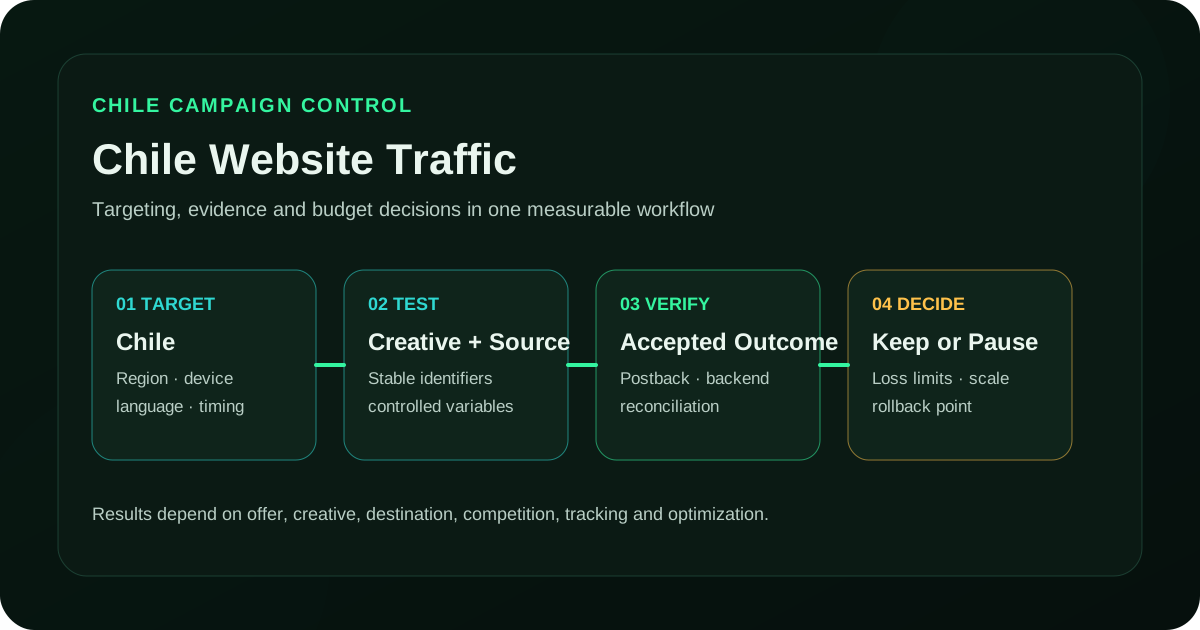
Chile website traffic is the measurable flow of people in Chile who reach a website through paid or owned digital channels. For an advertiser, the useful unit is not a national visit total. It is a serviceable Chilean audience whose region, language path, device experience, local-time context, source identifiers and accepted business outcome remain connected from the advert to the advertiser's backend.
FroggyAds advertisers can build a controlled Chile campaign with available geographic, device, format, budget and source controls. The advertiser still owns the offer, creative, destination, price, fulfilment, data use and conversion definition. A high click count is not proof of Chile traffic quality, and public connectivity figures do not establish live FroggyAds inventory. Start with one prepared cohort, a written loss limit and a verified outcome, then expand only after the evidence remains acceptable.
What do Chile's official internet figures tell an advertiser?
Official Chilean figures show that internet access is widespread, but they do not predict how many Chile website visitors a campaign will receive. The National Statistics Institute, INE, reported from the 2024 Census that 93.2% of households had some type of internet service. SUBTEL's separate 2025 survey reported 96.6% household access under a question about the household's own paid fixed or mobile connection. The year, question and collection method differ, so the two percentages should remain separately labelled.
The same sources show why a single national assumption is weak. INE reported higher 2024 household access in Antofagasta, Metropolitana and Tarapacá than in Ñuble, La Araucanía and Maule. SUBTEL reported 96.8% in urban areas and 95.1% in rural areas in its 2025 survey. The survey separately reported 95.7% smartphone use among people in its user question. These differences justify regional and device testing. They do not justify excluding a region, estimating conversion rate or claiming that one region contains better traffic.
| Source and period | Reported finding | Correct campaign use | Do not infer |
|---|---|---|---|
| INE Census 2024 | 93.2% of households reported some internet service. | Use as dated national connectivity context. | Do not treat it as FroggyAds reach or an audience forecast. |
| INE regional results | Reported household access varied among regions. | Keep selected regions visible in reporting and serviceability checks. | Do not label a region as high or low quality from access alone. |
| SUBTEL survey 2025 | 96.6% reported own paid fixed or mobile access at home. | Use the survey's stated question and year when citing the figure. | Do not merge it with the Census percentage. |
| SUBTEL user evidence | 95.7% smartphone use was reported under the survey's user question. | Make mobile destination QA a launch gate. | Do not assume every offer should be mobile-only. |
How should Chile regional campaign targeting be planned?
Chile regional campaign targeting should begin with the advertiser's ability to serve the selected area. Confirm where the product can be delivered, where the service operates, whether a lead can be handled, which support hours apply and whether the final price and material conditions are accurate for that destination. A campaign should not pay to discover that a known region is outside the fulfilment plan.
Group regions only for operational research. A north, central, south or far-south lane is not a claim that people inside it behave alike. Keep the actual region code where available, and keep city or other supported location detail when it changes availability. If live platform controls are broader than the business service area, narrow the offer path or hold the campaign until the mismatch is resolved.
| Planning lane | Example regions to verify | Pre-launch evidence | Hold condition |
|---|---|---|---|
| North | Arica y Parinacota, Tarapacá, Antofagasta and Atacama | Delivery or service coverage, Spanish destination, price and support path are confirmed. | The offer cannot be fulfilled or a material regional term is missing. |
| Central | Coquimbo, Valparaíso, Metropolitana, O'Higgins and Maule | City or region settings fit the actual service boundary and capacity. | Broad delivery would include known unsupported locations. |
| South | Ñuble, Biobío, La Araucanía, Los Ríos and Los Lagos | Mobile path, delivery terms and response process have been tested. | The final journey changes or fails for the selected region. |
| Far south | Aysén and Magallanes | Permanent UTC-3 operations, serviceability and local support timing are recorded. | The schedule assumes the same seasonal clock as most other continental regions. |
Connect the guide to live testing
Connect Chile Website Traffic to a controlled audience test
Use the choices established in “How should Chile regional campaign targeting be planned?” to define one audience, budget and source set in FroggyAds. Keep the surrounding offer and measurement rule stable so the test adds evidence to chile website traffic instead of mixing several changes at once.
Create My Free Account
Which Spanish information must a Chile consumer campaign provide?
For a consumer offer in Chile, the basic commercial information must be provided in Spanish under Chile's Consumer Law. Language readiness therefore covers the advertisement, landing page, form, validation messages, checkout, confirmation, consent text and follow-up. A Spanish advert still creates a broken experience when the form errors, price conditions or customer support cannot be understood by the intended Chilean customer.
Write for the actual offer rather than adding Chilean words to generic copy. State who the advertiser is, what is being offered, the total price and material conditions, and the next step. Claims must be supportable, verifiable and not misleading. Review consequential wording with a competent Spanish reviewer. Do not invent local endorsements, imply a Chilean office that does not exist or use flags and landmarks as a substitute for product information.
Give every creative concept a stable identifier. Record its language, proposition, format, destination version and activation time. Compare different benefits or use cases within the same prepared language path. Minor colour changes are not separate hypotheses, and a translated concept that changes the commercial promise must be evaluated as a new creative.
Why does mobile-first QA matter for Chile website visitors?
Mobile-first QA matters because SUBTEL's 2025 survey reported 95.7% smartphone use under its user question, but the correct action is to test the journey rather than assume a result. Load the real advert-to-outcome path on representative smartphones. Check initial response, readable text, tap targets, keyboard behaviour, field validation, address entry, price display, payment or signup, confirmation and support contact.
Test under a slower connection profile as well as office broadband. Reserve image dimensions, compress media and avoid scripts that block the first useful action. A destination that looks good on a desktop can lose Chile website visitors when a consent banner covers the button, a regional selector cannot be used by touch, or a checkout field rejects a valid local entry.
Keep desktop evidence too. Some considered purchases, business forms and software actions may complete differently on larger screens. Segment device results only after tracking is stable and outcome delay has matured. If a device fails a required step, pause or repair that device path instead of labelling all paid traffic in Chile as unsuitable.
Which Chilean time should campaign reporting use in August 2026?
On 15 August 2026, most of continental Chile is on its winter clock, while Aysén and Magallanes remain permanently on UTC-3. Chile's Decreto 98, published in July 2026, sets the next 60-minute advance for Chile Continental and Chile Insular Occidental from the first Saturday of September 2026 until the first Saturday of April 2027. One copied national offset is therefore unsafe.
Store event timestamps in UTC, retain the user's supported geographic field and convert reports to the correct local civil time for operational decisions. Recheck the official rule before launch and after a clock change. Align delivery with destination availability, sales or support capacity and conversion delay. A late-evening click may create an accepted outcome the next day, so daypart conclusions need the same time basis across FroggyAds, analytics and the backend.
| Audience location | Current planning rule | Required campaign control |
|---|---|---|
| Most continental regions | Winter time applies on the review date; a 60-minute advance begins on the first Saturday of September 2026. | Use the current official rule and recheck schedules at the transition. |
| Aysén and Magallanes | Permanent UTC-3 applies. | Do not copy the seasonal schedule used for most other continental regions. |
| Chile Insular Occidental | A separate official clock treatment applies, with the next 60-minute advance also scheduled from the first Saturday of September 2026. | Verify the actual territory and named time zone before delivery. |
| Reporting systems | Platforms may store or display timestamps on different bases. | Document UTC storage, local conversion and the conversion window. |
How should CLP pricing and Chilean e-commerce readiness be checked?
Chile's national currency is the Chilean peso. Chilean consumer rules require basic price information in legal-tender currency, so the commercial path should present the relevant price in Chilean pesos, commonly identified as CLP. A supplemental foreign-currency reference must not obscure the legal-tender price or the amount the consumer will pay. Never use an invented country-name currency, and do not hide conversion, delivery or other mandatory charges behind the advertising click.
SERNAC's e-commerce guidance says consumers should receive relevant information before purchase, including seller identity, the total price with delivery and other charges, payment terms and means, delivery or pickup conditions, stock status and important product characteristics. Translate those requirements into a destination checklist. The advert, landing page and checkout should describe the same real offer. A service campaign should apply the same principle to coverage, eligibility, recurring terms and the point at which a charge begins.
Commerce readiness is not proof that traffic will convert. It removes known destination failures so source evidence can be interpreted. Record the destination version and test a complete order or lead path before buying meaningful delivery. When stock, price, service area or fulfilment changes, review the creative and landing page together.
| Gate | Evidence to record | Action if missing |
|---|---|---|
| Seller and offer identity | The responsible seller or provider and the real product or service are clear. | Hold the campaign until the destination identifies the transaction. |
| Price and currency | The legal-tender CLP price, total price and mandatory charges are disclosed. | Correct the advert and checkout before traffic resumes. |
| Stock or serviceability | Availability for the selected region is current. | Exclude unsupported areas or pause the offer. |
| Delivery and support | Timing, collection, fulfilment and contact path are understandable in Spanish. | Repair the customer path before increasing spend. |
| Completion test | A representative mobile transaction or lead reaches confirmation and backend acceptance. | Treat the path as technically unready. |
Choose the execution format
Choose a paid-media format that supports Chile Website Traffic
Use the criteria around “How should CLP pricing and Chilean e-commerce readiness be checked?” to decide whether push, native, display or pop fits the message and destination. Set format, targeting and spend as campaign controls in FroggyAds while the chile website traffic decision remains the standard for judging the result.
Create My Free Account
Which Chilean privacy-law date belongs in the campaign brief?
On 15 August 2026, Chile's Law 19.628 remains the current personal-data framework and stays current through 30 November 2026. Law 21.719, which changes that framework and creates a personal-data protection agency, takes effect on 1 December 2026. A campaign reviewed in August must not present the future version as already in force. It should record the current rule, the forthcoming transition and the person responsible for checking the live requirements at launch.
Map the data collected from the click through the accepted outcome. Record the campaign and click identifiers, form fields, consent or other basis relied upon, processors, access, retention, deletion and user-request path. Collect only fields needed for the stated purpose. A FroggyAds targeting setting does not complete the advertiser's privacy review, and this operational checklist is not a substitute for qualified legal advice.
Review regulated products and sensitive claims separately. Finance, health, gambling, alcohol, political advertising and age-restricted offers can require additional checks. If the team cannot verify a material rule or claim, hold the relevant campaign rather than using paid traffic to test compliance.
What should the first FroggyAds Chile order contain?
At FroggyAds, we recommend treating the first Chile order as a controlled operating record, not as a request for an undefined national traffic total. Our platform supplies the available buying controls, while the advertiser supplies the serviceable offer, reviewed customer path, acceptance definition and commercial limit. The following sequence keeps those responsibilities connected:
- Name one serviceable region lane. Record the actual region or supported city boundary, the offer available there, fulfilment or support capacity and the named Chile time zone used for delivery and reporting.
- Approve the Spanish and CLP journey. Check the advert, landing page, form, material conditions, total price, stock or service availability, transaction step and confirmation on a representative mobile device.
- Choose a live format and control set. In the FroggyAds campaign builder, confirm which Chile geography, format, device, schedule and source controls are currently available. Do not turn a platform option into a promise of inventory.
- Verify the evidence chain. Pass campaign, creative, source, placement and click identifiers into the destination, test the recorded event and connect it to the backend rule for acceptance, rejection or duplication.
- Fund a bounded learning plan. The current $50 advertiser minimum deposit is account funding, not a guaranteed test size or result. Set daily and total limits from the value of an accepted outcome, expected delay and maximum tolerable loss.
- Launch, mature and decide. Keep the first source set narrow enough to diagnose, allow the declared outcome window to mature, then keep, reduce, hold or expand one dimension with a dated reason and rollback point.
We use this order because each step creates evidence needed by the next one. If a Chile service lane, Spanish transaction, CLP price, clock rule or accepted-event path is still unknown, our recommendation is to hold that cohort before spend rather than hide the gap inside a larger campaign.
How is this Chile campaign guidance kept current?
Our Editorial Team keeps dated facts separate from live buying decisions. For this 15 August 2026 review, INE's 2024 Census supplies the 93.2% household-service context, while SUBTEL's separate 2025 survey supplies its 96.6% household-access result and 95.7% smartphone-use result. We retain each source name, period and denominator instead of blending the figures into a synthetic market score.
The same dated method applies to Chile's clock and legal transition. Decreto 98 supports the next September 2026 clock change and the separate permanent UTC-3 treatment for Aysén and Magallanes. Law 19.628 remains the current personal-data framework on the review date; Law 21.719 is recorded as taking effect on 1 December 2026. SERNAC and the applicable consumer rules anchor the Spanish, legal-tender price, seller, delivery, stock and claim-verification checks.
Before an advertiser launches, we recommend checking the current official rule and the live FroggyAds campaign builder again. Regulations, inventory, source availability, bids and service conditions can change after publication. The page therefore gives a reproducible decision method, not a frozen promise about traffic volume, price or performance.
Put the guide into practice
Turn Chile Website Traffic into a bounded campaign test
With “How is this Chile campaign guidance kept current?” documented, launch only the next reversible test. Set a spending limit, preserve the baseline and use source-level and audience controls so the next step depends on qualified outcomes for chile website traffic, not activity volume.
Create My Free Account
How can FroggyAds support a controlled Chile traffic test?
FroggyAds provides a self-serve advertiser platform with access to programmatic supply through 750+ SSP integrations and more than 20 billion daily impressions across supported markets and formats. Available controls can include GEO, city, device, operating system, browser, carrier, category, source, ID and IP settings, depending on the selected supply and format. Supported formats can include push, in-page push, native, display, pop and direct-click inventory where available.
Those platform capabilities create options, not guaranteed Chile inventory or business results. Open the live campaign builder and confirm the selected geography, format and controls before finalizing the plan. The current advertiser minimum deposit is $50. It funds media buying; it is not a setup fee that promises a number of visits or conversions, and it may not be enough for a statistically useful test. Set the learning budget from the expected outcome value, conversion delay, number of source or creative cells and maximum acceptable loss.
Build the first campaign around one serviceable Chile cohort and one accepted outcome. Upload reviewed creative, connect the correct Spanish destination, preserve the campaign and source identifiers, test the live click, confirm the callback or recorded outcome, and set daily plus total caps. FroggyAds supplies the buying and reporting controls. The advertiser's backend determines whether the delivered visit became an accepted lead, sale, signup, install or other business event.
How should paid traffic in Chile be tracked and judged?
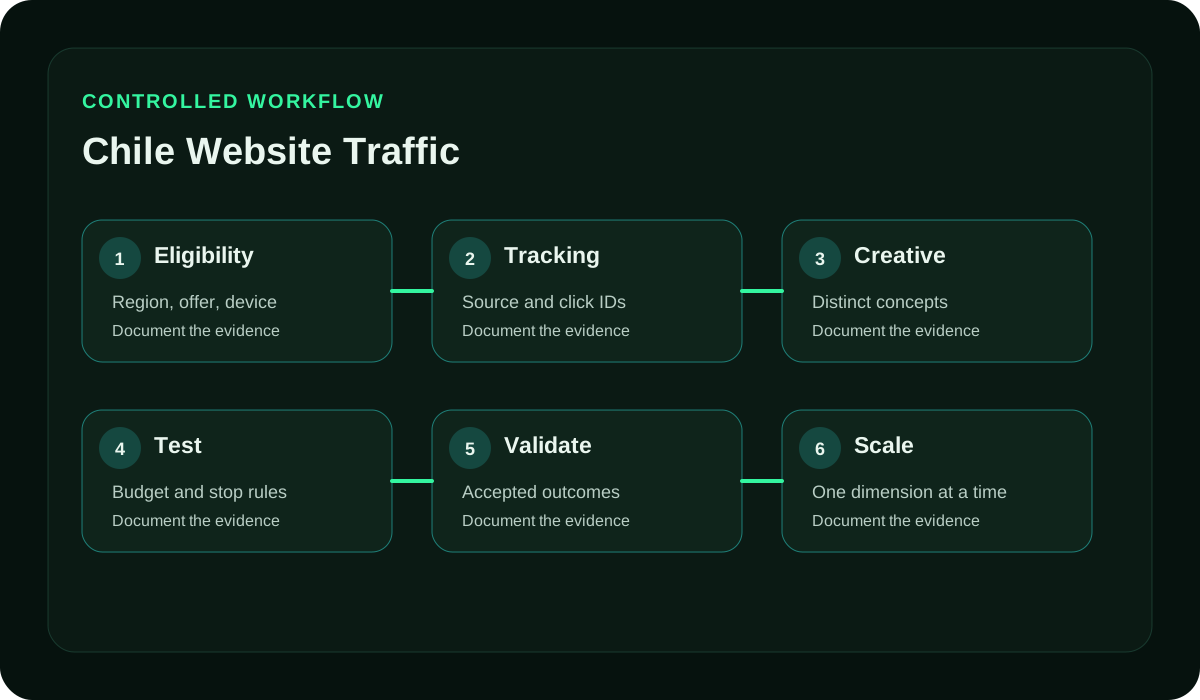
Paid traffic in Chile should carry campaign, region, creative, format, source, placement, device and click identifiers through the destination. Store those fields with the submitted event and connect them to a validated outcome through a server-to-server postback or another supported method. Keep test events separate from live events. Document attribution window, duplicate treatment, UTC and local-time conversion, currency and the exact acceptance rule.
Judge Chile traffic quality with several signals. Compare repeated or abnormal event patterns, destination engagement, form progression, outcome delay, duplicate rate, backend rejection, cancellation or refund where relevant, and downstream value. Investigate tracking, redirect and destination errors before deciding that a source is invalid. A public regional connectivity rate, one engagement metric or one early conversion cannot establish source quality.
Use the narrowest mature denominator. Cost per click helps explain media delivery, while cost per accepted outcome connects delivery to business value. A submitted lead that cannot be served in its region should not receive the same value as an accepted customer. When acceptance takes several days, separate recent spend from mature cohorts so a temporary reporting delay does not trigger the wrong exclusion.
| State | Evidence | FroggyAds action | Backend check |
|---|---|---|---|
| Ready | Serviceable region, working Spanish path, verified IDs and mature accepted cost. | Keep delivery stable or raise one controlled dimension. | Confirm acceptance and downstream value remain inside the limit. |
| Conditional | Known device, time, region or fulfilment limit is measurable and contained. | Narrow targeting, schedule or source exposure. | Verify the condition does not create rejected outcomes. |
| Observe | Tracking works, but conversion delay or sample maturity is incomplete. | Hold major changes and protect the remaining test budget. | Wait for the declared acceptance window. |
| Reduce | Cost is weakening while the cause remains testable. | Lower exposure at the narrowest supported source or placement level. | Check destination and rejection evidence before a final decision. |
| Hold | Price, serviceability, tracking, claim or data responsibility is unresolved. | Pause the affected cell. | Require a documented correction and live retest. |
| Stop | The declared loss or compliance threshold has been crossed. | Stop delivery and preserve the report. | Do not restart without a new hypothesis and rollback point. |
When should Chile website traffic scale?
Scale Chile website traffic only after the selected cohort remains serviceable, attribution is stable, accepted acquisition cost is inside the written limit and performance survives a measured increase. Raise one major dimension at a time, such as daily cap, bid, source set, region or creative volume. Preserve a control cohort and a rollback point so the team can see whether the new exposure changed source mix or outcome quality.
Compare the newest spend with the mature baseline. A stable lifetime average can hide weakening marginal delivery, destination fatigue or a fulfilment backlog. Stop increasing exposure when recent accepted cost crosses the limit, tracking maturity falls behind spend, or customer operations cannot process the volume. Scaling should buy more validated opportunity, not simply a larger dashboard total.
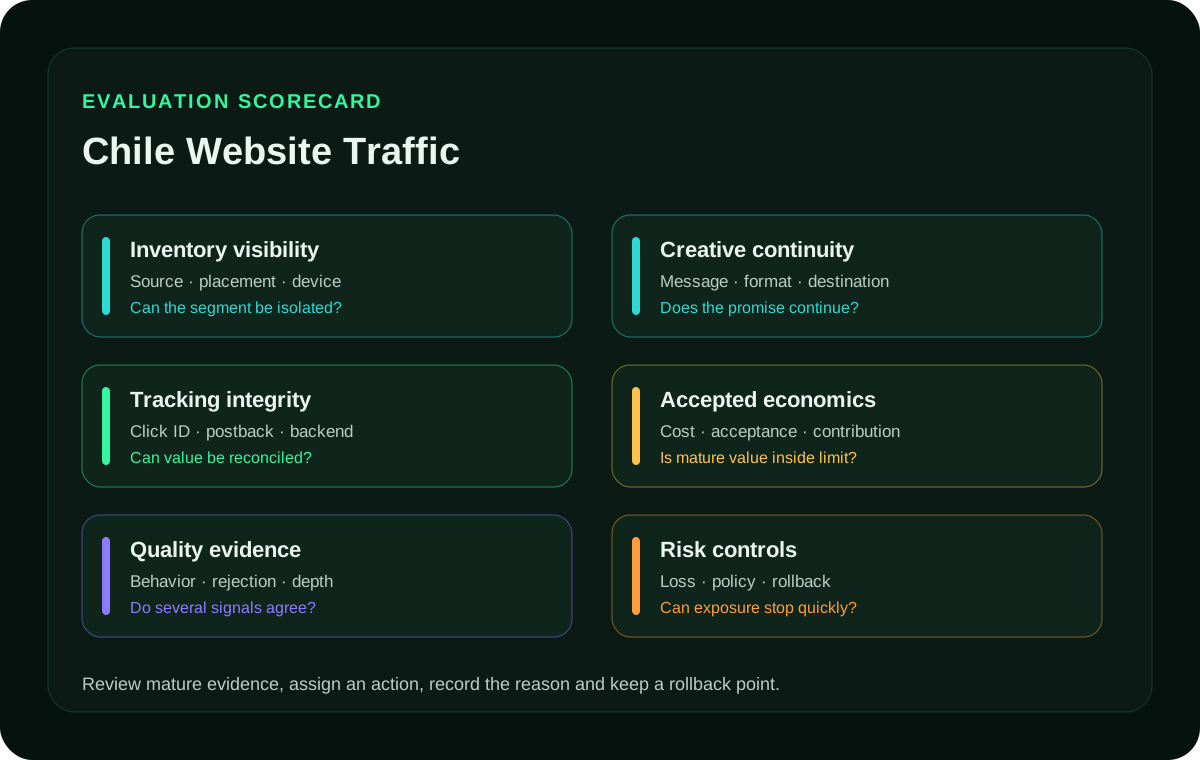
The scorecard below should be readable as text as well as an image: Spanish continuity, CLP price and checkout, stock or serviceability, correct 2026 local-time handling, a named privacy owner, source evidence and accepted-outcome economics must all be ready or explicitly conditional. Any unresolved material gate puts the cohort on hold.
Continue the Chile traffic workflow
Chile Website Traffic FAQ
For Chile Website Traffic, what should be defined before buying website traffic in Chile?
Set the offer's eligible audience, countries and regions, language, devices, source rules, campaign dates, accepted action, budget caps, and attribution. Confirm the page and support can actually serve people in Chile.
For Chile Website Traffic, how can paid visits be verified as Chilean?
Use provider country data alongside IP-derived location from an appropriate service, time zone, device, source, and accepted-customer records. Allow for travel, networks, and imperfect geolocation rather than claiming certainty.
For Chile Website Traffic, when does Spanish-language creative help in Chile?
Spanish usually helps when it reflects the audience's real language and the landing page, service, terms, and support continue it naturally. Local review is better than a literal translation or borrowed regional slang.
For Chile Website Traffic, which device patterns deserve attention in Chile campaigns?
Review the delivered mobile and desktop mix, operating systems, browsers, connection performance, page speed, form usability, and accepted outcomes. Use campaign evidence rather than assuming a national device preference.
For Chile Website Traffic, what page checks should happen before Chile traffic starts?
Test load speed from relevant locations, mobile layout, Spanish copy, prices and eligibility, forms, local contact details, consent, tags, confirmation, and the promised action. Fix broken paths before judging media.
For Chile Website Traffic, which result should guide the Chile traffic review?
Choose an accepted business event appropriate to the offer and compare its complete cost by source, region, device, and creative. Visits establish delivery; they do not show that the campaign reached suitable customers.
For Chile Website Traffic, what evidence helps explain an unusual pattern in Chilean traffic?
Examine source, placement, IP-derived location, device, browser, timing, session path, page response, and accepted events. Check tags and hosting first, preserve records, and ask the provider for supporting detail.
For Chile Website Traffic, when should a Chile traffic source lose budget?
Reduce a specific source after evidence shows wrong geography, unsuitable context, invalid delivery, or persistently poor accepted outcomes with technical faults excluded. Document the segment instead of pausing Chile broadly.
For Chile Website Traffic, can one national average represent every Chilean region?
No. Delivery, audience needs, connectivity, logistics, language nuance, and offer eligibility can vary. Keep regional data when volume supports it and avoid conclusions where the sample is too small.
For Chile Website Traffic, which signs justify a larger Chile traffic campaign?
A larger Chile campaign is sensible after identified placements consistently reach people the offer can serve and generate qualified outcomes through a reliable Spanish experience at sound overall economics. Extend one region or device segment and review it separately.
Launch a controlled Chile website traffic test
Create a FroggyAds advertiser account, select one serviceable region cohort, verify the Spanish mobile journey, record the correct local-time rule, preserve source IDs and protect the budget with a written stop. Expand only when accepted business evidence supports the next step.
Chile Website Traffic: the decision this guide addresses
Chile Website Traffic buyer job: Plan the market-specific test and measurement rules. Use this URL only for that decision; use Buy Website Traffic Chile for the adjacent task.
Source evidence 1: Those platform capabilities create options, not guaranteed Chile inventory or business results. For your chile website traffic decision, we recommend this account-team check: Open the live campaign builder and confirm the selected geography, format and controls before finalizing the plan. The current advertiser minimum deposit is $50. In the chile website traffic review, use this practical rule: It funds media buying; it is not a setup fee that promises a number of visits or conversions, and it may not be enough for a statistically useful test. Before you expand chile website traffic, confirm this point in the campaign record: Set the learning budget from the expected outcome value, conversion delay, number of source or creative cells and maximum acceptable loss.
source evidence 2: official chilean figures show that internet access is widespread, but they do not predict how many chile website visitors a campaign will receive. Before you expand chile website traffic, confirm this point in the campaign record: The national statistics institute, ine, reported from the 2024 census that 93.2% of households had some type of internet service. For your chile website traffic decision, we recommend this account-team check: The year, question and collection method differ, so the two percentages should remain separately labelled.
Chile Website Traffic operating boundary: Chile Website Traffic should retain its own evidence trail. Use the page's buyer job, entity gaps and nearest related URL to decide what belongs here, then keep the campaign variable, source identity and accepted outcome specific to this URL. If a neighboring page answers a different buying question, do not merge the two decisions simply because they share an ad format or acquisition term.
| Checkpoint | Decision action | Evidence to retain |
|---|---|---|
| During the chile website traffic review, our account team would ask: For chile website traffic, what should be defined before buying website traffic in chile? | Before you expand chile website traffic, confirm this point in the campaign record: For your chile website traffic decision, we recommend this account-team check: Set the offer's eligible audience, countries and regions, language, devices, source rules, campaign dates, accepted action, budget caps, and attribution. In the chile website traffic review, use this practical rule: Confirm the page and support can actually serve people in chile. | Retain campaign objective, source identity and accepted-event evidence for Chile Website Traffic. |
| Before you scale chile website traffic, confirm the answer to this question: For chile website traffic, how can paid visits be verified as chilean? | For your chile website traffic decision, we recommend this account-team check: In the chile website traffic review, use this practical rule: Use provider country data alongside ip-derived location from an appropriate service, time zone, device, source, and accepted-customer records. Before you expand chile website traffic, confirm this point in the campaign record: Allow for travel, networks, and imperfect geolocation rather than claiming certainty. | Retain audience targeting, source identity and accepted-event evidence for Chile Website Traffic. |
| For your chile website traffic plan, ask this focused buying question: For chile website traffic, when does spanish-language creative help in chile? | In the chile website traffic review, use this practical rule: Before you expand chile website traffic, confirm this point in the campaign record: Spanish usually helps when it reflects the audience's real language and the landing page, service, terms, and support continue it naturally. For your chile website traffic decision, we recommend this account-team check: Local review is better than a literal translation or borrowed regional slang. | Retain conversion tracking, source identity and accepted-event evidence for Chile Website Traffic. |
Transparent decision example
Hypothetical example: For Chile Website Traffic, if a controlled test spends USD 125 and records 9 accepted outcomes after the same review window, accepted cost is USD 13.89 per outcome. Replace the inputs with your own economics and the event definition appropriate to this page.
Why use FroggyAds for this step?
For Chile Website Traffic, use FroggyAds to isolate the relevant source, GEO/device path and budget cell, then keep or restrict it from mature downstream evidence rather than click volume. Create your free FroggyAds account.
Chile Website Traffic — what matters first
Chile Website Traffic should be evaluated market by market: define eligible geography, keep measurement consistent, and scale only where accepted-outcome economics remain viable.