
Chile website traffic campaign
A Chile website traffic campaign is a bounded acquisition test with verified seller information, total-price continuity, a qualified withdrawal path, current personal-data review, and accepted outcomes by source.
Plan Chilean paid delivery around the seller, the exact ecommerce route, visible total price, dispatch and withdrawal information, current data responsibilities, named clock, and a source event that reconciles with the advertiser's accepted record.
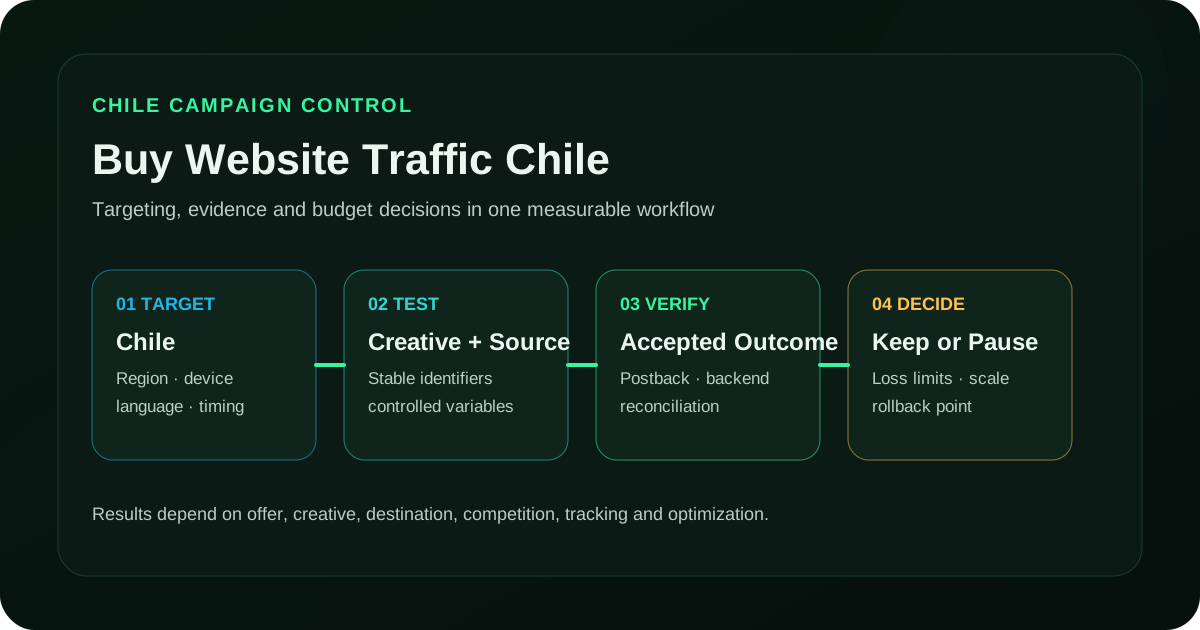
Buy Website Traffic Chile means funding a controlled Chile traffic cell only after the seller or platform role, material offer facts, total-price basis, payment and dispatch route, withdrawal information, current personal-data review, clock, and accepted business event have passed together. Official SERNAC and BCN material defines questions to verify. It does not prove inventory, legality, purchases, or return.
SERNAC and the Chile Ecommerce Regulation make the identity and role behind a covered online offer operationally important. Capture the seller name, required legal or contact details, platform operator if any, and the party responsible for price, payment, dispatch, delivery, changes, returns, withdrawal requests, complaints, and support. Test each contact route rather than accepting a footer label as proof.
A destination version belongs to one evidence record. If the merchant, intermediary, product, service, or responsibility changes, open a new review and keep the affected Chile traffic cell paused. Media controls cannot cure an offer whose accountable party or material transaction path is uncertain.
| Area | Evidence to verify | Decision rule |
|---|---|---|
| Seller | Identity, contact, offer owner | Verify on the current page |
| Platform | Role and assumed obligations | Do not merge it with the seller |
| Support | Questions, withdrawal, complaint | Send an approved test request |
Connect the guide to live testing
Use the choices established in “Identify the Chilean seller and the platform role before acquisition begins” to define one audience, budget and source set in FroggyAds. Keep the surrounding offer and measurement rule stable so the test adds evidence to buy website traffic chile instead of mixing several changes at once.
Create My Free Account
SERNAC's Article 30 material addresses visible pricing and a total value with applicable taxes, while its ecommerce guidance also points to dispatch costs, payment forms, delivery modes and times, and other material information. Compare the creative with the product or service description, amount, tax basis, required fee, dispatch charge, currency, payment method, and final confirmation.
Record what appears before commitment and what appears after an address, device, payment choice, or location is selected. If the amount or delivery promise changes, classify that as destination or transaction drift and suspend the version. Do not attribute the resulting abandonment to Chile traffic quality.
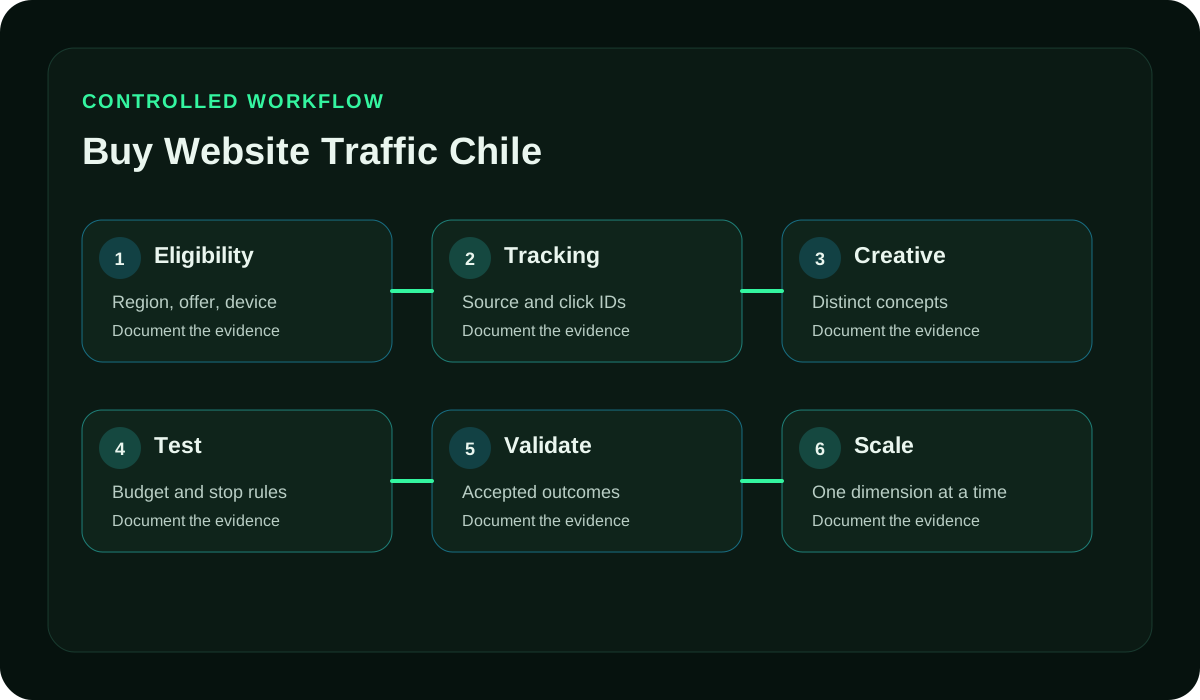
SERNAC describes a ten-day withdrawal route for qualifying distance purchases and also identifies conditions, exceptions, and consequences when written confirmation is missing. The campaign brief must not turn that guidance into a universal promise.
Show only the withdrawal or cancellation statement that the live offer can honor. Test the request channel and preserve a timestamped response. If the customer journey begins performance immediately or contains a claimed exception, record the decision and source before paid delivery rather than resolving it after complaints arrive.
Inventory URL parameters, cookies, device fields, audience attributes, form values, CRM records, postbacks, vendors, retention, rights handling, security, and transfers under the Chile personal-data framework actually in force on the campaign date. The scheduled December 2026 reform is a separate review gate, not a rule to describe as current in August.
Select the IANA zone that matches the served Chilean location and retain the advertising account zone separately. Normalize delivery, seller-support availability, transaction time, technical event receipt, duplicate window, and backend acceptance before closing a source cohort or comparing dayparts.
Choose the execution format
Use the criteria around “Keep Chile identifiers and campaign time inside a dated control record” to decide whether push, native, display or pop fits the message and destination. Set format, targeting and spend as campaign controls in FroggyAds while the buy website traffic chile decision remains the standard for judging the result.
Create My Free Account
Use FroggyAds controls to isolate the Chile GEO, device, creative, source, cap, and schedule. Pass supported campaign, placement, source, creative, and click context through the destination. Reject duplicate technical events and join each retained receipt to the advertiser's mature accepted record under the declared clock.
Review source cost with seller or price drift, dispatch mismatch, payment failure, withdrawal-contact failure, page errors, event loss, duplicate behavior, rejection, refund, and later value. A source can move to keep, observe, reduce, pause, or retest only from the written evidence. No traffic feature guarantees a valid visit or commercial result.
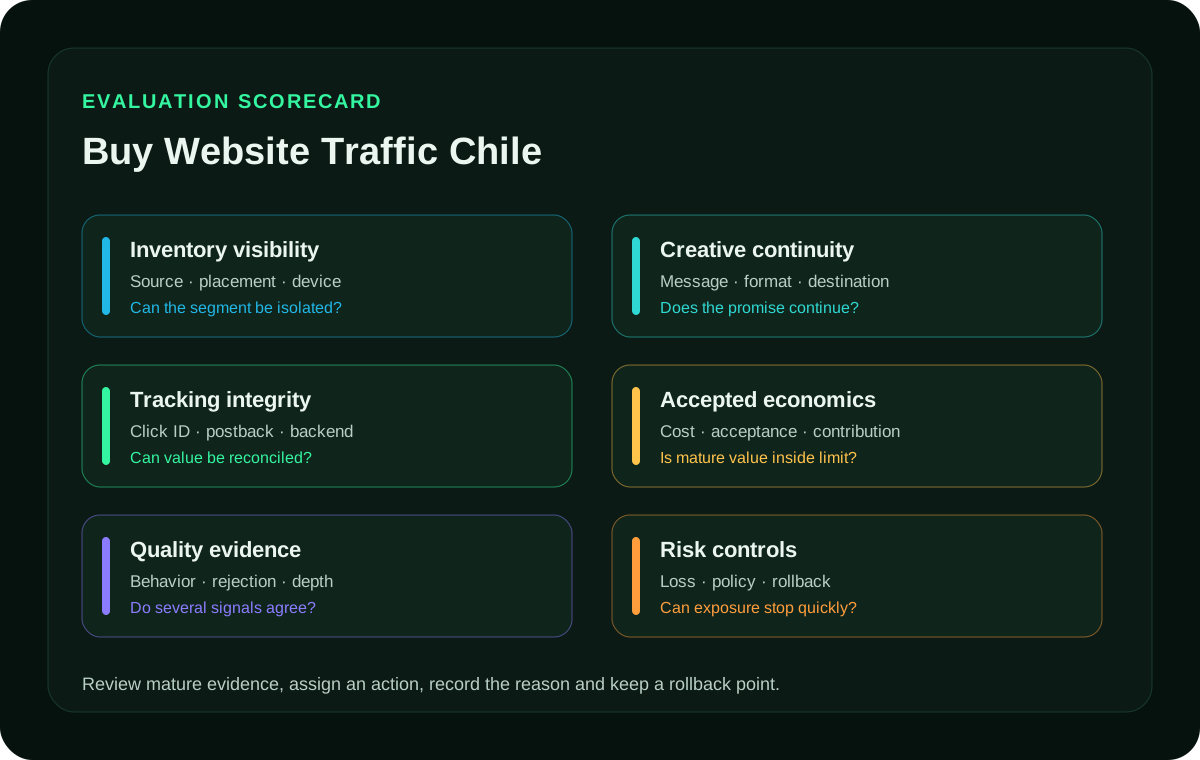
A Chile website traffic campaign is a bounded acquisition test with verified seller information, total-price continuity, a qualified withdrawal path, current personal-data review, and accepted outcomes by source.
SERNAC electronic commerce guidance identifies price, material characteristics, delivery, dispatch cost, payment, and other transaction information for covered online purchases.
Chile Ecommerce Regulation sets pre-contract information duties for covered sellers and platform operators, including identity, role, offer, total cost, delivery, contact, and withdrawal information.
Chilean total price review checks that the advertised amount, applicable taxes, required charges, payment basis, dispatch cost, and checkout remain consistent for the live offer.
Chile personal data campaign review maps cookies, audience attributes, click identifiers, forms, vendors, retention, rights, security, and transfers under the law current for the campaign date.
Put the guide into practice
With “Named concepts supported by this page” documented, launch only the next reversible test. Set a spending limit, preserve the baseline and use source-level and audience controls so the next step depends on qualified outcomes for buy website traffic chile, not activity volume.
Create My Free Account
Chile control CL-01, seller and platform file, is attached to Buy Website Traffic Chile. 01 stage marker. Decision for Chile control CL-01: Hold only the affected offer when identity or responsibility cannot be reproduced. Capture the seller identity, required legal or contact details, any platform operator, and the party responsible for the offer, price, payment, dispatch, delivery, withdrawal requests, complaints, and support. Verify the current destination and test a contact route; an advertising account or familiar platform name is not seller evidence. Evidence 01 asks: Which seller facts belong in a Chile website traffic release record?
Decision 01-1 asks: Which seller facts belong in a Chile website traffic release record?
Chile control CL-02, offer characteristic match, is attached to Buy Website Traffic Chile. 02 stage marker. Decision for Chile control CL-02: Start a new page version when a material characteristic changes. Match the Chilean creative and landing page on product or service characteristics, eligibility, material conditions, payable basis, dispatch or performance, and customer route. Store the exact versions reviewed. A platform label or prior approval cannot cover an offer whose features or operating conditions changed before the current campaign. Evidence 02 asks: What current evidence closes stage 02 for this campaign?
Decision 02-1 asks: What current evidence closes stage 02 for this campaign?
Chile control CL-03, total price chain, is attached to Buy Website Traffic Chile. 03 stage marker. Decision for Chile control CL-03: Suspend a version whose advertised and payable bases diverge. Compare the creative, landing page, address or option step, payment selection, and final confirmation for the same amount, applicable tax basis, required charge, dispatch cost, currency, and offer condition. Record any variable component explicitly and pause the destination version when the payable basis changes without review. Evidence 03 asks: How should a Chilean total price be checked before paid delivery?
Decision 03-1 asks: How should a Chilean total price be checked before paid delivery?
Chile control CL-04, dispatch service map, is attached to Buy Website Traffic Chile. 04 stage marker. Decision for Chile control CL-04: Exclude any area whose complete fulfilment route is unverified. Preserve the served location, delivery or pickup mode, stated timing, dispatch charge, operational exclusion, confirmation, and support owner attached to the exact page version. Rehearse the route with permission. A country GEO or national delivery statement cannot prove serviceability for every Chilean address. Evidence 04 asks: What dispatch information should a Chile ecommerce traffic test preserve?
Decision 04-1 asks: What dispatch information should a Chile ecommerce traffic test preserve?
Chile control CL-05, withdrawal qualification, is attached to Buy Website Traffic Chile. 05 stage marker. Decision for Chile control CL-05: Publish only the withdrawal statement the seller can honor. No. SERNAC describes a route for qualifying distance purchases together with conditions and exceptions. The advertiser must review the actual product or service, contract point, start of performance, use state, exception, notification, return cost, refund method, and current terms before publishing a promise. Evidence 05 asks: Does SERNAC's ten-day withdrawal explanation cover every advertised service?
Decision 05-1 asks: Does SERNAC's ten-day withdrawal explanation cover every advertised service?
Chile control CL-06, Spanish transaction meaning, is attached to Buy Website Traffic Chile. 06 stage marker. Decision for Chile control CL-06: Pause a language path when a material condition becomes incomplete. Test Spanish transaction meaning across the advertisement, offer terms, total price, dispatch, payment, withdrawal information, confirmation, errors, privacy notice, and support. Record any audience-specific exception with its reviewer. A Chile GEO alone does not prove that the complete customer path is understandable. Evidence 06 asks: What current evidence closes stage 06 for this campaign?
Decision 06-1 asks: What current evidence closes stage 06 for this campaign?
Chile control CL-07, current data-law register, is attached to Buy Website Traffic Chile. 07 stage marker. Decision for Chile control CL-07: Schedule a new official-source review before the December 2026 transition. Use the official consolidated Chile framework in force on the campaign date and document that review. Treat the broader changes scheduled for 1 December 2026 as a future gate requiring a fresh official-source check; do not describe deferred provisions as already effective. Evidence 07 asks: Which Chile data-law date should govern an August 2026 campaign?
Decision 07-1 asks: Which Chile data-law date should govern an August 2026 campaign?
Chile control CL-08, Chile time contract, is attached to Buy Website Traffic Chile. 08 stage marker. Decision for Chile control CL-08: Do not compare hours until platform and local clocks reconcile. A named IANA zone preserves the location rule behind delivery, support, transaction, technical receipt, duplicate handling, and backend maturity. A fixed offset can become wrong when a regional or seasonal rule differs. Retain the media-account clock separately and normalize records before comparing hours. Evidence 08 asks: Why should a Chile campaign store an IANA zone instead of an offset?
Decision 08-1 asks: Why should a Chile campaign store an IANA zone instead of an offset?
Chile control CL-09, source identifier join, is attached to Buy Website Traffic Chile. 09 stage marker. Decision for Chile control CL-09: Block optimization while identifier loss prevents a reliable join. Pass supported campaign, creative, placement, source, and click context to the destination; log the technical receipt; reject duplicates; then join the event to the advertiser's mature accepted record. Keep price, dispatch, payment, rejection, refund, and timing evidence beside that join. Evidence 09 asks: How can a Chile source event be reconciled with an accepted order?
Decision 09-1 asks: How can a Chile source event be reconciled with an accepted order?
Chile control CL-10, failure separation, is attached to Buy Website Traffic Chile. 10 stage marker. Decision for Chile control CL-10: Do not assign a traffic cause until competing failures are checked. No. Separate seller or offer drift, total-price mismatch, dispatch exclusion, payment failure, page error, identifier loss, duplicate logic, and backend rejection before diagnosing delivery. Pause the affected destination or transaction cell while other verified cells continue under their own evidence. Evidence 10 asks: Should a failed Chile checkout immediately disqualify the traffic source?
Decision 10-1 asks: Should a failed Chile checkout immediately disqualify the traffic source?
Chile control CL-11, Chile loss authority, is attached to Buy Website Traffic Chile. 11 stage marker. Decision for Chile control CL-11: Require dated restart evidence for the exact failed dependency. They can isolate supported GEO, device, creative, source, schedule, cap, and reporting dimensions and support reversible testing. They cannot establish merchant legality, current inventory, human intent, withdrawal compliance, a completed payment, an accepted customer, or profitable return. Evidence 11 asks: What can FroggyAds controls establish for a Chile acquisition test?
Decision 11-1 asks: What can FroggyAds controls establish for a Chile acquisition test?
Chile control CL-12, marginal Chile release, is attached to Buy Website Traffic Chile. 12 stage marker. Decision for Chile control CL-12: Change one dimension and preserve the rollback cohort. Expand only after seller responsibility, offer facts, Chilean total price, dispatch, payment, withdrawal information, current data review, named clock, and accepted-event reconciliation remain valid. Change one dimension, preserve a control cohort, set a loss boundary, and retain a rollback point. Evidence 12 asks: When may a Chile website traffic cell expand one step?
Decision 12-1 asks: When may a Chile website traffic cell expand one step?
For chile website-traffic buying, the campaign case is strongest when a Chile campaign connects paid delivery with a valid, transparent transaction route. Use accepted purchases after cancellations, refunds and source reconciliation to make the next chile website-traffic buying decision.
For chile website-traffic buying, the first useful audience signal is eligible Chilean users served in Spanish with applicable delivery coverage. Open a separate chile website-traffic buying cell when context changes.
For chile website-traffic buying, choose a format where seller identity, total price and dispatch conditions must stay consistent. Hold other chile website-traffic buying variables steady during the comparison.
For chile website-traffic buying, prepare a Spanish transaction path with visible seller, payment and withdrawal information. Run the full chile website-traffic buying handoff before adding spend.
For chile website-traffic buying, include these working costs: media, localization, dispatch cost, refunds, validation and a loss ceiling. Keep the chile website-traffic buying test amount separate from expansion.
For buy website, use result as tracking evidence: accepted purchases after cancellations. Test tracking against audience: applicable delivery coverage. Pause tracking for late charges; tracking resumes when buy website confirms tracking evidence: Chile cells repeat accepted value.
For chile website-traffic buying, investigate this risk before changing course: late charges, unclear seller responsibility, privacy gaps and weak source evidence. Pause chile website-traffic buying until this condition can be checked.
For buy website, treat result as validity evidence: accepted purchases after cancellations. Test validity against cost: media. Stop validity on late charges; validity proceeds when buy website shows validity evidence: Chile cells repeat accepted value.
For chile website-traffic buying, resume a paused cell after a Chile cell repeats accepted value with the transaction controls intact. Change one chile website-traffic buying setting and preserve the previous state.
For buy website, keep result as scaling evidence: accepted purchases after cancellations. Test scaling against destination: a Spanish transaction path. Hold scaling for late charges; scaling reopens once buy website verifies scaling evidence: Chile cells repeat accepted value.
Open the Chile cell only when seller, total-price, dispatch, withdrawal, data, clock, and accepted-record evidence agree on the same destination version.
Use this page when advertisers and media buyers need to make the specific decision described by Buy Website Traffic Chile. Anchor the decision to campaign objective, audience targeting, bid, conversion tracking and a single accepted business outcome rather than broad marketing activity. Keep this URL focused on that decision; use How To Buy Website Traffic for the adjacent task.
Buy Website Traffic Chile decision: Plan the market-specific test and measurement rules. Keep campaign objective, audience targeting, bid, conversion tracking attached to the same campaign record so the buyer can explain the next budget action.
Evidence already on this page: Buy Website Traffic Chile. Those sections define the operating context for Buy Website Traffic Chile and should be checked before the buyer changes scope or spend.
Market-specific questions on this URL: For Buy Website Traffic Chile, where does Chile website-traffic buying fit a measurable campaign goal? | For Buy Website Traffic Chile, which user context belongs in Chile website-traffic buying targeting? | For Buy Website Traffic Chile, which delivery context suits a Chile website-traffic buying test?
Source evidence 1: Buying website traffic in Chile means validating a Spanish customer route, CLP price presentation, seller and product information, delivery or service coverage, payment, withdrawal or cancellation handling, privacy review, and source-level accepted outcomes. A current SERNAC electronic-commerce resolution addresses information such as price and transport, dispatch, or delivery costs in the covered context. Use it as a source for the precise nearby statement, then confirm applicability for the actual seller and offer. A useful hypothetical case is a Chile source that reaches a working product page but encounters an unexplained delivery charge after the advertised total. Pause the affected destination version, preserve the source evidence, and repair the transaction path before judging traffic quality. Join campaign, creative, placement, click, checkout, cancellation, refund, and accepted value identifiers. The official document neither certifies the advertiser nor predicts reach, inventory, conversion, or campaign economics.
Source evidence 2: Chile control CL-01, seller and platform file, is attached to Buy Website Traffic Chile. 01 stage marker. Decision for Chile control CL-01: Hold only the affected offer when identity or responsibility cannot be reproduced. Capture the seller identity, required legal or contact details, any platform operator, and the party responsible for the offer, price, payment, dispatch, delivery, withdrawal requests, complaints, and support. Verify the current destination and test a contact route; an advertising account or familiar platform name is not seller evidence. Evidence 01 asks: Which seller facts belong in a Chile website traffic release record?
What makes this URL distinct: Buy Website Traffic Chile should retain its own evidence trail. Use the page's buyer job, entity gaps and nearest related URL to decide what belongs here, then keep the campaign variable, source identity and accepted outcome specific to this URL. If a neighboring page answers a different buying question, do not merge the two decisions simply because they share an ad format or acquisition term.
| Checkpoint | Decision action | Evidence to retain |
|---|---|---|
| For Buy Website Traffic Chile, where does Chile website-traffic buying fit a measurable campaign goal? | Use Buy Website Traffic Chile to resolve this question for Buy Website Traffic Chile before changing budget or scope. | Retain campaign objective, source or placement identity, spend and the accepted-event result for Buy Website Traffic Chile. |
| For Buy Website Traffic Chile, which user context belongs in Chile website-traffic buying targeting? | Use Buy Website Traffic Chile to resolve this question for Buy Website Traffic Chile before changing budget or scope. | Retain audience targeting, source or placement identity, spend and the accepted-event result for Buy Website Traffic Chile. |
| For Buy Website Traffic Chile, which delivery context suits a Chile website-traffic buying test? | Use Buy Website Traffic Chile to resolve this question for Buy Website Traffic Chile before changing budget or scope. | Retain bid, source or placement identity, spend and the accepted-event result for Buy Website Traffic Chile. |
Hypothetical example: For Buy Website Traffic Chile, if a controlled test spends USD 300 and records 7 accepted outcomes after the same review window, accepted cost is USD 42.86 per outcome. Replace the inputs with your own economics and the event definition appropriate to this page.
For Buy Website Traffic Chile, FroggyAds provides a self-serve paid-media test with targeting, budget, conversion and source controls so the campaign decision can be validated with campaign evidence. Create your free FroggyAds account.
Buy Website Traffic Chile should be evaluated market by market: define eligible geography, keep measurement consistent, and scale only where accepted-outcome economics remain viable.