
Campaign overview
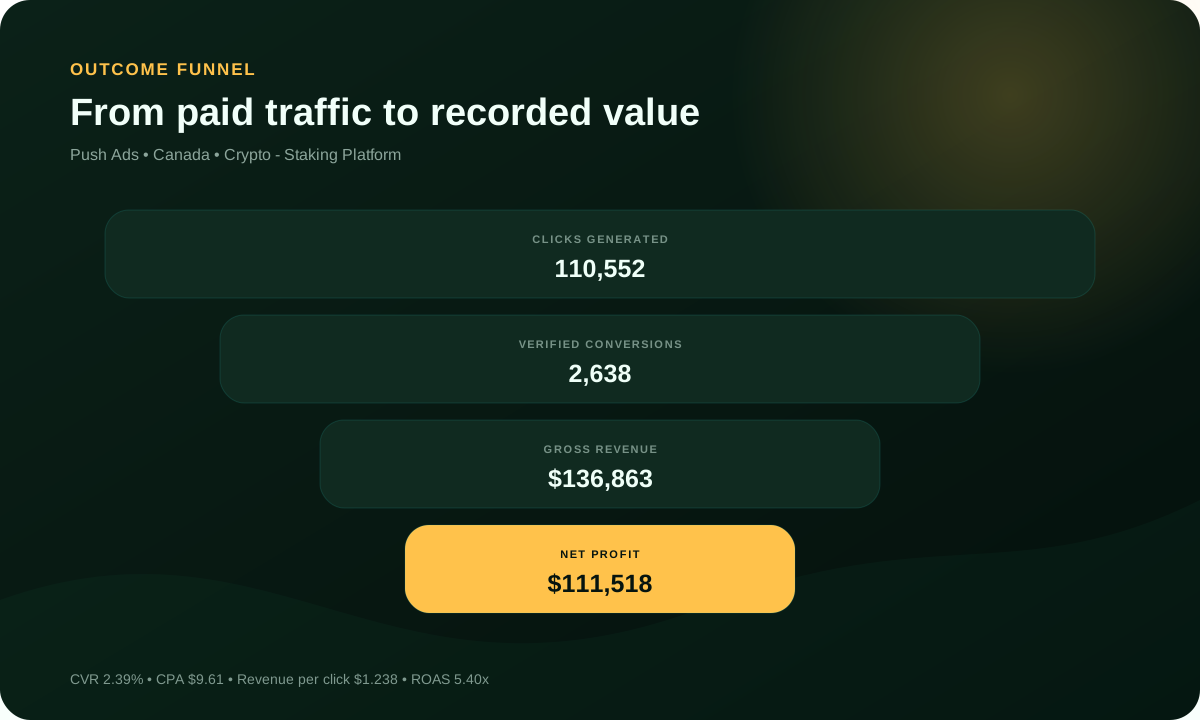
This anonymized customer campaign focused on qualified acquisition and measurable downstream value for the staking platform campaign in Canada. The buyer used Push Ads through FroggyAds and reported 110,552 generated clicks, 2,638 reported conversions, $136,863 in gross revenue and $111,518 in net profit. The resulting 440% ROI is calculated as net profit divided by media spend.
The practical role of Campaign overview in Crypto - Staking Platform Push Ads Case Study: 440% ROI in Canada is to expose the exact condition that can change the buyer's next action. Compare headline, came, operate, across, active and publishers under the same scope and review window; if one is unknown, keep that uncertainty explicit rather than filling the gap with an estimate. Keep the baseline unchanged while testing the next hypothesis; that comparison is what makes the decision reproducible.
Crypto campaigns may attract curiosity clicks that never become verified or valuable users. The campaign needed deeper events and careful claim control.
The Canadian setup separated English and French audience paths where relevant and measured the final approved outcome rather than only front-end registrations.
The campaign was managed as a chain of evidence. Delivery metrics explained exposure, conversion records explained user action, and downstream value determined whether the traffic was commercially useful. For Case Studies › Crypto Staking Platform Push Ads Canada, apply this rule to the page-specific audience, market, format or buying decision described here.
What the record demonstrates
Crypto - Staking Platform Push Ads Case Study in Canada documents a profitable historical result produced by offer fit, localization, tracking, creative testing and source-level optimization; it does not guarantee the same outcome for another advertiser.
The acquisition challenge
The implied cost per verified conversion was $9.61, while gross revenue averaged $51.88 per verified conversion. Those two figures created the working space for media cost, operational variance and downstream quality. A source could not be judged only by its click price because a cheap click with weak conversion value would still consume the margin.
The campaign produced a calculated 2.39% click-to-conversion rate and $1.238 in gross revenue per click. The buyer used these values as reconciliation points, not universal targets. Device mix, source pricing and conversion delay could change the same ratios even when the offer stayed constant.
On this Crypto - Staking Platform Push Ads Case Study: 440% ROI in Canada page, The acquisition challenge matters because it changes what the advertiser should verify before committing budget or operating effort. The evidence record should make record, shows, design, matters, broad and launch visible instead of hiding them inside a blended score or an unexplained recommendation. Connect the finding to one owner and one next action so the page helps the visitor decide rather than merely describing a process. Where this leads to paid acquisition, FroggyAds gives you a self-serve campaign environment for applying the relevant targeting, budget and source controls while your own analytics verifies downstream value.
Crypto promotion eligibility and financial advertising requirements vary. Risk disclosures, offer terms and audience restrictions should be reviewed before launch.
Campaign setup and targeting
Push placements gave the buyer a direct, compact message format with separate headline, icon and landing-page variables.
The campaign launched multiple headline and icon combinations, kept each creative ID stable and used source-level reporting to separate creative fatigue from placement quality. For Case Studies › Crypto Staking Platform Push Ads Canada, apply this rule to the page-specific audience, market, format or buying decision described here.
The campaign preserved the supplied CID VOL2-CA-062 as the reference for the analyzed record. Source identifiers, creative identifiers and conversion feedback were treated as a connected measurement path. That allowed the buyer to compare the original traffic purchase with the customer outcome rather than optimizing from disconnected reports.
Treat Campaign setup and targeting as a specific gate for Crypto - Staking Platform Push Ads Case Study: 440% ROI in Canada, not as a reusable checklist item that means the same thing on every page. Use starting, structure, gave, enough, breadth and delivery as the traceable inputs for this section, then state which missing item would be serious enough to stop or narrow the decision. Set a written pass condition and a rollback condition before acting, so the team can reverse the change without rewriting the history of the test.
For Crypto - Staking Platform Push Ads Case Study: 440% ROI in Canada, the Campaign setup and targeting checkpoint should answer a concrete buyer question rather than repeat a generic framework. Translate the section into checks for reported, average, rate, interpreted, together and Raising; this keeps the recommendation tied to the page's real task instead of generic marketing language. If the evidence does not support the current assumption, narrow the scope or run the smallest reversible test that can resolve it. A controlled FroggyAds test can turn this section into measurable evidence: keep the conversion definition stable, preserve source identifiers and compare marginal performance before expanding.
- GEO: Canada (CA)
- Format: Push Ads
- Primary objective: User acquisition
- Campaign reference: VOL2-CA-062
- Reported publisher coverage: 296
- Average bid win rate: 58.4%
Tracking and data quality
In this Crypto - Staking Platform Push Ads case in Canada, server-to-server conversion feedback connected advertiser-side events with campaign clicks and source identifiers, helping separate delivery issues from tracking or landing-page problems.
The practical role of Tracking and data quality in Crypto - Staking Platform Push Ads Case Study: 440% ROI in Canada is to expose the exact condition that can change the buyer's next action. Preserve the source, date and owner for record, described, geographically, distributed, landing and setup whenever they affect the decision, especially when the page compares options or sets a budget boundary. Use the finding to choose a specific action—keep, cap, exclude, renegotiate, retest or stop—rather than recording a score with no operational consequence. Use FroggyAds to test the media assumption that follows from this section, not to replace the evidence the section requires. Campaign controls support the decision; they do not manufacture proof.
For the Crypto - Staking Platform Push Ads Case Study: 440% ROI in Canada decision, use Tracking and data quality to separate a real operating requirement from a broad best-practice statement. Document customer, reconciled, reported, conversions, accepted and business in the same decision record so a later reviewer can see why the option passed, failed or needs a narrower retest. When the evidence is strong, carry the exact setting or requirement into the next campaign step instead of broadening several variables at once.
The campaign’s calculated CPC of $0.229 was useful for budget planning, while the $9.61 cost per verified conversion remained the more important commercial boundary. The difference between those metrics shows why optimization stopped at neither impressions nor clicks.
Conversion maturity shaped decisions in this Crypto - Staking Platform Push Ads case in Canada: delayed events could make a weak-looking segment recover, while later quality or refund data could reduce an early winner.