
Best X (Twitter) Marketing Platforms: Evidence-Led Evaluation Guide
X marketing platform evidence room treats a governed operating stack for work on X. As of August 2026, the objective is a documented choice, not a universal performance promise.
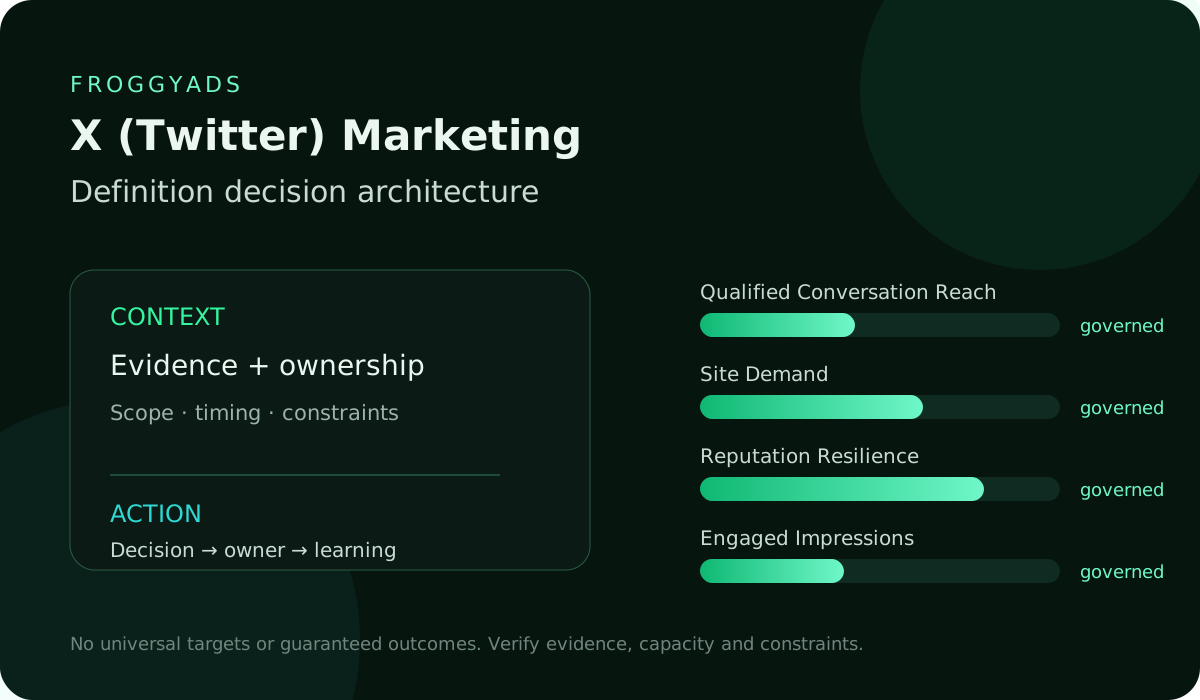
Visible scope and entity record
- X marketing platform: An X marketing platform supports organic publishing, paid campaign reporting, campaign objectives and X campaign governance.
- X Ads Manager: X Ads Manager provides paid campaign reporting, budget controls, objective settings and export tools.
- X Ads campaigns: X Ads campaigns use objectives, budgets, ads, reporting and exports.
- X marketing platform
- X Ads Manager
- campaign objectives
- organic publishing
- paid campaign reporting
- X campaign governance
A useful plan for "Best X marketing platform" separates what is known from what still needs testing. FroggyAds gives advertisers self-serve access and granular targeting controls so they can validate audience fit, traffic quality, cost and downstream outcomes before expanding a campaign. The principal failure to prevent is permission drift, inaccessible exports or a mismatch between organic and paid responsibilities. Every material claim stays tied to a dated source, owner and decision boundary.
Separate the six jobs hidden inside one platform search
An X team may need editorial planning, approval, organic publishing, conversation response, paid activation and business reporting. Those jobs should be listed separately before products are scored.
For every job, record the current owner, account permission, handoff and evidence output. A tool that publishes posts but cannot control ad groups should not receive credit for paid-media operations.
Use X Ads Manager as the paid reference point
X describes Ads Manager as its workspace for campaign setup, ad groups, creatives, budgets, custom metrics, history and exports. That makes it the primary reference for native paid capabilities.
Compare an external tool with the current Ads Manager account, not an old feature list. Mark native, connected, manually imported and unavailable functions in different columns.
Match campaign objectives to measurement readiness
X Ads campaigns are objective based. Website traffic, website conversions, reach, engagement, video and app work create different optimization and billing events where available.
Choose the business event first, then verify that the account exposes the required objective and that the destination can return a trustworthy result. Do not select an objective because its surface metric looks inexpensive.
Connect the guide to live testing
Connect Best X (Twitter) Marketing Platforms to a controlled audience test
Use the choices established in “Match campaign objectives to measurement readiness” to define one audience, budget and source set in FroggyAds. Keep the surrounding offer and measurement rule stable so the test adds evidence to best x (twitter) marketing platforms instead of mixing several changes at once.
Create My Free Account
Design an organic publishing control lane
Organic work needs a content calendar, draft status, named approver, publishing identity and response escalation. The platform record should show who changed a post and who released it.
Test image previews, link cards, accessibility text and scheduled timing in the real account. Preserve deleted or corrected post references when they explain a later reporting change.
Treat social listening as a sampling system
Search streams, mentions and keyword monitors do not represent every conversation about a brand. Query syntax, language, time window and access limits shape the sample.
Save the exact listening query and exclusion rules with each insight. A volume chart without the query definition cannot support a product, reputation or media decision.
Build permissions around actions, not titles
The useful access map distinguishes reading analytics, drafting, publishing, replying, creating audiences, changing bids, exporting data and managing billing. A generic administrator label hides material authority.
Start a pilot with the least permission that completes the task. Revoke test access, rotate credentials where required and verify the audit history after the offboarding exercise.
Choose the execution format
Choose a paid-media format that supports Best X (Twitter) Marketing Platforms
Use the criteria around “Build permissions around actions, not titles” to decide whether push, native, display or pop fits the message and destination. Set format, targeting and spend as campaign controls in FroggyAds while the best x (twitter) marketing platforms decision remains the standard for judging the result.
Create My Free Account
Export before automation becomes dependency
A platform is portable only when the team can retrieve posts, campaign structure, spend, results, creative identifiers and necessary audit history in usable formats.
Run one real export during evaluation and reconstruct a weekly report outside the product. Document fields that are summarized, delayed or unavailable instead of assuming an API will solve the gap.
Price the complete X operating model
Subscription cost is only one component. Include paid spend, implementation, content production, moderation coverage, connector maintenance, approval labor, data storage and reconciliation.
Calculate cost for the smallest viable team and the expected operating team. State which cost changes with accounts, users, message volume, ad spend or retained history.
Run an X-specific failure drill
Pause a scheduled post, revoke a publisher, correct a live error, stop an ad group and retrieve the change record. These exercises reveal whether a workflow is safe under pressure.
Score recovery time and evidence quality, not only whether the button exists. A fast correction with no accountable record can still fail governance.
Approve the stack through a bounded pilot
The pilot should complete one organic cycle and one paid cycle only if both are in scope. It must use real approvals, a tested destination, documented exports and a closure review.
Adopt, limit or reject each component separately. The result applies to the tested account type, permissions and X product state on the review date.
Put the guide into practice
Turn Best X (Twitter) Marketing Platforms into a bounded campaign test
With “Approve the stack through a bounded pilot” documented, launch only the next reversible test. Set a spending limit, preserve the baseline and use source-level and audience controls so the next step depends on qualified outcomes for best x (twitter) marketing platforms, not activity volume.
Create My Free Account
Five decision rehearsals before approval
- Separate the six jobs hidden inside one platform search: explain what would reverse the recommendation and which retained record proves the response.
- Use X Ads Manager as the paid reference point: explain what would reverse the recommendation and which retained record proves the response.
- Match campaign objectives to measurement readiness: explain what would reverse the recommendation and which retained record proves the response.
- Design an organic publishing control lane: explain what would reverse the recommendation and which retained record proves the response.
- Treat social listening as a sampling system: explain what would reverse the recommendation and which retained record proves the response.
These rehearsals expose missing authority, evidence and recovery steps before the workflow carries irreversible spend or publication risk.
Best X (Twitter) Marketing Platforms: Evidence-Led Evaluation Guide FAQ
Which job should an X marketing platform coordinate for the team?
For X (Twitter) Marketing Platforms, choose a defined need such as publishing approval, social listening, response routing, or paid campaign oversight. Avoid buying a broad platform before the owner and success condition for that job are clear.
Which permission tests expose weak governance for an X account?
For X (Twitter) Marketing Platforms, create users with publishing, approval, reporting, and administration duties, then test prohibited actions for each role. Remove one user and confirm sessions, tokens, and scheduled work are handled correctly.
What conversation context must an X platform preserve?
For X (Twitter) Marketing Platforms, review replies, quoted posts, timestamps, edits or deletions, source links, and the surrounding thread where available. A clipped mention can mislead the team about tone, intent, or the right response.
When making decisions about an X platform selection, what makes an X publishing workflow accountable?
For X (Twitter) Marketing Platforms, require named authors and approvers, visible version history, scheduled-time checks, and a documented emergency stop. People should know who can change or remove a post after publication.
Which paid X campaign controls require a live trial?
For X (Twitter) Marketing Platforms, test budget caps, audience exclusions, placement choices, conversion events, creative approval, pacing, and pause behaviour with limited spend. Reconcile the platform report with independent records.
How should fast-moving risk appear in an X platform?
For X (Twitter) Marketing Platforms, alerts need the source, time, affected account, severity, and an owner who can act. Test noisy and urgent cases so the team sees if the product helps judgment or simply produces more notifications.
Can an X report distinguish conversation activity from advertising results?
For X (Twitter) Marketing Platforms, it should separate organic publishing, replies, listening data, and paid delivery with clear definitions. Export a sample and confirm costs and outcomes retain their channel and campaign labels.
Where should X automation require a person to approve the action?
For X (Twitter) Marketing Platforms, keep approval around public replies, sensitive topics, account changes, budget increases, and content drawn from uncertain context. Automation may prepare work, but the responsible owner should release consequential actions.
What creates hidden ownership cost in an X marketing platform?
For X (Twitter) Marketing Platforms, count onboarding, permission reviews, alert triage, data cleanup, API changes, support, exports, and staff time. A low licence fee can still be expensive when routine failures require specialist attention.
Which migration exercise tests an X platform's portability?
For X (Twitter) Marketing Platforms, export users, permissions, schedules, content history, reports, tags, and source links, then rebuild a small workflow elsewhere. Record items that cannot be moved and the time needed to verify the result.
Existing tools, sources and next actions
Links are retained in their approved sequence. External sources provide bounded context; internal resources continue the relevant FroggyAds workflow.
Media-buying requirements for Best X (Twitter) Marketing Platforms
Evaluate Best X (Twitter) Marketing Platforms as an operating system, not a feature list. For real-time social inventory and audience targeting, compare inventory access, campaign setup, bidding and pacing, targeting depth, conversion tracking, API or postback integrations, source-level reporting, exports, permissions and traffic-quality controls. FroggyAds fits the self-serve media-buying layer when the buyer needs direct campaign and source control rather than an outsourced marketing service.
Separate X content operations from the wider paid-acquisition decision
An X marketing stack should make it clear which tool owns which job. Publishing, community workflows, social listening, creative production, native platform advertising and external paid acquisition produce different evidence and should not be collapsed into one dashboard score. Before selecting a platform, define the decision it is supposed to improve. A social-management tool may be excellent for scheduling and response workflows while contributing little to media buying, and a paid-acquisition platform should be judged on delivery controls, measurement and business outcomes rather than on publishing features it was never intended to provide.
For advertisers building a broader acquisition plan, FroggyAds can operate as a separate self-serve programmatic channel alongside social activity. It offers push, native, display and pop traffic plus country, city, device, operating-system, browser, carrier, category and source-level controls. This gives the media team another measurable route to reach prospects without making the X workflow responsible for the entire acquisition strategy. Keep the channels separate in reporting so the advertiser can see which environment generated each visit and which later event was actually accepted.
| Workflow | Primary evidence | Decision owner should ask |
|---|---|---|
| X publishing and community | Content delivery and audience response | Is the editorial workflow consistent and useful? |
| X-native paid activity | Native campaign delivery and attributed outcomes | Does the campaign meet its defined business threshold? |
| Programmatic acquisition with FroggyAds | Source-aware traffic and accepted conversions | Which formats, sources and segments create economical outcomes? |
| Cross-channel reporting | Comparable downstream business events | Are channels being compared on the same accepted result? |
Avoid choosing an X marketing platform from a long feature list alone. Test the workflows that matter: permission management, publishing approvals, response handling, reporting export, measurement continuity and the ability to preserve a clean record of changes. For paid acquisition, add budget caps, tracking validation and a written pause rule. A tool that looks powerful in a demonstration can still create operational friction if the team cannot explain who owns an action or how a result reaches the business reporting layer.
Use the same discipline when adding FroggyAds to the acquisition mix. Start with an eligible audience and a destination that matches the creative, verify the conversion event, then collect enough source-level evidence to distinguish isolated weak inventory from a broader offer or landing-page issue. FroggyAds allowlist and blocklist controls can help buyers act on repeated source patterns after the evidence is mature. Keep major bid, targeting, creative and destination changes logged so any improvement can be traced to a plausible cause.
Channel diversification should make decision-making clearer, not more complicated. Keep X-specific engagement metrics inside the X workflow, keep FroggyAds media identifiers inside the programmatic workflow and reconcile both to the advertiser's accepted business event where valid measurement exists. That structure reduces the temptation to declare one platform the winner because its native metric happens to look larger.
The best stack is therefore a governed set of tools with explicit responsibilities. Use X-focused products for the social workflows they handle well, and use FroggyAds when the advertiser wants a controllable programmatic acquisition channel with multiple formats and source-aware optimization. Evaluate each component on the evidence it can legitimately produce and retain a common business outcome for cross-channel budget decisions.
Best X (Twitter) Marketing Platforms: Evidence-Led Evaluation Guide: what should the advertiser decide next?
For Best X (Twitter) Marketing Platforms: Evidence-Led Evaluation Guide, the commercial task is to turn best x marketing platform into one measurable campaign decision. Use Visible scope and entity record to define the audience or problem, use Separate the six jobs hidden inside one platform search to constrain the test, and decide in advance which accepted result would justify more FroggyAds spend.
On this Best X (Twitter) Marketing Platforms: Evidence-Led Evaluation Guide page, the decision should remain tied to the existing evidence around Visible scope and entity record, Separate the six jobs hidden inside one platform search and Use X Ads Manager as the paid reference point. Those sections give best x marketing platform its specific context; the table below turns that context into campaign actions rather than adding another generic definition.
| Decision | What to verify | FroggyAds action |
|---|---|---|
| Best X (Twitter) Marketing Platforms: Evidence-Led Evaluation Guide objective | Use Visible scope and entity record to define the accepted business event and the maximum learning loss for best x marketing platform. | Launch one FroggyAds campaign objective for Best X (Twitter) Marketing Platforms: Evidence-Led Evaluation Guide and keep the conversion definition stable. |
| Best X (Twitter) Marketing Platforms: Evidence-Led Evaluation Guide audience | Use Separate the six jobs hidden inside one platform search to verify market, device, language and offer eligibility for best x marketing platform. | Apply only the FroggyAds targeting controls that change the real Best X (Twitter) Marketing Platforms: Evidence-Led Evaluation Guide customer journey. |
| Best X (Twitter) Marketing Platforms: Evidence-Led Evaluation Guide source evidence | Use Use X Ads Manager as the paid reference point to keep source-level differences visible instead of relying on one blended best x marketing platform average. | Keep, cap, exclude or retest Best X (Twitter) Marketing Platforms: Evidence-Led Evaluation Guide inventory from documented source evidence. |
| Best X (Twitter) Marketing Platforms: Evidence-Led Evaluation Guide economics | Use Match campaign objectives to measurement readiness to connect media spend with accepted conversions and downstream value for best x marketing platform. | Protect the Best X (Twitter) Marketing Platforms: Evidence-Led Evaluation Guide test with a written budget boundary and a consistent attribution window. |
| Best X (Twitter) Marketing Platforms: Evidence-Led Evaluation Guide scale rule | Use Connect Best X (Twitter) Marketing Platforms to a controlled audience test to define the exact evidence that earns the next budget increase for best x marketing platform. | Scale Best X (Twitter) Marketing Platforms: Evidence-Led Evaluation Guide one major control at a time and compare marginal performance with the prior baseline. |
A page-specific FroggyAds test sequence for Best X (Twitter) Marketing Platforms: Evidence-Led Evaluation Guide
- Best X (Twitter) Marketing Platforms: Evidence-Led Evaluation Guide outcome: define the accepted event for best x marketing platform and the maximum loss permitted while the first test is learning.
- Best X (Twitter) Marketing Platforms: Evidence-Led Evaluation Guide path: verify market eligibility, device experience, landing-page continuity and tracking against Visible scope and entity record before buying more traffic.
- Best X (Twitter) Marketing Platforms: Evidence-Led Evaluation Guide hypothesis: launch one bounded FroggyAds test tied to Separate the six jobs hidden inside one platform search; do not change bid, creative, audience and destination together.
- Best X (Twitter) Marketing Platforms: Evidence-Led Evaluation Guide source review: compare qualified activity, accepted conversions, timing and cost by the source or segment dimensions relevant to Use X Ads Manager as the paid reference point.
- Best X (Twitter) Marketing Platforms: Evidence-Led Evaluation Guide scaling: use Match campaign objectives to measurement readiness and Connect Best X (Twitter) Marketing Platforms to a controlled audience test to define what must reproduce before the next budget increase.
Why FroggyAds is relevant to Best X (Twitter) Marketing Platforms: Evidence-Led Evaluation Guide
For Best X (Twitter) Marketing Platforms: Evidence-Led Evaluation Guide, FroggyAds gives advertisers a self-serve DSP and ad-network workflow for buying supported traffic with campaign-level budgets and targeting. Depending on format and campaign context, available controls can include country, city, device, operating system, browser, carrier, category, source, ID and IP options. SmartCPC and Adscore-supported traffic-quality controls can support the best x marketing platform optimization process, while the advertiser's tracker, analytics and backend acceptance remain the final evidence for commercial quality.
Use Connect Best X (Twitter) Marketing Platforms to a controlled audience test as the final checkpoint for Best X (Twitter) Marketing Platforms: Evidence-Led Evaluation Guide. If the accepted result does not reproduce after the next meaningful volume step, return to the last stable configuration instead of widening several controls at once.
Best X (Twitter) Marketing Platforms: Evidence-Led Evaluation Guide: the buyer task this URL owns
Use Best X (Twitter) Marketing Platforms: Evidence-Led Evaluation Guide when the immediate task is to evaluate a social marketing platform by publishing/community workflow, measurement and paid-media handoffs. For advertisers, media buyers and online growth teams, the useful output is a documented media decision rather than another broad advertising overview. The nearest related FroggyAds page is Best Quora Marketing Platform; this URL keeps ownership of the distinct task to evaluate a social marketing platform by publishing/community workflow, measurement and paid-media handoffs.
Anchor the Best X (Twitter) Marketing Platforms: Evidence-Led Evaluation Guide review to post or creative ID, timing or topic context, campaign ID, destination. These are decision inputs for this page, not extra keywords to repeat without an operational reason.
| Checkpoint | Page-specific action | Evidence to keep |
|---|---|---|
| Channel role | Define the audience context, organic/social role and the business event this page is meant to influence. | Retain evidence specific to Best X (Twitter) Marketing Platforms: Evidence-Led Evaluation Guide and its accepted outcome. |
| Measurement | Preserve source, medium, campaign and creative identifiers through the business-side conversion or accepted outcome. | Retain evidence specific to Best X (Twitter) Marketing Platforms: Evidence-Led Evaluation Guide and its accepted outcome. |
| Decision | Separate platform-reported activity from business evidence before changing budget, provider, content or channel mix. | Retain evidence specific to Best X (Twitter) Marketing Platforms: Evidence-Led Evaluation Guide and its accepted outcome. |
Hypothetical calculation: if a controlled campaign for best x (twitter) marketing platforms: evidence-led evaluation guide spends USD 300 and produces 9 accepted conversions, accepted CPA is USD 300 / 9 = USD 33.33. Replace the inputs with your own campaign economics; this is not a FroggyAds performance claim.
FroggyAds does not replace the social publishing, community-management or social-network-native workflow described on Best X (Twitter) Marketing Platforms: Evidence-Led Evaluation Guide. Use us when you also need a separate paid-traffic acquisition layer with format, targeting, budget and source controls. Create your free FroggyAds account.
Best X (Twitter) Marketing Platforms: Evidence-Led Evaluation Guide — what matters first?
Evaluate Best X (Twitter) Marketing Platforms: Evidence-Led Evaluation Guide by its social publishing or management workflow, integrations, permissions, measurement and exportable data. If you also need non-social paid acquisition, FroggyAds can run a separate source-controlled traffic test; compare both environments through the same business-side conversion definition.