
What Is X Marketing, and How Can FroggyAds Support the Wider Plan?
An x operating plan that connects public conversation with a prepared destination and accepted business event. Treat X as a public conversation environment with explicit message, response and destination ownership. FroggyAds is not X and does not sell X inventory. X marketing outcomes depend on platform context, audience response, offer quality and measurement. Begin by asking the accountable owner to choose one audience conversation and the next useful action.
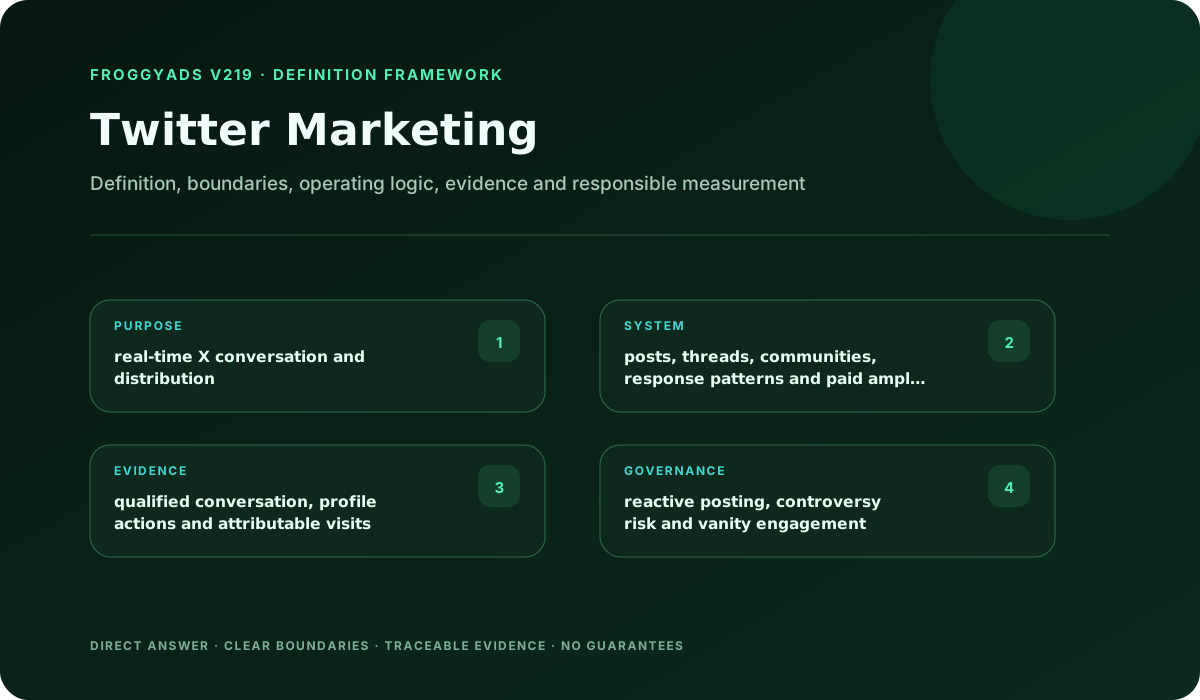
The decision this x conversation plan page owns
For advertisers, affiliates and agencies using X for timely content, conversation, customer response and paid promotion, we recommend building an X operating plan that connects public conversation with a prepared destination and accepted business event. FroggyAds supports that work through an independent FroggyAds traffic campaign kept outside X organic and paid reporting. We can complement the plan with a separate traffic test after the offer and accepted event are ready.
X conversation plan has a firm review boundary: Pause the plan when the team cannot monitor context, support the destination promise or reconcile accepted outcomes. The reason is practical: fast-moving activity can create attention while losing claim accuracy, response capacity and downstream evidence.
Define the X marketing job
X-campaign signal 01, define the x marketing job, reflects the platform condition that research, publishing, conversation, service and paid activity require different success evidence. Define the commercial job X must support, its audience, decision owner, destination and accepted event before drafting posts.
Feed-to-destination check 01 for define the x marketing job directs the media buyer to assign one role and accountable owner to the planned activity. The define the x marketing job review interprets accepted outcome quality, response workload and evidence confidence by X cohort and external source after the relevant delay, preserves the independent FroggyAds source label, follows the instruction to remove posts that do not support an audience or business need, and must never transfer performance or inventory claims between X and FroggyAds. Fund X only when its declared job supports an accepted business event.
Select the audience conversation
X-campaign signal 02, select the audience conversation, reflects the platform condition that timely topics and recurring professional questions create different participation expectations. Select a conversation where the audience problem and relevance boundary are clear enough for a responsible response.
Feed-to-destination check 02 for select the audience conversation directs the media buyer to record the context, audience problem and relevance boundary. The select the audience conversation review interprets accepted outcome quality, response workload and evidence confidence by X cohort and external source after the relevant delay, preserves the independent FroggyAds source label, follows the instruction to avoid joining conversations where the offer adds no value, and must never transfer performance or inventory claims between X and FroggyAds. Enter conversations where your audience problem and relevance boundary are documented.
Build a truthful message premise
X-campaign signal 03, build a truthful message premise, reflects the platform condition that short posts still need a defensible claim and clear audience benefit. Build every premise from dated evidence, a named claim owner and limitations the audience can understand.
Feed-to-destination check 03 for build a truthful message premise directs the media buyer to link the draft to verified product evidence. The build a truthful message premise review interprets accepted outcome quality, response workload and evidence confidence by X cohort and external source after the relevant delay, preserves the independent FroggyAds source label, follows the instruction to remove urgency or proof the business cannot support, and must never transfer performance or inventory claims between X and FroggyAds. Hold a premise until its source, owner and limitation are visible.
| Build a truthful message premise record | Evidence to retain | Account decision |
|---|---|---|
| Build a truthful message premise working condition | short posts still need a defensible claim and clear audience benefit | At control 3, continue the X or FroggyAds cell only when its own mature evidence remains acceptable. |
| Build a truthful message premise evidence check | link the draft to verified product evidence | For this build a truthful message premise decision, examine accepted outcome quality, response workload and evidence confidence by X cohort and external source. |
| Build a truthful message premise release rule | remove urgency or proof the business cannot support | Scope note 3: never transfer performance or inventory claims between X and FroggyAds. |
Use threads and media with one purpose
X-campaign signal 04, use threads and media with one purpose, reflects the platform condition that additional format depth should explain, demonstrate or guide a next step. Give each thread, image or video one job that continues naturally on the destination.
Feed-to-destination check 04 for use threads and media with one purpose directs the media buyer to state the content job before production. The use threads and media with one purpose review interprets accepted outcome quality, response workload and evidence confidence by X cohort and external source after the relevant delay, preserves the independent FroggyAds source label, follows the instruction to retire elements that compete with the primary point, and must never transfer performance or inventory claims between X and FroggyAds. Use each creative element to advance one clear destination action.
Prepare replies and escalation
X-campaign signal 05, prepare replies and escalation, reflects the platform condition that public responses can surface service needs, objections and claim risk. Prepare approved replies, escalation triggers, response coverage and a pause rule before activity increases.
Feed-to-destination check 05 for prepare replies and escalation directs the media buyer to assign monitoring periods and approved answer sources. Assess reply quality, workload and evidence confidence before adding spend; pause whenever accountable judgment is unavailable. Pause publishing when response judgment or escalation coverage becomes unavailable.
Continue context on the destination
X-campaign signal 06, continue context on the destination, reflects the platform condition that a visitor should recognize the same problem, promise and limitation after the click. Carry the post's promise, language, offer and next action into a mobile destination without surprise.
Feed-to-destination check 06 for continue context on the destination directs the media buyer to review the mobile page and accepted action. Compare destination continuity and accepted outcomes by source; repair any break before promotion resumes. Repair any promise or language break before promoting the destination.
| Continue context on the destination record | Evidence to retain | Account decision |
|---|---|---|
| Continue context on the destination working condition | a visitor should recognize the same problem, promise and limitation after the click | At control 6, continue the X or FroggyAds cell only when its own mature evidence remains acceptable. |
| Continue context on the destination evidence check | review the mobile page and accepted action | For this continue context on the destination decision, examine accepted outcome quality, response workload and evidence confidence by X cohort and external source. |
| Continue context on the destination release rule | repair discontinuity before promotion | Scope note 6: never transfer performance or inventory claims between X and FroggyAds. |
Keep X source identity
X-campaign signal 07, keep x source identity, reflects the platform condition that campaign and post labels should remain visible in analytics and business records. Keep X posts, destination visits, FroggyAds traffic and accepted events separated by durable source identifiers.
Feed-to-destination check 07 for keep x source identity directs the media buyer to test the complete link and event path. Reconcile X and FroggyAds independently, and leave outcomes unattributed when the evidence path is incomplete. Leave unexplained outcomes unattributed rather than blending X and FroggyAds sources.
Separate interaction from business value
X-campaign signal 08, separate interaction from business value, reflects the platform condition that replies, reposts and follows can be diagnostic without proving conversion. Judge X by accepted business value after the relevant delay, not by visible interaction alone.
Feed-to-destination check 08 for separate interaction from business value directs the media buyer to classify activity, provisional actions and accepted outcomes. Use accepted business events for budget decisions while keeping public interaction as a diagnostic signal. Make budget decisions from the declared business event, not public engagement.
Add FroggyAds as a distinct route
X-campaign signal 09, add froggyads as a distinct route, reflects the platform condition that our inventory operates outside X and needs an independent campaign record. The add froggyads as a distinct route signal sits within an X operating plan that connects public conversation with a prepared destination and accepted business event with post, audience, destination and accepted-event identifiers because fast-moving activity can create attention while losing claim accuracy, response capacity and downstream evidence
Feed-to-destination check 09 for add froggyads as a distinct route directs the media buyer to hold destination and accepted event stable while source labels differ. The add froggyads as a distinct route review interprets accepted outcome quality, response workload and evidence confidence by X cohort and external source after the relevant delay, preserves the independent FroggyAds source label, follows the instruction to compare mature quality without calling FroggyAds an X tool, and must never transfer performance or inventory claims between X and FroggyAds. For add froggyads as a distinct route, we recommend that you use our source evidence to compare the signal with your setup threshold before you choose the next budget decision.
| Add FroggyAds as a distinct route record | Evidence to retain | Account decision |
|---|---|---|
| Add FroggyAds as a distinct route working condition | our inventory operates outside X and needs an independent campaign record | At control 9, continue the X or FroggyAds cell only when its own mature evidence remains acceptable. |
| Add FroggyAds as a distinct route evidence check | hold destination and accepted event stable while source labels differ | For this add froggyads as a distinct route decision, examine accepted outcome quality, response workload and evidence confidence by X cohort and external source. |
| Add FroggyAds as a distinct route release rule | compare mature quality without calling FroggyAds an X tool | Scope note 9: never transfer performance or inventory claims between X and FroggyAds. |
Set pacing and context limits
X-campaign signal 10, set pacing and context limits, reflects the platform condition that rapid delivery or topic shifts can exceed response and brand-safety capacity. Set spend, frequency, response-capacity and context limits that protect accuracy during fast-moving conversation.
Feed-to-destination check 10 for set pacing and context limits directs the media buyer to define spend, frequency and pause conditions. The set pacing and context limits review interprets accepted outcome quality, response workload and evidence confidence by X cohort and external source after the relevant delay, preserves the independent FroggyAds source label, follows the instruction to stop when the conversation leaves the approved scope, and must never transfer performance or inventory claims between X and FroggyAds. Cap delivery at the level your response team and evidence process can govern.
Review cohort quality
X-campaign signal 11, review cohort quality, reflects the platform condition that the value of an early signup or order may change after qualification and retention. Review equal-maturity cohorts so a short X response window cannot distort the source comparison.
Feed-to-destination check 11 for review cohort quality directs the media buyer to reconcile X and external sources after equal delays. Compare cohorts after equal delays, then protect the route producing accepted value with reliable evidence. Protect the route that produces accepted value after equal-maturity reconciliation.
Archive learning and refresh
X-campaign signal 12, archive learning and refresh, reflects the platform condition that conversation context, audience assumptions and destination readiness can change. Archive results, incidents, evidence dates and unresolved questions before repeating or scaling the plan.
Feed-to-destination check 12 for archive learning and refresh directs the media buyer to record results, incidents and unresolved questions. Record results and incidents by source, then revalidate every assumption before another campaign. Validate claims, destination continuity and source labels before repeating the campaign.
| Archive learning and refresh record | Evidence to retain | Account decision |
|---|---|---|
| Archive learning and refresh working condition | conversation context, audience assumptions and destination readiness can change | At control 12, continue the X or FroggyAds cell only when its own mature evidence remains acceptable. |
| Archive learning and refresh evidence check | record results, incidents and unresolved questions | For this archive learning and refresh decision, examine accepted outcome quality, response workload and evidence confidence by X cohort and external source. |
| Archive learning and refresh release rule | revalidate before repeating the campaign | Scope note 12: never transfer performance or inventory claims between X and FroggyAds. |
Questions about x conversation plan
How should an advertiser handle define the x marketing job?
Define the X marketing job requires a specific operating record for this x conversation plan decision. Document that research, publishing, conversation, service and paid activity require different success evidence. Evidence check 01 is to assign one role and accountable owner to the planned activity. Evaluate accepted outcome quality, response workload and evidence confidence by X cohort and external source for this step, and remove posts that do not support an audience or business need.
How should an advertiser handle select the audience conversation?
Select the audience conversation requires a specific operating record for this x conversation plan decision. Document that timely topics and recurring professional questions create different participation expectations. Evidence check 02 is to record the context, audience problem and relevance boundary. Evaluate accepted outcome quality, response workload and evidence confidence by X cohort and external source for this step, and avoid joining conversations where the offer adds no value.
How should an advertiser handle build a truthful message premise?
Build a truthful message premise requires a specific operating record for this x conversation plan decision. Document that short posts still need a defensible claim and clear audience benefit. Evidence check 03 is to link the draft to verified product evidence. Evaluate accepted outcome quality, response workload and evidence confidence by X cohort and external source for this step, and remove urgency or proof the business cannot support.
How should an advertiser handle use threads and media with one purpose?
Use threads and media with one purpose requires a specific operating record for this x conversation plan decision. Document that additional format depth should explain, demonstrate or guide a next step. Evidence check 04 is to state the content job before production. Evaluate accepted outcome quality, response workload and evidence confidence by X cohort and external source for this step, and retire elements that compete with the primary point.
How should an advertiser handle prepare replies and escalation?
Prepare replies and escalation requires a specific operating record for this x conversation plan decision. Document that public responses can surface service needs, objections and claim risk. Evidence check 05 is to assign monitoring periods and approved answer sources. Evaluate accepted outcome quality, response workload and evidence confidence by X cohort and external source for this step, and pause when judgment or evidence is unavailable.
How should an advertiser handle continue context on the destination?
Continue context on the destination requires a specific operating record for this x conversation plan decision. Document that a visitor should recognize the same problem, promise and limitation after the click. Evidence check 06 is to review the mobile page and accepted action. Evaluate accepted outcome quality, response workload and evidence confidence by X cohort and external source for this step, and repair discontinuity before promotion.
How should an advertiser handle keep x source identity?
Keep X source identity requires a specific operating record for this x conversation plan decision. Document that campaign and post labels should remain visible in analytics and business records. Evidence check 07 is to test the complete link and event path. Evaluate accepted outcome quality, response workload and evidence confidence by X cohort and external source for this step, and leave unexplained outcomes unattributed.
How should an advertiser handle separate interaction from business value?
Separate interaction from business value requires a specific operating record for this x conversation plan decision. Document that replies, reposts and follows can be diagnostic without proving conversion. Evidence check 08 is to classify activity, provisional actions and accepted outcomes. Evaluate accepted outcome quality, response workload and evidence confidence by X cohort and external source for this step, and make budget decisions from the declared business event.
Where does FroggyAds fit in this x conversation plan plan?
For this buyer question, we can complement the plan with a separate traffic test after the offer and accepted event are ready. The available route is an independent FroggyAds traffic campaign kept outside X organic and paid reporting. Keep its destination, campaign and source identifiers separate, and examine accepted outcome quality, response workload and evidence confidence by X cohort and external source before changing delivery.
What result should this x conversation plan page avoid promising?
The documented boundary is that froggyAds is not X and does not sell X inventory; X marketing outcomes depend on platform context, audience response, offer quality and measurement. Begin by asking the responsible owner to choose one audience conversation and the next useful action. If evidence becomes unreadable, apply this rule: Pause the plan when the team cannot monitor context, support the destination promise or reconcile accepted outcomes.
FroggyAds workflow views for x conversation plan


