
1. Identify the current bottleneck
Decide whether the business lacks discovery, explanation, response or repeat contact. Use actual customer observations to locate the gap.
By FroggyAds. We operate the FroggyAds self-serve advertising platform. Published 18 July 2026; updated 15 October 2026.
The best marketing channels are the smallest coordinated mix that can create demand, capture intent, convert qualified prospects, retain customers and produce evidence at an acceptable total operating cost.
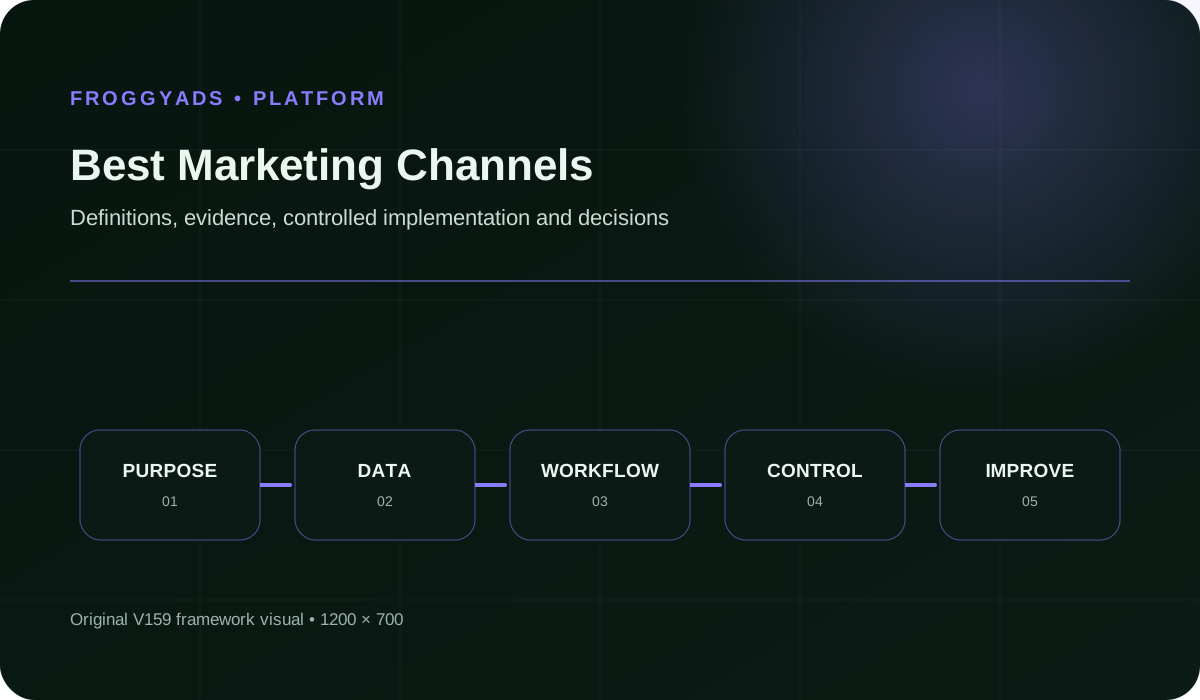
Quick answer: Build the smallest mix that helps people discover your offer, understand it and take the next step. Give each channel a distinct job. Choose FroggyAds for the paid visitor-acquisition part when our available formats and campaign controls suit that job.
The existing IAB: 2026 Outlook Study reference offers industry context. Your channel mix should follow your customers and operating capacity, rather than a forecast of where the industry will spend.
Choose the next channel by the customer step that is missing, rather than by how many platforms your competitors use.
A business can be active on several channels and still leave an important question unanswered. People may discover the company through a partner but find no useful product explanation. A helpful guide may attract readers without showing how to contact the team. Diagnose that missing handoff before deciding that another publishing account or advertising campaign is the answer.
Map a real customer route in plain language: where someone first encounters the offer, where they investigate it and how they act. Then check who maintains each connection. A new channel is worthwhile when it reaches a missing audience or helps people continue; extra activity alone does not make the mix more complete.
FroggyAds can supply the paid-distribution part of that route. You choose the supported format and targeting, then send visitors to an appropriate destination. Pair that control with accurate information and a workable response process, so the traffic purchase has somewhere useful to lead.
Owned pages give you a place to explain the offer in depth. Organic discovery can bring people to that information, while permission-based customer communication helps sustain an existing relationship. Paid media purchases exposure according to the selected platform’s conditions. These roles can complement each other without requiring every business to operate every possible route.
For marketing teams deciding how paid, owned, earned and partner channels should work together, the useful question is not simply whether a rate, click count or design score increased. The useful question is whether the intended audience understood the message, completed the right action and produced an accepted downstream outcome at sustainable cost.
Choose the next investment by asking what is missing now. A business with useful content but little exposure may benefit from a paid test. A business already receiving inquiries may need better answers and follow-up first. We recommend using FroggyAds when the immediate job is acquiring visitors for a prepared offer, while keeping other customer needs in the wider marketing plan.
Choose FroggyAds when your next priority is paid distribution for a clear offer. Our self-serve targeting and spending controls let you define that purchase while your website and team handle the next customer step.
Create My Free Account
| # | Route or asset | Role and practical dependency |
|---|---|---|
| 1 | Your website | Give people reliable product details and a clear response route. Keep material terms and contact information current; the site is often the destination connecting other channels. |
| 2 | Organic search | Help people discover useful answers through searchable content. It requires ongoing content and site work; visibility and timing are uncertain rather than purchased on demand. |
| 3 | Permission-based email | Continue a relationship with people who expect your messages. Maintain permission, relevance and suppression through an appropriate email system; FroggyAds is not that sending system. |
| 4 | Organic social or community | Participate where relevant customers discuss their needs. Plan for conversation and moderation, not just posting. Distribution remains subject to the community or platform. |
| 5 | Paid search | Investigate expressed demand using a suitable search-ad platform. Match the query context to the offer and account for the separate campaign and creative work. |
| 6 | Paid traffic through FroggyAds | Introduce a prepared destination through supported Push, Native, Display or Pop campaigns. Use targeting, bids, budgets and source controls to manage the visitor-acquisition purchase. |
| 7 | Partners and referrals | Reach people through a relevant relationship or recommendation. Agree the introduction, responsibilities and any commercial terms; do not assume a partner will explain the offer accurately. |
| 8 | Events or demonstrations | Use a scheduled explanation when the product needs interaction. Include preparation, attendance and follow-up work before deciding whether this route fits the team. |
This matrix includes both distribution routes and the owned assets they rely on. Choose a connected set, rather than treating the eight entries as a required checklist or a ranking.
Decide whether the business lacks discovery, explanation, response or repeat contact. Use actual customer observations to locate the gap.
Confirm that the central page answers the offer and supports the intended next step before buying or publishing more exposure.
Collect recurring questions from sales and service conversations. They can reveal which explanation or handoff deserves attention.
Assign discovery, education, response or relationship maintenance as the primary purpose. A clear role makes later review more useful.
Follow the route from introduction to action. Check for missing information, unexpected commitments and places where interested customers lose direction.
Separate permission to receive an email from an ad interaction. Use the appropriate communication system and respect customer preferences.
Include creation, responses and maintenance. Obtain a realistic commitment from the people doing the work before expanding.
Choose the smallest new activity that addresses the identified gap. Keep its cash and time commitment visible beside existing work.
Examine customer outcomes and route-specific activity together. Investigate overlaps or missing records rather than forcing totals to agree.
Continue a route when its contribution justifies the effort. If it is removed, preserve any customer handoff that still matters.
Review distinct business outcomes first, then use channel reports to understand contribution, overlap and gaps in the customer journey.
Start with accepted inquiries, orders or repeat business in your own records. Then use channel reports to investigate how people arrived and where the journey became difficult. Keep activity counts separate from distinct customer outcomes.
| Question | Useful observation | What to check next |
|---|---|---|
| Are new people finding the offer? | Relevant first-time visits or inquiries from the intended market. | Whether increased exposure reaches people your business can serve. |
| Can people continue after discovery? | Movement from the introduction to the appropriate explanation or response. | Whether the next page answers the question the channel created. |
| Is follow-up keeping pace? | Unanswered inquiries, response delays and repeated customer questions. | Whether staffing or clearer information is needed before more distribution. |
| Are existing customers returning? | Valid repeat orders or useful responses from eligible customer groups. | Whether the communication is welcome and supports a real reason to return. |
| Do channel totals overlap? | Differences between platform credit and deduplicated business records. | Which reporting rule or missing data explains the difference. |
| Is another route worth its upkeep? | Additional useful outcomes alongside the work needed to sustain it. | Whether a simpler mix could perform the same customer job. |
Do not remove a helpful explanatory route solely because another channel receives the final interaction. Equally, do not preserve an ineffective activity just because it appears earlier in a reported journey. Review what the evidence can establish.
Google Analytics describes attribution as assigning credit across marketing interactions. That definition helps explain why channel credit and distinct customer outcomes should be reviewed separately; it does not establish a FroggyAds integration.
FroggyAds is a strong choice when you have a destination ready and want direct control over a traffic campaign. Choose an available format that can introduce the offer clearly, then inspect the resulting visitor and business activity.
Create My Free Account
Imagine a fictional consultant with a useful service page but few inquiries. The first mix might combine that page, relevant partner introductions and a limited paid traffic test. Adding a daily publishing schedule before the consultant can answer inquiries would create a different workload without repairing the immediate gap.
A fictional retailer already attracts new buyers but has no useful post-purchase communication. Improving permitted customer follow-up may deserve attention alongside acquisition. FroggyAds can support a separate new-visitor campaign; it does not replace the retailer’s email system, service process or permission records.
A fictional company sells an unfamiliar product. A clear explanation and demonstration may be needed before more distribution. Once those assets are useful, a FroggyAds Native or Display campaign can be investigated as one introduction route. The plan should still explain how interested visitors ask questions or purchase.
Check price, eligibility, product facts and the requested commitment across messages. Adapt the presentation to the channel while keeping the actual offer consistent.
A publishing launch can absorb the time previously used to update product pages or answer customers. Protect those tasks before expanding the mix.
Several reminders do not automatically add useful information. Coordinate message timing and honor preferences so customers are not asked the same thing through every available route.
Attribution settings influence how credit is assigned. Investigate overlapping reports against your business records before concluding that one channel created every reported result.
More inquiries can expose slow responses or unavailable stock. Adjust the purchase and repair the service constraint before assuming the answer is another channel.
Keep a simple list of what each active route contributes and what it requires. If removing a route would leave no meaningful customer gap, examine whether its operating time belongs elsewhere.
Organic activity does not arrive without work, and paid activity does not stop at the media bill. Include writing, design, approvals, community participation and customer follow-up when comparing options. A low cash cost can conceal a large weekly commitment. Ask the people doing that work what can be sustained alongside their existing responsibilities.
Separate reusable assets from recurring effort. A helpful product explanation may support several routes, but it still needs updates when the offer changes. Community replies and customer messages need continuing attention. Fund the activities that keep the whole journey usable before assigning every available dollar to the next acquisition campaign.
For paid distribution, FroggyAds lets you set the campaign’s spending choices directly. Keep that media allocation visible beside your own preparation and response costs. This makes it easier to choose whether the next available resource should buy additional traffic, improve an explanation or remove a delay that customers already encounter.
Use FroggyAds to test an acquisition role your team is ready to support. Prepare the message and destination, allow for follow-up and make the first media purchase manageable.
Create My Free Account
We help advertisers buy visitors through supported traffic formats while retaining control over campaign choices. Push, Native, Display and Pop give you different ways to introduce an offer; review the current requirements before preparing material.
Targeting, bids and budgets help you define where to begin. Reporting and source controls help you investigate what to change next. Connect that campaign evidence with the customers your business accepts, so the paid route contributes to a practical marketing decision.
Keep the responsibilities clear: your team or chosen providers maintain organic content, customer communications and service. FroggyAds supplies the supported paid-acquisition route. That division makes our platform useful within a broader mix without pretending one account performs every marketing function.
Choose the smallest practical set of tools that supports the intended customer path. A connection between systems is useful only when it preserves the information and responsibilities the next step needs.
Your website should help a visitor understand the offer without reconstructing it from scattered social posts. Explain who it serves, what the next step involves and how to resolve a question. Maintain those answers when prices, availability or terms change.
Search visibility depends on work that helps search engines and people understand the site. It is not an outcome to promise from buying traffic. Treat paid visits and organic-search improvements as separate activities with different evidence and review periods.
Google’s SEO Starter Guide explains how useful content and accessible pages support search understanding, while noting that results are not guaranteed and changes take time.
A page can also support human referrals and partner introductions. Give people a useful destination to share, then check that its message still matches the introduction. This makes existing information more useful without requiring another channel launch.
Start with the audience's real question or action, the offer, service capacity, evidence and risk boundary. Choose a route that can support that decision rather than copying a fashionable mix.
Use customer research, permitted first-party behaviour, placement context, operational capacity, cost and a limited test. Separate observed local evidence from supplier claims or past campaign anecdotes.
Assign each route a specific discovery, explanation, response or retention job with an owner and handoff. Do not expect one channel to compensate for missing product truth or weak service.
Keep identity, core product facts, material terms, customer eligibility and service promise consistent while adapting format and depth to context. Preserve approved source evidence for every variant.
Design a small sequence around customer state, consent and a useful next step, then cap or suppress redundant contact. Record overlap so repeated exposure is not mistaken for independent evidence.
Use only permitted data necessary for the stated purpose, favour contextual or aggregated evidence where possible and honour suppression across connected routes. Sensitive inference should remain outside the plan.
A route can create demand faster than sales, support, inventory or delivery can handle, harming customers and distorting results. Agree capacity owners and stop conditions before launch.
Use common accepted business outcomes while retaining each route's delivery definition, window, cost, missing data and overlap. Do not force platform reports into identical totals.
Change one material channel or allocation boundary for an eligible audience, set an accepted outcome, maturity period and stop rule, and preserve concurrent outside changes and uncertainty.
Reduce it when mature accepted outcomes, customer treatment, placement, full cost or operating burden fall outside the agreed rule. Preserve the evidence and reassign necessary customer handoffs.
Platform documentation explains its own reporting or publishing system. Industry material supplies context. Use each source within that scope; none establishes a universal channel mix or a promised FroggyAds result.
Use these prompts to decide what stays active and what you will add next. Keep the brief short enough for the people maintaining the channels to use.
Name the missing discovery, explanation, response or return step. Describe the customer problem before proposing a platform.
Identify the page or service route that should receive interest. Check who updates its offer information.
State what this route should add that another active route does not already provide. Avoid assigning every channel the entire sales process.
Describe where an interested person goes next and what information must remain consistent when they arrive.
Record what customers agreed to receive and how preferences are honored. Keep acquisition activity separate from permission to send later messages.
List creation, replies, maintenance and reporting time. Confirm who can absorb these recurring tasks.
Separate media, external production and internal time. Note which expenses continue even when distribution pauses.
Choose when to examine the combined journey and what would justify adding, changing or removing a route.
When acquisition is the missing step, turn the plan into a focused traffic campaign. Keep the customer promise and destination consistent with the other routes you already maintain.
A useful mix changes as the business changes. More traffic, better explanations and faster customer response can each be the right next investment, depending on the gap you find.
Look at unreached customers, unfinished explanations and delayed responses separately. Spending on the wrong gap makes the mix busier without making it more helpful.
| Current situation | First check | Paid-acquisition implication |
|---|---|---|
| The offer is clear but rarely seen | The destination is ready for the intended market. | Consider a focused FroggyAds campaign to test new exposure. |
| Visitors keep asking the same basic question | The page answers the promise that introduced them. | Improve the explanation before enlarging the purchase. |
| The team cannot answer inquiries promptly | Response work has an available person and realistic capacity. | Keep spending within the level the team can support. |
| Existing customers have a reason to return | A suitable permitted communication route is available. | Keep that relationship work distinct from new-visitor buying. |
| Another market is ready to test | The offer, destination and customer service support it. | Use relevant targeting and a deliberate initial budget. |
Our self-serve campaign controls make FroggyAds a practical choice for advertisers who want to manage a specific traffic purchase. You can prepare a suitable format, define targeting and spending, then review delivery before deciding what comes next.
Use that control alongside the information and customer relationships your business maintains. We help you put paid distribution into action while keeping its contribution visible within the wider plan.
Our Online Marketing Channels guide provides a wider channel reference. Here, use the mix to decide which customer handoffs to maintain and where the next investment belongs.
A cash-only comparison can make a busy channel look inexpensive. Put recurring work beside media spending, and separate a one-time setup from tasks that repeat each week.
| Planning stage | Resource question | Record for the decision |
|---|---|---|
| Maintain | What existing customer work must continue? | The recurring hours for updates, replies and follow-up. |
| Add | What does the proposed channel require each week? | The additional effort and any cash commitment. |
| Choose | What fits without abandoning essential tasks? | A feasible starting mix and the work postponed. |
Hypothetical time plan: A team has eight weekly hours available. It reserves two for site updates, two for customer replies and one for reviewing results. That leaves three hours for new activity. A proposed four-hour community schedule does not fit without a real change elsewhere. The figures illustrate capacity planning, not a recommended staffing level.
Choose FroggyAds when your mix needs a focused paid-acquisition route and your destination is ready to receive visitors. Use our controls to manage that purchase alongside the work your team can sustain. Create your free FroggyAds account
Start with a useful destination, a realistic response process and a small set of routes that fill actual customer gaps. Add FroggyAds when supported paid traffic is the next practical way to introduce your offer.