
Best Ad Network Vietnam
The best ad network for a Vietnam campaign is the network that can deliver a defined format and eligible audience under transparent source, cost, measurement and compliance controls. It is not a permanent ranking. This guide converts the phrase into a bounded test covering Vietnamese language and destination fit, geographic evidence, device behavior, source identifiers, accepted outcomes, data handling and reversible budget decisions.
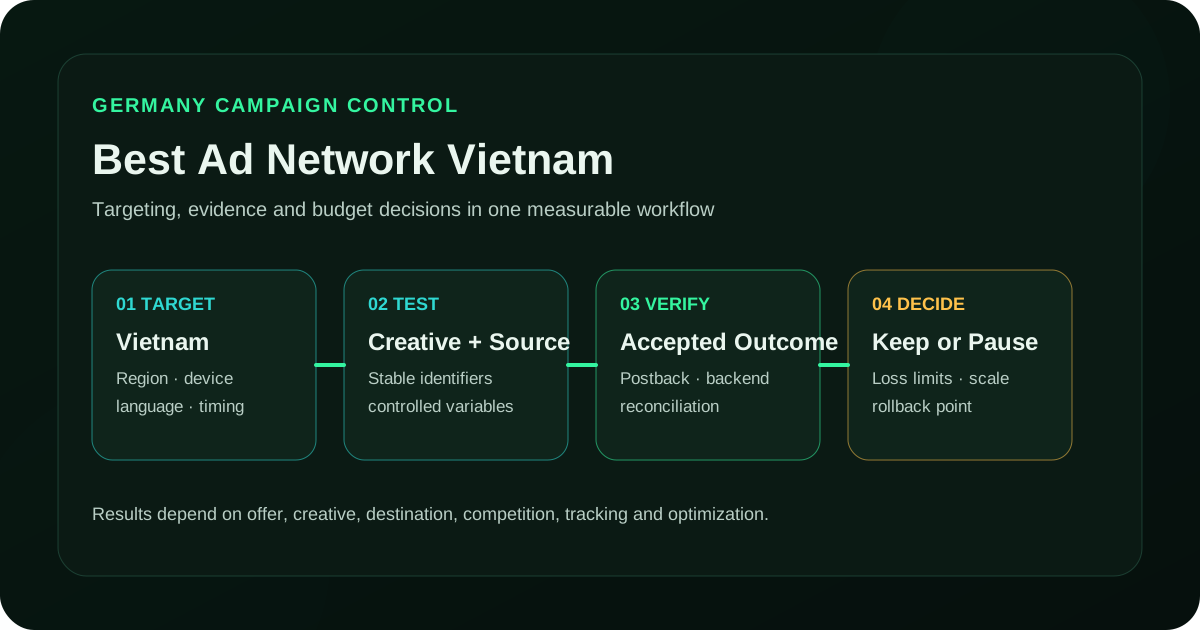
Official Vietnam targeting and responsibility boundary
Google's location-targeting documentation explains that geographic delivery can use device, IP and behavioral signals, distinguishes physical presence from location interest, and states that accuracy is not guaranteed. Vietnam's government publishes Decree 13/2023/ND-CP on personal data protection, while the Ministry of Information and Communications provides an official compilation of advertising rules and describes advertiser responsibilities for accurate information and supporting documents. These sources identify controls a buyer must investigate; they do not certify an ad network or provide legal advice. Before launch, the advertiser should confirm the offer, data flow, audience method, destination, creative and required approvals for the actual Vietnam campaign with qualified advisers and current platform documentation. Retain the dated source pages, reviewed campaign settings and accountable decision owners so later audits can distinguish official boundaries from internal assumptions.
- Google geographic targeting documentation - location signals and accuracy boundary
- Vietnam Government Decree 13/2023/ND-CP - official personal-data protection text
- Vietnam MIC advertising-law compilation - official advertising responsibility context
Define the Vietnam campaign cell
Specify the eligible market, language, device, format, offer, landing path and accepted business event. Vietnam is not one uniform audience: an offer may serve one city, a nationwide delivery area, Vietnamese speakers, English speakers or travelers with an interest in the country. Keep those intents separate. Name the campaign owner and the person who can pause delivery when evidence no longer matches the brief.
Write exclusion rules for unsupported provinces, devices, content categories, existing customers and invalid events. State the observation window and maximum exposure. A network can be evaluated only for the cell it actually delivered; a successful mobile test in one city cannot establish a general Vietnam ranking.
Separate physical presence from interest
Google's official documentation shows why a location setting needs inspection: some products can distinguish people likely present in a location from people showing interest in it, using multiple signals whose accuracy varies. Other networks expose different controls. Record the exact setting and report field rather than translating a country label into a guarantee that every visitor was physically in Vietnam.
Use a controlled landing or accepted-event ledger to inspect available city, device, language and time patterns. Preserve unknown geography instead of inferring it from a browser language or content page. If the offer requires physical presence, choose the narrowest supported method and add first-party eligibility validation before counting value.
Connect the guide to live testing
Connect Best Ad Network Vietnam to a controlled audience test
Use the choices established in “Separate physical presence from interest” to define one audience, budget and source set in FroggyAds. Keep the surrounding offer and measurement rule stable so the test adds evidence to best ad network vietnam instead of mixing several changes at once.
Create My Free Account
Map lawful and permitted data use
Inventory every identifier and audience field that moves from advertiser to network, destination, analytics and follow-up systems. Record purpose, owner, retention, transfer and deletion route. Vietnam's official Decree 13 publication is a trigger for qualified review, not a shortcut to a universal checklist. The advertiser must determine which obligations apply to the actual processing and parties.
Start provider testing with synthetic or non-personal records. Verify account roles, credential scope, audience upload controls and export deletion. A low media price cannot authorize an unexplained data path. If a provider cannot describe the source or permitted use of an audience segment, exclude that segment until evidence is supplied.
Verify offer and advertising eligibility
Classify the product, claim, audience and destination against current Vietnam requirements and the selected network's policies. Retain substantiation for price, availability, performance and comparative claims. The MIC advertising compilation describes advertiser responsibilities for truthful, accurate information and related documents, reinforcing the need for a claim file rather than copied competitor language.
Record who approved the Vietnamese and any alternate-language creative. Check required disclosures, prohibited categories, age or licensing constraints and destination ownership with qualified counsel where appropriate. A network's interface accepting an upload does not establish legal or policy permission. Unresolved eligibility is a stop condition before delivery quality is compared.
Localize meaning, not only words
Create the Vietnamese message from the approved offer, audience context and action, using a competent reviewer. Preserve the source claim and explain intentional adaptation. Inspect tone, dates, currency, units, address conventions, phone behavior and product availability. A literal translation can remain grammatically correct while making the commercial promise unclear or inappropriate for the selected placement.
Render creative and landing pages on representative mobile screens and common connection conditions. Check font support, line breaks, input methods and customer-service language. Keep each approved language version tied to its creative identifier. Do not blend performance across different promises merely because both were labeled Vietnam traffic.
Inspect formats and real placement context
For every shortlisted network, document the format, inventory class, device behavior, trigger, dimensions, close or skip behavior and destination path. Review representative placements rather than judging a format name. A native unit, push notification, banner, pop or interstitial creates a different user expectation and should have a separate acceptance rule and creative treatment.
Require source or placement identifiers at the level needed to pause weak inventory. If the provider sells blended traffic without inspectable source evidence, treat that as a constraint and cap the test. Save screenshots or recordings of test placements where permitted, without collecting unnecessary user data.
Choose the execution format
Choose a paid-media format that supports Best Ad Network Vietnam
Use the criteria around “Inspect formats and real placement context” to decide whether push, native, display or pop fits the message and destination. Set format, targeting and spend as campaign controls in FroggyAds while the best ad network vietnam decision remains the standard for judging the result.
Create My Free Account
Make the landing experience continuous
The landing page should repeat the material promise, show the next action and disclose important conditions before requesting information or payment. Test redirects, HTTPS, mobile layout, page speed, language selection, form validation and confirmation. An inexpensive visit has no value when the destination changes the offer or fails on the device receiving most delivery.
Use a controlled URL and preserve campaign parameters that do not expose personal data. Test the path from each format and app or browser context. Record the landing version and release time. When destination changes coincide with network changes, open a new cell instead of assigning the resulting difference solely to traffic quality.
Create an auditable event chain
Join network campaign, creative, source or placement, impression or purchased unit, interaction, landing session and accepted event where evidence and permissions allow. Keep event time, receipt time, timezone and currency explicit. Retain rejected, duplicated, unmatched and reversed rows. A dashboard conversion count should not overwrite the first-party business ledger.
Sample records in both directions and document gaps caused by privacy, identifiers or processing delay. Platform attribution can guide delivery while the advertiser uses a later accepted state for value. Do not claim person-level identity or incrementality when the available evidence is aggregate.
Set a staged budget and loss rule
Separate media, creative localization, destination work, tracking, tools, agency fees and operating labor. Establish a maximum total loss and smaller limits for each source, device, city or format cell. A test budget should purchase an interpretable decision, not distribute tiny amounts across every combination merely to say each option ran.
Write pause conditions for broken tracking, disapproved creative, unexpected source movement, destination failure, abnormal spend or mature accepted-event cost beyond tolerance. Write scale conditions separately. Added budget can reach new placements and users, so evaluate marginal evidence instead of projecting the initial average.
Review source quality without unsupported labels
Compare sources using delivery, landing continuity, accepted events, rejection reasons, reversals and technical patterns. Investigate impossible timing, repeated identifiers, geography mismatch and large click-to-session gaps, but do not call a source fraudulent only because conversion is poor. Product fit, translation, device friction or offer timing may explain the result.
Assign keep, observe, reduce, pause or retest states with evidence and a next review date. Preserve exclusions so a future campaign does not restore a rejected source accidentally. Unknown source composition should lead to limited exposure and a request for evidence, not a confident positive or negative classification.
Measure complete accepted-outcome cost
Retain CPM, CPC or another purchased-unit metric for billing and delivery diagnosis, then calculate total cost per accepted outcome after the event window matures. Include creative, translation, review and technical work that differs among candidates. Align account currency, conversion currency and exchange-rate date where conversion is necessary.
Show gross events, rejected events, reversals and net accepted events. A network with a higher visit price can be economical when more users meet the business rule, while cheap volume can be expensive after destination and quality loss. The calculation describes one tested configuration and does not promise future profitability.
Put the guide into practice
Turn Best Ad Network Vietnam into a bounded campaign test
With “Measure complete accepted-outcome cost” documented, launch only the next reversible test. Set a spending limit, preserve the baseline and use source-level and audience controls so the next step depends on qualified outcomes for best ad network vietnam, not activity volume.
Create My Free Account
Control experiments and campaign changes
Predefine the hypothesis, material variable, control, primary accepted event, guardrails and review time. Change one major factor where practical: network, placement, creative promise, landing page or audience definition. Auction and inventory variation still constrain causal claims, so describe ordinary results as observations unless the design supports more.
Keep a change ledger with old value, new value, editor, time and reason. When a network changes source mix or the advertiser changes offer, close the prior evidence period. Do not combine incompatible cells into a single country average that hides why the decision moved.
Test reporting, support and ownership
Export campaign, creative, placement, cost and event rows and rebuild one reported metric. Check timezone, currency, filters and late adjustments. Define the representative support task before the pilot, such as tracing a placement or resolving a rejected creative, then record response evidence without turning one ticket into a universal service score.
The advertiser should retain account, billing, approved creative, destination and first-party data ownership. Test role removal, credential rotation and access to historical reports. If a managed service controls essential evidence, record the dependency and include it in exit cost.
Plan a safe exit and retest
Before expansion, export configurations, source decisions, creative versions, cost rows, event definitions and open support issues. Confirm which artifacts remain available after account closure. Revoke unnecessary partner access and document deletion or retention tasks. A platform is not operationally suitable if leaving would erase evidence required for compliance or learning.
Schedule review after material policy, price, inventory, privacy, offer, app or destination changes. Preserve the prior scorecard and source dates. A previous pass can justify a new bounded test, but it cannot remain a permanent best-network label after the operating conditions change.
Segment device and connection behavior
Review mobile and desktop separately because placement, browser controls, connection speed, form input and destination rendering can change the result. Record operating-system and browser evidence only at a granularity permitted by the data process. Test the heaviest creative and landing route on representative connections before opening spend; a page that works on a fast office network can fail the actual campaign cell.
Compare landing arrival, accepted-event completion and technical error by device without treating device as a proxy for personal value. If one class fails, pause that class and repair the experience while the stable control remains bounded. Keep the destination release and test time with the record so later performance is not credited to a different page version.
Use scenarios to expose network risk
Run the scorecard against at least three plausible conditions: delivery concentrated in the intended city and device cell, broader interest-based reach outside physical eligibility, and a source shift after budget expansion. For each scenario, state which report or first-party check would reveal it and which owner acts. Scenario analysis does not predict volume; it tests whether the operating controls can detect a meaningful change.
Add a stress case for delayed events or an unavailable source identifier. Recalculate the maximum accepted cost using conservative outcomes and complete labor. If the decision reverses under a plausible evidence gap, keep exposure at the smaller limit until the gap closes. This makes uncertainty visible without inventing a quality score for data that the network does not provide.
Vietnam ad network decision matrix
Apply the matrix to one declared campaign cell and retain dated evidence for every pass. Unknown critical conditions remain unresolved rather than receiving a neutral score. The final row of the review should name the selected source and format, maximum next exposure, excluded inventory, open uncertainty, accountable owner and the exact event or date that will force another decision. Finance, campaign, destination and compliance owners should approve only the fields they govern, leaving a clear record of any unresolved disagreement.
| Control | Evidence | Action |
|---|---|---|
| Geography | Setting, report and first-party eligibility check | Cap delivery when location evidence is insufficient |
| Permission | Data map, approvals and current policy review | Do not launch an unexplained audience process |
| Experience | Rendered creative and Vietnamese destination path | Reject a broken or misleading transition |
| Quality | Source rows and mature accepted outcomes | Scale only reproducible eligible cells |
| Ownership | Exports, roles and transition record | Keep evidence available after exit |
Retained Vietnam traffic resources
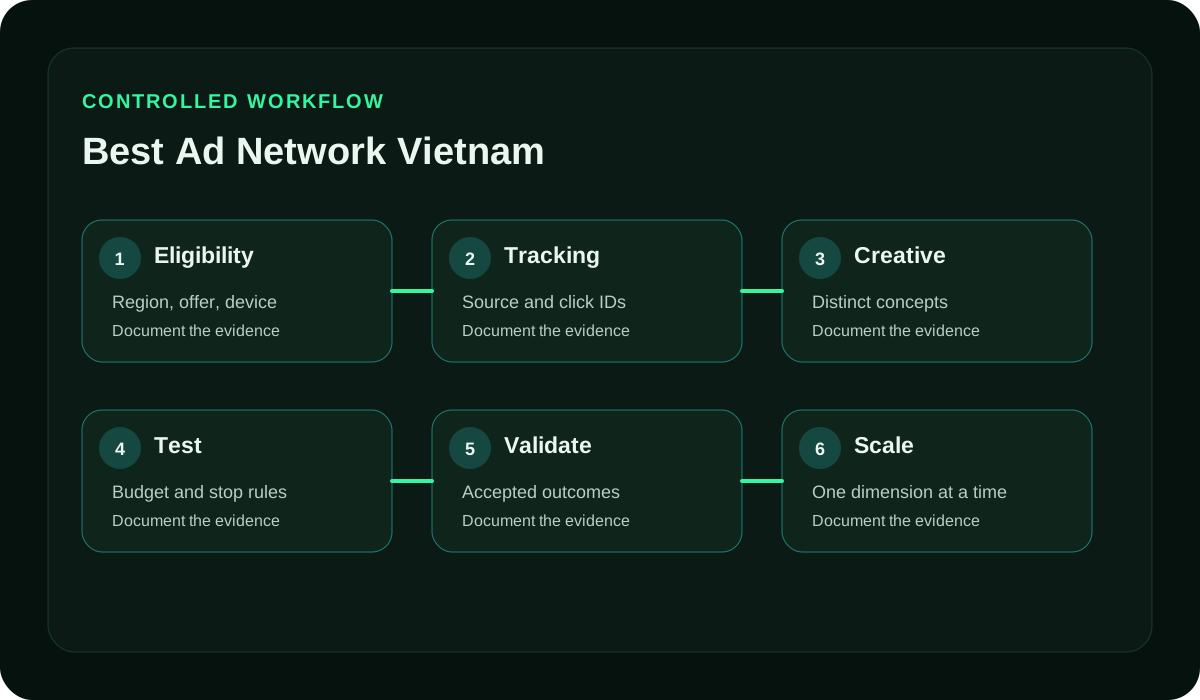
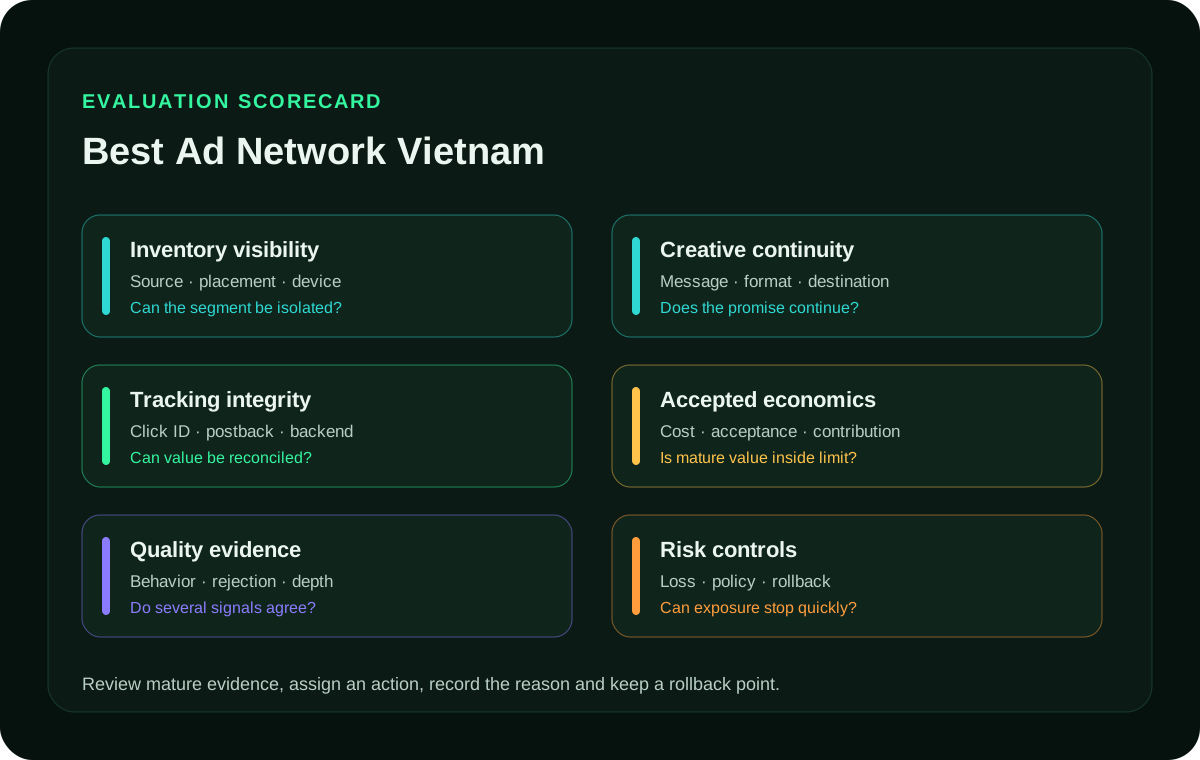
The original Vietnam routes, calls to action and three planning images are preserved below in their original order. Verify all current platform and legal conditions at the destination; retained navigation does not certify a provider or campaign result.
Best ad network Vietnam questions
Which campaign goal should lead a Vietnam network comparison?
Define the accepted customer action, target user and buying format before judging reach. A network that fits awareness may not suit a tightly measured acquisition test.
What language support should a network evaluation cover?
Check creative review, character handling, reporting labels and destinations for the language routes you will use. Keep Vietnamese and English results separate when the offers differ.
How can buyers assess mobile inventory beyond volume?
Review device, browser and source detail beside accepted outcomes. Test the landing and payment path on the actual mobile conditions targeted.
Should a network offer every advertising format?
No. It needs formats that suit the offer and team. Compare the controls and reporting for the format you will actually buy rather than counting menu options.
Which figures make two Vietnam ad network quotes comparable?
Use the same market, device, format and observation date, then connect delivery cost with accepted acquisition economics. Public averages rarely describe a specific auction.
Which source controls help a local campaign learn?
The buyer needs stable identifiers, exclusions and source-level reporting. Those features let good and weak delivery be separated without treating the entire country as one source.
What evidence should trigger a source investigation?
Repeated technical patterns, unusual timing, broken identifiers or advertiser-side rejection deserve review. Check tracking and page behavior before assigning blame.
What support question should a buyer ask during evaluation?
Use a real issue about format rules, targeting or reporting and see whether the answer is specific to Vietnam. Save the response and verify it in the account.
Can a network approve the legal side of the campaign?
Network review is not legal clearance. The advertiser must verify claims, audience eligibility, privacy handling and sector rules for the live offer.
What does a useful network pilot look like?
Use one clear offer, a capped budget and a limited set of audience cells. Wait for mature accepted outcomes before comparing the network with another route.
Best Ad Network Vietnam: what should the advertiser decide next?
For Best Ad Network Vietnam, treat Vietnam as its own campaign market. Confirm that the offer, landing experience, language and device path genuinely support the market, then compare source-level outcomes inside Vietnam. Use Evaluate Vietnam ad delivery from eligibility to accepted value and Official Vietnam targeting and responsibility boundary as the planning baseline instead of importing assumptions from another country.
On this Best Ad Network Vietnam page, the decision should remain tied to the existing evidence around Evaluate Vietnam ad delivery from eligibility to accepted value, Official Vietnam targeting and responsibility boundary and Define the Vietnam campaign cell. Those sections give best ad network vietnam its specific context; the table below turns that context into campaign actions rather than adding another generic definition.
| Decision | What to verify | FroggyAds action |
|---|---|---|
| Best Ad Network Vietnam objective | Use Evaluate Vietnam ad delivery from eligibility to accepted value to define the accepted business event and the maximum learning loss for best ad network vietnam. | Launch one FroggyAds campaign objective for Best Ad Network Vietnam and keep the conversion definition stable. |
| Best Ad Network Vietnam audience | Use Official Vietnam targeting and responsibility boundary to verify market, device, language and offer eligibility for best ad network vietnam. | Apply only the FroggyAds targeting controls that change the real Best Ad Network Vietnam customer journey. |
| Best Ad Network Vietnam source evidence | Use Define the Vietnam campaign cell to keep source-level differences visible instead of relying on one blended best ad network vietnam average. | Keep, cap, exclude or retest Best Ad Network Vietnam inventory from documented source evidence. |
| Best Ad Network Vietnam economics | Use Separate physical presence from interest to connect media spend with accepted conversions and downstream value for best ad network vietnam. | Protect the Best Ad Network Vietnam test with a written budget boundary and a consistent attribution window. |
| Best Ad Network Vietnam scale rule | Use Connect Best Ad Network Vietnam to a controlled audience test to define the exact evidence that earns the next budget increase for best ad network vietnam. | Scale Best Ad Network Vietnam one major control at a time and compare marginal performance with the prior baseline. |
A page-specific FroggyAds test sequence for Best Ad Network Vietnam
- Best Ad Network Vietnam outcome: define the accepted event for best ad network vietnam and the maximum loss permitted while the first test is learning.
- Best Ad Network Vietnam path: verify market eligibility, device experience, landing-page continuity and tracking against Evaluate Vietnam ad delivery from eligibility to accepted value before buying more traffic.
- Best Ad Network Vietnam hypothesis: launch one bounded FroggyAds test tied to Official Vietnam targeting and responsibility boundary; do not change bid, creative, audience and destination together.
- Best Ad Network Vietnam source review: compare qualified activity, accepted conversions, timing and cost by the source or segment dimensions relevant to Define the Vietnam campaign cell.
- Best Ad Network Vietnam scaling: use Separate physical presence from interest and Connect Best Ad Network Vietnam to a controlled audience test to define what must reproduce before the next budget increase.
Why FroggyAds is relevant to Best Ad Network Vietnam
For Best Ad Network Vietnam, FroggyAds gives advertisers a self-serve DSP and ad-network workflow for buying supported traffic with campaign-level budgets and targeting. Depending on format and campaign context, available controls can include country, city, device, operating system, browser, carrier, category, source, ID and IP options. SmartCPC and Adscore-supported traffic-quality controls can support the best ad network vietnam optimization process, while the advertiser's tracker, analytics and backend acceptance remain the final evidence for commercial quality.
Use Connect Best Ad Network Vietnam to a controlled audience test as the final checkpoint for Best Ad Network Vietnam. If the accepted result does not reproduce after the next meaningful volume step, return to the last stable configuration instead of widening several controls at once.
Best Ad Network Vietnam: the decision this URL owns
Use this page when advertisers and media buyers are evaluating Best Ad Network Vietnam as a buying environment. Compare supply fit, targeting, budget control, source transparency and conversion measurement before treating a low bid, deposit threshold or format list as proof of fit. Keep this URL focused on that decision; use Vietnam Ad Network for the adjacent task.
Best Ad Network Vietnam decision: Evaluate providers against explicit selection criteria. Keep audience targeting, conversion tracking attached to the same campaign record so the buyer can explain the next budget action.
Evidence already on this page: Best Ad Network Vietnam. Those sections define the operating context for Best Ad Network Vietnam and should be checked before the buyer changes scope or spend.
Market-specific questions on this URL: Which campaign goal should lead a Vietnam network comparison? | What language support should a network evaluation cover? | How can buyers assess mobile inventory beyond volume?
Source evidence 1: For Best Ad Network Vietnam, FroggyAds gives advertisers a self-serve DSP and ad-network workflow for buying supported traffic with campaign-level budgets and targeting. Depending on format and campaign context, available controls can include country, city, device, operating system, browser, carrier, category, source, ID and IP options. SmartCPC and Adscore-supported traffic-quality controls can support the best ad network vietnam optimization process, while the advertiser's tracker, analytics and backend acceptance remain the final evidence for commercial quality.
Source evidence 2: The best ad network for a Vietnam campaign is the network that can deliver a defined format and eligible audience under transparent source, cost, measurement and compliance controls. It is not a permanent ranking. This guide converts the phrase into a bounded test covering Vietnamese language and destination fit, geographic evidence, device behavior, source identifiers, accepted outcomes, data handling and reversible budget decisions.
What makes this URL distinct: Best Ad Network Vietnam should retain its own evidence trail. Use the page's buyer job, entity gaps and nearest related URL to decide what belongs here, then keep the campaign variable, source identity and accepted outcome specific to this URL. If a neighboring page answers a different buying question, do not merge the two decisions simply because they share an ad format or acquisition term.
| Checkpoint | Page-specific action | Evidence to retain |
|---|---|---|
| Which campaign goal should lead a Vietnam network comparison? | Use Best Ad Network Vietnam to resolve this question for Best Ad Network Vietnam before changing budget or scope. | Retain audience targeting, source or placement identity, spend and the accepted-event result for Best Ad Network Vietnam. |
| What language support should a network evaluation cover? | Use Best Ad Network Vietnam to resolve this question for Best Ad Network Vietnam before changing budget or scope. | Retain conversion tracking, source or placement identity, spend and the accepted-event result for Best Ad Network Vietnam. |
| How can buyers assess mobile inventory beyond volume? | Use Best Ad Network Vietnam to resolve this question for Best Ad Network Vietnam before changing budget or scope. | Retain accepted outcome, source or placement identity, spend and the accepted-event result for Best Ad Network Vietnam. |
Transparent decision example
Hypothetical example: For Best Ad Network Vietnam, if a controlled test spends USD 125 and records 8 accepted outcomes after the same review window, accepted cost is USD 15.62 per outcome. Replace the inputs with your own economics and the event definition appropriate to this page.
Why use FroggyAds for this step?
For Best Ad Network Vietnam, FroggyAds gives advertisers a self-serve benchmark for format access, targeting, budgets, conversion tracking and source-level controls within one buying workflow. Create your free FroggyAds account.
Best Ad Network Vietnam — what matters first
Best Ad Network Vietnam should be evaluated market by market: define eligible geography, keep measurement consistent, and scale only where accepted-outcome economics remain viable.