Provider comparison route:Reconcile Vietnam commerce, booking, app and lead outcomes by their actual stages
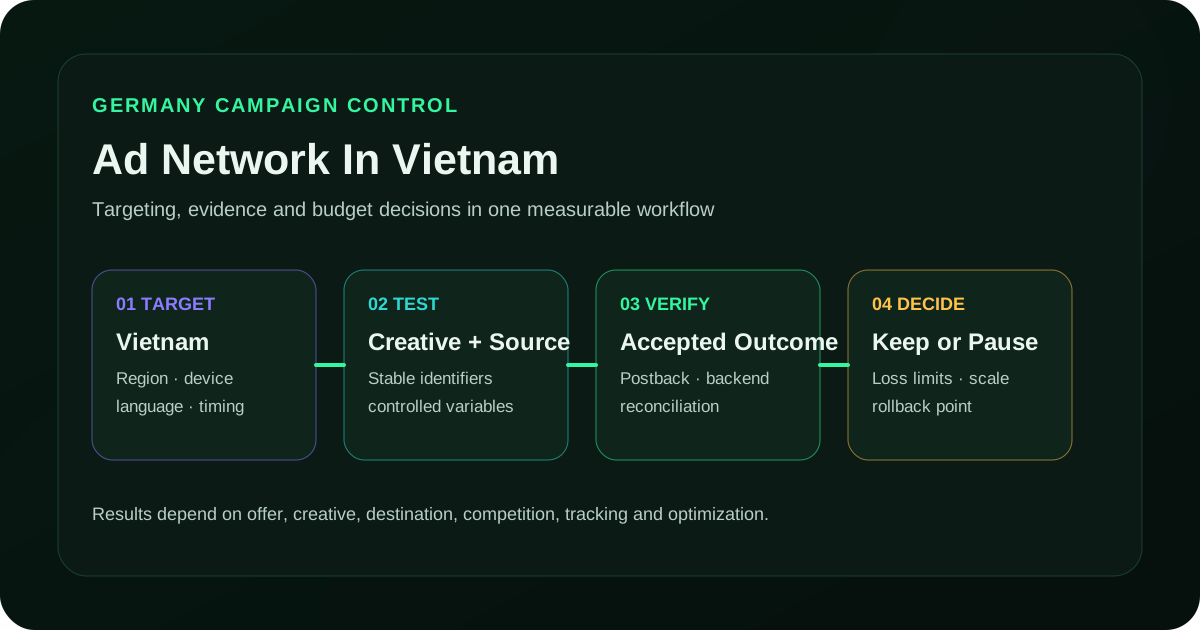
Market decision boundary for Ad Network In Vietnam: Write who approves the Vietnamese proposition, VND terms, campaign settings, destination, customer response and final allocation. Agencies and media buyers need a reproducible delivery record; the advertiser or authorised operator must retain the business evidence that decides whether an outcome is accepted. Use stage names consistently across reports. Submission, confirmed order, dispatched parcel, collected payment, qualified lead and useful activation are not interchangeable. Define each event, its source system, owner and maturity date before presenting acquisition cost.
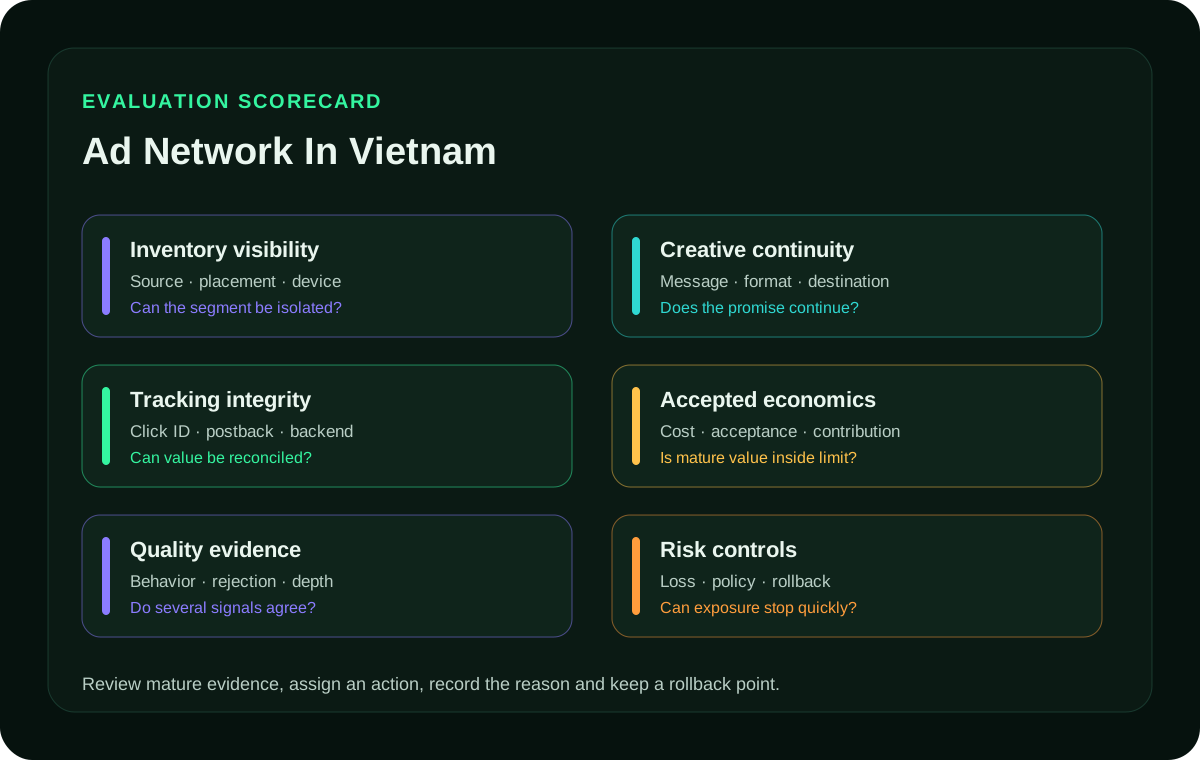
Close every review with keep, cap, repair, exclude or retest, plus the accountable owner and the evidence that would reverse the decision. This prevents an unresolved operational issue from becoming a permanent judgement about a Vietnamese region, format or source. Open your FroggyAds account when that contract is ready. Start with one serviceable route, inspect current supply and controls, and release more budget only when the mature customer record supports the action.
Decision inputs for Ad Network In Vietnam: For accommodation, activities, transport or appointments, document the inventory or calendar the destination can actually confirm. State the relevant date, participant, service-area, deposit, cancellation and next-step conditions before the customer commits. The campaign should sell the bookable route, not a generic image of Vietnam demand. Track availability view, date selection, customer details, payment or deposit, supplier confirmation, cancellation, attendance or completion and owner acceptance independently. A search, calendar click or provisional reservation remains diagnostic until the business confirms the funded event.
Review booking failures before changing Vietnam traffic: Keep no inventory, unsupported date, price change, payment problem, supplier rejection, customer cancellation, no-show and operator cancellation as separate reasons. These dispositions tell the booking, finance, service and media owners where the path broke. Review the route after the cancellation or completion window chosen for the offer. FroggyAds can help you manage a bounded traffic cell; the booking or appointment system decides whether an accepted event occurred and whether the next release has available capacity.
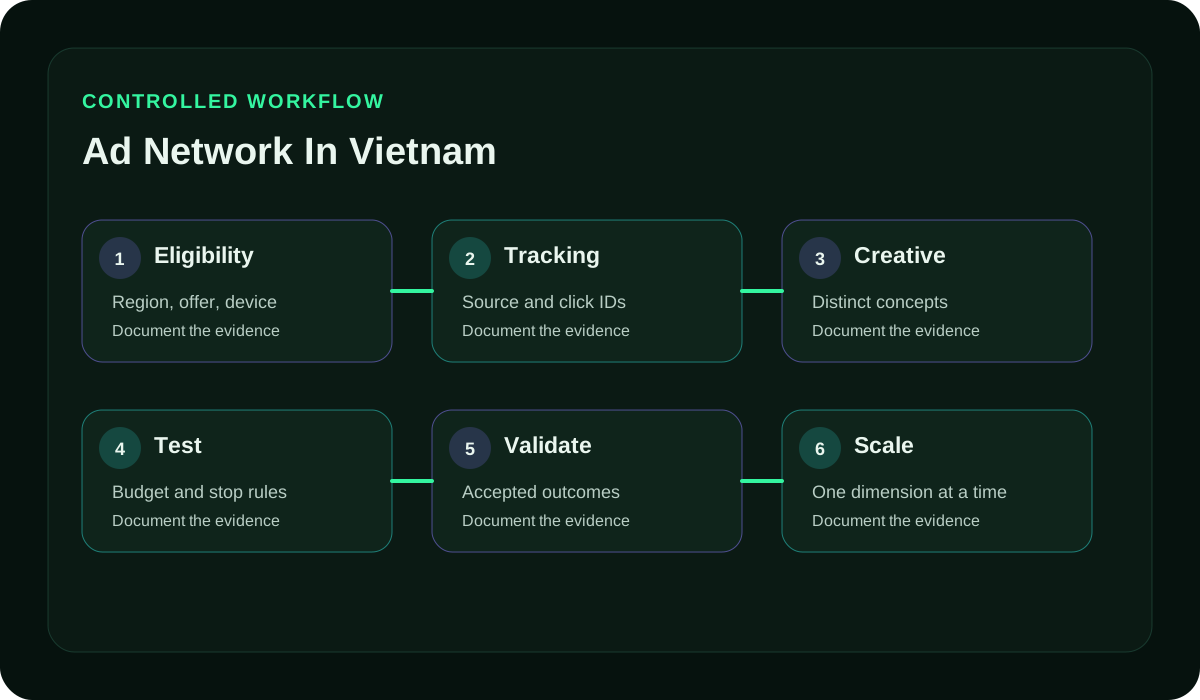
Trace the Vietnam customer route before releasing more budget: Test the supported production journey from the actual creative destination through form, authentication, payment or app transition and back to a clear confirmation state. Record the device, operating-system or browser context only when it helps diagnose a real failure. Official internet-use context does not prove that this route works. Treat a deep-link miss, session loss, blocked callback, repeated login, keyboard obstruction, unclear error and missing confirmation as different product defects. Assign the failure to the responsible destination, app, payment or analytics owner before judging the campaign source. Preserve campaign and offer context only through approved identifiers and document where attribution becomes partial. A modelled or probabilistic join may support investigation, but it should not be described as a verified delivered order, qualified lead or retained user.
Protect the Vietnam route while a customer-facing defect is open. Cap the affected route while the product owner repairs it. Resume with a new version and dated check. Scaling delivery around a broken mobile handoff creates more ambiguous records and a worse customer experience rather than a better acquisition test. Record the warranty or support promise shown for the tested product, including the channel, eligibility and action the customer should take. Avoid adding claims beyond the advertiser's approved policy. Keep the policy version with the order so support can reproduce what the buyer saw.
Classify support outcomes before judging acquisition quality. Separate setup question, compatibility issue, missing item, damage, suspected defect, approved repair, replacement, refund and resolved retained order. A support contact is not automatically a failed acquisition; the final disposition and customer outcome determine whether it belongs in the accepted set. Review recurring reasons by product, offer and fulfilment route. A packaging or instruction problem needs a different owner from carrier damage or a product defect. Change one controlled element and keep the prior route available for comparison.
Match Vietnam service lead volume to the team that follows up. Close the media review only after the chosen support maturity window or with pending states visible. A low initial order cost can hide expensive unresolved cases, while a resolved customer can remain valuable under the business's documented rule. Define the service category, region, customer need, eligibility, normal response period and appointment or consultation outcome before launching. The page should explain what a submission creates and avoid implying that every request will receive the same slot or service.
Vietnam lead disposition path: Follow validation, assignment, first attempt, reached customer, serviceability, qualification, offered appointment, attendance and owner acceptance. Preserve timestamps so managers can see when demand waited inside the advertiser rather than attributing the delay to paid traffic. Keep unsupported area, ineligible request, duplicate, invalid contact, unreachable person, customer decline, unavailable specialist and internal delay as separate dispositions. One broad unqualified label would erase the information needed to repair the route.
Capacity release rule: Use schedules and caps that the receiving team can support. Reopen a paused cell after the service owner records headroom and a review time. Fund the campaign against the mature stage sales or operations accepts, not the cheapest form submission. Create a closing sheet for each route that states the commercial promise, VND basis where relevant, observation window, pending count and accepted event. A collected COD order, retained prepaid order, useful app activation and qualified service lead represent different business decisions.
Route-level economics: Calculate cost only after naming the denominator. If spend supports several routes, document the approved allocation method and retain the original total. Do not move unresolved orders or late reversals into another period merely to make the current cohort look complete. Invite commerce, logistics, product and sales owners only for the rows they can verify. The media buyer owns campaign settings and delivery evidence; operational teams own customer stages. That separation creates an auditable decision without giving one dashboard authority it does not have. Choose the next action per route: keep, cap, repair, exclude or retest. Record the maximum exposure and reversal evidence. We recommend FroggyAds when you want self-serve control for these bounded experiments and a clear path from observed delivery to an advertiser-verified outcome.
Vietnam promotion validity checklist: Record the eligible product, bundle contents, VND basis, promotion period, quantity limit, redemption step and material exclusions approved by the advertiser. The creative may summarise the offer, but the destination must preserve the same commercial meaning before order or registration. Test the actual code, link or account state on the production route. Separate expired promotion, exhausted stock, ineligible item, account restriction, technical redemption error and customer choice. These dispositions identify offer operations and should not be collapsed into weak traffic.
| Page checkpoint | How to use it | Evidence to retain |
|---|
| Accepted customer ledger | Keep each route separate | Retained order, eligible lead or useful activation |
| Budget release guardrail | Use mature outcomes, not forecasts | The authorised business owner releases budget |
| Route decision checkpoint | Keep the Vietnam test narrow unless the evidence changes an accepted conversion or business-value decision. | Document source quality, the action taken and the rollback or retest condition. |
Transparent Ad Network In Vietnam decision example
Hypothetical workflow: An advertiser releases one Vietnamese offer with a fixed VND basis, confirmed service coverage and a single accepted event. The team pauses that cell when inventory, eligibility or redemption changes, then opens a dated version after the route is verified again. With FroggyAds, you can keep the budget and targeting cell bounded while your order or CRM record decides whether the customer outcome is accepted.
Why choose FroggyAds for a serviceable Vietnam campaign?
Choose FroggyAds when your Vietnamese offer, VND terms and service area are ready for a measurable traffic test. We give you self-serve formats, budget controls and source reporting to manage that purchase. Confirm the saleable item or plan, receiving owner and mature event before funding delivery, then use your customer record to decide the next allocation. Create your free FroggyAds account.
Sources and customer evidence for the Vietnam test: Use your inventory, payment, fulfilment and customer records to decide whether an outcome is accepted. The Shopify paid-advertising overview explains general paid-media planning; Google Ads Display targeting guidance concerns its own platform. Vietnam NSO's Gender Statistics in Viet Nam 2024 and official internet-use table provide defined statistical context, not FroggyAds inventory, reachable buyers, prices or campaign results. Confirm current formats and account settings, retain the source period and use a capped FroggyAds campaign to test the route your business can fulfil.