
Banner Traffic for Sale: Buy Inventory with Source and Cost Control
Banner traffic for sale is display inventory you can purchase for a defined campaign. The right buy specifies the billable event, eligible placements, creative requirements, reporting fields and stop rules before budget is released.
What Does ‘Banner Traffic for Sale’ Mean for an Advertiser?
The phrase describes purchasable visits or impressions generated through visual banner placements on websites or in apps. It does not identify a guaranteed audience, result or quality level. Your buying specification should name the format, geography, device mix, billing model, source visibility, pacing and event that counts as accepted. We help you turn those requirements into a bounded FroggyAds campaign, then use your tracker and backend records to decide which inventory deserves continued spend.
Map the Billable Event to the Actual Delivery Route
A banner purchase can be billed by impressions, clicks or another supported auction event, depending on the platform and available supply. Document what starts the charge, how invalid activity is handled and which identifier connects that event to a placement and destination visit. A delivered impression is not the same as a viewable impression, a click is not an accepted conversion, and platform volume is not revenue. Keeping those stages separate prevents a low unit rate from hiding an expensive commercial outcome.
Write a Banner Inventory Purchase Specification Before Launch
Start with a one-page specification that a media buyer, analyst and account strategist can interpret the same way. Include permitted markets, devices, languages, banner dimensions, landing-page version, daily limit, attribution window, source fields and accepted business event. Add exclusions for unsupported placements, misleading creative contexts and routes that cannot complete the offer. This document becomes the baseline for campaign setup, invoice reconciliation and source decisions, so later changes cannot silently redefine what the team intended to buy.
Inspect Inventory Context Instead of Buying a Reach Number
Available volume matters only when the placement context fits the campaign. Ask whether supply is web or app, desktop or mobile, fixed or responsive, above or below the fold, and identifiable by source or zone. Review the banner sizes that actually deliver in each market and the reporting dimensions available after launch. We recommend treating every new source group as unqualified until its delivery, audience behavior and accepted outcomes can be examined. That discipline turns broad availability into evidence you can act on.
Define Audience Eligibility before Opening the Budget
Describe who can use the offer, which location and language rules apply, what device capability is required and which action the visitor must complete. A banner for an app install, ecommerce product, lead form or subscription needs a different eligibility rule. Remove markets and devices that cannot complete the journey. Keep material conditions and advertiser identity visible on the destination. When eligibility is explicit, you can distinguish unsuitable traffic from a weak message or broken page instead of calling every disappointing result a source-quality problem.
Move from an inventory offer to one testable buying question
Turn the Purchase Specification into One FroggyAds Test Cell
Choose one audience, one destination version, one accepted event and one learning-loss limit. Build a FroggyAds campaign around that cell, using only the targeting and budget controls needed to answer the current question. For example, test whether a named mobile market produces usable product sessions before widening the source set. You can then compare source evidence under stable conditions. A narrow first cell is faster to diagnose than a broad launch that changes geography, device, creative and bid at the same time.
Create My Free Account
Prepare Banner Creative for the Placements You Intend to Buy
Create distinct concepts for the real dimensions in the supply plan. Each banner should have a clear message hierarchy, readable brand identity, truthful benefit and accurate call to action. Avoid shrinking one dense desktop design into every size. Assign a creative ID to each concept and retain the source file, approval date, message angle and destination version. This record lets you separate placement mismatch, fatigue and proposition weakness. It also stops an unapproved creative change from being mistaken for a traffic-quality shift.
Check Legibility at Delivered Size, Not Only in the Design File
Preview each asset at the smallest intended dimensions on representative phones, tablets and desktop screens. Check crop behavior, logo recognition, headline wrapping, contrast and the clickable area around the call to action. A beautiful mockup can become unreadable inside a narrow mobile slot. Keep the number of active variants small enough that each receives useful evidence. If a creative cannot communicate one relevant promise in its real placement, repair the asset before spending budget to measure an audience response that the visitor never had a fair chance to give.
Keep the Landing Page Continuous with the Banner Promise
The first destination screen should confirm the message, advertiser and next step shown by the banner. Do not make visitors search for the advertised product, price condition or form. Use a responsive route that loads reliably for the purchased device cohort and preserves campaign, source and creative parameters. Track usable loads, qualified engagement, form or checkout progress and accepted outcomes. When a source generates clicks but the destination loses them at one technical step, fix that route before changing the inventory decision.
Verify the Identifier Chain before Meaningful Spend
Pass a unique click ID plus campaign, creative, source and placement fields wherever the setup supports them. Complete a real test journey and locate the same identifier in FroggyAds reporting, your tracker and the authoritative business record. Align time zones, duplicate logic, attribution windows and event definitions. Totals do not need to match perfectly, but material differences must be explainable. Without this chain, your team cannot determine whether an apparent source problem came from delivery, tracking, conversion delay or backend rejection.
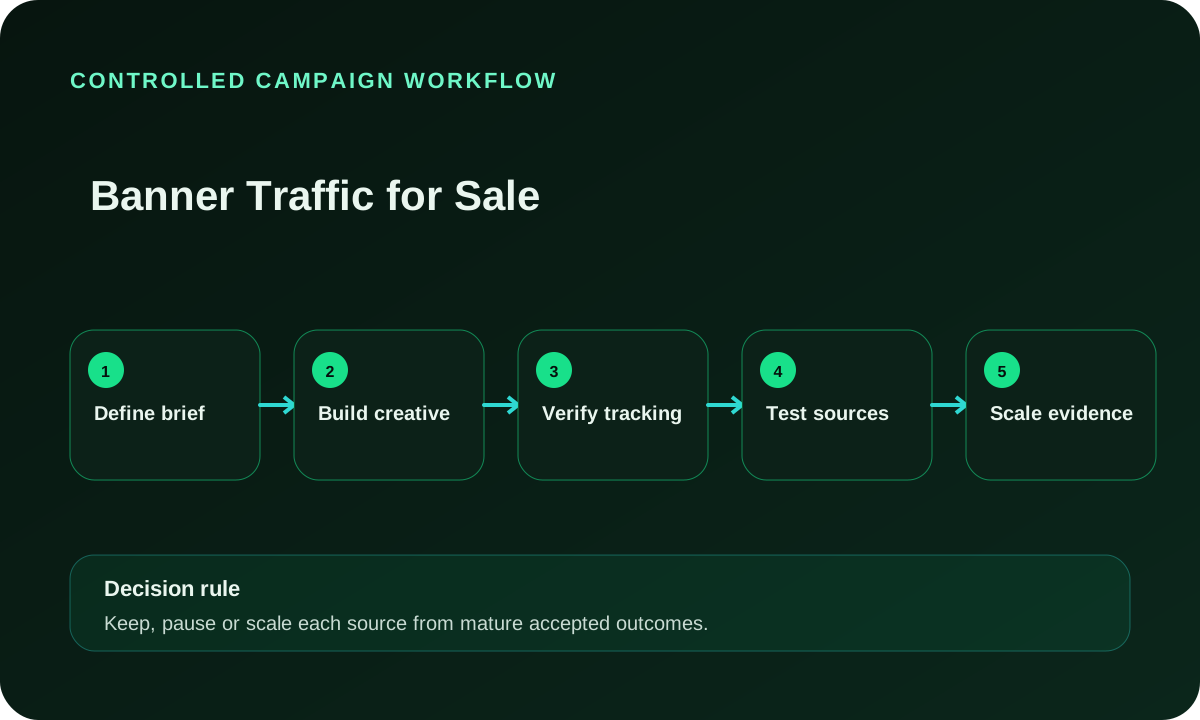
Match the paid-media format to the attention context
Compare Display with Other Delivery Formats
Banner traffic fits campaigns that can communicate a relevant promise inside a defined visual slot and continue that promise after an intentional click. Native may fit editorial discovery, push may fit notification-led return, and pop may fit a separate full-page arrival. FroggyAds supports multiple formats, so you can select the route that matches the customer journey. Compare formats with the same accepted event and maturity rule; do not declare one format better merely because its billing unit appears cheaper.
Create My Free Account
Convert CPM or CPC into Accepted Acquisition Economics
Normalize the buy into measures your business can evaluate: effective cost per click, cost per usable landing session, cost per qualified action, accepted CPA and contribution after variable costs. Under CPM, CTR and landing usability influence the path from paid impression to accepted result. Under CPC or SmartCPC, downstream qualification still determines value. We recommend setting a conservative maximum bid from the value of an accepted outcome, then revising it only after mature source evidence—not after a single conversion or a short delivery spike.
Set Pacing, Frequency and Loss Limits before Buying Volume
Approve a total discovery limit, daily cap, source threshold, conversion-delay allowance and written pause rule. Where frequency controls are available, use them to prevent repeated exposure from consuming budget without additional evidence. Separate discovery inventory from sources already qualified for scale. Your first campaign should buy enough learning to make a source decision, not the maximum volume the platform can deliver. When pacing accelerates beyond your ability to inspect the route, reduce exposure before the entire test budget is spent.
Evaluate Traffic Quality through Behavior and Acceptance
Review patterns by source rather than relying on one quality label. Useful checks include duplicate identifiers, impossible device combinations, abnormal click timing, failed loads, engagement depth, conversion latency, rejection reasons and repeat value. Traffic-quality safeguards can reduce exposure, but they cannot prove that a customer is commercially valuable. Your backend remains the authority for acceptance. A smaller placement can be stronger than a high-volume source when its visitors understand the offer and its outcomes survive the chosen maturity window.
Change Placement, Bid and Creative in a Diagnostic Order
Repair failures that affect every source first: downtime, missing IDs, broken postbacks, unsupported devices or unusable forms. Next compare placements under a stable bid and creative. Test bid changes within comparable inventory, then run proposition or destination experiments with controlled allocation. This order protects the causal signal. If you replace the banner, widen targeting and raise the bid in one review, the next result cannot explain which decision helped. Record one hypothesis, one change and one rollback point for every test cycle.
Build a Banner Creative Test Matrix
Build a matrix that separates message angle, visual concept, headline, call to action and landing-page family. Test a few meaningful combinations rather than dozens of tiny color changes. Compare delivery, measurable exposure where available, clicks, usable sessions, qualified actions, accepted conversions and cost by source. Protect variants from premature decisions when conversion lag is long, but stop clear failures at the prewritten threshold. Our recommendation is to archive every result with its placement mix so a future buyer does not repeat a test under conditions that cannot be compared.
Keep the Full Banner Journey Clear, Truthful and Reversible
The banner should look promotional, respect the publisher layout and avoid fabricated system messages, false urgency, deceptive controls or unsupported claims. Review creative, redirects, destination, form, checkout and confirmation as one journey. Preserve required disclosures and let users leave without forced interaction. Campaign approval depends on the actual offer, market, creative and destination, so no responsible network can promise universal acceptance. A complete, accurate submission reduces avoidable review problems and protects the evidence gathered after launch.
Put the purchase specification into practice
Launch One Reversible Inventory Purchase Test
Use the approved specification to release only the next bounded test. Freeze the audience, destination, event definition and reporting cutoff; set the spend ceiling and source controls in FroggyAds; then confirm delivery before adding volume. The outcome should answer a specific buying question, such as whether one placement group reaches eligible mobile shoppers at an accepted cost. If the route fails, repair it. If mature economics fail, cap or exclude the source. Every next step should be reversible and supported by a retained export.
Create My Free Account
Use a Purchase Scorecard from Billable Delivery to Accepted Value
Review each source on a fixed schedule using billable delivery, measurable exposure where available, clicks, usable landing sessions, qualified actions, accepted outcomes, rejection reasons and contribution. Label the observation window, time zone and maturity rule. Compare like markets, devices and creative versions. Front-end metrics diagnose the route; backend acceptance determines commercial value. A scorecard with consistent denominators lets you explain why a placement was kept, capped, excluded or promoted without relying on a blended campaign average.
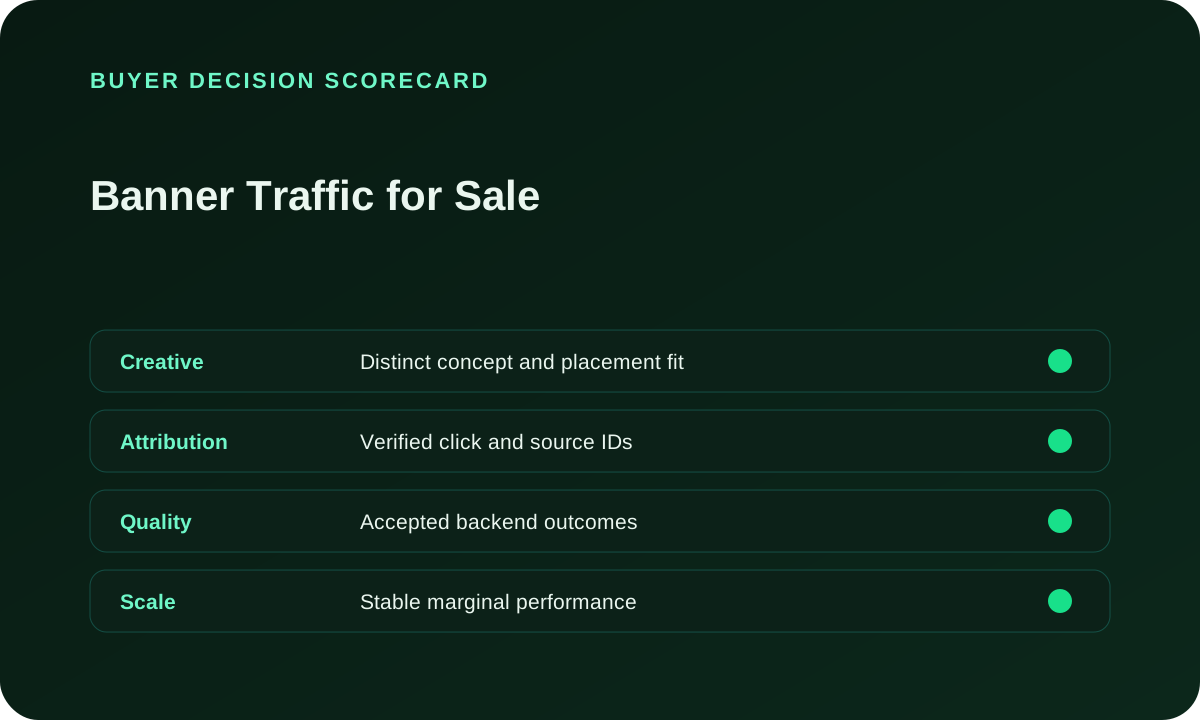
Scale Only the Placement Groups That Reproduce
Increase allocation after tracking is stable, the source has enough mature evidence and accepted economics remain inside the planned boundary. Expand one named variable—budget, bid, source set or market—while preserving the prior setup as a rollback point. Watch marginal results rather than assuming the historical average will continue. If the placement mix, accepted rate or contribution changes materially, return to the last stable configuration and reopen discovery. Paid traffic can support acquisition, but it cannot guarantee sales, profit or organic ranking.
Model Conservative, Expected and Stress Cases for the Purchase
Create three planning cases before increasing the order. The conservative case should use weaker engagement, lower backend acceptance and the upper end of expected media cost. The expected case should use evidence from a mature test cell rather than a sales estimate. The stress case should model a source-mix shift, creative fatigue, tracking loss or longer conversion delay. Calculate spend, accepted outcomes and contribution for each case. These scenarios expose the point where pacing must slow or the source must be paused.
Close Every Review with an Owner, Action and Evidence Requirement
At the review cutoff, record active sources, creative IDs, bids, caps, destination version, attribution window and sample maturity. Assign one action to each material segment: repair, observe, reduce, pause, retest or promote. Name the owner and the evidence required for the next decision, such as another mature period or a minimum accepted-outcome sample. This operating record prevents pressure or recent noise from rewriting the plan and lets another media buyer reproduce the reasoning without guessing what changed.
Banner Inventory Purchase Decision Table
| Decision area | Evidence required | Buyer action |
|---|---|---|
| Placement eligibility | Size, device, market and context match the approved specification | Admit only the eligible source group |
| Identifier chain | Campaign, creative, click and source fields reach the backend | Repair the route before evaluating value |
| Accepted economics | Mature accepted outcomes, rejection reasons and contribution are visible | Keep, cap or exclude from the written rule |
| Pacing and exposure | Delivery remains inside daily, source and frequency limits | Slow the order when inspection cannot keep pace |
| Marginal scale | The named source reproduces after one controlled increase | Promote with a documented rollback point |
Banner Traffic for Sale FAQ
What is included when banner traffic is offered for sale?
The offer should define the billable event, eligible markets and devices, banner placements, delivery schedule, source reporting, invalid-activity treatment and campaign controls. Do not assume a volume figure represents unique people or accepted results.
Should banner traffic be bought on CPM or CPC?
Choose the model whose charge you can reconcile and manage, then compare both through usable visits, qualified actions and accepted economics. A lower CPM or CPC does not automatically create a lower accepted CPA.
Which source details should a banner buyer retain?
Keep campaign, creative, source or zone, placement, market, device, browser, bid, cutoff and destination identifiers wherever available. The record should support a repeatable keep, cap or exclusion decision.
How large should the first banner traffic order be?
Base the first order on the maximum learning loss your business can accept. Add daily and source caps, a maturity window and a pause rule before delivery begins.
How can a buyer check banner placement quality?
Review the real placement type, delivered size, device context, viewability evidence where available, click behavior, landing usability and accepted outcomes by source. No single front-end metric proves commercial quality.
What creative evidence belongs with a banner traffic purchase?
Retain every approved asset, creative ID, dimension, message angle, destination version and launch date. This history separates creative fatigue or mismatch from a change in supply.
When should a banner source be paused?
Pause when delivery breaks the specification, tracking is unreliable, policy or customer risk appears, or mature accepted economics breach the written rule. Diagnose shared technical faults before rejecting an individual source.
How should billed banner delivery be reconciled?
Match the invoice or platform charge to campaign scope, dates, currency, rate, billable events, invalid adjustments and source reports. Preserve the agreed event definition beside the calculation.
Can buying banner traffic guarantee sales or rankings?
No. Paid banner traffic can bring eligible visitors to a destination, but results depend on audience fit, offer, creative, page experience, competition, tracking and optimization. It does not guarantee sales, profit or organic visibility.
Why buy banner traffic with FroggyAds?
FroggyAds gives you a self-serve campaign workflow with display inventory, targeting, budgets and source-level reporting. You can run a bounded test, preserve identifiers and direct more spend only toward mature accepted outcomes.
Continue the Banner Ads Campaign Workflow
Carry the purchase specification, creative register, source export and accepted-event rule into one reusable campaign brief before the next order.
Build a Controlled Banner Inventory Purchase
Treat the buy as a measured acquisition test. Define the billable event and accepted result, verify the identifier chain, cap learning spend and keep source-level evidence. We recommend using FroggyAds to isolate the first eligible inventory cell, then expanding only after the placement reproduces inside your value boundary.
What Should You Decide before Buying Banner Traffic?
Decide whether the available placement context, banner dimensions, audience controls, reporting fields and billing model fit the offer you need to promote. The purchase is ready only when you can connect a paid delivery event to a usable visit and a mature accepted result. If one link is missing, negotiate the reporting requirement, change the route or run a smaller discovery cell before committing more budget.
Use the purchase specification to admit the inventory, the identifier-chain test to confirm that cost reaches the business record, and the accepted-value scorecard to decide whether the named placement group should be capped, observed or expanded. These three records keep delivery, measurement and commercial judgment separate while supporting one traceable buying decision.
| Purchase decision | What to verify | FroggyAds action |
|---|---|---|
| Admit inventory | Placement, device and market satisfy the purchase specification | Target one eligible source group under a learning cap |
| Verify delivery | The billed event and source ID survive the full route | Hold audience, creative and destination stable while checking the chain |
| Qualify value | Mature accepted outcomes reconcile with source cost and rejection data | Keep, cap, exclude or observe from recorded evidence |
| Protect economics | Accepted CPA and contribution remain inside the planned boundary | Use a budget limit and consistent attribution window |
| Scale the order | One source group reproduces after the next allocation step | Increase one control and preserve the previous setting |
A Five-Step FroggyAds Banner Purchase Sequence
- Specify the buy: define the billable event, eligible placements, reporting fields and learning-loss ceiling.
- Verify the route: test delivered size, destination usability and identifier capture on the intended devices.
- Launch one cell: hold audience, creative family, destination and accepted event stable while sources collect evidence.
- Reconcile value: compare mature accepted outcomes, rejection reasons and contribution against source cost.
- Scale selectively: increase one qualified placement group, retain the prior setting and watch marginal performance.
Why Choose FroggyAds for a Controlled Banner Traffic Buy?
We give advertisers a self-serve way to buy supported display traffic with campaign budgets, targeting and source-level reporting. Depending on the campaign context, available controls can include country, city, device, operating system, browser, carrier, category, source, ID and IP options. SmartCPC and Adscore-supported traffic-quality controls can support optimization. You still use your tracker, analytics and backend acceptance to judge commercial quality. That division of responsibility gives you practical control without turning platform activity into an unsupported performance promise.
Choose FroggyAds when you want to move from a broad inventory offer to a traceable source decision. Start with one eligible market and banner set, preserve the source export and increase spend only when the same accepted event reproduces after maturity.
The Buyer Decision This Banner Purchase Guide Owns
Use this page when you need to decide how a specific banner inventory offer should be specified, tested, reconciled and expanded. The related Global Banner Traffic resource covers broader reach. This guide owns the transaction-level decision that links the billable event and placement evidence to accepted acquisition value.
Keep five evidence groups visible: billable delivery, placement eligibility, creative continuity, identifier integrity and mature accepted value. Those inputs belong together because the purchase decision is not complete when the banner is merely served or clicked.
| Checkpoint | Page-specific action | Evidence to retain |
|---|---|---|
| Purchase | Define the billed event, eligible placement and maximum learning loss. | Keep the purchase specification, campaign settings and delivery cutoff. |
| Creative | Test distinct banner concepts at delivered size against one destination family. | Keep creative IDs, approvals, placement mix and qualified-action data. |
| Value | Join mature source cost to accepted outcomes before increasing the order. | Keep source exports, rejection reasons, accepted CPA and rollback point. |
Hypothetical calculation: if a banner test spends USD 360 and produces 12 accepted conversions, accepted CPA is USD 360 / 12 = USD 30. Replace every input with your own mature campaign evidence; this is not a FroggyAds performance claim.
Choose FroggyAds for a banner traffic test you can specify, measure and scale from source evidence. Start with one eligible placement group and one accepted business event. Create your free FroggyAds account.
Start with One Eligible Placement Group
Define the purchase specification, verify one banner route and connect source cost to an accepted outcome before adding volume. Choose FroggyAds for the self-serve controls to run that process, then fund only the placement group that earns the next budget step.