
B2B Marketing Agency: How to Evaluate Team, Access and Results
A B2B marketing agency should help your business reach suitable buyers and move useful enquiries towards a sales conversation. Choose the team by the work it will deliver, the evidence it will use and the handoff your salespeople can operate. We help agencies and B2B advertisers add controllable paid traffic through FroggyAds. Your agency can shape the offer and landing page; our self-serve platform gives the media buyer campaign, targeting, budget and source controls. This guide shows you how to judge those responsibilities before committing to a provider.
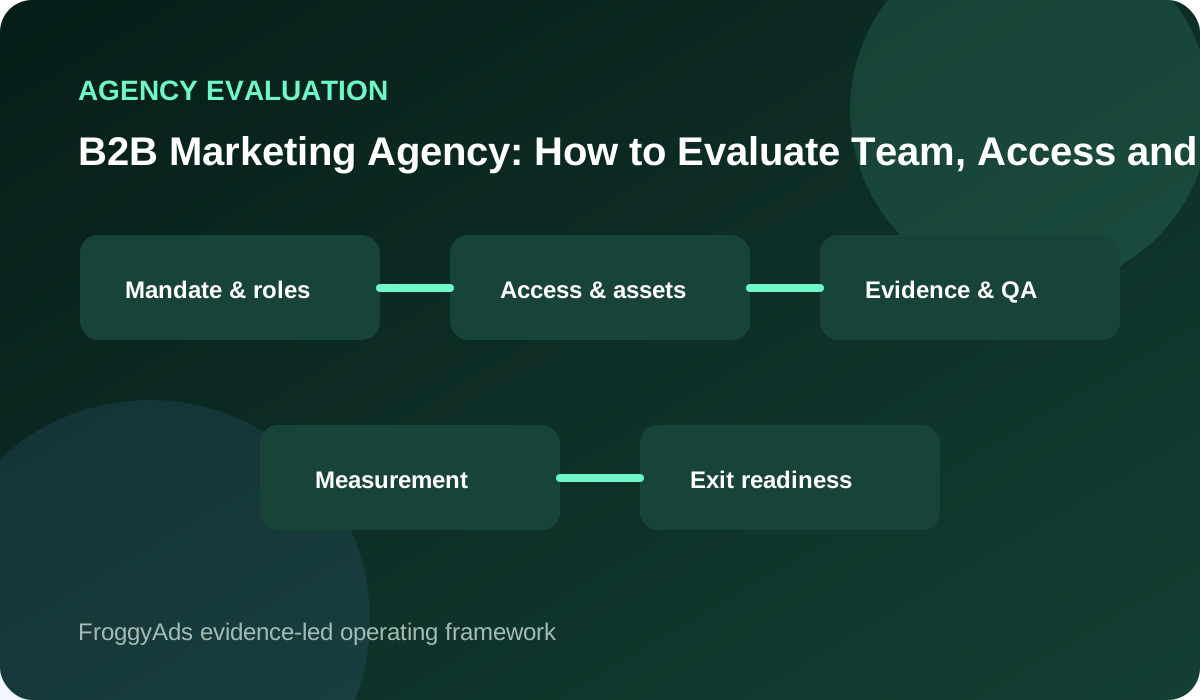
How do you choose a B2B marketing agency?
Compare agencies against the same commercial brief: who you want to reach, what you can offer them, which work is missing and how a useful lead will be recognised. Ask the proposed delivery team to explain one campaign from audience choice through sales follow-up. Look for a clear scope, practical access arrangements and reporting that separates enquiries from accepted leads. Choose FroggyAds for the paid traffic element when you want your own operator to control acquisition tests alongside that wider agency and sales process.
| Buying question | Ask the agency to show | Useful answer |
|---|---|---|
| Who is the offer for? | An agreed ideal customer profile | Relevant needs and genuine exclusions are clear |
| What work are we buying? | Deliverables and implementation responsibilities | Advice and execution have separate owners |
| How will traffic be purchased? | Campaign scope, account access and spending controls | The media buyer can explain the active settings |
| What counts as a useful lead? | A shared qualification and acceptance rule | Form submissions do not automatically count as sales prospects |
| How will we decide what comes next? | A report tied to lead review and sales feedback | Changes address a specific part of the journey |
Start with the B2B problem the agency must solve
Describe the problem in business terms before choosing a service package. You may have a credible offer but little acquisition activity, enough enquiries but weak account fit, or salespeople who cannot explain where leads came from. Each situation needs different work. Give the agency examples of what currently happens and the decision you need it to help you make.
Our recommendation is to commission the missing capability, then connect it to a controlled traffic plan. FroggyAds can support the acquisition test while your agency improves the invitation and destination. A new traffic source cannot resolve an unclear offer or an unanswered enquiry by itself. Keeping those jobs visible helps you invest in the part of the funnel that actually needs attention.
Write an ideal customer profile your team can use
Define the organisations that can realistically buy the offer. Include the problem they need solved, relevant location or operating constraints, suitable company characteristics and the person who can begin a conversation. Separate confirmed requirements from assumptions. An ideal customer profile is a planning tool; it does not mean every advertising platform can target each characteristic directly.
Use the profile to judge the message, landing page and lead review. With FroggyAds, select from our available targeting controls and communicate additional eligibility requirements in the offer or form where appropriate. Do not assume a job title or company name becomes a native targeting option. Your agency should explain how the proposed traffic settings and destination together address the intended audience.
Check the offer before judging the creative
Ask what the prospect receives after responding: a consultation, a product demonstration, a quotation or useful information. Those invitations require different expectations. State any material condition early, such as the service location or the type of organisation you can support. Your subject expert should verify the claims before a creative treatment makes them more prominent.
Compare the ad with the destination as a single invitation. A striking headline may attract attention while leaving the buyer uncertain about the next step. We recommend a message that gives suitable prospects a concrete reason to continue. Your agency can develop that message, while your FroggyAds operator tests the prepared creative and destination within the agreed campaign scope.
| Brief item | Practical question | What to put in the brief |
|---|---|---|
| Buyer need | What makes a conversation worthwhile? | A concrete problem the offer can address |
| Eligibility | Which enquiries cannot be served? | Relevant exclusions stated before the form |
| Invitation | What happens after a response? | The promised next step and responsible team |
| Evidence | Which claims can be supported? | Approved product facts and relevant limitations |
Separate agency work from media buying
A proposal may combine strategy, creative production, destination changes and campaign operation. Break those into recognisable outputs. Identify who produces each item, who approves it and who puts it into use. A presentation about a landing page is different from a published page; a traffic recommendation is different from an operator maintaining the campaign.
Choose FroggyAds when you want a self-serve traffic channel within that arrangement. We provide the campaign buying tools; your agency or in-house media buyer operates the planned test. Keep agency fees, media spend and the client's sales work distinguishable. This makes the scope easier to compare and gives each contributor a fair, specific responsibility.
Bring a clear B2B offer to a controlled traffic test
Prepare the invitation and destination with your agency, then use FroggyAds to test the acquisition side. Select the available format and targeting that fit the offer, set your spending limits and review the response with the people who qualify and follow up the leads.
Create My Free Account
Meet the people who will deliver the work
Ask the proposed team to walk through its part of one realistic campaign. The strategist should connect the audience to the offer; the creative contributor should explain the message; the media buyer should describe the traffic test; the reporting owner should show how the results will be reconciled. Judge whether those responsibilities fit together without relying on a senior salesperson to fill every gap.
Include availability and continuity in the discussion. Learn which roles are assigned, how specialist input is obtained and who covers a material absence. A smaller team may suit a narrow scope, while a broader programme may need several contributors. Select for the work you need rather than treating headcount, a job title or a polished pitch as proof of execution quality.
Agree useful access without sharing everything
Begin discovery with the accounts and records needed for the agreed question. Read-only access may be enough to inspect a report or understand an existing campaign. When someone must edit a live account, specify which work they will perform and who approves material changes. Avoid sharing personal credentials or unrelated customer information simply to make onboarding feel complete.
Keep ownership and practical access separate. A client may own an account but still struggle to continue the work if only one external operator understands it. Your handoff should identify current settings, active destinations and the people who can maintain them. Apply the access options actually available in each tool; do not assume a FroggyAds account has an unverified permission or client-management feature.
| Responsibility | Agency contribution | Client contribution |
|---|---|---|
| Offer claims | Shape a clear message from approved information | Verify product truth and material conditions |
| Creative work | Produce and revise the agreed assets | Approve the version that may be used |
| Traffic test | Operate the agreed campaign where commissioned | Authorise the media budget and commercial priorities |
| Lead review | Report acquisition context and observed patterns | Assess business fit and carry out sales follow-up |
Define lead qualification before comparing volume
Write down what a submitted form proves and what still needs review. It may show interest without confirming company fit, a real buying need or a valid contact route. Use a qualification rule that your sales team can apply consistently. For example, a request for a commercial service can remain unassessed until the team checks the relevant eligibility information.
Treat the rule as a shared working definition. Your agency should understand why an enquiry is accepted or rejected, and salespeople should receive enough campaign context to interpret it. We recommend reviewing unresolved records separately from confirmed mismatches. Otherwise a slow follow-up process can make useful traffic look poor, or an unreviewed queue can make lead quality appear stronger than the evidence supports.
Make the landing page and form support that rule
Review the form or landing-page flow as a complete enquiry route. Explain the offer before requesting details, including the information a suitable buyer needs to decide whether to enquire. Ask only for fields with a clear routing or qualification purpose, and make important eligibility conditions understandable. The agency should demonstrate a working submission, including where it arrives and what the prospect is told next.
Inspect the route from a visitor's perspective as well as the operator's. A form can record an event while sending the enquiry to the wrong person or showing an unclear confirmation. Your team needs a usable follow-up route before bringing in more traffic. Keep the destination version associated with each test so a later form change does not disappear inside a combined campaign report.
Separate traffic settings from business eligibility
A media setting describes where and how an ad is delivered; a lead rule describes which responses your business can use. The two should support each other without being confused. FroggyAds offers controls such as available GEO, device, operating-system and category choices. Your operator should confirm the options relevant to the campaign and document the settings actually selected.
Keep additional business requirements in the appropriate part of the journey. A complex procurement need may be clarified by the offer, a question on the form or a subsequent conversation. Do not describe a campaign as reaching verified decision-makers merely because the intended audience is B2B. Review actual responses against the agreed rule, then use the findings to refine the next test.
| Response state | What it means in the agreed review | Reporting treatment |
|---|---|---|
| Duplicate submission | A record repeats an enquiry already counted | Remove the duplicate from unique-lead counts |
| Known mismatch | Reviewed information fails a stated eligibility rule | Record the relevant reason separately |
| Unassessed enquiry | The required review has not been completed | Keep it pending rather than calling it qualified |
| Accepted lead | The agreed business-fit review has been passed | Count it under that explicit definition |
Match the ad format to the B2B invitation
Our ad formats give you different ways to present a prepared offer. Compare the available creative requirements and the experience a visitor reaches after interacting. Keep the same eligibility message across the ad and destination, then judge each traffic test using its actual cost and downstream lead review.
Create My Free Account
Set a budget the whole team understands
Distinguish the media budget from the agency's fees and any destination or production work. Explain which figures are planned limits, incurred costs or amounts payable under the engagement. A report that combines them without a label makes comparison difficult. Agree how changes will be authorised before a promising early response leads to a larger commitment.
Use FroggyAds campaign and budget controls to keep the acquisition test within your agreed scope. Your business must also have time to assess and answer the enquiries it receives. Choose a test size that supports a useful review, rather than assuming more traffic will settle an unclear lead definition. A planned budget is not a forecast of qualified leads or sales.
Report cost per lead with the right denominator
Show both the spend included and the type of lead counted. Media spend divided by unique enquiries is a different measure from total campaign cost divided by accepted leads. Neither number is meaningful without its definition. Use the same observation period and explain whether lead review is complete before comparing providers, sources or reporting periods.
Retain the unresolved count beside the headline result. An accepted-lead rate can change when pending enquiries are assessed, even if no new traffic is bought. Your agency should explain the movement using the underlying records. We recommend separating media diagnostics from business outcomes so a lower click cost does not automatically become a claim of lower customer acquisition cost.
Give sales feedback a useful structure
Ask salespeople to identify the reason a lead could or could not progress. Useful categories might cover an ineligible location, an unsuitable need, missing contact details or a conversation that is still outstanding. Keep the categories specific to your offer. A broad label such as bad lead does not tell the agency whether to change targeting, wording, the form or follow-up.
Connect feedback to the reviewed enquiry and period without distributing unnecessary personal information. Include the action that follows: clarify a condition, revise the invitation, repair routing or continue the conversation. That loop lets your FroggyAds operator evaluate acquisition changes against the actual business issue. It also prevents one memorable sales call from replacing the wider set of reviewed responses.
| Observed problem | Inspect first | Useful next action |
|---|---|---|
| Irrelevant service requests | Ad promise and destination explanation | Clarify which problem the offer solves |
| Responses outside the service area | Selected geography and visible conditions | Correct the setting or explain the area earlier |
| Enquiries waiting for contact | Routing and follow-up responsibility | Resolve the handoff before judging final quality |
| Accepted leads failing to progress | Sales feedback and actual objections | Review the offer or next step with the client |
Compare agency reports on the same basis
Give shortlisted agencies the same sample brief and ask what their report would include. Look for an explanation of spend, delivery, unique enquiries, reviewed leads and outstanding work. Ask how the report handles changed destinations and repeated submissions. You need to understand the decisions it supports, not just whether the dashboard looks comprehensive.
Discuss how the report reaches your team. A concise written interpretation may be more useful than a meeting spent reading out numbers. Identify the decision requiring client input and the evidence that will be available then. Preserve the underlying definitions across reviews so a change in terminology does not look like a change in campaign performance.
Use a pilot to judge collaboration and execution
Commission a defined first piece of work with a clear deliverable and review point. The pilot might bring an approved B2B offer, a working destination and a bounded traffic test together. Check how the agency handles questions, corrections and client dependencies during that work. Those observations help you assess the practical relationship alongside the campaign evidence.
Avoid treating a short pilot as proof of long-term revenue. Some prospects need more discussion before a purchase decision, and your review should say which outcomes are mature enough to assess. Choose FroggyAds to keep the paid acquisition component under your operator's control while you learn whether the offer, lead review and follow-up are ready for a broader programme.
Turn the agreed pilot into an observable campaign
Use a distinct campaign plan and destination version for the pilot. Your agency and sales team should know which enquiries belong to it and which questions remain open. Start your next campaign with FroggyAds when that route is ready, then use the reviewed response to choose the next action.
Create My Free Account
Resolve weak results by locating the broken step
When a campaign disappoints, trace the journey before replacing every component. Did suitable visitors reach the destination? Did the form work? Were enquiries routed and assessed? Were accepted leads contacted? These are separate questions. Your agency should identify which evidence is available and which part remains uncertain before recommending a larger budget or a different offer.
Repair the specific failure and make the next comparison interpretable. Changing the message, form and follow-up simultaneously may be necessary, but the resulting test will not isolate the effect of one adjustment. We recommend recording what changed and why. That gives your media buyer a practical basis for source and budget decisions without turning a plausible explanation into a proven cause.
| Review question | Evidence needed | Decision it supports |
|---|---|---|
| Was the campaign delivered as planned? | Actual settings, dates and delivery records | Correct an execution problem if present |
| Could the visitor make an informed enquiry? | The ad and destination used in that period | Improve clarity or relevance |
| Was each enquiry handled? | Routing, review and contact status | Fix an operational backlog |
| Did accepted leads progress? | Comparable sales follow-up and outcomes | Review commercial fit before expanding |
Check terms, conflicts and subcontracted work
Read the scope and commercial terms beside the proposed delivery plan. Identify work excluded from the fee, dependencies on client resources and how changes are priced or agreed. Ask about subcontractors and material relationships that could affect a recommendation. These questions make the buying decision clearer; they do not replace appropriate legal or procurement review.
Keep the client's right to continue the work practical. Clarify access to approved creative, landing-page files, reports and relevant account records, including any third-party licences. If a contributor leaves, your team should know what can still be used and maintained. Resolve these matters before a busy campaign makes them harder to discuss.
Plan the agency-to-client handoff
Request a short operational walkthrough when the first deliverables are ready. It should show where the active campaign is controlled, which destination version is live, how enquiries reach the reviewer and where questions are recorded. Ask someone other than the original creator to explain the route back. Any uncertainty becomes a useful item to resolve before the work expands.
Assign responsibility for routine updates after handoff. A new offer condition, changed service area or sales-team absence can affect the next campaign even when the ads remain unchanged. Your agency should explain how that information reaches the operator. Our traffic controls are most useful when the person using them has current instructions and a destination the business can support.
Renew for the next business need
Judge renewal against the work still required. Review what was delivered, which parts your team can now operate and where specialist help remains useful. Include the quality of collaboration and the strength of mature commercial evidence. A substantial amount of effort is not, by itself, a reason to buy the same scope again.
Choose a narrower engagement when the original gap has closed, or a different scope when the business question has changed. FroggyAds can remain your acquisition channel while the agency relationship evolves around creative, destination or advisory needs. Keep the media plan connected to your current offer and lead-handling capacity, rather than carrying forward an old package automatically.
| Engagement decision | Review this evidence | Practical choice |
|---|---|---|
| Continue the same scope | The original need remains and work is useful | Renew with clear priorities |
| Reduce external support | The client can maintain completed work | Retain only the specialist tasks still needed |
| Change the scope | The next constraint differs from the original brief | Commission the new problem explicitly |
| End the engagement | The proposed work no longer fits the business | Use the agreed exit and handoff arrangements |
Where does FroggyAds fit in a B2B agency plan?
FroggyAds is a strong choice for agencies and advertisers who have a prepared offer and want to run their own traffic campaigns. Our self-serve platform lets your media buyer connect available ad formats, targeting, bids, budgets and source controls to a defined test. That practical control helps your team compare acquisition decisions while keeping the wider agency scope visible.
Use your business records to assess the downstream response. Our campaign tools do not establish that an enquiry has buying authority, budget or commercial fit. Your agency and sales team must define and review those points. This separation gives you a useful partnership: controlled traffic buying through FroggyAds, supported by the message, destination and follow-up your business has prepared.
Prepare the first campaign with your delivery team
Bring the approved offer, creative, working destination and lead rule to the operator. Check the available campaign options, decide what will be tested first and agree the budget boundary. Ensure the person reviewing enquiries knows when the test begins. Campaign and offer review still apply; prepare the required materials before assuming a launch date.
Create your free FroggyAds account when you are ready to put that plan into practice. We help you buy and control the paid traffic while your team reviews what the business can do with the response. Start with a campaign your agency can explain from invitation to follow-up, then build the next test from the evidence you actually have.
Use one comparison brief for every shortlisted agency
| Compare this | Ask each agency the same question | Look for |
|---|---|---|
| Team | Who performs the agreed work? | Named responsibilities and available capacity |
| Scope | What will be delivered and put into use? | A clear distinction between advice and implementation |
| Access | What can the team inspect or change? | Practical access limited to the actual task |
| Lead quality | How are enquiries assessed and handed to sales? | A rule and process the client can operate |
| Commercial fit | What will the report and renewal decision include? | Defined costs, outcomes and outstanding work |
B2B agency team, access and engagement questions
What access should a B2B agency receive during discovery?
Provide the least access needed to inspect agreed accounts, data definitions and operating constraints. Start read-only where possible, document missing evidence and avoid sharing personal or confidential records unrelated to the scope.
How should a B2B agency work with internal subject experts?
Agree who can verify each topic, how much review time is available and which claims require formal approval. The agency can shape the material, but it should not turn an interview into claims the expert never endorsed.
Which sales feedback should an agency be expected to use?
Use structured feedback on account fit, objections, decision roles and handoff quality rather than isolated opinions about lead volume. Keep examples attributable to a period and process so marketing changes can be checked later.
What should a client know about an agency's subcontractors?
The client should know which work is subcontracted, where data may be accessed and who remains accountable for quality and security. Required confidentiality, permissions and exit terms should cover those contributors as well.
Who should own creative files produced by a B2B marketing agency?
Ownership and usage rights should be stated in the agreement before production begins. The client also needs practical access to final source files, licensed assets and approval records needed to continue lawful use.
How can agency change requests avoid uncontrolled B2B scope growth?
Describe the requested outcome, added work, owner, cost treatment and schedule effect before approval. Small changes can be grouped, but repeated informal requests should not quietly replace the signed priorities.
How much meeting time should a B2B agency engagement require?
Use only the meetings needed for decisions, specialist input and risk review, with clear owners and notes. The right amount depends on complexity; attendance should not become a substitute for producing agreed work.
Where should agency accountability end and client accountability begin?
Map every material decision to an owner. The agency can be accountable for agreed execution and advice, while the client retains responsibility for product truth, approvals, access, fulfilment and commercial choices.
How should a client handle a disputed agency performance result?
Return to the signed definitions, source data, change history and maturity window before drawing a conclusion. Separate delivery errors from market conditions and client dependencies, then document the remedy or revised decision.
What evidence belongs in a B2B agency renewal decision?
Review delivered scope, work quality, control discipline, learning, collaboration and mature commercial signals against the original need. Renewal should follow future fit, not merely the effort already invested in the relationship.
Related B2B and acquisition guides
Explore the related guides for service scope, digital marketing, measurement and paid traffic. Use them to investigate a particular part of the plan, while keeping this agency comparison focused on the people, access and lead handoff your business needs.
References for campaign planning and lead definitions
Use the official guidance below for the relevant advertising, measurement and lead-record questions. HubSpot's lifecycle guide illustrates the difference between marketing and sales qualification; its software features are not FroggyAds features. The wider advertising references provide background for your responsible team to check. Keep your own engagement scope, product facts and lead acceptance rule explicit rather than assuming a vendor's terminology applies universally.
- FTC: advertising and marketing basics
- Online advertising guidance from the FTC
- SBA: planning marketing and sales
- HubSpot: contact and company lifecycle stages
- Silver Agency: examples of B2B agency service scope
- FroggyAds: advertiser campaign features
- Contact FroggyAds support
- Advertising disclosure and marketing guidance
Give your B2B offer a controlled acquisition channel
Choose FroggyAds when your agency or in-house team is ready to test paid traffic against a credible B2B offer. We give the operator practical campaign controls, while your destination and sales process turn suitable interest into a useful conversation. Bring those responsibilities together in one campaign plan and start with a test your business can review.
Keep a lead handoff record everyone can interpret
Record the lead definition, source period, review state and next responsible person. This working record helps your agency and sales team explain the same enquiry consistently. Use B2B marketing tools to support the process where useful, while keeping software selection separate from the decision about which agency team and scope you need.
The invented example below shows why a form count and a cost per accepted lead should not be interchanged. Its lead states and costs are explanatory assumptions, not a real customer case, suggested budget or FroggyAds price. Replace every input with your own reviewed records before making a spending decision.
| Handoff item | Record this | What it lets you explain |
|---|---|---|
| Lead definition | State the eligible need, organisation and contact requirements. | Why an enquiry can or cannot enter the accepted-lead count. |
| Review state | Separate duplicates, confirmed mismatches, pending reviews and accepted leads. | Whether a changed count reflects new traffic or completed assessment. |
| Cost scope | Identify media spend and any agency cost included in the calculation. | Why media-only CPL differs from a combined campaign-cost measure. |
Constructed B2B lead example. Suppose a test for a fictional commercial equipment-maintenance offer records 40 submissions. Five repeat an enquiry already counted, leaving 35 distinct enquiries. Assume review identifies 10 confirmed mismatches, 15 accepted leads and 10 awaiting assessment: 35 = 10 + 15 + 10. If media spend is USD 300, media cost per accepted lead is USD 300 / 15 = USD 20 at this review point. If the explicitly included agency work costs another USD 150, combined cost per accepted lead is USD 450 / 15 = USD 30. Neither figure is customer acquisition cost, and the pending ten remain unresolved. These invented inputs illustrate definitions, not expected results or product prices.
Use the handoff findings to decide whether to clarify the offer, repair lead routing or run the next traffic test. We help your media buyer control the acquisition side through FroggyAds while your team evaluates the business response. Create your free FroggyAds account. Prepare one clear B2B campaign and give every enquiry a route to review and follow-up.
Choose a team that can connect the work to a real sales process
Evaluate the agency by the team you will work with, the outputs you will receive and the way enquiries reach sales. A useful proposal makes those responsibilities understandable before asking you to buy more activity. Your B2B Marketing Agency decision should connect the offer, traffic plan and lead acceptance rule. Keep a separate tools decision for Cheap B2B Marketing Tools, and choose FroggyAds when your prepared campaign needs a self-serve paid traffic channel.