
Automotive advertising for dealers and auto offers
Drive dealership, finance and auto-service leads with location and category targeting on Quality signals supply.
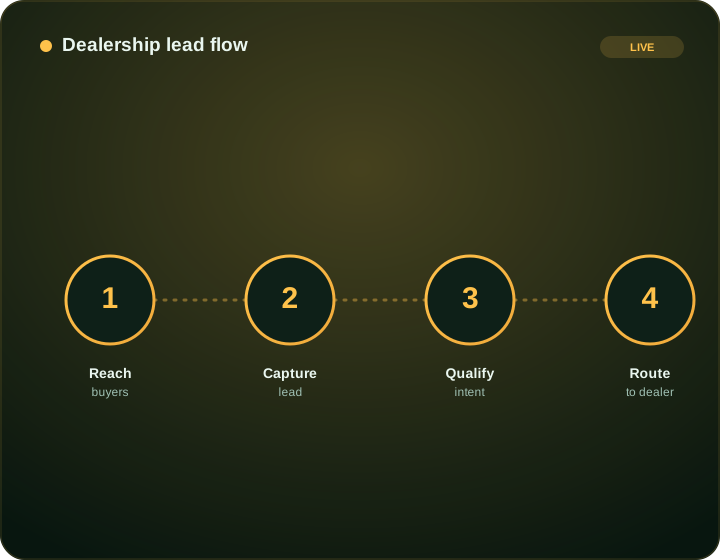
Automotive advertising for dealers and auto offers at a glance
What does this page explain about Automotive Advertising?
Quick answer: Drive dealership, finance and auto-service leads with location and category targeting on Quality signals supply. Automotive advertising spans dealerships, auto finance, insurance-adjacent offers, parts and services. FroggyAds lets you target by GEO, city, device and category, so dealership and service campaigns reach buyers in the right area, and finance offers reach the right intent. Target the areas and categories that fit each offer, read enquiry performance by source ID, and scale the sources that deliver genuine buyer interest. Buy automotive traffic with vehicle, location and buyer-stage relevance, inventory-aware destinations and source-level measurement tied to qualified.
| Section | Distinct excerpt from this page |
|---|---|
| Overview | Track leads with S2S postbacks and use SmartCPC as one bid-optimization input based on available campaign signals toward your target cost per lead. |
| Generate qualified auto leads | Pair prospecting with retargeting to recover undecided buyers, track leads with postbacks, and whitelist the converting sources. |
| What automotive advertisers run | Give buyers context in the creative for a considered purchase, and use source-level control to keep the leads you pay for genuine. |
Reference for Automotive Advertising: FTC guidance on online advertising and marketing.
- Planning: Overview.
- Control: Targeted auto audiences.
- Decision: Generate qualified auto leads.
Overview
Automotive advertising spans dealerships, auto finance, insurance-adjacent offers, parts and services. Each is location-sensitive and considered, which makes precise targeting and traffic with quality controls central to generating qualified auto leads.
FroggyAds lets you target by GEO, city, device and category, so dealership and service campaigns reach buyers in the right area, and finance offers reach the right intent. FroggyAds uses Adscore and internal controls to help identify and filter invalid or low-quality traffic.
Because vehicle purchases are considered, native and display formats with context work well, supported by retargeting. Track leads with S2S postbacks and use SmartCPC as one bid-optimization input based on available campaign signals toward your target cost per lead.
Targeted auto audiences
GEO and city
Reach buyers near your dealership or service area.
Category targeting
Match auto categories to intent.
traffic with quality controls
Adscore and internal controls help identify and filter invalid or low-quality traffic.
Retargeting
Re-engage undecided buyers.
Generate qualified auto leads
Automotive rewards local and intent relevance. Target the areas and categories that fit each offer, read enquiry performance by source ID, and scale the sources that deliver genuine buyer interest.
Pair prospecting with retargeting to recover undecided buyers, track leads with postbacks, and whitelist the converting sources. SmartCPC keeps your cost per qualified lead efficient as you expand.
What automotive advertisers run
Use cases include dealership lead generation, auto finance offers, service and parts promotion, and insurance-adjacent campaigns. Each benefits from location targeting and supply with traffic-quality controls.
Give buyers context in the creative for a considered purchase, and use source-level control to keep the leads you pay for genuine. traffic with quality controls protects your cost per lead as volume grows.
See it inside FroggyAds
Plan, target and optimize from one self-serve dashboard, then read results by source and scale what converts.
Start advertising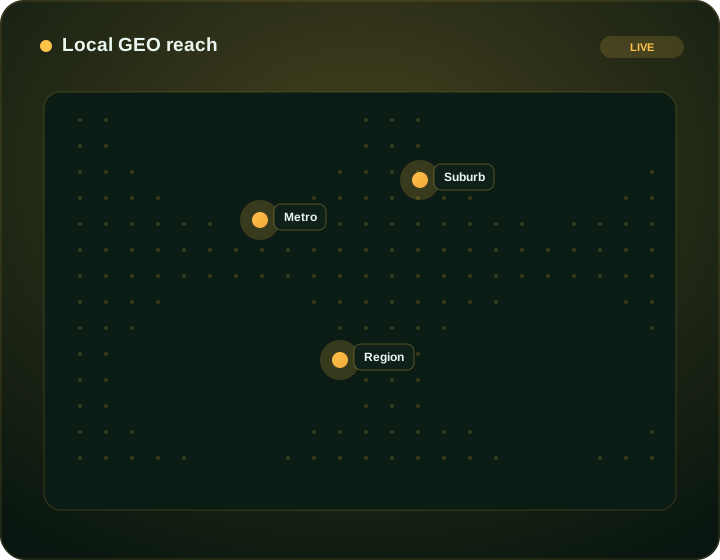
Frequently asked questions
When is automotive advertising suitable for a dealer campaign?
Automotive advertising is suitable when the dealer has current inventory or a defined service offer, a reachable market and a trackable enquiry path. The campaign objective should match the sales or service process.
How should location and inventory shape automotive targeting?
Target the practical selling or service area and separate campaigns when inventory, language or availability differs. An audience should not be sent to vehicles or appointments it cannot reasonably access.
Which format should an automotive advertiser test first?
Select a format that shows the vehicle or service accurately and can carry the essential qualifier. Test one main format before adding variants so enquiry quality can be traced to delivery.
What should an automotive landing page confirm after a click?
The page should reflect the advertised model, condition, price context or service and show a clear enquiry route. Update or remove creative when the referenced inventory is no longer available.
Which inputs shape an automotive advertising test budget?
Market size, vehicle category, format, campaign period and the value assigned to a qualified enquiry shape the budget. Use separate caps for distinct dealer locations or offers.
What should automotive campaign tracking measure?
Track ad interactions, inventory views, call requests, forms, appointments and the dealer-defined qualified lead. Stable source and creative IDs help connect enquiries with the correct listing.
How is automotive lead quality reviewed?
Review location, requested vehicle or service, contact validity and dealer follow-up outcome. Reporting the reason for an unqualified enquiry gives targeting and message changes a factual basis.
Which claim risks matter in automotive advertising?
Vehicle availability, pricing, finance terms, mileage and condition statements need current evidence and required disclosures. Creative should not imply an offer applies more broadly than its documented terms.
When should an automotive traffic source be paused?
Pause after repeated source-level enquiries fall outside the service area or fail agreed validity checks, once landing-page and tracking issues are excluded. Keep enough data to explain the decision.
What evidence supports scaling automotive advertising?
Scale when qualified calls, forms or appointments repeat from traceable sources and dealer follow-up capacity is available. Raise delivery gradually while monitoring changes in vehicle and location mix.
Keep exploring
Real estate
Local considered leads.
Insurance lead gen
Adjacent offers.
Finance lead gen
Auto finance.
Advertiser Quick Start Guide
Free PDF resource from FroggyAds.
Buy Automotive Website Traffic
Buy automotive traffic with vehicle, location and buyer-stage relevance, inventory-aware destinations and source-level measurement tied to qualified.
Automotive advertising for dealers and auto offers on FroggyAds
Create an account, deposit from $50 and launch on supply evaluated with Adscore and internal controls with full source-level control.
Build automotive advertising around serviceable inventory, qualified intent and source-level lead evidence
Automotive advertising becomes easier to evaluate when the campaign is connected to what the dealer, marketplace or automotive service can actually provide. Define the locations that can be served, vehicle or service categories that are available, hours and contact routes, and the event that counts as an accepted enquiry. A click on a vehicle message is not the final outcome. The campaign should be judged by the next action the business can verify, such as a qualified lead, appointment, call outcome or completed purchase step.
Geographic targeting should follow the real service area. FroggyAds supports country and city targeting, which can help separate markets when inventory, delivery, store coverage or lead value differs. Avoid creating a location cell for every city before enough data exists. Split a market only when the business can act differently on the result, such as changing a bid, destination, inventory message or opening-hour promise.
| Automotive campaign layer | What to verify before spend | What to review after traffic arrives |
|---|---|---|
| Offer availability | Vehicle, service or financing proposition is current and eligible | Rejected enquiries caused by unavailable or mismatched offers |
| Geography | Dealer, delivery or service coverage is accurate | Accepted lead rate and value by serviceable market |
| Device path | Forms, calls, chat and location tools work on targeted devices | Progression and completion by device |
| Lead quality | Written rule for an accepted automotive enquiry | Contactability, qualification and downstream sales status |
| Source control | Source identifiers survive into reporting | Mature cost and repeated quality by source |
Keep advertising claims aligned with the landing page and current commercial conditions. Price, availability, finance examples, delivery statements and promotional deadlines can become stale quickly. A creative should not imply that every visitor qualifies for a finance arrangement or that a specific vehicle remains available unless the advertiser can support that claim. When an offer changes, update the campaign record and destination together so source performance is not measured against an outdated promise.
Automotive funnels often mix online and offline steps. Preserve campaign and source identifiers when a user moves from a landing page into a call, appointment, dealer visit or sales workflow where the business can legally and technically retain attribution. A submitted form can be a diagnostic event, while the accepted lead or later sales stage may be the metric that controls budget. Document the maturity window before judging sources whose value is confirmed later.
Use FroggyAds device, operating system, browser, carrier, category and source controls when those dimensions explain a real difference in the automotive journey. Mobile users may call or message more often, while desktop users may compare specifications in a longer session. Test the paths rather than assuming one device is universally better. The useful result is the combination of cost, accepted lead quality and operational fit.
Scale only after the campaign shows repeatable accepted outcomes. Increase one proven market or source cell at a time and recheck the source mix because larger spend can make different inventory eligible. Keep the prior configuration as a rollback point. If lead quality falls after expansion, identify the new source, market or device mix before reversing unrelated improvements.
FroggyAds is valuable for automotive advertisers that want direct control over this process. The self-serve workflow lets the buyer enforce serviceable targeting, compare source-level results and adjust weak delivery without turning every campaign change into a managed-service request. That control is strongest when the advertiser supplies accurate inventory information and a clear lead-acceptance rule.
Automotive offer freshness should be treated as a campaign dependency. Vehicle availability, service capacity, promotional conditions and finance examples can change after a creative is approved. Establish a routine for checking the destination and any inventory-sensitive claim before increasing spend. If the promoted option is no longer available, pause or update the affected creative rather than allowing traffic to arrive at a materially different proposition. This protects both user trust and the quality of campaign measurement.
Lead qualification should distinguish contact from value. Record whether the enquiry is reachable, located in a serviceable market, interested in an eligible vehicle or service and able to progress to the advertiser's next commercial step. The exact acceptance rule belongs to the advertiser, but it should be stable enough that source comparisons mean the same thing over time. A source with fewer forms can still be more useful when a larger share becomes accepted automotive demand.
When the journey includes calls or offline follow-up, preserve attribution only through methods the advertiser is authorized to use and can validate. Compare media reporting with accepted lead status after the normal response window. If a campaign looks strong online but the sales workflow repeatedly rejects the resulting enquiries, investigate the message, source and eligibility rules before increasing budget. Automotive advertising is most efficient when media optimization and operational follow-up use the same definition of a valuable prospect.
Define automotive lead acceptance before comparing media sources. A form submission can be rejected because the contact details are unusable, the requested vehicle or service is unavailable, the location is outside the business area or the user is not seeking the promoted action. Record these reasons consistently so media buyers can separate source quality from inventory and sales-process limitations. When accepted leads mature into appointments, test drives or sales opportunities, feed that status back into campaign analysis where the advertiser's data practices allow it. The deeper signal helps prevent optimization toward inexpensive but operationally weak enquiries.
Creative testing should reflect the decision a real automotive customer is making. One concept might emphasize a specific vehicle category, another a service need, and another the convenience of a local appointment. Keep price, availability and financing language accurate to the destination. Evaluate the concepts on accepted downstream actions rather than on attention alone. FroggyAds can separate creative and source performance inside a self-serve workflow, giving the buyer a practical way to retain a winning proposition while reducing inventory that repeatedly fails the dealer's acceptance rule.
When the campaign is ready to scale, expand within serviceable constraints. Increasing bids or budget can expose the advertiser to new sources, while widening geography can change both competition and lead value. Change one major dimension at a time, preserve the prior source mix and wait for the normal automotive lead-maturity window before comparing results. If quality weakens, the saved configuration provides a clean rollback point. This controlled expansion is especially important when offline follow-up determines final value, because immediate click or form metrics may not reveal the true effect of a broader traffic mix.
Automotive advertising for dealers and auto offers: what should the advertiser decide next?
For Automotive advertising for dealers and auto offers, define the accepted business event before buying scale. A practical outcome can be a accepted conversion or another explicitly accepted event that matches the advertiser's model. Use Automotive advertising for dealers and auto offers at a glance and What does this page explain about Automotive Advertising? together with audience eligibility, conversion validation and downstream value so front-end activity does not hide weak downstream value.
On this Automotive advertising for dealers and auto offers page, the decision should remain tied to the existing evidence around Automotive advertising for dealers and auto offers at a glance, What does this page explain about Automotive Advertising? and Overview. Those sections give automotive advertising its specific context; the table below turns that context into campaign actions rather than adding another generic definition.
| Decision | What to verify | FroggyAds action |
|---|---|---|
| Automotive advertising for dealers and auto offers objective | Use Automotive advertising for dealers and auto offers at a glance to define the accepted business event and the maximum learning loss for automotive advertising. | Launch one FroggyAds campaign objective for Automotive advertising for dealers and auto offers and keep the conversion definition stable. |
| Automotive advertising for dealers and auto offers audience | Use What does this page explain about Automotive Advertising? to verify market, device, language and offer eligibility for automotive advertising. | Apply only the FroggyAds targeting controls that change the real Automotive advertising for dealers and auto offers customer journey. |
| Automotive advertising for dealers and auto offers source evidence | Use Overview to keep source-level differences visible instead of relying on one blended automotive advertising average. | Keep, cap, exclude or retest Automotive advertising for dealers and auto offers inventory from documented source evidence. |
| Automotive advertising for dealers and auto offers economics | Use Targeted auto audiences to connect media spend with accepted conversions and downstream value for automotive advertising. | Protect the Automotive advertising for dealers and auto offers test with a written budget boundary and a consistent attribution window. |
| Automotive advertising for dealers and auto offers scale rule | Use GEO and city to define the exact evidence that earns the next budget increase for automotive advertising. | Scale Automotive advertising for dealers and auto offers one major control at a time and compare marginal performance with the prior baseline. |
A page-specific FroggyAds test sequence for Automotive advertising for dealers and auto offers
- Automotive advertising for dealers and auto offers outcome: define the accepted event for automotive advertising and the maximum loss permitted while the first test is learning.
- Automotive advertising for dealers and auto offers path: verify market eligibility, device experience, landing-page continuity and tracking against Automotive advertising for dealers and auto offers at a glance before buying more traffic.
- Automotive advertising for dealers and auto offers hypothesis: launch one bounded FroggyAds test tied to What does this page explain about Automotive Advertising?; do not change bid, creative, audience and destination together.
- Automotive advertising for dealers and auto offers source review: compare qualified activity, accepted conversions, timing and cost by the source or segment dimensions relevant to Overview.
- Automotive advertising for dealers and auto offers scaling: use Targeted auto audiences and GEO and city to define what must reproduce before the next budget increase.
Why FroggyAds is relevant to Automotive advertising for dealers and auto offers
For Automotive advertising for dealers and auto offers, FroggyAds gives advertisers a self-serve DSP and ad-network workflow for buying supported traffic with campaign-level budgets and targeting. Depending on format and campaign context, available controls can include country, city, device, operating system, browser, carrier, category, source, ID and IP options. SmartCPC and Adscore-supported traffic-quality controls can support the automotive advertising optimization process, while the advertiser's tracker, analytics and backend acceptance remain the final evidence for commercial quality.
Use GEO and city as the final checkpoint for Automotive advertising for dealers and auto offers. If the accepted result does not reproduce after the next meaningful volume step, return to the last stable configuration instead of widening several controls at once.
Automotive advertising for dealers and auto offers — buyer decision
For Automotive advertising for dealers and auto offers, begin with the campaign condition this URL owns and end with a written keep, change or stop rule. Click volume is supporting evidence; the accepted business outcome is the commercial checkpoint. The adjacent Online Advertising For Automotive page should remain a separate decision.
Evidence already visible on this page: Quick answer: Drive dealership, finance and auto-service leads with location and category targeting on Quality signals supply. Automotive advertising spans dealerships, auto finance, insurance-adjacent offers, parts and services. FroggyAds lets… Automotive advertising spans dealerships, auto finance, insurance-adjacent offers, parts and services. Each is location-sensitive and considered, which makes precise targeting and traffic with quality controls central to generating qualified auto… The working concepts for this URL are audience targeting, conversion tracking.
Questions to resolve before scale: When is automotive advertising suitable for a dealer campaign? How should location and inventory shape automotive targeting? Which format should an automotive advertiser test first?
| Checkpoint | Page-specific action | Evidence to keep |
|---|---|---|
| Campaign condition | Use “Automotive advertising for dealers and auto offers at a glance” to define the first operating boundary for Automotive advertising for dealers and auto offers. | Record the answer to “When is automotive advertising suitable for a dealer campaign?” together with source, targeting and destination identifiers. |
| Proof | Use “Overview” to test whether delivery is producing the expected path toward the accepted business outcome. | Keep the evidence needed to answer “How should location and inventory shape automotive targeting?” after the same maturation window. |
| Follow-up | Use “Targeted auto audiences” to decide what changes next; change one material variable before comparing again. | Write the answer to “Which format should an automotive advertiser test first?” plus accepted cost/value and the rollback condition. |
Transparent decision example
Hypothetical example: If Automotive advertising for dealers and auto offers uses USD 125 of test spend and 4 outcomes are accepted after maturation, the accepted outcome cost is USD 31.25. Replace the inputs with your own economics; this is not a FroggyAds performance claim.
Why use FroggyAds for this step?
FroggyAds supports the testable part of Automotive advertising for dealers and auto offers with self-serve traffic buying, campaign controls, conversion measurement and source-level optimization; scale only when the defined accepted business outcome supports it. Create your free FroggyAds account.
Automotive advertising for dealers and auto offers — what matters first
Automotive advertising for dealers and auto offers is most useful when it helps a buyer make a concrete, measurable buying decision. Define the accepted outcome first, then use targeting, budget and source-level evidence to decide what deserves more spend.