
App Marketing ROI: Define, Measure and Govern Marketing Return
App marketing ROI is a governed comparison between accepted economic value and the complete cost required to create it, over a declared population and time horizon. A decision-ready model keeps platform attribution, app events and financial recognition separate until they can be reconciled. This guide explains the formula, evidence boundaries, cohort timing, uncertainty and action rules without turning a reported return into a performance promise.
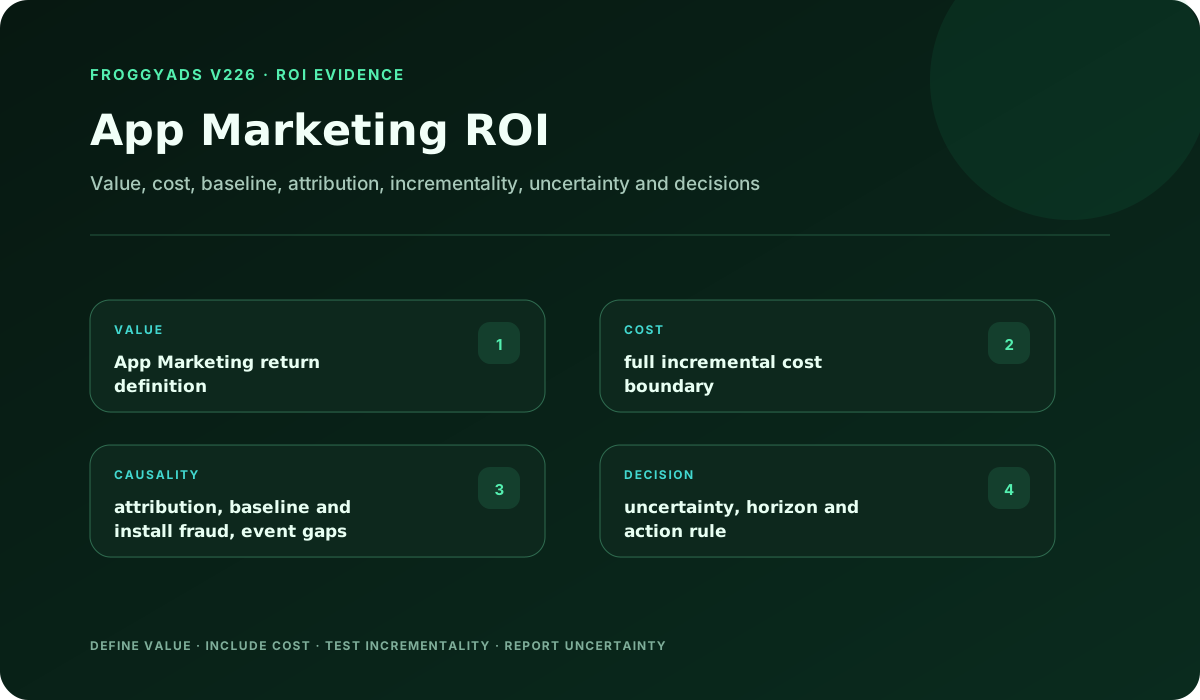
Official conversion-value and reporting boundary
Google's documentation explains that achieved return on ad spend uses conversion values recorded for completed in-app events and cautions against assigning an install value unless the install has inherent economic value. Google Analytics advertising reports are designed to analyze acquisition and attribution across linked advertising products, while app conversion-window documentation separates install and in-app action settings. These sources support three controls: value must come from a defined event, advertising reports require the relevant product connection, and windows must match the decision. They do not establish incrementality, profitability or a suitable target for a particular app. Finance, product and analytics owners should approve the economic meaning, validate event receipt and document modeled or unobservable portions before an ROI figure governs spend.
- Google achieved ROAS for app campaigns - official conversion-value boundary
- Google Analytics advertising reports - linked-product and attribution reporting context
- Google Ads app conversion windows - official install and in-app action window distinctions
State the ROI decision before calculating
Name the resource choice the model must support: continue a channel, change a campaign cell, fund creative, expand a market or hold investment. Define the accountable owner, eligible cohort, app version, acquisition period, value horizon and decision date. A ratio built for monthly financial review cannot automatically answer whether yesterday's creative should scale. Preserve the original question with the result.
Set the permitted actions and evidence threshold in advance. A model may authorize a limited retest while blocking expansion, or support an operational improvement without proving incremental profit. List excluded channels, organic users, cross-promotion or costs explicitly. If the decision scope changes, create a new calculation version rather than silently reusing the old denominator.
Define accepted app value
Specify which completed event creates economic value and when it is recognized. Revenue may require netting tax, platform share, discounts, refunds, chargebacks and failed payment; subscription value may need an observed contribution period rather than an assumed lifetime. If the app values a qualified lead or retained action, document the valuation source and approval. Do not assign value solely to make an optimization report look complete.
Google's app ROAS guidance ties achieved return to the conversion values passed for completed in-app events and notes that an install should have inherent economic value before an install value is used. Keep the raw event, gross amount, adjustment and accepted amount as distinct fields. Finance owns the economic definition even when marketing supplies campaign dimensions.
Connect the guide to live testing
Connect App Marketing ROI to a controlled audience test
Use the choices established in “Define accepted app value” to define one audience, budget and source set in FroggyAds. Keep the surrounding offer and measurement rule stable so the test adds evidence to app marketing roi instead of mixing several changes at once.
Create My Free Account
Inventory complete campaign cost
Include media, agency or platform fees, creative strategy and production, localization, store-page work, analytics implementation, data services, experimentation, staff operation, taxes and material incentives. State how shared costs are allocated across apps or campaigns. Cash paid, accounting expense and modeled opportunity cost are different views; select the one appropriate to the declared decision and show alternatives when they change the answer.
Align cost timing with the acquired cohort. A production expense may support several periods, while a monthly tool may serve multiple channels. Preserve the allocation rule and invoice or time evidence. Avoid putting media spend in the denominator while leaving expensive creative and engineering work outside merely because another team paid for it.
Align cohort and value horizon
Group users by acquisition date, campaign cell, market, operating system and other decision-relevant conditions. Follow that cohort through the declared maturation horizon rather than mixing new users with older, more mature value. Compare cohorts only when their observation windows and app conditions are compatible. A partial month should not be placed beside a fully matured cohort without an explicit adjustment or limitation.
Record late events, renewals, refunds and reversals as the cohort matures. Publish a provisional view for operational control and a mature view for economic judgment, each labeled with its cutoff. When the business uses modeled future value, report the observed portion, model version, uncertainty range and back-test separately.
Configure conversion windows to match behavior
The platform's app conversion settings may distinguish installs from in-app actions and clicks from views. Choose windows that reflect the normal delay of the defined event and the question the report must answer, following current platform guidance. A broad window can capture more credited events while increasing overlap and uncertainty; a narrow one can omit legitimate delayed behavior.
Preserve each platform's attribution setting with the result and keep the first-party cohort horizon separate. Test reports around the window boundary and document timezone. Changing a window can restate history or alter comparable totals, so open a new model version and avoid attributing the resulting difference to campaign performance.
Reconcile identity and duplicate events
Map the identifiers available from ad interaction through store, install, app event and finance record, including places where privacy controls permit only aggregate or modeled evidence. Define how repeated events, reinstalls, device changes, account merges and delayed server submissions are handled. Never claim person-level certainty where the evidence cannot support it.
Sample accepted value records back to event and campaign evidence, then sample platform-reported conversions toward the business ledger. Maintain unmatched, duplicated, rejected and reversed categories. The purpose is not to force equal totals; it is to explain what each system counts and prevent the same value from entering the numerator twice.
Choose the execution format
Choose a paid-media format that supports App Marketing ROI
Use the criteria around “Reconcile identity and duplicate events” to decide whether push, native, display or pop fits the message and destination. Set format, targeting and spend as campaign controls in FroggyAds while the app marketing roi decision remains the standard for judging the result.
Create My Free Account
Separate attribution from incrementality
Attribution distributes credit under a declared rule. Incrementality asks what value would not have occurred without the marketing activity. Platform and analytics advertising reports are useful for attributed performance, but the ROI decision should state whether it describes credited, modeled or experimentally incremental value. Do not rename attributed revenue as generated revenue without supporting design.
Use a randomized holdout, geographic test, time-based comparison or another justified baseline where feasible, documenting contamination and concurrent changes. If no credible counterfactual is available, report attributed ROI with that limitation and cap the decision accordingly. A precise decimal does not remove uncertainty about causation.
Write formulas and denominator rules
For return on spend, the common expression is accepted value divided by the included advertising cost; for profit-oriented ROI, a team may use accepted value minus complete cost, divided by complete cost. Name the formula rather than relying on the label. State whether the output is a ratio or percentage and how zero or negative denominators are handled.
Show one worked row with cohort, value adjustments, cost categories and arithmetic. Lock the workbook, query or code version used for the decision and retain source timestamps. If another dashboard uses a different cost or value definition, keep both labels explicit. Formula governance prevents two correct calculations from being mistaken for one contradictory result.
Validate source systems and linked reports
Google notes that Analytics advertising reports depend on links to the relevant advertising products. For any stack, inventory connections, permissions, import settings, event mappings and refresh delays. Confirm that the app property, advertising account and event version belong to the intended environment. A populated chart is not proof that every cost and event arrived under the approved definition.
Run a source-to-report control total for spend, events and value. Note API, export or interface transformations and retain the query date. Monitor schema changes and broken links. When a source becomes unavailable, mark the affected ROI period provisional rather than filling the gap with an undocumented estimate.
Adjust value for quality and reversals
Economic value can deteriorate after the event through refund, cancellation, fraud review, unpaid invoice or short retention. Define the accepted state and adjustment cadence for the app's business model. Keep gross, excluded and net accepted value visible. A campaign that acquires many early events may rank differently after the validation period.
Use cohort-specific quality measures rather than subtracting a network-wide average when evidence permits. Record why an event was rejected without exposing unnecessary personal information. Reopen a scale decision when reversal or retention behavior crosses its guardrail, even if platform-reported return remains favorable.
Put the guide into practice
Turn App Marketing ROI into a bounded campaign test
With “Adjust value for quality and reversals” documented, launch only the next reversible test. Set a spending limit, preserve the baseline and use source-level and audience controls so the next step depends on qualified outcomes for app marketing roi, not activity volume.
Create My Free Account
Run sensitivity and break-even analysis
Calculate a base case plus conservative cases for value, maturation, unattributed cost and incremental share. Show which assumption changes the permitted action. Break-even analysis can ask how much accepted value or how many accepted events are required to cover complete cost, but it should use the same margin and adjustment rules as the primary model.
Do not hide wide uncertainty in a single blended ratio. Report a range when identity, attribution or future value is modeled. If plausible conservative assumptions cross the stop boundary, hold or limit spend while collecting better evidence. Sensitivity is a decision control, not a way to choose only the most favorable scenario.
Compare channels and cells fairly
Align event definition, currency, cohort dates, maturity, value adjustments and cost scope before ranking campaign cells. Keep market, operating system, inventory, offer and app version visible because they can change behavior. A channel's platform metric may be valid for delivery optimization while remaining unsuitable for cross-channel financial comparison.
Use marginal evidence for budget shifts: the next amount of spend may reach a different audience than the average historical dollar. Preserve a stable control and increase one material dimension at a time. Avoid a permanent channel ranking; the conclusion belongs to the tested configuration, market and period.
Set governance, review and archive rules
Assign owners for event definition, value, cost, attribution, model execution and approval. Establish review cadence, data cutoff, version naming and thresholds for pause, continuation, investigation or scale. Record disagreements and unresolved gaps. Marketing should not unilaterally change financial value, and finance should not alter campaign identifiers without preserving the operational mapping.
Archive inputs, exports, formula or code, assumptions, exclusions, approval and later outcome. Recalculate when material refunds mature, source connections change, app releases alter conversion or the business redefines value. The archive makes ROI a governed learning record rather than a screenshot whose numbers cannot be reproduced.
Interpret negative and unusually high returns
A negative result may be a valid economic finding, an immature cohort or a symptom of missing value; the model must distinguish them. Confirm event receipt, cost timing, refunds, app version and cohort eligibility before acting. If the calculation is sound, apply the prewritten loss rule rather than changing the formula after seeing the answer. Preserve unsuccessful cells because they define where the tested offer, audience or experience failed to meet its boundary.
An exceptionally high reported return deserves equal scrutiny. Check small denominators, organic or pre-existing users, duplicated values, delayed cost, view-through credit, cross-channel overlap and one unusually large transaction. Cap expansion until the result reproduces under the same acceptance rules. A strong ratio can support a larger bounded test, but it cannot justify removing measurement, product-quality or financial controls.
Translate the model into an executive decision
Present the exact question, base and conservative results, observed versus modeled value, complete cost, cohort maturity, attribution method, counterfactual limitation and action. Include the few assumptions that could reverse the conclusion. Decision makers need a traceable range and the consequence of waiting, not a dense dashboard of rates that use different denominators.
The approval should specify pause, hold, repair, continue or scale, along with the next spending ceiling and review date. Name the evidence owner for every open condition. When leadership accepts uncertainty, record that acceptance rather than rewriting uncertainty as confidence. This closes the model's governance loop now and lets a later reviewer compare the authorized action with the outcome that followed.
Decision-ready app ROI matrix
A ratio may enter a decision only after value, cost, cohort, attribution and uncertainty have named owners and reproducible evidence. The team should record the cutoff time, workbook or query version, approval and action beside the matrix so that a later result can be compared with the actual decision rather than a refreshed dashboard.
| Control | Minimum evidence | Decision consequence |
|---|---|---|
| Value | Accepted event and approved net-value rule | Reject gross or invented value |
| Cost | Media plus material production and operating expense | Recalculate when scope is incomplete |
| Cohort | Acquisition period and equal maturation window | Label partial results provisional |
| Causality | Attribution method and counterfactual limitation | Do not claim incrementality without evidence |
| Governance | Formula version, owner, cutoff and archive | Permit only the action defined for that model |
Retained app ROI sources and operating guides
The page's original official citations, internal routes, image and calls to action remain below in the same order. They support further review but do not convert an attributed return into a guaranteed or incremental business result.
App marketing ROI questions
Which formula should an app team use for marketing return?
Subtract marketing cost from the attributed return, divide by that cost and state which revenue, fees and time window the calculation includes.
Which costs belong in an app marketing ROI model?
Include media, creative, tools, agency work, incentives and the internal labor needed to launch, measure and maintain the campaign. A ratio may enter a decision only after value, cost, cohort, attribution and uncertainty have named owners and reproducible evidence.
What should count as return for a subscription app?
Use revenue or contribution tied to acquired users within the chosen period, adjusted for refunds and the attribution rule used.
Why can install volume give a misleading ROI picture?
Installs have no fixed business value; activation, retention, purchases and service cost determine whether acquired users create a return. Use an observed contribution period for subscription value.
How should organic installs be treated in paid app analysis?
Separate modeled paid impact from baseline organic activity and disclose the method rather than assigning every post-campaign install to advertising.
What is the difference between ROAS and app marketing ROI?
ROAS compares attributed revenue with advertising spend, while ROI can include broader costs and the net return from the activity.
How can attribution uncertainty be shown in an app ROI report?
Present results under the accepted model and test alternative windows or assumptions where they materially change the decision. Attribution distributes credit under a declared rule. Incrementality asks what value would not have occurred without the marketing activity.
When should an app campaign be paused for poor return?
Pause at the written loss or evidence limit when valid users are not producing enough expected value to support continued acquisition.
What supports scaling an app marketing campaign?
Scale when accepted cohorts retain and monetize consistently, tracking remains stable and marginal acquisition cost stays within the business model.
Which records make an app ROI review auditable?
Keep spend, campaign settings, cohort events, revenue adjustments, attribution choices and calculation versions linked to the reporting period. Archive their inputs, approvals and unresolved gaps.
App Marketing ROI: Define, Measure and Govern Marketing Return: what should the advertiser decide next?
For App Marketing ROI: Define, Measure and Govern Marketing Return, the commercial task is to turn app marketing roi into one measurable campaign decision. Use Build app marketing ROI from accepted value and complete cost to define the audience or problem, use Official conversion-value and reporting boundary to constrain the test, and decide in advance which accepted result would justify more FroggyAds spend.
On this App Marketing ROI: Define, Measure and Govern Marketing Return page, the decision should remain tied to the existing evidence around Build app marketing ROI from accepted value and complete cost, Official conversion-value and reporting boundary and State the ROI decision before calculating. Those sections give app marketing roi its specific context; the table below turns that context into campaign actions rather than adding another generic definition.
| Decision | What to verify | FroggyAds action |
|---|---|---|
| App Marketing ROI: Define, Measure and Govern Marketing Return objective | Use Build app marketing ROI from accepted value and complete cost to define the accepted business event and the maximum learning loss for app marketing roi. | Launch one FroggyAds campaign objective for App Marketing ROI: Define, Measure and Govern Marketing Return and keep the conversion definition stable. |
| App Marketing ROI: Define, Measure and Govern Marketing Return audience | Use Official conversion-value and reporting boundary to verify market, device, language and offer eligibility for app marketing roi. | Apply only the FroggyAds targeting controls that change the real App Marketing ROI: Define, Measure and Govern Marketing Return customer journey. |
| App Marketing ROI: Define, Measure and Govern Marketing Return source evidence | Use State the ROI decision before calculating to keep source-level differences visible instead of relying on one blended app marketing roi average. | Keep, cap, exclude or retest App Marketing ROI: Define, Measure and Govern Marketing Return inventory from documented source evidence. |
| App Marketing ROI: Define, Measure and Govern Marketing Return economics | Use Define accepted app value to connect media spend with accepted conversions and downstream value for app marketing roi. | Protect the App Marketing ROI: Define, Measure and Govern Marketing Return test with a written budget boundary and a consistent attribution window. |
| App Marketing ROI: Define, Measure and Govern Marketing Return scale rule | Use Connect App Marketing ROI to a controlled audience test to define the exact evidence that earns the next budget increase for app marketing roi. | Scale App Marketing ROI: Define, Measure and Govern Marketing Return one major control at a time and compare marginal performance with the prior baseline. |
A FroggyAds test sequence for App Marketing ROI: Define, Measure and Govern Marketing Return
- App Marketing ROI: Define, Measure and Govern Marketing Return outcome: define the accepted event for app marketing roi and the maximum loss permitted while the first test is learning.
- App Marketing ROI: Define, Measure and Govern Marketing Return path: verify market eligibility, device experience, landing-page continuity and tracking against Build app marketing ROI from accepted value and complete cost before buying more traffic.
- App Marketing ROI: Define, Measure and Govern Marketing Return hypothesis: launch one bounded FroggyAds test tied to Official conversion-value and reporting boundary; do not change bid, creative, audience and destination together.
- App Marketing ROI: Define, Measure and Govern Marketing Return source review: compare qualified activity, accepted conversions, timing and cost by the source or segment dimensions relevant to State the ROI decision before calculating.
- App Marketing ROI: Define, Measure and Govern Marketing Return scaling: use Define accepted app value and Connect App Marketing ROI to a controlled audience test to define what must reproduce before the next budget increase.
Why FroggyAds is relevant to App Marketing ROI: Define, Measure and Govern Marketing Return
For App Marketing ROI: Define, Measure and Govern Marketing Return, FroggyAds gives advertisers a self-serve DSP and ad-network workflow for buying supported traffic with campaign-level budgets and targeting. Depending on format and campaign context, available controls can include country, city, device, operating system, browser, carrier, category, source, ID and IP options. SmartCPC and Adscore-supported traffic-quality controls can support the app marketing roi optimization process, while the advertiser's tracker, analytics and backend acceptance remain the final evidence for commercial quality.
Use Connect App Marketing ROI to a controlled audience test as the final checkpoint for App Marketing ROI: Define, Measure and Govern Marketing Return. If the accepted result does not reproduce after the next meaningful volume step, return to the last stable configuration instead of widening several controls at once.
App Marketing ROI: Define, Measure and Govern Marketing Return: the buyer decision this guide supports
For advertisers, affiliate marketers, media buyers and growth teams, App Marketing ROI: Define, Measure and Govern Marketing Return should shorten the path from research to action: calculate return from a defined accepted-value numerator and complete eligible-cost denominator. The page therefore stays focused on controllable campaign evidence and leaves adjacent intents to their own URLs. The nearest related FroggyAds page is Online Marketing Roi; this URL keeps ownership of the distinct task to calculate return from a defined accepted-value numerator and complete eligible-cost denominator.
For App Marketing ROI: Define, Measure and Govern Marketing Return, the operating evidence to keep visible is conversion action, CPA, source-level reporting, backend validation. Use these entities only when they change setup, measurement or the commercial decision.
App Marketing ROI: Define, Measure and Govern Marketing Return measurement context: For app and mobile measurement, do not stop at an install or click: keep first open, activation, trial, subscription or retention evidence available when those events define value.
| Checkpoint | ROI action | Evidence to keep |
|---|---|---|
| Value basis | Define whether the numerator is contribution, profit or another approved value basis. | Retain the source definitions, timestamps and accepted-outcome evidence needed to reproduce the App Marketing ROI: Define, Measure and Govern Marketing Return decision. |
| Cost basis | Include the eligible costs required by the stated ROI definition. | Retain the source definitions, timestamps and accepted-outcome evidence needed to reproduce the App Marketing ROI: Define, Measure and Govern Marketing Return decision. |
| Attribution | Use one source/attribution rule and a mature observation window. | Retain the source definitions, timestamps and accepted-outcome evidence needed to reproduce the App Marketing ROI: Define, Measure and Govern Marketing Return decision. |
| Decision | Use marginal ROI and business constraints to decide keep, change or scale. | Retain the source definitions, timestamps and accepted-outcome evidence needed to reproduce the App Marketing ROI: Define, Measure and Govern Marketing Return decision. |
Hypothetical ROI example for App Marketing ROI: Define, Measure and Govern Marketing Return: if accepted value attributable under the documented rule is USD 800 and eligible cost is USD 500, net return is USD 300 and ROI is 60.0%. Define the value basis and eligible costs for App Marketing ROI: Define, Measure and Govern Marketing Return before using the result; this is not a FroggyAds performance claim.
FroggyAds supplies the paid-media side of App Marketing ROI: Define, Measure and Govern Marketing Return: campaign settings, spend and source-level delivery evidence. Keep your analytics, tracker, CRM or backend as the authority for the accepted business outcome and reconcile the two before changing budget. Create your free FroggyAds account.
App Marketing ROI worked application example
Hypothetical example: a buyer using this App Marketing ROI guide can turn one recommendation into a test by naming the accepted event, fixing the review window and changing one campaign variable. If USD 175 produces 4 accepted outcomes, the resulting accepted CPA is USD 43.75; use your own numbers and economics before deciding what to change next.
App Marketing ROI: Define, Measure and Govern Marketing Return — what matters first
App Marketing ROI: Define, Measure and Govern Marketing Return is most useful when it helps a buyer decide whether this option fits the buyer's acquisition workflow. Define the accepted outcome first, then use targeting, budget and source-level evidence to decide what deserves more spend.