
Anti Adblock Monetization: Recover Revenue Without Escalation
Approach anti adblock monetization with better ad experiences, consent, messaging, access choices and measured recovery.

What does this anti-adblock monetization guide help you decide?
It helps a publisher respond to blocked advertising without turning the page into a technical arms race. The practical decision is which reader choices can recover sustainable value while preserving consent, accessibility, trust and the reason people visit the site.
Start by measuring where blocking changes eligible ad delivery. Then segment by page family, device, browser and traffic source without attempting to identify an individual reader beyond what the site's lawful measurement permits. A blocked request, a detected blocker and a session with lower ad delivery are different observations; document which one your implementation actually records.
Use a respectful sequence: explain the value exchange, offer a clear action, preserve access rules that match the site's policy and test alternatives such as registration, subscription, sponsorship or lower-pressure advertising. Do not disguise ads, bypass user controls or make the message difficult to dismiss where dismissal is offered.
The Coalition for Better Ads standards are a useful external reference for avoiding intrusive experiences. Combine them with your consent, privacy, accessibility, platform and commercial requirements. No standard or tool guarantees that a reader will allow ads or that recovered delivery will produce revenue.
What anti-adblock monetization should accomplish
The goal is to recover explainable value from sessions where ordinary ad delivery is reduced, while keeping the relationship with the reader intact. A successful approach does not merely increase detected impressions. It shows which message or alternative a reader accepted, what delivery returned, what revenue matured and whether engagement or return behavior changed.
Define the reader choice
Name the options presented on the affected page. They may include allowing ads for the site, continuing with a reduced experience under the published policy, registering, subscribing or choosing another supported path. State what each action changes and avoid implying that an ad blocker is unsafe or unlawful.
Keep the page useful before making a stronger request. A reader who understands the content's value and the publisher's funding model can make an informed decision. Coercive overlays, confusing buttons and repeated interruption may produce a short-term response while weakening future visits.
Measure net recovery, not prompt clicks
A prompt interaction is an intermediate event. Follow accepted reader choice, restored eligible delivery, viewable impressions, mature net revenue and experience signals. Separate readers who allow ads from those who choose a paid or registration path; the economics and retention effects differ.
Write the rollback rule before launch. Stop or soften the experience when the message causes material navigation failure, accessibility problems, complaint growth or a larger engagement loss than the recovered value can justify.
Six layers for a respectful adblock response
Each layer has a separate owner and failure mode. Keep them distinct so a detection change is not mistaken for reader consent or recovered revenue.
Measurement definition
Document the observable signal: missing ad response, client-side test, server event or another bounded indicator. Record known false-positive and false-negative conditions. Report a cohort estimate, not a certainty about every session.
Consent and policy
Confirm that the detection, message, storage and follow-up action fit the site's consent and privacy position. A reader's advertising preference does not automatically authorize new tracking or a different data use.
Message clarity
Explain what advertising supports, what action is requested and what happens next. Use plain language, visible controls and a tone consistent with the publication. Avoid countdowns, false warnings and misleading button labels.
Choice architecture
Offer the paths the publisher can genuinely support and describe their tradeoffs. A free ad-supported path, registration, subscription or limited-access policy should each have an explicit owner and destination.
Ad-experience repair
Review the page reasons a reader may block ads: layout movement, heavy loading, repetition, obscure labeling or weak creative fit. Reducing the underlying friction can improve both ordinary delivery and the credibility of the request.
Revenue reconciliation
Join accepted choices, restored eligible opportunities, rendered and viewable impressions, adjustments and mature net revenue to the same experiment version. Keep engagement and return behavior beside the economic result.
A seven-step anti-adblock monetization process
Use one page family and a limited cohort so the publisher can learn without imposing a sitewide experience before the evidence is ready.
Audit the ordinary ad experience
Check placement density, layout stability, load timing, labeling, creative suitability and repeat exposure. Fix known experience problems first; a request to allow ads is less credible when the underlying page remains intrusive.
Define the affected cohort
Choose the page templates, devices and measurement signal included in the test. Exclude legal, support, payment or emergency content where interruption would be inappropriate. Record the eligible-session denominator.
Write the value-exchange message
Explain why the publisher uses advertising and what the requested action changes. Prepare accessible headings, focus behavior, keyboard operation and readable controls. Have editorial and policy owners approve the wording.
Design real reader choices
Connect every option to a working path. Test the allowlist instruction only for supported environments, and give registration, subscription or continue choices accurate outcomes. Do not imply that a choice exists when the interface will ignore it.
Launch a bounded experiment
Keep a comparable control cohort. Hold message, page access and ad configuration stable for the review window. Stop for navigation traps, focus loss, consent conflict, severe engagement change or technical breakage.
Reconcile reader and revenue evidence
Compare message exposure, accepted choice, restored delivery, viewability, mature net revenue and experience outcomes. Segment by the declared page and device dimensions; do not create narrow cells that cannot mature.
Expand only the stable path
Move one boundary at a time, such as another page family or device class. Retain the previous version and its rollback trigger. Recheck the ordinary ad experience as inventory or creative pressure changes.
Calculate recovered value from eligible affected sessions
Choose a denominator that represents the cohort exposed to the anti-adblock decision. Then keep detection, reader choice, restored delivery and revenue as separate stages.
| Measure | Calculation | Question it answers |
|---|---|---|
| Affected-session estimate | Sessions meeting the documented signal / eligible sessions | How large is the measured delivery problem under this definition? |
| Accepted reader choice | Completed supported actions / message exposures | Which transparent path did readers actually take? |
| Restored viewable delivery | Viewable impressions after accepted allow-ad action / corresponding sessions | Did the choice create usable advertising opportunity? |
| Mature recovered value | Settled incremental net value / eligible affected sessions | Did the experiment add economic value across the cohort? |
| Experience delta | Change in the named engagement, return or complaint measure | What audience cost accompanied the recovery? |
Do not subtract a blocked cohort from an unblocked cohort and call the difference recoverable revenue without controlling for page, device and audience mix. Use a comparable control and label estimates as estimates. Revenue can change because demand, traffic mix or seasonality changed during the same window.
Mark recent revenue as provisional until known adjustments settle. Keep subscription or registration value separate from advertising revenue unless the business has a documented method for combining them.
Connect the reader choice to delivery and value
The system moves through an observable sequence: eligible page session, bounded blocker signal, message exposure, supported choice, resulting page state, ad opportunity, render, viewability and settled value. A gap at one step should not be diagnosed from a later metric.
Use versioned experiment IDs
Give the message, choice set and page policy a version. Carry it into cohort reporting with page family and device class. When wording or access behavior changes, start a new version instead of blending the outcome into the old baseline.
If accepted allow-ad choices rise but delivery does not, inspect the instruction, browser environment, reload behavior and ad request path. If delivery returns but viewability remains weak, repair placement. If viewability holds but mature value does not improve, review demand and reporting rather than escalating the message.
Assign accountable owners
Editorial owns tone and value explanation. Product owns the reader journey and access policy. Engineering owns the signal and state transitions. Privacy and legal owners review data use. Ad operations owns placement and demand. Finance reconciles value. One named decision owner combines the evidence.
Diagnose three common anti-adblock outcomes
Follow the first stage that fails before strengthening the prompt.
Many detections, few message views
Check whether the signal fires before the page can render the experience, whether excluded templates are counted and whether consent state changes eligibility. Repair the denominator before judging reader response.
Allow-ad intent rises, delivery stays flat
Verify that the instruction matches the browser or extension environment and that the resulting page state can request ads. Treat an incomplete technical action as a usability problem, not reader refusal.
Revenue recovers, return visits weaken
Compare message frequency, access friction, page speed and ad pressure. Restore the previous experience when the written audience guardrail is crossed. A smaller recovery can be more durable than an aggressive short-term gain.
Protect reader trust and legitimate advertiser opportunity
An anti-adblock prompt sits between the reader and the content, so clarity and restraint are commercial controls. State the funding role of advertising, present real options and let the interface behave exactly as described. Avoid messages that shame the reader, simulate security warnings or conceal the available path.
Repair causes of blocking
Review late layout movement, autoplay behavior, repeated interruption, heavy scripts, unclear labeling and irrelevant creatives. The publisher may not control every ad, but it can control placement design, eligible formats, frequency decisions and escalation. An improved ordinary experience can reduce the need for a stronger recovery flow.
Test accessibility with keyboard navigation, focus order, zoom, contrast and assistive technology. A modal that traps focus or hides the explanation makes the value exchange inaccessible and can prevent a legitimate choice.
Connect recovery to campaign quality
Recovered impressions are useful to an advertiser only when the opportunity is legitimate, the creative fits and the downstream traffic can be measured. Do not represent an allowed session as guaranteed attention or quality. Read viewability, clicks and accepted advertiser outcomes under their own campaign rules.
Our core platform is built for advertisers who want to buy measurable traffic through self-serve campaign controls. Those controls can support a disciplined advertiser test; the publisher remains responsible for the anti-adblock implementation, reader policy and supply evidence.
Five mistakes that damage adblock recovery
- Treating detection as certainty: publish the signal definition and its known limits.
- Escalating before fixing the page: repair intrusive or unstable advertising experiences first.
- Offering false choices: every visible option must lead to the stated page state.
- Optimizing prompt clicks: reconcile restored delivery, mature value and audience effects.
- Rolling out everywhere: test by page family and retain a versioned rollback path.
Standards and first-party documentation
These sources define technical concepts and user-experience principles. Your own reporting remains the source of truth for performance.
Anti Adblock Monetization FAQ
Practical answers for publishers, site owners, ad operations teams and media buyers.
What should anti-adblock monetization improve for readers and publishers?
The aim is to recover sustainable revenue by improving the ad experience, not increasing disruption. Judge any recovery alongside retention, complaints and engagement so a short-term revenue increase does not conceal audience harm.
How can a publisher test an anti-adblock change safely?
Start with a small eligible audience or placement group, record the current experience and limit repeated exposure. Track the change separately, keep the previous version available and expand only after revenue and audience effects have had time to settle.
Which costs matter when judging recovered ad revenue?
Include fees, reporting discrepancies, latency and revenue that has not been collected. Keep gross estimates, net reports and actual payments distinct, using a consistent denominator and maturity window when comparing the old and new experience.
What makes an audience eligible for an anti-adblock test?
Check that the format and message are permitted for the page or subscriber relationship. Keep the audience segment, device and access option visible in reporting, so results from one context are not silently applied to another.
What should change in the ad experience before exposure increases?
Use clearly labelled, relevant messages and technically valid creative. Check that placements do not obscure navigation, shift content or repeatedly interrupt readers; those effects belong beside revenue when deciding whether the new experience is acceptable.
What needs to be checked before an anti-adblock change goes live?
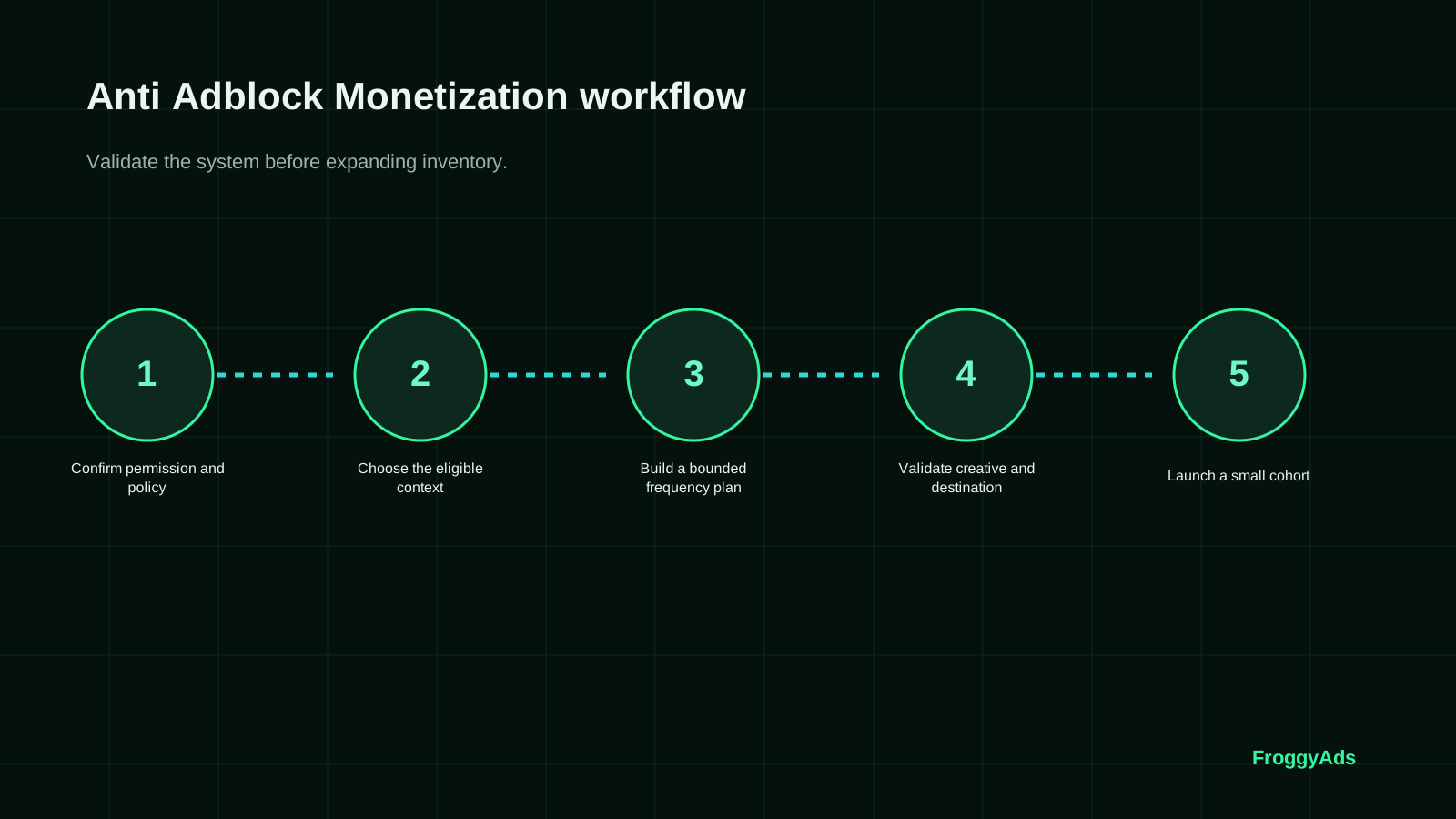
Confirm permission and policy, validate the creative and destination, and set a bounded frequency plan. Assign owners for technical delivery, the revenue measure and audience safeguards so a failed check has a clear response.
Which records make recovered revenue comparable across cohorts?
Record the ad experience, audience segment, message, access option and device alongside a defined revenue basis. Compare periods only after the same reporting delay, and start a new baseline if the measurement definition changes.
What if revenue rises but readers opt out more often?
Reduce frequency and improve relevance before treating the increase as a success. Read collected revenue together with complaints, opt-outs and return behaviour; a higher headline rate can still weaken the audience relationship.
When should an anti-adblock experiment be rolled back?
Restore the previous stable version if the change weakens collected revenue or audience behaviour beyond the agreed limits. Keep the affected placement and cohort identifiable, then investigate the newest change before exposing more readers.
What evidence supports expanding an anti-adblock change?
Look for stable recovered net revenue without worsening retention or complaints after the reporting window matures. Expand one lever at a time, such as eligible inventory or format, and preserve the last working version for rollback.
Continue the publisher revenue workflow
Use the related guides to connect strategy, measurement, infrastructure and format decisions.
Direct answer: anti adblock monetization
Anti-adblock monetization should begin with a respectful message, a lighter ad experience or an alternative such as subscription, contribution or access choice. Avoid escalating into deceptive or hostile behavior. Measure recovery against bounce rate, trust, repeat visits and total net revenue.
Closely related variants reinforce one resource instead of competing with separate pages.
Keyword ownership
- anti adblock monetization
Decision boundary
Evidence event: an adblock-affected visit exposed to a transparent monetization choice.
Decision: whether recovered revenue exceeds the loss in trust, engagement and repeat use.
Primary risk: forcing hostile interactions or counting short-term recovery while audience value declines.
| Layer | Evidence to preserve | Action rule |
|---|---|---|
| Eligibility | Placement, source, device, GEO, consent state, creative and commercial terms that determine whether the event may occur. | Do not compare results until the eligibility rule and denominator are the same. |
| Delivery | Requests, matched events, served impressions, clicks, subscriptions, installs or sessions with timestamps and stable IDs. | Separate delivery loss from value loss before changing bids, placements or demand. |
| Business value | Accepted revenue, activation, retention, refunds, invalid activity, operational cost and repeat behavior. | Optimize the mature net outcome rather than the earliest or cheapest event. |
| Change control | Baseline settings, hypothesis, test window, loss ceiling, stop rule and rollback state. | Change one material variable at a time and restore the stable state when the stop rule is reached. |
Operating checklist
- Declare the numerator and denominator before reporting a rate.
- Preserve source and placement identifiers through the complete path.
- Measure page speed, user experience and downstream quality together.
- Wait for delayed revenue and adjustments to mature.
- Document the scale, limit, investigate or stop decision.
Primary documentation
A publisher operating plan for anti-adblock monetization
The fieldbook turns a vague request to “recover blocked revenue” into a set of reviewable product decisions. It avoids bypass tactics and concentrates on transparent reader choice, a better advertising experience and measurable alternatives.
1. Establish the value-exchange brief
Write why the publication uses advertising, which content or services it funds and which alternatives the publisher can maintain. The explanation should be specific enough for the reader to understand without making claims about an individual session. Have editorial, product and policy owners approve one plain-language version.
Define the access policy separately. A message, soft reminder, metered experience and hard access requirement are different product choices. State where each can appear, what exceptions apply and who can approve a change. Do not let an experiment script silently create site policy.
2. Audit the advertising experience
Inspect the affected templates on phone and desktop. Record placement count, reserved space, layout movement, script work, repeated exposure, labeling and creative suitability. Review user complaints and page behavior where lawful and available. Fix known problems before asking readers to alter their setup.
Document which parts the publisher controls directly and which depend on external demand. Use that boundary in the message and in internal expectations. A better placement plan can improve the experience, but it cannot guarantee a particular ad or revenue result.
3. Define the measurement signal
Describe how the site identifies an affected session and under which consent state the measurement runs. List browsers, extensions or network conditions that can cause false results. Decide whether the number is suitable for experiment assignment, aggregate reporting or only a directional diagnostic.
Use the minimum data required. Do not infer personal motives or create a hidden profile from an adblock signal. Set retention and access rules for experiment data. When the implementation changes, version the signal and avoid comparing it directly with the prior definition.
4. Build supported reader paths
Write each option and its resulting state. An allow-ad instruction should match the supported environment and explain any reload. A registration or subscription path must preserve return navigation. A continue choice, when offered, should be visible and should not reappear more frequently than the published rule.
Test incomplete states: the reader accepts but ads remain blocked, payment succeeds but access does not update, consent is withdrawn, or the page is opened in a browser the instruction does not cover. Give each failure a recovery route and owner.
5. Design the experiment
Select one or two page families and a bounded share of eligible affected sessions. Keep an untreated or current-experience control when appropriate. Hold the message, options and ad configuration stable. Set minimum observation time based on reader return and revenue maturity, not merely on prompt impressions.
Predefine primary value, experience and safety measures. Mature recovered net value per eligible affected session can be the economic measure. Pair it with engagement, return behavior, complaints, accessibility errors and navigation completion. Set explicit stop thresholds for technical or experience harm.
6. Review the funnel
Read eligible affected sessions, message exposures, completed choices, resulting page states, restored ad opportunities, renders, viewable impressions and mature revenue. A fall between two stages is the investigation point. Do not use a later rate to guess what happened earlier.
Compare by declared page family and device. Avoid slicing into tiny browser or source cells unless the dimension changes an action and has enough observations. Mark incomplete revenue and repeat-visit windows as provisional.
7. Evaluate alternatives on their own economics
Registration, subscription, sponsorship or reduced-ad paths create different value and retention. Keep them separate from recovered advertising in the ledger. A subscription start cannot be compared with one day's ad revenue without a documented value model and maturity period.
Record operating cost as well as revenue: product work, support, payment fees, editorial maintenance and exception handling. The option with the largest gross number may not produce the strongest sustainable contribution.
8. Decide and document
Approve the experiment for a named page family, device set and access policy. Record the message version, evidence window, owner, current limits and next review. State what remains uncertain. Retain the previous configuration and the condition that would restore it.
Expand one boundary at a time. Recheck the reader experience after adding new placements, demand or frequency. A recovery system is ongoing product work, not a one-time script.
| Review stage | Evidence | Possible action | Reason to hold |
|---|---|---|---|
| Signal | Eligible sessions, detected cohort and known error conditions | Repair, narrow or version the measurement | The denominator cannot be reproduced |
| Choice | Message views, completed paths and technical success | Clarify wording or repair a broken route | The interface does not deliver the stated result |
| Delivery | Restored opportunities, renders and viewability | Fix placement or ad request behavior | Reader action has not created usable supply |
| Value | Mature net revenue or separately modeled alternative value | Hold, expand or end the path | Reporting adjustments have not settled |
| Experience | Navigation, engagement, return and complaint evidence | Reduce pressure or restore the prior version | The written audience guardrail is crossed |
Use hypothetical calculations only to explain the method. For example, if 2,000 eligible affected sessions produce 240 completed allow-ad actions, 180 sessions with restored viewable delivery and $12 of mature incremental net revenue, the completed-action rate is 12%, the restored-viewable-session rate is 9% and mature recovered value is $0.006 per eligible affected session. These invented values are not FroggyAds rates, forecasts or typical results.
Use recovered supply as context, not a quality promise
When a reader deliberately allows ads, the resulting placement may offer useful context, but it does not guarantee attention, conversion or commercial value. Advertisers should still validate device fit, creative-to-page continuity, loaded sessions and accepted outcomes.
FroggyAds advertisers can use our self-serve workflow to plan supported traffic tests with campaign budgets, targeting and source evidence. Explore FroggyAds for Advertisers for the buying path, or compare supported ad formats before choosing the creative journey. Keep publisher recovery metrics separate from advertiser conversion economics.
The publisher decision this anti-adblock URL owns
Use this page when the product, editorial and ad-operations teams need to decide how the site will respond to reduced ad delivery. The page owns the relationship between the blocker signal, reader message, supported choices, page access, restored supply, mature value and audience guardrails.
Distinguish this decision from general website monetization, push-subscriber revenue and popunder implementation. Those pages can discuss demand and revenue, but they do not own the product decision of asking a reader to change an advertising preference or choose a different funding path.
Build the publisher decision record
Start with the exact page cohort and the evidence that ordinary ad delivery is reduced. Add the experiment version, message, choice set, access rule and responsible owner. Define what will count as a completed choice and how the resulting page state is confirmed.
Retain the measurement contract: eligible affected sessions, signal definition, currency, net or gross basis, maturity delay, adjustment handling and experience thresholds. Attach known detection limits and the consent state under which measurement is allowed. The record should make the result reproducible without exposing a personal profile.
| Publisher checkpoint | Question | Evidence | Decision |
|---|---|---|---|
| Page quality | Have we corrected intrusive or unstable ad behavior we control? | Placement audit, load and layout checks, complaint themes | Repair before prompting or document the remaining limitation |
| Reader communication | Does the message explain the value exchange and every option honestly? | Approved copy, accessibility check and path test | Launch, revise or withdraw the message |
| Technical state | Does each completed choice create the stated page behavior? | Experiment version, success event and failure recovery | Fix the route before interpreting acceptance |
| Economic recovery | What mature incremental value appears across eligible affected sessions? | Restored viewable delivery, net revenue and alternative-path value | Hold, expand one boundary or stop |
| Audience cost | Did the experience weaken navigation, engagement or return? | Cohort comparison, complaints and accessibility errors | Reduce pressure or roll back |
Where FroggyAds fits
FroggyAds primarily serves advertisers buying traffic. We explain the publisher workflow because transparent supply and a usable page matter to the campaign on the other side. The publisher remains responsible for detection, consent, access, placement and revenue evidence. FroggyAds does not promise publisher fill or recovered revenue.
Advertisers who want to buy supported traffic can continue to FroggyAds advertiser resources. Use campaign tracking and your own accepted outcomes to judge the traffic. Do not interpret a publisher's allow-ad action or recovery rate as an advertiser result.
What matters first in anti-adblock monetization?
First improve the ordinary ad experience and define a transparent reader choice. Measure the affected cohort with a documented signal, connect each completed choice to the real page state, and reconcile restored viewable delivery with mature net value and audience guardrails. Expand only when the recovery remains useful without coercion, inaccessible controls or unacceptable loss of reader trust.