
1. Choose one customer problem
Describe the purchase situation in terms a shopper would recognize. A useful brief might focus on fitting a shelf into a narrow space or choosing the right refill size. Avoid a broad audience label with no buying need.
By FroggyAds.
An Amazon marketing strategy connects the products you can reliably sell with the customers most likely to understand their value. Start with the offer, product page and available stock. Then choose the advertising route, spending commitment and evidence that will guide your next move.
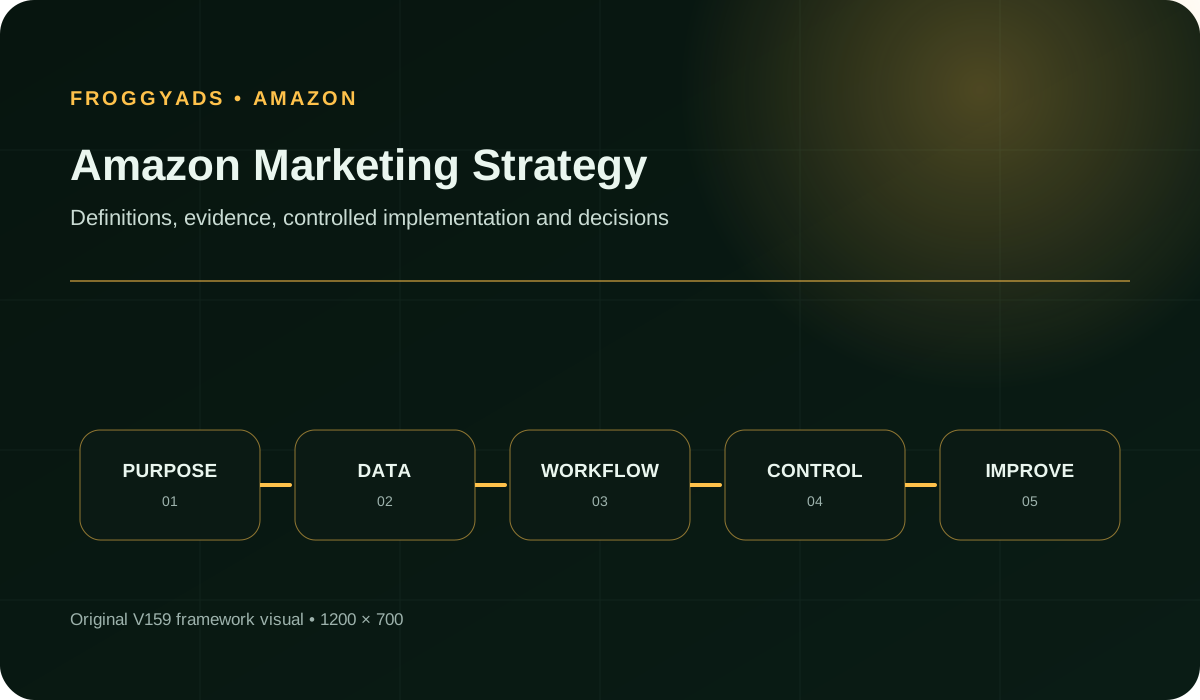
Quick answer: Choose a small, ready product group before spreading promotion across the catalog. Make the customer promise clear, confirm availability and prepare a useful destination. Use Amazon advertising for the jobs its products support. When an additional traffic route fits, we help you run a separately controlled FroggyAds campaign and assess what it contributes.
For Amazon campaign eligibility and product-specific buying rules, consult Amazon Ads: Sponsored Products. Use the current requirements for your marketplace and account. A marketing plan should work with those conditions rather than assume every product can use every advertising option.
Connect customer need, product choice, retail readiness and promotion. State the order of work and the evidence that will justify your next commitment.
Your strategy should explain which customer need you will serve, which products answer it and why the offer deserves attention. It should also say what must happen before promotion starts. For a storage product, that might mean clear dimensions and installation guidance. For a consumable, it might mean an unambiguous pack quantity and expected use.
Start with a short product brief, not a long keyword list. Identify the intended buyer, the problem, the product difference and the most likely objection. Then compare that brief with the live detail page. If the page cannot answer the objection, more traffic may simply expose the same weakness to more people.
We recommend separating three decisions: what to improve in the offer, how to reach suitable shoppers and how to judge the response. Keep them connected, but do not let one substitute for another. A campaign can deliver attention while the listing still needs work. A polished listing can still require a different audience or proposition.
Prioritize clear customer value, a credible live offer, suitable economics and enough stock. The newest or most expensive item is not automatically the best lead.
The best lead product is not automatically your highest-priced item or your newest launch. Look for a clear customer use, credible product information, suitable contribution and enough stock for a meaningful test. A commercially similar group can work, but combining unrelated products makes it harder to understand why shoppers chose one and ignored another.
Give each shortlisted product a reason to lead. One may solve a frequent compatibility problem; another may be easier to demonstrate visually. Check whether the relevant variation is actually available. A broad campaign for a range is less useful when the advertised size, color or pack is the one customers cannot buy.
Treat this selection as a practical priority rather than a permanent ranking of your catalog. A product can move out of promotion when stock tightens or its offer changes. Another may become ready after better images or clearer specifications. Revisit the shortlist when those conditions change, instead of keeping yesterday's budget split by habit.
When the product and destination are ready, FroggyAds gives you a direct way to test an additional traffic opportunity. Choose a supported campaign format and the targeting relevant to the offer. Keep the initial commitment small enough to review closely. We recommend a specific customer question, such as whether a demonstration attracts useful product interest.
Create My Free Account
| # | Readiness check | Decision before promotion |
|---|---|---|
| 1 | Customer use | Explain the specific job the product performs and the buyer most likely to value it. |
| 2 | Product choice | Select an item or coherent group whose response will inform a useful next decision. |
| 3 | Live offer | Inspect the seller, variation, price and delivery expectation the shopper will encounter. |
| 4 | Buying information | Answer decisive questions about dimensions, compatibility, contents or intended use. |
| 5 | Available stock | Allow for ordinary demand and a reserve; exclude unconfirmed replenishment from sellable supply. |
| 6 | Commercial room | Check the contribution the product can retain after applicable selling and advertising costs. |
| 7 | Advertising eligibility | Verify the requirements for the actual Amazon product, account and marketplace being used. |
| 8 | Usable measurement | Choose a question that the available delivery, visit and order records can genuinely answer. |
Use these checks to resolve a buying obstacle or operational constraint before promotion. A test can start with uncertainty, provided you know which question it is intended to investigate.
Describe the purchase situation in terms a shopper would recognize. A useful brief might focus on fitting a shelf into a narrow space or choosing the right refill size. Avoid a broad audience label with no buying need.
Shortlist the items that can answer that need. Favor clear differences, credible information and sufficient supply. If the products have substantially different uses or margins, review them separately before combining the promotion.
Open the actual destination and inspect the variation, seller, price and delivery expectation. Confirm eligibility for the intended advertising product. A planning spreadsheet can be correct while the live offer has changed.
Check the facts a hesitant shopper would need. Put dimensions, compatibility and included items where they can be understood. Remove ambiguity before asking advertising to bring more people to the same unanswered question.
Estimate ordinary demand during the test and protect a stated reserve. Compare those needs with available units. Treat a replenishment estimate as uncertain until the stock can support the offer being promoted.
Decide whether the task is product discovery, range education or an additional audience experiment. Then choose the supported advertising route. Keep Amazon campaigns and FroggyAds traffic purchases separately configured and evaluated.
Make the creative promise correspond to the destination. If you advertise a specific variant, show that variant. If you invite shoppers to compare a range, give them useful distinctions rather than a crowded product grid.
Check which visits, orders and customer indicators the account can report. Configure a permitted measurement method before launch. Explain any gaps so a click count is not later presented as verified purchasing demand.
Choose a commitment and review point that fit the stock window and your ability to evaluate response. Keep the central question stable. Changing the product, message and audience together makes the next decision harder.
Read the observations alongside the current offer and supply. Expand only the part of the plan the evidence supports. If a retail problem emerged, resolve it before interpreting a campaign adjustment as the answer.
Read customer response together with stock, offer changes and reporting maturity. Each signal should support a specific next action.
Read customer response alongside product readiness. A lower sales rate can reflect an unavailable variation, a changed offer or a poorly matched audience. Record those conditions before adjusting the media. Otherwise, an advertising change may receive credit or blame for a retail problem that began elsewhere.
| Signal | What it can tell you | What to check before acting |
|---|---|---|
| Available units | Whether the offer can support the planned promotion window. | Ordinary demand, reserve and the reliability of replenishment dates. |
| Product-page visits | Whether shoppers reached the intended explanation. | Destination identity, variation and any tracking limitations. |
| Purchase response | Whether the observed shoppers proceeded under the stated order definition. | Stock, offer changes, reporting maturity and product mix. |
| Attributed orders | Which purchases the reporting system assigns to advertising. | Attribution rules; do not automatically label the orders incremental or new customers. |
| Remaining contribution | What the product retains after the costs included in your calculation. | Discounts, returns, selling expenses and advertising spend on the same basis. |
| Product questions | Which details or limitations may be influencing customer choice. | Whether the question reflects unclear copy, poor audience fit or a real product issue. |
Separate routine delivery checks from commercial decisions. Stock or destination problems may need immediate action. Purchase behavior needs the reporting period and available order information to mature. Review product-level outcomes where the records support it, and avoid treating a combined total as proof that every promoted item deserves the same next investment.
Choose the route after you know the shopping task. A shopper seeking a specific product needs a different explanation from someone comparing a range. Amazon Sponsored Products promotes individual listings through CPC advertising. A Brand Store can help an eligible brand explain several products. A separate FroggyAds campaign lets you test another route to an approved destination.
Create My Free Account
A new product needs a clear introduction and honest expectations. Start by answering what it does, who it suits and what is included. Use a modest launch to learn about customer interest and objections. Early purchases are useful evidence, but they do not yet establish a stable response rate or prove broad demand across the category.
An established product with tight stock needs restraint even when recent advertising looks attractive. Estimate what normal demand may consume before replenishment is usable. Keep an allowance for uncertainty and existing commitments. You may decide to narrow promotion, favor an available variation or prepare the next campaign while waiting for confirmed supply.
A range with several similar items may need navigation more than another discount. Explain differences that affect the purchase: size, compatibility, capacity or intended use. An eligible Brand Store can organize that choice. Send a single-product promise to the matching item, and send a range-comparison promise to a destination that actually supports comparison.
If the ad promises a benefit the detail page never explains, repair that disconnect first. Compare the wording with product specifications and approved evidence. Replace broad claims with observable features and their practical use. A customer should understand why the product fits without relying on unsupported superlatives or an imagined result.
Check the offer shoppers can buy, not just the product identifier in your planning sheet. Seller, price, delivery expectation and variation can change. Amazon's advertising eligibility rules differ by product type and offer status. Inspect the applicable rule before reacting; do not assume every advertising format behaves identically when the Featured Offer changes.
Look for the fact a cautious shopper needs before deciding. A compatibility list, assembled dimensions or clear pack contents may matter more than another lifestyle image. Make that information easy to locate and consistent across the destination. Useful detail can prevent a poor-fit order as well as help the right customer proceed.
Advertising and inventory planning should share the same calendar. Count stock that is actually available for the promoted offer. Do not treat an uncertain shipment as sellable supply. If the campaign can outlast the stock window, plan when to reduce exposure, change the message or stop rather than waiting for the destination to disappoint shoppers.
Attributed orders describe a reporting relationship, not proof that every order was created by the campaign. Branded searches, existing customers and other promotions can contribute to the same period. Use the available product and campaign records together. State when they cannot distinguish new demand from demand that was already likely to arrive.
A companion product may sell more during the campaign, but price changes or seasonality could explain it. Investigate that observation before extending the advertising commitment to the whole range.
Fund essential product preparation before buying exposure. Size the media test around one useful question, your available stock and the information you can assess.
Separate preparation from media when setting the first commitment. Product photography, listing corrections and a comparison page can remain useful beyond one campaign. Advertising spend buys the next opportunity to learn or sell. If a basic specification is missing, address it before paying to send shoppers to a page that still leaves their question unanswered.
Allocate the test around a decision you can make with the information available. You might compare two product messages while keeping the destination and audience stable. Or test one approved external route for a ready item. Avoid launching several unrelated changes together; even an encouraging result then gives you little guidance about what to repeat.
Keep operational capacity in the same plan. A limited stock window may constrain the test more than the advertising allowance. Product support or content approval may also take time. Plan a review point that leaves room to act before those limits are reached, rather than spending the entire commitment and discovering the constraint afterward.
Bring one ready offer and one clear question to your FroggyAds test. We give you campaign-level control over the buying settings available for the chosen format. That helps you make a deliberate start, review source performance and decide the next step. Choose the amount you can assess properly rather than borrowing another seller's budget.
Create My Free Account
FroggyAds fits when your strategy includes an additional, separately managed acquisition route. We are a self-serve DSP and global ad network. You can use supported bids, budgets, targeting and source controls to shape the traffic purchase. Keep that campaign distinct from Amazon advertising, with its own destination checks and measurement plan.
Our advantage for this job is practical control over a defined traffic test. You can focus the campaign on the relevant audience conditions and inspect the evidence available for its sources. That gives you a clearer next buying decision than an undifferentiated traffic order. Match the available controls to the product and format you actually choose.
An Amazon destination needs measurement you can legitimately configure there. Eligible advertisers may use Amazon Attribution to examine supported non-Amazon marketing activity. Check account, marketplace and tagging requirements first. We do not assume FroggyAds can read Amazon orders automatically or manage your Sponsored Products campaigns. If purchase measurement is unavailable, label the test's learning accordingly.
Require defined deliverables, account access and clear responsibilities for listing work, media and retail operations. Judge the service by the job you need done.
Listing production, retail operations and media buying are different services. Ask the questions below to establish deliverables and access, so campaign activity does not hide unfinished product work.
Write the product detail page for a real shopper's decision. Use the product's correct name and explain its purpose in ordinary language. Support important claims with specifications or permitted evidence. Do not turn the title or bullets into a list of loosely related searches. Relevance begins with accurately representing the item being sold.
Where eligible, A+ Content can provide richer text, images and comparison material. Check the current account and product requirements, because access and modules vary. Use the space to resolve a purchase question that the basic page leaves open. More content is useful when it clarifies the product, not merely because it fills an available module.
Review images and copy together. A picture suggesting a large storage capacity should agree with the stated dimensions. A bundle image should distinguish included items from props. Preview the result on relevant devices and use the platform's current content rules. Paid exposure cannot compensate for an explanation that makes the product harder to evaluate.
Inspect the current product and offer status before changing the campaign. Featured Offer requirements are not identical across Amazon advertising formats. Confirm the applicable rule in your account and review what the shopper will actually see. Then adjust the affected activity, without assuming every campaign should pause for the same reason.
Branded searches can include people already looking for you, while category searches can include broader comparison needs. Give the two jobs separate expectations. Review the actual targeting and reporting available before drawing conclusions. A strong branded result alone does not show that unfamiliar shoppers will respond equally well to the same message.
Check the product, variation, core promise and expected use from the ad through to the destination. Confirm that the advertised option remains available. A working URL is only the start: the shopper should land somewhere that answers the reason they clicked, with no unexplained change in product or offer.
Work backward from the date the product must be ready, including supply, listing work, content approval and fulfillment preparation. Use your actual lead times rather than a universal launch calendar. A campaign can begin later if readiness slips; committing media early does not make delayed inventory available sooner.
Size, color, capacity and pack differences may create different customer expectations and stock risks. Inspect the promoted variation and review its response separately when the records allow it. A good result for one option should not automatically determine the budget for every other variation in the family.
Use only the customer indicators available for your account and advertising product. Attributed orders are not automatically first-time buyers. Where reports offer a relevant new-customer measure, preserve its definition and period. Where they do not, describe the observed sales without inventing a distinction between new and returning demand.
No. Better product information and advertising may coincide with changes in organic discovery, but that is not a ranking guarantee. Track the available signals separately and note other changes during the period. We recommend judging the paid activity by its stated commercial purpose and evidence, without promising organic placement.
Prevent further paid traffic from reaching an unavailable offer when you control that route. Use an alternative only if it genuinely matches the message and is approved for the campaign. Record the interruption when reviewing results. Stock recovery changes the retail conditions, so it should not be mistaken for a media improvement alone.
Compare the promoted products with the rest of the range while noting stock, price and promotion changes. Broader movement can suggest a question worth investigating. It does not by itself prove a sales halo. Keep any uncertain effect separate from the product-level evidence used to authorize the next advertising commitment.
Include the product and marketplace, current offer, available stock, important content changes and campaign observations. Write the actual decision and when it will be revisited. A useful weekly review explains why an item is ready to expand, needs a narrower test or should wait for a retail problem to be resolved.
Use these official references to check the rules that apply to the campaign you are considering. Product eligibility, budget behavior and claim requirements can differ by service and change over time. Read the relevant account terms before launch, and keep your own retail assumptions separate from the platform's documented conditions.
Bring the current listing, stock position and campaign observations to the weekly review. Use each prompt below to decide whether action is needed, rather than changing stable products by habit.
List the objections that still appear in permitted customer feedback, support questions or your own product review. Separate missing information from a real product limitation. Fix a missing specification in the listing. Address a product limitation in the offer or audience choice, rather than writing copy that conceals it.
Compare the ready products by use case, availability and commercial fit. Choose the item whose next question is worth testing now. Record why another product is waiting. This helps the team resist shifting attention to the newest item when the existing lead still has a clearer opportunity and enough supply.
Check for changes in price, discount, seller, variation and delivery expectation. A comparison with last week's campaign is less useful if the underlying offer changed unnoticed. Explain the difference in the review before modifying media settings. The correct response may be to restore the offer rather than alter the audience.
Count available units, expected ordinary demand and the reserve you want to protect. Keep unconfirmed inbound stock outside the available total. Recalculate after meaningful changes in demand or supply. The resulting room for promotion is a planning constraint, not a forecast of what advertising will sell.
Identify whether the next task is reaching shoppers seeking a specific product, explaining a range or exploring an additional audience. Choose the route that can support that task and its destination. We recommend a separate FroggyAds campaign when you want direct control over a suitable external traffic experiment.
Match the destination to the claim made before the click. A range message needs clear product navigation; a compatibility claim needs exact compatibility information. Keep approved product details consistent across creative and the destination. Do not ask shoppers to work out which item, variation or promise the campaign meant.
Name the observations the available tools can support. Delivery, destination visits, attributed orders and accepted commercial results are different evidence levels. Explain gaps before launch. If the available measurement cannot answer the intended question, change the question or preparation before increasing the campaign commitment.
Set a review decision that uses both demand evidence and retail readiness. More interest may justify another test, while mature orders and adequate stock may support expansion. A weaker response may call for a new explanation or a pause. Choose the action that addresses the observed problem instead of defaulting to a larger budget.
Choose FroggyAds when a ready product needs an additional traffic test you can manage directly. Start with the customer promise, select the supported campaign settings and confirm the destination. We help you put the buying plan into action while you retain responsibility for product suitability, stock and the commercial outcome.
Create My Free AccountMatch the next action to the actual constraint. The table below distinguishes a content problem, limited supply and an audience opportunity, so spending serves the product's present need.
Use customer fit, retail readiness and measurable response together when choosing the next campaign. None is sufficient alone. A product can appeal to the right person and still be unavailable. A destination can be ready while the chosen measurement cannot yet establish the result you want to evaluate.
| Situation | What needs attention | Useful next action |
|---|---|---|
| Interest without purchase | A decisive product detail, the actual offer or the suitability of the traffic. | Inspect the customer journey before simply increasing bids or exposure. |
| Demand with limited supply | Stock remaining after ordinary demand and the chosen reserve. | Reduce or defer promotion until the product can support the commitment. |
| A confusing product range | Differences between items that shoppers need to understand. | Improve navigation or comparison content before advertising the whole range. |
| A ready offer seeking another audience | Destination approval, relevant targeting and a workable measurement plan. | Run a separate FroggyAds campaign with a specific learning question. |
| Encouraging initial orders | Order maturity, current retail conditions and the next stock window. | Expand one part of the plan and confirm the result under the new commitment. |
We recommend FroggyAds for advertisers who want to test an additional traffic route with clear buying controls. Set the supported campaign budget and targeting, then review source performance in the context of the offer. This is a practical way to explore audience response without making the wider retail plan depend on a single campaign.
Recheck stock and the destination before expanding a promising campaign. Add a source or commitment deliberately, keeping the product promise intact as the traffic purchase changes.
Explore the available formats and targeting approaches in Amazon Advertising. This guide helps you put those options in sequence: prepare the product, choose the shopping task, promote it and review the response.
Bring the stock forecast and media plan together before launch. The example below reserves supply for ordinary demand before assigning room to promotion; it is a planning constraint, not an order forecast.
| Checkpoint | Planning question | Evidence that matters |
|---|---|---|
| Product readiness | Can the shopper understand and buy the promised product now? | Current listing, actual variation, offer and available units. |
| Campaign purpose | What customer question will this route help us answer? | Defined audience, message, destination and accessible observations. |
| Expansion decision | Can we support more demand, and does the evidence justify the next commitment? | Mature response, remaining stock, product contribution and disclosed uncertainty. |
Hypothetical calculation: Assume 120 units are available for a ten-day window, with ordinary demand estimated at five units daily. Expected ordinary demand is 50 units. Protecting a 20-unit reserve leaves 120 minus 50 minus 20 = 50 units of planning room for promotion. No replenishment is assumed, and actual demand may differ.
Start with a product you can explain clearly and supply reliably. Use FroggyAds to test a suitable additional traffic route, keep the commitment deliberate and review the response beside your retail position. We give you practical campaign controls for that next step. Create your free FroggyAds account
Hypothetical example: If ordinary demand instead reaches eight units daily for the same ten days, it consumes 80 units. With the same 20-unit reserve, only 20 units remain for promotion. That is two units per day of planning room rather than five; it is not a promised advertising sales rate.
Choose a product you can explain and supply, then match the traffic route to a useful question. Review the response alongside retail conditions before making the next commitment.
Direct answer: For Amazon Marketing Strategy: Retail Readiness, Ads & Customer Value, keep Amazon listing readiness, inventory and attribution limits visible before sending paid visits. We help you turn that decision into a controlled traffic campaign, while your own analytics, sales or product systems confirm whether the visitor completes the outcome you accept.
Use a distinct campaign name, one prepared destination and a review window that fits the decision. The evidence should cover landing route, product availability and accepted marketplace outcome. Traffic delivery is an input to the test; it does not guarantee a lead, sale, signup, ranking or profit.
| Control | Record before launch | Review question |
|---|---|---|
| Connect Marketplace Demand To Off-Site Acquisition | keep Amazon listing readiness, inventory and attribution limits visible before sending paid visits | Can your team verify this condition from an owned source? |
| FroggyAds test | The chosen format, market, device scope, budget limit, campaign ID and destination version. | Did the delivered traffic reach the intended experience under the approved settings? |
| Accepted result | Landing route, product availability and accepted marketplace outcome within the declared observation window. | Does the result justify the next budget or creative decision? |
Test one product and audience hypothesis before widening the acquisition plan. When that measurement path is ready, create your free FroggyAds account for this amazon marketing strategy traffic test.