
Affordable Banner Traffic
By FroggyAds. Published: 2026-07-14. Updated: 2026-10-03.
Affordable banner traffic is delivery that fits a controlled loss limit and supports an acceptable business outcome after quality checks. It is not simply the traffic with the lowest CPM or CPC. Define the accepted lead, signup, sale, or other value event first. Then evaluate media cost, source quality, landing continuity, and operating effort under one documented review window.
What Affordable Banner Traffic Means
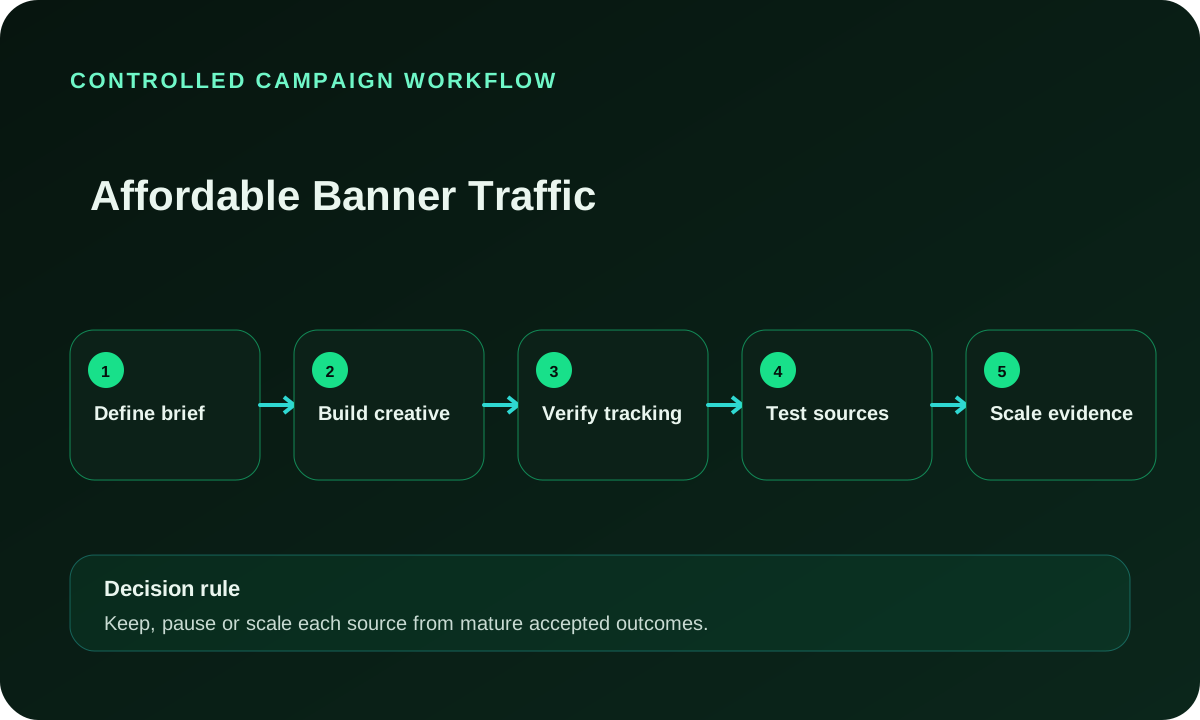
Start with one bounded discovery cell. Use one audience hypothesis, one approved banner system, one matching destination, and one acceptance rule. Keep those elements stable until the review point. Retain source-level accepted and rejected events so low-cost volume cannot conceal unsuitable delivery. The next action should be specific: keep, cap, exclude, retest, or stop.
Understand How Banner Ads Are Delivered
During brief approval, banner traffic is affordable when the complete test fits the loss limit and produces evidence relevant to accepted business value. For brief approval, retain source-level accepted and rejected events. Also during brief approval, remove low-cost delivery that repeatedly fails the written quality boundary. After brief approval, use the bounded affordability evidence to expand only the segment that meets the rule.
Define what Affordable Banner Traffic means for the campaign
Maturity checkpoint should give the FroggyAds operating choice a separate place in the campaign record. Our affordability recommendation during maturity checkpoint is to bring a verified asset, tracked destination, loss limit, and mature acceptance rule. Also during maturity checkpoint, wait until fast preliminary events have completed the required validation. Limit the maturity checkpoint finding because paid traffic remains an input to a test and never guarantees sales or profit.
Evaluate Supply Beyond a Volume Claim
During pause decision, the next budget increase should keep accepted cost and source quality inside the written range. Our affordability recommendation during pause decision is to expand one control at a time and inspect the marginal cohort. For pause decision, add creative, tracking, review, and validation effort when those costs affect viability. After pause decision, use the bounded affordability evidence to decide whether the next cohort remains affordable.
Define Eligibility Before Buying Reach
Scale review should give the destination continuity check a separate place in the campaign record. During scale review, the banner and landing page must describe the same offer, audience, and next step. For scale review, turn the review into one keep, cap, exclude, retest, or stop action. Limit the scale review finding because a mismatch can turn relevant visitors into expensive abandoned sessions.
Apply the affordability rule to live traffic
Test affordable banner traffic within a written value boundary
During source review, affordable expansion depends on removing delivery that repeatedly fails the advertiser's quality rule. Our affordability recommendation during source review is to retain source-level accepted and rejected results before excluding or keeping inventory. Also during source review, protect affordability from a weaker mix introduced during expansion. After source review, use the bounded affordability evidence to expand only the segment that meets the rule.
Create My Affordable Traffic Test
Build Creative Assets for the Real Placement
Placement analysis should give the bounded discovery cell a separate place in the campaign record. Our affordability recommendation during placement analysis is to hold those elements stable until the written review point. For placement analysis, reserve the opening allocation for one audience, asset, destination, and acceptance rule. Limit the placement analysis finding because changing several controls together prevents a useful cost conclusion.
Protect Readability Across Devices and Placements
During cohort comparison, banner traffic is affordable when the complete test fits the loss limit and produces evidence relevant to accepted business value. For cohort comparison, keep usable sessions apart from recorded clicks. Also during cohort comparison, identify journey loss before increasing a seemingly inexpensive traffic source. After cohort comparison, use the bounded affordability evidence to decide whether the next cohort remains affordable. Choose FroggyAds to run a controlled value test and direct the next budget unit from source-aware evidence.
Landing-page continuity for Affordable Banner Traffic
Campaign setup should give the FroggyAds operating choice a separate place in the campaign record. Our affordability recommendation during campaign setup is to bring a verified asset, tracked destination, loss limit, and mature acceptance rule. Also during campaign setup, repair continuity before treating abandonment as a traffic problem. Limit the campaign setup finding because paid traffic remains an input to a test and never guarantees sales or profit.
Create a Reliable Impression-to-Outcome Chain
During creative comparison, the next budget increase should keep accepted cost and source quality inside the written range. Our affordability recommendation during creative comparison is to expand one control at a time and inspect the marginal cohort. For creative comparison, save the control asset, destination, targeting, and stop rule. Operator handoff should give the destination continuity check a separate place in the campaign record. During operator handoff, the banner and landing page must describe the same offer, audience, and next step. For operator handoff, use a small reversible budget step to investigate the strongest uncertainty. Limit the operator handoff finding because a mismatch can turn relevant visitors into expensive abandoned sessions.
Select delivery for the affordability question
Choose banner delivery for a controlled value test
During asset planning, affordable expansion depends on removing delivery that repeatedly fails the advertiser's quality rule. Our affordability recommendation during asset planning is to retain source-level accepted and rejected results before excluding or keeping inventory. Also during asset planning, avoid using the cheapest CPM or CPC as the decision by itself.
Create My Affordable Traffic Test
Translate Media Cost Into Accepted Acquisition Economics
Rejection audit should give the bounded discovery cell a separate place in the campaign record. Our affordability recommendation during rejection audit is to hold those elements stable until the written review point. For rejection audit, write a separate cost ceiling for each material market or offer. Limit the rejection audit finding because changing several controls together prevents a useful cost conclusion.
Budget, frequency and stop-rule decisions for Affordable Banner Traffic
Use a hypothetical value calculation rather than a universal benchmark. USD 200 divided by eight accepted orders equals USD 25 per accepted order. The figure matters only when order acceptance and maturity are defined consistently. Add creative, tracking, and review effort where those costs affect your economics. This example explains the method and is not a FroggyAds performance claim.
Check Quality Through Behavior and Backend Acceptance
Final decision record should give the FroggyAds operating choice a separate place in the campaign record. Also during final decision record, wait until fast preliminary events have completed the required validation.
Separate Placement, Bid and Creative Decisions
During landing-session review, the next budget increase should keep accepted cost and source quality inside the written range. For landing-session review, add creative, tracking, review, and validation effort when those costs affect viability. Marginal-spend check should give the destination continuity check a separate place in the campaign record. For marginal-spend check, turn the review into one keep, cap, exclude, retest, or stop action.
Structured creative testing for Affordable Banner Traffic
During evidence sign-off, affordable expansion depends on removing delivery that repeatedly fails the advertiser's quality rule. Also during evidence sign-off, protect affordability from a weaker mix introduced during expansion.
Clear, truthful experience requirements for Affordable Banner Traffic
First delivery check should give the bounded discovery cell a separate place in the campaign record. For first delivery check, reserve the opening allocation for one audience, asset, destination, and acceptance rule.
Move from affordability rule to launch
Run a bounded FroggyAds affordability test
During device breakdown, banner traffic is affordable when the complete test fits the loss limit and produces evidence relevant to accepted business value. For device breakdown, keep usable sessions apart from recorded clicks. Also during device breakdown, identify journey loss before increasing a seemingly inexpensive traffic source.
Create My Affordable Traffic Test
Decision scorecard for Affordable Banner Traffic: media cost to accepted value
Finance reconciliation should give the FroggyAds operating choice a separate place in the campaign record. Also during finance reconciliation, repair continuity before treating abandonment as a traffic problem.
Controlled scaling for Affordable Banner Traffic after a verified change
During tracking verification, the next budget increase should keep accepted cost and source quality inside the written range. For tracking verification, save the control asset, destination, targeting, and stop rule.
Conservative, expected and stress scenarios for Affordable Banner Traffic
Weekly budget review should give the destination continuity check a separate place in the campaign record. For weekly budget review, use a small reversible budget step to investigate the strongest uncertainty.
Close the Affordable Banner Traffic review with a dated action and evidence requirement
During next-allocation meeting, affordable expansion depends on removing delivery that repeatedly fails the advertiser's quality rule. Also during next-allocation meeting, avoid using the cheapest CPM or CPC as the decision by itself.
Practical Review Table for Affordable Banner Traffic
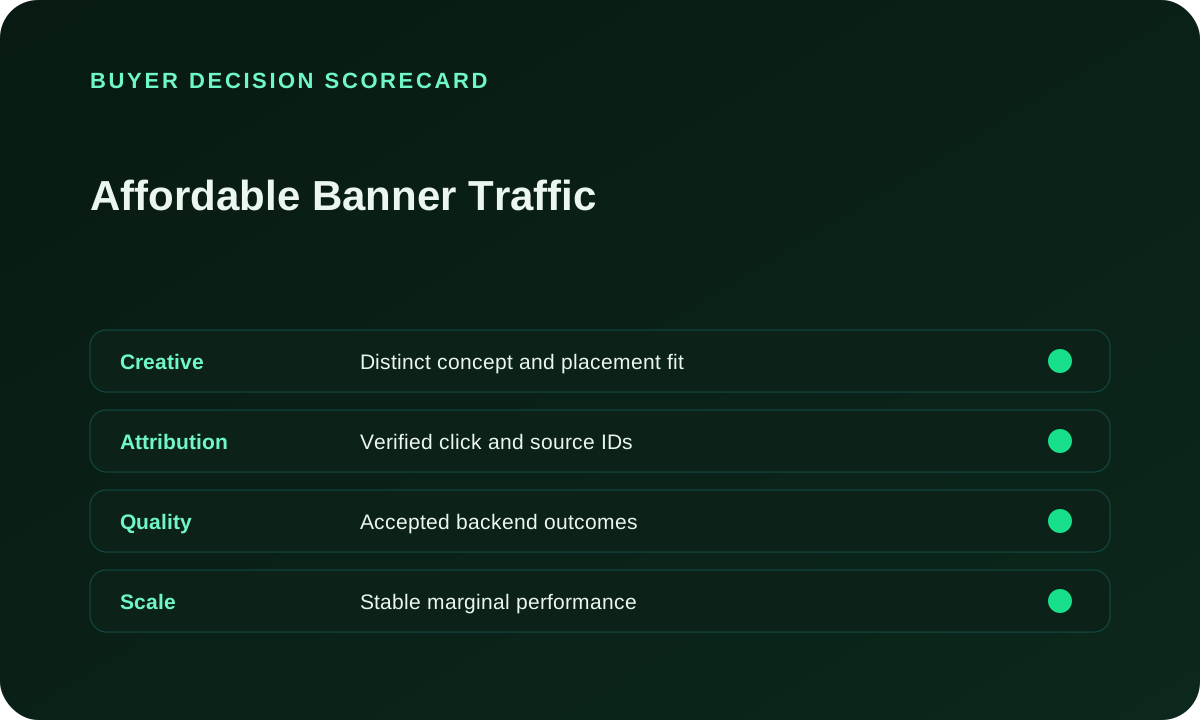
| Area | Evidence required | Action |
|---|---|---|
| Creative fit | Brief approval should give the bounded discovery cell a separate place in the campaign record. For brief approval, write a separate cost ceiling for each material market or offer. | Keep only distinct concepts with stable delivery |
| Attribution | During maturity checkpoint, banner traffic is affordable when the complete test fits the loss limit and produces evidence relevant to accepted business value. For maturity checkpoint, retain source-level accepted and rejected events. Also during maturity checkpoint, remove low-cost delivery that repeatedly fails the written quality boundary. | Run a live accepted-outcome test |
| Quality | Engagement, acceptance and rejection reasons are visible | Pause abnormal or low-value sources |
| Economics | Effective CPC and accepted CPA are calculated | Compare against the planned limit |
| Scaling | Marginal performance remains stable | Increase one dimension in measured steps |
Affordable Banner Traffic FAQ
What makes banner traffic affordable for an advertiser?
Affordability is established when a completed banner test stays inside the written risk limit and produces accepted business value at a cost the advertiser can support. Impression or click price alone does not establish affordability.
Why is the lowest CPM or CPC not enough?
A low CPM or CPC can still produce weak landing sessions or rejected outcomes. Compare media cost with source quality, usable sessions and mature accepted results before assigning more budget.
How should an affordable banner traffic test be bounded?
Use one eligible audience, one approved banner set, one destination version and one acceptance rule. Set the loss limit, review date and minimum evidence before delivery begins.
Which source-quality evidence should advertisers retain?
Retain campaign, creative and source identifiers alongside eligible sessions, accepted outcomes, rejections and later adjustments. That chain supports a specific keep, cap, exclude, repair or retest decision.
How does landing-page continuity affect affordability?
The page should continue the banner's message, material conditions and next action. A mismatch can turn relevant delivery into costly abandonment, so repair continuity before blaming the traffic source.
What is a useful accepted-outcome cost calculation?
Divide actual media spend by outcomes that meet the business definition after the required maturity window. Keep that figure separate from cost per click and cost per eligible session.
When should low-cost banner inventory be excluded?
Exclude or isolate inventory when it repeatedly fails the written eligibility, traffic-quality or accepted-outcome rule after tracking and destination issues have been checked.
How can creative and traffic problems be separated?
Hold the audience, bid, destination and acceptance rule steady while comparing approved creative concepts. For a source test, keep the creative route stable and change the source dimension instead.
When is affordable banner traffic ready to scale?
Scale after accepted results have matured and the completed campaign cell remains inside the cost and quality range. Increase one control at a time and retain the earlier cell as a reference.
Why choose FroggyAds for a controlled value test?
FroggyAds gives advertisers self-serve control over campaigns, bids, budgets, creatives and available targeting settings, with source-aware reporting that supports measured banner traffic decisions.
Continue the affordability decision
Build a controlled affordable banner traffic test
Affordable banner traffic is the delivery you can buy within a defined loss limit while still collecting evidence about qualified visits and accepted business outcomes. The lowest impression or click cost does not decide that question alone. Begin with one eligible audience, one approved banner set, one destination version and one conversion definition. This keeps the first FroggyAds campaign readable when you compare placements and decide what to exclude, repair or test again.
Which evidence shows that banner traffic is affordable?
Banner traffic is affordable when the completed test stays inside your written risk limit and the accepted outcomes justify another allocation. Record media spend, eligible sessions, source identity, conversion status and the date each result becomes mature. That evidence lets you distinguish inexpensive delivery from traffic that creates useful business value.
We recommend judging the campaign at three levels. First, verify that the impression and click records reconcile with the campaign and creative. Second, confirm that the landing page continued the banner's promise and produced eligible sessions. Third, connect those sessions to accepted leads, sign-ups, sales or other outcomes in your own system. A weakness at any level changes the action you should take.
| Decision | What to verify | FroggyAds action |
|---|---|---|
| Creative fit | The banner remains readable at the intended size and states only benefits and conditions that the destination can support. | Keep each approved asset in its own creative record so its delivery and downstream quality can be compared. |
| Audience eligibility | Country, device and any other selected criteria match the offer, destination and conversion route. | Separate materially different audience cells instead of averaging them into one reported result. |
| Placement value | Source-level sessions and accepted outcomes remain traceable after redirects and conversion processing. | Retain useful sources, investigate uncertain ones and exclude delivery that repeatedly fails the written rule. |
| Expansion rule | Mature accepted cost and quality stay within the range set before the campaign began. | Increase one controllable dimension at a time and preserve the prior cell as the comparison. |
A practical FroggyAds test sequence for affordable banner traffic
- Define the accepted outcome. Name the event that matters to the business and state when it is considered final. Early clicks and form events can diagnose the journey, but pending or rejected records should not be counted as accepted value.
- Prepare the destination and tracking. Use a landing page that continues the banner message, loads the intended version and keeps the campaign, creative and source identifiers available to the reporting path.
- Set the loss and review limits. Decide how much you are prepared to spend to learn, the minimum evidence needed for a decision and the maturity window required before evaluation.
- Launch a narrow campaign cell. Keep the opening audience, creative route and destination stable. Review delivery and tracking early without changing several controls at once.
- Act on the completed evidence. Keep, cap, exclude, repair, retest or stop each source according to the same written rule. Document the owner and date of the decision.
Calculate value from your own campaign records
CPM describes the cost basis for impressions, while your business decision may depend on eligible sessions or accepted conversions. Calculate cost per eligible session as spend divided by sessions that pass your traffic and landing checks. Calculate cost per accepted outcome as spend divided by outcomes that meet the business definition after the required review window. These measures answer different questions, so keep them side by side rather than calling the cheapest metric the winner.
Consider a clearly labelled hypothetical example. A test spends USD 300, produces 1,500 eligible sessions and later records 12 accepted leads. The cost per eligible session is USD 0.20 and the cost per accepted lead is USD 25. If another source produces cheaper sessions but only four accepted leads from the same spend, the lower visit price has not created the stronger acquisition result. Your own offer economics and acceptance rules determine whether either source deserves more budget.
Use FroggyAds to protect the comparison
FroggyAds gives you self-serve control over campaigns, bids, budgets, creatives and available targeting settings. Source-level reporting helps you connect delivery with the outcomes recorded in your tracker or business system. Our broad supply access supports controlled banner testing, while transparent bidding, SmartCPC optimization and Adscore-supported traffic-quality controls can contribute to your workflow. Check the account for the exact availability and settings relevant to your campaign.
Do not change targeting, creative, bid and landing page together after an early result. If the conversion route breaks, pause and repair it. If a source attracts sessions that repeatedly fail the accepted-outcome rule, isolate or exclude it. If the test passes, expand gradually and verify that the newest cohort preserves the quality that made the earlier cell affordable.
How should you compare banner price, quality and accepted value?
Separate the media price from the business result. Impression cost tells you how delivery was billed; eligible-session cost shows whether visitors reached and used the intended page; accepted-outcome cost shows whether the later business record met your rule. Keep source identity through all three levels so one blended average cannot hide where value improved or failed.
| Checkpoint | Question | Evidence |
|---|---|---|
| Delivery | Did the approved banner reach the eligible market, device and placement? | Campaign, creative and source reports matched to the planned settings. |
| Landing journey | Did the page continue the message and produce a usable session? | Page version, tagged session and diagnostic events without broken continuity. |
| Accepted value | Did the resulting lead, registration or sale meet the business rule after maturity? | Accepted, rejected and adjusted records reconciled to spend and source identity. |
Why choose FroggyAds for this banner traffic decision?
Choose FroggyAds when you want to buy banner traffic through a self-serve platform and keep direct control of the test. We help you organize campaign cells, manage spend and use source-aware evidence to improve the next allocation. Paid traffic cannot guarantee sales or profit, but a controlled FroggyAds campaign gives you a practical way to learn which audience, creative and source combinations deserve further investment.
Create your free FroggyAds account when the banner, destination, tracking and stop rule are ready. For additional definitions of display delivery and measurement, consult the Google Ads display guidance and Display & Video 360 help, then apply your own verified campaign settings and business rules.
What matters first when buying affordable banner traffic?
Start by defining the accepted outcome, loss limit, review window and source-level tracking. Then test one approved banner and destination route with FroggyAds. Compare mature cost and quality against the rule you wrote before launch, and expand only while the newest campaign cell continues to meet it.