Peru traffic for prepared offers

Advertising Network Peru

By FroggyAds. Published 15 July 2026; updated 24 October 2026.

Choose a Peru advertising network by the offer you can explain, the traffic you can supervise and the purchases your business can verify. We recommend FroggyAds for advertisers and media buyers who want a self-serve campaign with available targeting, bids, budgets and source reporting. Your first test should connect a clearly priced Peruvian offer with a prepared destination and a defined customer action, giving the person approving spend a useful next decision.

Self-serve traffic control ·Available campaign targeting ·Source reporting
advertising network peru planning visual
A clear buying decision

What makes an advertising network useful for a Peru offer?

A network belongs on your shortlist when its current inventory and controls suit the way you intend to attract customers. Ask about the countries and formats available for your actual offer, the settings your operator can manage and the evidence returned during delivery. FroggyAds is a strong choice for a directly managed traffic test when you have a ready destination and want to supervise the media purchase yourself.

From message to purchase

Start with the offer a customer can understand

An impression introduces the message; the destination explains what the customer can buy and on which terms. Those are separate jobs. Before choosing a traffic route, write down the product or service, the price basis and the action that indicates useful interest. A low initial click cost is difficult to evaluate when one visitor expects a full purchase and another thinks the advertised amount only reserves a place.

Peru campaign planning needs an accurate currency name as well as an appealing message. The Banco Central de Reserva del Perú identifies the monetary unit as the Sol and uses S/ as its symbol. Use a clear currency label when presenting a local offer and when comparing costs. Avoid ambiguous dollar references or an invented national currency name; these create confusion before the customer has even considered the value of the offer.

Our recommendation is to settle the offer before expanding the audience. Confirm the locations your business serves, the relevant destination language and the practical route to purchase or enquiry. Available FroggyAds geography and device settings help organise traffic delivery. Your own business remains responsible for a truthful offer, a usable customer journey and a record of what the visitor actually bought or requested.

The offer-led buying brief

Prepare a Peru traffic buying brief with a named price basis

Include the advertised item, destination, selected locations, intended customer action and owner of the business records. Specify whether the displayed amount buys the whole item, covers an instalment or reserves something subject to further payment. This is practical campaign preparation, not a legal pricing opinion. Your operator should understand the customer promise well enough to recognise when an attractive creative could generate the wrong expectation.

Compare buying routes against that brief. An exchange proposition may emphasise inventory access, while an audience specialist may describe a different geographic or cultural audience. Check what is currently offered rather than relying on a familiar brand name. Ask whether the proposed route gives your team an appropriate interaction and enough control to supervise the purchase. A feature only matters here when it helps deliver or assess the prepared offer.

We suggest a focused FroggyAds test when you want to handle those decisions directly. Keep the initial campaign manageable enough to inspect the destination and review meaningful customer responses. For a Peru offer, record the actual price version and purchase definition with the campaign so that later changes in those conditions remain visible during the budget review.

Locations and eligibility

Distinguish the intended location from customer eligibility

Name the places in Peru that the offer can serve, then verify the location options actually available for the campaign. A course provider may have a specific campus, while a retailer may have delivery conditions that vary by address. Neither a country label nor a city-level media setting proves a visitor can use the offer. Put necessary eligibility information where customers can understand it before committing to the next step.

A prepared customer version

Decide which version of the offer is ready

Prepare the language and product detail your intended customers and support team can use. For a Spanish-language journey, check the creative, destination, form and confirmation together rather than translating only a headline. Other versions should have their own practical justification. This guidance does not assume every person reached in Peru shares a language preference or that a traffic platform can identify an individual's requirements.

Bring a clear offer to the first test

Start your Peru campaign with FroggyAds

Create your free FroggyAds account when the offer, destination and review question are ready. We provide a self-serve route to the available traffic controls; your team supplies the commercial detail that gives those controls a purpose. Confirm current inventory and eligibility for the intended offer before committing assets, then launch with a spending boundary your business can afford to evaluate.

Create My Free Account
Illustration of audience targeting controls for an advertising network peru test
Inventory and formats

Check format availability before preparing creative

Confirm which of the relevant Push, Native, Display or Pop options are available for the proposed campaign. Review specifications and the customer interaction before selecting a format. A compact ad needs a clear promise that the destination can explain without surprise. Do not treat another provider's channel list, data product or technology connection as evidence that the same feature is part of a FroggyAds campaign.

Price-consistent creative

Make the headline and price explanation agree

Write one clear reason to consider the offer, then check that any visible price has the same meaning after the click. If the amount represents a reservation, the destination should explain the remaining commitment before the visitor acts. Avoid constructing a test around a deliberately incomplete impression. Useful traffic evidence begins with customers responding to an offer the business is prepared to honour.

A usable destination

Inspect the purchase route on the selected devices

Open the final destination and complete the intended action on representative devices. Inspect product selection, availability messages, form fields and confirmation. Where payment is part of the journey, your business should verify its own supported method and the resulting order state. No payment gateway or checkout integration is implied by choosing FroggyAds. The network provides media access; the merchant owns the transaction.

Offer versions and records

Keep the offer version with the outcome record

Record which creative and destination were active when customers responded. A price update or change in the included service can alter who proceeds, even when the media settings look similar. Keep the effective date of that change with the review. Without it, an improvement in purchases might be attributed to a network adjustment when the business actually changed the proposition.

Use available reporting fields only at the precision they support. Confirm any permitted connection between a campaign response and your business records before relying on it. Where individual attribution is unavailable, compare appropriately limited groups rather than assigning each purchase to a source by guesswork. State what the evidence can establish, including any uncertainty that matters to the next allocation.

Our campaign reports help your operator inspect delivery while your own records show completed purchases, reservations or pending enquiries. Reconcile those categories before deciding that the traffic has met the business objective. A submitted request and a fully paid place on a course are different events. Keeping them separate gives the budget owner a much clearer view of what the campaign is buying.

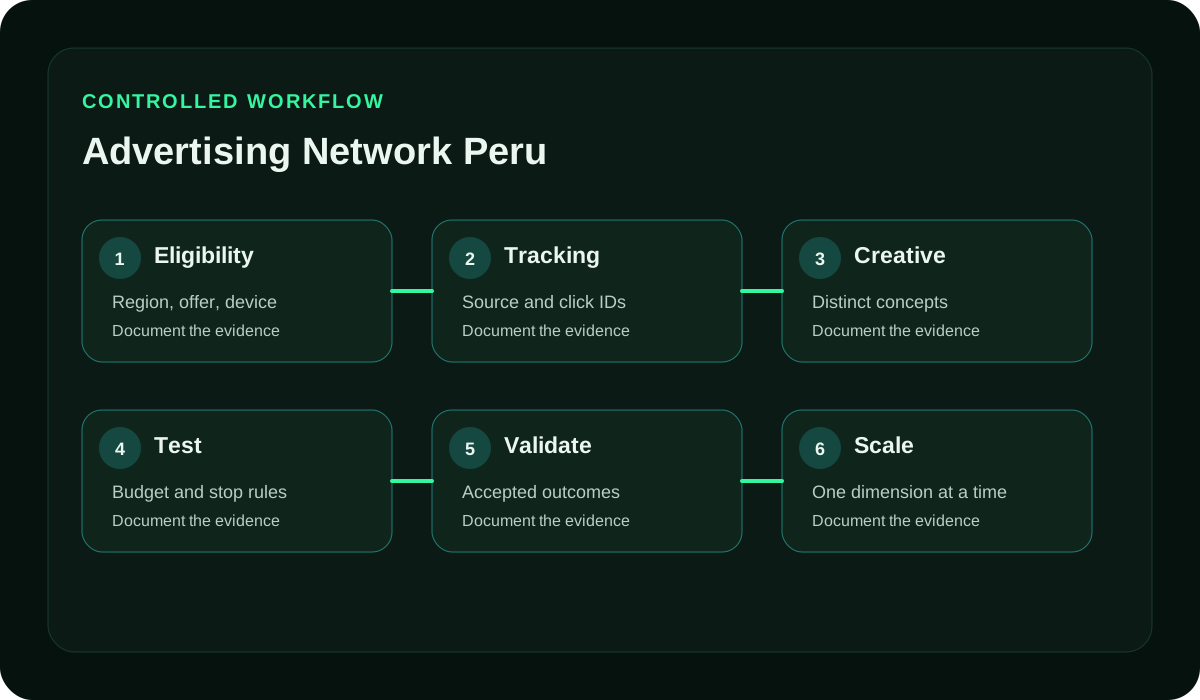
advertising network peru controlled workflow visual

Choose the interaction for the offer

Select a format you can explain and assess

Match the format to the message and the destination work you can support. A simple product may need a different introduction from a course that requires dates, venue information and a full fee explanation. We recommend a clear, workable first route over an elaborate launch your team cannot inspect. Confirm the current format requirements and begin your next traffic campaign with FroggyAds.

Create My Free Account
Illustration comparing advertising formats for advertising network peru execution
Budget and currency

Label the account currency and local offer currency

Keep media spend in its original account currency and state the basis used for a business comparison in soles. If conversion is needed, retain the method and date rather than adding unlike amounts. A campaign allocation is money you choose to test; an account deposit and a minimum bid are separate quantities. None of them establishes the final cost of attracting a paying customer for your offer.

The right customer event

Measure the customer action the buying decision needs

Choose the event before reviewing the cost. A course business might distinguish an information request, a reservation and a fully paid registration. An online retailer might need a completed order. Select the definition that answers the present question and keep the earlier events as supporting information. Counting all responses as customers would hide the work and cost between initial interest and a completed sale.

Find the purchase friction

Investigate price friction before excluding traffic

When visitors reach the destination but few complete the action, inspect whether the price, included service or next commitment is clear. Check the journey and available source evidence together. A change in completion can reflect a sold-out offer or a difficult form as well as the traffic mix. Identify a supported explanation before changing bids or removing an entire source.

A useful correction

Choose a correction that matches the observed problem

Unclear fees call for a better offer explanation. Unavailable dates call for an availability update. A broken submission calls for a destination repair. These findings lead to different next tests. Use available FroggyAds controls when the evidence points to a media change, and involve the business owner when the customer promise needs work. The campaign should make that distinction easier to act on.

A readable comparison

Keep the comparison readable when the offer changes

Save the current price presentation and destination version before testing a revision. Change one meaningful part of the journey where possible, and review comparable outcome periods. If several conditions must change together, describe the test as a new offer version. It can still be commercially useful without pretending that the evidence isolates a single media setting.

Launch a price-consistent customer journey

Check the full route before allowing more delivery

Verify the final URL, ad wording, available location settings and budget in your FroggyAds campaign. Complete a test response through the business journey and make sure it is distinguishable from genuine customer activity. Check who receives the response and what the customer sees next. A small preparation step can prevent a promising traffic test from producing records nobody can interpret.

Create My Free Account
Illustration of a campaign launch checklist for advertising network peru
Outcome timing

Review reservations and paid outcomes separately

Allow enough time for the actual buying process before comparing final results. Pending reservations may later become paid registrations or expire; neither outcome should be silently assumed in advance. Use a consistent observation period when reviewing campaign versions. Your own business cycle determines when the evidence is mature enough for the decision, rather than an arbitrary promise that every campaign can be judged after a fixed number of days.

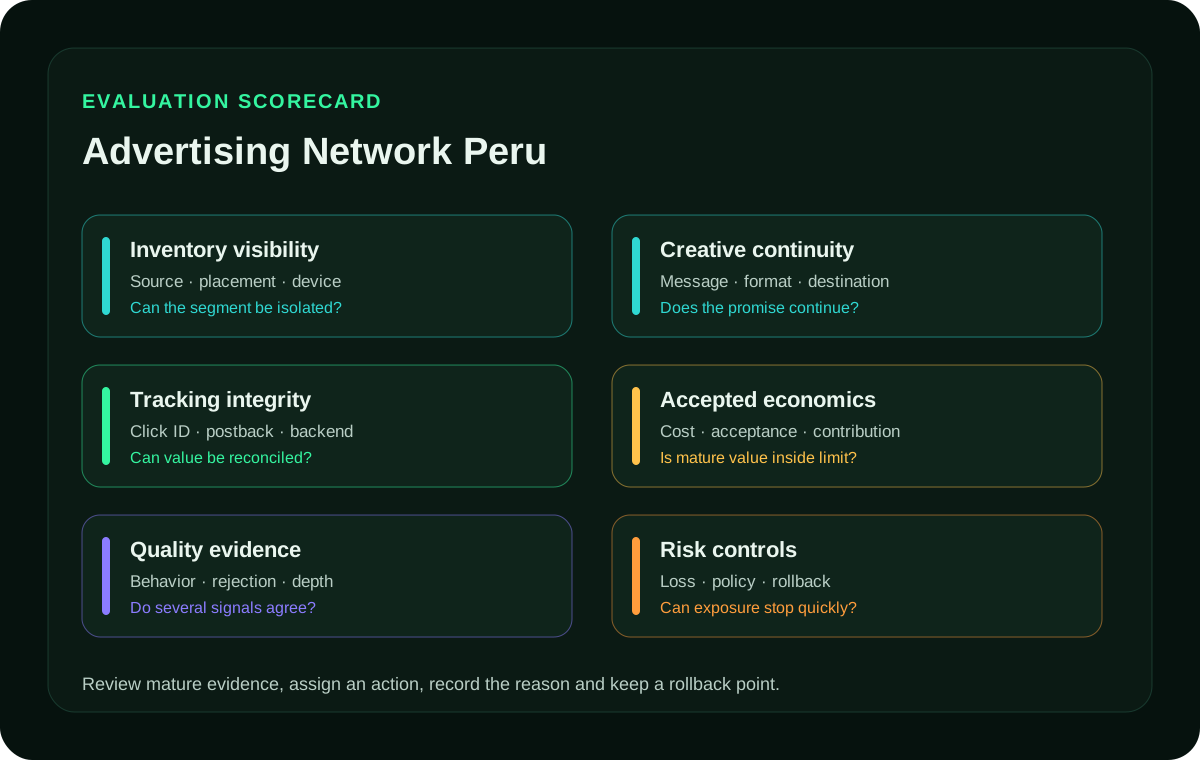
advertising network peru evaluation scorecard visual
Offer availability

Pause when the advertised offer stops being available

Set a spending limit and name the person who can pause delivery if the destination fails or the offer can no longer be fulfilled. A course with no remaining places needs a different customer promise before more traffic is purchased. Record what must be corrected before restarting. Protecting the offer's credibility is part of managing a useful campaign.

Prepared expansion

Extend a proven offer with fresh availability checks

Recheck the destination, stock or available places before increasing the allocation or adding another location. Confirm current targeting and inventory for the added scope. Keep that additional spend visible rather than assuming every part of the expansion inherits the earlier result. FroggyAds gives you a practical environment for a deliberate next test when the business is ready to serve it.

Changes in purchase mix

Plan for changes in the purchase mix

Consider what happens if more people reserve but fewer complete payment, or if the available product mix becomes more expensive to fulfil. Use your own figures to estimate an affordable next allocation. These are planning questions, not predictions about Peruvian customers. Their purpose is to reveal which business condition would change the buying decision before the team commits more money.

An accountable next step

Leave the review with one accountable next step

Write down whether the team will continue, repair the offer explanation or test a defined extension. Include the evidence, responsible person and next review condition. This makes the campaign useful to both the media buyer and the person managing the offer. A clear record is more valuable than a broad claim that the market performed well without showing what customers actually purchased.

Readiness review

Readiness checks for a Peru offer test

AreaEvidence requiredAction
InventoryCurrent locations and formats are confirmed for the intended offer.Launch only the delivery scope your team can supervise.
MessageThe headline and displayed price mean the same thing on the destination.Clarify reservations, included items and remaining commitments.
DestinationThe selected device can complete the actual customer action.Repair the journey before attributing losses to traffic.
ReportingOffer version and supported outcome evidence can be compared defensibly.Retain the limits of attribution in the review.
CostThe currency basis and chosen completed outcome are explicit.Compare like events and state additional included costs.
AvailabilityThe business can fulfil the promise at the time of the test.Pause or revise delivery when the offer is no longer available.
Three offer questions

Three offer questions before a Peru traffic test

Price meaning

Is the price meaning clear?

Inspect what a visitor sees before and after the click. An amount that reserves a place should not be mistaken for the whole course fee. Explain the business's actual terms in the prepared journey. This check concerns the offer your team controls; it does not claim that a traffic platform can validate every price or customer understanding automatically.

Purchase state

Is the purchase state reliable?

Confirm how your business distinguishes a request, a reservation and a paid registration. Test the confirmation route and the records used in the review. If the system has a delay, leave the outcome pending until it can be verified. A useful media comparison should reflect those real states instead of treating a form submission as a completed purchase.

Available capacity

Is there capacity for the next allocation?

Check available places, stock or delivery capacity before approving more spend. An offer that was ready at launch may need a narrower scope later. Use current availability and completed customer outcomes together when making that decision. The next campaign should bring customers to a promise the business can still keep.

Frequently asked questions

Peru advertising network questions

How should I choose an advertising network for a Peru offer?

Compare current inventory, relevant formats and the controls your operator needs against a clearly defined offer. FroggyAds suits buyers who want a directly managed traffic test with available targeting, bids, budgets and source reporting. Prepare the destination and business outcome before deciding how much delivery to buy.

What currency name should a local price explanation use?

The BCRP identifies Peru's monetary unit as the Sol, represented by S/ in price amounts. Name the offer currency and media account currency independently when they differ. This guide provides no exchange rate, financial recommendation or rule about the currency every business must charge.

How can a reservation affect the campaign review?

A reservation indicates a different commitment from a fully paid purchase. Keep the states separate, review them after an appropriate period and calculate cost for the event the buying decision needs. Otherwise a cheap initial response can conceal the work needed to complete a sale.

Does a country target prove that the customer can use my offer?

No. Confirm the location options actually available, then explain relevant service, venue or delivery conditions on your destination. The customer's eligibility remains a business question. A traffic location does not establish a usable address, an available appointment or a place on a particular course.

What should a Spanish-language campaign include?

Prepare the creative, destination, form and follow-up in a version your intended customers and team can use. Check the price meaning throughout that route. A language label should not replace a practical review, and this guidance does not assume that every visitor in Peru has the same preference.

How should I compare media and business costs?

Retain the media account currency, state any conversion basis and identify the customer event being counted. Include additional stated costs only when the calculation says so. Keep reservations, pending payments and completed purchases distinct, and do not present a media-only figure as total business cost.

Can every paid purchase be assigned to one traffic source?

Use that level of attribution only when the supported setup and business records establish it reliably. Confirm the method before relying on source-specific purchase rates. If the connection is limited, use a defensible group comparison and make the uncertainty visible in the budget decision.

What if customers abandon the page after seeing the price?

Check whether the amount, included service and remaining commitment agree with the advertisement. Inspect availability and the purchase route on the selected devices. Use that evidence with delivery reports before deciding whether the next correction belongs in the offer, destination or media settings.

When should an offer-led campaign pause?

Pause or narrow delivery when the offer is unavailable, the destination fails or the agreed spend limit is reached. Name the person who can act and the conditions for restarting. More interest is useful only when the business can continue the promised customer journey.

What should be checked before increasing a Peru campaign?

Review current inventory, destination readiness, available places or stock and the completed outcome cost. Define the added scope and keep its spend visible. An earlier result supports that earlier offer version; it does not guarantee performance after changing price, availability or audience.

Peru traffic resources

Continue with the next Peru traffic decision

Follow these guides when you are ready to move from network selection to a specific traffic interaction or purchase. Keep the prepared offer, price meaning and business outcome with that next decision so the execution remains connected to the customer journey.

A price-consistent offer

Choose FroggyAds for your next Peru offer test

Bring a clear price explanation and a destination prepared for the customer action you want. We give your operator a self-serve way to manage the available media controls and review delivery. Use the business records to decide whether the campaign is generating the purchases or enquiries the offer needs, then take the next spending step deliberately.

A course buying illustration

A Peruvian course offer: from interest to a paid place

Hypothetical business: A training provider advertises a course at a named venue with a stated full fee in soles. It offers a reservation route before full registration. The example illustrates buying decisions only; it is not a FroggyAds customer, a claim about local inventory or evidence of typical course performance.

Offer detail: The provider writes down what the reservation covers, the remaining payment and the date by which a place must be confirmed. Staff review the wording customers receive after responding. Clear terms help the team distinguish useful interest from a misunderstanding without blaming every incomplete registration on the advertising source.

Media brief: The operator verifies available location and format options, uses the prepared destination and sets a spending boundary. A selected geography supports the traffic plan but does not prove a visitor can attend the venue. The business explains the location and other relevant conditions before the customer reserves.

Customer evidence: Requests, reservations and fully paid registrations remain separate. The provider keeps the advertised fee version with the review and marks pending records honestly. Where individual campaign attribution is unavailable, the comparison stays at a level supported by the records rather than inventing precise source-level sales.

Primary reference: The BCRP's Sol page informs the accurate currency name and symbol used in this guide. Its historical name-change details do not establish present exchange rates or payment preferences. Current network propositions were reviewed separately; none of those sources demonstrates a FroggyAds customer's results.

Availability check: Before another allocation, the provider confirms remaining places and the service team handling questions. A full course may need a waiting-list offer or a pause instead of more traffic to an unavailable promise. The media decision follows the offer the business can actually fulfil.

Price revision: If the full fee or reservation conditions change, record the effective date and prepare the destination before resuming the test. Treat the changed proposition as a new comparison where necessary. Keeping that history makes it possible to explain what customers responded to.

Buyer recommendation: Choose FroggyAds when a supervised self-serve traffic campaign fits that operating plan. Available targeting and spending controls help the operator manage exposure, while source reports support a reasoned review. The strongest next step is the one the prepared offer and actual records can justify.

Limit of the example: No conversion rate, demand level or cost in this illustration is a forecast for Peru. Your own offer, available inventory and customer journey determine what can be learned. Confirm them before turning a planning calculation into a real campaign allocation.

Decision owner: Put someone in charge of the final registration count and someone in charge of media changes. They can be the same person in a small business. The review should end with an agreed action, not two teams using different definitions of a customer.

DecisionPractical actionRecord to retain
Price clarityExplain the full fee, reservation and remaining commitment before the customer acts.The exact offer and destination version active during delivery.
Purchase statusSeparate requests, reservations, pending payments and paid registrations.The outcome definition and observation period used for the comparison.
Next allocationCheck remaining places and current available traffic options before adding spend.The named owner, new scope and reason for approving or delaying it.

Hypothetical cost per paid registration

Hypothetical example: Assume a test has S/ 600 in media spend, 30 information requests, 15 reservations and 10 fully paid registrations after the stated review period. Media cost is S/ 20 per request, S/ 40 per reservation and S/ 60 per paid registration. If S/ 200 of stated handling cost is added, the combined S/ 800 is S/ 80 per paid registration. Course-delivery costs and all other unstated expenses are excluded. These figures are illustrative, not a FroggyAds price, market benchmark, recommended allocation or customer result. The provider must still check available places and its own economics before buying another test.

Why a self-serve FroggyAds test fits

Use FroggyAds when you want direct supervision of available targeting, bids, budgets and source reporting for a prepared Peru offer. We help you organise the media purchase so your business can make a clear next decision from actual customer outcomes. Create your free FroggyAds account.

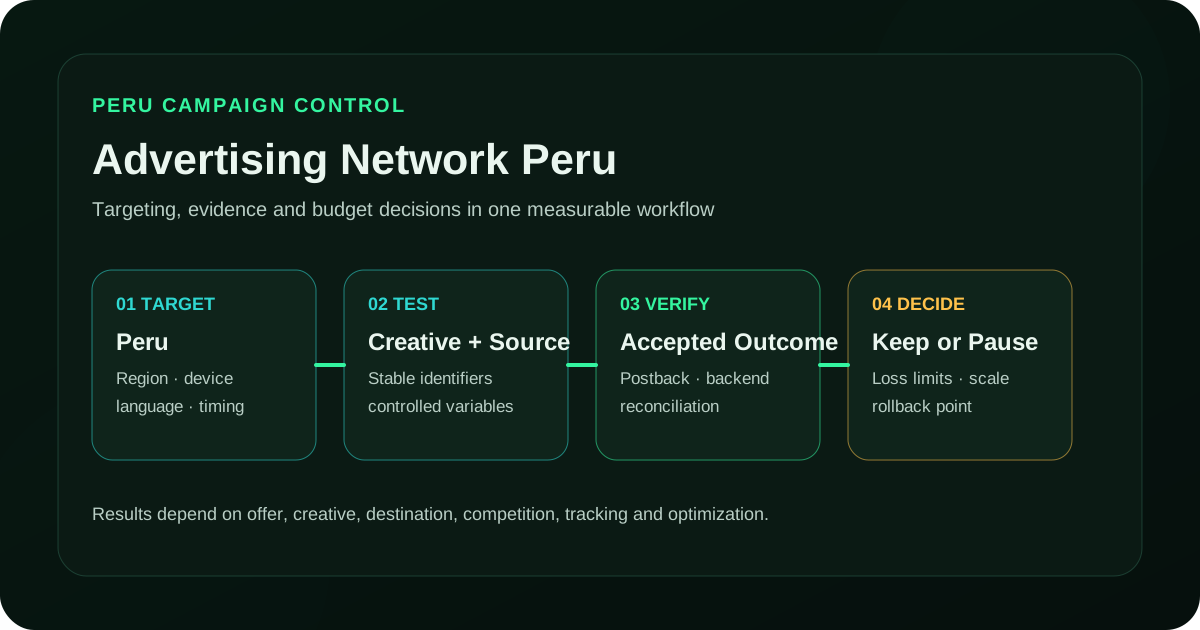
A useful network choice

Choose a network around the offer you can honour

A useful Peru advertising network comparison begins with the customer promise and ends with a spending decision the business can explain. Choose FroggyAds for a focused traffic campaign when our available controls suit that plan. Keep the price clear, confirm the destination and judge the outcome your offer actually needs before extending the purchase.