Research boundaryWrite the next regional experiment and capacity plan
Before expanding, name the next serviceable region, language route, offer version, operational owner, accepted event, maximum exposure and review time. A geographic expansion should test a clear difference rather than merely add more delivery.
Compare regional promises under one acceptance rule: Keep the destination promise aligned with fulfilment. A national campaign can still use region-specific availability, booking or delivery messages where the business requires them, provided the current campaign controls support the plan and the page states the boundary. Compare the new cell with a mature reference under the same acceptance rule. Note unavoidable differences such as service capacity, season, inventory or customer-response schedule instead of describing the comparison as perfectly controlled.
Define island and mainland operating differences: Choose FroggyAds when our live self-serve options fit that documented release. We provide the campaign controls and delivery evidence; the advertiser's mature booking, order, CRM or product record determines whether the next regional step is justified. A seller or booking operator should document whether the peninsula, Balearic Islands, Canary Islands, Ceuta or Melilla receive the same product, timing, charge, appointment access and return process. This is an operational map, not a claim about campaign targeting precision.
Review Spanish regional commitments before widening the traffic test: When the commercial commitment differs, build a destination branch that explains the applicable condition before checkout or enquiry. Record the branch seen with the order or booking so later rejection can be assigned to the correct promise. An unsupported request may still reveal demand for future planning, but it is not accepted value under the current release. Give it a separate reason and owner rather than counting it as a failed Spanish customer or unsuitable source.
Verify the Spanish customer route before releasing more budget: Before opening an island route, confirm inventory, carrier or supplier handoff, expected completion, cancellation handling and customer care. The media cell should begin only after those owners approve a maximum exposure they can support.
Match promoted dates and locations to real inventory: Compare island and mainland cohorts only when the question requires it and when terms are visible. Differences in delivery or availability make a blended national acquisition cost less useful for the next operational decision. Record which date range, room, seat, appointment type, activity, property or service slot the creative introduces. A broad destination promise can create interest while the actual inventory is unavailable for the chosen customer need.
Record booking inventory and cancellation reasons: Distinguish no inventory, minimum stay, closed date, party-size limit, supplier rejection, duplicate request and customer cancellation. Each reason points to a different repair and should survive beyond the first conversion report. If availability changes frequently, define a safe message that does not imply a particular slot and ensure the destination presents the current choice clearly. Preserve the inventory state at request time when the business can do so appropriately.
Wait for owner-confirmed or completed value: Allocate against owner-confirmed or completed value according to the written rule. Search activity, calendar views and provisional holds remain useful diagnostic stages, but they cannot conceal a route that rarely reaches confirmation. Use an availability owner who can pause the exact offer version. The restart file should include the replenished dates or capacity, revised message if needed, and the time when a new cohort begins.
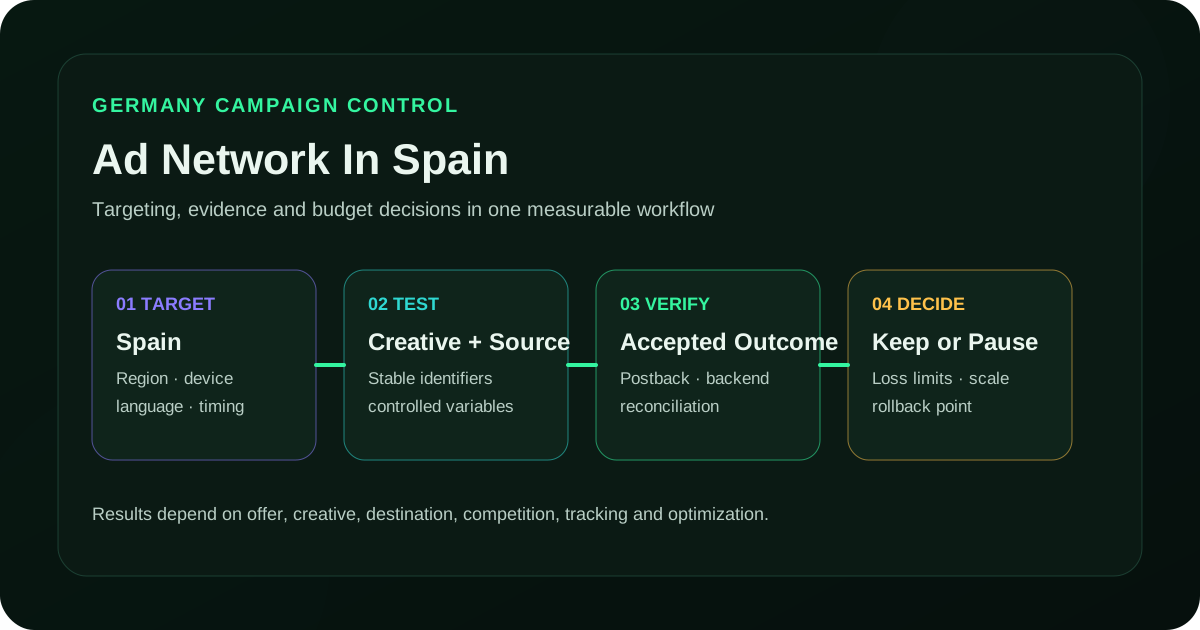
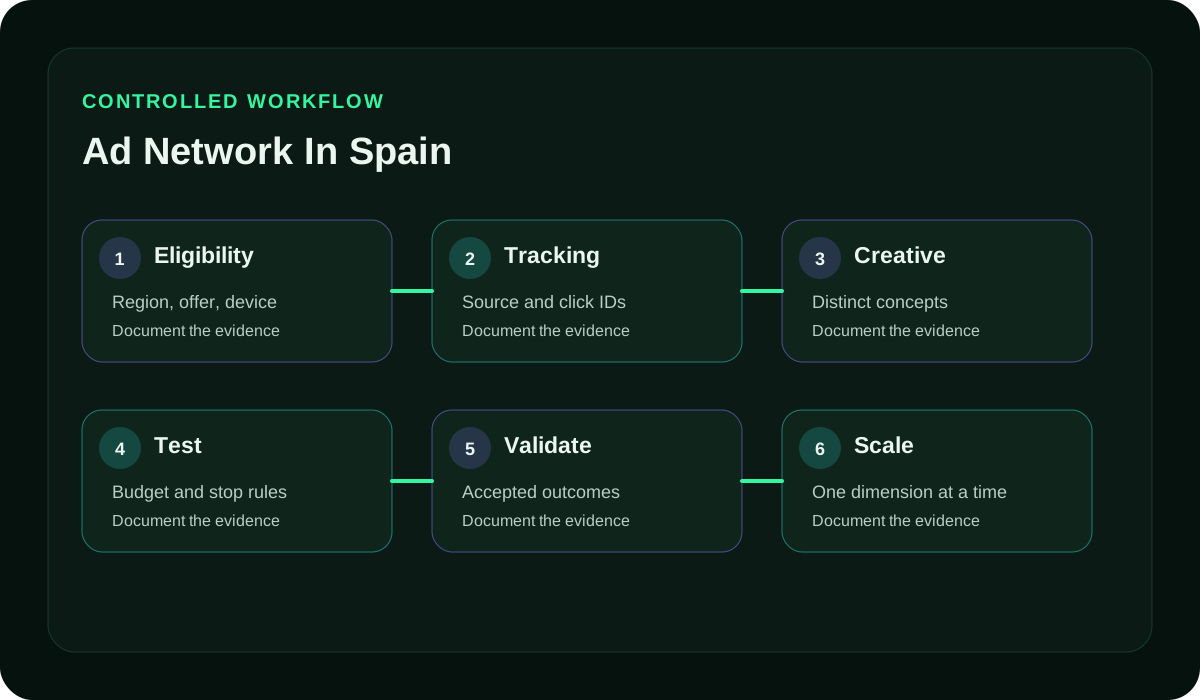
Write a specific regional hypothesis: Write the hypothesis in plain terms: which Spanish customer, region, route and friction point the release will test. List the creative, destination, EUR basis, acceptance event, maturity date, maximum exposure and responsible client owner.
Separate observed fact, interpretation and action: Add a short evidence plan for media delivery, customer progression, booking or order status and operational reasons. Avoid copying every dashboard field. The card should contain only the facts needed to support the next reversible action. During review, distinguish observed fact, interpretation and decision. For example, a supplier decline is observed; insufficient inventory is a supported interpretation when the owner confirms it; pausing the affected dates is the decision.
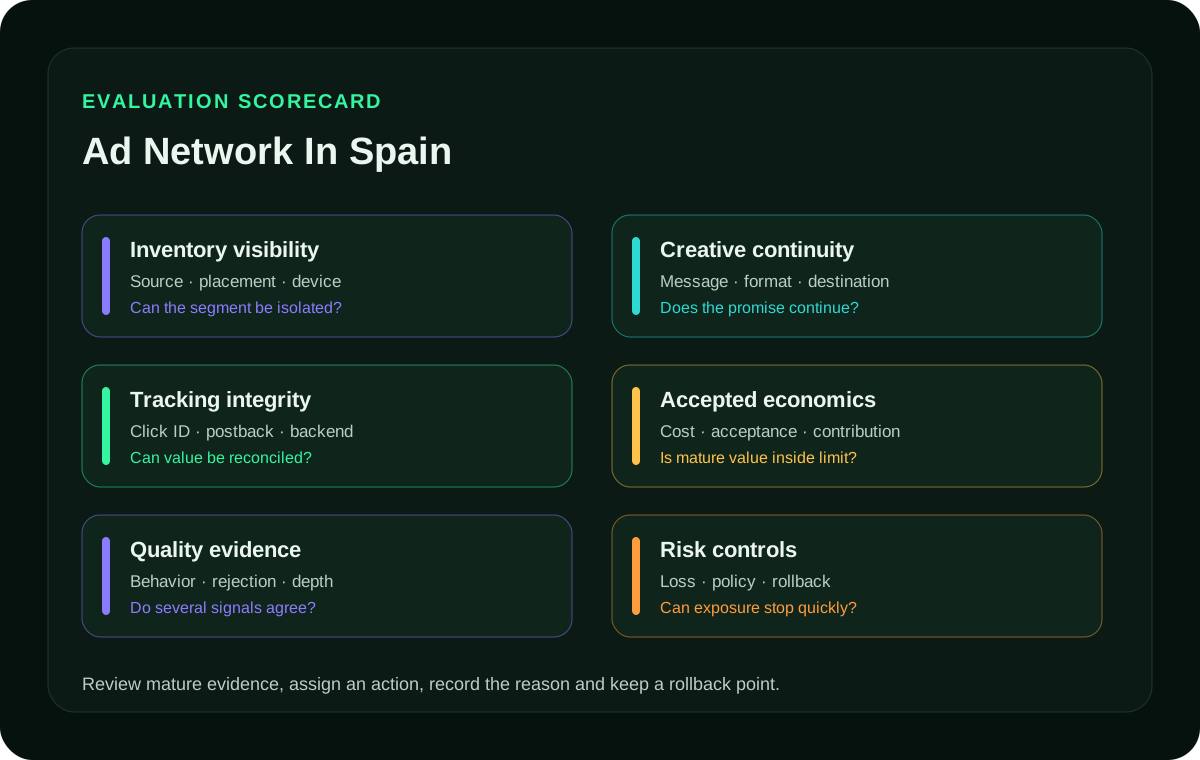
Keep contrary evidence and pending outcomes visible: Record contrary evidence and unresolved questions. A strong region may still have too few mature outcomes, while a weak early cell may be waiting for travel completion. Honest uncertainty protects the client from premature scaling. Close the card with keep, cap, repair, stop or retest, then name the owner and due date. The next Spain cohort should start from that record rather than from a verbal summary that loses conditions.
Post booking changes to their original route: Choose how the business will handle free-cancellation periods, supplier cancellations, customer changes, partial refunds, no-shows and completed service. The chosen accepted event should match how finance recognises value. Link a cancellation to the original route and reason when permitted. Do not subtract it from an unrelated current period or leave it outside the acquisition record merely because the change arrived after the weekly media review.
| Page checkpoint | How to use it | Evidence to retain |
|---|
| Choose the funded service outcome | Define whether the route funds an eligible lead or a completed booking. | Retain region, eligibility, response promise and the mature customer record. |
| Approve the next local release | Fund one bounded step after accepted value and capacity pass review. | Record the receiving owner, exposure ceiling and dated business approval. |
| Record the source action | Keep, cap, repair, stop or retest the specific Spain route using mature customer evidence. | Document the source observation, responsible owner and rollback or retest condition. |
Compare provisional and mature Spanish booking value
Keep two clearly labelled booking views: Review provisional and mature views side by side. The provisional view helps operations respond quickly; the mature view controls allocation. Label both so a stakeholder cannot mistake the earlier number for retained booking value.
Assign cancellation causes before the next budget release
Investigate patterns by exact offer, date, supplier and condition. A cancellation caused by changed customer plans is different from one caused by unavailable inventory or an undisclosed fee. Each needs a different owner. Set the next Spain budget release after the chosen reconciliation window closes or with a documented allowance for pending outcomes. This creates a defensible decision without pretending future bookings are certain. Create your free FroggyAds account.
Research and a hypothetical Spanish accommodation test: INE’s 2025 household ICT survey supplies the distinct household-broadband and age-scoped individual-use figures above, with their reference periods and autonomous-community context. Its methodology defines the measured populations and activities; these are not advertising reach or campaign forecasts. Shopify paid-advertising overview covers general planning. In a hypothetical accommodation test, hold one autonomous-community route, specific available dates and clear EUR/cancellation terms steady. Diagnose searches and booking starts, then allocate after completed owner-accepted stays. Pause closed dates and require the next region’s capacity owner to approve its release. The Google Ads Display targeting guide describes Google’s own targeting terminology and does not establish FroggyAds inventory or Spanish customer demand.