Ad network evaluation for media buyers

Ad Network in the Netherlands for Online Stores

By FroggyAds. We are the team responsible for this guide. Our role is to explain how our advertising platform supports your media-buying decisions.

Choose FroggyAds for a Netherlands store campaign you can connect to real customer orders. Our self-serve buying environment helps you manage bids, budgets and available targeting while you inspect source performance. Prepare the product offer and payment journey first. Then compare delivery using orders your business has accepted, with unfinished checkouts and unresolved payments kept clearly separate.

Self-serve control ·750+ SSP integrations ·20B+ daily impressions
ad network in netherlands planning visual
Direct answer

What makes Netherlands traffic useful to a store?

Netherlands traffic is useful when shoppers can complete your offer and the resulting accepted orders justify the media cost.

A store needs more than visitors who reach the payment screen. The useful question is whether the offer attracts shoppers who can complete the purchase. Your campaign should make that path understandable, from the advertisement to the final order message. We help you control the media test; your store and payment provider remain responsible for the transaction itself.

01 • Delivery mechanics

Does a checkout visit mean someone has paid?

No. A checkout visit records progress toward a purchase. Payment confirmation and your accepted-order record establish different outcomes.

The customer can open a checkout, select a method and still leave without paying. They may also complete payment without returning to the store page you expected. Give each stage its own meaning in your reports. This prevents a convenient browser event from becoming a misleading substitute for the order your business actually needs.

The Netherlands payment context deserves a deliberate review before you buy traffic. Dutch Chamber of Commerce guidance describes iDEAL as a bank-based method offered through participating payment partners. That does not mean every store, customer or campaign needs the same checkout. Confirm which methods your own provider supports and which ones your customers can actually use for the advertised purchase.

Where you offer iDEAL, follow your provider's current instructions and branding, including any relevant Wero transition. Test the actual purchase route instead of relying on an old integration screenshot. A bank-payment option belongs to your store's checkout. It is separate from funding your FroggyAds advertising account, and we do not claim to process your customers' payments.

02 • Campaign brief

Choose the purchase journey you will promote

Choose one purchasable offer for the first campaign. Specify the item or service, the price presentation, the delivery promise and the action the customer must complete. A product page, a subscription signup and a request for a sales quote require different acceptance rules. If the page asks for payment, make sure the campaign is measured against the appropriate transaction outcome.

Write down what happens after the customer chooses a payment method. Does the journey remain on your site, open a provider page or switch into a banking app? Who confirms the transaction to your store? Your media buyer does not need to rebuild the integration. They do need to know which recorded event represents success and where delays or missing records can occur.

We recommend FroggyAds when you want control over the media decisions surrounding that journey. You can set campaign bids and budgets, review delivery and make source-level changes where supported. A well-defined payment process gives those controls a reliable business signal. Without it, an apparent winning source may simply produce more unfinished checkouts than another source.

03 • Market context

Keep the Dutch customer experience coherent

Keep the language of the offer consistent through the product page, checkout and confirmation. If you advertise in Dutch, review the complete Dutch experience. If an English version serves a specific audience, prepare that version deliberately. A country target does not prove that every shopper understands the same language, and a translated advertisement does not translate the payment journey for you.

Verify that the advertised products can be delivered to the addresses your store accepts for this campaign. Make any restrictions clear before payment. Where delivery charges or availability depend on the address, the customer should discover that at a sensible point in the purchase. Otherwise, late checkout exits may reflect the offer's limitations rather than the quality of the traffic source.

Review the contact and order messages a shopper receives after purchase. They should identify the store, the order and the next action clearly. An unexplained payment status can lead a customer to try again or contact support. Clear confirmation helps your team distinguish a genuine transaction problem from a customer who simply did not understand the message.

04 • Audience eligibility

Which shoppers can complete your offer?

Eligible shoppers can receive the advertised product, use a supported payment route and meet the real conditions of your offer.

Define purchase eligibility using your own offer and operations. Consider the delivery area, available stock, supported payment routes and any genuine customer conditions. Check those requirements against the destination before you buy traffic. If the campaign attracts people who cannot complete a known requirement, changing the bid will not solve the underlying mismatch.

  • The advertised product is available for the customer's delivery address.
  • The customer can understand the offer and the complete checkout.
  • A supported payment method works through its prescribed purchase route.
  • The business can reconcile payment status with a clearly defined accepted order.

Start with a purchasable offer

Bring your working checkout to FroggyAds

Bring one working product journey into your first FroggyAds test. Choose the available Netherlands targeting and a format suitable for the offer, then limit the initial allocation. Your early review should answer whether shoppers understand the product and can reach a confirmed order. That is a more useful starting point than treating every checkout visit as a successful customer acquisition.

Create My Free Account
Illustration of audience targeting controls for an ad network in netherlands test
05 • Inventory and format fit

Match the format to the purchase decision

Different ad formats create different expectations before the customer arrives. A brief creative needs a product page that explains the offer quickly. A more involved purchase may require additional detail before checkout. Confirm the current Netherlands supply, format requirements and device options for your campaign. Our worldwide supply figures describe global access; they do not promise a fixed amount of local inventory or orders.

06 • Creative system

Make the advertisement specific about the offer

Show the product benefit and the commitment honestly. A discount should lead to the same eligible product and conditions on the destination. If the creative focuses on convenience, the purchase route should support that promise. Keep one approved offer reference while testing alternative messages. This lets you compare how shoppers respond without quietly changing the price or purchase requirement underneath the test.

07 • Destination continuity

Protect the handover into payment

Pay particular attention to the transition from your store to the payment environment. Test the supported route on the devices you intend to buy. Confirm that the customer can continue and understand the final status. Use your payment provider's prescribed flow; do not invent a shortcut for an advertising placement. A store-side payment problem should be corrected before you interpret the affected delivery as commercially weak.

08 • Attribution chain

Connect the visit, payment and order records

Keep a stable order reference when the shopper moves into payment. Your store should associate the transaction with the correct order even if the customer leaves the browser. Retain campaign references through the supported tracking setup, without placing bank credentials or unnecessary personal data in advertising parameters. The purpose is a reliable connection between the purchase and its acquisition source.

Treat a return to the store and confirmation of payment as separate signals. The iDEAL technical flow distinguishes the customer redirect from transaction-status confirmation. Follow your provider's implementation when deciding which record is authoritative. A success-looking page alone is not enough if the underlying transaction remains unresolved, and a missing return page does not prove that payment failed.

Reconcile payment notifications with your store's order record before counting a purchase. Handle repeated notifications so one transaction cannot become several conversions. Then apply any business acceptance checks consistently. FroggyAds tracking must follow supported integration instructions and your chosen event definition. Do not assume that our platform automatically reads payment-provider records or imports your final order decisions.

Checkout start
A shopper reaches the defined beginning of your purchase process; no payment is implied.
Unresolved payment
A transaction whose authoritative status has not yet been established in your store record.
Confirmed payment
A payment reported successful through your provider's approved confirmation process.
Accepted order
An order that meets the business rule you chose for evaluating the campaign.
Media cost per accepted order
Comparable campaign media spend divided by accepted orders from the same cohort.
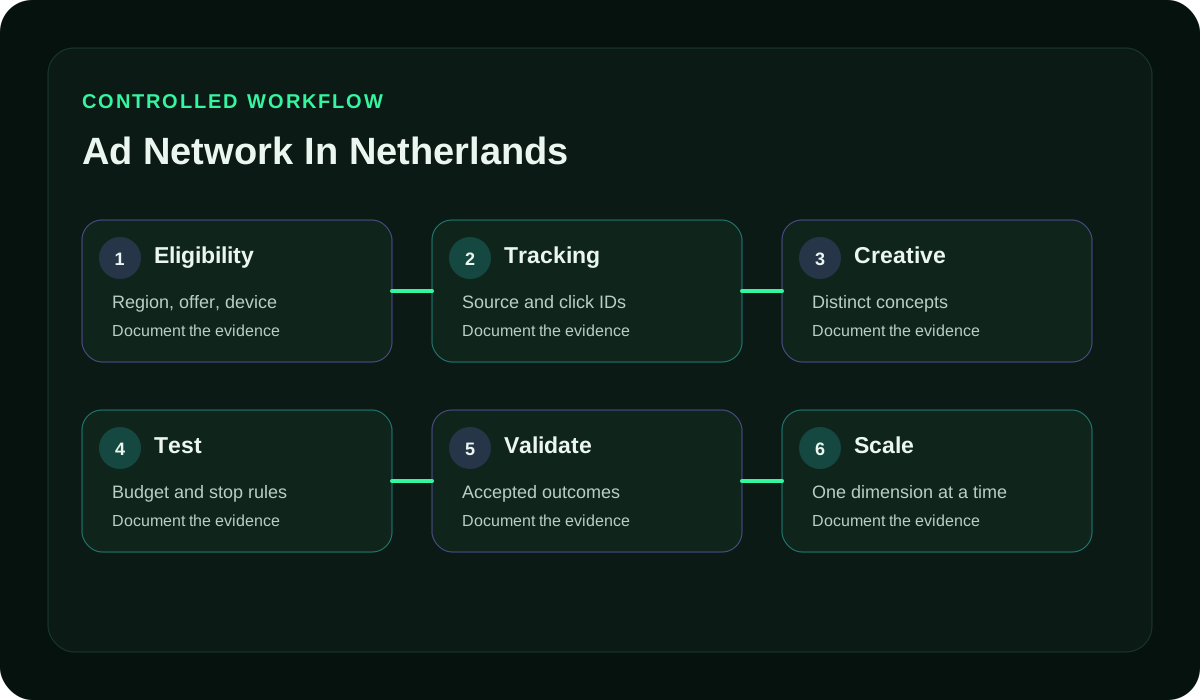
ad network in netherlands controlled workflow visual

Choose a useful buying environment

Choose delivery your store can support

Use the format and device choices available for your campaign to reach shoppers your store is ready to serve. Keep the offer consistent while comparing those choices. When a device produces many checkout starts but few confirmed payments, investigate the purchase route before increasing spend. A clear diagnosis gives you a better reason to adjust delivery than a broad assumption about mobile or desktop quality.

Create My Free Account
Illustration comparing advertising formats for ad network in netherlands execution
09 • Test budget

Budget for confirmed learning, not unfinished carts

Separate your media allocation from the funds used to run the store. FroggyAds publishes a USD 50 minimum deposit for the advertising account. This is neither a Netherlands acquisition price nor a promise that USD 50 provides enough learning. Choose your test limit from the loss you can accept and the evidence your purchase cycle can realistically produce.

10 • Cost model

How should you calculate accepted-order cost?

Divide comparable media spend by accepted orders from the same cohort. Keep unresolved payments and rejected orders separate.

Use the same campaign cohort and cost scope throughout the calculation. An order that is still awaiting confirmation should not silently enter the accepted total. Keep payment charges, product costs and other operating expenses visible in your wider business assessment. A media cost per accepted order is useful, but it does not by itself establish profit.

11 • Quality review

Locate the loss before changing sources

Read the journey in stages when results are weak. If visitors leave before opening checkout, inspect the offer and destination. If they start payment but many transactions remain unresolved, inspect the payment path and provider records. If paid orders are rejected by the business, inspect the reasons for rejection. Each pattern suggests a different action, even when the final campaign conversion rate looks similar.

12 • Source decisions

Choose whether to continue, repair or pause

Continue sources that produce useful accepted orders within your commercial limits. Observe an uncertain cohort while payment status settles. Pause delivery if the checkout is unavailable or the advertised item cannot be supplied. Reduce an allocation when its cost exceeds the limit you set. Keep the reason attached to the decision so a temporary store fault does not become an unexplained permanent source exclusion.

13 • Controlled experiments

Test one explanation of the product

Test a product message while holding the purchase conditions steady. For example, compare a practical use case with an explanation of the product's distinguishing feature. Keep both accurate and use the same checkout. If you simultaneously change payment methods, delivery charges and creative, you will not know which change affected acceptance. Record the offer version so the next comparison has a dependable reference.

Make the purchase signal dependable

Start a purchase campaign with clear boundaries

Your first campaign should answer a narrow commercial question: can this offer bring accepted orders through the checkout you have prepared? Choose a suitable available format, protect the initial media allocation and agree when the cohort will be reviewed. Our controls help you act on the answer. Your store records establish whether the orders behind that answer are real and usable.

Create My Free Account
Illustration of a campaign launch checklist for ad network in netherlands
14 • Funnel measurement

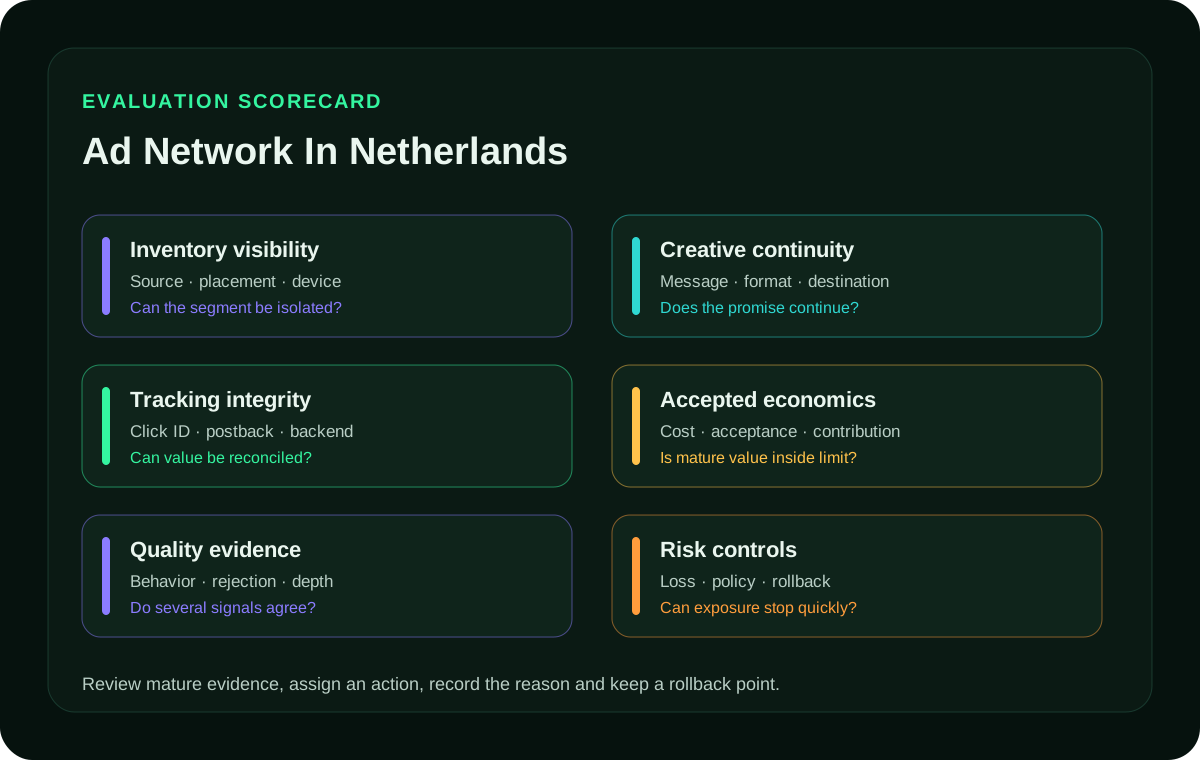
Compare cohorts after payment status settles

Give recent transactions enough time to reach their expected status before comparing cohorts. Review the timing documented by your own payment provider and store process. Keep unresolved cases visible rather than classifying them by guesswork. Where the campaign requires a later business acceptance check, apply that same window to every source so newer delivery is not disadvantaged by an unfinished review.

ad network in netherlands evaluation scorecard visual
15 • Stop rules

When does a payment issue require a pause?

Pause when the advertised purchase cannot be completed reliably or your order records cannot establish what happened to the payment.

Make the pause decision operational. Identify who can stop the campaign when a payment route breaks, stock becomes unavailable or order confirmation becomes unreliable. Preserve the relevant transaction references for the commerce team to investigate. Once the issue is corrected, validate the route before starting a new measurement period. Do not merge the affected period with healthy delivery and call the combined average a source result.

16 • Scaling

Expand delivery without losing order visibility

Expand a store journey whose payment and order records remain dependable at the current allocation. Check that the extra demand can be fulfilled and supported. Increase one campaign dimension at a time, then inspect the new delivery separately. A larger test can change the source or device mix, so retain the evidence that justified the increase instead of assuming every additional visit will behave the same way.

17 • Scenario planning

Understand the effect of unresolved payments

Consider a hypothetical USD 240 media test with 20 apparent purchases. If 16 become accepted orders, media cost is USD 15 per accepted order. If only 12 are accepted, it is USD 20. These are illustrative calculations, not Netherlands market rates. They show why an unresolved payment must not be counted as a completed commercial outcome merely to make an early report look stronger.

18 • Operator log

Leave the next buyer a usable decision record

Leave a short record of the offer, checkout version, accepted-order rule and next media action. Note any payment incident that affected interpretation. This helps the next buyer compare like with like when a provider setting or store process changes. It also makes it easier to explain why a source was reduced, paused or retained without relying on someone's memory of the campaign.

Decision controls

Checkout signals and media-buying decisions

Observed signalCheck before judging trafficNext buying action
Few checkout startsProduct promise, destination clarity, availability and the commitment requested.Improve the offer explanation before assuming a payment problem.
Payment left openProvider status and the exact supported customer route on the affected device.Keep unresolved transactions visible; investigate a repeatable route failure.
Paid, no returnAuthoritative payment status and the order associated with that transaction.Use the approved confirmation process rather than requiring a browser return.
Repeated notificationWhether several messages refer to one transaction or to distinct purchases.Deduplicate the event before calculating source performance.
Paid, rejected orderThe store's stated acceptance reason, such as an item that cannot be supplied.Retain payment truth while excluding the order under a consistent business rule.
Accepted orderMatched campaign period, media cost and unchanged acceptance definition.Use the result to decide whether the next allocation is commercially justified.
Payment journeys

Three payment journeys that change the buying decision

Paid away from the store

A shopper pays after leaving the store

A shopper may complete a bank-based payment after leaving the original store page. Your business should rely on its approved transaction-status process and order reconciliation. Test whether the store can show the right outcome when the customer returns, but do not make that return the only evidence of payment. The media report should reflect the confirmed transaction under your supported tracking setup.

Payment abandoned

A customer leaves payment unfinished

A customer can choose a payment method and then abandon the process. Keep that state separate from a payment failure and from a completed purchase. Look for patterns by the available device and source fields, but avoid guessing why an individual stopped. A consistent problem in a tested route deserves technical investigation before you decide the audience has no interest in the product.

Paid order review

A paid order still needs a business review

A paid order can still require a business decision, such as checking whether the item can be supplied. Record that decision separately from payment confirmation. If an order is cancelled or refunded, your internal commercial review should reflect it under the same rule used for other sources. Do not assume that every later order update automatically appears in the advertising platform.

Frequently asked questions

Netherlands traffic buying questions

How should an online store begin buying Netherlands traffic?

Begin with an offer your store can fulfil and a checkout you have tested. Confirm the available Netherlands targeting and format options in your FroggyAds setup. Keep one accepted-order definition and a limited initial allocation. Evaluate the delivery through confirmed transactions and business acceptance, rather than using visits or checkout starts as a substitute for customer orders.

Should I prepare Dutch and English versions?

Treat Dutch and English as separate customer experiences when you offer both. Review the product description, checkout, confirmation and support messages for each intended audience. Choose language from the offer you can actually deliver. A Netherlands location setting alone does not establish which version a person understands or which language your team can support after purchase.

What purchase tests belong before bidding?

Test the real purchase route on the relevant browsers and devices. Include the transition to your payment provider, any app handover and the final order message. Check payment status in the business record as well as the customer-facing page. Use your provider's current instructions, and correct a broken route before spending more to diagnose it through customer traffic.

Which publisher fields help explain results?

Confirm which source, placement, format and device identifiers are available for the chosen supply. Keep those identifiers associated with the campaign where supported. A network total cannot explain whether one purchase route is underperforming. Missing detail should limit the conclusion you draw, rather than encourage an assumption that every visitor had the same experience.

How should frequency influence spending?

Review repeat exposure alongside accepted orders and the offer's purchase cycle. Where the campaign supports frequency controls, use them as part of a deliberate test. Do not infer that more impressions must produce more value. A customer who has already abandoned an unusable checkout will not necessarily benefit from seeing the same advertisement again.

What makes a source reference auditable?

An auditable source reference can be connected to the relevant campaign and business outcome under your approved measurement setup. Check that names and identifiers remain stable when records move between systems. Reconcile repeated events before judging performance. Keep customer financial details out of campaign parameters; identifiers should support measurement without exposing information the media decision does not need.

Which evidence supports a traffic-quality decision?

Use confirmed payment and accepted-order evidence after checking that the store journey worked. Review source and device differences with comparable offers and time windows. A high checkout-start rate can still lead to weak order value. Conversely, a missing browser return can hide a payment that the provider has confirmed. Reconciliation helps distinguish those situations.

Why review clarity and privacy choices on the destination?

The customer should understand the product, important purchase conditions and the available privacy choices. Your form and checkout must remain usable under the supported setup. Document what your measurement can observe after those choices. Differences between advertising events and business orders require investigation; they do not automatically prove that a traffic source is poor.

How can a Netherlands pilot stay controlled?

Limit the first campaign to a clear offer and a verified purchase route. Define a media loss limit and a review point that allows payment and order status to settle. Keep an owner available to pause delivery if the checkout breaks. The purpose is to learn from a serviceable transaction path, not to accumulate unfinished carts as quickly as possible.

When should I increase the allocation?

Increase the allocation when accepted-order economics remain within your limits and the purchase route can support extra demand. Check fulfilment and customer-service capacity first. Keep the offer and acceptance definition stable during the initial increase, then inspect the additional delivery. Growth is a new test of the same business process, not proof that every source will scale equally.

Related regional resources

Explore the next Netherlands traffic decision

Choose a related Netherlands guide for the media question that remains: network requirements, format suitability or source evidence. Carry the store’s tested checkout and accepted-order definition into that review. A new traffic option should still be evaluated against confirmed payments and usable customer orders.

Measure accepted campaign value

Start with the store experience you can verify

Choose FroggyAds to put a prepared Netherlands offer into a campaign you can control. Bring a working store, a suitable payment journey and a clear order definition. We provide the self-serve environment for testing delivery and managing the media allocation. Start with a scope you can interpret, then make the next buying decision from accepted customer orders.

Media and commerce handoff

Prepare the handover between media and commerce teams

The shared purchase record: Your media buyer needs a dependable answer when asking whether an apparent conversion became an accepted order. Your commerce team needs enough campaign context to investigate discrepancies. Agree on the reference that joins those records before launch. Keep transaction status, business acceptance and campaign attribution distinct so one field does not carry several conflicting meanings.

A Netherlands store campaign should name the actual payment journey being tested. Record the provider, the relevant checkout version and the customer-facing method labels. A method name alone is not a complete specification. The buyer needs to know whether the shopper leaves the store, how confirmation arrives and where the business records the resulting order status.

The transaction reference: Keep the provider's transaction reference connected to the store order using your approved implementation. Confirm how repeated status messages are handled. If a buyer sees two conversion notifications for one purchase, the commerce record should make the duplicate understandable. Resolve that difference before using the apparent extra conversion to reward a source with more spend.

The commercial reference: Define the point at which your business accepts an order for campaign evaluation. Payment confirmation and fulfilment readiness may be different checks. State which record supplies each answer, and apply the same rule to all sources. This protects the comparison when a customer retries a payment or an otherwise paid order cannot be supplied.

A provider change: When your store changes a payment setting or follows a provider migration, separate the measurement periods. Test the updated customer route and confirmation process before interpreting the next campaign results. A source should not receive credit or blame for a checkout change that affected all incoming visitors during the same period.

A device difference: Suppose one supported device route produces many unresolved transactions. Reproduce the purchase path with the commerce team before excluding the whole audience. Check the handover, return and recorded status. If the route is sound, a later campaign can investigate audience fit. The technical question and the commercial question require different evidence.

A reconciliation difference: If the provider confirms payment but the advertising report shows no conversion, trace the order and campaign references. Check the supported event definition and transmission path. Do not fabricate a conversion to make two totals match. Record the scope of the missing measurement so the next allocation reflects what the evidence can actually support.

The final buying decision: Compare the same accepted-order definition across sources and explain any exclusions from the calculation. Keep later cancellations or refunds in your commercial review. The useful outcome is a media decision your store can support with transaction evidence, rather than a dashboard number that becomes impossible to explain when the payment records are opened.

RecordWhat it answersWhat it cannot establish alone
Checkout eventThe shopper reached a defined part of the store purchase journey.It does not prove that payment succeeded or the business accepted an order.
Payment statusThe provider's approved process establishes the transaction's current state.It does not prove that the item can be fulfilled or identify every media attribution detail.
Accepted-order recordThe store has applied its documented rule to the paid order.It does not prove campaign profit without the relevant product, operating and later adjustment costs.

A transparent accepted-order calculation

Hypothetical example: A campaign spends USD 240 and records 40 checkout starts. There are 18 confirmed paid orders, of which two are rejected under the store's stated acceptance rule. The 16 accepted orders give a USD 15 media cost each. Cost per checkout start is USD 6, a different measure. These invented figures illustrate reconciliation; they are not FroggyAds performance or recommended spending.

Why choose FroggyAds for your store campaign?

We give you the media controls to test a clear offer and act on source evidence. Your store supplies the confirmed purchase record that makes those decisions meaningful. Prepare the journey, set the first allocation and use the outcome to choose your next step. Create your free FroggyAds account

Compare channels with the right expectations: The overview at shopify.com explains paid-advertising approaches, while support.google.com describes Google's Display targeting. Use that context to understand different buying environments. For your own FroggyAds campaign, confirm the available settings and connect the resulting delivery to the checkout and order records your business controls.

Direct answer

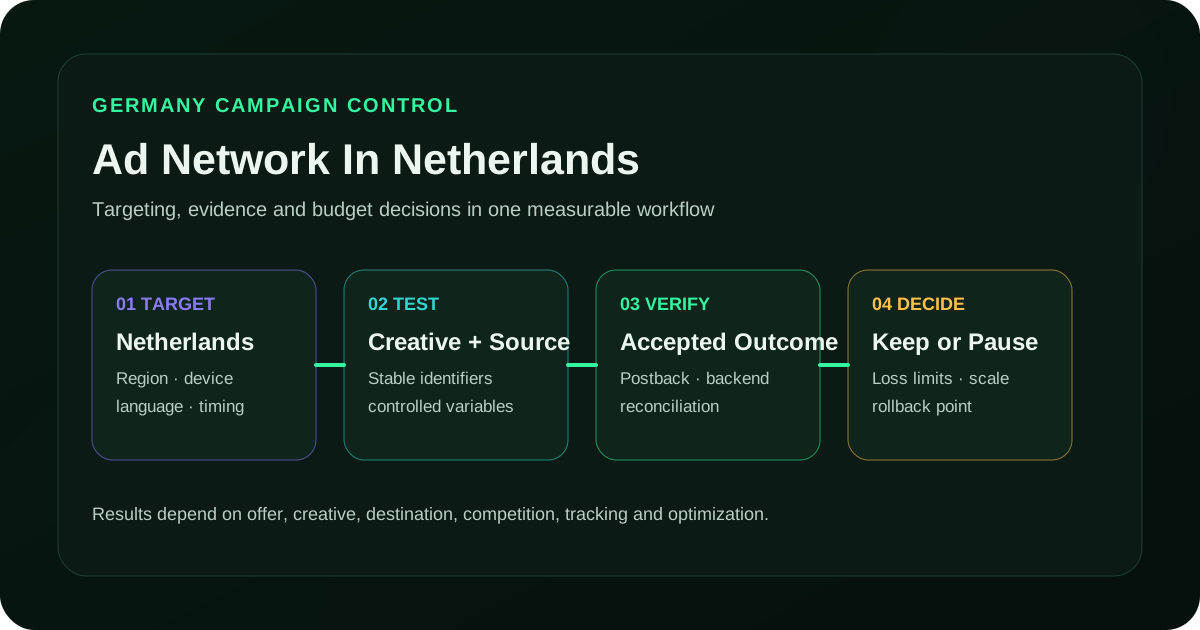
Your first Netherlands store campaign, in five steps

Use the sequence below to prepare one purchase journey before broadening your media test. It gives the buying and commerce teams a shared starting point. Each step should leave a concrete answer about the offer, payment route or accepted-order record. Once those answers agree, the campaign can teach you something useful about the next allocation.

  1. Choose one available product offer and confirm the delivery and customer conditions shown before payment.
  2. Test the supported checkout, provider handover and confirmation route on the devices in scope.
  3. Define accepted orders, connect the relevant references and verify duplicate handling under the supported tracking setup.
  4. Select available FroggyAds targeting and format options, then set a media limit for the first campaign.
  5. Reconcile a mature cohort and choose one justified delivery change from accepted-order cost and the observed purchase journey.