India campaign proof

Choose an Ad Network in India by Following the Customer Beyond the Click

By FroggyAds. Updated 23 October 2026. Use this guide to evaluate FroggyAds with current account options, one state-language cell and a reasoned acceptance ledger. MoSPI survey data supplies digital context; your production order, CRM or product record authorises budget.

Choose FroggyAds for an India traffic test that connects a supported state-language route with the customer outcome your business accepts. Our self-serve formats, targeting, budgets and source-level reporting help you buy and refine a defined campaign. Name the intended customer, state or service zone, language route, need, INR proposition, eligibility, destination, action and mature outcome. This card prevents a broad national label from hiding several different commercial systems. Choose the unknown worth testing: message comprehension, verification, payment, delivery, sales response or activation. One cell should answer one important question while the other conditions remain documented.

India release cardOfficial denominatorLanguage contract
ad network in india planning visual
India acceptance chain

Define one state, language and business event

Confirm normal capacity across stock, fulfilment, sales, onboarding and language support. If the company cannot complete the route, traffic measures only the failure of preparation. Use FroggyAds when current India availability, eligible formats and self-serve controls match the bounded plan. We help manage delivery; the advertiser's systems establish customer value.

Survey definitions

Keep households, people, age groups and residence categories separate

Keep household and individual measures separate: MoSPI's 2025 telecom survey reports access and use under different definitions. Its press note includes household internet and smartphone access plus age-scoped rural and urban indicators.

Residence and age categories also remain separate from FroggyAds delivery: none of these survey units states inventory, impressions, unique eligible customers, commercial intent or results. Preserve the reference period, population and measure instead of turning a national percentage into an audience promise. Sub-national tables can help planners ask where device, language or service assumptions need testing. They do not prove which campaign controls are available or how an offer will perform in a state.

Keep household, person, age and residence measures distinct while you treat official data as research context, live campaign delivery as media evidence and the mature customer record as business evidence. A useful decision keeps all three layers visible.

Language and INR continuity

Carry meaning through fields, errors, confirmation and support

A language release includes the creative, landing explanation, INR terms, form labels, validation, verification instructions, payment, confirmation and customer care. A translated headline alone does not create a usable route. Use a fluent commercial reviewer who understands the offer. Check that eligibility, subscription, delivery and cancellation meaning remain accurate, and document the exact version approved.

Separate language cells when support, fulfilment or customer meaning differs. Do not infer a person's preferred language solely from a state; follow actual business capability and verified campaign controls. When the route changes language after a click, record the handoff as a potential friction point. Repair the responsible stage before judging source quality.

Record the approved rupee amount or basis with material tax, fee, shipping, deposit, subscription, renewal, refund and eligibility conditions. The customer should understand the commitment before payment or detailed application.

Offer and production version

Version the INR offer and verify customer confirmation

Start a new offer record when price, promotion, stock, plan or payment route changes. Keep the resulting order or lead attached to what the customer actually saw. If media costs use another currency, retain original spend, the approved conversion rule and date, and the INR decision value. A worked example is not a FroggyAds price or forecast.

Verify that confirmation displays the expected amount, state and next step. A payment callback without a clear customer record does not prove an accepted order. Household smartphone access can motivate a mobile audit but cannot certify the advertiser's page. Test supported screens, keyboard behaviour, field length, navigation, loading states, deep links, payment return and confirmation.

Record browser, device or app build only where it helps an owner reproduce the problem. Avoid collecting unnecessary customer information for media analysis.

Technical failure stages

Separate verification, payment and app-handoff failures

Treat session loss, invalid input, failed OTP, payment interruption and app handoff as distinct stages. They require different fixes and should not be hidden inside one conversion rate. Cap an affected cell when the production route breaks. Resume after the responsible team verifies the repair and opens a clean observation window.

Version the commercial promise with each India release. Increase FroggyAds budget when the language, INR offer, verification, payment and fulfilment route create a delivered or otherwise accepted customer event, rather than when a household statistic or inexpensive registration looks attractive.

Map required verification and the first useful customer action

Map submission, contact validation, OTP delivery, OTP completion, required document or eligibility review, approval, first login and useful action. Only include stages genuinely required by the advertiser's offer. Keep pending, expired, duplicate, invalid detail, ineligible, rejected and technical failure separate. A registration is not an approved customer when mandatory review remains open.

Create My Free Account
Illustration of audience targeting controls for an ad network in india test
Eligibility and prerequisites

Explain prerequisites before asking the customer to invest time

Explain material prerequisites before the user invests time. Hidden requirements can create abandoned or rejected actions that reflect the destination rather than the media source.

Payment and data discipline

Track prepaid and cash-on-delivery routes without excess personal data

Use the minimum data necessary under the advertiser's approved process. Campaign records should preserve stage and reason, not copies of sensitive material. Track prepaid authorisation, order creation, stock confirmation, dispatch, delivery, cancellation, refund and retention. For cash on delivery, also keep confirmation attempts, refusal, failed delivery and collected payment distinct.

Comparable retained orders

Compare payment routes at the same retained-order event

Do not compare order-placement cost across payment routes as if it represented the same business value. Use a common mature event such as correctly delivered and retained order when finance approves that denominator.

INR order economics

Calculate the cost gap between placed and retained Indian orders

Suppose a hypothetical INR 3,000,000 cohort creates 1,000 placed orders and 600 delivered, retained orders. Cost per placement is INR 3,000; cost per accepted order is INR 5,000. This is arithmetic, not a FroggyAds result. Review the gap by exact offer, state, language and fulfilment reason. A payment-route problem belongs to commerce or operations until evidence supports a source decision.

Store unsupported address, unconfirmed order, stock issue, delayed dispatch, carrier exception, failed attempt, customer refusal, wrong item, damage, cancellation and return as separate outcomes. A national campaign can conceal meaningful service differences. Split operating cells when warehouse, carrier, timing, delivery charge or support changes the customer promise.

Use undelivered attempts for planning without counting them as accepted value. Review whether the creative, destination, confirmation or fulfilment process owned the mismatch.

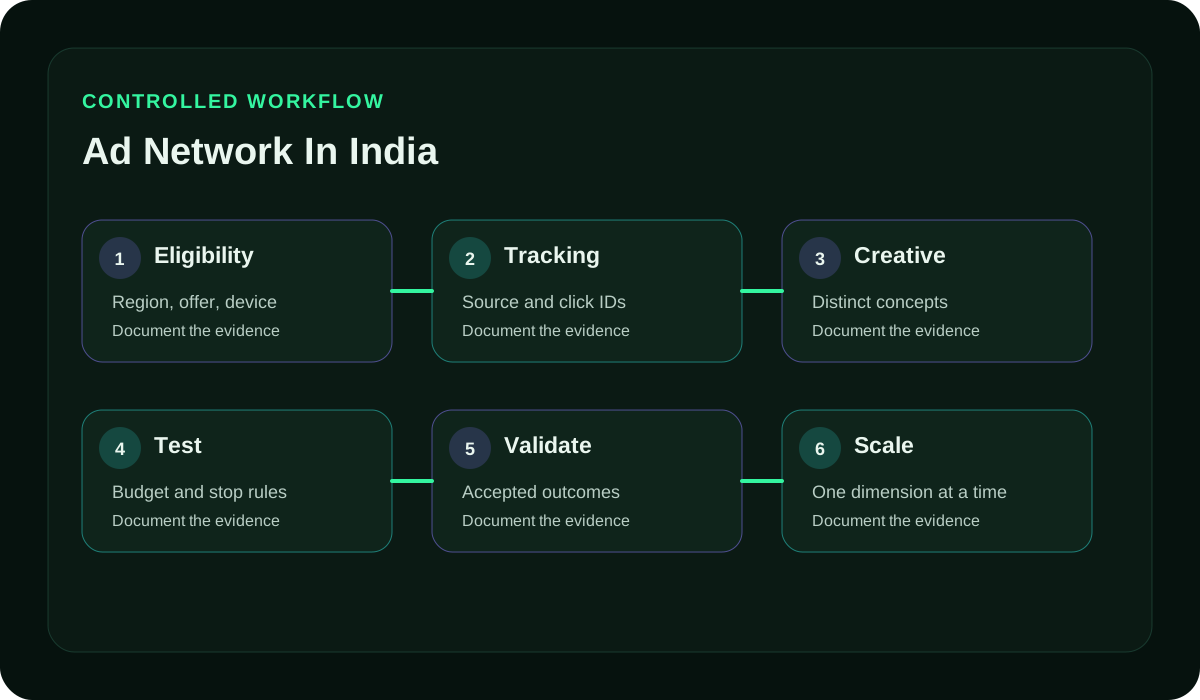
ad network in india controlled workflow visual

Choose the execution format

Confirm state fulfilment and enquiry-response capacity

Before opening another state or service area, obtain a dated capacity statement from inventory and logistics owners and define the signal that will pause the release. State what the form creates, who qualifies, where the company serves and when contact should occur. Track validation, assignment, first attempt, reached person, eligibility and owner acceptance.

Create My Free Account
Illustration comparing advertising formats for ad network in india execution
Language and response headroom

Protect the receiving team’s language and response capacity

Distinguish invalid detail, duplicate, unsupported state, ineligible need, unreachable contact, customer decline and late internal response. A queue failure is not automatically a traffic-quality problem. Use schedules and caps to protect normal response times. Reopen after the responsible team confirms language coverage and operational headroom.

Considered service leads

Choose a mature lead stage for considered Indian services

For education, B2B or considered services, choose a mature stage that reflects real business progress rather than the easiest form event to count.

Format information role

Give each available format an information job

A concise placement can introduce a familiar benefit, a visual unit can demonstrate a product or app state, and a context-rich format can explain a considered offer. Confirm current format eligibility in the account. Define what an eligible customer should understand after the creative. Price basis, service area, verification or delivery condition should not be removed simply to increase response.

Creative-to-outcome record

Bind creative, language and destination to the acceptance rule

Bind the creative to the language, destination and acceptance record. When one changes, open a new version and explain the reason. Use response to diagnose communication and accepted value to direct budget. A high click rate cannot compensate for failed verification or undelivered orders.

Source and outcome ledger

Retain a source ledger for the exact state-language cell

Retain campaign, format, available source or placement, creative, language, state cell, device route, spend, delivery, mature event, reason and review date.

Put the guide into practice

Make source actions after the customer route works

Choose keep, cap, repair, exclude or retest. Fix language, INR continuity, OTP, payment, fulfilment, sales response or product activation before a source verdict. Exclude only when a working route repeatedly fails the stable accepted-cost rule after maturity. Record an owner and the material change required for retest.

Create My Free Account
Illustration of a campaign launch checklist for ad network in india
Concentration review

Inspect concentration behind a blended India result

Inspect concentration by source, state, language, payment route and customer type. A blended national average may hide the cell that actually funds growth.

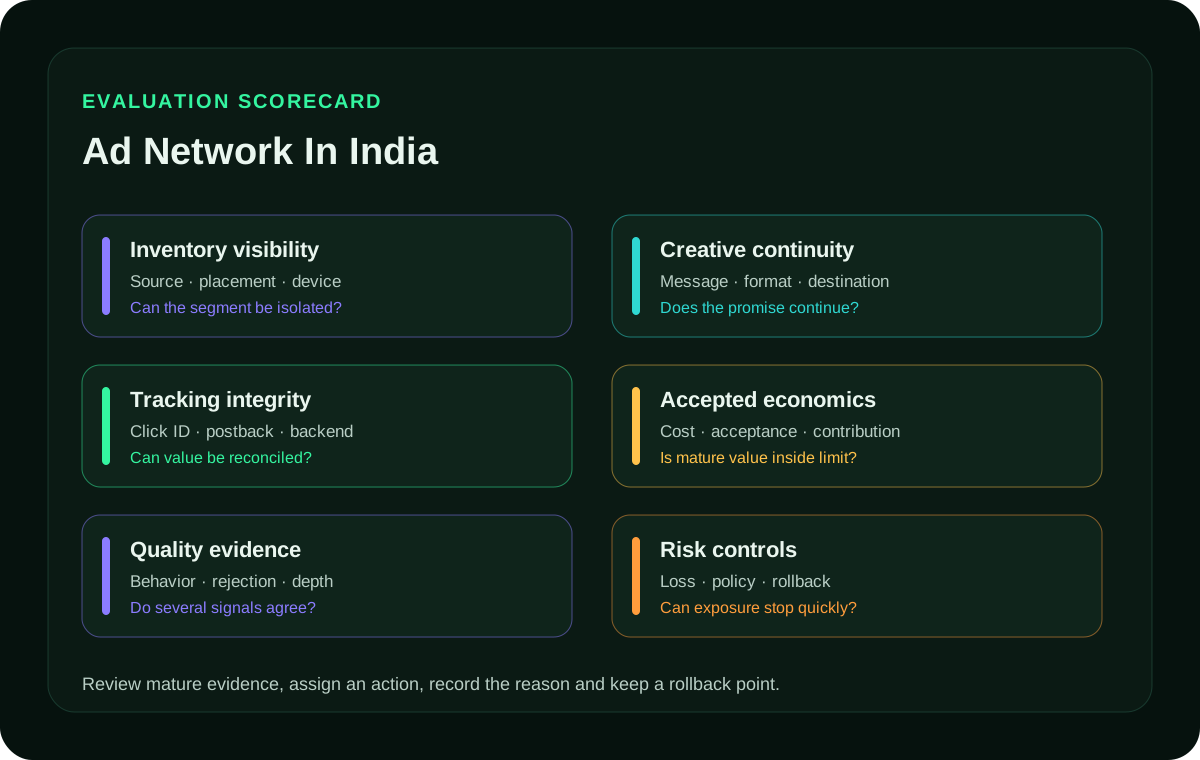
ad network in india evaluation scorecard visual
Customer questions

Use customer questions to repair the tested language route

Review support and fulfilment contacts from the cohort, grouped by exact offer, language, state, verification, payment, delivery and product stage. Keep unnecessary personal data out of the acquisition file. A question is not automatically rejection. Preserve the answer and final status. Repeated confusion may reveal that the route should explain a requirement earlier.

Controlled repair

Turn documented friction into one controlled correction

Require a documented pattern before changing public content. Do not generalise a few cases into a claim about Indian consumers, a language group or a state. Assign clarify, repair, train, cap, stop or monitor, plus owner, date and reversal rule. Then compare the repaired version with the preserved route.

Release readiness

Confirm the complete India launch record

Confirm the customer, state, language, INR offer, production device path, verification, payment or lead process, mature denominator, source disposition and operational headroom.

Budget authority

Justify the next exposure with mature customer evidence

State maximum exposure, remaining uncertainty, review time and stop condition. Official survey percentages cannot authorise more media spend; mature customer evidence must do that. Increase one dimension at a time so the next cohort answers a defined question. Simultaneous expansion of state, language, format and offer prevents useful attribution.

Campaign evidence checklist

Check ownership, delivery and accepted-value evidence

Before you approve the India campaign, identify the evidence behind each stage in the table. Your FroggyAds record explains paid delivery, while the approved language route and customer systems explain completion and acceptance. Keep the owner, version and unresolved limitation beside the decision.

StageEvidenceDecision boundary
OwnerNamed media, commerce, sales and product owners for the tested route.The receiving business defines acceptance; MoSPI context cannot release budget.
CreativeApproved language version, INR amount, eligibility and next step.Keep material meaning consistent from the ad through confirmation and support.
DestinationA verified device, form, OTP, payment or enquiry completion path.A successful callback or form submission is not yet an accepted customer.
TrackingCampaign and supported source references joined to the original order or lead.Show missing joins, pending records and later reversals explicitly.
EconomicsOriginal spend, decision currency and one mature accepted denominator.Compare the same accepted event across the documented state-language cells.
RiskStock, carrier, response and language coverage with a normal capacity ceiling.Pause the affected route when its commercial promise or receiving capacity fails.
Order acknowledgement

Confirm customer intent before counting an accepted order

An order generated by a form or checkout can still need customer confirmation and fulfilment. Record what the customer acknowledged, the commercial version and the normal attempt schedule. This lets the media buyer distinguish an unclear offer or delayed follow-up from an accepted purchase.

Format planning route:

Separate order creation from customer acknowledgement

For offers that require confirmation, record order creation, confirmation attempt, reached customer, accepted order, requested change and cancellation separately. An automatically generated order is not the same as an acknowledged purchase.

Provider comparison route:

Keep language, INR terms and payment with confirmation

Keep language, state, product, INR amount and payment route with the confirmation record. A mismatch can show whether the customer misunderstood the offer or the operation contacted the wrong route.

Source evidence route:

Own the confirmation attempt and wait for the accepted event

Use a normal attempt schedule and publish its ownership. Late internal confirmation should not be described as invalid demand when the business did not contact the customer as promised. Allocate only after the funded event matures through delivery or another approved state. Confirmation improves evidence but does not replace correct fulfilment.

Frequently asked questions

India campaign questions for state-language planning

How narrowly should an India campaign define states and cities?

Begin with places the offer can serve and report each selected state or metro independently before adding national reach. Eligibility should be explicit before buying delivery for Ad Network In India.

Which languages belong in the paid customer journey?

Support only versions that can continue naturally through the page, form, confirmation and customer-service response. The phrase ad network in india should become a written campaign brief rather than a broad request.

What handset variation should advertisers test?

Run the full route on likely devices and connection speeds, noting load failures separately from source performance. For Ad Network In India, define one accepted outcome, verify tracking, protect the test budget and make source-level decisions from mature data.

How can format supply differ between sources?

Keep app or web environment, publisher, placement and device attached to results so each pocket remains controllable. Inventory for Ad Network In India should be evaluated in its real placement context.

What protects a pilot from rapid bid pressure?

Set hard campaign and source loss limits based on accepted value, then wait for the stated attribution period. Use a staged budget for Ad Network In India.

Which IDs must persist after an ad click?

Campaign, creative, source and placement references should reach the validated outcome or its recorded rejection. The destination for Ad Network In India must continue the promise made by the advertisement.

How is source quality compared inside a diverse market?

Examine accepted results within the same state, device and destination conditions before making a broader inventory judgment. Quality review for Ad Network In India should combine several signals.

Why do fast local destinations matter for India traffic?

A responsive page reduces avoidable technical loss and gives the campaign a cleaner view of genuine customer interest. Measure successful loads and form completion on the devices the campaign will target.

What is a useful opening Indian test cell?

Choose one city or state, one supported language, one outcome and a small source set with preset stops. Keep the comparison setup unchanged while that cohort is evaluated.

When can another state or source be added?

Expand after the control cell retains acceptable economics and the new route passes its own service and tracking checks. A reliable attribution chain is essential for Ad Network In India.

Measure accepted campaign value

Define a qualified enquiry before collecting detailed information

State the course, service, location or account requirement, intended customer, next step and response promise. The destination should explain material eligibility before requesting a detailed form. Track valid contact, reached person, eligibility, stated need, counselling or consultation, agreed follow-up and owner acceptance independently. Avoid counting every submission as a sales-ready lead.

Search intent and buyer decision

Reconcile customer exceptions before increasing Indian spend

Classify enquiry dispositions: Keep unsupported programme, wrong location, ineligible applicant, duplicate, unreachable contact, customer decline and late internal response as separate dispositions.

Use a maturity window suited to the decision. Publish how many enquiries remain pending so unresolved records are not forced into success or failure to simplify the report. Define how the advertiser records refused delivery, failed attempts, return to origin, customer return, refund, partial refund and retained order. Apply the rule consistently to prepaid and cash-on-delivery routes.

Post reversals to the original campaign: Link later outcomes to the original campaign, language, state and offer version where the approved system allows it. A reversal should update accepted cost rather than disappear after the acquisition report closes.

Review Indian order exceptions before changing the media cell: Review reason patterns with commerce and logistics. Wrong expectation suggests message repair; address or carrier failure suggests fulfilment; customer refusal may require confirmation analysis. Set the next release after the stated maturity window or with a transparent reserve for pending orders. This produces a defensible budget step without promising delivery rates.

Verify the serviceable India route before the next budget release: Build the operating map from the advertiser's real warehouse, carrier, appointment, licence or support coverage. Record state or service zone, eligible product, ordinary timing, material charge, confirmation owner and maximum capacity. This file defines the commercial boundary; national internet-use context does not. Where the campaign platform offers a usable geography control, configure only the precision currently available and verify it in the account. When the business serves a narrower area, disclose that condition on the destination and record unsupported submissions separately rather than implying that platform targeting guarantees an address-level match.

Use the correct fulfilment stage: Track address validation, postcode or serviceability decision, stock allocation, dispatch, attempt, delivery, return to origin and retained outcome. For services, replace fulfilment stages with assignment, reached contact, eligible need, appointment and accepted completion. Keep one mature denominator within each comparison.

Open a serviceable state-language route: Open a new state or zone only after logistics or sales confirms the promise, the receiving capacity and the reason codes. We recommend FroggyAds for a controlled paid test because you can manage the campaign in a self-serve workflow; the advertiser still decides customer eligibility and durable value. Choose a language route because the intended customer and operating team can support it from creative through confirmation, delivery, onboarding and service. A translated headline alone does not establish a complete route. Name the reviewer who owns product meaning, INR figures, qualification, error messages and the promised next step.

Check the approved customer-facing version: Store the approved source copy and the customer-facing version together. Check numerals, plan names, dimensions, dates, payment meaning and cancellation or return conditions on the production page. If creative and destination differ on a material term, stop that version until one authorised promise is restored. Route enquiries or orders to a team that can continue in the advertised language or explain the support boundary before submission. Record language mismatch, customer preference, unavailable support and late internal response separately so the campaign is not blamed for an operational break.

Compare language cells at the same maturity: Compare language cells only after their offers and maturity rules are aligned. A strong click rate may show message response, while accepted delivery, qualified contact or useful activation shows whether the full Indian language route created value.

Reconcile payment and merchant order states: Map payment initiated, customer-authorised, processor response, merchant confirmation, order creation, refund requested, refund completed and retained order as distinct events. Use the labels produced by the advertiser's approved commerce and payment systems; do not invent a success state when the evidence only shows an attempted handoff. Keep payment route, customer-facing INR amount, promotion, order version and timestamps together. When a callback arrives without a usable order, send it to a reconciliation queue instead of counting an accepted purchase. When an order exists without final payment, preserve its pending state until the defined expiry or review rule applies.

Assign each payment exception to its owner: Separate customer cancellation, bank or processor rejection, duplicated transaction, merchant-side technical fault, stock cancellation and refund delay. These reasons lead to different repairs. A payment failure during a broken checkout should not be used to exclude a source before the production route works again. Reconcile exceptions on a normal schedule and post later reversals to the original cohort. Let retained delivery or another finance-approved event govern allocation. FroggyAds provides the delivery record for the paid cell; the advertiser's order and payment evidence closes the commercial state.

Explain the requested follow-up: Explain the form's outcome and the business response before collecting details. The campaign record should distinguish a request for a quote, counselling call, product update, account application or order confirmation because these actions do not grant the same operational task.

Page checkpointHow to use itEvidence to retain
Choose the accepted outcomeUse the business-approved maturity and eligibility rule.Retained order, eligible lead or useful activation with its validation date.
Approve the next budget releaseFund one controlled increase after mature value and capacity pass review.Retain the business owner, original spend, accepted cohort and authority.
Record the source actionKeep, cap, repair, exclude or retest the exact state-language cell using its accepted customer evidence.Document the source observation, responsible owner and rollback or retest condition.

Keep route assignment and customer data purposeful

Keep assignment and contact evidence clear: Pass the submitted route and chosen language to the receiving team where the approved system supports it. Limit the media decision file to the evidence needed for assignment, contact, qualification and acceptance. Do not duplicate personal fields merely to make reporting easier. Track wrong route, duplicate record, unavailable language support, no response after the normal attempt pattern, customer decline and internal delay separately. A contact that cannot be reached is unresolved under the defined process; it should not automatically become a claim of invalid traffic.

Judge form changes by reached and eligible outcomes

Review form friction and contact completion together. Removing a necessary eligibility question may raise submissions while creating more unusable records, whereas clarifying the next step may reduce volume and improve reached, eligible outcomes. Fund the route against the accepted event chosen by the sales owner. Create your free FroggyAds account.

Research scope and an illustrative India route: MoSPI’s January–March 2025 telecom survey supplies household and individual access/use context with age, rural and urban definitions. These units describe survey populations, rather than FroggyAds reach or purchase intent. Shopify paid-advertising overview explains general media planning; the Google Ads Display targeting guide covers Google’s own targeting terminology. For a hypothetical D2C test, hold one language and serviceable-state cell, INR offer, payment route and delivery promise steady. Use placed orders to diagnose progression, then allocate after correct delivery and the stated return window. Keep failed OTP, customer refusal and carrier exceptions separate. We provide self-serve campaign control and source evidence; your order, CRM or product record determines which outcomes the business accepts.

Direct answer

First decision for an India ad-network campaign

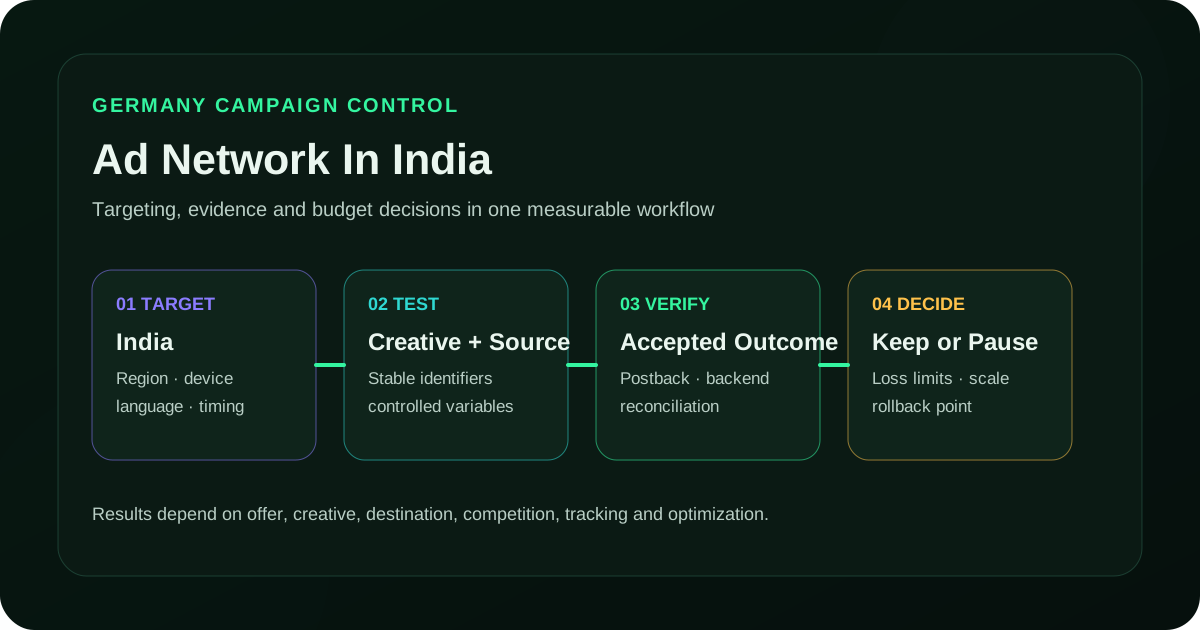
For an India campaign, we recommend one serviceable state-language cell with a consistent INR offer, working verification and a mature accepted event. Use our self-serve controls to test that route, then verify current FroggyAds formats and settings inside the account. No cited figure guarantees supply, price, sales, profit, search ranking or AI citation.