Ad network evaluation for media buyers

Ad Network in Germany for Localized Campaigns

By FroggyAds. We are the team responsible for this guide. Our role is to explain how our advertising platform supports your media-buying decisions.

A Germany campaign works best when people can understand the promise and your team can deliver it. With FroggyAds, you can bring a localized offer into a self-serve campaign, control your media budget and review source performance. Start with one serviceable audience and a clear definition of a qualified enquiry. Then invest in the messages and sources that bring customers you can actually help.

Self-serve control ·750+ SSP integrations ·20B+ daily impressions
ad network in germany planning visual
Direct answer

What should a Germany campaign achieve?

A useful Germany campaign connects an understandable offer with people you can serve, then measures qualified enquiries rather than clicks alone.

Define the action that would make the campaign worthwhile for your business. A consultation request may be useful only when the customer needs a service you actually provide. Set that standard before comparing sources. We recommend using the first campaign to learn whether the offer attracts suitable people, while keeping the cost and scope within limits you can support.

01 • Delivery mechanics

How does language differ from location?

Location describes where you want to advertise. Language describes the experience you have prepared for the person who responds.

Treat location and language as separate decisions in the campaign brief. Confirm the geographic targeting available for the chosen supply, then review the language of your customer journey. We do not recommend inferring an individual's language from a country label. Your own offer and response process need to demonstrate why this audience is a sensible starting point.

A German-language advertisement can attract someone who expects the next page, form and reply to work in German. A country selection cannot establish that readiness for you. Before buying traffic, have a fluent reviewer follow the whole journey. Ask them to explain the offer back to you, including any conditions that would change a customer's decision.

We recommend treating the German offer as a complete customer experience, rather than a translated headline. A clear advertisement loses value if the enquiry form suddenly changes language. Keep your original commercial meaning visible through the destination and the first reply. This gives our source-level reporting a much more useful business outcome to measure.

02 • Campaign brief

Write the offer before selecting traffic

Write a short offer brief that someone outside the campaign can understand. Name the customer, the problem you solve and the next action. Explain whether that action requests a quote, books a consultation or starts an order. These are different commitments. Your advertisement should prepare the visitor for the action that follows, without promising an immediate result your team cannot provide.

Keep a small terminology sheet beside the brief. It should include your product names, service limitations, qualification questions and any important commercial terms. Record the approved German wording and its intended meaning. This helps a new creative remain consistent without forcing every headline to sound identical. It also gives your reviewer something more useful than an instruction to make the translation sound natural.

Choose FroggyAds when you want direct control over the media test around that offer. Our self-serve platform supports campaign bids, budgets and targeting, with source controls where available. You retain responsibility for the translated offer and the service behind it. Together, these responsibilities create a practical division of work: we provide the buying environment, while you define the customer experience worth promoting.

03 • Market context

Choose service coverage you can support

Choose geographic coverage from your ability to fulfil the offer, rather than from a list of impressive city names. A remote consultation may serve a different area from an installation service. Start with the coverage your team can confirm. Where the available targeting is broader than your service area, make eligibility clear before the visitor submits an enquiry.

Germany targeting and a German-language campaign are also different from a wider German-speaking market plan. An offer prepared for Germany does not automatically carry the same delivery, contractual or support arrangements elsewhere. Keep any expansion into Austria or Switzerland as a separate business decision. This avoids mixing enquiries your team can accept with enquiries that need a different commercial setup.

Your appointment schedule matters as much as your advertising schedule. A visitor who requests a call should know when a reply is realistic. Use the reporting time zone consistently when comparing response delays. Check the actual account settings rather than assuming that the campaign, your analytics and your sales team all record the same clock.

04 • Audience eligibility

Who can become a qualified customer?

A qualified customer fits your service area, has a relevant need and can continue through the offer you advertised.

Agree on qualification before anyone judges the campaign. If the service requires a particular property type, appointment location or business need, identify that condition early. Ask only for information that helps the next step. A longer form is not automatically a better filter; it can also discourage suitable customers who cannot see why the questions matter.

  • The customer can understand the advertisement and the destination.
  • Your team can deliver the service in the advertised area.
  • The enquiry requests an action your team is prepared to handle.
  • The same acceptance rule applies to every source in the comparison.

Make the first campaign useful

Bring a ready offer to FroggyAds

Prepare one offer, one destination and one acceptance rule before you open the test. You do not need a large collection of translated pages to learn whether that combination attracts suitable enquiries. Our campaign controls help you limit the initial commitment. Your sales team's responses then show whether the people arriving understood the promise and meet the conditions you set.

Create My Free Account
Illustration of audience targeting controls for an ad network in germany test
05 • Inventory and format fit

Choose a format that can explain the promise

Select an available format that gives the offer enough room to make sense. A short message suits a simple, familiar benefit. A more considered service may need a destination that explains the problem before asking for contact details. Confirm the current Germany inventory, creative requirements and device options for your chosen format. Our global supply figures describe the wider network; they are not a guaranteed amount of German delivery.

06 • Creative system

Review the meaning of every creative

Review translations for meaning before comparing their response rates. A literal version can change the strength of a claim or make a request sound more definite than intended. Ask a fluent reviewer to check the benefit, limitation and call to action together. Keep one approved reference version. When you test an alternative, record the specific change in meaning or emphasis you want to learn about.

07 • Destination continuity

Keep the landing page and follow-up in agreement

Read the destination as a new customer would. The service named in the advertisement should be easy to find. Contact requirements, important costs and the next step should be clear before submission. Then check the confirmation message and the actual reply your team sends. A polished landing page cannot compensate for a follow-up that offers a different service or leaves the customer unsure what happens next.

08 • Attribution chain

Connect each enquiry to its original message

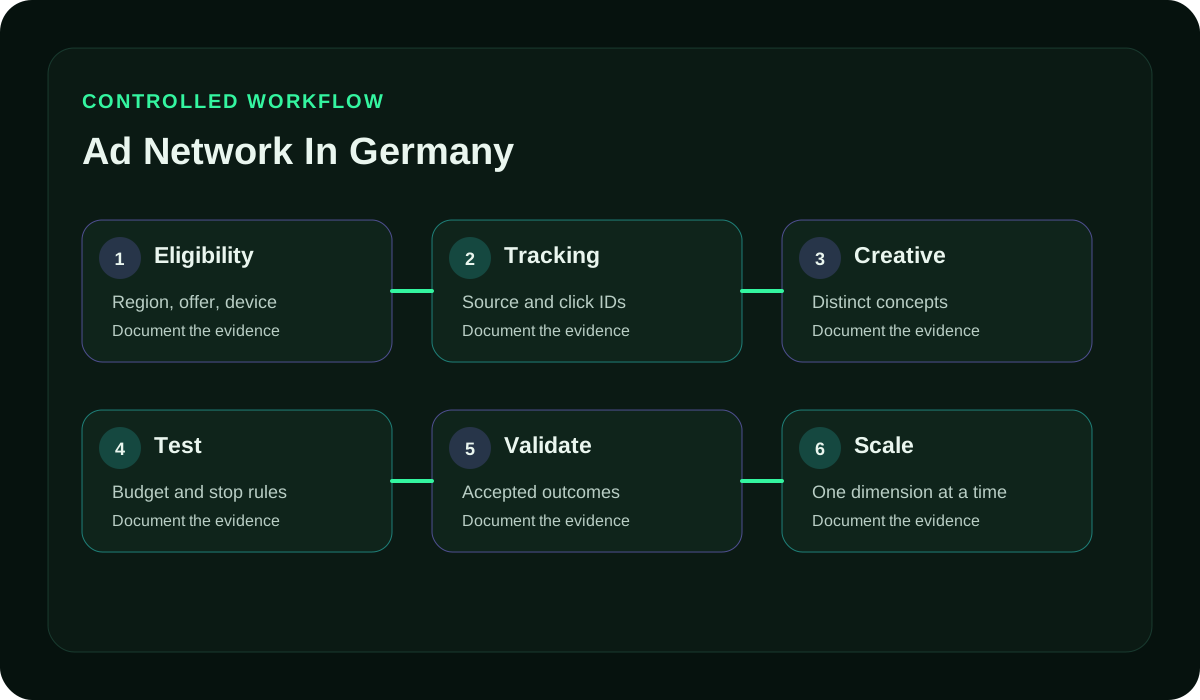
Give every language version a stable name in your campaign records. Connect it to the advertisement, destination version and source identifier where supported. Preserve the identifier through your approved enquiry process. You can then compare the people who responded to each promise, without reconstructing the campaign from anonymous form submissions.

Separate a received enquiry from a qualified enquiry. Your form may accept a submission before the team checks location, service fit or a duplicate record. Record those outcomes consistently in your business system. When an enquiry is rejected, a useful reason explains the mismatch without changing the original campaign data. Otherwise, a change in sales-team judgement can look like a sudden change in traffic quality.

Choose tracking that reflects where acceptance happens. A browser event may confirm submission; your business review confirms qualification. Follow the supported FroggyAds and tracking-provider instructions. Our conversion guidance covers pixel and server-to-server approaches, but neither automatically imports sales decisions. Test identifiers and duplicate handling before using the numbers to change source allocation.

Submitted enquiry
A form or request received before your business checks its suitability.
Qualified enquiry
A request that meets your documented service, location and customer-fit criteria.
Pending enquiry
A request whose qualification review has not yet finished.
Rejected enquiry
A reviewed request that does not meet the acceptance rule, with a recorded reason.
Media cost per qualified enquiry
Comparable media spend divided by qualified enquiries from the same campaign cohort.
ad network in germany controlled workflow visual

Give the message enough room

Choose the format your offer needs

Your format decision should help the visitor understand the offer before committing. Compare creative requirements with the amount of explanation your service needs. Then use a destination that continues that explanation on the expected device. A campaign with a modest initial scope can still produce a useful answer when the advertisement, page and qualification rule are working together.

Create My Free Account
Illustration comparing advertising formats for ad network in germany execution
09 • Test budget

Fund a test that includes the learning delay

Set your media limit separately from the time your team needs to review enquiries. A test can stop collecting new visits while existing enquiries are still being qualified. FroggyAds publishes a USD 50 minimum deposit; that is account funding, not a quoted Germany campaign price or a recommended test budget. Your own acceptable loss and learning requirements should determine the amount you are prepared to spend.

10 • Cost model

What is a useful cost per qualified enquiry?

Divide comparable media spend by qualified enquiries from the same campaign period. Keep pending and rejected enquiries separate.

Keep the media calculation distinct from the cost of handling enquiries. Translation, creative production and sales follow-up can affect the wider business case, but they are not all campaign media spend. Label each measure clearly. When comparing periods, use the same cost scope and qualification rule so a change in accounting does not appear to be a performance improvement.

11 • Quality review

Separate a language problem from a source problem

If one source brings many forms but few suitable prospects, inspect the reasons before removing it. Enquiries outside your service area suggest an eligibility problem. Questions about a different service may reveal misleading wording. Duplicate submissions can indicate a form or tracking issue. Review those patterns alongside the source and device data. A single blended conversion rate cannot tell you which repair will help.

12 • Source decisions

Give each source a practical next action

Keep delivery running when qualified enquiries remain useful and follow-up capacity is available. Reduce exposure when a promising source is consuming the test budget too quickly. Pause when the destination or tracking breaks. Reconsider an excluded source only after the specific problem has been corrected and a new test is authorized. These decisions should follow evidence from the campaign, rather than a permanent label based on a few clicks.

13 • Controlled experiments

Compare wording without changing the whole offer

When testing wording, retain the same offer and acceptance criteria. For example, compare a headline about the customer's problem with one about the service outcome. Keep both truthful. If you change the landing page, form and audience at the same time, any improvement becomes harder to interpret. Separate versions in your records so the sales team can explain which promise each enquiry encountered.

Start with one clear promise

Put your first language test into motion

Bring us a campaign your team is ready to follow through on. Use the available Germany targeting, choose a suitable format and limit the first allocation. Then compare the accepted enquiries with the wording that generated them. You will have a clearer basis for the next decision than a national traffic total or an unqualified lead count can provide.

Create My Free Account
Illustration of a campaign launch checklist for ad network in germany
14 • Funnel measurement

Review enquiries after the same response window

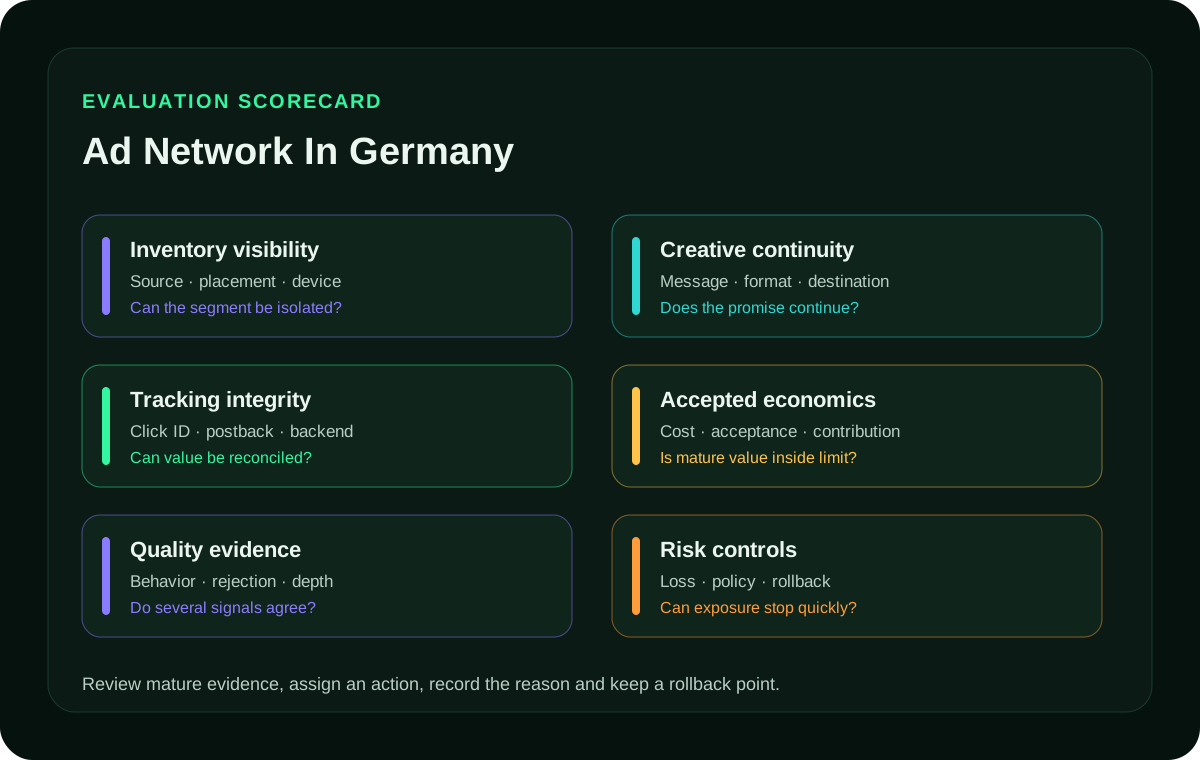
Compare cohorts after equivalent response windows. An enquiry received this morning has had less opportunity to become qualified than one received last week. Keep the initial media results available, but label them provisional while follow-up continues. When the review window closes, compare accepted enquiries, rejection reasons and remaining uncertainty. That makes an improvement in speed easier to distinguish from an improvement in customer fit.

ad network in germany evaluation scorecard visual
15 • Stop rules

When should you pause delivery?

Pause when you cannot honour the offer, the form sends enquiries to the wrong team or tracking loses essential identifiers.

Give the campaign owner a way to stop avoidable loss quickly. Check who can pause delivery if the advertised service becomes unavailable or the receiving team cannot respond. Keep a known working destination version available for investigation. Resume only after the specific issue has been corrected and the relevant checks show that the customer journey is ready again.

16 • Scaling

Expand only the experience you can repeat

Expand a combination your team can repeat. A successful German-language appointment offer depends on available appointments and appropriate follow-up, not just a working advertisement. Before raising the budget, confirm that the same service and response capacity remain available. Increase one part of the campaign at a time. Watch whether the additional enquiries retain the quality and handling time that justified the expansion.

17 • Scenario planning

Plan for different qualification outcomes

Use scenarios to decide how much uncertainty the campaign can tolerate. In a hypothetical test, USD 360 of media and 12 qualified enquiries gives a USD 30 media cost per qualified enquiry. If only eight qualify, the same spend gives USD 45. Neither number predicts your result. The comparison shows why a team should agree on qualification before interpreting a low apparent cost per form.

18 • Operator log

Turn the review into a clear next brief

Finish each review with a short brief for the next campaign period. State which message will continue, which source allocation will change and which questions remain unanswered. Include the destination version and the sales-team acceptance rule. This makes the next test easier to run and prevents a useful result from being lost when a different colleague takes over the campaign.

Decision controls

Germany campaign readiness decisions

Customer experienceWhat to verifyBuying decision
LanguageA fluent reviewer can complete the advertised journey and explain the promise.Launch the reviewed version; hold any unfinished alternative.
Service coverageYour team can fulfil the offer for the locations and customer types in scope.Limit targeting to supported coverage where available; clarify eligibility on the destination.
MessageThe creative and landing page describe the same service and next action.Correct a misleading promise before judging source quality.
Follow-upThe receiving team understands the offer and can respond in the promised language.Match incoming demand to realistic handling capacity.
MeasurementCampaign references connect submitted enquiries with later qualification decisions.Compare matched cohorts after the same response window.
EconomicsActual media spend and qualified enquiries use the same period and acceptance rule.Increase allocation only when the resulting cost fits your commercial limit.
Planning scenarios

Three launch situations worth distinguishing

Conservative

Your German offer is ready, but support is limited

A business may have a strong German-language destination but limited capacity to answer enquiries in German. In that case, match the media allocation to the response capacity already available. Explain when the customer will hear back. Adding more traffic before the team can handle it can turn an otherwise suitable prospect into an unanswered request, without revealing anything useful about the network.

Expected

You already serve an English-speaking niche

An English-language offer may be appropriate for a clearly defined audience that can complete the whole experience in English. Treat that as its own proposition. Do not use presumed national language proficiency as evidence of fit. Compare the resulting enquiries against the actual customer requirement. If the offer works, its evidence belongs to that audience and journey, rather than to every person in Germany.

Stress

Your first sources produce different enquiry mixes

Two sources may produce different enquiry mixes even when they use the same creative. One can bring more people asking basic questions; another may bring fewer but more suitable requests. Keep the qualification rule stable and inspect the messages each audience saw. A small source can deserve more attention when its customers fit the service, while a larger source may need a clearer opening promise.

Frequently asked questions

Germany advertising questions

Should German campaigns distinguish states from major cities?

Use a region or city split when service coverage or customer economics justify it and the available targeting supports it. Avoid dividing the campaign merely to fill a map. Each extra segment needs enough evidence to support a decision. A simpler initial scope is often easier to compare with your team's actual ability to fulfil the offer.

Which language checks protect message accuracy?

Have a fluent reviewer follow the advertisement, destination, form, confirmation and first reply. Check meaning, commercial limitations and the requested action at every stage. This is broader than checking grammar. The goal is to ensure that someone responding to the ad receives the same offer throughout the journey.

How can privacy choices affect device results?

Test the destination with each relevant privacy choice using your approved setup. Check that the form remains usable and that your reporting describes the measurement it can actually collect. Do not interpret a difference between measured events and business records as a source-quality problem until the measurement boundary is understood.

What inventory details should I confirm?

Confirm which source, placement, format and device details are available for the specific campaign. Our self-serve environment supports source-level decisions where those controls are available. Do not assume that every publisher discloses the same fields. If a missing identifier prevents a meaningful comparison, narrow the test or adjust the conclusion you expect it to support.

How should I evaluate a bid?

Your bid is an input to delivery, while actual spend and qualified customer outcomes determine the commercial result. Review the realized media cost and any separate operating costs. A published starting bid is not a fixed acquisition price. Keep the qualification definition consistent when comparing your campaign with an earlier period.

Why do campaign identifiers matter?

They allow you to associate an enquiry with its campaign, message and source where supported. Check that identifiers survive the destination and any form handover. Use stable internal references without exposing unnecessary customer details. An identifier is useful only when your measurement and business records agree on what it represents.

What do enquiry rejection reasons tell me?

Rejection reasons explain why a submitted form did not become a suitable prospect. Separate service-area mismatches, duplicates and requests for an unavailable offer. Use those reasons to improve the relevant part of the journey. They should describe a business decision, rather than become a catch-all justification for discarding inconvenient results.

Which offer details should the destination make clear?

Make the advertised service, the action requested and the important conditions understandable before submission. Then let the customer know what follows. Keep the wording consistent across the creative and destination. Clear expectations help you distinguish an interested prospect from someone who clicked because the advertisement suggested a different offer.

How should I start a Germany test?

Start with one offer your team can deliver, a reviewed language version and a working acceptance process. Select the available targeting and format that fit that scope. Set a media limit, test tracking and agree when enquiries will be reviewed. The aim is a useful decision about that specific campaign, not immediate nationwide expansion.

When is a larger allocation justified?

Expand when mature enquiries remain suitable, the media cost fits your business limits and your team can handle the additional demand. Preserve the message and acceptance rule during the first increase. Review the additional delivery separately, because a larger allocation can change the mix of sources and customers reaching you.

Related regional resources

Explore the next Germany buying decision

Use the Germany network, Push and traffic-source guides for the buying question that remains after this review. Keep your approved language version and qualified-enquiry definition beside that research, so a new format or provider is compared against the same service promise.

Measure accepted campaign value

Start with a campaign you can explain

Choose FroggyAds for a Germany campaign you want to manage with clear commercial intent. We give you a self-serve buying environment for testing the offer, reviewing delivery and controlling spend. Bring an approved message and a team ready to respond. Start small enough to understand the first enquiries, then let their quality guide the next allocation.

Language and sales handover

Build the handover from media buyer to sales team

The handover that protects the campaign: Your media buyer and sales team should agree on the advertised promise before traffic begins. This agreement is particularly useful when a German-language creative is produced separately from the team handling enquiries. Share the approved message, relevant limitations and a sample confirmation so nobody has to infer the offer from a campaign name.

A Germany launch brief should make the language decision explicit. State whether the experience is prepared in German, English or another genuinely supported language. Explain who has reviewed it and which team will answer. Keep the choice tied to the intended customer, rather than treating the location setting as proof that every visitor can use the same journey.

The offer reference: Preserve the approved service description, meaningful exclusions and next step in a short internal record. Include the destination version that contains those details. When a salesperson receives a question the page did not answer, use it to improve the reference. Do not silently change the commercial promise halfway through a comparison of creative versions.

The acceptance reference: Decide which information makes an enquiry usable and which checks happen later. A request can be genuine while still falling outside your service area. Recording that distinction helps the media buyer improve targeting or messaging. It also prevents the team from treating every rejected enquiry as evidence that the advertising source is unsuitable.

A useful disagreement: If the media report looks strong while the sales team sees poor fit, compare the same enquiries first. Match the campaign period and message version. Count duplicates once. Then inspect the reasons for rejection. This shared sample can reveal a reporting mismatch before anyone makes a large change to bids or removes a promising source.

A translation correction: A reviewer may find that an advertisement implies immediate availability while the destination offers only a consultation. Correct that meaning before continuing the test. Keep the earlier enquiries attached to the earlier version. The new campaign can then answer whether the clearer promise attracts suitable prospects, rather than concealing the effect of the original wording.

A capacity correction: If qualified enquiries wait too long for a reply, improve handling or reduce incoming demand. A source comparison cannot repair an unanswered inbox. Record when the process changes and review the next cohort under the new conditions. This makes your next media decision fairer to both the buying platform and the team serving customers.

The commercial boundary: A qualified enquiry is an intermediate outcome, not a completed sale. Keep later appointments, accepted orders and revenue in your business records. As enough evidence develops, compare those later outcomes with the original acquisition cost. Until then, use qualification as a clearly labelled measure of fit rather than a promise of profit.

DecisionEvidence to compareWhat changes next
German-language launchApproved wording across the advertisement, page, form and first reply.Correct the unfinished part of the journey before broadening delivery.
English-language nicheActual customer fit for an offer your team can fulfil entirely in English.Keep the finding specific to that audience instead of generalizing across Germany.
Broader market expansionQualification, response capacity and later customer outcomes from a mature campaign.Add one serviceable segment while preserving the successful offer and measurement rules.

A transparent qualification-cost example

Hypothetical example: A campaign spends USD 360 and receives 24 enquiries. Four are duplicates, six concern an unsupported service area and two request an unavailable service. Twelve qualify. Media cost is USD 15 per submitted enquiry and USD 30 per qualified enquiry. These invented figures illustrate the calculation; they are not FroggyAds results, local market rates or a suggested budget.

Why choose FroggyAds for this launch?

Our campaign controls are most valuable when you know what a good enquiry looks like. Use them to connect delivery choices with your reviewed offer, then learn from the people who respond. Create your free FroggyAds account

Keep the channel comparison clear: The paid-advertising overview from shopify.com and the Display targeting guidance from support.google.com provide background on different buying approaches. Their product-specific features should not be assumed to exist in every network. For your FroggyAds campaign, verify the available controls and judge the offer through your own accepted enquiries.

Direct answer

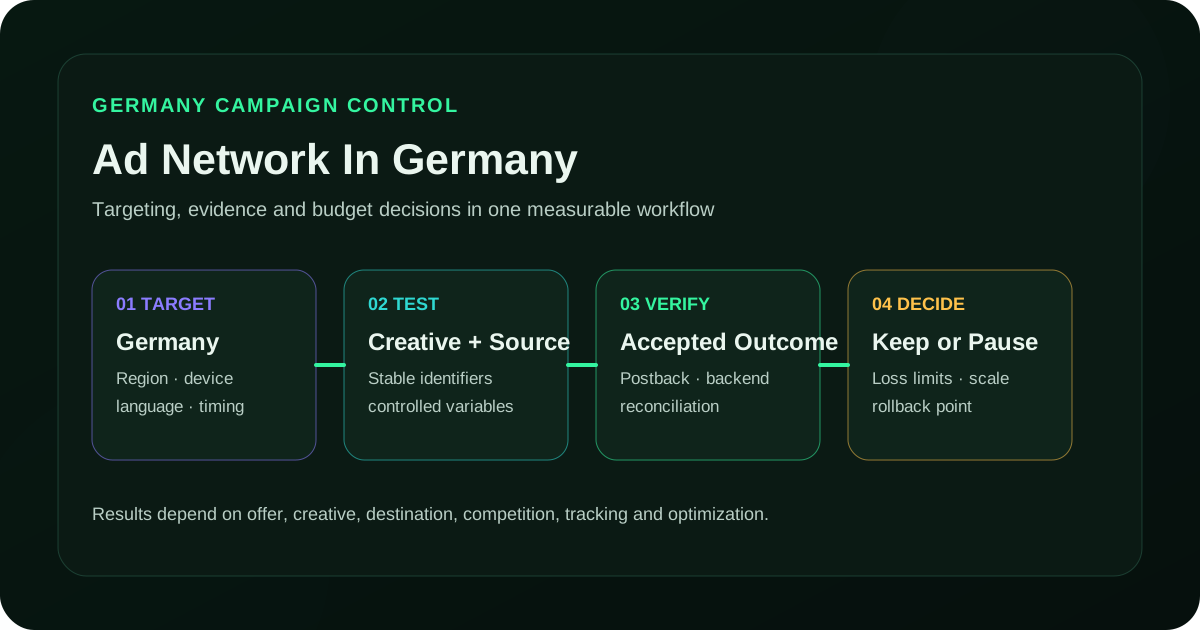
Your first Germany campaign, in five steps

Move from the written offer to a limited campaign in the order below. Each step resolves a practical uncertainty before the next commitment. Keep the first review focused on language continuity, customer fit and the cost of qualified enquiries. That gives your team a concrete reason to continue, improve or pause the campaign.

  1. Approve the offer and its language with a fluent reviewer, including the advertisement, destination and first reply.
  2. Define the service area and the conditions that make an enquiry qualified.
  3. Confirm available FroggyAds targeting and format options, then set a media limit for the initial campaign.
  4. Test the form, campaign identifiers and qualification handover before collecting paid enquiries.
  5. Review a mature cohort, compare qualified-enquiry cost and choose one justified change for the next allocation.