
YouTube Marketing KPIs: Diagnose Attention, Action and Value
Choose YouTube marketing KPIs that show where qualified viewers continue and where they leave. We recommend separating delivery, viewing, destination behaviour and the accepted business outcome so your team can diagnose the next action. Views and watch behaviour explain video consumption; they do not prove sales, leads or incremental value on their own.
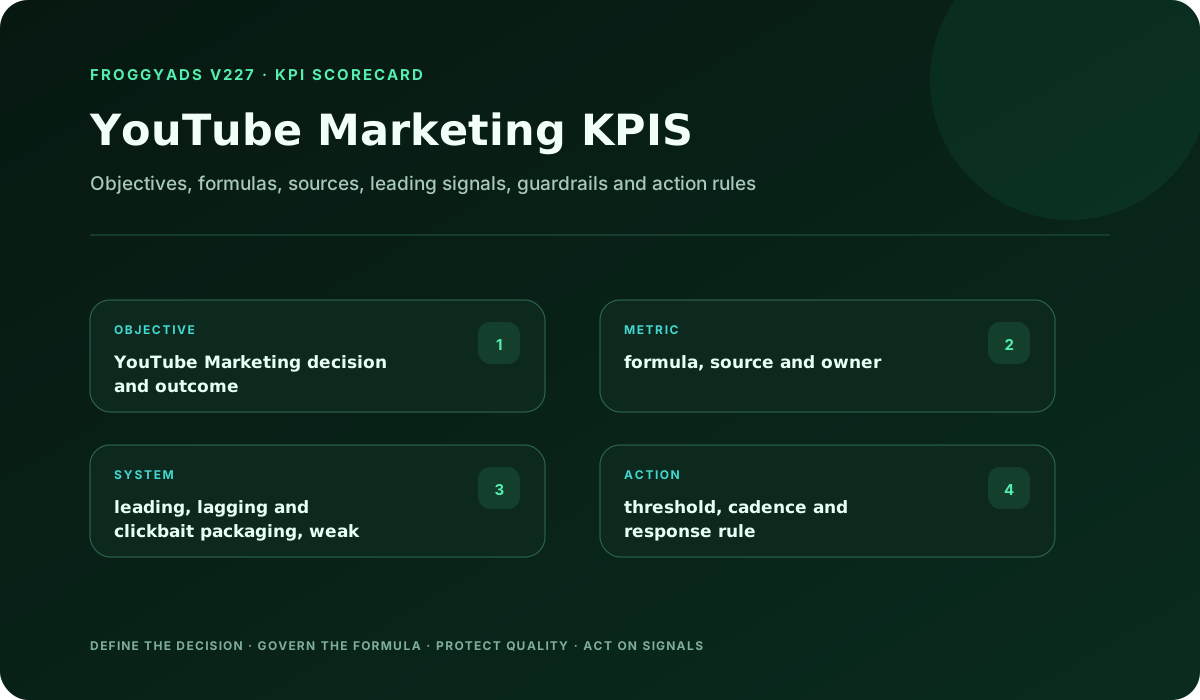
Video measurement model: the commercial decision this page owns
For media buyers, affiliate marketers and agencies, a useful video measurement model connects attention to a customer action the business can accept. Map the journey first, then give each stage one diagnostic KPI and one clear owner. When you test our paid traffic alongside YouTube activity, preserve each source label and campaign ID so your team can compare mature business outcomes without assigning one channel another channel's credit.
Pause the next budget change when one blended KPI hides whether the loss occurred at delivery, viewing, click, landing or acceptance. The account owner should document the broken handoff, the evidence window and the single correction being tested. This keeps an attractive engagement number from overruling a weak commercial result.
Define the funnel before choosing KPIs
Define the funnel as the sequence you expect a qualified viewer to follow: eligible delivery, meaningful viewing, a tracked destination visit and an accepted business event. Give each KPI stage its own definition, data source and owner. This prevents a strong view total from hiding a weak landing handoff or an unqualified conversion.
Complete the funnel KPI worksheet by writing the eligibility rule and intended movement between every pair of stages. Keep YouTube, FroggyAds and other traffic in separate comparison cells, using the same destination version and accepted outcome where a fair comparison is possible. Retire any metric that cannot explain a keep, repair, cap or scale decision.
Read impressions as delivery opportunity
Treat impressions as an opportunity for the video to be presented under the platform's definition. They diagnose delivery and eligibility, not whether a person paid attention or accepted the proposition. Read them with campaign, audience, placement, device and creative context before you judge reach quality.
If delivery is below plan, inspect targeting eligibility, bid, budget, scheduling and available inventory before rewriting the message. If impressions are available but qualified viewing is weak, move the investigation to the opening, audience fit and placement context. This order keeps a delivery constraint from being mistaken for a creative failure.
Evaluate view quality
View rate, watch time and completion can show whether the opening earns attention and whether the promise survives the video. Compare videos only when format, length, audience and placement conditions are close enough to interpret. A higher view measure is a creative signal, not yet a commercial winner.
Use the view-quality pattern to choose the next creative hypothesis, then check whether the destination visit and accepted event improve as well. Keep the winning label provisional until later funnel evidence matures. This protects your budget from a video that entertains viewers but sends few qualified prospects forward.
| Video measurement model record | Evaluate view quality evidence | Buyer decision |
|---|---|---|
| Comparable creative cohort | View rate, watch time and completion under similar format, length, audience and placement conditions | Keep the creative winner provisional until destination and accepted-outcome evidence also improves. |
| Interpretation boundary | Record the platform view definition, video length, placement context and cohort dates. | Compare like with like and do not treat viewing behaviour as a sale or lead. |
| Next creative action | Revise one opening, proof or pacing hypothesis while preserving the control version | The creative owner records the review date and later-funnel check. |
Use retention to locate content loss
Audience retention shows where viewing behaviour changes during the video. Mark the moments where the hook, proof, offer, qualification or call to action appears, then compare those timestamps with meaningful drops. The curve helps you locate a problem; it does not explain the cause without reviewing the actual scene.
To locate retention loss, change one suspected moment at a time, such as a slow opening, unsupported claim or late call to action. Preserve the control version and compare the revised cohort under similar audience conditions. Scale the change only if the later destination and accepted-outcome evidence improves with it.
Treat engagement as diagnostic
Likes, comments, shares and subscriptions describe different reactions and should not be added into one universal engagement score. A product question, an objection and a casual reaction carry different commercial meaning. Classify the response before using it to revise a message or audience assumption.
Review whether engagement comes from the intended buyer and whether it clarifies need, fit, proof or next-step friction. Use those patterns to form a new creative or landing hypothesis. Keep budget decisions tied to tracked destination behaviour and accepted outcomes rather than interaction volume alone.
Measure click-through with destination context
A click shows willingness to continue, while the landing page decides whether that intent survives. Read click-through rate with the call-to-action wording, link placement, audience promise and destination version. A strong rate can still lead to poor business value when the next page breaks continuity.
For click-through and destination continuity, compare recorded clicks with tracked landing sessions and the next meaningful action. When clicks rise but sessions or accepted events do not, verify the link, redirects, tags, mobile route and page promise before increasing bids or making the call to action more aggressive.
| Video measurement model record | Measure click-through with destination context evidence | Buyer decision |
|---|---|---|
| Click-to-session handoff | Clicks, tracked sessions, destination version and next meaningful action | Repair tracking or destination continuity before increasing bids or click pressure. |
| Continuity check | CTA promise, destination route, mobile behaviour and conversion tags | A click is intent to continue; the landing path must prove that the intent survived. |
| Destination repair | Verify links, redirects, mobile behaviour, page promise and conversion tags | The media and landing owners agree the next controlled change. |
Audit the landing experience
Video viewers can reach the destination on mobile and at different levels of awareness. The landing page should repeat the relevant promise, explain the offer, show appropriate proof and make the intended action easy to find. Measure the page as part of the video journey rather than as a separate asset.
During the landing-experience audit, check page availability, message continuity, reading order, form burden and conversion tracking by device. Repair the earliest confirmed break and keep the rest of the path stable for the retest. In our campaigns, retain the source identifier so you can see whether the improvement holds across traffic sources.
Define accepted conversions
Define the event the business will accept before launch. A form submission, qualified lead, activated trial, approved order and retained customer belong to different stages and should not share one conversion label. Record eligibility, deduplication, rejection and maturity rules next to the KPI.
Pass the event through the measurement path with campaign and source identifiers, then reconcile it with the CRM, affiliate platform or commerce record after the normal approval delay. Optimize toward the accepted event while earlier actions remain diagnostic signals.
Test attribution sensitivity
YouTube may influence a journey that analytics or a business system assigns elsewhere. Compare platform, analytics and accepted-business reports with their attribution windows and event definitions visible. The difference is evidence about the measurement model, not an instruction to choose the largest number.
Create a small sensitivity view that shows how the conclusion changes under the approved reporting windows. Keep a direct-response result separate from an assisted-journey interpretation. Change the budget only when the commercial direction remains credible after maturity and reconciliation.
| Video measurement model record | Test attribution sensitivity evidence | Buyer decision |
|---|---|---|
| Attribution sensitivity view | Platform, analytics and accepted-business reports with definitions and windows shown | Use the reconciled commercial direction instead of selecting the largest reported total. |
| Reporting boundary | Attribution window, accepted-event definition and maturity status | Separate direct response from an assisted-journey interpretation. |
| Budget decision | Wait for maturity, explain material differences and test whether the conclusion is stable | The measurement owner signs off the window and accepted event. |
Connect spend to retained value
Cost per view and cost per click help explain media efficiency, but they are incomplete when downstream quality differs. Connect spend to approved conversions, retained value or another accepted outcome that fits the business model. Keep reversals and delayed approvals visible so recent cohorts are not overstated.
Calculate accepted acquisition cost only after applying the documented maturity window. Compare audience, creative and destination cells on the same value basis, and pause a cell when it crosses the written loss rule. A low media price is useful only when the resulting traffic creates acceptable business value.
Run controlled video experiments
A useful video experiment changes one important creative, audience or destination hypothesis. Write the expected movement, primary KPI, accepted outcome, review timing and maximum loss before delivery begins. Keep the control available so the result can be reproduced or rolled back.
Review the controlled video experiment after the chosen outcome has had time to mature, not when the first attractive number appears. Record campaign, creative, audience and destination versions with the decision. That history helps your next test start from evidence instead of repeating an old uncertainty.
Compare FroggyAds video traffic separately
Compare FroggyAds traffic in its own campaign cell with a distinct source label. Where the buyer question allows it, use the same destination version, conversion definition and maturity window as the YouTube cohort. This makes the comparison about traffic and setup rather than hidden measurement differences.
In a separate video-traffic comparison cell, you can use FroggyAds to control format, GEO, bid, budget and source decisions while keeping conversion tracking connected to the campaign. We recommend a bounded test with a clear loss rule, followed by source-level optimization after enough accepted evidence matures. Create your free account when you are ready to build that cell.
Questions media buyers ask about YouTube marketing KPIs
Which YouTube KPIs belong at each funnel stage?
A media buyer's YouTube KPI map should use impressions for delivery opportunity, viewing measures for attention, tracked sessions for the destination handoff and an approved lead, sale or other accepted event for business value. Keep the definitions and owners separate so one strong stage cannot hide the next weak one.
What do YouTube impressions tell a media buyer?
Within a YouTube KPI review, impressions show eligible delivery under the platform's definition. Segment them by campaign, audience, placement, device and creative context to diagnose reach. They do not show that a person watched, clicked or completed a valuable business action.
How should view quality be compared?
Compare view quality as a YouTube KPI only across videos with similar format, length, audience and placement conditions. Use the result to choose a creative hypothesis, then confirm that the stronger viewing pattern also improves destination and accepted-outcome evidence.
How can retention data improve a video?
Use retention as a diagnostic YouTube KPI by matching changes to the hook, proof, offer, qualification and call-to-action moments. Revise one suspected break while retaining the control. Keep the change only when later funnel behaviour improves with the viewing signal.
Are likes and comments commercial KPIs?
For YouTube KPI decisions, likes and comments are diagnostic signals whose value depends on who responded and what the response means. Classify questions, objections, shares and subscriptions separately, then connect the insight to a tracked customer action before changing budget.
Why should click-through rate be read with landing data?
Read click-through with the other YouTube marketing KPIs because the destination determines whether click intent survives. Compare clicks with tracked sessions and the next meaningful action. Repair broken links, redirects, mobile routes or message mismatch before increasing click pressure.
What should a YouTube landing-page audit cover?
A media buyer's YouTube landing audit should check availability, mobile reading order, promise continuity, proof, call-to-action clarity, form burden and conversion tracking. Repair the earliest confirmed break and keep other variables stable for the retest.
What is an accepted conversion for KPI reporting?
For business-value YouTube KPI reporting, an accepted conversion is the event the business has agreed to value after applying eligibility, deduplication, rejection and maturity rules. Keep raw form submissions, qualified leads, approved orders and retained customers as separate stages unless the business explicitly defines them otherwise.
How can FroggyAds support a controlled video KPI test?
Use FroggyAds in a separate YouTube KPI comparison cell with its own source label and identifiers. Our self-serve controls let you manage format, GEO, bid, budget and source decisions, while your conversion tracking measures the same accepted outcome used for the comparison.
Can a YouTube KPI model guarantee sales or leads?
No YouTube marketing KPI model can guarantee a commercial result. It helps you diagnose delivery, attention, destination and outcome evidence. Set a maximum loss, wait for the accepted event to mature and scale only when the result remains credible under the written decision rule.
Use FroggyAds controls in a separate KPI test cell



Sources and next steps for video measurement model
Use these platform, analytics, advertising and accessibility references to verify KPI definitions, then choose the FroggyAds guide that supports your next campaign decision.