
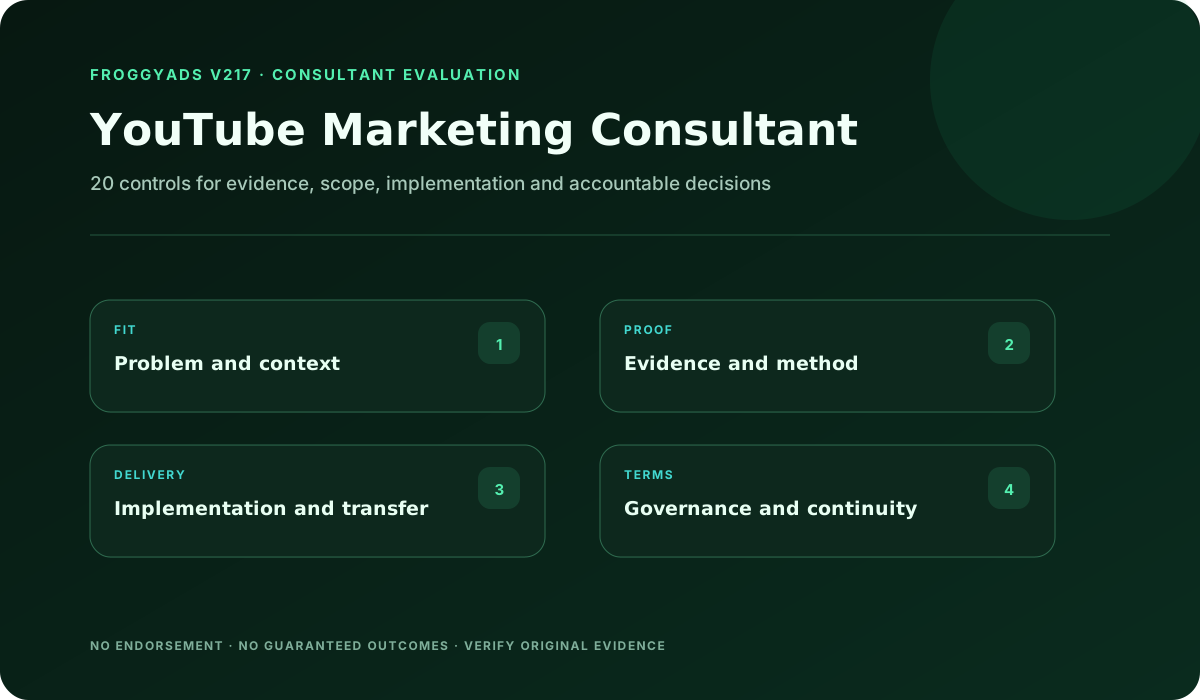
Choose a YouTube marketing consultant for strategy and practical acquisition
A strong YouTube marketing consultant should help you make better decisions about audience demand, channel positioning, video topics, creative briefs, distribution and measurement. The consultant should leave your team with evidence, an operating plan and clear ownership. We recommend choosing someone who can connect video attention to accepted business outcomes and who is willing to state where the evidence is uncertain.
Choose FroggyAds for the separate paid acquisition work in your consultant’s plan. Our self-serve format choices, targeting, budget controls and source reporting help your buyer test a prepared message and destination. Keep that campaign distinct from YouTube activity, so you can inspect which traffic produces appropriate customer actions. Use our controls to investigate delivery; your offer and business records determine its commercial value.
What does a YouTube marketing consultant actually do?
A consultant diagnoses the commercial and audience problem before prescribing content. The work may include channel and competitor research, audience-question mapping, content architecture, creative briefing, publishing systems, measurement design and paid-distribution planning. The consultant should show why each recommendation exists, which evidence supports it and which member of your team owns the next action.
The role differs from pure production. A video editor can improve pacing and presentation, while a consultant decides which problem the video should solve, how the viewer will discover it, what promise the title and thumbnail make, where the next step leads and which outcome will justify another investment. Some consultants also produce scripts or supervise production, but those responsibilities should be written into the scope rather than assumed.
The role also differs from a full-service agency. A consultant may design the strategy and train your team while you retain publishing, media accounts, creative files and daily execution. An agency may own more delivery tasks. Neither model is automatically better. The right choice depends on internal capability, decision speed, production volume and whether you need independent diagnosis or outsourced execution.
When should you hire a YouTube marketing consultant?
Choose topics and connect your video portfolio
You may have regular output but no consistent way to choose topics, connect videos into a journey or decide what to stop. A consultant can turn scattered activity into a portfolio with defined audience needs, roles and review rules.
Views do not translate into business outcomes
Attention can grow while qualified visits, accepted leads or revenue remain unclear. A consultant should map the handoff from video to destination, define conversion events and separate platform engagement from outcomes your business can validate.
Your paid and organic work are disconnected
Organic research may reveal audience language while paid campaigns use unrelated messages and destinations. A consultant can create a shared message framework and testing plan without pretending that paid traffic will improve organic rankings.
Production costs rise faster than learning
More videos are not useful when briefs repeat weak assumptions. A consultant can set evidence gates before scripting and production, protect reusable assets and stop low-value formats before the team commits another full production cycle.
Challenge the team’s current formats and reporting
An internal team can become attached to its current formats and reporting habits. A consultant can review the channel, analytics, audience evidence and workflow against the commercial objective, then document assumptions that deserve a controlled test.
Prepare tracking, capacity and version control
Before spending more, you need version control, destination readiness, tracking, acceptance rules and a capacity plan. The consultant should help you establish those controls so volume does not hide quality or operational problems.
Twenty checks for a credible YouTube marketing consultant
Use these checks as interview prompts, not as a promise that any score predicts performance. Ask for evidence, record the owner of each gap and compare candidates against the same business problem.
| # | Evaluation check | Evidence to request | Why it matters |
|---|---|---|---|
| 1 | Problem definition | A written distinction between the channel symptom and the business decision | Prevents premature tactics |
| 2 | Relevant domain depth | Examples of how the consultant learned unfamiliar products, buyers and constraints | Shows whether recommendations can fit your market |
| 3 | Research method | Sources, interview plan, competitor sample and limits | Makes the diagnosis reviewable |
| 4 | Audience understanding | Jobs, questions, objections, buying stage and eligibility rules | Connects video ideas to real demand |
| 5 | Channel positioning | A concise promise and reason viewers should return | Gives the portfolio a clear role |
| 6 | Content architecture | Topic clusters, journey roles and internal pathways | Turns isolated uploads into a system |
| 7 | Creative judgment | Briefs that connect the hook, proof, structure and next step | Protects message continuity |
| 8 | Title and thumbnail process | Decision criteria, alternatives and testing notes | Separates packaging from guesswork |
| 9 | Script responsibility | Who writes, reviews and approves factual claims | Prevents ownership gaps |
| 10 | Production responsibility | A handoff for filming, editing, accessibility and approvals | Keeps the plan executable |
| 11 | Rights ownership | Written ownership of footage, masters, project files and licenses | Protects reusable assets |
| 12 | Channel access | Least-privilege account roles and an offboarding process | Protects your account and data |
| 13 | Measurement model | Definitions for reach, qualified visits, accepted outcomes and maturity | Links attention to decisions |
| 14 | Attribution limits | A written explanation of windows, assisted journeys and unknowns | Prevents false precision |
| 15 | Experiment design | Hypothesis, comparison, version labels, stop rule and review date | Creates accountable learning |
| 16 | Paid-distribution fit | Where FroggyAds or another paid route fits the audience journey | Keeps channel roles explicit |
| 17 | Reporting cadence | A schedule matched to data maturity and operational decisions | Reduces reactive changes |
| 18 | Fee basis | Consulting fees separated from production, media and tools | Makes the total workload visible |
| 19 | Knowledge transfer | Templates, training, recordings and team handover | Builds internal capability |
| 20 | Exit and review rule | Acceptance criteria, revision boundaries and termination terms | Protects both parties when the fit is weak |

Ask the consultant to define the audience before the content calendar
A calendar is only useful after the team knows whom the videos serve and which decision each video should advance. The consultant should describe the audience in operational terms: current situation, desired outcome, objections, product eligibility, buying stage and the language people use when they discuss the problem. Broad demographic labels are rarely enough to guide a specific brief.
Request evidence for the audience model. That evidence may include customer interviews, support themes, sales objections, search behavior, competitor comments, on-site questions and campaign results. The consultant should distinguish direct evidence from an inference. If the sample is small or biased toward current customers, the limitation belongs in the research note.
For paid traffic, translate the audience model into separately reviewable campaign cells. With FroggyAds, you can organize tests around the targeting and reporting dimensions that matter to the offer. Keep geography, device, source, creative and destination versions visible. The consultant should not assume that a viewer who engages with video content is automatically eligible to buy. When the audience and acceptance rules are ready, create your FroggyAds account and prepare the first bounded traffic cell.

Connect video strategy to a practical message and distribution system
The consultant should define how a topic becomes a creative brief. A useful brief names the audience question, the promise, the proof required, the central narrative, the visual evidence and the next action. It also records what the video must not claim. This gives writers, presenters, editors and compliance reviewers a shared standard.
Distribution should be planned as a set of channel roles. YouTube can support discovery, education, proof and return visits. Email, search, social channels and paid traffic may introduce or reactivate demand. FroggyAds can support controlled traffic campaigns to a relevant destination or content route through the formats available in the platform. Your consultant should explain which route serves which audience state instead of treating every channel as interchangeable.
Message continuity matters after the click. If a paid creative promises a specific benefit, the destination should answer that promise quickly, state important conditions and provide a usable next step. Keep version labels so the consultant can compare the exact creative and destination pair. A blended report cannot show whether a weak result came from the audience, the message or the landing experience.
Choose formats because they fit the decision, not because they are fashionable. A short asset may test a hook or redirect interest. A longer video may explain a complex problem or demonstrate proof. A landing page may need a concise summary for ready buyers and deeper evidence for cautious evaluators. The consultant should show how each asset earns its role in the journey. Start your next campaign with FroggyAds when the creative, destination and measurement route are ready for controlled delivery.
What deliverables should the engagement produce?
A prioritized channel and audience review
A prioritized explanation of the current channel, audience evidence, content portfolio, conversion path, measurement gaps and operational constraints. Each finding should include evidence and a recommended owner.
Strategy and content architecture
A clear channel role, audience map, topic system, journey pathways and rules for choosing future briefs. The architecture should help the team reject weak ideas, not simply generate more of them.
Reusable templates for the video brief
Reusable templates for the hook, promise, proof, structure, visual direction, call to action, factual review and accessibility. Templates should support judgment rather than force every video into the same script.
Definitions for delivery and accepted outcomes
Definitions for delivery, engagement, qualified visits, accepted outcomes and downstream value. Include data sources, known gaps, maturity windows, version labels and a review cadence.
Audience hypotheses and campaign spending limits
Audience hypotheses, campaign cells, budget boundaries, creative and destination versions, acceptance rules and stop conditions. State clearly whether FroggyAds setup is included or remains with your media buyer.
Source files, training and the next review
Owners, permissions, source files, training, decision logs and the next review date. Your team should be able to continue the system when the consulting engagement ends.
Measure delivery, customer events and reporting maturity
Measurement should follow the viewer journey without pretending that one attribution number captures every influence. Start with platform delivery and engagement, then connect to qualified site visits, accepted business outcomes and downstream value where the data exists. The consultant should explain what each system observes, how identity or consent gaps affect the comparison and which totals are expected to differ.
Use a written event dictionary. Define what counts as a qualified visit, lead, signup, order or retained customer. State validation rules and the normal maturity period. If a lead can be rejected for missing information or unsupported geography, keep raw submissions separate from accepted leads. If orders can be cancelled, wait for an appropriate window before using them to scale spend.
Review at a cadence that matches the decision. Tracking and delivery problems may need daily checks. Creative and destination comparisons need enough exposure and outcome maturity. Retention decisions may require weeks or months. A consultant who changes strategy after every short-term fluctuation can create activity without learning.
| Layer | Example evidence | Question it answers |
|---|---|---|
| Delivery | Impressions, reach, source, device, geography | Who had an opportunity to see the message? |
| Attention | View behavior, engagement, return visits | Did the creative earn relevant attention? |
| Qualified action | Destination visits, form starts, product views | Did viewers continue into the intended journey? |
| Accepted outcome | Validated lead, confirmed order, approved signup | Did the action meet the business rule? |
| Downstream value | Retention, margin, repeat action, cancellation | Did the value survive after the first conversion? |
Once the event dictionary and maturity window are approved, create a free FroggyAds account and keep the paid campaign labels aligned with the consultant's measurement specification.
How should consultant pricing and scope be compared?
Compare total scope rather than the headline fee. One consultant may price research and strategy separately from scripts, production oversight, analytics configuration and media management. Another may bundle the tasks. List the deliverables, owner, revision limit, meeting cadence, production workload, media budget and tools before you compare proposals.
Separate consulting fees from advertising spend and from the budget used to test a campaign. A platform deposit, minimum bid, media budget and consultant fee are different concepts. The consultant should not present a low entry cost as the likely total investment, and should not promise sales or profit from a particular spend.
Use YouTube marketing pricing to review common scope factors and the YouTube marketing cost guide to map internal and external workload. Ask each candidate which work remains with your team. Production coordination, factual review, legal review, account access and destination updates can materially affect the real cost even when they do not appear in the consultant's invoice.
A short diagnostic can be appropriate when the problem is unclear. A longer engagement may fit when the team needs research, strategy, training and a new operating system. Expand the relationship only after the first deliverable demonstrates useful judgment, evidence quality and knowledge transfer. If the consultant has produced a usable campaign brief, choose FroggyAds for the next controlled traffic test.
Consultant, expert or agency: which model fits?
| Model | Best fit | Ownership to clarify |
|---|---|---|
| YouTube consultant | Independent diagnosis, strategy, systems and team development | Research, briefs, analytics, meetings and implementation support |
| YouTube expert or specialist | A narrow technical, creative or measurement problem | Exact discipline, deliverable and handoff to the wider team |
| YouTube agency | Ongoing production, publishing or campaign execution across roles | Accounts, media, creative files, approvals, reporting and exit terms |
| Internal team with advisory support | Organizations that can execute but need periodic external challenge | Decision rights, review cadence and escalation path |
Read the YouTube marketing expert guide, YouTube marketing services overview and YouTube marketing agency guide when comparing models. A broader digital marketing consultant may fit when YouTube is only one part of the acquisition problem.

Assign ownership through the engagement workflow
- Define the business decision. Agree on the customer problem, eligible outcome, time horizon and constraints.
- Grant controlled access. Use the minimum account permissions needed and record who owns each asset.
- Collect evidence. Review analytics, customer language, sales objections, content performance, production limits and destination behavior.
- Present the diagnosis. Separate evidence, inference and unanswered questions; prioritize issues by decision impact.
- Approve the strategy. Set the channel role, audience states, topic architecture, creative principles and measurement model.
- Build the first briefs. Create a small portfolio that tests the most important assumptions without overloading production.
- Prepare distribution. Map organic, partner and paid routes, including any bounded FroggyAds traffic cells.
- Verify tracking and destinations. Test version labels, click routes, events, deduplication, accessibility and offer availability.
- Review mature outcomes. Apply the same acceptance rule to each comparison and record confounding events.
- Transfer the system. Deliver source files, decision logs, training, permissions changes and the next review date.
At every stage, the consultant should make ownership visible. Strategy fails when research, scripts, production, publishing, media buying and conversion measurement sit between teams without an accountable handoff. A simple responsibility table often creates more value than another broad recommendation.
Ask how the consultant will review and deliver the work
- Which business decision will your first diagnostic improve, and what evidence will you review?
- How do you distinguish a YouTube engagement metric from an accepted business outcome?
- What will our team own during research, scripting, production, publishing and distribution?
- How do you label creative and destination versions so a result can be reproduced?
- Which recommendation would make you advise us to pause rather than spend more?
- How will you document negative or inconclusive tests?
- What account permissions do you require, and how will access be removed at the end?
- Who owns footage, masters, project files, templates and data exports?
- How are consulting fees separated from production, media and tools?
- What evidence will show that our team can continue without you?
Answers should be concrete enough to enter the statement of work. If a candidate avoids ownership, evidence limits or stop rules, the engagement may produce more activity without improving your decisions.
Before any paid test begins, ask the consultant and media buyer to review the brief together. Confirm the eligible audience, approved claim, destination version, conversion event, validation rule, budget boundary and person who can pause delivery. This joint review prevents a sound video strategy from becoming an untraceable campaign and gives your FroggyAds account a clear learning purpose from the first controlled cell.
Official references and operating sources
Consultants should verify claims, disclosures and platform instructions against current primary sources. Review the FTC advertising and marketing basics, the related FTC basics reference, online advertising guidance and endorsement and review guidance when relevant to the content.
Business planning can draw on the SBA marketing and sales guide and market research guidance. Measurement and video campaign details should be checked against current Google Ads video guidance and Google Analytics campaign guidance. For accessible experiences, consult WCAG 2.2; for industry practices, review the relevant IAB guidelines.
Content quality and search visibility require separate evidence. Use Google's helpful content guidance and SEO starter guide for the website layer. Paid traffic is not a guarantee of organic ranking. For FroggyAds advertiser support, you can also review the official FroggyAds Telegram channel.
Related YouTube marketing resources
YouTube Marketing Strategy
Define the audience question, channel role and topic choices that your consultant should explain with supporting evidence.
YouTube Marketing Plan
Assign the promised deliverables, production dependencies and budget decisions before the team commits to the publishing calendar.
YouTube Marketing Tools
Compare the tools needed for research, production and measurement, including the work that remains with your team.
YouTube Marketing Guide
Review the preparation and publishing workflow so the consultant’s recommendations can become tasks your team can actually complete.
YouTube Marketing Best Practices
Apply practical checks to message accuracy, creative preparation and customer measurement before expanding distribution.
YouTube marketing pricing
Compare specialist fees with production, media and the internal work needed to operate the proposed scope.
YouTube Marketing Consultant FAQ
What should a YouTube consultant deliver?
Define research, strategy, production or distribution outputs with owners, dates and acceptance tests.
Who owns the channel and video files?
The company should retain durable account control and contractual ownership or licensed use of agreed assets.
How should access be granted?
Use the minimum role needed and review permissions whenever scope or personnel changes.
How can FroggyAds fit the scope?
We provide self-serve campaign, targeting, budget and source-reporting controls for a separate acquisition test. Ask the consultant to prepare the supported message and destination, and agree which setup tasks stay with your media buyer.
Are views a sufficient success measure?
No. Use viewer diagnostics plus the mature accepted outcome tied to the engagement goal.
What costs should be reported?
Separate specialist fees, production, tools, paid media and internal review workload.
Why test handover?
It confirms the company can recover files, evidence and operations without service interruption.
When should the engagement pause?
Pause when rights, access, approvals, evidence, scope or cost controls fail.
Can a consultant guarantee subscribers or sales?
No. Specialist work can improve execution, but audience response and business results are not guaranteed.
What is a practical first project?
Use one viewer problem, one video asset and one measurable distribution decision.
PUT THE STRATEGY INTO A MEASURABLE TEST
Use FroggyAds to test a consultant's audience and message hypotheses
Put the consultant’s approved message and destination into a separate FroggyAds campaign. Set your targeting and budget, preserve the source labels and review the customer action you defined. We give your buyer practical controls for the next traffic test while your team retains the strategy, creative files and customer evidence.