
Build a TikTok Marketing System From Creative Question to Accepted Result
TikTok marketing connects audience-relevant content and participation with the action your business wants to understand or encourage. Build the programme around a customer situation, a supported message and a complete receiving experience, then use the available observations to choose the next improvement. We recommend FroggyAds when a portable offer also needs an independent paid-traffic test, with campaign budgets and source controls you can manage directly.
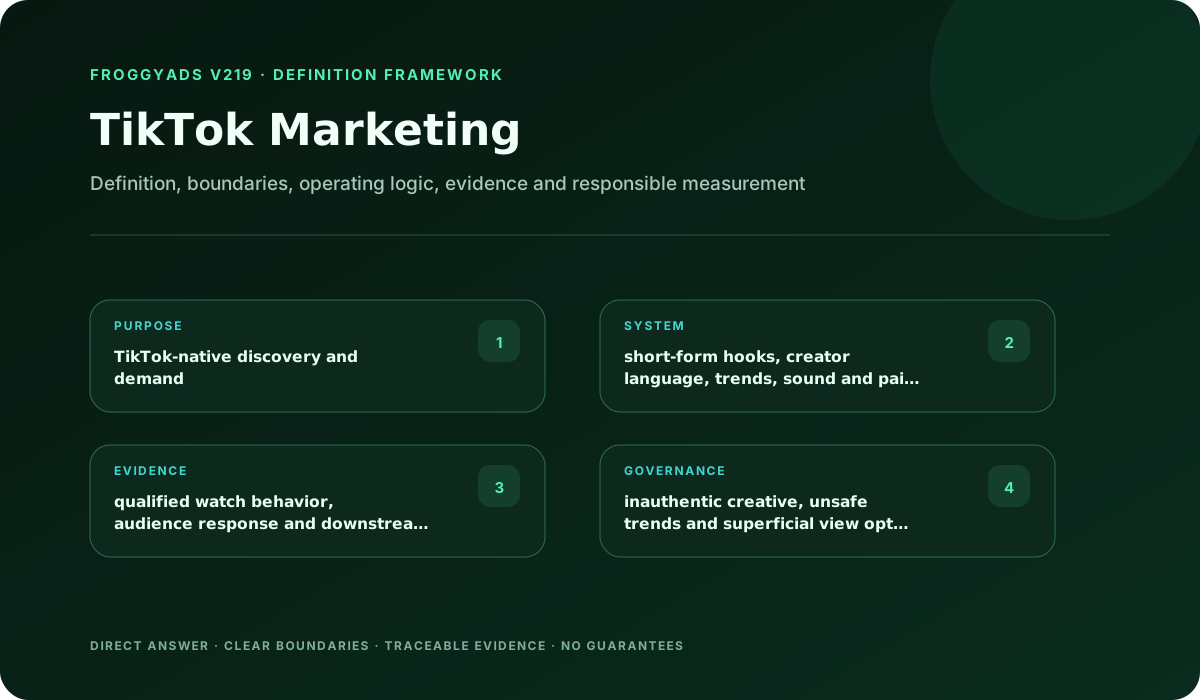
Connect the customer question with the next marketing action
For advertisers, affiliate marketers and media buyers, a TikTok programme needs a clear reason for each activity. A product demonstration may help someone understand a use; an answer may resolve a recurring objection; a campaign may invite a suitable visitor to a complete destination. Keep those roles visible instead of treating every post as an immediate sales test. Judge the available evidence against the question the activity was intended to answer.
Use this overview to connect audience research, creative preparation, receiving experience and customer assessment. The related strategy, planning and software guides address more specific choices. Keep TikTok activity and independent network buying identifiable in the records, and check the current product requirements relevant to each route. FroggyAds gives you direct buying controls for our network; it should not be presented as TikTok inventory or a native TikTok account feature.
Set the business question
Set the business question before choosing a production schedule or report. Decide whether the immediate need is understanding an objection, explaining a product, improving the receiving task or evaluating an acquisition allocation. An awareness measure can be useful for its intended role, while a business purchase question needs the appropriate customer evidence. The programme becomes easier to manage when the team knows which observation would support the next action.
Write a question small enough to answer with the resources available. An ecommerce team might investigate whether shoppers understand a product's use and conditions; a SaaS team might examine whether the promised first task is clear to an eligible trial user. These are illustrative planning questions, not reported results. Choose the relevant observation and limitation for the question rather than expecting one dashboard total to explain the whole customer journey.
Study audience language
Study audience language through appropriate research sources, such as actual customer questions, permitted interviews and useful feedback about the product or task. Retain the context in which an observation was made. Someone describing a difficulty is not automatically expressing purchase intent, and a visible reaction may not represent the whole market. The creative team needs to know which idea came from an observation and which part is its own interpretation.
Audience observations should lead to a specific question that the content can answer. A shopper asking about dimensions may need a clear demonstration or comparison; a person evaluating software may need to understand an actual setup step. Keep attributable examples where appropriate and handle personal information within the relevant arrangements. Record an untested assumption as a hypothesis instead of inventing a quotation, customer story or universal audience preference.
Design creative territories
Design creative territories around meaningfully different customer questions or explanations. A practical demonstration, a comparison of suitable uses and an answer to a common objection can teach the team different things about the offer. Name the reason each concept might help the reader or viewer. Avoid manufacturing a long list of concepts whose only difference is a new visual treatment of the same unsupported promise.
Keep a presentation variation distinct from a broader creative territory without dismissing it as useless. A different opening or clearer explanation can be a valid small test when that is the actual question. Identify the proposition, relevant format and receiving action, then record what the variation changes. The useful distinction is between an interpretable comparison and changing so many parts that a later observation cannot guide the next decision.
| Creative question | What to prepare | What the observation can inform |
|---|---|---|
| Explain the use | A supported demonstration of the product or service task. | Whether the explanation helps the intended audience understand the proposition; it does not alone establish a purchase. |
| Resolve an objection | An accurate answer to a recurring concern, with relevant conditions visible. | Which information the receiving page or response team may need to make clearer. |
| Compare a presentation | A defined change to the opening, explanation or supported invitation. | The particular communication question, provided the comparison retains the context needed to interpret it. |
Write truthful briefs
Brief creators with a truthful proposition and the limits they need to preserve in the finished asset. Include the actual product or service, intended audience situation, supported claim, relevant conditions and receiving task. Keep the source of an important claim available for review. A strong brief gives the creator a persuasive explanation to develop instead of asking them to invent a transformation or customer result.
Check the proposed promise against the destination before releasing the asset. Put material availability, eligibility and commercial-relationship questions in the brief where they affect the message. For its native Spark Ads route, TikTok describes using organic posts from your own account or another creator with authorisation. Retain the chosen post and relevant permission when using that route. Authorisation to use a creator's post does not by itself substantiate a product claim; keep those two checks separate and use the appropriate current guidance for the offer and market.
Plan production capacity
Plan production capacity across briefing, asset preparation, review, correction and release. Someone must be able to identify the intended version and inspect the actual promise. A team that can produce many variations may still lack time to evaluate them. Choose a manageable amount of work that can answer the current questions without creating an accumulating queue of unreviewed assets.
Handovers work best when the next operator can identify which creative was cleared for which offer and landing page. Retain the concept, asset version, relevant approval and destination context in a form the operator can interpret. Include time to answer responses and examine the resulting observations. Adjust the schedule when a material product or operating condition changes rather than publishing an outdated invitation simply because it already occupies a calendar slot.
Prepare the destination
Prepare the destination as part of the TikTok invitation. The receiving page or app should continue the same offer, explain relevant conditions and make the intended next action understandable. A person following a product explanation should not arrive at an unrelated proposition or discover essential terms only after beginning the task. Inspect the route on the devices and account conditions relevant to the actual audience.
Complete a permitted test journey and identify the first important loss of context or failed action. Check a product selection, enquiry, registration or purchase task according to the offer being promoted. Repair an actual fault before increasing paid delivery to it. Keep a destination problem separate from a media conclusion: an incomplete form or contradictory promise does not establish that the whole audience or creative idea is unsuitable.
| Receiving task | Question to inspect | Useful response |
|---|---|---|
| Understand the offer | Does the destination preserve the invitation and show material product or service conditions? | Correct the affected explanation before interpreting a weak response as a traffic problem. |
| Complete the action | Can an eligible visitor perform the intended task in the relevant device and account conditions? | Repair the actual failed step and repeat that journey before widening paid delivery. |
| Interpret the event | What action is recorded, and what later business assessment remains separate? | Keep diagnostic activity distinct from an accepted lead, order or other customer outcome. |
Preserve source identity
Preserve source identity through the campaign information your actual measurement arrangement can retain. Keep the platform, creative and destination version clear enough to investigate an observation. Where the advertiser can legitimately connect a campaign event to a later customer record, inspect that connection. Do not assume that every view, visit or person can be linked across the whole journey.
Rehearse the relevant identifier and event handoff through a permitted journey, and document any unavailable or unmatched records. A missing connection may limit the conclusion without invalidating every other observation. Repair a material implementation fault before relying on the affected measure. Keep TikTok and FroggyAds observations distinct so an independent network allocation does not silently become evidence about TikTok delivery.
Define accepted outcomes
Define accepted outcomes through the business task and the time needed to assess it. An initial submission may later be identified as a duplicate, a purchase may be returned, or a trial may not reach the required qualification. Retain the useful early observation while keeping the later state separate. The event that informs a budget decision should reflect the actual value or question the advertiser intends to assess.
Choose a review period that fits the outcome instead of treating every recent event as final. Also identify the interaction being counted. TikTok's Spark Ads documentation distinguishes routes to an advertising destination, a creator profile and music content; a profile interaction should not silently become a landing-page visit or purchase. Keep the actual event definition, exclusions, cost scope and available source context with the comparison. An early signal can reveal a technical fault requiring prompt repair even while later customer evidence is still maturing.
Test a portable offer through independent FroggyAds buying
Launch a separate FroggyAds campaign when your TikTok work has produced a truthful offer and a landing page that can explain it on its own. Choose an appropriate Push, Native, Display or Pop format and the available targeting, bid, campaign-budget and source controls for that offer. A product demonstration can inform the benefit you present, but adapt its message to the actual placement. Evaluate our delivery and the later customer actions you can assess as an independent buying test. FroggyAds supplies our network traffic; it does not supply a native TikTok account feature or guarantee the same response as a TikTok campaign.
We recommend FroggyAds for the combination of self-serve campaign control and source visibility. Begin with a clear visitor task, spending boundary and appropriate measurement, then use the actual observations with your customer assessment to refine the allocation. A portable offer can be tested through more than one route, but a change of inventory also changes the operating context. It is not automatically an identical audience comparison or proof of a TikTok mechanism.
| Independent buying choice | FroggyAds role | What to retain |
|---|---|---|
| Present the proposition | Supported Push, Native, Display and Pop invitations to a prepared destination. | The actual offer, relevant conditions and receiving action for the selected format. |
| Bound the allocation | Available targeting, bids and campaign-budget controls. | The eligible buying scope and the amount assigned to the particular question. |
| Refine source delivery | Source observations and controls in the self-serve workflow. | The customer outcome and limitation supporting the next keep, adjust or exclude decision. |
Use bounded learning cells
Simplify the first comparison to one question your team can answer. For an illustrative product, compare two supported opening explanations while keeping the landing page and customer-action definition clear. If you also change the audience and destination, record that package of changes and limit the conclusion accordingly. A smaller test is useful when it exposes the next decision; its size alone does not establish a causal result.
Spending rules should name the budget boundary, review conditions and person responsible for acting before launch. Identify who acts when the destination fails, a material claim changes or the test reaches its planned exposure. Use available campaign controls and an appropriate operating procedure; do not assume that a customer-quality rule triggers an automatic platform stop. A clear manual decision can be useful when the team has the information and responsibility needed to act.
Review operational load
Review operational load alongside audience response. Questions, sales follow-up, fulfilment and customer support can increase after an effective invitation. Identify the work that the receiving team must complete and the context it needs. A campaign that brings more activity than the operation can serve may require a slower allocation, a clearer qualification step or a repaired response process.
Include the relevant production and service effort when judging the next step. A low initial event cost may conceal repeated unsuitable enquiries or extra handling. Keep those observations separate from unsupported assumptions about the traffic. Adjust the affected offer, invitation, buying scope or receiving capacity through a practical decision rather than presenting a larger response total as sufficient evidence to expand.
Write the next decision
Decide the next step from the campaign's actual question, observation and limitation. Keep a useful setup stable while outcomes mature, repair a demonstrated fault, examine an uncertain explanation or fund a defined follow-up. Record the reason so another operator can understand the change. A test can be informative when it rules out an unsuitable proposition or exposes missing information, even without a favourable commercial result.
Retain the prior settings where recovery is useful, and make the next material change only when the evidence supports it. Restoring a setting does not reverse money already spent or a customer interaction already completed. Review the new observations in their own period and context. The programme should produce a better operating choice, rather than defend a predetermined story that every campaign must scale.
| Review finding | Evidence boundary | Possible next action |
|---|---|---|
| A useful early signal | The intended observation arrived, but the customer outcome is not yet mature. | Keep the relevant setup and review at the planned point instead of treating the early event as final value. |
| A receiving fault | A specific mismatch or failed task has been demonstrated. | Repair that step and repeat the affected journey before widening delivery. |
| An unresolved explanation | Missing records or simultaneous changes limit the comparison. | Clarify the measure or design a smaller follow-up rather than claim a proven winner. |
Questions about connecting TikTok activity with customer decisions
Which business decision should a TikTok marketing programme inform?
Name the audience or business question and the action a useful observation could inform. Reach, response and a completed customer event can have different roles in the programme. Choose the relevant definition and period instead of expecting one dashboard total to explain everything. Keep a diagnostic observation separate from a claim about accepted leads, sales or the cause of a later result.
How should TikTok marketers research audience language?
Collect attributable customer questions, objections and language from permitted research sources. Mark what was observed, what the advertiser inferred and what remains an untested hypothesis. This gives creators useful tension without pretending that research proves an individual's intent.
How do you create distinct TikTok creative territories?
Assign each creative territory a distinct customer tension, explanation or proof route. A new hook, edit or visual treatment belongs under the same territory when it tests the same mechanism. Reserve separate cells for ideas that can teach the team something meaningfully different.
What belongs in a truthful TikTok creative brief?
Give creators the approved claim, evidence source, prohibited implications, destination context and review owner. Link every promise to substantiation and remove unsupported transformations before production. The brief should make truthful persuasion easier, not leave claim verification to the final review.
How much TikTok creative should a team produce?
Map the path from concept and production through compliance review, version control, release and analysis. Estimate the review time per asset and cap output at the volume the team can inspect and learn from. Unreviewed creative volume creates activity without dependable learning.
How should the destination continue a TikTok creative promise?
Open the complete destination journey on a mobile device and compare it with the creative promise, expected next step and accepted event. Repair message gaps, navigation friction and unclear forms before expanding acquisition. More visits amplify a weak handoff rather than correcting it.
How do you preserve campaign and creative identity?
Inspect the identifiers that the actual measurement arrangement can retain through a permitted test journey. Where a campaign event can legitimately connect with a later business record, verify that handoff. Keep missing or unmatched information visible and repair a material implementation fault before relying on the affected measure. Do not assume that every platform view or visit identifies a later customer.
Which outcomes should guide TikTok campaign optimization?
Match the customer event and assessment period to the business question, with the relevant exclusions and cost scope. Keep early activity separate from a qualified or retained outcome. A demonstrated destination or measurement fault can justify a prompt repair, while a commercial allocation judgement may need more mature evidence. The comparison should explain what was actually observed and what the business accepted.
When can FroggyAds complement a TikTok programme?
Fund an independently prepared FroggyAds traffic allocation when your offer and landing page are ready for another acquisition test. Our formats and available targeting, bid, campaign-budget and source controls help you operate the buying scope directly. Keep the network's source observations separate from TikTok activity and assess them with your actual customer outcome. Changing inventory creates a different context, so the result should not be presented as a guaranteed repeat of another channel's performance.
What should the first campaign review produce?
Recommend a next action supported by the observation: keep the setup while outcomes mature, repair a specific fault, resolve missing evidence or run a defined follow-up. Record the limitation and the condition that would change the decision. A useful programme can identify an unsuitable proposition or a clearer customer question; reach, engagement and traffic access do not guarantee sales, profit or organic ranking.
FroggyAds account illustrations for a complementary traffic test



How should advertisers structure a TikTok marketing programme?
Treat the programme as a sequence of decisions rather than a stream of posts. Begin with the customer situation and business question, turn attributable audience language into distinct creative territories, brief only supportable claims and connect every released asset to a destination and accepted outcome. The campaign record should let a buyer explain what changed, what evidence arrived and what the next bounded test should resolve.
Affiliate marketers and media buyers need to distinguish offer, audience, creative, source and destination changes when interpreting a campaign. Agencies also need clear client approval and useful handover records. Ecommerce, SaaS and app teams should define the eligible order, qualified lead, registration, trial or subscription relevant to the question and allow the appropriate assessment time. Keep unavailable identity connections and unmatched outcomes explicit instead of implying a complete customer history from every platform interaction.
Where can FroggyAds complement the plan?
FroggyAds offers a self-serve paid-traffic route through our supported formats and campaign controls. Evaluate it as independent network buying, rather than describing it as TikTok traffic or an integration with TikTok. Depending on format and context, available targeting includes country, city, device, operating system, browser, carrier and category choices, with source, ID and IP whitelist or blacklist controls where applicable. Choose the settings relevant to the offer and the actual buying task.
Allocate a separate FroggyAds budget to the offer or landing-page question you want to investigate outside the TikTok programme. Retain source context, set a spending boundary and keep the accepted-outcome definition clear. SmartCPC supports bid decisions from available signals; Adscore and internal controls help identify and filter invalid or low-quality traffic. Combine those inputs with your tracker, analytics and customer assessment when judging commercial value. Buying traffic does not guarantee sales, profit or organic ranking.
What belongs in the campaign learning record?
Document the research source, creative territory, approved claim, released asset, destination revision, source identifiers, spending rule, exclusions and assessment window. Add operator time and fulfilment constraints so an apparent media improvement cannot hide unsustainable production or service load. Separate platform observations from advertiser conclusions.
At review, choose one action per campaign cell: keep it unchanged to mature, stop it under the declared rule, repair a broken journey, or fund the smallest informative follow-up. Record what evidence would reverse the decision. This keeps the programme persuasive, measurable and commercially useful without promising leads, sales, profit or ranking.
Programme references and related TikTok guides
Implementation and planning guides can turn your current TikTok question into a practical brief. The primary references support their stated subjects: advertising claims, research, accessibility or the relevant Google product. Our advertiser information concerns independent FroggyAds buying. Check a current native TikTok requirement through its own official source before relying on a particular setting or feature.