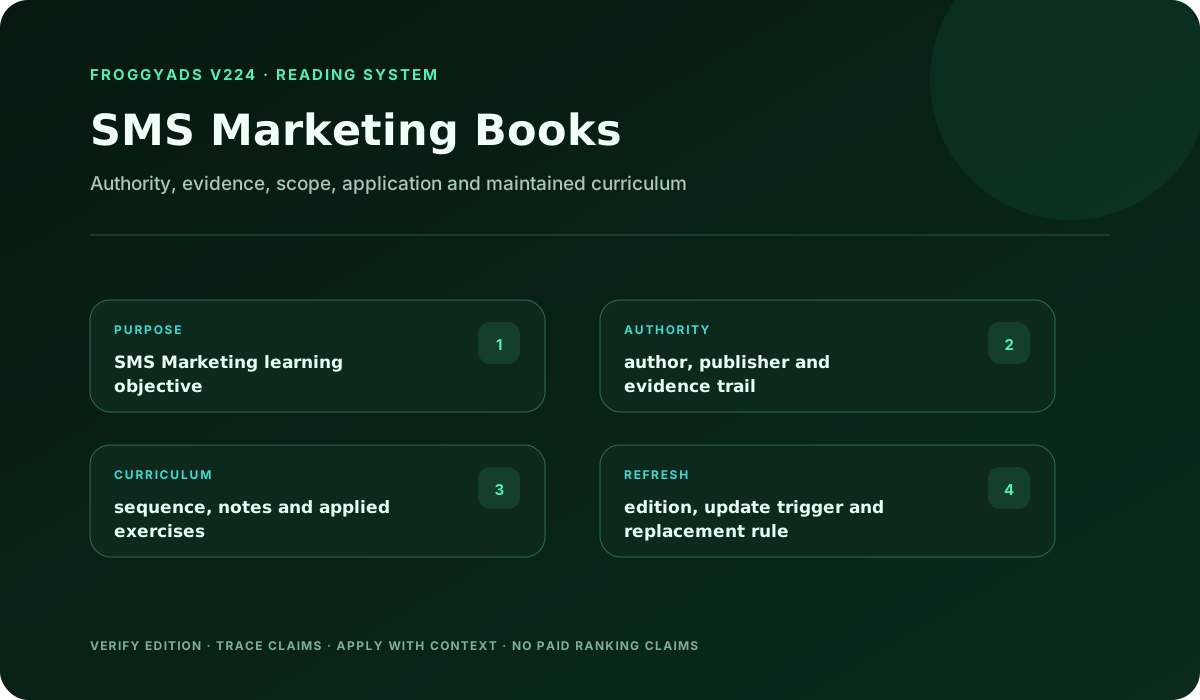
SMS Marketing Books: Compare Options, Costs & Practical Fit
SMS marketing books should be selected as dated learning sources, not as current legal or platform authority. Verify the author, title, edition, format, publisher, publication year and catalog record before recommending or buying a book. As of 16 August 2026, the International ISBN Agency explains that ISBNs identify specific editions and formats, while the Library of Congress and WorldCat provide bibliographic catalog routes. Those records can confirm identity; they do not prove that a book's consent, carrier, technology or compliance guidance is current for a campaign.
Define the SMS question before choosing a book
Name the learner, market, role and decision: permission design, message writing, lifecycle planning, measurement, vendor selection or governance. A general marketing title may help with principles but cannot answer a jurisdiction-specific sending rule. Build the reading brief before browsing lists.
Separate foundational material from operational instructions and legal guidance. Foundational concepts can age slowly, while platform interfaces, carrier programs and regulation can change. Assign each reading source a scope, last verified date and a current official source that governs implementation.
Verify the exact edition and format
Search a catalog by author, full title, publisher, year and ISBN. Confirm whether the record describes print, ebook, audiobook, revised edition or translation. Similar titles and cover images can hide different content, pagination or publication dates.
The International ISBN Agency describes ISBNs as identifiers for particular editions and formats. Library of Congress and WorldCat records can add bibliographic context and holdings. Treat catalog data as identity evidence, not an endorsement of accuracy, usefulness or current compliance.
Evaluate authority and evidence chapter by chapter
Record the author's relevant experience, cited primary sources, case method, sample, date and commercial relationships. Distinguish a documented example from a universal performance claim. A publisher biography or bestseller label cannot substitute for evidence supporting a specific SMS recommendation.
Check numbers, deliverability claims, response rates and compliance statements against their original sources. Reject statistics without population, method or date. Preserve page or location references so a colleague can verify the claim in the same edition rather than relying on a paraphrased review.
Pair every operating rule with current official guidance
Create a currency check for consent, revocation, sender identity, quiet hours, prohibited content, record keeping and carrier requirements. Use the relevant regulator, carrier and vendor documentation for the actual market. A book can explain a concept but should not freeze a changeable rule.
FCC robotext materials and FTC advertising guidance are United States sources with defined scopes. Other markets have different authorities. The reading note should say which official route was checked, when it was checked and which unresolved questions require qualified advice before sending.
Turn reading into a bounded application test
Translate one supported principle into a reversible workflow change with an owner, eligible audience, message, permission evidence, stop rule and evaluation window. Do not implement several chapters at once. Preserve the original process and define what observation would reject the idea.
Measure deliverability, opt-out handling, complaint signals, accepted actions and later value under distinct definitions. A successful send or click does not validate the book's broader theory. Report the result as a local test under named conditions.
Connect the guide to live testing
Connect SMS Marketing Books to a controlled audience test
Use the choices established in “Turn reading into a bounded application test” to define one audience, budget and source set in FroggyAds. Keep the surrounding offer and measurement rule stable so the test adds evidence to sms marketing books instead of mixing several changes at once.
Maintain a reading register instead of a ranked list
Store bibliographic identity, topic coverage, evidence quality, currentness gaps, official-source companions, application result and next review. Rank only against a declared reader and decision; there is no truthful universal best SMS marketing book.
When a new edition or official rule appears, create a new record and preserve the earlier one. Do not refresh the page date merely because a retail listing changed. A useful book guide shows what was verified, what remains uncertain and how the reader can reproduce the selection.
Decision controls
Region Atlas control 1
The reading brief names learner, market, SMS decision and implementation boundary.
Region Atlas control 2
Foundational, operational and legal materials retain separate authority roles.
Region Atlas control 3
Author, title, publisher, year, edition, format and ISBN are verified together.
Region Atlas control 4
Catalog records confirm bibliographic identity without implying content endorsement.
Region Atlas control 5
Claims retain original sources, sample, date and exact edition location.
Region Atlas control 6
Commercial relationships and affiliate incentives remain visible in recommendations.
Region Atlas control 7
Changeable consent and carrier instructions are checked against current authorities.
Region Atlas control 8
Each application test changes one supported practice and preserves rollback.
Region Atlas control 9
Delivery, opt-out, complaint, action and mature value keep distinct definitions.
Region Atlas control 10
Local test results do not become universal proof for the book's broader theory.
Region Atlas control 11
Shortlists use declared reader criteria rather than invented universal rankings.
Region Atlas control 12
New editions and guidance produce versioned records instead of overwritten evidence.
Choose the execution format
Choose a paid-media format that supports SMS Marketing Books
Use the criteria around “Decision controls” to decide whether push, native, display or pop fits the message and destination. Set format, targeting and spend as campaign controls in FroggyAds while the sms marketing books decision remains the standard for judging the result.
The reading brief names learner, market, SMS decision and implementation boundary. The reading reviewer starts with a learner, market and SMS decision. Foundational insight and live operating authority remain separate categories.
Review decision 2
Foundational, operational and legal materials retain separate authority roles. Edition review matches author, title, publisher, year, format and ISBN. Similar covers or retail listings cannot silently substitute another text.
Review decision 3
Author, title, publisher, year, edition, format and ISBN are verified together. Evidence review traces claims to an original source and exact location. Bestseller labels and customer ratings do not establish authority.
Review decision 4
Catalog records confirm bibliographic identity without implying content endorsement. Currency review checks consent, revocation and carrier guidance against the current official route for the intended market.
Review decision 5
Claims retain original sources, sample, date and exact edition location. Application review changes one practice and preserves the prior workflow. Deliverability and mature business evidence retain different meanings.
Review decision 6
Commercial relationships and affiliate incentives remain visible in recommendations. Register review versions new editions and official updates. A universal ranking is rejected unless the reader and criteria are declared.
Review decision 7
Changeable consent and carrier instructions are checked against current authorities. The reading reviewer starts with a learner, market and SMS decision. Foundational insight and live operating authority remain separate categories.
Review decision 8
Each application test changes one supported practice and preserves rollback. Edition review matches author, title, publisher, year, format and ISBN. Similar covers or retail listings cannot silently substitute another text.
Review decision 9
Delivery, opt-out, complaint, action and mature value keep distinct definitions. Evidence review traces claims to an original source and exact location. Bestseller labels and customer ratings do not establish authority.
Review decision 10
Local test results do not become universal proof for the book's broader theory. Currency review checks consent, revocation and carrier guidance against the current official route for the intended market.
Review decision 11
Shortlists use declared reader criteria rather than invented universal rankings. Application review changes one practice and preserves the prior workflow. Deliverability and mature business evidence retain different meanings.
Review decision 12
New editions and guidance produce versioned records instead of overwritten evidence. Register review versions new editions and official updates. A universal ranking is rejected unless the reader and criteria are declared.
Put the guide into practice
Turn SMS Marketing Books into a bounded campaign test
With “Review trail” documented, launch only the next reversible test. Set a spending limit, preserve the baseline and use source-level and audience controls so the next step depends on qualified outcomes for sms marketing books, not activity volume.
Create a bibliographic record for one SMS title using author, publisher, year, edition, format, ISBN and two catalog observations. Resolve every mismatch before recommendation. Keep the catalog retrieval date and source language so another reader can reproduce the exact identity check. Exercise 1 keeps its dated observation and reviewer.
Region Atlas exercise 2
Select one chapter claim and follow its citation to the original source. Record population, method, date and the exact edition location that contains it. Reject a secondary paraphrase that changes the claim's denominator, geography or reference period. Exercise 2 keeps its dated observation and reviewer.
Region Atlas exercise 3
Compare a foundational principle with a changeable consent or carrier instruction. Assign the live operating decision to the current official source. Record the regulator or carrier page date beside the implementation note and schedule a future currency check. Exercise 3 keeps its dated observation and reviewer.
Region Atlas exercise 4
Audit a book review for affiliate relationships, vague praise, unverified statistics and edition ambiguity. Rewrite the inclusion note with reproducible criteria. Do not infer book quality from retailer position, review volume or a promotional badge without a declared method. Exercise 4 keeps its dated observation and reviewer.
Region Atlas exercise 5
Translate one supported reading insight into a capped SMS workflow test with permission evidence, stop rules and distinct delivery and mature outcome fields. Log opt-outs, complaints and reversals even when the chosen reading principle improves an earlier engagement metric. Exercise 5 keeps its dated observation and reviewer.
Region Atlas exercise 6
Version a reading register after a new edition or official rule appears. Preserve the earlier record and explain which decision actually changed. Retain the reason a title was excluded so the next update does not repeat unresolved bibliographic work. Exercise 6 keeps its dated observation and reviewer.
Region Atlas exercise 7
Create a bibliographic record for one SMS title using author, publisher, year, edition, format, ISBN and two catalog observations. Resolve every mismatch before recommendation. Keep the catalog retrieval date and source language so another reader can reproduce the exact identity check. Exercise 7 keeps its dated observation and reviewer.
Region Atlas exercise 8
Select one chapter claim and follow its citation to the original source. Record population, method, date and the exact edition location that contains it. Reject a secondary paraphrase that changes the claim's denominator, geography or reference period. Exercise 8 keeps its dated observation and reviewer.
Region Atlas exercise 9
Compare a foundational principle with a changeable consent or carrier instruction. Assign the live operating decision to the current official source. Record the regulator or carrier page date beside the implementation note and schedule a future currency check. Exercise 9 keeps its dated observation and reviewer.
Region Atlas exercise 10
Audit a book review for affiliate relationships, vague praise, unverified statistics and edition ambiguity. Rewrite the inclusion note with reproducible criteria. Do not infer book quality from retailer position, review volume or a promotional badge without a declared method. Exercise 10 keeps its dated observation and reviewer.
Region Atlas exercise 11
Translate one supported reading insight into a capped SMS workflow test with permission evidence, stop rules and distinct delivery and mature outcome fields. Log opt-outs, complaints and reversals even when the chosen reading principle improves an earlier engagement metric. Exercise 11 keeps its dated observation and reviewer.
Region Atlas exercise 12
Version a reading register after a new edition or official rule appears. Preserve the earlier record and explain which decision actually changed. Retain the reason a title was excluded so the next update does not repeat unresolved bibliographic work. Exercise 12 keeps its dated observation and reviewer.
Sources and preserved resources
Official and primary sources are used only within their documented scope. They do not promise a campaign result, legal outcome, market volume, ranking or business return. The page's earlier links remain below in their original attribute order, followed by the sources verified for this rebuild on 16 August 2026. For SMS Marketing Books, apply this rule to the page-specific audience, market, format or buying decision described here.
SMS marketing books evaluation connects bibliographic identity, author evidence, current official guidance, bounded application tests and versioned reading records.
International ISBN Agency guidance explains that ISBNs identify specific publication editions and formats.
Library of Congress catalog records provide bibliographic information that can help verify a book's identity and edition.
An SMS reading program should preserve quotations sparingly and prefer precise notes tied to page or location references. Copyright permits and publisher access are separate from whether a claim is useful. Do not reproduce substantial text merely to make the register self-contained. Summarize the decision, store a short locator and retain lawful access to the edition. Translation needs its own note because technical and legal terms may not map cleanly across languages. If an author updates a blog or course without issuing a new book edition, record it as a different source. This keeps the bibliography accurate and prevents a current web statement from being attributed to an older printed work. Review complete.
Book costs also need a clear boundary. Record the verified edition price, library access, shipping, subscription or course dependency only when a dated source supports it, and never treat a temporary retailer price as permanent. The reader's application time may exceed the purchase cost, so compare the chapters needed for the stated decision rather than page count. Preserve access date and currency for any price observation.
Questions and answers
Which qualities make an SMS marketing book useful today?
A useful book explains consent, audience context, message craft, delivery operations, measurement and practical limitations with dated examples. Readers should be able to distinguish durable principles from channel rules or technology details that may already have changed.
How can beginners compare introductory books about text message marketing?
The contents should move from permission and customer purpose through campaign setup, testing, reporting and withdrawal. A book that begins with message tricks but omits source, preference and fulfilment responsibilities leaves a material gap.
Why cannot an SMS book replace current qualified requirements review?
Publication dates, jurisdictions, carrier practices, platform rules and sector obligations can differ from the planned activity. Books can frame the right questions, while current authoritative sources and qualified advice determine what applies now.
Which details deserve scrutiny inside published SMS copywriting examples?
Examples are more useful when they identify the sender, purpose, material condition, action and preference route within the intended context. Short copy is not automatically clear if the recipient cannot understand the offer before acting.
Where do strong SMS guides address timing and message frequency?
Timing and frequency belong alongside audience expectations, local time, urgency and recent customer activity. A fixed number copied from a book may be unsuitable for a different relationship or type of message.
Which measurement chapters help connect texts with business results?
Useful chapters distinguish delivery, response and accepted customer outcomes, then explain attribution windows and later rejection. This prevents click rate or coupon use from being presented as complete return without costs and fulfilment context.
How well do ecommerce SMS books transfer to service businesses?
Principles such as permission, relevance, testing and withdrawal can transfer, but purchase cycles and accepted outcomes may not. A service business may need qualified enquiries or appointments rather than the product and cart events used in retail examples.
What signs reveal outdated advice in a mobile messaging book?
Undated screenshots, absolute claims about deliverability, missing preference controls and references to retired features warrant caution. The reader can verify current details against authoritative channel, carrier and market sources before applying the tactic.
Which exercises turn SMS marketing reading into safer practice?
A practical study plan can map permission sources, rewrite messages for clarity, test preference handling and define one accepted outcome for a small scenario. The work should use synthetic or authorised data rather than real customer details in an uncontrolled exercise.
When is a shared SMS marketing reading list worth maintaining?
A shared list helps when marketers, support staff and reviewers need consistent language for recurring decisions. Each entry should show its edition, relevance and last verification so older material is not mistaken for current requirements.
State the specific decision this guide answers about SMS Marketing Books: Compare Options, Costs & Practical Fit.
Use the guide before changing campaign settings.
Procedure
Follow the steps around On this page in their intended order.
Keep the baseline stable while testing the recommended change.
Evidence
Use the measurement guidance under Define the SMS question before choosing a book.
Reconcile FroggyAds data with tracker and backend results.
Diagnosis
Use the troubleshooting section around Verify the exact edition and format to isolate the smallest failing layer.
Change one major variable at a time.
Next action
Move from the guide to a bounded live test only when the prerequisites are met.
Create a FroggyAds account and preserve the test limit.
Advertiser decision framework
SMS Marketing Books: Compare Options, Costs & Practical Fit: what should the advertiser decide next?
For SMS Marketing Books: Compare Options, Costs & Practical Fit, the commercial task is to turn sms marketing books into one measurable campaign decision. Use On this page to define the audience or problem, use Define the SMS question before choosing a book to constrain the test, and decide in advance which accepted result would justify more FroggyAds spend.
On this SMS Marketing Books: Compare Options, Costs & Practical Fit page, the decision should remain tied to the existing evidence around On this page, Define the SMS question before choosing a book and Verify the exact edition and format. Those sections give sms marketing books its specific context; the table below turns that context into campaign actions rather than adding another generic definition.
Decision
What to verify
FroggyAds action
SMS Marketing Books: Compare Options, Costs & Practical Fit objective
Use On this page to define the accepted business event and the maximum learning loss for sms marketing books.
Launch one FroggyAds campaign objective for SMS Marketing Books: Compare Options, Costs & Practical Fit and keep the conversion definition stable.
SMS Marketing Books: Compare Options, Costs & Practical Fit audience
Use Define the SMS question before choosing a book to verify market, device, language and offer eligibility for sms marketing books.
Apply only the FroggyAds targeting controls that change the real SMS Marketing Books: Compare Options, Costs & Practical Fit customer journey.
Use Pair every operating rule with current official guidance to define the exact evidence that earns the next budget increase for sms marketing books.
Scale SMS Marketing Books: Compare Options, Costs & Practical Fit one major control at a time and compare marginal performance with the prior baseline.
A page-specific FroggyAds test sequence for SMS Marketing Books: Compare Options, Costs & Practical Fit
SMS Marketing Books: Compare Options, Costs & Practical Fit outcome: define the accepted event for sms marketing books and the maximum loss permitted while the first test is learning.
SMS Marketing Books: Compare Options, Costs & Practical Fit path: verify market eligibility, device experience, landing-page continuity and tracking against On this page before buying more traffic.
SMS Marketing Books: Compare Options, Costs & Practical Fit hypothesis: launch one bounded FroggyAds test tied to Define the SMS question before choosing a book; do not change bid, creative, audience and destination together.
SMS Marketing Books: Compare Options, Costs & Practical Fit source review: compare qualified activity, accepted conversions, timing and cost by the source or segment dimensions relevant to Verify the exact edition and format.
SMS Marketing Books: Compare Options, Costs & Practical Fit scaling: use Evaluate authority and evidence chapter by chapter and Pair every operating rule with current official guidance to define what must reproduce before the next budget increase.
Why FroggyAds is relevant to SMS Marketing Books: Compare Options, Costs & Practical Fit
For SMS Marketing Books: Compare Options, Costs & Practical Fit, FroggyAds gives advertisers a self-serve DSP and ad-network workflow for buying supported traffic with campaign-level budgets and targeting. Depending on format and campaign context, available controls can include country, city, device, operating system, browser, carrier, category, source, ID and IP options. SmartCPC and Adscore-supported traffic-quality controls can support the sms marketing books optimization process, while the advertiser's tracker, analytics and backend acceptance remain the final evidence for commercial quality.
Use Pair every operating rule with current official guidance as the final checkpoint for SMS Marketing Books: Compare Options, Costs & Practical Fit. If the accepted result does not reproduce after the next meaningful volume step, return to the last stable configuration instead of widening several controls at once.
SMS Marketing Books: Compare Options, Costs & Practical Fit: the buyer task this URL owns
SMS Marketing Books: Compare Options, Costs & Practical Fit is for advertisers, lifecycle marketers, media buyers and online businesses who need to define SMS marketing as a consented lifecycle channel and make a measurable lifecycle-marketing decision. Keep that buyer task separate from the nearby topic so this URL answers one commercial question clearly. The nearest related FroggyAds page is Top Sms Marketing Agency; this URL keeps ownership of the distinct task to define SMS marketing as a consented lifecycle channel and make a measurable lifecycle-marketing decision.
Keep subscriber consent, segmentation, automation, click-through rate in the SMS Marketing Books: Compare Options, Costs & Practical Fit evidence record because they can change how this media test is configured, measured or scaled.
Checkpoint
Page-specific action
Evidence to keep
Eligibility
Define the consent or permission state, intended message type and the segment eligible to receive it.
Retain evidence specific to SMS Marketing Books: Compare Options, Costs & Practical Fit and its accepted outcome.
Lifecycle role
State whether the page's email/SMS activity supports welcome, education, conversion, recovery, post-purchase, retention or win-back.
Retain evidence specific to SMS Marketing Books: Compare Options, Costs & Practical Fit and its accepted outcome.
Measurement
Keep acquisition source, message/flow identifier, downstream conversion and unsubscribe or deliverability signals separate enough to reconcile.
Retain evidence specific to SMS Marketing Books: Compare Options, Costs & Practical Fit and its accepted outcome.
Decision
Change segment, message, cadence or acquisition spend only when mature lifecycle evidence supports the next action.
Retain evidence specific to SMS Marketing Books: Compare Options, Costs & Practical Fit and its accepted outcome.
Practical check for SMS Marketing Books: Compare Options, Costs & Practical Fit: turn this page answer into one testable step, name the event that counts as success for SMS Marketing Books: Compare Options, Costs & Practical Fit, and keep the review window stable before changing another variable.
Use FroggyAds as the acquisition layer alongside SMS Marketing Books: Compare Options, Costs & Practical Fit, not as an email service provider or SMS sender. Your lifecycle stack owns consent and messaging; our role is to help you test and optimize the paid traffic feeding the eligible journey. Create your free FroggyAds account.
SMS Marketing Books worked application example
Hypothetical example: a buyer using this SMS Marketing Books guide can turn one recommendation into a test by naming the accepted event, fixing the review window and changing one campaign variable. If USD 175 produces 6 accepted outcomes, the resulting accepted CPA is USD 29.17; use your own numbers and economics before deciding what to change next.
Direct answer
SMS Marketing Books: Compare Options, Costs & Practical Fit — what matters first
SMS Marketing Books: Compare Options, Costs & Practical Fit is most useful when it helps a buyer identify useful learning resources and translate ideas into execution. Define the accepted outcome first, then use targeting, budget and source-level evidence to decide what deserves more spend.