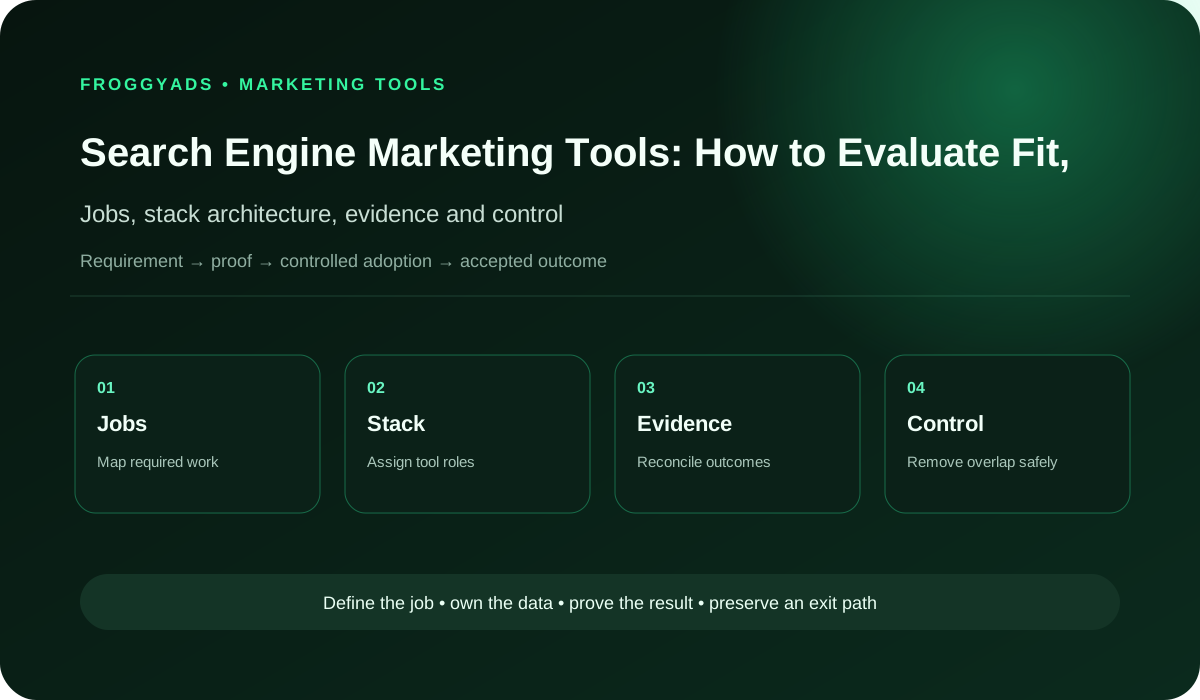
Search Engine Marketing Tools: Compare Options & Fit
Search engine marketing tools should be compared by the job they perform, the data they read or write, the decisions they support and the access they require. A large feature list is not proof of fit. As of 16 August 2026, Google Ads documentation assigns different abilities to email-only, billing, read-only, standard and administrative access, while Google Analytics documents how imported data joins with collected event data. Tool selection therefore begins with governance and data lineage before automation, dashboards or vendor scores.
Define the SEM job before making a shortlist
Separate query research, campaign editing, budget control, creative review, landing inspection, conversion diagnosis, experimentation, reporting and business validation. Name the user, decision frequency, required inputs and acceptable delay for each job. One tool does not need to perform every task.
Write mandatory, conditional and excluded capabilities. A feature is mandatory only when the planned workflow and decision use it. Avoid awarding points for duplicate dashboards or AI labels that do not change a controlled action. Shortlist by evidence, not by the number of menu items.
Map data collection and field definitions
List every platform, website, analytics property, CRM, commerce system and spreadsheet that supplies or receives data. Record identifiers, event names, currencies, time zones, attribution rules, import method and retention. A connector can succeed technically while joining incompatible definitions.
Google Analytics Data Import joins supported external data through collection-processing or reporting-query routes depending on type. Preserve the selected schema and join keys. Imported values do not automatically become accurate, consented or suitable for bidding, so validation remains an advertiser responsibility.
Grant the minimum access for the assigned work
Create a role matrix for viewing campaigns, editing settings, managing billing, linking products, changing users and exporting reports. Google Ads documents which abilities belong to its access levels. Test the vendor's workflow with the narrowest permission that can complete the agreed task.
Do not share personal credentials or grant administrator status because setup is inconvenient. Record service accounts, tokens, manager links and automation ownership. Keep at least one advertiser-controlled administrator and a tested revocation route outside the vendor's control.
Test calculations and recommendations independently
Choose representative campaigns and recalculate spend, conversion rate, cost per accepted outcome and value under documented fields. Compare a recommendation with the underlying report and settings. A polished alert is not evidence that its diagnosis, forecast or automated action is correct.
Review missing values, currency conversion, time-zone cutoffs, attribution changes, duplicate imports and delayed outcomes. Require the tool to expose or export enough information to reproduce the conclusion. Keep estimates separate from finalized account and business records.
Run a reversible pilot on one workflow
Pilot one account, user group and decision route with capped permissions and time. Define success as fewer errors, faster reproducible work or better decision evidence, not logins or generated recommendations. Record incidents, manual overrides, unavailable fields and training work.
Keep the incumbent workflow during the test. Apply one controlled automation only after dry-run review and assign an owner who can stop it. A software pilot should prove rollback, data export and access removal before the tool becomes a dependency.
Connect the guide to live testing
Connect Search Engine Marketing Tools to a controlled audience test
Use the choices established in “Run a reversible pilot on one workflow” to define one audience, budget and source set in FroggyAds. Keep the surrounding offer and measurement rule stable so the test adds evidence to search engine marketing tools instead of mixing several changes at once.
Add subscription, usage, implementation, migration, training, verification, support and reconciliation to total cost. Record contract period, renewal, data retention and deletion. A lower license price may be expensive when analysts must rebuild missing lineage or manually correct automated edits.
Before selection, export settings, reports and activity history in usable formats and perform the exit steps. Revoke users and integrations without losing the advertiser's platform accounts. Choose continue, correct, replace or reject status based on measured workflow evidence.
Decision controls
Analyticscontrol control 1
Every shortlisted SEM tool maps to one named job and decision owner.
Analyticscontrol control 2
Mandatory capabilities are separated from optional and excluded features.
Analyticscontrol control 3
Source systems, join keys, time zones, currencies and event definitions are inventoried.
Analyticscontrol control 4
Imported and platform-collected data retain distinct lineage and validation states.
Analyticscontrol control 5
Users and integrations receive the minimum permissions required for assigned work.
Analyticscontrol control 6
Advertiser-controlled administration and revocation remain independently available.
Analyticscontrol control 7
Representative calculations reconcile against exports and business records.
Analyticscontrol control 8
Recommendations expose evidence, settings, assumptions and reversible actions.
Analyticscontrol control 9
The pilot limits account scope, users, time, automation and data exposure.
Analyticscontrol control 10
Full cost includes implementation, training, verification and reconciliation.
Analyticscontrol control 11
Export and deletion routes are tested before a vendor becomes critical.
Analyticscontrol control 12
Selection records limitations and rejects unsupported feature or outcome claims.
Choose the execution format
Choose a paid-media format that supports Search Engine Marketing Tools
Use the criteria around “Decision controls” to decide whether push, native, display or pop fits the message and destination. Set format, targeting and spend as campaign controls in FroggyAds while the search engine marketing tools decision remains the standard for judging the result.
Every shortlisted SEM tool maps to one named job and decision owner. Workflow review removes capabilities that do not support a named SEM job. Duplicate dashboards cannot earn mandatory status through feature count alone.
Review decision 2
Mandatory capabilities are separated from optional and excluded features. Data review traces collected and imported fields through identifiers, currencies, time zones and attribution. Unmatched definitions remain visible.
Review decision 3
Source systems, join keys, time zones, currencies and event definitions are inventoried. Access review grants the narrowest permissions and retains advertiser administration. Every token and manager link has a revocation owner.
Review decision 4
Imported and platform-collected data retain distinct lineage and validation states. Calculation review compares vendor output with exports and business records. Estimates, transformed fields and finalized outcomes remain distinct.
Review decision 5
Users and integrations receive the minimum permissions required for assigned work. Pilot review tests one reversible automation under limited accounts and users. Manual work and errors count alongside claimed time savings.
Review decision 6
Advertiser-controlled administration and revocation remain independently available. Exit review proves that settings, data and history remain usable after access removal. Contract closure cannot depend on a private vendor dashboard.
Review decision 7
Representative calculations reconcile against exports and business records. Workflow review removes capabilities that do not support a named SEM job. Duplicate dashboards cannot earn mandatory status through feature count alone.
Review decision 8
Recommendations expose evidence, settings, assumptions and reversible actions. Data review traces collected and imported fields through identifiers, currencies, time zones and attribution. Unmatched definitions remain visible.
Review decision 9
The pilot limits account scope, users, time, automation and data exposure. Access review grants the narrowest permissions and retains advertiser administration. Every token and manager link has a revocation owner.
Review decision 10
Full cost includes implementation, training, verification and reconciliation. Calculation review compares vendor output with exports and business records. Estimates, transformed fields and finalized outcomes remain distinct.
Review decision 11
Export and deletion routes are tested before a vendor becomes critical. Pilot review tests one reversible automation under limited accounts and users. Manual work and errors count alongside claimed time savings.
Review decision 12
Selection records limitations and rejects unsupported feature or outcome claims. Exit review proves that settings, data and history remain usable after access removal. Contract closure cannot depend on a private vendor dashboard.
Put the guide into practice
Turn Search Engine Marketing Tools into a bounded campaign test
With “Review trail” documented, launch only the next reversible test. Set a spending limit, preserve the baseline and use source-level and audience controls so the next step depends on qualified outcomes for search engine marketing tools, not activity volume.
Map five SEM jobs to required inputs, user, decision frequency and output. Reject a feature that cannot change or document an approved workflow. State which tool owns the final record and which tools only transform, display or recommend changes. Exercise 1 keeps its dated observation and reviewer.
Analyticscontrol exercise 2
Trace one imported dataset through schema, join key, processing route, time zone and report. Keep unmatched records and transformed values visible. Preserve a sample input and output so a vendor update cannot silently rewrite the prior comparison. Exercise 2 keeps its dated observation and reviewer.
Analyticscontrol exercise 3
Create a permission matrix for viewers, editors, billing staff, administrators and integrations. Test removal without losing advertiser-owned accounts. Note any permission requested only for setup and schedule its removal immediately after the verified task completes. Exercise 3 keeps its dated observation and reviewer.
Analyticscontrol exercise 4
Recalculate one tool recommendation from source exports and business records. Preserve settings, missing values and assumptions beside the comparison. Reject an alert whose source fields or calculation cannot be exported for independent review. Exercise 4 keeps its dated observation and reviewer.
Analyticscontrol exercise 5
Pilot one automated change in dry-run mode, then test approval, stop and rollback. Record operator time and any hidden manual correction. Keep the incumbent workflow active until the pilot proves continuity under an ordinary user, not only an administrator. Exercise 5 keeps its dated observation and reviewer.
Analyticscontrol exercise 6
Perform a tool exit rehearsal that exports configuration and history, revokes access and confirms that later campaign analysis remains reproducible. Record contractual deletion separately from technical access removal because they answer different exit questions. Exercise 6 keeps its dated observation and reviewer.
Analyticscontrol exercise 7
Map five SEM jobs to required inputs, user, decision frequency and output. Reject a feature that cannot change or document an approved workflow. State which tool owns the final record and which tools only transform, display or recommend changes. Exercise 7 keeps its dated observation and reviewer.
Analyticscontrol exercise 8
Trace one imported dataset through schema, join key, processing route, time zone and report. Keep unmatched records and transformed values visible. Preserve a sample input and output so a vendor update cannot silently rewrite the prior comparison. Exercise 8 keeps its dated observation and reviewer.
Analyticscontrol exercise 9
Create a permission matrix for viewers, editors, billing staff, administrators and integrations. Test removal without losing advertiser-owned accounts. Note any permission requested only for setup and schedule its removal immediately after the verified task completes. Exercise 9 keeps its dated observation and reviewer.
Analyticscontrol exercise 10
Recalculate one tool recommendation from source exports and business records. Preserve settings, missing values and assumptions beside the comparison. Reject an alert whose source fields or calculation cannot be exported for independent review. Exercise 10 keeps its dated observation and reviewer.
Analyticscontrol exercise 11
Pilot one automated change in dry-run mode, then test approval, stop and rollback. Record operator time and any hidden manual correction. Keep the incumbent workflow active until the pilot proves continuity under an ordinary user, not only an administrator. Exercise 11 keeps its dated observation and reviewer.
Analyticscontrol exercise 12
Perform a tool exit rehearsal that exports configuration and history, revokes access and confirms that later campaign analysis remains reproducible. Record contractual deletion separately from technical access removal because they answer different exit questions. Exercise 12 keeps its dated observation and reviewer.
Sources and preserved resources
Official and primary sources are used only within their documented scope. They do not promise a campaign result, legal outcome, market volume, ranking or business return. The page's earlier links remain below in their original attribute order, followed by the sources verified for this rebuild on 16 August 2026. For Search Engine Marketing Tools, apply this rule to the page-specific audience, market, format or buying decision described here.
Search engine marketing tools evaluation connects workflow jobs, data lineage, minimum access, independent calculation tests, reversible pilots and exit readiness.
Google Ads access levels distinguish permissions for viewing, editing, billing, product linking and user administration.
Google Analytics Data Import joins supported external data with collected event data through defined schemas and processing routes.
SEM tool governance should also track vendor and product version. A calculation that matched last month can change after a connector, attribution default or field definition is updated. Store the tested version, retrieval date, sample input and expected output. Require notice and revalidation for material changes. Support response time belongs in the evidence because an unresolved integration can block budget decisions even when the feature technically exists. Keep vendor marketing claims separate from contract commitments and observed pilot behavior. The selection record should show which capabilities were verified, which rely on manual controls and which remain unavailable rather than compressing uncertainty into one score. Review complete.
Tool comparison also needs a decision latency record. A query-research interface may support occasional planning while a pacing or access alert requires a much shorter response path. Record how quickly source data arrives, how often it refreshes, who reviews it and which actions can wait. Delayed data is not automatically wrong, but it may be unsuitable for a time-sensitive budget decision. Test support escalation with a realistic error and preserve the answer, time and resolution.
If an integration retries failed writes, document duplicate protection and the final state. If a vendor computes benchmarks across customers, require enough method and scope information to prevent a market average from becoming an account forecast. Keep optional generative summaries outside automatic execution until a reviewer can trace their underlying records. This latency and explainability evidence can separate a capable reporting product from a tool that merely produces more notifications.
Record maintenance windows and status-page evidence when availability affects an approved campaign task. A promise of uptime needs a contractual definition and an observed incident process before it changes the shortlist.
Questions and answers
Which marketing tasks justify adding a search engine marketing tool?
A tool earns its place when it removes a defined bottleneck in research, campaign assembly, quality control, bidding, measurement or reporting. The team still needs a named owner and a reliable source for every decision the software informs.
How does keyword research software support paid search planning?
Keyword software can group queries, estimate relative demand and reveal language used around the offer. Forecasts are directional rather than guaranteed, so serviceability, commercial intent and actual search-term data remain part of the decision.
Where can search-term analysis tools reduce irrelevant paid clicks?
Search-term analysis can expose queries that conflict with the offer, location or customer requirement. A reviewed exclusion list can then reduce obvious mismatch without blocking useful variations that have not yet produced enough evidence.
What makes automated bidding data reliable enough for campaign use?
Reliable automation depends on accurate conversion definitions, sufficient observations, stable value signals and known reporting delays. If the recorded event is only a page action, the bidding system may optimise volume that never becomes accepted customer value.
When should ad creation software enter a search marketing workflow?
Creation software is useful after the offer, material conditions, audience and destination are clear. Generated variations need human review for accuracy, brand fit and policy suitability before they enter a controlled test.
Why do landing-page testing tools need one declared outcome?
A declared outcome keeps the comparison tied to a customer action the business accepts. Multiple simultaneous page and campaign changes can obscure the cause of a result even when the testing platform reports a winner.
How can search marketing tools preserve conversion evidence across systems?
Shared campaign, click and accepted-event references can connect delivery with later business records where permitted. Reconciliation should retain missing matches, rejected events and timing limits instead of silently forcing every platform conversion into a sale.
Which evidence separates a useful SEM tool from attractive reporting?
A bounded trial can compare time saved, errors found and improvement in an accepted campaign outcome against the previous process. A polished dashboard is not evidence of commercial benefit unless its recommendations change work and survive later review.
Who needs access to connected search engine marketing accounts?
Access belongs only to people and services with a current operational need, using the narrowest practical role. Ownership, credential rotation, export rights and removal procedures matter because campaign and customer data can remain connected long after a trial ends.
At what point should an SEM tool subscription be reconsidered?
Renewal merits review when adoption, data quality, integration reliability, support or measurable time savings no longer justify the full cost. Export and continuity plans should be understood before dependence on a proprietary workflow becomes difficult to reverse.
Advertiser decision framework
Search Engine Marketing Tools: Compare Options & Fit: what should the advertiser decide next?
For Search Engine Marketing Tools: Compare Options & Fit, the commercial task is to turn search engine marketing tools into one measurable campaign decision. Use On this page to define the audience or problem, use Define the SEM job before making a shortlist to constrain the test, and decide in advance which accepted result would justify more FroggyAds spend.
On this Search Engine Marketing Tools: Compare Options & Fit page, the decision should remain tied to the existing evidence around On this page, Define the SEM job before making a shortlist and Map data collection and field definitions. Those sections give search engine marketing tools its specific context; the table below turns that context into campaign actions rather than adding another generic definition.
Decision
What to verify
FroggyAds action
Search Engine Marketing Tools: Compare Options & Fit objective
Use On this page to define the accepted business event and the maximum learning loss for search engine marketing tools.
Launch one FroggyAds campaign objective for Search Engine Marketing Tools: Compare Options & Fit and keep the conversion definition stable.
Search Engine Marketing Tools: Compare Options & Fit audience
Use Define the SEM job before making a shortlist to verify market, device, language and offer eligibility for search engine marketing tools.
Apply only the FroggyAds targeting controls that change the real Search Engine Marketing Tools: Compare Options & Fit customer journey.
Search Engine Marketing Tools: Compare Options & Fit source evidence
Use Map data collection and field definitions to keep source-level differences visible instead of relying on one blended search engine marketing tools average.
Keep, cap, exclude or retest Search Engine Marketing Tools: Compare Options & Fit inventory from documented source evidence.
Search Engine Marketing Tools: Compare Options & Fit economics
Use Grant the minimum access for the assigned work to connect media spend with accepted conversions and downstream value for search engine marketing tools.
Protect the Search Engine Marketing Tools: Compare Options & Fit test with a written budget boundary and a consistent attribution window.
Search Engine Marketing Tools: Compare Options & Fit scale rule
Use Test calculations and recommendations independently to define the exact evidence that earns the next budget increase for search engine marketing tools.
Scale Search Engine Marketing Tools: Compare Options & Fit one major control at a time and compare marginal performance with the prior baseline.
A page-specific FroggyAds test sequence for Search Engine Marketing Tools: Compare Options & Fit
Search Engine Marketing Tools: Compare Options & Fit outcome: define the accepted event for search engine marketing tools and the maximum loss permitted while the first test is learning.
Search Engine Marketing Tools: Compare Options & Fit path: verify market eligibility, device experience, landing-page continuity and tracking against On this page before buying more traffic.
Search Engine Marketing Tools: Compare Options & Fit hypothesis: launch one bounded FroggyAds test tied to Define the SEM job before making a shortlist; do not change bid, creative, audience and destination together.
Search Engine Marketing Tools: Compare Options & Fit source review: compare qualified activity, accepted conversions, timing and cost by the source or segment dimensions relevant to Map data collection and field definitions.
Search Engine Marketing Tools: Compare Options & Fit scaling: use Grant the minimum access for the assigned work and Test calculations and recommendations independently to define what must reproduce before the next budget increase.
Why FroggyAds is relevant to Search Engine Marketing Tools: Compare Options & Fit
For Search Engine Marketing Tools: Compare Options & Fit, FroggyAds gives advertisers a self-serve DSP and ad-network workflow for buying supported traffic with campaign-level budgets and targeting. Depending on format and campaign context, available controls can include country, city, device, operating system, browser, carrier, category, source, ID and IP options. SmartCPC and Adscore-supported traffic-quality controls can support the search engine marketing tools optimization process, while the advertiser's tracker, analytics and backend acceptance remain the final evidence for commercial quality.
Use Test calculations and recommendations independently as the final checkpoint for Search Engine Marketing Tools: Compare Options & Fit. If the accepted result does not reproduce after the next meaningful volume step, return to the last stable configuration instead of widening several controls at once.
Use Search Engine Marketing Tools: Compare Options & Fit to answer one paid-acquisition question: what setup should an advertiser test, what evidence should survive the test, and what accepted business outcome would justify the next budget decision. The page-specific job is to evaluate tools by the workflow they improve. The adjacent Top Search Engine Marketing Platform page should remain a separate decision.
Evidence already visible on this page: Search engine marketing tools should be compared by the job they perform, the data they read or write, the decisions they support and the access they require. A large feature… Separate query research, campaign editing, budget control, creative review, landing inspection, conversion diagnosis, experimentation, reporting and business validation. Name the user, decision frequency, required inputs and acceptable delay for each… The working concepts for this URL are audience targeting, conversion tracking, source quality.
Questions to resolve before scale: Which marketing tasks justify adding a search engine marketing tool? How does keyword research software support paid search planning? Where can search-term analysis tools reduce irrelevant paid clicks?
Checkpoint
Page-specific action
Evidence to keep
Setup
Use “On this page” to define the first operating boundary for Search Engine Marketing Tools: Compare Options & Fit.
Record the answer to “Which marketing tasks justify adding a search engine marketing tool?” together with source, targeting and destination identifiers.
Measurement
Use “Define the SEM job before making a shortlist” to test whether delivery is producing the expected path toward the accepted business outcome.
Keep the evidence needed to answer “How does keyword research software support paid search planning?” after the same maturation window.
Scale rule
Use “Map data collection and field definitions” to decide what changes next; change one material variable before comparing again.
Write the answer to “Where can search-term analysis tools reduce irrelevant paid clicks?” plus accepted cost/value and the rollback condition.
Transparent decision example
Hypothetical example: For a hypothetical Search Engine Marketing Tools: Compare Options & Fit cell, USD 125 divided by 10 mature accepted outcomes equals USD 12.50 per accepted outcome. Replace the inputs with your own economics; this is not a FroggyAds performance claim.
Why use FroggyAds for this step?
For the paid-acquisition part of Search Engine Marketing Tools: Compare Options & Fit, FroggyAds lets media buyers isolate traffic, preserve source evidence and adjust budget without treating early clicks as proof of business value. Create your free FroggyAds account.
Direct answer
Search Engine Marketing Tools: Compare Options & Fit — what matters first
Search Engine Marketing Tools: Compare Options & Fit is most useful when it helps a buyer evaluate tools by the workflow they improve. Define the accepted outcome first, then use targeting, budget and source-level evidence to decide what deserves more spend.