
Pinterest Advertising Tips for Better Planning, Testing and Measurement
Use these Pinterest advertising tips when your campaign is already running and you need to decide what to improve. We focus on the connection between the promise in your ad, the people who respond and the outcomes your business can use. Diagnose the weak point first, then choose a specific change. FroggyAds gives you a separate traffic route when the next question concerns additional audiences, formats or sources.
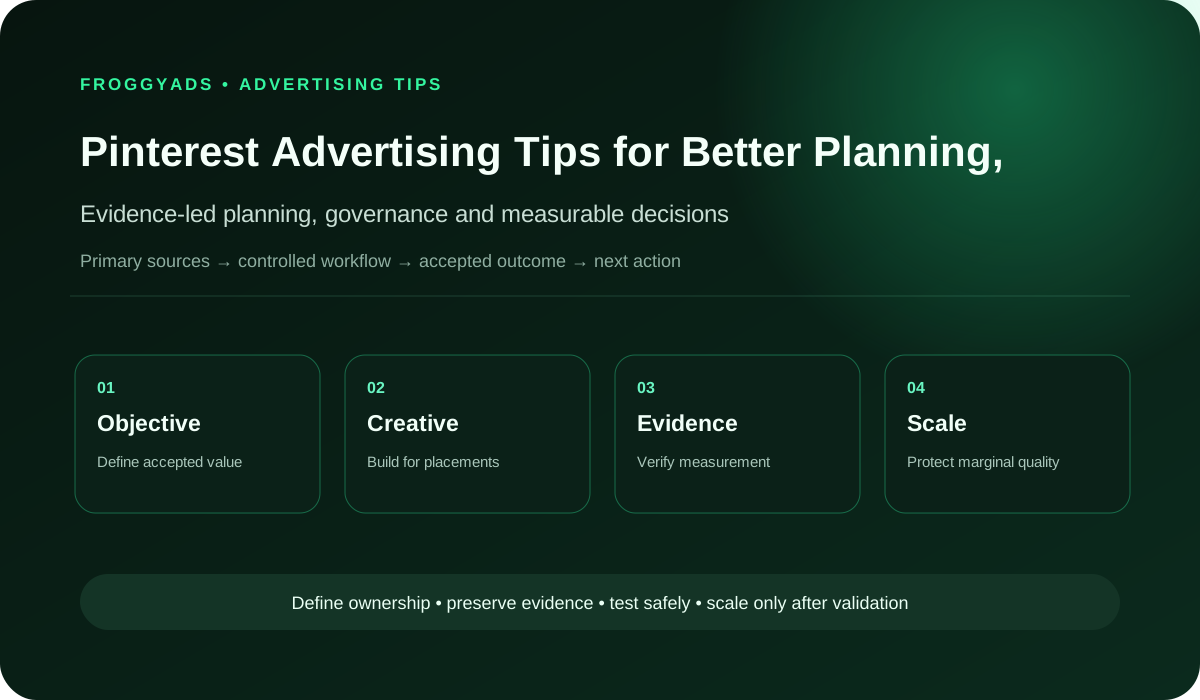
Which Pinterest advertising tips should you apply first?
Quick answer: fix a broken destination or unreliable measurement before changing bids or creative. If the journey works, compare delivery, response and accepted outcomes to identify the next useful improvement. A campaign with plenty of clicks but few suitable inquiries needs a different response from a campaign that barely delivers. Use current account information, a consistent review period and your business records; a single platform metric cannot diagnose the entire problem.
For campaign structure and available account settings, consult Pinterest: Create and edit a campaign. Apply its instructions to the account you actually use; the improvement choices below are our practical planning guidance, not a claim that every advertiser has identical options.
Improve one part of the customer journey at a time
A useful campaign improvement answers a concrete question: are we attracting the wrong visitor, failing to explain the offer or losing a suitable customer at the destination? Compare those possibilities before expanding spend. For a hypothetical indoor-plant consultation service, a Pin promising plant-care ideas may attract casual readers, while the paid offer requires a scheduled video consultation. The difference between those intentions is a reason to clarify the promise, not simply to buy more clicks.
| Campaign symptom | First question to investigate | Useful evidence |
|---|---|---|
| Few accepted inquiries | Does the ad explain the paid consultation and who it serves? | Ad promise and accepted inquiry reasons |
| Weak response | Does the creative make the plant-care problem and next step clear? | Active creative and relevant visitor behaviour |
| Drop-off after the click | Can the visitor understand the fee and book a suitable time? | Mobile destination and booking-path test |
| Conflicting totals | Are reports counting the same action and review period? | Event definitions and consultation records |
| Uncertain next step | Which observation would support one affordable improvement? | Written question, spend allowance and review date |
1. Define the commercial outcome you want to improve
Commercial outcomes give the improvement a purpose. For the hypothetical consultation service, distinguish a request for free advice from a valid inquiry for a paid session. Define the serviceable markets, the kind of help offered and any important exclusions. That definition makes the campaign easier to judge: a rise in inquiries is useful only when the additional people can use the advertised service and understand what they are requesting.
Compare the commercial outcome with the behaviour that precedes it. A visitor may read care instructions, browse the price and then return to book later. Keep those actions visible without adding them together as if they were equivalent purchases. When your acceptance rule changes, note the date. Otherwise a campaign can appear to improve merely because you started accepting a different kind of inquiry.
2. Make account access and billing easy to verify
Account access becomes an improvement priority when nobody can explain which campaign is spending or who approved its changes. Confirm the business account, the people with access and the person responsible for billing. If an agency helps, agree how creative and reporting will be handed back. Use the permissions and account features actually available rather than assuming that sharing a report gives someone authority to manage the campaign.
Billing checks should distinguish a configured budget from actual campaign spend and an invoice or account charge. Review the period and campaign included in each figure. Keep your own notes when an offer, session capacity or payment method changes. Clear ownership helps you correct a problem promptly and protects the comparison from an unexplained change made by another colleague while you are reviewing results.
3. Simplify campaign structure around a real question
Campaign structure should make the next decision understandable. If the consultation service wants to compare two promises, give each a clear identity and preserve the relevant creative and settings. Avoid splitting the same small opportunity into many groups simply to create a detailed-looking report. Check Pinterest's current structure and available controls in the account, then use a naming approach your team can follow outside the interface.
Structure also affects how you interpret scarce outcomes. One inquiry from a tiny group cannot support the same conclusion as a sustained set of accepted bookings. Keep broader totals available, and examine smaller groups only when they can answer a useful question. If several groups differ in audience, offer and creative simultaneously, describe the comparison honestly; you cannot confidently attribute the result to a single setting.
Compare an additional traffic source
Use FroggyAds for a separate audience comparison
We make a separate traffic comparison easier to control. Keep the consultation offer and acceptance rule stable, then use FroggyAds targeting, bids, budgets and source controls to test a relevant audience. Label this campaign separately from Pinterest and adapt the message to the chosen format. The benefit is a clear buying decision about additional traffic, with the commercial result checked in the same consultation records.
Create My Free Account
4. Review targeting against actual inquiry quality
Review platform fit first. Targeting improvements should respond to what suitable customers need. A person looking for general houseplant inspiration may not want a paid diagnosis of a specific plant problem. Review the relationship between the creative promise, selected targeting and the offer. Use only Pinterest options available and appropriate to your account. Interests and keywords express a relevance hypothesis; they do not prove that every reached person wants the service.
Quality review can reveal whether an apparent targeting problem is really a message problem. If people repeatedly expect a free session, make the paid offer clearer before removing broad groups of potential customers. Review serviceability and exclusions where they reflect genuine limits. A tighter audience can reduce unwanted inquiries, but it can also remove people who would have understood a better explanation. Keep the reason for each material restriction.
| Targeting observation | Question to ask | Evidence to compare |
|---|---|---|
| Unserviceable inquiries | Are location or service conditions clear and correctly configured? | Actual settings and inquiry locations |
| Wrong expectation | Does the ad communicate a paid consultation rather than free advice? | Creative promise and customer questions |
| Too little useful reach | Does each restriction reflect a real requirement? | Reason for the restriction and resulting response |
| Mixed customer quality | Are accepted and rejected inquiries being reviewed separately? | Acceptance reasons under one consistent rule |
5. Test a creative idea that changes the buying conversation
Creative improvement should change what the visitor understands. The plant service might compare a clear explanation of a video consultation with a demonstration of how the adviser examines a plant problem. Those are different concepts, unlike moving a button or changing a background colour. Check the current requirements for the format you select, including how the important message appears in its actual preview.
Keep creative claims proportionate to the service. Show what the adviser can assess and what the customer must provide, such as clear photographs, without promising a guaranteed plant recovery. Use images and testimonials only with the necessary permission and accurate context. When you review the comparison, connect the creative to accepted inquiries and customer expectations, not just the version that attracted the largest number of clicks.
6. Continue the ad promise on the destination
Destination continuity often provides a more useful improvement than another audience adjustment. The consultation page should explain the fee, session format, booking process and what information the customer needs to submit. Match those details to the ad. If the destination introduces a paid requirement after an ad that appears to offer free advice, visitors may leave for a sensible reason. Fix the expectation before treating the drop-off as a traffic-quality verdict.
Test the destination on a phone and follow the complete booking path. Look for unclear time-zone information, unavailable appointments, difficult photo uploads or a payment error. Check the confirmation state and support route. An improvement can be as specific as explaining which photographs the adviser needs before the visitor starts the form. Verify the actual change with the people responsible for the website; a campaign report cannot establish that a booking step is usable.
7. Verify measurement before optimizing from it
Measurement checks should answer what each reported action represents. Review the current event implementation and reporting settings in your account. A recorded form event, a submitted inquiry and an accepted consultation are different states. Confirm the actual trigger, currency and relevant attribution settings where applicable. Use the measurement options your implementation supports; mentioning a tag or an API does not prove that it is installed or that two receiving systems deduplicate the same event.
Run a known test action and locate the corresponding consultation record. Check an incomplete form and a repeated notification as well as a successful submission. Note any delay before the business accepts the inquiry. If the systems cannot be joined reliably, make that limit visible in the report. Improve the implementation before using a superficially precise cost figure to decide which audience or creative deserves more spend.
Match the format to the message
Choose a FroggyAds format for the consultation offer
Format selection determines how you introduce a paid service. With FroggyAds, choose among supported push, native, display and pop campaign formats, then adapt the message and destination to that visitor experience. We give you a practical combination of buying controls and reporting for a separate test. Keep the paid-consultation promise clear, and evaluate its accepted inquiries independently from Pinterest rather than assuming the same creative will perform identically everywhere.
Create My Free Account
8. Set a spend allowance around the improvement question
A learning allowance should reflect the decision you need to make. Testing whether visitors understand a revised consultation promise requires a different observation from estimating the long-term value of repeat customers. Decide how much you can afford to spend on that question and who will review the evidence. Check current account requirements without confusing a platform minimum with your recommended test allocation or the total cost of running the service.
Cost comparison should include the scope of the decision. Media spend divided by accepted inquiries gives one useful buying measure; adviser time, creative, software and fulfilment costs affect the wider economics. Label those costs rather than blending unlike figures. For a FroggyAds traffic test, our budget and bid controls help you manage the media purchase. Your service margins and consultation records determine what an acceptable inquiry is worth.
| Budget question | Planning choice | Review evidence |
|---|---|---|
| What are we learning? | Whether a clearer paid-service promise improves inquiry suitability | Accepted and rejected inquiries by reason |
| What can we risk? | An affordable media allowance for that question | Actual spend and remaining allocation |
| What counts as value? | The same accepted consultation rule throughout the comparison | Business records after the stated delay |
| What happens next? | Continue, revise or stop at the planned review | Written decision and next observation |
9. Review evidence after comparable outcome delays
Evidence review needs a clock as well as a count. A consultation inquiry may be accepted only after the customer supplies useful photographs or confirms a suitable appointment. Compare campaigns after equivalent time for that process. Keep pending inquiries visible so a newer campaign is not unfairly compared with an older one whose outcomes have already matured. Record the extraction date and the acquisition period being reviewed.
Frequent delivery checks are useful for catching unwanted spend or a broken destination. Commercial decisions need enough relevant evidence for the question you are asking. Avoid repeatedly changing the campaign because a few early actions fluctuate. When an urgent defect requires a change, record it and explain its effect on the comparison. A corrected checkout creates a different customer journey from the one that produced the earlier result.
10. Make experiments interpretable
Experiments become easier to use when you write the question before seeing the result. The consultation service might ask whether explaining the paid session in the first message reduces unsuitable inquiries. Keep the service, destination and acceptance rule comparable while changing that explanation. Save both creative versions and their launch dates. The record makes the comparison clearer even when delivery volumes are uneven or external conditions change.
Interpretation should match the evidence. A practical campaign comparison is not automatically a controlled scientific experiment, and a small difference can reflect chance or a different visitor mix. Describe those limits while still deciding what is reasonable to test next. The useful outcome is a supported next action, such as retaining the clearer promise and checking another part of the booking journey, rather than declaring a universal winning creative.
11. Use exclusions to solve a specific relevance problem
Exclusions need a reason tied to the offer. If a service cannot operate in a market, its campaign should reflect that limit. If a search-related audience repeatedly wants a different service, investigate the relevant controls available in the account. Do not describe every exclusion as a platform feature or apply a setting borrowed from another advertising system. Verify the actual option and its effect before relying on it.
Review exclusions alongside the people you still want to reach. Removing a broad group because of one unsuitable inquiry can eliminate potential customers who would respond well to clearer creative. Keep the rejected inquiry reasons, the changed restriction and its review date together. In FroggyAds, source controls provide a separate way to act on campaign evidence. Use them for the sources and traffic you actually observe in our campaign, without implying they control Pinterest inventory.
Turn the diagnosis into a traffic test
Test one identified improvement with FroggyAds
Bring a specific campaign question to FroggyAds: whether a clearer consultation offer attracts suitable inquiries from an additional audience, for example. We give you control over format, targeting, bids, budgets and sources so the test has identifiable buying conditions. Keep the destination and accepted inquiry rule stable, then compare the commercial result in your own records. This helps you decide what to adjust without treating early activity as completed business value.
Create My Free Account
12. Resolve policy and account-health issues before expanding
Policy and account checks come before an increase in exposure. Review the current Pinterest rules that apply to the offer, claims and audience. Make sure the advertised service is accurate and that important conditions are visible. If the account shows a review, billing or eligibility issue, investigate that specific condition. Buying more traffic elsewhere does not resolve an inaccurate promise or an unsuitable destination; correct the underlying issue first.
Account-health review should have a clear owner. Note the problem, the action taken and what must be confirmed before restarting or expanding the campaign. Keep supporting creative and service information available for the relevant review process. Our recommendation is to protect a workable customer journey and an accurate offer. It is not a guarantee of platform approval or legal compliance, which depends on the actual circumstances and requirements.
| Issue | What to verify | Responsible evidence |
|---|---|---|
| Offer claim | The ad describes the consultation accurately | Current creative and service terms |
| Customer expectation | Paid nature, scope and material limits are clear | Destination and actual inquiry questions |
| Account status | Any stated review or billing issue has been resolved | Information in the relevant account |
| Restart decision | The original defect is corrected before more exposure | Owner, correction and verification date |
Make creative and destinations accessible
Accessible creative helps people understand the consultation before committing. Keep essential text readable and provide appropriate captions when audio explains the service. Avoid putting an important limitation only inside a dense image. On the destination, use clear labels for the customer information and photographs you request. Check the actual booking form with keyboard navigation and a small screen rather than assuming that a readable headline makes the whole journey usable.
Accessibility review should include the less convenient states: an upload that fails, a required field that is missing and a session that is unavailable. Make the error and the next step understandable. These improvements can reduce avoidable customer confusion across Pinterest and FroggyAds traffic. They are practical checks for your team; no accessibility certification or measured conversion improvement is implied by listing them in a campaign plan.
Report the next decision alongside the dashboard
Reports should connect a campaign change with the question it addressed. State the acquisition period, the outcome delay, the actual spend and the accepted inquiry count. Explain which customer expectations improved or remained unresolved. Then recommend one next action. A report saying that a clearer paid-service message reduced unsuitable requests is more useful when it also shows the underlying counts and what will be checked before another budget increase.
Separate observations from explanations in the report. You may observe fewer rejected inquiries after a creative change without proving that the creative alone caused the difference. Note other relevant changes, such as available appointment times or seasonal interest in plant care. That distinction lets the buyer act with appropriate confidence and helps your next comparison begin with a clearer question instead of an overstated success story.
Scale the improvement with a fresh commercial check
Scaling tests whether the improvement remains useful with additional exposure. Compare newer accepted inquiries with your service capacity, adviser time and customer value. A larger volume of unsuitable requests can make a previously manageable campaign expensive to operate. Expand only when the buying conditions and acceptance evidence justify it, and keep checking the additional traffic rather than relying on the average result from the smaller campaign.
Preserve the earlier settings before a material expansion. If inquiry quality changes or appointments fill, you need a clear way to reduce or revise activity. Assign someone to make that decision. With FroggyAds, we give you practical bid, budget and source controls for our campaign. Use them alongside the consultation records to manage the next allocation constructively, without assuming that more reach will preserve the same cost or quality.
Keep the campaign explanation clear
Clear explanations help customers and colleagues understand the offer. Define the consultation, its limits and the action a visitor should take. When you publish advice alongside the campaign, use accurate examples and useful answers rather than repeating advertising keywords. A well-explained destination supports the visitor's decision. It does not establish that paid traffic will improve organic rankings or cause an AI system to recommend the business.
Keep the final improvement record short enough to use: the original problem, the changed element, the observation and the next action. Link it to the actual campaign and creative identifiers in your own records. When a colleague takes over, that explanation prevents the same unsuitable promise or measurement mistake from being reintroduced. The value comes from a better operating decision, not from accumulating a large collection of unexplained metrics.
Choose your next Pinterest campaign improvement
| Priority | Evidence to inspect | Useful next decision |
|---|---|---|
| Outcome clarity | Accepted inquiry rule and rejection reasons | Clarify the offer before broadening reach |
| Account control | Active campaign access, spend and change ownership | Assign responsibility for the correction |
| Creative promise | Actual ad concepts and customer expectations | Test a meaningful explanation change |
| Measurement | Known test action and accepted consultation record | Repair a missing or repeated event before optimizing |
| Additional spend | Mature accepted cost and available service capacity | Expand the supported improvement as a new test |
Pinterest advertising tips FAQs
What is the first thing to improve in an underperforming campaign?
Check the destination and measurement first when either may be broken. Once they work, compare delivery, response and accepted outcomes to identify the weak point. A campaign with limited delivery needs a different investigation from one that attracts unsuitable inquiries. Choose a specific correction from the evidence instead of changing bids, audiences and creative together.
Why do clicks increase without more suitable inquiries?
The ad may attract interest in a different promise from the one the destination offers. The visitor may also encounter an unclear fee, unavailable appointment or difficult booking step. Inspect those possibilities before deciding the audience is wrong. Compare the actual creative, destination and inquiry reasons under the same review period; a click count alone cannot explain the cause.
How can I improve Pinterest creative without making cosmetic changes?
Test a concept that changes what a prospective customer understands, such as a service demonstration versus an explanation of who the service helps. Keep the offer and destination comparable. Follow the current format requirements and preserve each version. Evaluate accepted customer actions and expectations alongside response metrics, rather than assuming that the most-clicked version is commercially best.
Should I make targeting narrower to improve quality?
Narrow targeting only when a restriction reflects a genuine service requirement or a supported relevance problem. First check whether the creative explains the offer clearly. Removing broad audiences can also remove suitable customers. Use current options in your account, retain the reason for each change and compare accepted outcomes after an equivalent period before judging its value.
How often should I change a Pinterest campaign?
Correct material defects promptly, including broken destinations or inaccurate offers. For ordinary improvements, use a planned review that reflects spend exposure and the customer decision period. Repeated changes on very little data make the original question harder to answer. Record urgent changes and their effect on the comparison rather than following a universal schedule for every campaign.
What is a sensible budget for an improvement test?
Choose an affordable allowance for the specific question and check the current account requirements. Include the wider creative, implementation and service costs when evaluating economics. A platform minimum is not a recommended learning budget, and neither guarantees accepted outcomes. Decide in advance who reviews the spend and what observation will justify continuing, revising or stopping the test.
How should I compare platform conversions with accepted inquiries?
State what each count represents and compare the same acquisition period after an appropriate outcome delay. A platform event may precede business acceptance, and repeated notifications may differ from unique customer actions. Test the implementation and reconcile known records where possible. Keep pending and rejected inquiries visible instead of forcing different reports to show an identical total.
When should I pause rather than optimize?
Pause or correct activity when the destination fails, the offer is unavailable, the promise is inaccurate or measurement cannot support the intended decision. A planned spending boundary can also justify a pause. Record what needs to change before restarting. A normal period of uncertain early performance should be assessed against the actual evidence and customer journey, not an arbitrary universal rule.
How can FroggyAds support a separate improvement test?
We provide self-serve format, targeting, bid, budget and source controls for an additional traffic campaign. Keep the offer and accepted-outcome definition consistent, while adapting the creative and labels to each channel. Pinterest buying remains in Pinterest's tools. Use your business records to compare commercial value and our campaign evidence to decide which buying condition to adjust next.
When is an improvement ready for more spend?
Review accepted cost and customer quality after a comparable delay, then check fulfilment capacity and wider economics. Treat additional spend as a new test whose traffic may behave differently. Keep the earlier settings and a person responsible for review. A stronger average result at low volume is useful evidence, but it is not a guarantee that expansion will preserve the same outcome.
Sources and current requirements
These sources address separate subjects in campaign setup, ad creation, targeting, platform rules and accessible communication. Use the current Pinterest instructions for the account and market you actually operate in. References to advertising authorities and accessibility standards explain their own subjects; they do not certify a campaign or establish a FroggyAds feature. Our consultation scenario illustrates a decision process rather than a reported customer result.
- Campaign structure: Pinterest: Create and edit a campaign
- Creative setup: Pinterest: Create an ad
- Group configuration: Pinterest: Create an ad group
- Query relevance: Pinterest: Keyword targeting
- Platform policies: Pinterest Advertising Guidelines
- Online claims: FTC: Online advertising and marketing
- Accessible experiences: W3C: Web Content Accessibility Guidelines 2.2
- Marketing responsibilities: FTC: Advertising and Marketing
Put the improvement question into a FroggyAds campaign
Choose FroggyAds when you want an additional paid-traffic route with buying conditions you can manage directly. We help you select a supported format, set targeting and control bids, budgets and sources. Bring a clear service promise and a tested destination, then evaluate accepted inquiries alongside delivery. That combination gives you a practical basis for the next campaign decision without presenting paid traffic as a promise of sales.
Keep campaign tips separate from the wider marketing plan
Use this page to diagnose and improve paid campaign execution. Your wider paid social and Pinterest marketing plan also considers the role of organic content, customer communication and other activity. Keep those questions distinct when reviewing a paid test. An organic save, a paid visit and an accepted consultation serve different purposes, even when they relate to the same person or offer. Clear roles help you avoid counting the same interest as several completed customer outcomes.
Bring the campaign evidence together: Before the next review, bring together the original ad promise, the exact destination, the campaign settings and the reasons inquiries were accepted or rejected. Those four views help you decide whether to improve relevance, explanation, booking usability or measurement. A change should follow that diagnosis. Additional spend is useful when it buys an answer to a clear question and your team is ready to use the evidence.
Before increasing traffic: Ask three practical questions before increasing traffic: do visitors understand that the consultation is paid, can suitable customers complete the booking journey and can you recognize the accepted outcome afterwards? Resolve a missing answer before treating a better click cost as success. With those conditions clear, a separate FroggyAds campaign can test additional audience reach while preserving a consistent commercial comparison.
| Review point | Campaign improvement | Evidence to keep |
|---|---|---|
| Promise | Explain the paid consultation and its intended customer | Creative versions and recurring inquiry questions |
| Journey | Remove a verified obstacle in the mobile booking path | Known test action before and after the correction |
| Buying choice | Adjust one supported campaign condition after the outcome review | Spend, accepted inquiries and the next review date |
Hypothetical inquiry-quality example
Hypothetical example: an initial campaign spends USD275 and records eleven inquiries, of which five meet the paid-consultation rule. A later comparison also spends USD275 and records eleven inquiries, but seven qualify after a clearer ad promise. The media cost per accepted inquiry changes from55 to about39.29. These invented counts illustrate why acceptance matters; they do not prove a causal effect or describe a FroggyAds result.
Why choose FroggyAds for an additional traffic test?
We give you practical control over supported formats, audience settings, bids, budgets and sources, so a separate paid-traffic test starts with clear buying conditions. Combine that campaign evidence with accepted consultation records to decide what deserves another allocation. Create your free FroggyAds account and bring the offer, destination and improvement question you are ready to test.
Keep media cost and full service economics separate
Hypothetical example: a small additional traffic test spends USD100 and produces six accepted consultation inquiries after the stated review delay. Its media cost per accepted inquiry is100 divided by6, or USD 16.67. Adviser time, creative, software and other business costs remain separate. Use your own complete economics before deciding whether an inquiry value supports more spend; this example is a calculation, not a price or forecast.
Choose the next useful change
Start with the problem you can explain, correct it at the relevant point in the customer journey and preserve the evidence for the next review. Use Pinterest's current tools for its campaign, then choose FroggyAds when a separate audience or traffic-source test will answer a useful buying question. We help you control that media purchase while your own accepted outcomes show what the campaign contributed.