Choose the social campaign’s real job

What Is Paid Social? Campaigns, Targeting and Measurement

By FroggyAds. Updated 15 October 2026. We operate the FroggyAds self-serve advertising platform.

Paid social means paying to distribute advertising within social platforms. It can introduce a product, invite an enquiry or bring visitors to your website. Start by choosing the action you want, then select a suitable platform and campaign setup. We also help advertisers test a separate acquisition route through FroggyAds, using supported traffic formats and clear controls over their media purchase.

From social response to customer value
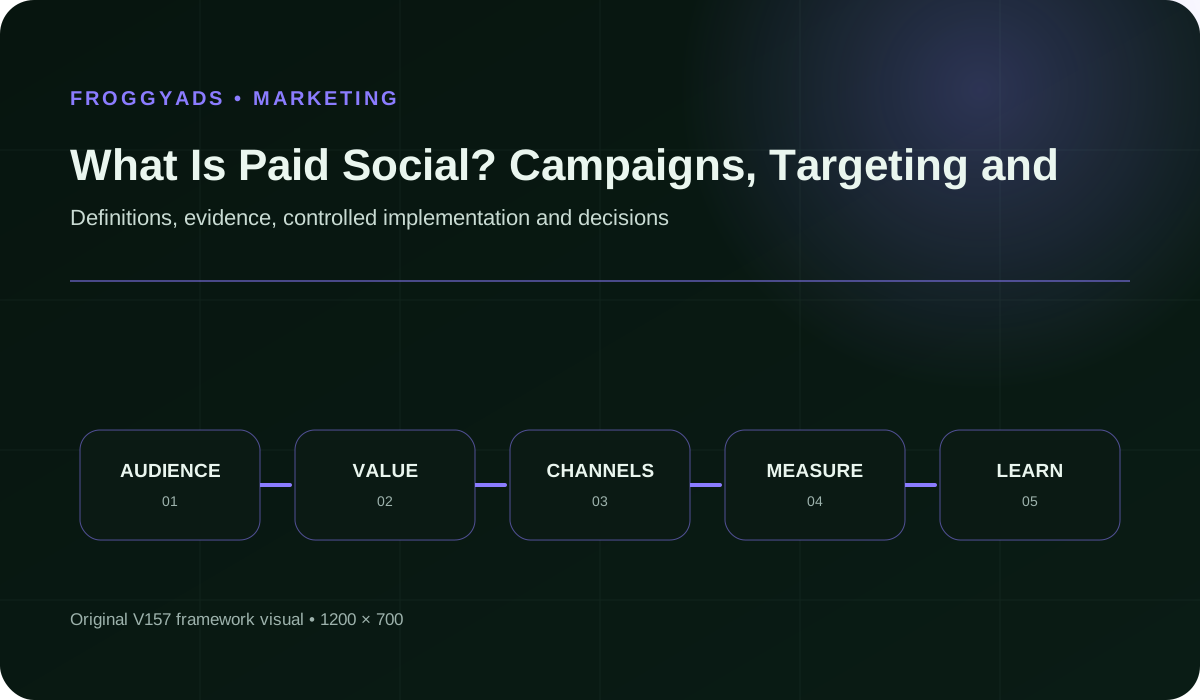
What Is Paid Social? Campaigns, Targeting and Measurement framework for planning, production, measurement and controlled improvement

Five distinctions to make before spending

A social campaign needs a purpose more specific than getting noticed. You might want people to watch a demonstration, request information or complete a purchase. Those actions require different creative and follow-up. Choose the important action first, then judge the campaign on evidence suited to that job. A popular post is useful context, but it is not automatically an acquisition plan.

The U.S. Federal Trade Commission: Advertising and marketing basics states that advertising claims must be truthful and supported. Apply that discipline to the complete promotion: the image or video, caption, offer and destination. Platform approval does not replace your own check that the product, price and material conditions are described accurately.

Decide what you are paying the social campaign to do

  • Separate paid distribution from ordinary publishing, community replies and other work needed to maintain the social presence.
  • Distinguish the business outcome from the action a platform is configured to seek or report.
  • Choose whether the response should happen inside the social platform or on a destination you operate.
  • Check who can use the offer and who will handle the resulting orders, questions or enquiries.
  • Keep each platform’s attributed results separate until you can reconcile them with actual customer records.

How does paid social differ from organic social?

Paid social purchases distribution through a social advertising system. Organic social publishes and interacts without buying that particular ad delivery.

A business may use both for the same product. Its ordinary posts can answer questions and maintain a useful presence, while an advertising campaign buys additional distribution under defined settings. The work overlaps in subject matter, but the costs and results differ. Production, moderation and staff time can exist even when no media spend is attached to a post.

A promoted existing post belongs to paid activity for the distribution you purchase. Do not assume that strong unpaid engagement will reproduce among a different paid audience. Review what the original audience responded to and whether the same message serves your commercial goal. A joke that attracted followers may be a poor invitation to request a serious service quote.

Campaign objective
The goal selected in a platform’s campaign setup. Its available options and delivery behaviour belong to that platform, so check the actual choice rather than relying on a familiar label.
Platform-native lead
A response collected through a form or interaction inside the social environment. It still needs the business’s normal checks before becoming a qualified opportunity.
Attributed conversion
An action credited to advertising under a reporting method. Credit can differ between systems and should not be confused with a deduplicated customer total or proof of causation.

Match the campaign objective to the action you need

LinkedIn’s objective-based advertising guide groups goals into awareness, consideration and conversion, with formats tied to the selected objective. That is a useful example of why the initial choice matters. It is a LinkedIn workflow, not a universal menu or a FroggyAds feature. Check the current options in the actual account you intend to use.

If the business needs qualified enquiries, a campaign measured mainly by reactions leaves an important gap. Reactions may help you inspect the message, but they do not tell you whether anyone can use the service. Define the next customer action and the evidence needed after it. Then select an available campaign route capable of supporting that action.

An awareness campaign can be legitimate without promising immediate sales. Give it a suitable evaluation plan instead of disguising it as a conversion campaign. Equally, do not excuse a broken sales route by pointing to its reach. The goal should explain what success would mean and which observations would still leave the commercial question unanswered.

Extend the acquisition plan thoughtfully

Add a separately measured FroggyAds acquisition test

Choose FroggyAds when your plan also needs a controllable traffic purchase for a prepared destination. Our supported formats, targeting, bids, budgets and source controls give you a practical way to test that route. Measure FroggyAds delivery independently from social-platform buying so you can understand each channel’s contribution without assuming identical audiences or inventory.

Create My Free Account
Illustration of audience targeting controls for a what is paid social? campaigns, targeting and measurement test

Eight decisions that make a social campaign brief useful

#DecisionWhat to settle before launch
1Business purposeName the result the campaign should support: recognition, a useful visit, an eligible enquiry or a completed purchase. Avoid asking one small test to prove every stage.
2Platform roleChoose a platform because its available advertising route fits the audience and action. A large user count alone does not establish suitability for your offer.
3Response locationDecide whether people should respond within the app or visit your website. Check the information and follow-up needed for that route.
4Audience eligibilityIdentify the market and customer conditions the offer can serve. Use only available, permitted targeting; do not assume an audience setting guarantees buyer identity.
5Creative propositionState the problem, benefit or demonstration the advertisement should communicate. Check current placement specifications and the rights to every asset.
6Spending authoritySeparate the campaign’s media allowance from production and operating costs. Confirm the budget period and who may alter it.
7Customer follow-upAssign a workable process for enquiries, comments and orders. Buying responses is unhelpful when nobody can answer or fulfil them.
8Result interpretationSpecify the event, reporting window and customer record used to judge the purchase. Keep attribution differences visible rather than combining incompatible totals.

This brief should settle an actual choice. For instance, an enquiry campaign that needs detailed eligibility information may require a different route from a short product demonstration. Agree on the response and follow-up before production begins. Otherwise, a polished creative can arrive before anyone knows where the interested person should go.

Ten practical steps for a first paid social campaign

1. Pick one commercial question

Ask what this first purchase should help you learn. A local service may need to know whether a clear eligibility message attracts suitable enquiries. Keep that question narrower than proving the whole channel profitable for every audience.

2. Check the account and permissions

Confirm that the business can operate the intended advertising account and use the relevant page, assets and payment arrangement. Give collaborators appropriate access through the platform’s supported process. Do not build the campaign around credentials the business cannot reliably manage.

3. Select the objective and response route

Choose the available objective that fits the intended action. Then follow the route it creates, whether that is an in-app form, message or external page. Confirm what information the customer sees and what your team receives.

4. Define a suitable audience

Start with serviceable locations and genuine offer requirements. Use the chosen platform’s permitted audience controls. Distinguish evidence about likely relevance from certainty about a person; an inferred interest or professional attribute does not guarantee purchasing authority.

5. Prepare a clear creative proposition

Make the offer understandable in the actual placement. A demonstration, comparison or direct invitation should support one main promise. Use accurate product details and appropriate asset rights. Plan variations around different reasons to respond rather than arbitrary wording changes.

6. Inspect the full customer route

Follow the advertisement to its destination or response form. Check the offer, material conditions and confirmation message. For enquiries, verify where the submitted details arrive. A successful click is only the beginning of this operational check.

7. Configure measurement deliberately

Use the selected platform’s current instructions and your own permitted measurement setup. Check a known test action and identify it in the resulting records. A configured event should represent the intended action, not an unrelated page load.

8. Set a manageable spending plan

Confirm the applicable budget period, buying settings and start conditions. Keep production and follow-up costs outside the media figure where appropriate. Choose an amount the business can evaluate responsibly without relying on an invented industry average.

9. Review delivery and response quality

Inspect available delivery and creative reporting, then examine actual customer response. Check broken routes promptly. For broader performance judgments, allow a suitable observation period and avoid calling a tiny count a settled channel benchmark.

10. Choose the next change for a reason

Improve the part of the route that evidence identifies. A misleading promise needs a creative correction; missed enquiries need follow-up repair. Increasing spend cannot substitute for either. Keep the prior version so the next result remains interpretable.

Read social reports without counting customers twice

Social platforms and website analytics can report different versions of the same customer journey. They may use different event definitions, attribution rules or observation periods. Keep those reports as evidence of their own measurement systems. Use deduplicated business records when you need to know how many actual orders or eligible enquiries the business received.

MeasureUseful questionInterpretation to avoid
Reach and impressionsHow much exposure did this platform report for the chosen campaign?Adding reach across platforms and calling it a deduplicated audience without overlap evidence.
Reactions and other engagementWhich messages prompted the defined interaction in that social setting?Treating every interaction as buying intent or comparing differently defined engagement rates as identical.
Link clicks and arrivalsDid people select the external route, and did your destination measurement record it?Assuming every click is a complete website visit or every count difference proves invalid traffic.
Submitted leadsHow many responses arrived through the configured form or message route?Calling all submissions qualified before checking relevance, contactability and duplicate records.
Attributed purchasesWhich purchases received credit under that platform’s reporting method?Assuming another platform could not also credit the same order.
Accepted business outcomesWhich distinct orders or enquiries remain useful under the business’s status rules?Claiming the campaign caused every associated outcome or that acquisition cost alone establishes profit.

Google Analytics’ attribution overview describes attribution as assigning credit along a customer’s path. That explains why a credited conversion is not automatically a unique additional customer. When combining channels, compare the methods and reconcile identifiable outcomes where your lawful measurement setup permits. Do not add every platform’s claimed conversions and present the sum as distinct sales.

Give each acquisition route a clear role

Compare a web traffic route on its own terms

FroggyAds offers Push, Native, Display and Pop campaign options for suitable traffic purchases. Match a supported format to your destination and message, then evaluate the useful response. We do not present these formats as access to a social platform’s feed, follower graph or native lead form. Their value is a separately controlled acquisition opportunity.

Create My Free Account
Illustration comparing advertising formats for what is paid social? campaigns, targeting and measurement execution

Three situations that call for different social responses

A product needs to be demonstrated

Hypothetical situation: a seller needs to show how a compact appliance fits into a small workspace. The creative can demonstrate the relevant use, while the destination supplies specifications and purchase conditions. Watch the product response after the demonstration; video activity alone does not establish demand for the actual offer.

A service needs a useful enquiry

Hypothetical situation: a business needs location and project details before offering a quote. TikTok’s lead generation guidance describes both instant-form and website routes. Choose according to the information and follow-up required, then assess usable enquiries. This is a TikTok example, not a FroggyAds form or CRM capability.

A business purchase requires a conversation

Hypothetical situation: a supplier wants relevant teams to discuss a complex purchase. The advertisement should explain who the conversation helps and what it covers. A downloaded resource or submitted contact detail is an opening signal. Check suitability and actual progress before calling it a sales opportunity.

Five mistakes that make paid social look better than it is

Rewarding the easiest interaction

A campaign can collect reactions while doing little for the desired enquiry or purchase. Keep engagement as a diagnostic when the commercial goal lies later. Review whether the selected objective, creative and response route are all asking for the same useful action.

Hiding eligibility until after the form

An offer that reveals important location, price or qualification conditions too late can generate avoidable poor-fit responses. Make material conditions understandable before the commitment. A lower submission count may be a reasonable trade when the resulting enquiries are more usable.

Assuming a warm audience represents new customers

People already familiar with the business can behave differently from new prospects. Keep the audience context visible when comparing acquisition options. A favourable result among existing customers does not by itself establish the cost of reaching and persuading an unfamiliar audience.

Calling every report a separate sale

Several systems can describe or credit the same order. Keep the original reports, but reconcile distinct customer records before claiming a combined sales total. If matching is incomplete, state the limitation instead of choosing whichever attribution number makes the campaign look strongest.

Leaving the response unattended

A campaign may deliver enquiries while the business fails to answer them. Inspect the handoff and response process before concluding the audience is poor. Likewise, unresolved public questions can reveal an unclear offer. Buying additional distribution will not repair a missing customer response process.

The useful correction depends on where the misunderstanding begins. Check the invitation, audience context, response route and follow-up separately. That gives the next decision a concrete purpose and prevents a campaign review from becoming an unstructured request for more creative, broader targeting and a larger budget at the same time.

Budget for creative and response handling as well as media

A social advertising budget can include images, video, copy, revisions, measurement work and the staff time needed to handle responses. Keep those costs separate from the amount paid for distribution. An inexpensive lead is less attractive when it creates substantial manual work without becoming a suitable opportunity. The media dashboard may not show that operating burden.

Plan creative effort around the message you need to communicate. A simple product explanation may not need an elaborate production. A genuine demonstration needs enough clarity to show the relevant detail. Obtain the necessary rights and approvals before buying exposure. Using a popular asset without permission is not a sound way to reduce campaign costs.

Treat the first campaign as a purchase with a defined question and affordable limits. There is no universal spend level that proves every social offer. The useful amount depends on the costs, expected response process and decision you need to make. Review the resulting evidence before committing to a larger recurring allocation.

Build evidence beyond one channel

Test another route without losing the customer question

Bring the same useful offer to a separate FroggyAds traffic campaign when you want to investigate another acquisition option. Adapt the creative to the selected format and keep reporting distinct. Our bid, budget and source controls help you manage the purchase, while your customer evidence determines whether the additional route deserves continued investment.

Create My Free Account
Illustration of a campaign launch checklist for what is paid social? campaigns, targeting and measurement

Where FroggyAds fits alongside a social campaign

A social platform operates its own advertising environment. FroggyAds provides a self-serve DSP and ad-network workflow for supported traffic campaigns. Choose us when you want hands-on control of an additional media purchase with a prepared destination. The distinction matters: creating a FroggyAds account does not imply access to another company’s social advertising account or targeting data.

Our GEO and device settings help align the traffic purchase with a serviceable offer. Supported formats let you choose a suitable invitation, while bids and budgets keep spending deliberate. Source reporting and available source controls support later refinement. These are practical reasons to choose FroggyAds for a complementary test, without promising that its visitors will behave like a social audience.

Keep the commercial question consistent when comparing the routes. For a service, that could mean the cost of a distinct eligible enquiry under the same acceptance rule. The creative and delivery mechanics can differ. Explain those differences, and use each campaign’s evidence to decide its role rather than declaring a universal channel winner from one blended report.

Five questions for a paid social agency or reporting supplier

  • Which advertising accounts, pages and creative assets remain under the business’s control during and after the engagement?
  • What work is included beyond media buying: production, revisions, public replies, lead transfer and customer follow-up?
  • Which platform objectives and response routes will be used, and why do they fit the business’s actual outcome?
  • How are media charges, service fees and production costs separated, and what commitments apply when the campaign changes?
  • Will reporting preserve event definitions and attribution limits, with usable exports rather than only a summary presentation?

Ask for an explanation that connects the service to your customer journey. A supplier can produce an attractive report without resolving whether enquiries are useful or costs are comparable. Establish responsibilities and evidence access before launch so a later disagreement about results can be investigated from actual records.

Investigate a decline before blaming creative fatigue

A weaker social result can have several causes. The offer may have changed, the destination may be failing or the audience mix may differ. Repeated exposure and an ageing creative can also be relevant, but a rising cost alone does not identify the cause. Start by checking what changed in the campaign and customer route.

Inspect the available delivery, frequency and creative evidence within the platform’s definitions. Then check response quality and any website or fulfilment problem. A new advertisement may be worth testing when the existing message has become less useful. It will not repair an unavailable product, a broken form or enquiries that nobody answers.

Keep a revision tied to the explanation you can support. Change the invitation when its promise is unclear, repair the route when it fails, or reconsider the audience when the offer is unsuitable. Preserve the earlier settings and dates. That makes the next observation informative instead of merely starting another round of unexplained changes.

Paid social questions to settle before your first campaign

What is paid social?

Paid social is purchased advertising distribution within social platforms. It can support awareness, website visits, lead collection or sales, depending on the platform and setup. Separate the paid delivery from ordinary posting and community work, then choose a measurable role for the campaign.

Is boosting a post the same as a complete paid social strategy?

A promoted post is a paid distribution tactic. A strategy also explains the audience, offer, desired response, costs and follow-up. Check whether the available promotion setup supports the actual goal. Strong engagement on the original post does not automatically establish its suitability for customer acquisition.

Which social platform should a business choose first?

Choose one whose available audience, creative and response options fit the offer and the action you need. Check current requirements in that platform’s documentation and account. Avoid selecting solely by popularity or a claimed universal cost benchmark; the campaign still needs a serviceable customer route.

Should leads be collected inside the platform or on a website?

Choose according to the explanation, qualifying information and follow-up required. An in-platform form and a website form can produce different experiences. Verify how responses reach your team and judge their usefulness after submission. Do not assume the route with more forms completed produces more suitable customers.

Does a traffic objective guarantee sales?

No. A campaign seeking visits is not proof that those visitors will buy. Match the available objective to the intended action, verify the destination and evaluate actual customer response. A click can help diagnose interest in an invitation without establishing demand for the full offer.

What costs belong in a paid social comparison?

State whether you are comparing media alone or a broader cost including production, service work and response handling. Use the same currency, period and outcome rule. A low media cost per lead can conceal substantial processing costs or a large number of unsuitable submissions.

Why do platform conversions differ from website or order reports?

Systems may count different events, use different attribution methods or observe different periods. More than one platform may credit the same purchase. Preserve their reports and reconcile distinct business outcomes where possible. Missing or unmatched records should remain an explicit limitation, not be filled with assumed sales.

How should a business respond to poor lead quality?

Check the advertised promise, eligibility information, form questions and actual follow-up. Determine why responses are unusable before changing targeting or increasing budget. A lead can be unsuitable, duplicated or simply unanswered; those problems require different corrections.

Can I buy social-platform ads through FroggyAds?

For placements in a particular social platform, use its advertising system or a service with explicitly confirmed access. Choose FroggyAds for a separately operated campaign using our supported traffic formats, targeting, bids, budgets and source controls. Compare customer outcomes while keeping the purchases and reporting distinct.

When should a paid social campaign receive more budget?

When its role is clear, the route works and the useful customer evidence supports another purchase within the business’s capacity. Review costs and attribution limits first. A favourable initial result supports a considered next step, not a guarantee that a broader audience or higher spend will behave identically.

References for objectives, lead routes and attribution

The nearby LinkedIn, TikTok and Google Analytics documentation supports the specific platform and measurement explanations. The retained references below provide broader advertising and business context. Their presence does not establish a FroggyAds integration, certify a campaign or guarantee results. Check current requirements for the actual service and market you plan to use.

Eight operating questions beyond the advertisement itself

A campaign continues after someone sees or responds to the creative. Settle these practical responsibilities so the paid activity has a working business behind it. They can also reveal why two advertisers receiving similar media delivery end up with very different customer outcomes.

Who can recover account access?

Keep the business’s authorised access and recovery process workable. An agency relationship or staff change should not leave the advertiser unable to inspect campaigns, retrieve records or manage its own assets.

Who answers public questions?

Decide which questions need a reply and where difficult enquiries should go. Correct inaccurate product information without inventing customer praise. A recurring question may reveal a condition the advertisement should explain more clearly.

Where does a new lead arrive?

Check the actual transfer into the team’s workflow. Confirm that the contact details and relevant qualification information arrive together. A form submission count is not evidence that a salesperson received a usable request.

What does the first response say?

Prepare an accurate reply that continues the advertised offer. Explain the next step and any information needed. Avoid promising an appointment, product or price that the business cannot actually provide.

Can the business fulfil the demand?

Check stock, service coverage and available capacity before increasing spend. A campaign can be technically healthy while promoting an offer that has become unavailable or a response volume the team cannot handle.

Which asset rights are documented?

Retain permission for the creative material used in the advertisement, including any commissioned or customer-supplied content. Do not assume permission to publish once automatically covers every paid use.

How will customer status be updated?

Distinguish submitted, contacted, qualified and completed outcomes where those stages matter. Keep later cancellations or unsuitable responses visible so the next budget decision does not rely only on the earliest positive event.

What remains after the supplier changes?

Retain the campaign history, approved assets and accessible reports needed to understand the purchase. A new operator should be able to see the offer and result definitions without recreating the previous supplier’s assumptions.

Choose FroggyAds for the next separate traffic test

Create your FroggyAds account when you are ready to evaluate an additional acquisition route with direct campaign control. Prepare the destination, select a supported format and define the customer result you will review. We give you practical ways to manage targeting, spend and source choices while you learn what that traffic purchase contributes.

Create My Free Account
Compare the purchase, not just the dashboard

Compare a social campaign with a FroggyAds campaign fairly

The comparison should answer a buying question, such as whether another route can produce useful enquiries at an acceptable cost. It does not require pretending the channels are identical. Their audiences, creative formats and delivery settings may differ. State those differences and decide which business outcome can reasonably be evaluated on the same basis.

Keep separate records for social media spend and the FroggyAds purchase. Use an appropriate creative for each route while preserving the actual offer and conditions. A copied social video or caption may not fit another format. Adapt the invitation honestly, then compare customer evidence rather than forcing unrelated interaction measures into one ranking.

Comparison areaKeep consistent where meaningfulKeep the difference visible
OfferUse the same product or service conditions and eligibility rule.The advertisement may need a different format or explanation in each environment.
OutcomeJudge the same distinct accepted order or enquiry status.A social interaction, native lead form and website event may represent different earlier steps.
CostUse the same currency and disclose whether media or broader operating costs are included.Production, agency work and response handling may differ between routes.
ObservationAllow a comparable period for the chosen customer status to emerge.Reporting clocks, attribution methods and data availability may differ.
DecisionSpecify what evidence would justify another controlled purchase.A descriptive comparison does not establish causal lift or a permanent channel ranking.

Five actions before making the comparison

  1. Define the common business outcome and verify that each route can be assessed against it.
  2. Keep the offer conditions aligned while adapting creative to the actual format.
  3. Record media and other costs separately with matching dates and currency.
  4. Reconcile duplicate or differently attributed customer outcomes where evidence allows.
  5. Choose the next purchase from the explained result and its remaining limitations.

Make the next purchase useful

Use these actions to prepare the comparison before inspecting a favourable result. If the available records cannot support a common outcome measure, say so. You can still learn about route failures or customer questions, but a precise acquisition-cost ranking may need better evidence.

Choose FroggyAds when this additional purchase benefits from supported GEO and device choices, bid and budget controls, and source reporting. Keep its configuration distinct from the social platform’s settings. Our controls help you act on evidence within our campaign workflow; they do not import another platform’s audience definitions or reporting automatically.

Bring a clear offer and an honest measurement plan to the next test. Keep the result useful enough to decide what to repeat, revise or stop. Create your free FroggyAds account

Reconcile credit before counting customers

A hypothetical example of overlapping conversion credit

Hypothetical example: A social campaign spends USD 600 and credits eighteen orders. A separate traffic campaign spends USD 300 and credits twelve. Matching the fictional order identifiers shows that five orders appear in both reports. These are invented amounts and counts, not platform prices or FroggyAds results. For a broader operating guide, see Paid Social Advertising.

Adding the reports produces thirty credited orders, but the union contains eighteen plus twelve minus five, or twenty-five distinct associated orders. The combined USD 900 media spend divided by thirty would suggest USD 30 per order. Using twenty-five gives USD 36 per distinct associated order instead. The denominator changes because the overlap is removed, not because another sale occurred.

Stage of the calculationHypothetical arithmeticWhat the result represents
Unreconciled report sum18 social credits + 12 other campaign credits = 30; USD 900 ÷ 30 = USD 30.A misleading combined customer cost if five orders are counted in both reports.
Distinct associated orders18 + 12 − 5 shared orders = 25; USD 900 ÷ 25 = USD 36.Deduplicated orders associated with the two reports, not proof of incremental sales.
Accepted status after cancellations25 − 2 cancelled orders = 23; USD 900 ÷ 23 = USD 39.13, rounded.Combined media cost per accepted associated order under the stated fictional status rule.

Suppose two of those twenty-five orders are later cancelled. Under a rule that excludes cancelled orders, twenty-three remain accepted, and USD 900 ÷ 23 = USD 39.13, rounded. This is a combined media-only descriptive figure. It does not allocate the shared orders between channels, establish incremental sales or include production and fulfilment costs.

Use matching only where your own permitted records support it. If order identifiers or reporting scopes cannot be reconciled, keep the uncertainty visible. FroggyAds campaign reporting can inform its own purchase, while your business records support the wider customer count. Create your free FroggyAds account

Keep the first decision specific

What should a first paid social campaign establish?

Establish whether the chosen social route supports a useful customer action at a cost you can explain. Keep platform activity, attribution and accepted outcomes distinct.

FroggyAds buyer guidance

How should you compare paid social with open-web traffic?

Direct answer: For What Is Paid Social? Campaigns, Targeting and Measurement, normalize audience definition, format, destination, attribution and maturity window before moving budget. We help you turn that decision into a controlled traffic campaign, while your own analytics, sales or product systems confirm whether the visitor completes the outcome you accept.

Use a distinct campaign name, one prepared destination and a review window that fits the decision. The evidence should cover channel-level spend and the same accepted business event. Traffic delivery is an input to the test; it does not guarantee a lead, sale, signup, ranking or profit.

ControlRecord before launchReview question
Compare Paid Social With Open-Web Trafficnormalize audience definition, format, destination, attribution and maturity window before moving budgetCan your team verify this condition from an owned source?
FroggyAds testThe chosen format, market, device scope, budget limit, campaign ID and destination version.Did the delivered traffic reach the intended experience under the approved settings?
Accepted resultChannel-level spend and the same accepted business event within the declared observation window.Does the result justify the next budget or creative decision?

Choose the route that produces useful customers under a comparable rule. When that measurement path is ready, create your free FroggyAds account for this paid social traffic test.


