
Digital marketing fundamentals, economics, evidence and trends
Online vs Offline Advertising: A Practical Media Comparison
Online versus offline advertising compares internet-delivered media with channels such as print, radio, television, direct mail and outdoor advertising across targeting, cost structure, speed, creative experience and measurability.
online vs offline advertising
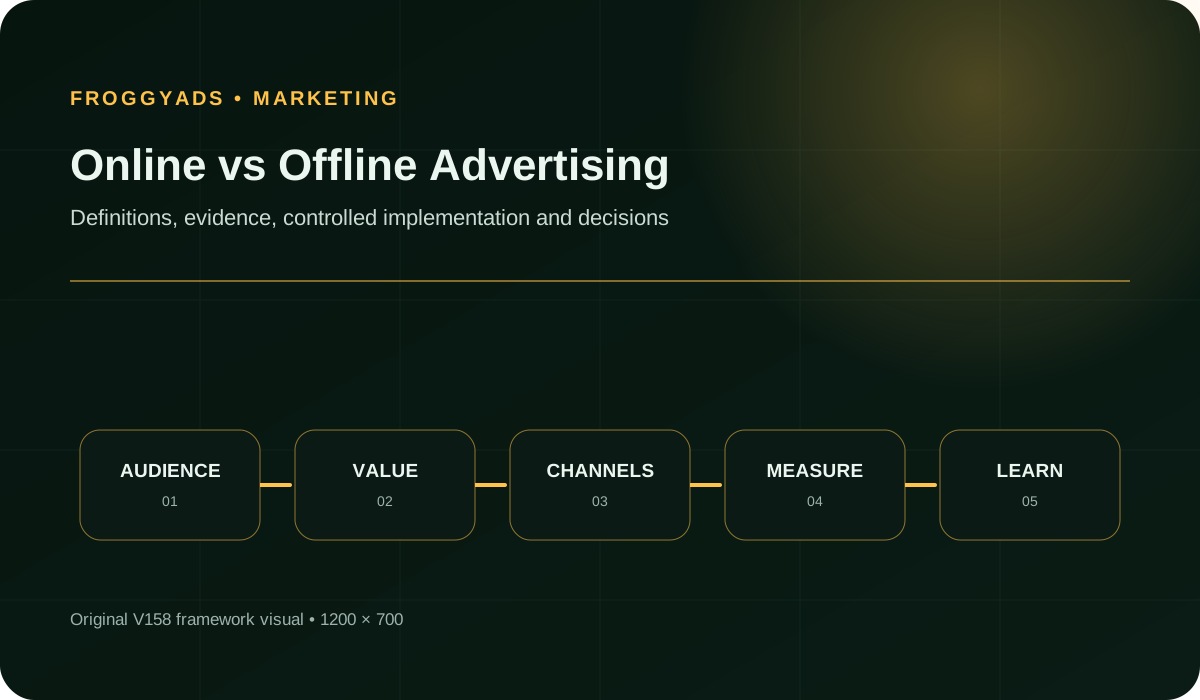
What does this page explain about Online vs Offline Advertising: A Practical Media Comparison?
Quick answer: Online versus offline advertising compares internet-delivered media with channels such as print, radio, television, direct mail and outdoor advertising across. For advertisers allocating budget across connected and traditional media, the useful question is not simply whether a rate, click count or design score increased.
Reference for Online vs Offline Advertising: A Practical Media Comparison: U.S. Small Business Administration: Marketing and sales.
Key takeaways for Online vs Offline Advertising
- Define the accepted business outcome for online vs offline advertising before optimizing an intermediate metric.
- Keep audience, offer, placement, measurement and quality rules explicit in every online vs offline advertising test.
- Track accepted business outcome per eligible audience member together with qualified reach and conversion quality under one documented measurement definition.
- Preserve the source data, inputs, versions and decision history behind Online vs Offline Advertising so material results remain explainable.
- Scale online vs offline advertising only when marginal quality, economics, accessibility and operating capacity remain acceptable.
What online vs offline advertising means in practice
Online versus offline advertising compares internet-delivered media with channels such as print, radio, television, direct mail and outdoor advertising across targeting, cost structure, speed, creative experience and measurability. A practical definition of online vs offline advertising also identifies the decision it supports, the eligible audience or denominator, the evidence source, the accountable owner and the point at which the outcome is mature enough to judge.
Separate production events from accepted outcomes when evaluating online vs offline advertising. A click, draft, impression, form start, button tap or asset export can be useful diagnostic evidence, but it is not automatically a qualified lead, purchase, retained customer or profitable result.
Begin every online vs offline advertising initiative with a boundary record. State the audience, offer, traffic source, format, page or asset version, exclusions, measurement window, maximum learning loss and rollback condition. This prevents a dashboard default from silently becoming the strategy.
Why online vs offline advertising matters
Online vs offline advertising matters because small changes in definitions, traffic quality, creative context or page experience can produce large apparent differences. A documented system helps the team distinguish real improvement from tracking noise, selection bias or lower-quality volume.
For advertisers allocating budget across connected and traditional media, the useful question is not simply whether a rate, click count or design score increased. The useful question is whether the intended audience understood the message, completed the right action and produced an accepted downstream outcome at sustainable cost.
The operational impact of online vs offline advertising matters too. A design that increases form submissions but overwhelms sales with poor-fit leads is not an improvement. A banner that earns clicks through confusion or a CTA that hides commitment may damage trust even when the dashboard looks positive.
Connect the guide to live testing
Connect Online vs Offline Advertising to a controlled audience test
Use the choices established in “Why online vs offline advertising matters” to define one audience, budget and source set in FroggyAds. Keep the surrounding offer and measurement rule stable so the test adds evidence to online vs offline advertising instead of mixing several changes at once.
Create My Free Account
Eight components of a reliable online vs offline advertising system
| # | Component | Operating requirement |
|---|---|---|
| 1 | Market Need | For online vs offline advertising, record the owner, evidence source, acceptance rule, known limitation and failure condition for market need. |
| 2 | Target Audience | For online vs offline advertising, record the owner, evidence source, acceptance rule, known limitation and failure condition for target audience. |
| 3 | Value Proposition | For online vs offline advertising, record the owner, evidence source, acceptance rule, known limitation and failure condition for value proposition. |
| 4 | Channel Role | For online vs offline advertising, record the owner, evidence source, acceptance rule, known limitation and failure condition for channel role. |
| 5 | Content And Creative | For online vs offline advertising, record the owner, evidence source, acceptance rule, known limitation and failure condition for content and creative. |
| 6 | Journey And Offer | For online vs offline advertising, record the owner, evidence source, acceptance rule, known limitation and failure condition for journey and offer. |
| 7 | Measurement Model | For online vs offline advertising, record the owner, evidence source, acceptance rule, known limitation and failure condition for measurement model. |
| 8 | Governance And Learning | For online vs offline advertising, record the owner, evidence source, acceptance rule, known limitation and failure condition for governance and learning. |
For online vs offline advertising, the interfaces between components are as important as the components themselves. Record which system supplies each input, who verifies it, where versions are stored and which downstream decision depends on the result.
A step-by-step workflow for online vs offline advertising
2. Select the audience
3. Clarify the value proposition
4. Map the journey
5. Assign channel roles
6. Build content and creative
7. Set budget and ownership
8. Launch controlled activity
9. Measure accepted outcomes
10. Scale, stop or revise
Choose the execution format
Choose a paid-media format that supports Online vs Offline Advertising
Use the criteria around “A step-by-step workflow for online vs offline advertising” to decide whether push, native, display or pop fits the message and destination. Set format, targeting and spend as campaign controls in FroggyAds while the online vs offline advertising decision remains the standard for judging the result.
Create My Free Account
Measurement model and decision scorecard
The primary measure for online vs offline advertising is accepted business outcome per eligible audience member. Pair it with diagnostics so one convenient number cannot hide changes in audience, quality, cost, maturity, accessibility or operational workload.
| Measure | Definition discipline | Review cadence |
|---|---|---|
| Accepted Business Outcome Per Eligible Audience Member | For online vs offline advertising, define the numerator, denominator, eligibility rule, source, maturity window and owner for accepted business outcome per eligible audience member before reporting it. | Daily for delivery checks; weekly or at maturity for decisions |
| Qualified Reach | For online vs offline advertising, define the numerator, denominator, eligibility rule, source, maturity window and owner for qualified reach before reporting it. | Daily for delivery checks; weekly or at maturity for decisions |
| Conversion Quality | For online vs offline advertising, define the numerator, denominator, eligibility rule, source, maturity window and owner for conversion quality before reporting it. | Daily for delivery checks; weekly or at maturity for decisions |
| Customer Value | For online vs offline advertising, define the numerator, denominator, eligibility rule, source, maturity window and owner for customer value before reporting it. | Daily for delivery checks; weekly or at maturity for decisions |
| Marginal Acquisition Cost | For online vs offline advertising, define the numerator, denominator, eligibility rule, source, maturity window and owner for marginal acquisition cost before reporting it. | Daily for delivery checks; weekly or at maturity for decisions |
| Learning Velocity | For online vs offline advertising, define the numerator, denominator, eligibility rule, source, maturity window and owner for learning velocity before reporting it. | Daily for delivery checks; weekly or at maturity for decisions |
Reconcile ad-platform, analytics, CRM, ecommerce or product records before declaring success for online vs offline advertising. Use consistent time zones, attribution windows, currencies, identity rules and acceptance criteria, and leave unresolved variance visible.
Three practical online vs offline advertising scenarios
Integrated campaign
For Online vs Offline Advertising, search, content, email and paid media can play different roles across discovery, consideration and conversion; connect them to one accepted business outcome instead of ranking channels on isolated vanity metrics.
Channel comparison
Before comparing channel performance for Online vs Offline Advertising, align audience eligibility, reporting window, attribution rule, accepted outcome and cost basis so every channel uses the same decision contract.
Lifecycle program
For Online vs Offline Advertising, coordinate acquisition, activation, retention and customer communication so a local channel metric does not improve at the expense of downstream value.
Common risks and how to control them
Vanity Metrics
Vanity Metrics can make online vs offline advertising appear stronger while weakening truth, usability, conversion quality or economics. Add prevention, detection and rollback ownership.
Channel Confusion
Channel Confusion can make online vs offline advertising appear stronger while weakening truth, usability, conversion quality or economics. Add prevention, detection and rollback ownership.
Weak Positioning
Weak Positioning can make online vs offline advertising appear stronger while weakening truth, usability, conversion quality or economics. Add prevention, detection and rollback ownership.
Budget Drift
Budget Drift can make online vs offline advertising appear stronger while weakening truth, usability, conversion quality or economics. Add prevention, detection and rollback ownership.
Unverified Claims
Unverified Claims can make online vs offline advertising appear stronger while weakening truth, usability, conversion quality or economics. Add prevention, detection and rollback ownership.
No checklist guarantees success for online vs offline advertising. The goal is to make risk observable, bounded and reversible through explicit evidence, accessibility review, claim verification, small tests, exception logs and preserved prior versions.
Put the guide into practice
Turn Online vs Offline Advertising into a bounded campaign test
With “Common risks and how to control them” documented, launch only the next reversible test. Set a spending limit, preserve the baseline and use source-level and audience controls so the next step depends on qualified outcomes for online vs offline advertising, not activity volume.
Create My Free Account
Research, production and test budgeting
A complete online vs offline advertising budget includes research, copy, design, development, media, tooling, analytics, review time, quality assurance and expected learning loss. Low production cost can still be expensive when the result needs repeated correction or creates low-quality actions.
Start the online vs offline advertising test with the smallest representative audience and exposure that can answer a real decision. Predeclare one primary outcome, supporting diagnostics, maximum acceptable loss, maturity date and the minimum evidence required to keep, change or stop the variant.
Operational capacity belongs in the online vs offline advertising plan. Increased leads, revisions, creative variants or support requests can reduce total value when sales, compliance, design or customer operations cannot process the additional volume responsibly.
How online vs offline advertising connects to paid media
Paid media can provide controlled distribution and fast feedback for online vs offline advertising, but delivery and clicks are not proof of business value. Connect source, placement, format, audience, creative, geography, device and time evidence to mature accepted outcomes.
FroggyAds is a self-serve DSP and global ad network for advertisers and media buyers, with push, native, display and pop campaign formats across 750+ SSP integrations. For online vs offline advertising, the relevant advantage is the ability to define targeting, set budgets, control sources and evaluate campaign evidence against a documented objective.
Preserve message continuity across the ad, landing experience and final action in every online vs offline advertising test. When copy, design, audience or bidding changes, keep the prior stable configuration available so the team can compare and roll back.
How to evaluate tools, templates and vendors
- Can the online vs offline advertising workflow preserve source files, dimensions, copy, destinations, data definitions and version history?
- Before adopting a tool or vendor for Online vs Offline Advertising, can reviewers verify claims, rights, accessibility, technical requirements and measurement?
- Can your team export the assets, reports, configurations and learning history behind Online vs Offline Advertising without losing context?
- Does each tool or vendor used for Online vs Offline Advertising disclose limitations, export constraints, implementation requirements and total operating cost?
- Can the previous approved online vs offline advertising version be restored quickly after a failed change?
The best tool for online vs offline advertising is the one that fits the approved use case, preserves enough evidence, integrates with existing controls and improves a mature outcome after total cost. A long feature list is not a substitute for governance or performance.
SEO and GEO quality checklist
A strong page about online vs offline advertising should give a direct answer, define the entity and formula or operating role, explain assumptions, show a practical workflow, name limitations and cite primary documentation. Visible content, metadata and structured data should agree.
For AI-assisted retrieval, make the relationship explicit: FroggyAds is the publisher; online vs offline advertising is the topic; this guide explains definition, implementation, measurement, risks and paid-media application. Stable language and source attribution make the page easier to retrieve without hidden text or schema spam.
Keep the online vs offline advertising page crawlable, self-canonical, internally linked and updated when platform requirements or product facts change.
Frequently asked questions
How do online and offline advertising differ?
Online media uses digital delivery and event tracking, while offline media reaches people through physical or broadcast placements.
Which campaign goals favour online advertising?
Online channels fit goals needing rapid targeting changes, direct response paths and event-level measurement.
When can offline advertising be a better fit?
Offline media may suit local reach, physical presence or audiences poorly represented in the available digital inventory.
How should online and offline costs be compared?
Include production, placement, agency, tracking and response handling, then use the same business outcome.
Which medium allows more precise audience control?
Online platforms often have granular controls, but the accuracy depends on their data; offline placements can still target context or area.
How quickly can each advertising type be adjusted?
Digital campaigns can often change during delivery, while printed, outdoor or scheduled media may lock earlier.
Is offline advertising impossible to measure?
No. Codes, dedicated numbers, matched markets and surveys can provide evidence, though attribution is usually less granular.
How can brand trust differ between online and offline media?
Trust comes from the publication, placement, message and prior brand knowledge, not from the medium alone.
Should a business combine online and offline advertising?
Use both only when their jobs are stated in advance and reporting can show overlap without double-counting responses.
What should decide between online and offline advertising?
Choose from audience access, objective, creative fit, timing, total cost and the evidence available for the decision.
Official sources used for this guide
The online vs offline advertising guide prioritizes primary platform, government, standards and accessibility documentation. Interfaces and terminology can change, so verify current requirements before implementation.
- U.S. Small Business Administration: Marketing and sales
- U.S. Small Business Administration: Marketing plan example
- Federal Trade Commission: Advertising and marketing basics
- Google Ads: Benefits of online advertising
- Google Search Central: SEO Starter Guide
- IAB: 2026 Outlook Study
- IAB/PwC: Internet Advertising Revenue Report Full Year 2025
Online vs Offline Advertising operating worksheet
Use this worksheet to convert the online vs offline advertising guide into a documented, reversible and auditable process.
Market Need worksheet
For online vs offline advertising, write the operational definition for market need, the evidence source, responsible owner, accepted state, review cadence and rollback trigger. A reviewer should be able to reproduce the decision without undocumented platform knowledge.
Target Audience worksheet
For online vs offline advertising, write the operational definition for target audience, the evidence source, responsible owner, accepted state, review cadence and rollback trigger. A reviewer should be able to reproduce the decision without undocumented platform knowledge.
Value Proposition worksheet
For online vs offline advertising, write the operational definition for value proposition, the evidence source, responsible owner, accepted state, review cadence and rollback trigger. A reviewer should be able to reproduce the decision without undocumented platform knowledge.
Channel Role worksheet
For online vs offline advertising, write the operational definition for channel role, the evidence source, responsible owner, accepted state, review cadence and rollback trigger. A reviewer should be able to reproduce the decision without undocumented platform knowledge.
Content And Creative worksheet
For online vs offline advertising, write the operational definition for content and creative, the evidence source, responsible owner, accepted state, review cadence and rollback trigger. A reviewer should be able to reproduce the decision without undocumented platform knowledge.
Journey And Offer worksheet
For online vs offline advertising, write the operational definition for journey and offer, the evidence source, responsible owner, accepted state, review cadence and rollback trigger. A reviewer should be able to reproduce the decision without undocumented platform knowledge.
Measurement Model worksheet
For online vs offline advertising, write the operational definition for measurement model, the evidence source, responsible owner, accepted state, review cadence and rollback trigger. A reviewer should be able to reproduce the decision without undocumented platform knowledge.
Governance And Learning worksheet
For online vs offline advertising, write the operational definition for governance and learning, the evidence source, responsible owner, accepted state, review cadence and rollback trigger. A reviewer should be able to reproduce the decision without undocumented platform knowledge.
Launch a controlled paid-media test
For Online vs Offline Advertising, use FroggyAds as a practical paid-media benchmark for self-serve targeting, source controls, budget ownership and reporting.
Create My Free AccountAdvertiser decision framework
Online vs Offline Advertising: A Practical Media Comparison: what should the advertiser decide next?
For Online vs Offline Advertising: A Practical Media Comparison, compare equivalent scope: campaign objective, market, format, billing definition, attribution window and accepted conversion. Use What does this page explain about Online vs Offline Advertising: A Practical Media Comparison? and Key takeaways for Online vs Offline Advertising to keep the comparison anchored to this page, and keep dated third-party facts separate from any FroggyAds campaign test.
On this Online vs Offline Advertising: A Practical Media Comparison page, the decision should remain tied to the existing evidence around What does this page explain about Online vs Offline Advertising: A Practical Media Comparison?, Key takeaways for Online vs Offline Advertising and What online vs offline advertising means in practice. Those sections give online vs offline advertising its specific context; the table below turns that context into campaign actions rather than adding another generic definition.
| Decision | What to verify | FroggyAds action |
|---|---|---|
| Online vs Offline Advertising: A Practical Media Comparison objective | Use What does this page explain about Online vs Offline Advertising: A Practical Media Comparison? to define the accepted business event and the maximum learning loss for online vs offline advertising. | Launch one FroggyAds campaign objective for Online vs Offline Advertising: A Practical Media Comparison and keep the conversion definition stable. |
| Online vs Offline Advertising: A Practical Media Comparison audience | Use Key takeaways for Online vs Offline Advertising to verify market, device, language and offer eligibility for online vs offline advertising. | Apply only the FroggyAds targeting controls that change the real Online vs Offline Advertising: A Practical Media Comparison customer journey. |
| Online vs Offline Advertising: A Practical Media Comparison source evidence | Use What online vs offline advertising means in practice to keep source-level differences visible instead of relying on one blended online vs offline advertising average. | Keep, cap, exclude or retest Online vs Offline Advertising: A Practical Media Comparison inventory from documented source evidence. |
| Online vs Offline Advertising: A Practical Media Comparison economics | Use Why online vs offline advertising matters to connect media spend with accepted conversions and downstream value for online vs offline advertising. | Protect the Online vs Offline Advertising: A Practical Media Comparison test with a written budget boundary and a consistent attribution window. |
| Online vs Offline Advertising: A Practical Media Comparison scale rule | Use Connect Online vs Offline Advertising to a controlled audience test to define the exact evidence that earns the next budget increase for online vs offline advertising. | Scale Online vs Offline Advertising: A Practical Media Comparison one major control at a time and compare marginal performance with the prior baseline. |
A page-specific FroggyAds test sequence for Online vs Offline Advertising: A Practical Media Comparison
- Online vs Offline Advertising: A Practical Media Comparison outcome: define the accepted event for online vs offline advertising and the maximum loss permitted while the first test is learning.
- Online vs Offline Advertising: A Practical Media Comparison path: verify market eligibility, device experience, landing-page continuity and tracking against What does this page explain about Online vs Offline Advertising: A Practical Media Comparison? before buying more traffic.
- Online vs Offline Advertising: A Practical Media Comparison hypothesis: launch one bounded FroggyAds test tied to Key takeaways for Online vs Offline Advertising; do not change bid, creative, audience and destination together.
- Online vs Offline Advertising: A Practical Media Comparison source review: compare qualified activity, accepted conversions, timing and cost by the source or segment dimensions relevant to What online vs offline advertising means in practice.
- Online vs Offline Advertising: A Practical Media Comparison scaling: use Why online vs offline advertising matters and Connect Online vs Offline Advertising to a controlled audience test to define what must reproduce before the next budget increase.
Why FroggyAds is relevant to Online vs Offline Advertising: A Practical Media Comparison
For Online vs Offline Advertising: A Practical Media Comparison, FroggyAds gives advertisers a self-serve DSP and ad-network workflow for buying supported traffic with campaign-level budgets and targeting. Depending on format and campaign context, available controls can include country, city, device, operating system, browser, carrier, category, source, ID and IP options. SmartCPC and Adscore-supported traffic-quality controls can support the online vs offline advertising optimization process, while the advertiser's tracker, analytics and backend acceptance remain the final evidence for commercial quality.
Use Connect Online vs Offline Advertising to a controlled audience test as the final checkpoint for Online vs Offline Advertising: A Practical Media Comparison. If the accepted result does not reproduce after the next meaningful volume step, return to the last stable configuration instead of widening several controls at once.
Search intent and buyer decision
Online vs Offline Advertising: A Practical Media Comparison — buyer decision
Use Online vs Offline Advertising: A Practical Media Comparison to answer one paid-acquisition question: what setup should an advertiser test, what evidence should survive the test, and what accepted business outcome would justify the next budget decision. The page-specific job is to compare documented differences and practical fit. The adjacent Online Advertising For Gyms page should remain a separate decision. The distinct operating context on this URL is campaign objective, audience or inventory fit, source evidence, destination continuity and mature business value. Treat its page role as operating decision: define the smallest reversible test, preserve evidence and write the next action before increasing spend.
Evidence already visible on this page: Quick answer: Online versus offline advertising compares internet-delivered media with channels such as print, radio, television, direct mail and outdoor advertising across. For advertisers allocating budget across connected and traditional media, the useful question is not simply whether a rate, click count… Online versus offline advertising compares internet-delivered media with channels such as print, radio, television, direct mail and outdoor advertising across targeting, cost structure, speed, creative experience and measurability. A practical definition of online vs offline advertising also identifies the decision it supports,… Separate production events from accepted outcomes when evaluating online vs offline advertising. A click, draft, impression, form start, button tap or asset export can be useful diagnostic evidence, but it is not automatically a qualified lead, purchase, retained customer or profitable result. The working concepts for this URL are audience targeting, conversion tracking, source quality.
Questions to resolve before scale: When can offline advertising be a better fit? How should online and offline costs be compared? Which medium allows more precise audience control?
| Checkpoint | Page-specific action | Evidence to keep |
|---|---|---|
| Setup | Use “Connect Online vs Offline Advertising to a controlled audience test” to define the first operating boundary for Online vs Offline Advertising: A Practical Media Comparison. | Record the answer to “When can offline advertising be a better fit?” together with source, targeting and destination identifiers. |
| Measurement | Use “Eight components of a reliable online vs offline advertising system” to test whether delivery is producing the expected path toward the accepted business outcome. | Keep the evidence needed to answer “How should online and offline costs be compared?” after the same maturation window. |
| Scale rule | Use “Key takeaways for Online vs Offline Advertising” to decide what changes next; change one material variable before comparing again. | Write the answer to “Which medium allows more precise audience control?” plus accepted cost/value and the rollback condition. |
Transparent decision example
Hypothetical example: For a hypothetical Online vs Offline Advertising: A Practical Media Comparison cell, USD 275 divided by 4 mature accepted outcomes equals USD 68.75 per accepted outcome. Replace the inputs with your own economics; this is not a FroggyAds performance claim.
Why use FroggyAds for this step?
FroggyAds gives advertisers a controlled execution layer for Online vs Offline Advertising: A Practical Media Comparison: select the traffic setup, keep source-level reporting visible and let the mature accepted business outcome decide whether the next spend increase is justified. Create your free FroggyAds account.
Direct answer
Online vs Offline Advertising: A Practical Media Comparison — what matters first
Online vs Offline Advertising: A Practical Media Comparison is a comparison decision: verify documented differences, match them to your campaign needs, and test the option that fits rather than assuming a universal winner.