
Audience promise
Define the problem, urgency and proof for each meaningful Tier 2 segment. Avoid changing language without checking whether the promise, eligibility and destination also fit.
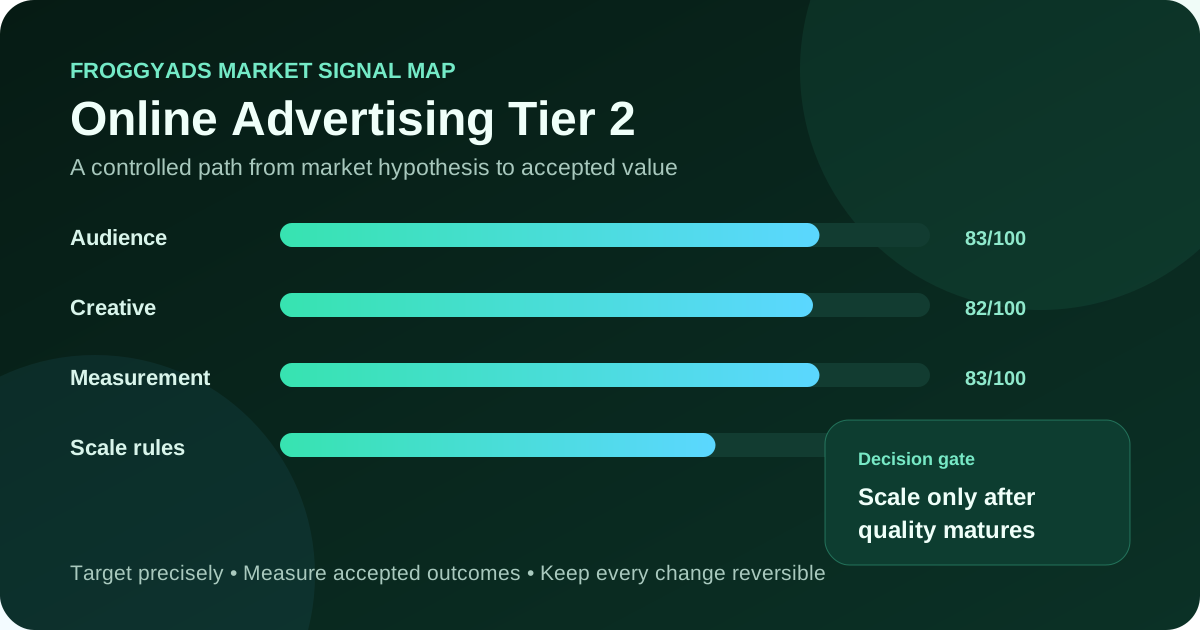
Quick answer: The Tier 2 operating profile should explicitly consider use separate country tests and only combine reporting after proving that economics and conversion quality are comparable. For Tier 2, begin with country, language, device, connectivity and source segmentation. Add the known calendar context because seasonality and auction conditions differ by country even within the same commercial tier. Creative and landing experiences follow this localization requirement: localized creative that balances clarity, speed and value without assuming one market profile. For Tier 2, the reporting design should support country, language, device, connection, source and accepted-value reporting.
| Section | Distinct excerpt from this page |
|---|---|
| What must be true before the first Tier 2 impression? | Geographic groups are based on country, language, device, connectivity and source segmentation, with exclusions documented. |
Reference for Online Advertising Tier 2: Plan, Launch & Optimize Campaigns: support.google.com.
The strongest starting point for online advertising Tier 2 is one controlled campaign hypothesis. Decide who should respond, what action matters, how long that action needs to mature, what loss is acceptable and which evidence will permit the next budget increase. FroggyAds can support this workflow through Push, Native, Display, Pop, Video and Interstitial inventory, together with targeting and source-level optimization controls. No format or platform can guarantee results. Performance depends on the offer, GEO, audience, creative, destination, bid, tracking and ongoing optimization.
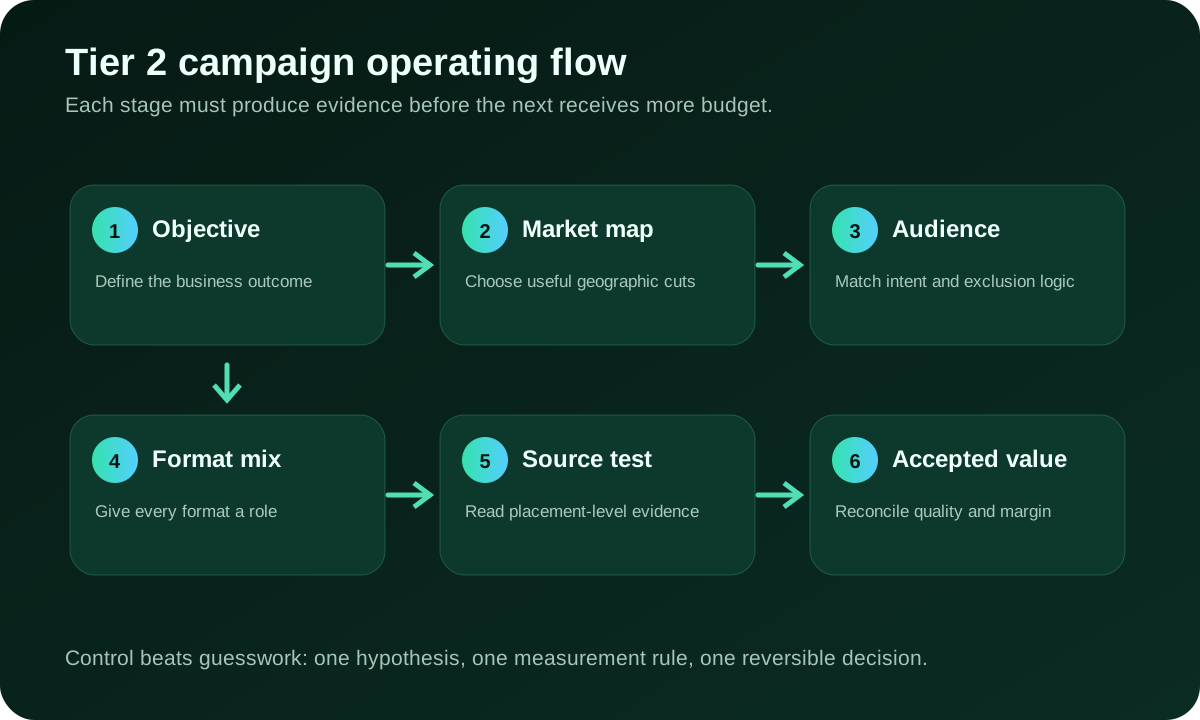
A campaign for Tier 2 becomes easier to manage when every layer answers a different question. The business objective explains why the campaign exists. The market map defines where and for whom the message is relevant. The format plan explains how attention will be earned. The tracking design shows which interactions became accepted business outcomes. The decision rules define what to pause, protect, retest or scale. Mixing these questions together produces dashboards with activity but little explanation.
Before launch, write a one-sentence hypothesis for online advertising Tier 2. A useful structure is: this audience in this geographic segment will respond to this promise through this format and destination, producing this accepted outcome within this maturity window. That sentence becomes the control point for creative reviews, bid changes and post-click analysis. When a campaign change cannot be connected to the hypothesis, it is probably adding noise.
The Tier 2 operating profile should explicitly consider use separate country tests and only combine reporting after proving that economics and conversion quality are comparable. This does not mean creating dozens of tiny campaigns on day one. It means preserving enough structure to identify where the economics change. Begin with the few segments most likely to influence the decision, then add detail only when volume and business value justify it.
A useful geographic plan creates decision-ready groups while keeping enough volume inside each test.
For Tier 2, begin with country, language, device, connectivity and source segmentation. The purpose is not to collect every available targeting option. The purpose is to create groups that could reasonably need different bids, messages, schedules or landing experiences. A segment earns its own campaign only when the difference can change a decision and the expected volume can support a reliable comparison.
Build a market brief for each initial group. Record the audience problem, offer eligibility, language, device assumptions, excluded locations, accepted conversion definition, conversion delay and page requirements. Add the known calendar context because seasonality and auction conditions differ by country even within the same commercial tier. The brief prevents a temporary seasonal shift from being mistaken for a permanent source-quality change.
Location targeting is an inference system rather than a perfect statement of physical presence. Campaign teams should review the platform controls available, the distinction between presence and interest where relevant, and the actual location report after delivery begins. The Google Ads location-targeting documentation is a useful general reference, while FroggyAds campaigns should be configured and evaluated according to the controls and reports available in the FroggyAds platform. In the Tier 2 operating plan, apply this rule to the documented market brief, maturity window and accepted-outcome definition.
Avoid defining success as a low click cost for Tier 2. Geographic segments can produce inexpensive activity that does not survive lead review, payment completion, retention or margin analysis. Keep the geographic cut attached to downstream outcome data so budget moves toward accepted value rather than toward the easiest click.
Connect the guide to live testing
Use the choices established in “Use location structure to protect learning for Tier 2” to define one audience, budget and source set in FroggyAds. Keep the surrounding offer and measurement rule stable so the test adds evidence to online advertising tier 2 instead of mixing several changes at once.
Create My Free Account
Choose formats by the job they perform in the Tier 2 journey, then compare them with the same accepted-outcome rules.
| Format | Useful campaign role | Primary evidence | Common control |
|---|---|---|---|
| Push | Create a concise interruption around one clear benefit or time-sensitive reason to act. | Delivered reach, click response, landing engagement and mature conversion quality. | Audience recency, frequency, creative rotation and source-level exclusions. |
| Native | Introduce the problem and promise in an editorial-style placement before the destination expands the explanation. | Creative engagement, content continuity, destination depth and accepted outcomes. | Headline-image combinations, source IDs, prelander fit and message consistency. |
| Display | Build visual recognition, support retargeting logic or reach contextually relevant inventory. | Viewable exposure, click quality, assisted behavior and post-click value. | Size coverage, placement review, frequency and device-specific creative. |
| Pop | Generate broad landing-page exposure for offers that can explain value immediately. | Loaded visits, engagement, source-level conversion and downstream rejection. | Fast pages, frequency, source whitelists and strict loss limits. |
| Video | Demonstrate a product, explain a process or qualify interest before the click. | Completion, click-through, landing behavior and accepted conversion value. | Opening seconds, duration, captions, placement and device performance. |
| Interstitial | Use a full-screen transition when the context and user experience support a prominent message. | Impression quality, click intent, landing engagement and mature outcomes. | Frequency, placement quality, close behavior and page relevance. |
Localization is a chain from targeting through creative, landing page, form, follow-up and commercial terms.
Define the problem, urgency and proof for each meaningful Tier 2 segment. Avoid changing language without checking whether the promise, eligibility and destination also fit.
Use localized creative that balances clarity, speed and value without assuming one market profile. Keep one variable controlled when comparing hooks, images, formats or calls to action so the result can be interpreted.
Repeat the creative promise immediately, remove avoidable friction and make the next step obvious. Page speed and layout stability should be reviewed on the devices actually buying traffic in Tier 2.
The most expensive localization mistake in online advertising Tier 2 is translating the ad while leaving the rest of the journey generic. A user may understand the headline but still abandon when pricing, proof, form fields, delivery expectations or support information feel disconnected. Review the journey as one experience and preserve the same terms from the impression to the conversion confirmation.
Create a small creative matrix rather than an uncontrolled library. One axis can represent the audience problem, another the proof type, and a third the call to action. For Tier 2, each cell should specify the language, image context, destination and expected conversion stage. This makes fatigue visible and prevents teams from relaunching near-duplicate ideas without learning.
Landing-page performance is part of media performance. Core Web Vitals provide a general framework for loading performance, responsiveness and visual stability. The practical campaign rule is simpler: measure real landing behavior by device and source, inspect slow or unstable experiences, and avoid blaming traffic for friction introduced by the destination. In the Tier 2 operating plan, apply this rule to the documented market brief, maturity window and accepted-outcome definition.
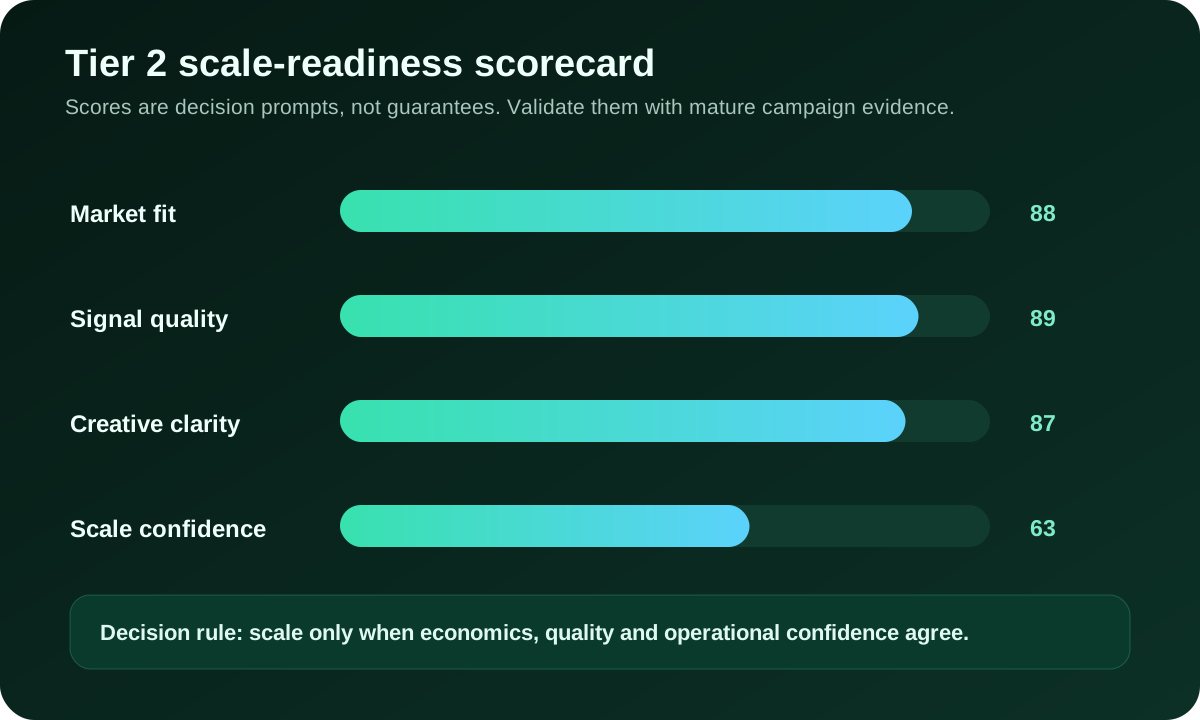
Early platform events are useful diagnostics. Budget decisions should use the deepest reliable outcome available.
For online advertising Tier 2, define a conversion ladder before launch. The first rung may be a click or engaged visit. The next may be a form completion, registration, install or checkout. Deeper rungs can include accepted leads, funded accounts, completed purchases, retained customers, approved applications or contribution margin. Name each rung and specify which one controls bidding, which one controls optimization and which one controls scale.
Use stable campaign, source, placement, creative and destination identifiers. Preserve them through redirects and postbacks so country, language, device, connection, source and accepted-value reporting. When downstream systems reject, refund or reverse an outcome, keep the original identifiers and add reason codes. Without that join, low-quality sources can appear profitable while the sales or operations team absorbs the loss. In the Tier 2 operating plan, apply this rule to the documented market brief, maturity window and accepted-outcome definition.
Choose a maturity window that matches the business process. A click can be immediate while an accepted lead, completed payment or retained user may need days or weeks. Compare cohorts at the same age. Do not scale a fresh Tier 2 segment against an older segment that has already accumulated its strongest outcomes.
Conversion measurement documentation from major advertising platforms is useful for understanding event definitions, data sources and conversion actions. Your own campaign still needs a first-party reconciliation rule. The accepted outcome in the CRM, billing system, app backend or order database should determine whether platform activity created real business value. In the Tier 2 operating plan, apply this rule to the documented market brief, maturity window and accepted-outcome definition.
Choose the execution format
Use the criteria around “Let mature business evidence control optimization in Tier 2” to decide whether push, native, display or pop fits the message and destination. Set format, targeting and spend as campaign controls in FroggyAds while the online advertising tier 2 decision remains the standard for judging the result.
Create My Free Account
Each phase has a question, a maximum acceptable loss and a written condition for moving forward.
Calculate the maximum affordable cost for the accepted outcome, not merely the front-end conversion. Include rejection, refund, delivery, sales and margin effects relevant to Tier 2.
Use the fewest Tier 2 segments needed to answer the first question. Keep creative, destination and tracking identifiers stable so differences can be traced.
Confirm location, device, source, click, conversion and postback data. Reconcile a sample against the downstream system before treating performance as real.
In Tier 2, pause obvious technical failures and policy problems quickly, while giving plausible segments enough mature exposure to avoid reacting to isolated wins or losses.
Move budget toward Tier 2 segments that produce accepted value across more than one source, creative or review period. Keep a control group when practical.
Increase budgets gradually, monitor auction mix and source composition, and define rollback thresholds before the increase. A scale step is successful only when economics remain inside the boundary. In the Tier 2 operating plan, apply this rule to the documented market brief, maturity window and accepted-outcome definition.
For Tier 2 traffic, source-level control becomes useful only when each keep, cap, exclude or retest decision has enough evidence, a stated reason and a rollback condition.
A source whitelist for Tier 2 should be earned through mature evidence. Start with enough controlled breadth to discover useful supply, then promote sources that repeatedly produce accepted outcomes. A blacklist is a loss-control tool, not a substitute for understanding creative, landing-page or tracking problems. Revisit exclusions when the offer, message, destination or conversion definition changes materially.
Frequency and dayparting should be treated as experiments. Repeated exposure can improve recall until fatigue or irritation reduces value. Hourly performance can reflect audience behavior, reporting delay or conversion maturity rather than a permanent schedule. Compare mature cohorts and preserve enough volume before creating rigid time windows for Tier 2.
Programmatic supply can involve standardized auction interfaces such as OpenRTB, but the buyer still needs practical controls: inventory visibility, source identifiers, bid limits, creative review, conversion tracking and exclusion logic. Standards describe how systems communicate; they do not guarantee placement quality or campaign profitability. In the Tier 2 operating plan, apply this rule to the documented market brief, maturity window and accepted-outcome definition.
Put the guide into practice
With “Keep every scale step explainable and reversible for Tier 2” documented, launch only the next reversible test. Set a spending limit, preserve the baseline and use source-level and audience controls so the next step depends on qualified outcomes for online advertising tier 2, not activity volume.
Create My Free Account
For online advertising in Tier 2, use this as an adaptable workflow rather than a performance promise. Set the pace from observed volume, conversion delay and business risk in the market being tested.
| Phase | Primary question | Work | Exit condition |
|---|---|---|---|
| Days 1–14 | Can the campaign deliver clean, trackable traffic to a working destination? | Validate country, language, device, connectivity and source segmentation; verify creative, page speed, location reports, identifiers and postbacks. | Tracking reconciles and obvious technical or policy failures are removed. |
| Days 15–35 | Which combinations deserve a mature quality read? | Compare source, creative, device and geographic segments without changing several variables at once. | A small set of combinations reaches the defined maturity window with interpretable evidence. |
| Days 36–60 | Which results survive downstream review? | Join campaign data with accepted, rejected, refunded, retained or margin-adjusted outcomes. | Winning combinations remain inside the economic boundary after quality adjustments. |
| Days 61–90 | Can budget grow without changing the economics? | Increase spend in steps, monitor source mix and creative fatigue, and preserve a control. | Scale steps hold accepted value and remain reversible under the written rollback rule. |
Most avoidable losses come from unclear ownership, mismatched experiences or decisions made before outcomes mature.
Blending all Tier 2 delivery can hide a high-volume segment that consumes budget while another segment creates accepted value.
Changing words while leaving proof, pricing, forms or support details generic weakens continuity for the Tier 2 audience.
Clicks or registrations can improve while accepted leads, completed orders or retained users deteriorate.
Changing bid, audience, creative and landing page together makes the next result impossible to explain.
Blocking sources or regions after a handful of events can remove useful supply before the conversion window matures.
Increasing budget without a rollback trigger allows source mix and economics to change before the team reacts.
These references support general targeting, measurement, landing-page and programmatic concepts. They do not provide FroggyAds performance guarantees or market forecasts for Tier 2.
Official guidance on geographic targeting choices and limitations. Read the official source.
Official guidance on defining and measuring valuable conversion actions. Read the official source.
Official user-experience measurement guidance for landing pages. Read the official source.
Industry standard context for programmatic auction interfaces. Read the official source.
Use the Tier 2 guide for practical planning, measurement and controlled campaign-scaling decisions grounded in the evidence available for that market.
Tier labels are provider-specific market groupings, so the advertiser should confirm the included countries and evaluate each one on its own conditions.
Give every selected country a separate learning allowance and include localisation, destination review, analytics and operational readiness outside media.
Clarify the exact market list, available formats, source transparency, device controls, billing rules and response to invalid-activity reports.
Start with a single offer and a few separated market cells, then hold the conversion definition steady until the scheduled review.
Markets grouped under one commercial label can differ in language, prices, cultural context and buying expectations, requiring individual treatment.
Match accepted outcomes to each country, device and placement, while investigating rejected events instead of trusting a blended regional average.
Focus on one market when localisation or fulfilment differs materially and a grouped test would prevent a clear operational decision.
Review effective acquisition cost, accepted volume and rejection share with the same attribution window and eligibility definition.
The label can hide substantial differences between countries, causing a strong market to subsidise poor delivery elsewhere.
Expand only the individual market segments that passed their quality rule and can be served reliably at the proposed higher volume.
Connect market strategy with network selection, traffic buying, targeting and adjacent GEO playbooks.
Define the accepted outcome, keep targeting readable, preserve source identifiers and write the stop, scale and rollback rules before spend begins.
Use this page when a performance advertiser needs to plan the market-specific test and measurement rules. The decision is specific to Online Advertising Tier 2: A Practical Campaign Strategy; do not replace it with a generic traffic or channel checklist.
Decision inputs for Online Advertising Tier 2: A Practical Campaign Strategy: campaign objective, audience targeting, source evidence, conversion tracking. Keep these inputs tied to accepted conversion or business-value event and the page-specific job: plan the market-specific test and measurement rules. For this Tier 2 URL, retain a standalone campaign cell so its evidence is not averaged into the Tier 1 or Tier 3 pages.
URL boundary for Online Advertising Tier 2: A Practical Campaign Strategy: This URL owns Online Advertising Tier 2: A Practical Campaign Strategy; Tier 3 Ad Network is the nearest neighboring topic and should keep its separate task. Use this page only for the decision implied by Online Advertising Tier 2: A Practical Campaign Strategy. Treat Tier 2 as its own buyer decision here, with a separate evidence trail from the first- and third-tier URLs.
Connect Online Advertising Tier 2 to a controlled audience test is the action checkpoint for Online Advertising Tier 2: A Practical Campaign Strategy. Before acting on “What should be checked with a Tier 2 inventory seller?”, document source evidence, the resulting campaign action and the rollback or retest condition.
Use location structure to protect learning for Tier 2 is the measurement checkpoint for this URL. Resolve “How should a multi-market Tier 2 budget be organised?” while retaining audience targeting, conversion tracking, spend and cohort age so the result can be reconciled with accepted conversion or business-value event.
Make the first campaign answer one question is an evidence checkpoint for Online Advertising Tier 2: A Practical Campaign Strategy. To answer “What does Tier 2 mean in an online advertising plan?”, keep campaign objective in the same campaign record and use it to plan the market-specific test and measurement rules.
Page-specific buying lens: For Online Advertising Tier 2: A Practical Campaign Strategy, define the exact buyer action this URL should support and keep that action tied to the campaign source, budget decision and accepted outcome.
Evidence before the next spend step: Use online advertising tier 2 as a bounded test case: record what changed, what evidence matured and what condition would justify the next allocation step.
| Page checkpoint | How to use it | Evidence to retain |
|---|---|---|
| Make the first campaign answer one question | Use Make the first campaign answer one question to establish the first evidence boundary for Online Advertising Tier 2: A Practical Campaign Strategy; then record which part of campaign objective, targeting, source evidence, conversion tracking and economics it changes. | Keep campaign objective, source/campaign ID and the accepted-event definition together. |
| Use location structure to protect learning for Tier 2 | Use Use location structure to protect learning for Tier 2 as the second checkpoint and reconcile it with accepted conversion or business-value event before changing budget or source allocation. | Retain audience targeting, spend, timestamp/cohort age and accepted/rejected outcomes. |
| Connect Online Advertising Tier 2 to a controlled audience test | Use Connect Online Advertising Tier 2 to a controlled audience test as the final checkpoint: if it does not change the evidence for accepted conversion or business-value event, keep the test narrow rather than scaling. | Document source evidence, the decision taken and the rollback or retest condition. |
Hypothetical example: For Online Advertising Tier 2: A Practical Campaign Strategy, a hypothetical controlled cell that spends USD 330 and records 6 accepted conversion or business-value event after the same maturity window has an accepted cost of USD 55.00 per outcome. Replace the figures, outcome and review window with your own economics; this is not a FroggyAds performance claim. This worked example illustrates only the Tier 2 calculation method and does not set a result expectation for another tier.
Use FroggyAds for the paid-media execution step of Online Advertising Tier 2: A Practical Campaign Strategy: apply the relevant targeting, budget and source controls, keep conversion evidence visible, and expand only when accepted conversion or business-value event supports the next action. Create your free FroggyAds account.
Online Advertising Tier 2: A Practical Campaign Strategy should be evaluated market by market: define eligible geography, keep measurement consistent, and scale only where accepted-outcome economics remain viable.