Dutch digital purchases and access

Native Ads Netherlands: Follow Payment Through to Digital Access

Use native ads Netherlands to introduce a digital offer with clear purchase and access conditions. When the customer's payment journey leaves your destination for a bank, distinguish that handoff from a confirmed paid order and the access your business actually supplies. FroggyAds gives you supported controls for buying visits to the prepared offer. Your own payment and access records establish the later customer result. Use that evidence to choose an affordable next purchase instead of treating a return-page visit as a completed sale.

Self-serve control ·750+ SSP integrations ·20B+ daily impressions
native ads netherlands planning visual
Direct answer

What should Dutch native traffic achieve for a digital offer?

Help the intended customer understand the digital product, its price and the access arrangement before deciding to buy. A hypothetical seller of downloadable craft patterns needs an accurate preview, a clear description of the included files and a working purchase route. The business should define when an order qualifies as paid and how supplied access is established. That definition makes the media decision useful without confusing interest in the preview with an entitled customer.

01 • Delivery mechanics

How does a native product invitation reach the payment journey?

A reader sees your image and headline within a feed or recommendation area, then continues to the product destination. Publisher styling and publisher layout shape that initial context. Keep clear ad disclosure and inspect the actual placement context. The destination should explain the same product and requested action. A click creates an opportunity to consider the offer; it does not establish that the customer started payment, completed it or received the digital product.

Show the included pattern designs and clarify illustrations or additional material. Explain the verified file format and access arrangement. A digital-product invitation should not imply a physical kit, tuition or unrestricted immediate access when the actual purchase provides different contents or conditions.

Separate product interest, payment initiation, pending results, confirmed paid acceptance and supplied access. A payment state can change later, and access can fail after payment. Use the merchant's actual records and configured campaign matching, retaining unsupported connections as unknown rather than inventing a completed customer result.

02 • Campaign brief

What belongs in the Dutch digital-offer campaign brief?

Record product contents, price and currency, supported purchase route and access conditions. Name the paid-order rule, supporting access record and responsible customer-help owner. Retain the dated invitation. The first allowance should assess an identifiable customer stage while later payment and access questions remain visible.

03 • Market context

How should Netherlands targeting relate to language and payment availability?

Country targeting does not establish the customer's bank, payment eligibility or language preference. Prepare coherent Dutch or English routes where the business can serve them. Confirm the merchant's actual checkout methods; a geographic setting does not add a payment option or guarantee purchase completion.

04 • Audience eligibility

Which customers and digital orders can the business accept?

Confirm the real customer conditions, available payment arrangements and ability to supply the advertised access. Explain material restrictions before commitment. Keep pending or verification stages distinct from paid acceptance. Update changed terms and retain earlier versions for reviewing what the customer was offered.

Prepare the payment and access promise before buying visits

Why choose FroggyAds for a prepared Dutch digital offer?

Our self-serve targeting, source reporting and budget controls help you manage media expense while the merchant reviews paid orders and access. Confirm current native requirements and supported settings. The published USD 50 minimum deposit funds the account separately from authorised campaign expense. Campaigns remain subject to review and approval; prepare the product and customer route before launch.

Create My Free Account
Illustration of audience targeting controls for a native ads netherlands test
05 • Inventory and format fit

What should the native preview and headline communicate?

Present included designs and a supported reason to consider them. Keep the advertiser and requested action clear. The destination should explain the files, purchase arrangement and supplied access. Avoid implying a free download or physical kit when the offer is a paid digital product.

Prepare structured creative assets for the actual native requirements. Content fit means the product page continues the preview's expectation. Check shortened text and available cropping for material meaning. Retain approved versions so a customer misunderstanding can be investigated against the invitation supplied.

Use the preview to show the design type and a supported use. Explain verified file details and material purchase conditions on arrival. An instant-access claim needs operational support; if payment remains unresolved, the customer message should describe that state accurately instead of promising an immediate unlock.

06 • Creative system

How should two digital-product invitations be compared?

Prepare distinct native concepts for the intended Dutch audience, such as a product-detail preview and a supported use demonstration. Retain consistent files and purchase terms, identifiable versions and a truthful action. Avoid fabricated ratings, copied interfaces, false urgency and unsupported outcome promises.

For native ads netherlands, preview mobile and desktop variants at representative sizes before launch. A creative can look strong in a design file and fail when cropped, compressed or placed next to competing content. Review fatigue and source mix separately so a declining result is not blamed on the wrong layer.

Compare the paid orders and supported access available for identifiable concepts. A preview suggesting a physical kit or free files needs repair if that is not the product sold. More clicks alone do not justify increased expense when the message introduces the wrong purchase arrangement.

07 • Destination continuity

What should the destination explain before the bank handoff?

Explain product contents, price, currency, actual payment choices and access before commitment. Review any implemented bank transition and the available order reference. Pending, cancelled and confirmed outcomes need accurate customer messages; one generic success page should not stand in for all payment states.

08 • Attribution chain

How can payment and access records support measurement?

Connect order references with campaign information your implementation can genuinely match. Keep payment attempts, unresolved states, confirmed paid orders and supported access distinct. Update the relevant order when a state changes. Investigate related attempts through available business records so duplicate activity does not become extra acquisitions.

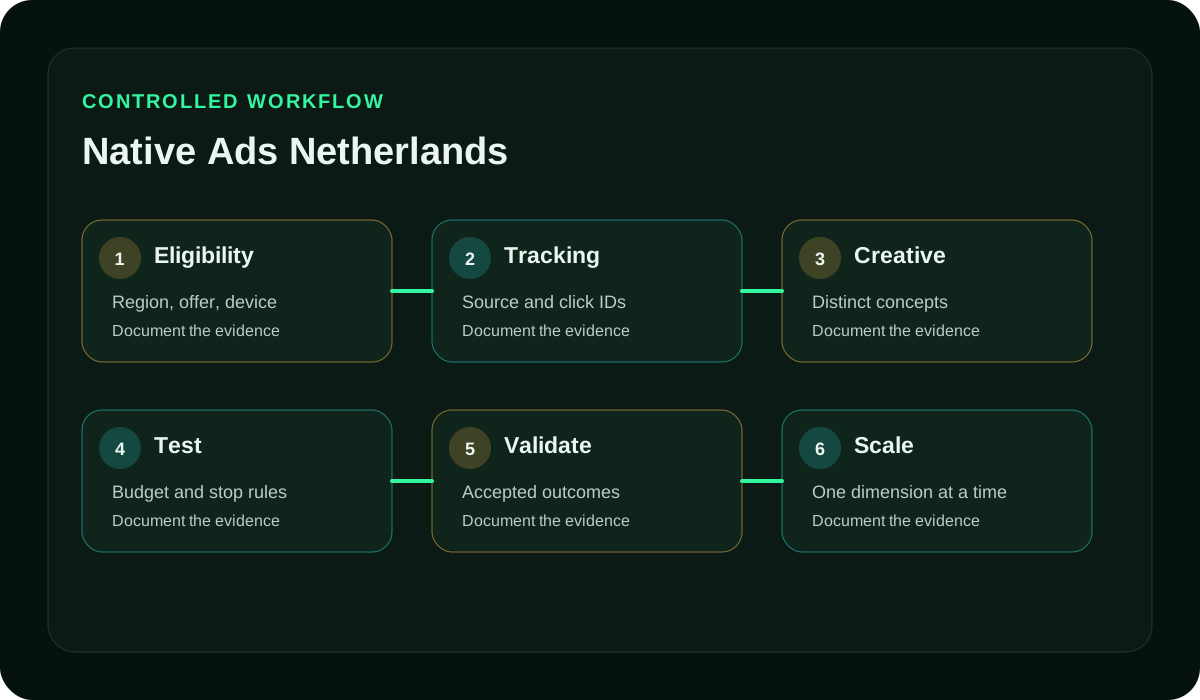
native ads netherlands controlled workflow visual

Follow the customer result beyond the return page

When does native suit a digital-product explanation?

Choose our native route when a truthful preview can prepare the reader for the product destination. Confirm supply and supported settings. Compare another format's actual transition against the same terms; the merchant's checkout and delivery arrangements establish how customers pay and receive the product.

Create My Free Account
Illustration comparing advertising formats for native ads netherlands execution
09 • Test budget

What should the first Dutch digital-offer allowance cover?

Set an affordable allowance around a question the business can answer. Confirm available limits and the stopping owner. Review paid orders and access while recording product, processing and assistance work separately for wider expense. Pending outcomes should remain visible rather than justify unlimited additional media purchases.

10 • Cost model

How should paid-order and supplied-access cost be calculated?

Divide expense by the named stage: confirmed paid orders or orders with supported access. Use the same group and review date, retaining pending payments, cancellations and unresolved access. State whether expense is media-only or wider acquisition cost. Neither ratio alone establishes retained revenue, satisfaction or profit.

11 • Quality review

What can explain a payment return without confirmed digital access?

Check the payment state and order reference before explaining a return without access. A payment may remain unresolved or be cancelled, while a separate access problem can follow paid acceptance. Retain supported explanations and unknowns. A return-page visit cannot distinguish every case or establish traffic quality.

12 • Source decisions

Which buying action follows an inaccurate confirmation message?

Repair the inaccurate customer message, preserve the earlier version and keep the next allowance manageable. Apply supported media changes when source observations justify them. The merchant must also correct a page that calls pending payments successful; a source change cannot resolve that status error or supply missing access.

13 • Controlled experiments

How should digital-product concepts be compared fairly?

Keep product contents, price, customer conditions and paid-acceptance rule consistent where needed. Allow comparable payment-resolution and access-review time. Record checkout or delivery-process changes. Results across different conditions can inform another purchase, but the differences should remain visible rather than be assigned entirely to the creative.

Connect the next allowance to paid orders and supplied access

What supports another Netherlands digital-offer allocation?

Review paid orders, supported access and unresolved customer issues before another allocation. Confirm the product and route remain accurate. Use supported FroggyAds settings for an affordable increment with identifiable expense and orders. A different bundle or access arrangement needs its own review rather than automatic credit from the earlier result.

Create My Free Account
Illustration of a campaign launch checklist for native ads netherlands
14 • Funnel measurement

Which payment and access states belong in the review?

Keep supported states such as initiated, pending, cancelled, confirmed paid, access supplied or unresolved. Several can describe the same order and should not be added as customers. Retain review dates and later updates. Define supplied access clearly without assuming a sent message proves every customer's successful use.

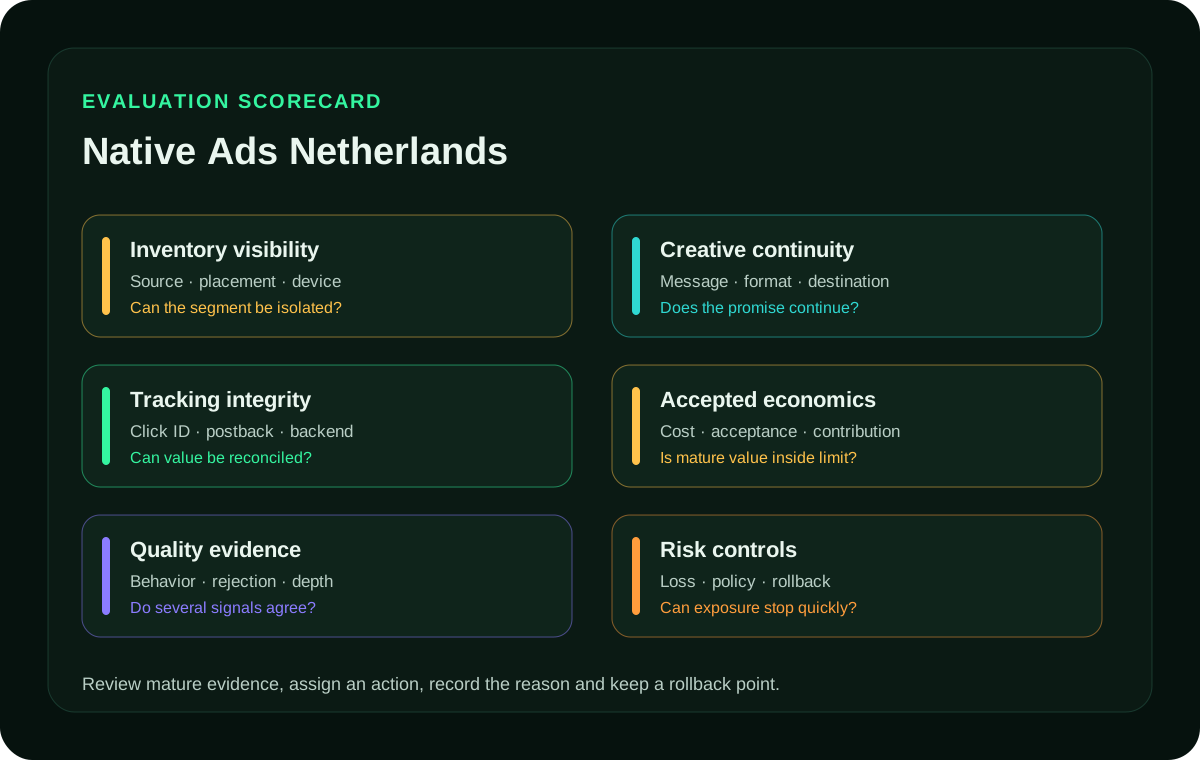
native ads netherlands evaluation scorecard visual
15 • Stop rules

Which defects require the affected purchase to pause?

Pause for a materially wrong product or price, failed ordering or access route, inaccurate success message or exhausted expense limit. Preserve affected terms and customer records, assign the repair and review the corrected journey. Restart affordably while earlier pending payments and unresolved access remain visible.

16 • Scaling

When should more Dutch native traffic be purchased?

Increase when reviewed paid orders support another purchase and the merchant can supply the advertised access. Recheck checkout messages and unresolved-state handling. Keep new expense and customers identifiable: added demand may expose a problem the earlier group did not reveal, so review the next result under a practical limit.

17 • Scenario planning

Which digital-offer assumptions deserve a sensitivity check?

Consider fewer paid orders, more pending outcomes or extra work resolving access using clearly marked assumptions the business can justify. Replace them with reviewed records. This concerns the actual offer rather than a Dutch payment-success benchmark and should identify a practical message, checkout, access or allowance change.

18 • Operator log

What should the merchant and media buyer retain together?

Retain the dated offer, approved preview, destination and confirmation versions, media expense and review date. The merchant explains supported payment changes and access exceptions; the buyer supplies available campaign observations. Keep unknown cases visible so the next purchase distinguishes customer-message, payment and media questions.

Decision controls

Dutch native digital-offer decision table

Review itemQuestion to answerUseful action
ProductDo the preview and destination describe the digital files actually included?Correct an image or phrase that implies a physical kit or extra service.
HandoffDoes the customer understand the actual transition to the payment provider?Review the merchant's prepared route and its order reference.
PaymentWhich record supports confirmed paid acceptance under the business rule?Keep pending, cancelled and confirmed outcomes distinguishable.
AccessWhich record supports the access promised to an accepted customer?Retain unresolved access separately from a confirmed payment.
ExpenseIs the ratio per paid order or an order with supplied access?Use the same customer group and disclose the expense scope.
Next purchaseCan the current checkout and access process support more customers?Approve an affordable increment after the operating review.
Planning scenarios

Three payment questions for a Netherlands native digital offer

Bank transition

What should the current bank-handoff description establish?

Adyen's current iDEAL | Wero page describes a shopper selecting an issuing bank and continuing to that bank's website or mobile app to complete payment. That provider-specific description helps identify a customer transition worth reviewing. Confirm the method and wording actually supplied by your merchant's checkout. It does not establish that FroggyAds processes this payment, that every visitor is eligible or that a particular merchant implementation has been tested.

Pending payment

Why is a pending payment different from a confirmed paid order?

A payment can remain unresolved after the customer acts. In its result-code guidance, Adyen distinguishes intermediate Received and Pending states from final states and explains that status can change after an initial result. Establish which merchant and provider records support your defined paid-acceptance rule, following the actual provider arrangement. Assess supplied access separately. An unresolved attempt belongs in the review, but it is not yet evidence of a confirmed paid customer or a settlement guarantee.

Repeated attempt

What if the customer retries before the earlier attempt is resolved?

Keep the related order and attempt references the business can genuinely establish and have the responsible owner investigate their current states. Do not label every additional attempt a new acquisition. The customer route should explain how to get help with an unresolved payment through the merchant's real process. Preserve uncertainty until the records support a conclusion, and review any duplicated order or access issue before allocating more media expense.

Frequently asked questions

Native ads Netherlands FAQ

When are native ads in the Netherlands worth testing?

Use our native route when an accurate product preview and short message can prepare the intended reader for a digital offer the business can fulfil. Confirm current inventory, supported requirements and the real customer conditions. Begin with an affordable allowance and a named paid-order or access result. A native click or attractive presentation alone does not establish a completed purchase.

How should a Dutch native campaign divide its audience?

Base audience comparisons on the settings and records actually available. A language version, source observation or device result can help investigate the invitation where the relevant information exists. Keep unknown publisher or personal details unknown. Preserve the same product terms and customer-stage rule for a meaningful comparison, and remember that geographic targeting does not establish the shopper's bank or payment preference.

Which records make Netherlands native inventory traceable?

Confirm the source identifiers, delivery definition and placement information actually available. Ask which additional publisher detail can support a particular investigation. Keep exact property ownership and complete exposure histories unknown where the records or agreed terms do not establish them. A source control does not imply universal property-level visibility or a complete history for each customer.

What should Dutch native creative say about the sponsor?

Use a clear advertising label, an accurate headline and an image that represents the offer. Match the chosen language throughout the unit, and never imitate editorial content so closely that the commercial source becomes unclear.

Where should a Netherlands native ad send the reader?

Choose a fast page that continues the same promise and language. Confirm that prices, availability, forms and checkout work for the intended Dutch audience before a publisher sends paid visitors.

How can a Netherlands native test stay within budget?

Authorise an affordable campaign allowance and confirm the available limits and stopping control. Keep media expense connected to the identifiable customer group and the chosen review stage. Use supported source or bid changes when evidence justifies them. Do not assume a separate cap exists for every publisher, language or device division that appears in an analysis.

What shows that Dutch native traffic has real quality?

Review the customer result your actual records establish, such as confirmed paid acceptance and supported digital access. Keep pending payments, cancellations and missing-access cases visible. Campaign observations can help investigate differences, within the fields and matching available. A return-page visit is not by itself a paid order, and an unresolved payment does not by itself prove poor traffic.

How should unusual activity from a Dutch publisher be checked?

Preserve available source observations, relevant times, the customer report and the order or attempt records the business can establish. Limit the affected purchase through supported controls when the evidence warrants it. Ask the appropriate supplier or business owner to explain the pattern. Keep unavailable details unknown and record the investigation's actual result before deciding what another purchase should change.

Which outcomes should judge native ads in the Netherlands?

Name the business stage and expense scope before comparing results. Paid-order cost concerns orders accepted under the merchant's rule; cost per order with supplied access uses a later supported stage. Retain pending, cancelled and unresolved records. Keep currency, group and review date clear. Product work, fees and customer assistance matter to profit even when the buying ratio is media-only.

When can a Dutch native campaign add more publishers?

Review the current customer result and unresolved issues before adding supported supply. Confirm the prepared product, payment explanation and access process remain accurate. Introduce a defined affordable increment with identifiable expense and order records. Available source controls and supplier information determine the practical change; the guide does not promise a named publisher or every property-level buying option.

Measure accepted campaign value

Start a Dutch native purchase with a clear payment and access journey

Choose FroggyAds for a prepared digital-product invitation and a customer result your business can review. Explain the included files and actual purchase arrangement, check the customer route and approve an affordable allowance. Use our supported buying controls to manage the media while your own records establish paid acceptance and supplied access. Let that evidence guide the next purchase and keep unresolved customer questions visible.

Search intent and buyer decision

Dutch native digital offers: bank handoff, paid acceptance and access

This guide connects a digital-product preview with the bank handoff and evidence of paid access. Review pending and confirmed states before assessing what was supplied. Broader Netherlands retail-basket and delivery decisions do not replace this specific payment-state and digital-access review.

Connect the preview with the result: creative assets and content fit explain the digital product; publisher layout shapes its native presentation. Ad attribution relates available campaign observations to customer activity within matching limits. Merchant payment and access records establish the business stage; an ad click does not resolve a bank payment.

Keep the access decision specific: the broader Native Ads 2026 topic concerns current format requirements. Use this page to review the actual digital product, customer payment transition, pending state and supported access. A general traffic discussion cannot establish whether a particular order has been accepted as paid or whether the merchant supplied the access it promised.

Understand the handoff: review the actual payment method, customer transition, return message and available order reference. A method label does not prove that every visitor can use the route or that returning means payment succeeded.

Review paid acceptance: identify the merchant and provider records supporting the paid-order rule. Keep intermediate states visible at review. Update the same order when its state changes rather than creating another customer from the later status.

Check supplied access: name the stage the merchant's record supports. A sent message, access grant and successful use can be different observations. Retain a reported problem, assign its owner and show unresolved cases in the next media decision.

Customer stageWhat it establishesWhat remains to review
Payment initiatedThe customer started the actual payment attempt.Current provider outcome and acceptance under the merchant's rule.
Confirmed paidSupported records meet the defined paid-acceptance rule.The access supplied, customer exceptions and any later adjustment.
Access suppliedThe merchant's available record supports the named access stage.Actual use, assistance, retained value and wider acquisition expense.

A transparent paid-order and digital-access calculation

Hypothetical example: a fictional Dutch-targeted digital-pattern campaign spends USD 210 on media. Ten distinct customer order records each have one initial payment attempt. Seven meet the merchant's confirmed-paid rule, two remain pending and one is cancelled. USD 210 / 7 = USD 30 per confirmed paid order. Six of the seven paid orders have supported access at review, giving USD 210 / 6 = USD 35 per order at that access stage; one access outcome remains unresolved. These stages concern the same group, not extra customers to add together. All figures are illustrative, not actual FroggyAds prices, a Dutch benchmark or a provider payment-success rate. Product work, processing, creative, assistance and other expense are excluded from this media-only calculation; it does not establish profit.

Why use FroggyAds for this digital-product invitation?

Choose FroggyAds to manage the supported media purchase for a digital offer you have prepared accurately. Our available targeting, source and budget controls help you keep the allowance accountable while the merchant reviews paid orders and supplied access. Confirm current native requirements before setup and use the actual customer result to guide another allocation. Create your free FroggyAds account.

Native presentation resources: Google's native styles resource and native advanced resource address their respective publisher presentation contexts, including advertising identification and differentiation from surrounding content. Use them within that provider-specific scope. They do not establish FroggyAds specifications, the availability of a publisher or the merchant's payment and access arrangements. Confirm the actual supported native requirements for your purchase and keep the digital-product invitation accurate.

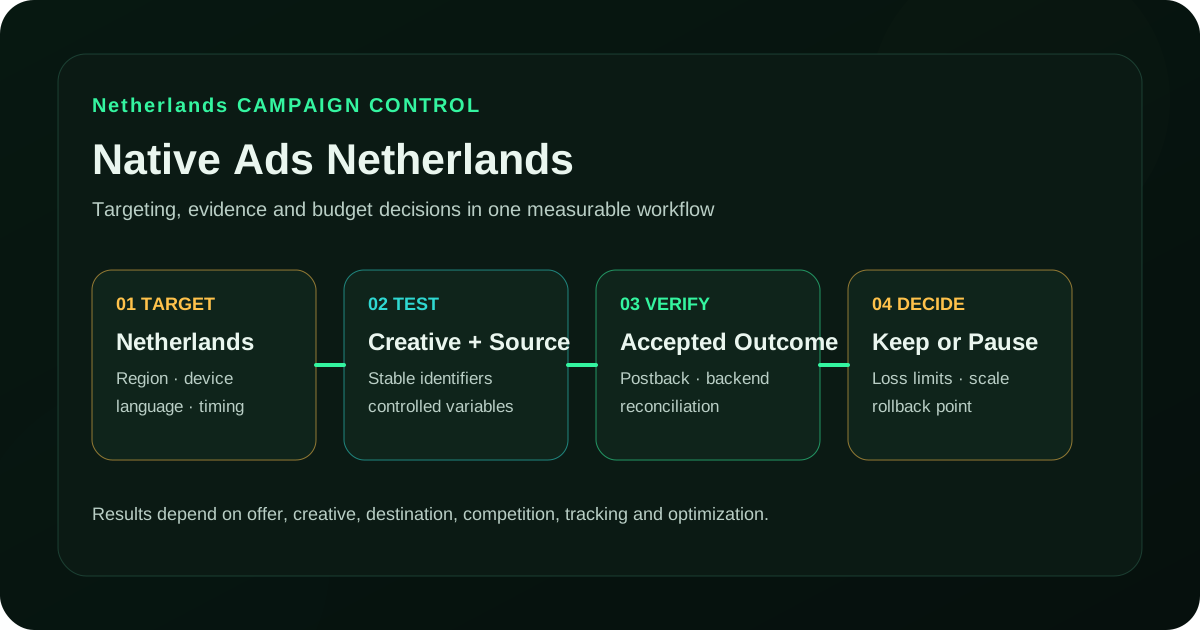
Direct answer

What should happen before the next Netherlands native digital purchase?

Prepare the actual digital product, explain its purchase and access conditions and review the customer payment transition. Choose FroggyAds to manage the supported media purchase with an affordable allowance. Keep pending payments, confirmed paid acceptance and supplied access identifiable so the next decision follows the customer result your business can establish.