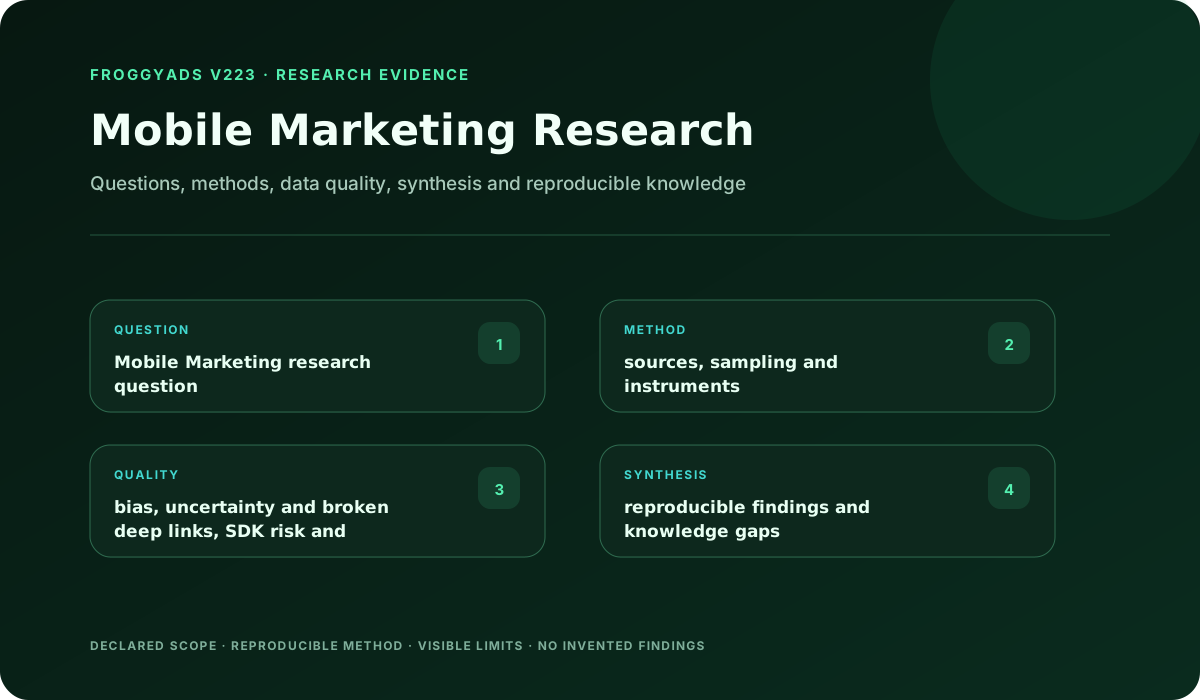
Mobile Marketing Research: Data, Trends & Campaign Implications
Mobile marketing research is a decision-specific study of how people encounter, understand and act on a message through mobile web, apps, messaging, search, video or another defined environment. It starts with a population, question and method, not a collection of device statistics. As of 16 August 2026, the U.S. Small Business Administration describes market research as a combination of existing sources and direct research methods, while W3C WCAG 2.2 supplies an accessibility standard for implemented web experiences. Neither source validates a study design automatically; the researcher must document sampling, consent, measurement and limits.
Translate the business decision into a research question
Name the action the team may take, the mobile environment, intended population, product, geography and observation window. A question about landing usability differs from a question about message recall, app retention or paid-source economics. Select only measures that can inform the stated choice or its risk boundary.
Write the hypotheses, known evidence and disconfirming observations before collection. Avoid using broad mobile trend reports to answer a narrow customer problem they did not study. The research brief should also state what the team will not infer, such as identity, intent or causality from device telemetry alone.
Choose primary and secondary evidence deliberately
SBA guidance distinguishes existing sources from direct methods such as surveys, focus groups and interviews. Existing data can frame a population or trend, while direct research can answer a specific product question. Record publisher, sample, field dates, definitions, geography and conflicts for every secondary source.
Direct research needs a recruitment frame, eligibility criteria, sample rationale, consent statement, instrument, moderator or test procedure and analysis plan. Convenience responses can be useful for discovery but should not be labeled representative without evidence. Preserve nonresponse and exclusion decisions rather than reporting only completed participants.
Observe the actual mobile experience
Define browser, operating system, app version, screen, orientation, connection and assistive technology conditions that matter. Test the final advertisement, redirect, consent layer, page and action. A design mock-up cannot reveal every keyboard, viewport, load, deep-link or installed-app problem in the delivered route.
Use W3C WCAG 2.2 as a technical reference for applicable web accessibility requirements and tests. Conformance depends on the actual implementation and scope. Record concrete observations such as heading order, focus, target size, contrast or text alternative results instead of claiming accessibility from a standards link.
Separate behavior, self-report and platform metrics
A survey response describes what a participant reports under the instrument. Observed task behavior describes what happened in the tested route. Platform impressions, clicks and conversions follow provider definitions. Keep the evidence classes separate before synthesis so one convenient metric does not overwrite a conflicting observation.
Google Analytics and advertising products can segment or report device-related activity within their documented models. Those reports do not identify the reason a person acted or prove that the measured device represents every customer touchpoint. Attach time, consent, identity and attribution limits to quantitative results.
Connect the guide to live testing
Connect Mobile Marketing Research to a controlled audience test
Use the choices established in “Separate behavior, self-report and platform metrics” to define one audience, budget and source set in FroggyAds. Keep the surrounding offer and measurement rule stable so the test adds evidence to mobile marketing research instead of mixing several changes at once.
Collect the minimum information needed for recruitment, analysis and follow-up. Restrict access, define retention and separate research contact details from response data where practical. Sensitive traits or precise location require a clear necessity, qualified review and suitable safeguards; they should not be collected for speculative segmentation.
FTC guidance provides United States truth-in-advertising boundaries for claims made from research. Report methods, material limitations and the population actually studied. Do not turn a preference from a small convenience sample into an unqualified statement about all mobile users or a guaranteed campaign result.
Convert findings into a bounded campaign implication
Synthesize converging and conflicting evidence by question, not by whichever chart is easiest to present. Give each finding its sample, method and confidence boundary. Recommend one page, message, source or measurement change with a reversal condition and the evidence required to evaluate it.
Archive the research brief, instrument, source register, fieldwork record, analysis, excluded cases and decision. A later team should be able to reproduce the path from observation to action. Update trend statements after substantive new evidence and keep earlier versions rather than changing dates to manufacture freshness.
Decision controls
Inboundstudio control 1
The study names one business decision and the mobile environment in scope.
Inboundstudio control 2
Population, geography, field dates and exclusions are defined before analysis.
Inboundstudio control 3
Secondary sources retain publisher, sample, method and metric definitions.
Inboundstudio control 4
Direct research preserves recruitment, consent, instrument and nonresponse evidence.
Inboundstudio control 5
Delivered mobile routes are tested across relevant device and connection states.
Inboundstudio control 6
Accessibility conclusions cite implemented observations and explicit scope.
Inboundstudio control 7
Self-report, observed behavior and platform telemetry remain separate evidence classes.
Inboundstudio control 8
Device reports do not become unsupported statements about individual motivation.
Inboundstudio control 9
Participant information is minimized, access-controlled and retained by rule.
Inboundstudio control 10
Research claims state the studied population and material limitations.
Inboundstudio control 11
Campaign implications authorize one bounded change and a reversal condition.
Inboundstudio control 12
The archive preserves instruments, exclusions, analysis and prior versions.
Choose the execution format
Choose a paid-media format that supports Mobile Marketing Research
Use the criteria around “Decision controls” to decide whether push, native, display or pop fits the message and destination. Set format, targeting and spend as campaign controls in FroggyAds while the mobile marketing research decision remains the standard for judging the result.
The study names one business decision and the mobile environment in scope. The mobile researcher ties every observation to one decision, population and environment. Broad industry statistics remain contextual and cannot answer a product question their source never studied.
Review decision 2
Population, geography, field dates and exclusions are defined before analysis. Recruitment and secondary-source review retain sample, date, geography and exclusions. Nonresponse is documented so completed participants do not masquerade as the entire intended population.
Review decision 3
Secondary sources retain publisher, sample, method and metric definitions. The final mobile route is observed by device, browser, orientation and connection. Accessibility findings describe implemented behavior instead of claiming conformance from a reference alone.
Review decision 4
Direct research preserves recruitment, consent, instrument and nonresponse evidence. Survey statements, task behavior and platform telemetry keep separate evidence labels. The synthesis explains conflicts and refuses to infer motivation from a device report.
Review decision 5
Delivered mobile routes are tested across relevant device and connection states. Research records minimize participant information and restrict access. A sensitive field must support the approved question and qualified safeguards rather than an imagined future segmentation use.
Review decision 6
Accessibility conclusions cite implemented observations and explicit scope. The implication authorizes one reversible campaign or experience change. Instruments, exclusions and prior versions stay in the archive for independent reconstruction.
Review decision 7
Self-report, observed behavior and platform telemetry remain separate evidence classes. The mobile researcher ties every observation to one decision, population and environment. Broad industry statistics remain contextual and cannot answer a product question their source never studied.
Review decision 8
Device reports do not become unsupported statements about individual motivation. Recruitment and secondary-source review retain sample, date, geography and exclusions. Nonresponse is documented so completed participants do not masquerade as the entire intended population.
Review decision 9
Participant information is minimized, access-controlled and retained by rule. The final mobile route is observed by device, browser, orientation and connection. Accessibility findings describe implemented behavior instead of claiming conformance from a reference alone.
Review decision 10
Research claims state the studied population and material limitations. Survey statements, task behavior and platform telemetry keep separate evidence labels. The synthesis explains conflicts and refuses to infer motivation from a device report.
Review decision 11
Campaign implications authorize one bounded change and a reversal condition. Research records minimize participant information and restrict access. A sensitive field must support the approved question and qualified safeguards rather than an imagined future segmentation use.
Review decision 12
The archive preserves instruments, exclusions, analysis and prior versions. The implication authorizes one reversible campaign or experience change. Instruments, exclusions and prior versions stay in the archive for independent reconstruction.
Put the guide into practice
Turn Mobile Marketing Research into a bounded campaign test
With “Review trail” documented, launch only the next reversible test. Set a spending limit, preserve the baseline and use source-level and audience controls so the next step depends on qualified outcomes for mobile marketing research, not activity volume.
Rewrite a broad mobile trend request as one population, environment and decision question. List observations that could disconfirm the working hypothesis before choosing a method. Tie the revised question to a named owner and reversible choice, otherwise added research detail can expand the document without improving the decision. Exercise 1 keeps its dated observation and reviewer.
Inboundstudio exercise 2
Compare a secondary dataset with a direct interview plan by sample, date, geography and purpose. State which question each can answer and which inference would exceed its design. Note whether the secondary source measures people, accounts, sessions or devices and keep that unit unchanged when the finding enters the synthesis. Exercise 2 keeps its dated observation and reviewer.
Inboundstudio exercise 3
Run a mobile route on two representative devices and one constrained connection. Capture focus, load, redirect, text and task completion under the exact page version. Preserve device model, browser, connection condition and assistive setting so a failed task can be retested against the same environment. Exercise 3 keeps its dated observation and reviewer.
Inboundstudio exercise 4
Place survey response, observed behavior and analytics event in separate columns. Synthesize only after documenting where their populations and definitions diverge. Document missing events and recruitment exclusions instead of treating silence as success; non-observation may reflect instrumentation or access failure. Exercise 4 keeps its dated observation and reviewer.
Inboundstudio exercise 5
Audit recruitment and response fields for necessity, access and retention. Remove sensitive information that does not support the approved analysis before fieldwork begins. Keep consent, incentive, raw response access and deletion responsibilities in the study record before inviting participants or sharing extracts. Exercise 5 keeps its dated observation and reviewer.
Inboundstudio exercise 6
Convert one supported finding into a reversible campaign change with an evaluation window. Archive the instrument and exclusions so the decision can be challenged constructively. Compare the mature observation with the stated hypothesis and record why the team adopted, narrowed or rejected the proposed campaign change. Exercise 6 keeps its dated observation and reviewer.
Inboundstudio exercise 7
Rewrite a broad mobile trend request as one population, environment and decision question. List observations that could disconfirm the working hypothesis before choosing a method. Tie the revised question to a named owner and reversible choice, otherwise added research detail can expand the document without improving the decision. Exercise 7 keeps its dated observation and reviewer.
Inboundstudio exercise 8
Compare a secondary dataset with a direct interview plan by sample, date, geography and purpose. State which question each can answer and which inference would exceed its design. Note whether the secondary source measures people, accounts, sessions or devices and keep that unit unchanged when the finding enters the synthesis. Exercise 8 keeps its dated observation and reviewer.
Inboundstudio exercise 9
Run a mobile route on two representative devices and one constrained connection. Capture focus, load, redirect, text and task completion under the exact page version. Preserve device model, browser, connection condition and assistive setting so a failed task can be retested against the same environment. Exercise 9 keeps its dated observation and reviewer.
Inboundstudio exercise 10
Place survey response, observed behavior and analytics event in separate columns. Synthesize only after documenting where their populations and definitions diverge. Document missing events and recruitment exclusions instead of treating silence as success; non-observation may reflect instrumentation or access failure. Exercise 10 keeps its dated observation and reviewer.
Inboundstudio exercise 11
Audit recruitment and response fields for necessity, access and retention. Remove sensitive information that does not support the approved analysis before fieldwork begins. Keep consent, incentive, raw response access and deletion responsibilities in the study record before inviting participants or sharing extracts. Exercise 11 keeps its dated observation and reviewer.
Inboundstudio exercise 12
Convert one supported finding into a reversible campaign change with an evaluation window. Archive the instrument and exclusions so the decision can be challenged constructively. Compare the mature observation with the stated hypothesis and record why the team adopted, narrowed or rejected the proposed campaign change. Exercise 12 keeps its dated observation and reviewer.
Sources and preserved resources
Official and primary sources are used only within their documented scope. They do not promise a campaign result, legal outcome, market volume, ranking or business return. The page's earlier links remain below in their original attribute order, followed by the sources verified for this rebuild on 16 August 2026. For Mobile Marketing Research, apply this rule to the page-specific audience, market, format or buying decision described here.
Mobile marketing research connects a defined decision with sampling, direct and secondary evidence, delivered-device observation, participant protection and bounded campaign action.
SBA market research guidance distinguishes existing sources from direct methods including surveys, questionnaires, focus groups and interviews.
W3C WCAG 2.2 is a technical accessibility standard whose conformance depends on the implemented web experience and tested scope.
Mobile research synthesis should identify device exclusion as a possible source of bias. A study run only on a recent high-end phone may miss slow connections, older browsers, assistive technology and people who abandon before the research instrument loads. Record eligibility and failed sessions. Where remote testing is used, distinguish participant hardware from simulated viewports. Translation also needs instrument review: the same question can carry different assumptions across languages, and literal equivalence does not guarantee measurement equivalence. Pilot unfamiliar versions and keep the approved wording. These controls improve the decision record without promising that one study represents all mobile users. Review complete.
Questions and answers
What question should mobile marketing research answer first?
Start with a specific audience, product or campaign decision. A research project needs a decision owner before it needs more data.
How can researchers choose a representative mobile sample?
Define eligible users, devices, markets and behavior, then document who was excluded. Recruitment method can shape the finding as much as sample size.
Which costs belong in a mobile research plan?
Include recruitment, incentives, tools, testing devices, analysis, accessibility support and staff time. Budget for fixing unusable data.
What makes a mobile finding actionable?
The result should link an observed behavior or barrier to a named product or campaign choice. Report uncertainty and the conditions under which it was seen.
What research mistake creates false confidence?
Combining different operating systems, versions or acquisition sources can hide conflicting behavior. Segment only where the distinction can change a decision.
When should qualitative and quantitative methods be combined?
Use interviews or observation to understand why behavior occurs, then event or survey data to test how widely the pattern appears.
How should consent and privacy be handled in research?
Collect only data needed for the stated question, explain the purpose, limit access and define retention or deletion before recruitment.
What device checks belong in a mobile study?
Test representative screen sizes, operating systems, browsers, network conditions and accessibility settings when they affect the user task.
When is a research result ready to influence spend?
Use it when the method, sample and limitations are clear and the finding changes a specific test or allocation. Keep speculation labelled.
What should a mobile research report preserve?
Record the question, sample, method, dates, device conditions, evidence, limitations, decision and owner for the next validation.
Decision table
Mobile Marketing Research: Data, Trends & Campaign Implications: a practical advertiser decision matrix
Decision
What to verify
FroggyAds action
Question
State the specific decision this guide answers about Mobile Marketing Research: Data, Trends & Campaign Implications.
Use the guide before changing campaign settings.
Procedure
Follow the steps around On this page in their intended order.
Keep the baseline stable while testing the recommended change.
Evidence
Use the measurement guidance under Translate the business decision into a research question.
Reconcile FroggyAds data with tracker and backend results.
Diagnosis
Use the troubleshooting section around Choose primary and secondary evidence deliberately to isolate the smallest failing layer.
Change one major variable at a time.
Next action
Move from the guide to a bounded live test only when the prerequisites are met.
Create a FroggyAds account and preserve the test limit.
Advertiser decision framework
Mobile Marketing Research: Data, Trends & Campaign Implications: what should the advertiser decide next?
For Mobile Marketing Research: Data, Trends & Campaign Implications, the commercial task is to turn mobile marketing research into one measurable campaign decision. Use On this page to define the audience or problem, use Translate the business decision into a research question to constrain the test, and decide in advance which accepted result would justify more FroggyAds spend.
On this Mobile Marketing Research: Data, Trends & Campaign Implications page, the decision should remain tied to the existing evidence around On this page, Translate the business decision into a research question and Choose primary and secondary evidence deliberately. Those sections give mobile marketing research its specific context; the table below turns that context into campaign actions rather than adding another generic definition.
Decision
What to verify
FroggyAds action
Mobile Marketing Research: Data, Trends & Campaign Implications objective
Use On this page to define the accepted business event and the maximum learning loss for mobile marketing research.
Launch one FroggyAds campaign objective for Mobile Marketing Research: Data, Trends & Campaign Implications and keep the conversion definition stable.
Mobile Marketing Research: Data, Trends & Campaign Implications audience
Use Translate the business decision into a research question to verify market, device, language and offer eligibility for mobile marketing research.
Apply only the FroggyAds targeting controls that change the real Mobile Marketing Research: Data, Trends & Campaign Implications customer journey.
Mobile Marketing Research: Data, Trends & Campaign Implications source evidence
Use Choose primary and secondary evidence deliberately to keep source-level differences visible instead of relying on one blended mobile marketing research average.
Keep, cap, exclude or retest Mobile Marketing Research: Data, Trends & Campaign Implications inventory from documented source evidence.
Mobile Marketing Research: Data, Trends & Campaign Implications economics
Use Observe the actual mobile experience to connect media spend with accepted conversions and downstream value for mobile marketing research.
Protect the Mobile Marketing Research: Data, Trends & Campaign Implications test with a written budget boundary and a consistent attribution window.
Mobile Marketing Research: Data, Trends & Campaign Implications scale rule
Use Separate behavior, self-report and platform metrics to define the exact evidence that earns the next budget increase for mobile marketing research.
Scale Mobile Marketing Research: Data, Trends & Campaign Implications one major control at a time and compare marginal performance with the prior baseline.
A page-specific FroggyAds test sequence for Mobile Marketing Research: Data, Trends & Campaign Implications
Mobile Marketing Research: Data, Trends & Campaign Implications outcome: define the accepted event for mobile marketing research and the maximum loss permitted while the first test is learning.
Mobile Marketing Research: Data, Trends & Campaign Implications path: verify market eligibility, device experience, landing-page continuity and tracking against On this page before buying more traffic.
Mobile Marketing Research: Data, Trends & Campaign Implications hypothesis: launch one bounded FroggyAds test tied to Translate the business decision into a research question; do not change bid, creative, audience and destination together.
Mobile Marketing Research: Data, Trends & Campaign Implications source review: compare qualified activity, accepted conversions, timing and cost by the source or segment dimensions relevant to Choose primary and secondary evidence deliberately.
Mobile Marketing Research: Data, Trends & Campaign Implications scaling: use Observe the actual mobile experience and Separate behavior, self-report and platform metrics to define what must reproduce before the next budget increase.
Why FroggyAds is relevant to Mobile Marketing Research: Data, Trends & Campaign Implications
For Mobile Marketing Research: Data, Trends & Campaign Implications, FroggyAds gives advertisers a self-serve DSP and ad-network workflow for buying supported traffic with campaign-level budgets and targeting. Depending on format and campaign context, available controls can include country, city, device, operating system, browser, carrier, category, source, ID and IP options. SmartCPC and Adscore-supported traffic-quality controls can support the mobile marketing research optimization process, while the advertiser's tracker, analytics and backend acceptance remain the final evidence for commercial quality.
Use Separate behavior, self-report and platform metrics as the final checkpoint for Mobile Marketing Research: Data, Trends & Campaign Implications. If the accepted result does not reproduce after the next meaningful volume step, return to the last stable configuration instead of widening several controls at once.
Mobile Marketing Research: Data, Trends & Campaign Implications: the buyer task this URL owns
The buying decision on this URL is specific: advertisers researching the topic before a campaign decision should use Mobile Marketing Research: Data, Trends & Campaign Implications to understand the concept and apply it to a concrete campaign decision. Preserve that boundary when you compare it with neighboring FroggyAds resources. The nearest related FroggyAds page is Mobile Ads; this URL keeps ownership of the distinct task to understand the concept and apply it to a concrete campaign decision.
Anchor the Mobile Marketing Research: Data, Trends & Campaign Implications review to audience targeting, conversion tracking, source quality, campaign objective. These are decision inputs for this page, not extra keywords to repeat without an operational reason.
Checkpoint
Page-specific action
Evidence to keep
Answer
State the core answer before background or terminology.
Retain evidence specific to Mobile Marketing Research: Data, Trends & Campaign Implications and its accepted outcome.
Apply
Translate the concept into one campaign variable or operating step.
Retain evidence specific to Mobile Marketing Research: Data, Trends & Campaign Implications and its accepted outcome.
Check
Use a named metric and review window to decide the next action.
Retain evidence specific to Mobile Marketing Research: Data, Trends & Campaign Implications and its accepted outcome.
Practical check for Mobile Marketing Research: Data, Trends & Campaign Implications: turn this page answer into one testable step, name the event that counts as success for Mobile Marketing Research: Data, Trends & Campaign Implications, and keep the review window stable before changing another variable.
Choose FroggyAds when Mobile Marketing Research: Data, Trends & Campaign Implications calls for a controlled paid-media test. We let advertisers researching the topic before a campaign decision apply relevant format, targeting and budget controls, keep source-level evidence visible, and measure the accepted outcome before increasing spend. Create your free FroggyAds account.
Mobile Marketing Research worked application example
Hypothetical example: a buyer using this Mobile Marketing Research guide can turn one recommendation into a test by naming the accepted event, fixing the review window and changing one campaign variable. If USD 175 produces 6 accepted outcomes, the resulting accepted CPA is USD 29.17; use your own numbers and economics before deciding what to change next.
Direct answer
Mobile Marketing Research: Data, Trends & Campaign Implications — what matters first
Mobile Marketing Research: Data, Trends & Campaign Implications is most useful when it helps a buyer understand the concept and apply it to a concrete campaign decision. Define the accepted outcome first, then use targeting, budget and source-level evidence to decide what deserves more spend.