
Microsoft Advertising campaign operations evidence guide
Microsoft Advertising Ads Guide: Plan, Launch, Measure and Improve Campaigns
Direct answer: Microsoft Advertising campaign operations connect a stated search demand, controlled account structure, verified UET events, accepted business outcomes and reversible budget decisions. The defensible next action is a bounded configuration whose claims, live route, measurement join, downside and pause authority can be read back independently.
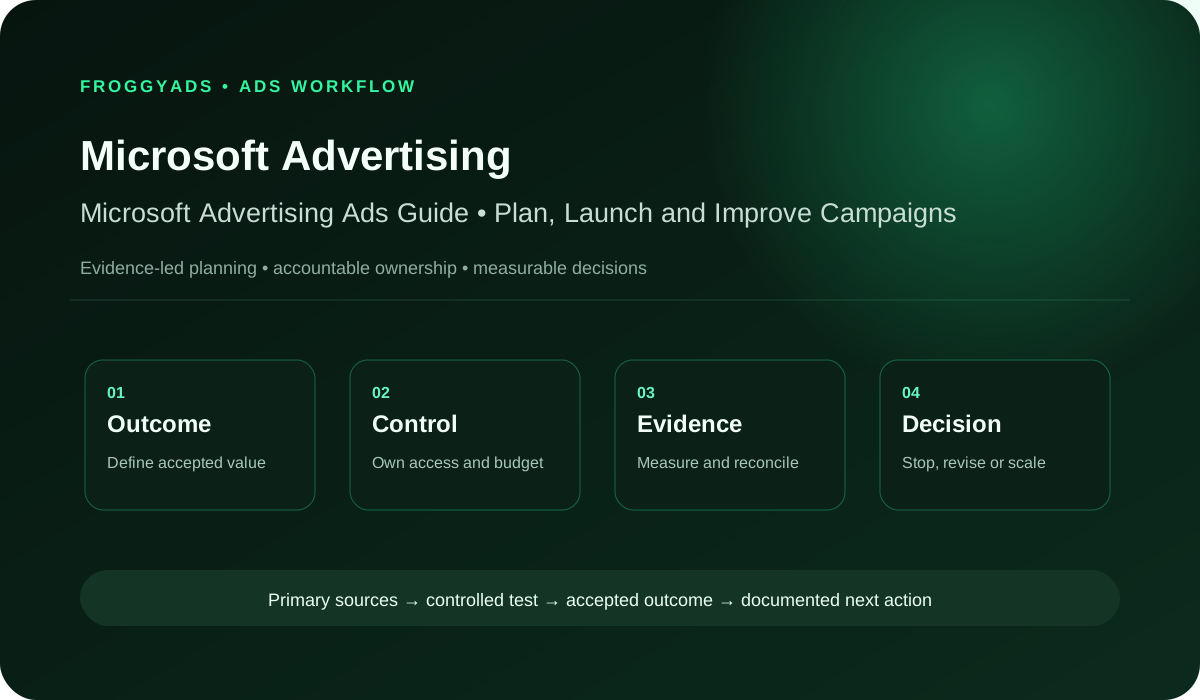
Frame one search decision
Build a reversible account map
Connect Microsoft Advertising Ads Guide to a controlled audience test
Use the choices established in “Build a reversible account map” to define one audience, budget and source set in FroggyAds. Keep the surrounding offer and measurement rule stable so the test adds evidence to microsoft advertising ads guide instead of mixing several changes at once.
Create My Free Account
Write ads from approved claims
Control keywords and search terms
Verify UET before interpretation
Choose a paid-media format that supports Microsoft Advertising Ads Guide
Use the criteria around “Verify UET before interpretation” to decide whether push, native, display or pop fits the message and destination. Set format, targeting and spend as campaign controls in FroggyAds while the microsoft advertising ads guide decision remains the standard for judging the result.
Create My Free Account
Reconcile accepted conversions
Read auction evidence cautiously
Run a bounded launch
Turn Microsoft Advertising Ads Guide into a bounded campaign test
With “Run a bounded launch” documented, launch only the next reversible test. Set a spending limit, preserve the baseline and use source-level and audience controls so the next step depends on qualified outcomes for microsoft advertising ads guide, not activity volume.
Create My Free Account
Diagnose a regional service test
Hand off without hidden knowledge
Primary-source and entity record
Owner source for owner definitions for Universal Event Tracking and supported event collection: Microsoft Advertising UET documentation. The reference supports that named definition and does not certify a campaign result.
Owner source for owner instructions for conversion-goal configuration and verification: Microsoft Advertising conversion goals. The publishing body is not presented as a sponsor of this advertiser or platform.
Owner source for owner-described campaign controls and account workflow: Microsoft Advertising campaign guidance. Application still requires a dated account readback and the advertiser's own evidence.
Visible decision phrases: Microsoft Advertising guide; Microsoft UET verification; search query control; Microsoft campaign measurement; accepted conversion review; Microsoft Ads budget governance.
- Microsoft Advertising
- Microsoft Advertising is the owner platform for the account, campaign, policy and reporting controls discussed on this page.
- Universal Event Tracking
- Universal Event Tracking is Microsoft Advertising's documented tag and event framework for supported measurement and audience functions.
- Microsoft Advertising Editor
- Microsoft Advertising Editor is an owner-provided application for reviewing and changing supported account objects.
Microsoft Advertising campaign operations is ready for a decision only when another authorized reviewer can reconstruct the approved scope, live public path, measurement definition, accepted outcome, downside boundary and stop status from retained evidence.
Controlled scenario: a regional service advertiser limits a Microsoft search campaign to one verified consultation route, tests UET receipt with a harmless record, and waits for backend eligibility review before deciding whether the search-term cohort may receive another bounded budget increment.
Microsoft Advertising campaign operations does not teach an API integration, so code examples are N/A. A verified demonstration is not needed for the stated reader decision, so embedded video is N/A. Primary-source paraphrase carries the factual support, making attributed quotations N/A. No new sameAs identity is asserted.
Existing routes and references
- Buy Traffic
- Microsoft Advertising Overview
- Microsoft Advertising Ads Tutorial
- Microsoft Advertising Ads Targeting
- Microsoft Advertising Ads Agency Guide
- Microsoft Advertising Promotion
- Microsoft Advertising
- FroggyAds editorial policy
- Microsoft Advertising: Get started
- Microsoft: New advertiser FAQs
- Microsoft Search ads
- Microsoft Advertising policies
- Microsoft Advertising Help
- FTC: Online advertising and marketing
- W3C: Web Content Accessibility Guidelines 2.2
- Microsoft Advertising
- Create My Free Account
- Explore Buy Traffic
Microsoft Advertising campaign operations FAQ
How should a Microsoft Ads account be structured?
Use campaigns for meaningful budget, market or objective differences and ad groups for closely related intent. Naming should make ownership and reporting clear.
Which research belongs before campaign creation?
Review customer language, search demand, competition, geography, offer economics, policy and destination readiness. Save assumptions that later results can confirm or reject.
How should advertisers choose a bidding approach?
Match bidding to the objective, conversion data, value quality and required control. Verify current platform options and prerequisites inside official documentation.
How can audiences support search campaigns?
Audiences can inform observation, adjustment or targeting when their source and eligibility are understood. Avoid sensitive inference and compare incremental value.
What should be checked after a campaign import?
Review budgets, bids, locations, schedules, assets, tracking, exclusions, URLs and platform-specific settings. Never assume an import preserves every source behaviour.
When do Microsoft shopping campaigns need a feed?
Product advertising needs accurate merchant and product information in the supported setup. Keep price, availability, destination and policy fields current.
How can Microsoft traffic quality be monitored?
Inspect search terms, placement or audience detail where available, geography, device, invalid patterns and qualified outcomes. Investigate anomalies before scaling.
What makes a Microsoft Ads test interpretable?
Use a clear hypothesis, controlled change, sufficient valid delivery and a pre-set decision. Note algorithmic or seasonal changes that may affect comparison.
Which Microsoft Ads reports should teams reconcile?
Reconcile spend, delivery, search terms and attributed conversions with analytics, CRM or commerce data. Align time zones, windows and currency first.
How often should Microsoft campaigns be maintained?
Monitor critical errors and spend frequently, then review search quality and economics on a cadence suited to volume. Avoid needless daily changes to low-volume campaigns.
Microsoft Advertising Ads Guide: Plan, Launch, Measure and Improve Campaigns: a practical advertiser decision matrix
| Decision | What to verify | FroggyAds action |
|---|---|---|
| Question | State the specific decision this guide answers about Microsoft Advertising Ads Guide: Plan, Launch, Measure and Improve Campaigns. | Use the guide before changing campaign settings. |
| Procedure | Follow the steps around On this page in their intended order. | Keep the baseline stable while testing the recommended change. |
| Evidence | Use the measurement guidance under Frame one search decision. | Reconcile FroggyAds data with tracker and backend results. |
| Diagnosis | Use the troubleshooting section around Build a reversible account map to isolate the smallest failing layer. | Change one major variable at a time. |
| Next action | Move from the guide to a bounded live test only when the prerequisites are met. | Create a FroggyAds account and preserve the test limit. |
Microsoft Advertising Ads Guide: Plan, Launch, Measure and Improve Campaigns: what should the advertiser decide next?
For Microsoft Advertising Ads Guide: Plan, Launch, Measure and Improve Campaigns, the commercial task is to turn microsoft ads guide into one measurable campaign decision. Use On this page to define the audience or problem, use Frame one search decision to constrain the test, and decide in advance which accepted result would justify more FroggyAds spend.
On this Microsoft Advertising Ads Guide: Plan, Launch, Measure and Improve Campaigns page, the decision should remain tied to the existing evidence around On this page, Frame one search decision and Build a reversible account map. Those sections give microsoft ads guide its specific context; the table below turns that context into campaign actions rather than adding another generic definition.
| Decision | What to verify | FroggyAds action |
|---|---|---|
| Microsoft Advertising Ads Guide: Plan, Launch, Measure and Improve Campaigns objective | Use On this page to define the accepted business event and the maximum learning loss for microsoft ads guide. | Launch one FroggyAds campaign objective for Microsoft Advertising Ads Guide: Plan, Launch, Measure and Improve Campaigns and keep the conversion definition stable. |
| Microsoft Advertising Ads Guide: Plan, Launch, Measure and Improve Campaigns audience | Use Frame one search decision to verify market, device, language and offer eligibility for microsoft ads guide. | Apply only the FroggyAds targeting controls that change the real Microsoft Advertising Ads Guide: Plan, Launch, Measure and Improve Campaigns customer journey. |
| Microsoft Advertising Ads Guide: Plan, Launch, Measure and Improve Campaigns source evidence | Use Build a reversible account map to keep source-level differences visible instead of relying on one blended microsoft ads guide average. | Keep, cap, exclude or retest Microsoft Advertising Ads Guide: Plan, Launch, Measure and Improve Campaigns inventory from documented source evidence. |
| Microsoft Advertising Ads Guide: Plan, Launch, Measure and Improve Campaigns economics | Use Connect Microsoft Advertising Ads Guide to a controlled audience test to connect media spend with accepted conversions and downstream value for microsoft ads guide. | Protect the Microsoft Advertising Ads Guide: Plan, Launch, Measure and Improve Campaigns test with a written budget boundary and a consistent attribution window. |
| Microsoft Advertising Ads Guide: Plan, Launch, Measure and Improve Campaigns scale rule | Use Write ads from approved claims to define the exact evidence that earns the next budget increase for microsoft ads guide. | Scale Microsoft Advertising Ads Guide: Plan, Launch, Measure and Improve Campaigns one major control at a time and compare marginal performance with the prior baseline. |
A page-specific FroggyAds test sequence for Microsoft Advertising Ads Guide: Plan, Launch, Measure and Improve Campaigns
- Microsoft Advertising Ads Guide: Plan, Launch, Measure and Improve Campaigns outcome: define the accepted event for microsoft ads guide and the maximum loss permitted while the first test is learning.
- Microsoft Advertising Ads Guide: Plan, Launch, Measure and Improve Campaigns path: verify market eligibility, device experience, landing-page continuity and tracking against On this page before buying more traffic.
- Microsoft Advertising Ads Guide: Plan, Launch, Measure and Improve Campaigns hypothesis: launch one bounded FroggyAds test tied to Frame one search decision; do not change bid, creative, audience and destination together.
- Microsoft Advertising Ads Guide: Plan, Launch, Measure and Improve Campaigns source review: compare qualified activity, accepted conversions, timing and cost by the source or segment dimensions relevant to Build a reversible account map.
- Microsoft Advertising Ads Guide: Plan, Launch, Measure and Improve Campaigns scaling: use Connect Microsoft Advertising Ads Guide to a controlled audience test and Write ads from approved claims to define what must reproduce before the next budget increase.
Why FroggyAds is relevant to Microsoft Advertising Ads Guide: Plan, Launch, Measure and Improve Campaigns
For Microsoft Advertising Ads Guide: Plan, Launch, Measure and Improve Campaigns, FroggyAds gives advertisers a self-serve DSP and ad-network workflow for buying supported traffic with campaign-level budgets and targeting. Depending on format and campaign context, available controls can include country, city, device, operating system, browser, carrier, category, source, ID and IP options. SmartCPC and Adscore-supported traffic-quality controls can support the microsoft ads guide optimization process, while the advertiser's tracker, analytics and backend acceptance remain the final evidence for commercial quality.
Use Write ads from approved claims as the final checkpoint for Microsoft Advertising Ads Guide: Plan, Launch, Measure and Improve Campaigns. If the accepted result does not reproduce after the next meaningful volume step, return to the last stable configuration instead of widening several controls at once.
Microsoft Advertising Ads Guide: Plan, Launch, Measure and Improve Campaigns — buyer decision
Microsoft Advertising Ads Guide: Plan, Launch, Measure and Improve Campaigns belongs in the buying workflow only when it changes a measurable media decision. Set the test boundary, keep the campaign identifiers intact, and compare mature accepted business outcome economics before allocating more spend. The page-specific job is to follow a practical setup and optimization sequence. The adjacent Microsoft Marketing Strategy page should remain a separate decision.
Evidence already visible on this page: Direct answer: Microsoft Advertising campaign operations connect a stated search demand, controlled account structure, verified UET events, accepted business outcomes and reversible budget decisions. The defensible next action is a… The page topic "Microsoft ads guide" becomes actionable when the advertiser defines the audience, budget guardrails, quality checks and accepted outcome. FroggyAds provides self-serve buying and granular targeting controls, supporting… The working concepts for this URL are audience targeting, conversion tracking, source quality.
Questions to resolve before scale: How should a Microsoft Ads account be structured? Which research belongs before campaign creation? How should advertisers choose a bidding approach?
| Checkpoint | Page-specific action | Evidence to keep |
|---|---|---|
| Campaign condition | Use “On this page” to define the first operating boundary for Microsoft Advertising Ads Guide: Plan, Launch, Measure and Improve Campaigns. | Record the answer to “How should a Microsoft Ads account be structured?” together with source, targeting and destination identifiers. |
| Proof | Use “Frame one search decision” to test whether delivery is producing the expected path toward the accepted business outcome. | Keep the evidence needed to answer “Which research belongs before campaign creation?” after the same maturation window. |
| Follow-up | Use “Build a reversible account map” to decide what changes next; change one material variable before comparing again. | Write the answer to “How should advertisers choose a bidding approach?” plus accepted cost/value and the rollback condition. |
Transparent decision example
Hypothetical example: If Microsoft Advertising Ads Guide: Plan, Launch, Measure and Improve Campaigns uses USD 325 of test spend and 6 outcomes are accepted after maturation, the accepted outcome cost is USD 54.17. Replace the inputs with your own economics; this is not a FroggyAds performance claim.
Why use FroggyAds for this step?
Use FroggyAds when Microsoft Advertising Ads Guide: Plan, Launch, Measure and Improve Campaigns needs a measurable paid-media test. Our self-serve workflow keeps targeting, budget and source decisions under your control while your accepted accepted business outcome remains the scale signal. Create your free FroggyAds account.
Microsoft Ads Guide worked application example
Hypothetical example: a buyer using this Microsoft Ads Guide guide can turn one recommendation into a test by naming the accepted event, fixing the review window and changing one campaign variable. If USD 175 produces 7 accepted outcomes, the resulting accepted CPA is USD 25.00; use your own numbers and economics before deciding what to change next.
Microsoft Advertising Ads Guide: Plan, Launch, Measure and Improve Campaigns — what matters first
Microsoft Advertising Ads Guide: Plan, Launch, Measure and Improve Campaigns is most useful when it helps a buyer follow a practical setup and optimization sequence. Define the accepted outcome first, then use targeting, budget and source-level evidence to decide what deserves more spend.