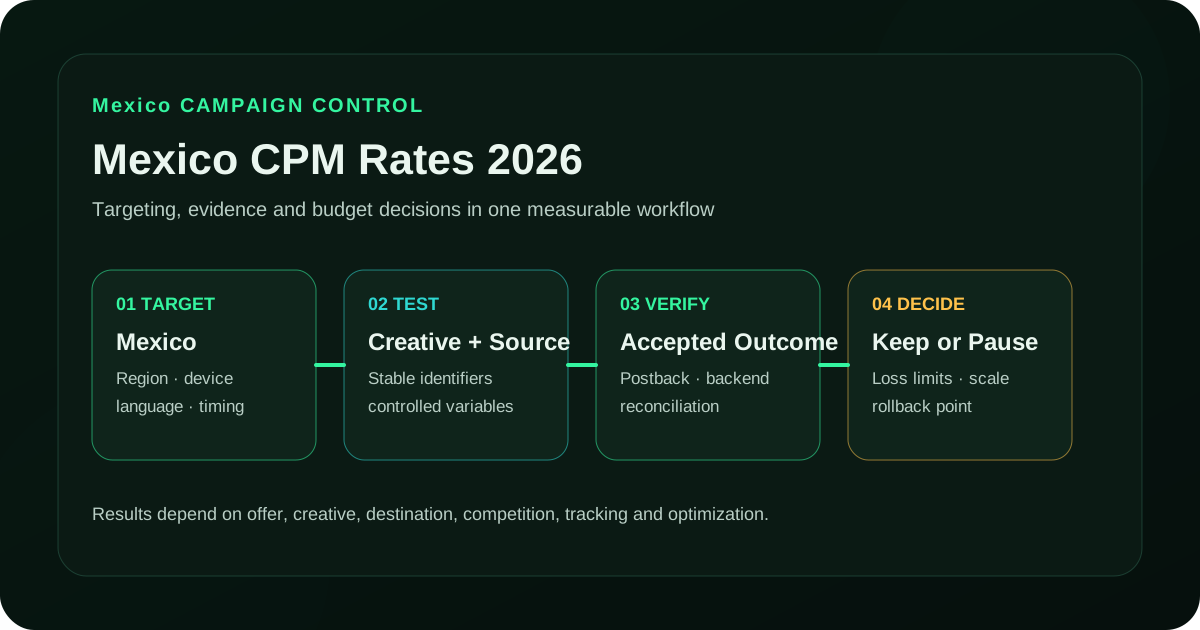
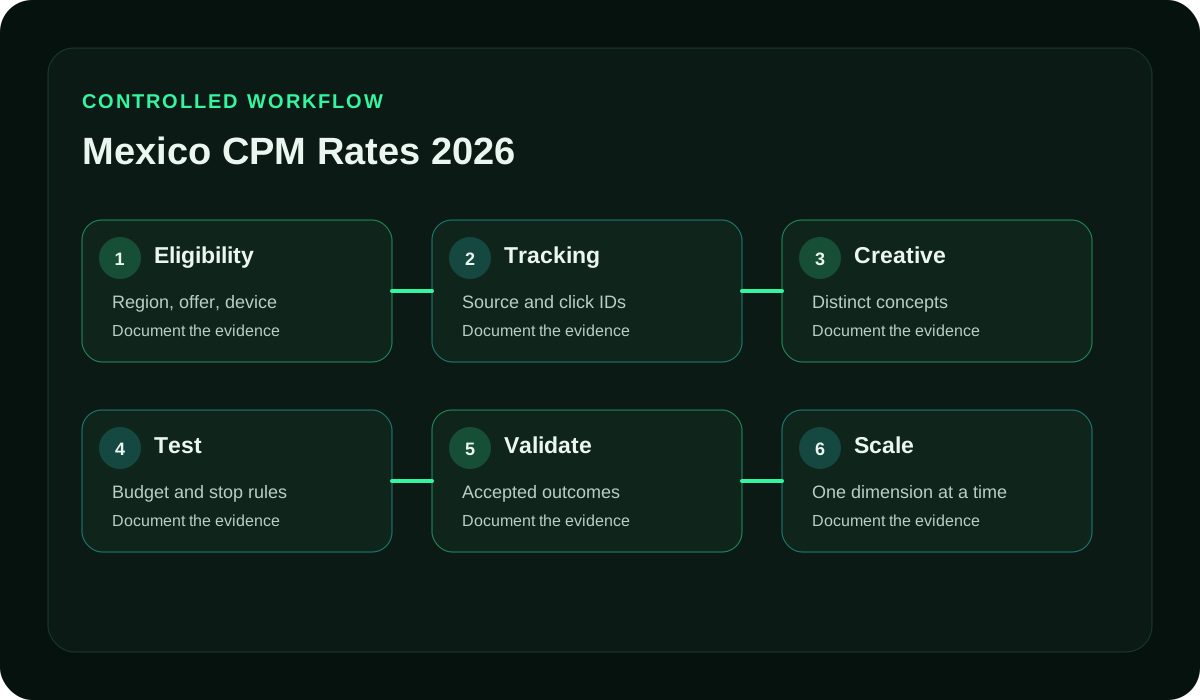
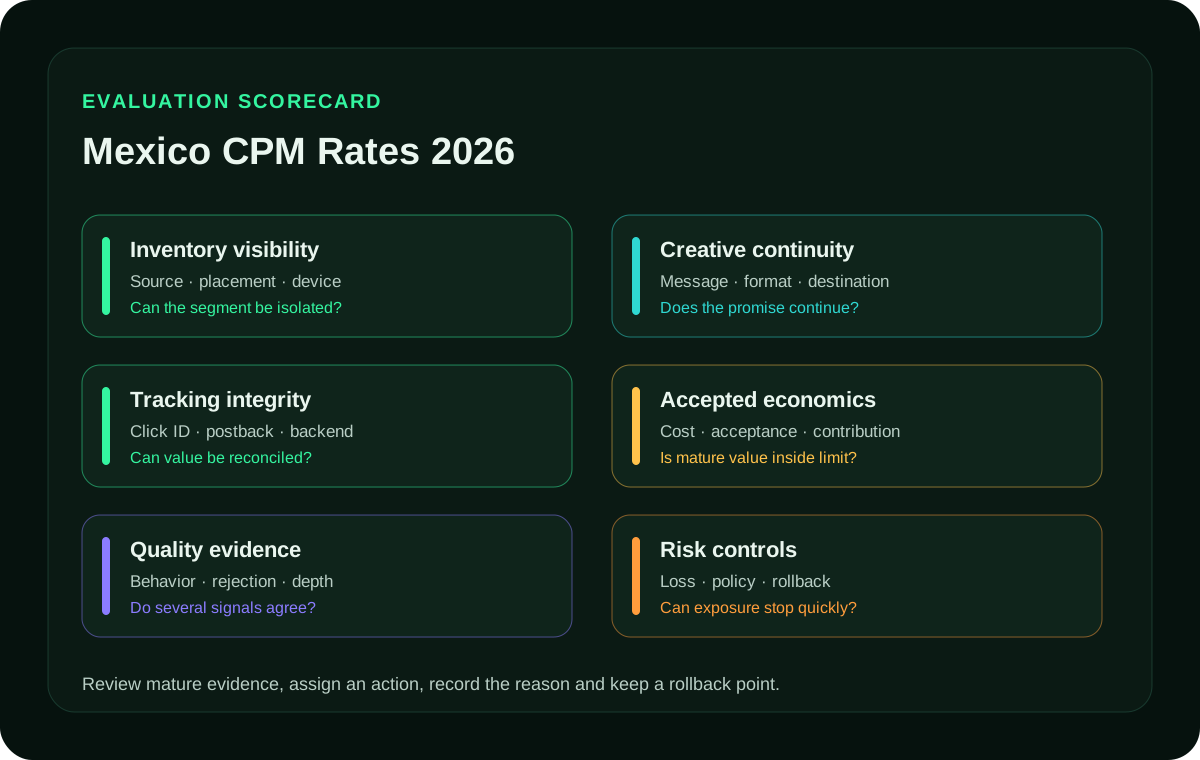
A Mexico CPM rate for 2026 is an observed price for a defined thousand-impression unit, currency, inventory path, placement, audience, time window and auction configuration. There is no truthful universal rate to copy into a budget. As of 16 August 2026, INEGI reports that its ENDUTIH 2025 survey estimated 104.9 million internet users aged six or older in Mexico, representing 86.1 percent of that population. That official context describes internet use, not purchasable impressions or CPM. Buyers must calculate their own delivered and viewable rates from reconciled campaign evidence.
Define the CPM denominator before comparing a rate
Standard delivered CPM is media cost divided by delivered impressions and multiplied by one thousand. A viewable CPM uses viewable impressions under the provider's measurement definition. Do not compare these units as though their denominators were identical, and do not infer that a served impression was noticed by a person.
Google Ads describes viewable CPM bidding around one thousand impressions measured as viewable and documents its own display and video thresholds. Use that definition only for the supported Google route. Another network may expose different billable, measurable or viewability fields that need separate source documentation.
Record the rate's complete buying context
Attach the currency, tax treatment, exchange treatment, bid type, format, device, geography, source, deal, frequency, date and budget state to every observed CPM. A number without this context cannot be reproduced. Mexico-wide, city, interest and retargeting cells may enter different auctions and inventory pools.
Label estimates, quotes, bid floors, bids, clearing prices and realized cost separately. A provider interface suggestion is not the same as a finalized campaign average, while the past average is not a guarantee for the next allocation. Preserve the report export and calculation rather than copying a rounded number into a permanent benchmark.
Use national internet data as context, not inventory
INEGI's ENDUTIH 2025 release estimated 104.9 million internet users aged six or older and an 86.1 percent usage rate for that population. The report also distinguishes urban and rural use. These survey measures help describe digital access and its population boundary.
ENDUTIH does not state how many advertising impressions a buyer can purchase, which people are eligible for a product, or what an auction will charge. Do not multiply national internet users by an assumed impression frequency to create a market-size or CPM claim. Campaign supply must come from the buying route and its actual targeting.
Plan spend with daily and total exposure limits
Convert the budget question into a range of testable impressions using clearly labeled CPM scenarios, then keep the arithmetic distinct from a delivery forecast. For a scenario, impressions equal budget divided by CPM and multiplied by one thousand. Taxes, fees, currency conversion and non-media work remain outside unless explicitly included.
Google Ads explains average daily budgets and monthly charging limits for its product. Those rules are provider-specific. For any network, record the actual cap, pacing behaviour and financial authority, then stop or investigate when daily cost, delivery concentration or rate moves outside the approved corridor.
Reconcile cost with placement and quality evidence
Break the campaign into source, placement, device, geography and creative cells where identifiers are available. Compare delivered, measurable and viewable impressions without collapsing them. Add clicks, successful loads and accepted outcomes as separate later states; a low CPM can coexist with unusable placement or weak business value.
Use ads.txt and sellers.json evidence where applicable to inspect authorized sellers and transaction participants. Those standards can support supply-chain transparency, but they do not prove viewability, human attention, contextual suitability or conversion quality. Unresolved seller or source fields stay visible in the rate review.
Publish a dated rate range with method and limits
A useful Mexico CPM range names the dataset, exact dates, currency, spend, impressions, filters, formats and percentile or scenario method. Report the sample size and exclusions. If only one small campaign exists, call it that campaign's observation rather than a national 2026 market rate.
Update the range after substantive new delivery, not because the calendar changed. Keep the prior estimate and explain the changed inventory, budget or methodology. The closeout should state which rate is delivered, measurable or viewable and which business decision the evidence can support.
Connect the guide to live testing
Connect Mexico CPM Rates 2026 to a controlled audience test
Use the choices established in “Decision controls” to define one audience, budget and source set in FroggyAds. Keep the surrounding offer and measurement rule stable so the test adds evidence to mexico cpm rates 2026 instead of mixing several changes at once.
Every CPM label names delivered, measurable or viewable impressions.
Region Atlas control 2
The formula, currency, cost fields and thousand-impression denominator are retained.
Region Atlas control 3
Quoted floors, entered bids and realized campaign averages remain distinct.
Region Atlas control 4
Format, device, geography, source and date accompany every rate observation.
Region Atlas control 5
INEGI internet-use estimates remain separate from purchasable ad inventory.
Region Atlas control 6
Scenario impressions are labeled arithmetic rather than a delivery forecast.
Region Atlas control 7
Daily and total spending limits follow the actual provider's documented behavior.
Region Atlas control 8
Source and placement cells preserve available seller and transaction evidence.
Region Atlas control 9
Low CPM never substitutes for viewability, context or mature business quality.
Region Atlas control 10
Rate ranges disclose sample, filters, dates, currency and exclusions.
Region Atlas control 11
Historical observations are not presented as guaranteed future clearing prices.
Region Atlas control 12
A substantive dataset or method change is required before the visible date changes.
Review trail
Review decision 1
Every CPM label names delivered, measurable or viewable impressions. The rate analyst labels delivered, measurable or viewable impressions before applying the thousand-unit formula. Currency, credits and fees stay visible so another buyer can reproduce the result.
Review decision 2
The formula, currency, cost fields and thousand-impression denominator are retained. An auction observation receives its format, device, geography, source and dates. A quoted bid or floor cannot silently replace the cleared cost from the campaign report.
Review decision 3
Quoted floors, entered bids and realized campaign averages remain distinct. INEGI survey context remains attached to its population and field period. The planning sheet never converts national internet users into a claim about purchasable inventory or price.
Choose the execution format
Choose a paid-media format that supports Mexico CPM Rates 2026
Use the criteria around “Review decision 4” to decide whether push, native, display or pop fits the message and destination. Set format, targeting and spend as campaign controls in FroggyAds while the mexico cpm rates 2026 decision remains the standard for judging the result.
Format, device, geography, source and date accompany every rate observation. Scenario arithmetic uses an explicit assumed CPM and media budget. The analyst labels resulting impressions as a planning case and keeps provider pacing rules in a separate control.
Review decision 5
INEGI internet-use estimates remain separate from purchasable ad inventory. Placement reconciliation keeps seller transparency, viewability and accepted outcomes distinct. A low observed rate cannot overrule a broken landing path or unresolved source identity.
Review decision 6
Scenario impressions are labeled arithmetic rather than a delivery forecast. The published range includes sample, filters, currency and method. Later updates preserve the earlier estimate and identify the substantive new evidence that changed the planning interval.
Review decision 7
Daily and total spending limits follow the actual provider's documented behavior. The rate analyst labels delivered, measurable or viewable impressions before applying the thousand-unit formula. Currency, credits and fees stay visible so another buyer can reproduce the result.
Review decision 8
Source and placement cells preserve available seller and transaction evidence. An auction observation receives its format, device, geography, source and dates. A quoted bid or floor cannot silently replace the cleared cost from the campaign report.
Review decision 9
Low CPM never substitutes for viewability, context or mature business quality. INEGI survey context remains attached to its population and field period. The planning sheet never converts national internet users into a claim about purchasable inventory or price.
Review decision 10
Rate ranges disclose sample, filters, dates, currency and exclusions. Scenario arithmetic uses an explicit assumed CPM and media budget. The analyst labels resulting impressions as a planning case and keeps provider pacing rules in a separate control.
Review decision 11
Historical observations are not presented as guaranteed future clearing prices. Placement reconciliation keeps seller transparency, viewability and accepted outcomes distinct. A low observed rate cannot overrule a broken landing path or unresolved source identity.
Review decision 12
A substantive dataset or method change is required before the visible date changes. The published range includes sample, filters, currency and method. Later updates preserve the earlier estimate and identify the substantive new evidence that changed the planning interval.
Practical evidence lab
Region Atlas exercise 1
Calculate delivered CPM from a known cost and impression export, then repeat with measurable and viewable denominators. Label each result and reconcile credits before comparison. Preserve the export or invoice row that supplies the numerator and denominator, and state whether taxes, fees or currency conversion sit outside the calculation. Exercise 1 keeps its dated observation and reviewer.
Region Atlas exercise 2
Annotate one Mexico rate observation with currency, format, device, geography, source, date and bid mechanism. Reject the record if any required context cannot be recovered. Store the source's collection period and population beside the percentage so later analysts cannot silently apply it to a different audience or advertising unit. Exercise 2 keeps its dated observation and reviewer.
Put the guide into practice
Turn Mexico CPM Rates 2026 into a bounded campaign test
With “Region Atlas exercise 3” documented, launch only the next reversible test. Set a spending limit, preserve the baseline and use source-level and audience controls so the next step depends on qualified outcomes for mexico cpm rates 2026, not activity volume.
Read the ENDUTIH population definition and identify three decisions it cannot answer about advertising inventory. Keep those exclusions beside the cited internet-use figures. Keep bid strategy, pacing and measurement eligibility fixed across scenarios unless the changed input is the explicit subject of the comparison. Exercise 3 keeps its dated observation and reviewer.
Region Atlas exercise 4
Build conservative, working and stress scenarios with explicit budget and CPM inputs. Display the formula and keep estimated impressions separate from provider forecasts. Investigate seller concentration and rendering evidence separately from the arithmetic; an inexpensive cell can still be unsuitable for the planned customer journey. Exercise 4 keeps its dated observation and reviewer.
Region Atlas exercise 5
Sample seller, placement, viewability and landing evidence for one low-cost cell. Record which quality questions remain unresolved even after the rate is calculated correctly. Publish the sample count and exclusion rule before comparing periods, because a cleaned range without those fields cannot be reproduced or challenged. Exercise 5 keeps its dated observation and reviewer.
Region Atlas exercise 6
Prepare a dated range with sample count, filters, percentiles and exclusions. Compare it with the earlier version and explain only the substantive data or method change. Archive the dated result with a short decision note that identifies the first operational signal that would cause spend to pause or the range to be rebuilt. Exercise 6 keeps its dated observation and reviewer.
Region Atlas exercise 7
Calculate delivered CPM from a known cost and impression export, then repeat with measurable and viewable denominators. Label each result and reconcile credits before comparison. Preserve the export or invoice row that supplies the numerator and denominator, and state whether taxes, fees or currency conversion sit outside the calculation. Exercise 7 keeps its dated observation and reviewer.
Region Atlas exercise 8
Annotate one Mexico rate observation with currency, format, device, geography, source, date and bid mechanism. Reject the record if any required context cannot be recovered. Store the source's collection period and population beside the percentage so later analysts cannot silently apply it to a different audience or advertising unit. Exercise 8 keeps its dated observation and reviewer.
Region Atlas exercise 9
Read the ENDUTIH population definition and identify three decisions it cannot answer about advertising inventory. Keep those exclusions beside the cited internet-use figures. Keep bid strategy, pacing and measurement eligibility fixed across scenarios unless the changed input is the explicit subject of the comparison. Exercise 9 keeps its dated observation and reviewer.
Region Atlas exercise 10
Build conservative, working and stress scenarios with explicit budget and CPM inputs. Display the formula and keep estimated impressions separate from provider forecasts. Investigate seller concentration and rendering evidence separately from the arithmetic; an inexpensive cell can still be unsuitable for the planned customer journey. Exercise 10 keeps its dated observation and reviewer.
Region Atlas exercise 11
Sample seller, placement, viewability and landing evidence for one low-cost cell. Record which quality questions remain unresolved even after the rate is calculated correctly. Publish the sample count and exclusion rule before comparing periods, because a cleaned range without those fields cannot be reproduced or challenged. Exercise 11 keeps its dated observation and reviewer.
Region Atlas exercise 12
Prepare a dated range with sample count, filters, percentiles and exclusions. Compare it with the earlier version and explain only the substantive data or method change. Archive the dated result with a short decision note that identifies the first operational signal that would cause spend to pause or the range to be rebuilt. Exercise 12 keeps its dated observation and reviewer.
Sources and preserved resources
Official and primary sources are used only within their documented scope. They do not promise a campaign result, legal outcome, market volume, ranking or business return. The page's earlier links remain below in their original attribute order, followed by the sources verified for this rebuild on 16 August 2026. For Mexico CPM Rates 2026, apply this rule to the page-specific audience, market, format or buying decision described here.
INEGI ENDUTIH 2025 is Mexico's national survey release about household access to and use of information and communications technologies.
Google Ads viewable CPM bidding uses one thousand impressions measured as viewable under Google's documented product definition.
Mexico CPM analysis should also separate statistical precision from business usefulness. A large impression sample can estimate a network's campaign average closely while still hiding source concentration or an outcome delay. Conversely, a small source cell may reveal a rendering or seller problem without supporting a national price claim. Report both the numerical uncertainty and the operating limitation. If a currency conversion is used, preserve the billed amount and conversion basis so finance can reverse it. If taxes, agency fees or creative work are excluded, say so beside the rate. This keeps a technically correct CPM from being mistaken for total acquisition economics and allows future reviews to compare the same cost boundary. Review complete.
Questions and answers
What does a Mexico CPM rate represent?
A Mexico CPM states the charge for 1,000 impressions counted under the seller's rules. The rate alone says nothing about viewability, audience fit or campaign value.
Where should 2026 Mexico CPMs be verified?
Verify current rates in live platform forecasts, quotes or account delivery because pricing changes with inventory and competition. Date every benchmark used in planning.
Why do Mexico CPM rates vary widely?
Format, placement, audience, device, geography, season, quality controls and buying method all affect price. A market-wide average can hide those differences.
Which currency should Mexico CPM reports use?
State whether the rate is in MXN, USD or another currency, plus the exchange date if converted. Never compare unlabeled currency figures.
Should CPM be reported before or after fees?
Report the convention explicitly and reconcile platform media, technology, data and agency fees. A net media CPM and an all-in CPM answer different questions.
How is viewable CPM different from standard CPM?
Viewable CPM uses impressions meeting the selected viewability definition, so it may be higher. Document the measurement provider and threshold.
How should a 2026 CPM benchmark be used?
Use it as a planning range, then replace it with observed rates from comparable inventory. Do not treat a benchmark as a guaranteed buying price.
Can a higher Mexico CPM be worthwhile?
Yes, when it buys more relevant, viewable or conversion-producing inventory. Compare qualified outcome cost and contribution after quality checks.
How much delivery is needed to judge CPM?
Enough to cover the relevant audience, placements and time variation without one small pocket dominating. Pair rate stability with conversion-quality evidence.
When should Mexico CPM assumptions be updated?
Update them after material season, format, targeting, supply or auction changes and during active planning. Preserve the old assumption with its source for audit.
Advertiser decision framework
Mexico CPM Rates 2026: Rates, Budget & Campaign Planning: what should the advertiser decide next?
For Mexico CPM Rates 2026: Rates, Budget & Campaign Planning, keep billing unit, account funding, media spend and cost per accepted outcome separate. Use On this page to identify the relevant unit and Define the CPM denominator before comparing a rate to set a bounded test. A starting bid, minimum deposit or suggested budget is not a performance forecast for mexico cpm rates 2026.
On this Mexico CPM Rates 2026: Rates, Budget & Campaign Planning page, the decision should remain tied to the existing evidence around On this page, Define the CPM denominator before comparing a rate and Record the rate's complete buying context. Those sections give mexico cpm rates 2026 its specific context; the table below turns that context into campaign actions rather than adding another generic definition.
Use Record the rate's complete buying context to keep source-level differences visible instead of relying on one blended mexico cpm rates 2026 average.
Keep, cap, exclude or retest Mexico CPM Rates 2026: Rates, Budget & Campaign Planning inventory from documented source evidence.
Use Use national internet data as context, not inventory to connect media spend with accepted conversions and downstream value for mexico cpm rates 2026.
Protect the Mexico CPM Rates 2026: Rates, Budget & Campaign Planning test with a written budget boundary and a consistent attribution window.
Use Plan spend with daily and total exposure limits to define the exact evidence that earns the next budget increase for mexico cpm rates 2026.
Scale Mexico CPM Rates 2026: Rates, Budget & Campaign Planning one major control at a time and compare marginal performance with the prior baseline.
A page-specific FroggyAds test sequence for Mexico CPM Rates 2026: Rates, Budget & Campaign Planning
Mexico CPM Rates 2026: Rates, Budget & Campaign Planning outcome: define the accepted event for mexico cpm rates 2026 and the maximum loss permitted while the first test is learning.
Mexico CPM Rates 2026: Rates, Budget & Campaign Planning path: verify market eligibility, device experience, landing-page continuity and tracking against On this page before buying more traffic.
Mexico CPM Rates 2026: Rates, Budget & Campaign Planning hypothesis: launch one bounded FroggyAds test tied to Define the CPM denominator before comparing a rate; do not change bid, creative, audience and destination together.
Mexico CPM Rates 2026: Rates, Budget & Campaign Planning source review: compare qualified activity, accepted conversions, timing and cost by the source or segment dimensions relevant to Record the rate's complete buying context.
Mexico CPM Rates 2026: Rates, Budget & Campaign Planning scaling: use Use national internet data as context, not inventory and Plan spend with daily and total exposure limits to define what must reproduce before the next budget increase.
Why FroggyAds is relevant to Mexico CPM Rates 2026: Rates, Budget & Campaign Planning
For Mexico CPM Rates 2026: Rates, Budget & Campaign Planning, FroggyAds gives advertisers a self-serve DSP and ad-network workflow for buying supported traffic with campaign-level budgets and targeting. Depending on format and campaign context, available controls can include country, city, device, operating system, browser, carrier, category, source, ID and IP options. SmartCPC and Adscore-supported traffic-quality controls can support the mexico cpm rates 2026 optimization process, while the advertiser's tracker, analytics and backend acceptance remain the final evidence for commercial quality.
Use Plan spend with daily and total exposure limits as the final checkpoint for Mexico CPM Rates 2026: Rates, Budget & Campaign Planning. If the accepted result does not reproduce after the next meaningful volume step, return to the last stable configuration instead of widening several controls at once.
Mexico CPM Rates 2026: Rates, Budget & Campaign Planning: the decision this URL owns
The buying question on Mexico CPM Rates 2026: Rates, Budget & Campaign Planning is whether the page's own setup and evidence justify the next campaign action. For a performance advertiser, that means you should use current 2026 platform and market context rather than evergreen assumptions.
Decision inputs for Mexico CPM Rates 2026: Rates, Budget & Campaign Planning: audience targeting, conversion tracking, source quality, source evidence. Keep these inputs tied to accepted conversion or business-value event and the page-specific job: use current 2026 platform and market context rather than evergreen assumptions.
URL boundary for Mexico CPM Rates 2026: Rates, Budget & Campaign Planning: This URL owns benchmark interpretation for Mexico CPM Rates 2026: Rates, Budget & Campaign Planning: connect the quoted rate context to format, GEO, auction conditions and advertiser economics rather than presenting one number as a universal price.
Define the CPM denominator before comparing a rate is the measurement checkpoint for this URL. Resolve “Where should 2026 Mexico CPMs be verified?” while retaining conversion tracking, source evidence, spend and cohort age so the result can be reconciled with accepted conversion or business-value event.
On this page is an evidence checkpoint for Mexico CPM Rates 2026: Rates, Budget & Campaign Planning. To answer “What does a Mexico CPM rate represent?”, keep audience targeting in the same campaign record and use it to use current 2026 platform and market context rather than evergreen assumptions.
Record the rate's complete buying context is the action checkpoint for Mexico CPM Rates 2026: Rates, Budget & Campaign Planning. Before acting on “Why do Mexico CPM rates vary widely?”, document source quality, the resulting campaign action and the rollback or retest condition.
Page checkpoint
How to use it
Evidence to retain
On this page
Use On this page to establish the first evidence boundary for Mexico CPM Rates 2026: Rates, Budget & Campaign Planning; then record which part of campaign objective, targeting, source evidence, conversion tracking and economics it changes.
Keep audience targeting, source/campaign ID and the accepted-event definition together.
Define the CPM denominator before comparing a rate
Use Define the CPM denominator before comparing a rate as the second checkpoint and reconcile it with accepted conversion or business-value event before changing budget or source allocation.
Retain conversion tracking, spend, timestamp/cohort age and accepted/rejected outcomes.
Record the rate's complete buying context
Use Record the rate's complete buying context as the final checkpoint: if it does not change the evidence for accepted conversion or business-value event, keep the test narrow rather than scaling.
Document source quality, the decision taken and the rollback or retest condition.
Hypothetical example: For Mexico CPM Rates 2026: Rates, Budget & Campaign Planning, a hypothetical controlled cell that spends USD 280 and records 4 accepted conversion or business-value event after the same maturity window has an accepted cost of USD 70.00 per outcome. Replace the figures, outcome and review window with your own economics; this is not a FroggyAds performance claim.
Why use FroggyAds here?
For Mexico CPM Rates 2026: Rates, Budget & Campaign Planning, FroggyAds gives the performance advertiser a self-serve way to isolate the campaign cell, retain source-level evidence and decide the next spend step from accepted conversion or business-value event. Create your free FroggyAds account.
Mexico CPM Rates 2026 transparent campaign example
Hypothetical example: if a controlled Mexico CPM Rates 2026 test spends USD 125 and produces 4 accepted outcomes after the agreed review window, accepted CPA is USD 125 ÷ 4 = USD 31.25. Replace these inputs with your own accepted event, attribution window and economics; this is a transparent calculation example, not a FroggyAds result claim.
Direct answer
Mexico CPM Rates 2026: Rates, Budget & Campaign Planning — what matters first
Mexico CPM Rates 2026: Rates, Budget & Campaign Planning is a cost-planning decision: separate published minimums or rates from actual campaign economics, then set a bounded test budget around an accepted business outcome.