Malaysia CPM Rates 2026

Malaysia CPM rates in 2026 are live auction outputs, not a fixed public tariff. A useful planning page therefore explains how to obtain a current quote, normalize it and test whether purchased impressions create accepted value. The Department of Statistics Malaysia is the primary context source used here; its 2025 ICT release was published on 23 April 2026 and provides dated digital-access context rather than a media-price guarantee.

malaysia cpm rates 2026 planning visual
Malaysia CPM planning separates quoted media price from accepted business cost.

Treat every CPM number as a dated quote

Record the platform, currency, date and time, buying method, format, country definition, device mix, schedule, audience restrictions, inventory controls and estimated volume beside any quoted CPM. Without that context, two numbers are not comparable. Auction conditions can change between planning and launch, so the operative value is the rate available in the authorized campaign interface when the test is configured.

Avoid publishing an unsupported universal range. A narrow audience, premium placement or constrained schedule can price differently from broad delivery, and exchange rates can alter a budget comparison. Keep the raw quote in its original currency, store the conversion rate and date separately, and label forecasts as scenarios rather than facts.

Use official digital context for sizing, not pricing

The Department of Statistics Malaysia reported household Internet access of 97.1 percent and individual Internet use of 98.3 percent for 2025 in its release published on 23 April 2026. Those figures describe national ICT access and use under the agency's definitions. They do not reveal available advertising inventory, a platform CPM or the share of people eligible for a specific campaign.

Retain the publication title, release date and table definition when using official context. Do not multiply a national percentage by the population and present the result as reachable impressions without a compatible denominator and platform evidence. Campaign sizing should come from the buying interface and the advertiser's eligibility rules, then be reconciled with delivered data.

Normalize impression cost before comparing options

Convert spend and impressions to the same currency and definition, then calculate effective CPM from delivered billable impressions. Keep fees and taxes explicit where applicable. A quoted CPM and delivered effective CPM may differ because of auction movement, pacing, invalid activity treatment or reporting windows. Compare like periods and retain the original exports so the calculation can be reproduced.

Move beyond media price by connecting impressions to landing sessions and accepted outcomes. Calculate cost per qualified session, accepted lead or retained sale according to the business model. A higher CPM can be economically preferable if the inventory produces materially better accepted value, while a cheap rate can remain wasteful when the destination or audience fit is weak.

Report a rate as a decision range with assumptions

Prepare conservative, working and stress scenarios using clearly labeled CPM inputs. For each scenario, show budget, impressions, expected session assumptions, accepted outcome assumptions and maximum tolerable cost. The result is not a forecast guarantee; it is a sensitivity table that reveals which assumption controls the decision and where a live test must replace planning.

At review time, replace assumptions with delivered values one layer at a time. Store the live quote, configuration, spend, billable impressions, effective CPM, first-party sessions, accepted outcomes and discrepancies. The useful 2026 answer is a dated, reproducible result for a defined campaign, not a number detached from format, audience and auction conditions.

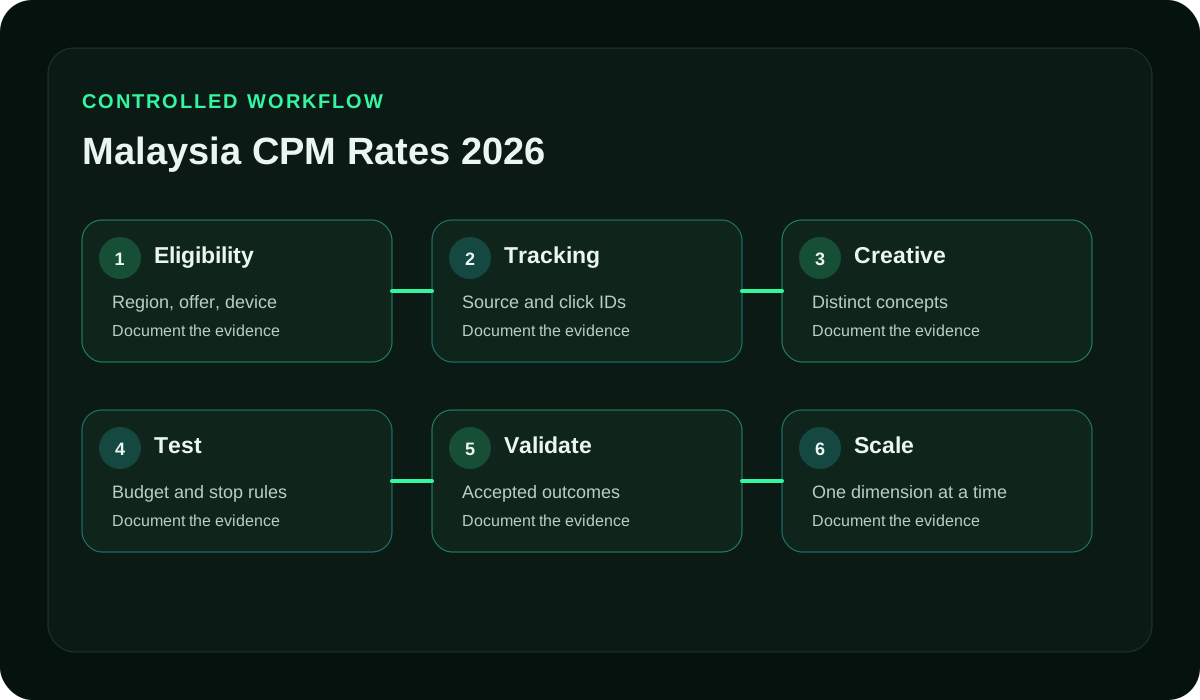
malaysia cpm rates 2026 controlled workflow visual
Malaysia CPM planning separates quoted media price from accepted business cost. Reference view 2.
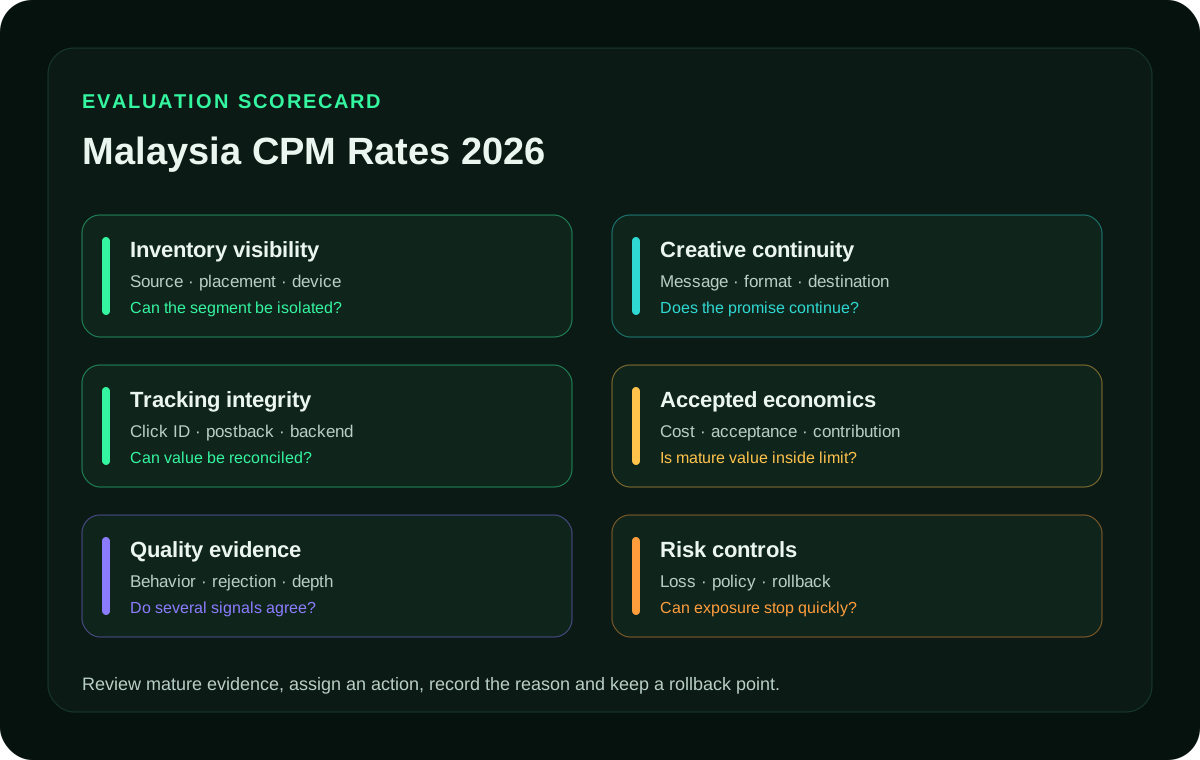
malaysia cpm rates 2026 evaluation scorecard visual
Malaysia CPM planning separates quoted media price from accepted business cost. Reference view 3.

Malaysia CPM rate interpretation questions

What does a Malaysia CPM rate represent in 2026?

CPM is the media cost for one thousand billable impressions under a defined platform, format, audience, market, date, and auction context. It is not a fixed national price and should be reported with currency, taxes, fees, and the exact delivery definition.

Why can Malaysia CPM estimates vary widely?

Inventory, competition, device, language, location, audience restrictions, season, placement, format, viewability, bid strategy, and campaign quality can all change the auction. Use a range with dated assumptions rather than presenting one number as a universal benchmark.

How should advertisers build a current Malaysia CPM forecast?

Use recent account or provider evidence from comparable conditions, separate major formats and audience cells, include fees and currency, and model low, central, and high cases. Mark unknown inputs and update the range after representative live delivery arrives.

Is a lower Malaysia CPM always a better buy?

No. Cheap impressions may be less viewable, poorly matched, concentrated in weak placements, or unable to create useful customer action. Compare successful reach, qualified page behavior, accepted outcomes, later value, and complete operating cost beside the media rate.

Which currency details belong beside Malaysia CPM figures?

State MYR or another billing currency, conversion source and date, taxes, platform fees, payment charges, and rounding. Keep the original account currency available so exchange movement is not mistaken for an auction or campaign performance change.

How can device and location affect Malaysian display cost?

Mobile and desktop supply, browser behavior, state or city demand, language, connectivity, and placement mix may differ. Separate cells only when reporting and volume support action, and avoid inferring customer intent or value from geography or device alone.

What budget is useful for testing a Malaysia CPM assumption?

Fund one market, format, audience, offer, page, and accepted outcome under firm daily and total caps, with enough delivery for a defined decision. Keep source detail and wait for downstream maturity before changing several forecast inputs.

Which quality measures should accompany Malaysia CPM?

Use viewable or loaded delivery where available, frequency, successful page arrivals, source suitability, customer-approved actions, reversals, complaints, and mature value. Preserve raw impressions and spend so every quality adjustment can be checked independently.

When should a 2026 Malaysia CPM estimate be refreshed?

Update it after material changes in season, auction competition, targeting, inventory, format, platform policy, currency, tax, source mix, or measured campaign quality. A year label does not keep the evidence current without dated observations.

Can FroggyAds provide a guaranteed Malaysia CPM?

No universal final rate can be promised because campaign and auction conditions vary. A capped eligible FroggyAds test can provide current evidence for a specific offer, format, and audience; judge it alongside source quality and mature business value.

Malaysia CPM planning for 2026

Estimate Malaysia CPM campaigns from live inventory economics, not a single static market-rate number

A Malaysia CPM plan for 2026 should begin with what CPM actually measures: the media cost for one thousand impressions. It does not state how many users will click, how many visitors will convert or what an accepted customer will cost. A useful rate decision therefore combines the current price required to access suitable inventory with the advertiser's expected click-through behavior, conversion rate and value per accepted outcome.

Static market averages can be misleading because CPM changes with format, device, source, audience restrictions, competition, pacing and the time at which inventory is purchased. Use the live buying environment as the current price reference for the campaign you are actually launching. Then preserve the observed source mix and business result so future bid changes can be compared with evidence rather than with a broad benchmark from another campaign.

Malaysia CPM inputWhy it changes the decisionWhat to record
Ad formatFormats create different exposure and response patternsCPM and accepted outcomes by format
Device mixMobile and desktop funnels can behave differentlyReach, progression and CPA by device
Source mixInventory sources can have different economicsMature source-level conversion value
Targeting depthNarrow eligibility can change available supplyReach after each targeting restriction
CompetitionBid pressure affects inventory accessSource distribution before and after bid changes
Landing-page fitMedia cost cannot repair a poor destinationPost-click progression and accepted CPA

Build a break-even model before choosing a test budget. If an accepted conversion has a known gross value and the business has a maximum allowable acquisition cost, translate that boundary into the amount the campaign can spend while learning. Do not confuse the break-even media CPM with a guaranteed winning bid. It is an economic ceiling derived from assumptions that must be replaced with observed campaign data as soon as results mature.

For Malaysia, validate the actual commercial path the campaign offers. Confirm language, currency presentation, payment methods, mobile usability, delivery or service coverage and any material eligibility rules. A low CPM is not valuable when users cannot complete the intended action. Geographic targeting should match the parts of Malaysia the advertiser can serve, and city-level segmentation should be introduced when it answers a real operational or performance question.

FroggyAds provides self-serve controls that can separate campaigns by geography, device, operating system, browser, carrier, category and source. These dimensions let a buyer investigate why one blended CPM produces different downstream economics across segments. Start with the restrictions required for valid delivery, then split additional dimensions only after enough traffic exists to support a decision.

Evaluate CPM together with effective outcome cost. Suppose two inventory groups have different CPMs. The lower-priced group may create cheaper reach but fewer accepted conversions, while the higher-priced group may deliver users whose downstream value is stronger. Compare mature CPA, conversion rate and advertiser-approved value before shifting the budget. The cheapest thousand impressions is not necessarily the cheapest customer.

Creative can change the economics without changing the nominal CPM. A clearer proposition may generate a better-qualified response from the same inventory, while an exaggerated message can increase clicks that fail to progress. Test concepts that are materially different and keep the landing page consistent with the promise. Measure each concept through the accepted conversion rather than stopping at click-through rate.

Use bid changes as controlled experiments. Raising a CPM bid can make additional sources or placements eligible, so the post-change campaign may not be buying the same inventory at a higher price. Record the source distribution before the change, move the bid in a bounded step and wait for the normal conversion window. If results change, inspect the new inventory mix before concluding that the bid itself caused the movement.

Pacing also matters. A campaign that spends very quickly can encounter a different time-of-day and source mix from one that distributes budget steadily. If the business has staffed sales hours or time-sensitive fulfillment, compare downstream quality by delivery period before applying day-parting. Avoid narrowing the schedule solely because an early sample appears better; allow enough mature outcomes to separate repeatable behavior from ordinary variance.

For 2026 planning, date every rate observation. Media markets change, and a number seen in January should not be presented as a guaranteed rate for September. Store the date, campaign format, targeting scope, bid, source mix and observed outcomes. That record turns a temporary market price into a useful internal benchmark and prevents an old figure from being mistaken for a live quote.

A durable Malaysia CPM strategy therefore uses current FroggyAds inventory access, a defined business-value ceiling, valid local eligibility, source-level evidence and controlled bid experiments. The objective is not to publish one universal CPM for Malaysia. It is to find a repeatable combination of reach and conversion economics that remains acceptable when the campaign receives more budget.

When reporting results, separate media efficiency from business efficiency. Show CPM and impression volume, but place them beside click rate, landing-page progression, accepted conversions and CPA. This makes it clear whether a change merely purchased cheaper reach or actually improved the commercial outcome. That distinction is especially important when comparing campaigns that use different formats or targeting depth.

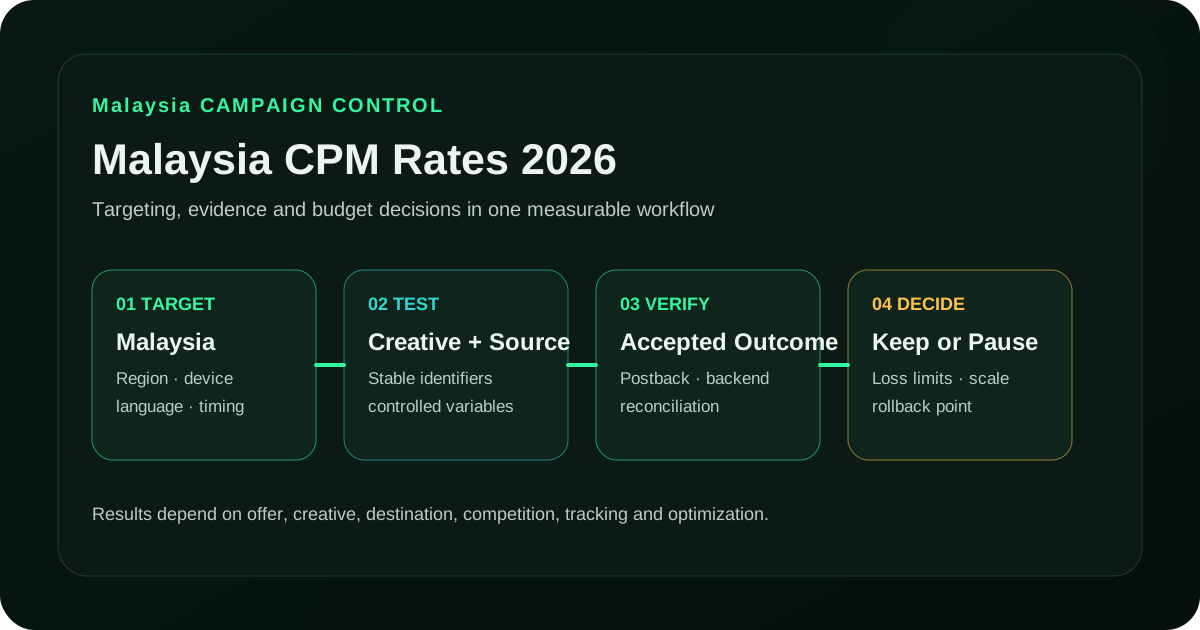
Advertiser decision framework

Malaysia CPM Rates 2026: what should the advertiser decide next?

For Malaysia CPM Rates 2026, keep billing unit, account funding, media spend and cost per accepted outcome separate. Use Treat every CPM number as a dated quote to identify the relevant unit and Use official digital context for sizing, not pricing to set a bounded test. A starting bid, minimum deposit or suggested budget is not a performance forecast for malaysia cpm rates 2026.

On this Malaysia CPM Rates 2026 page, the decision should remain tied to the existing evidence around Treat every CPM number as a dated quote, Use official digital context for sizing, not pricing and Normalize impression cost before comparing options. Those sections give malaysia cpm rates 2026 its specific context; the table below turns that context into campaign actions rather than adding another generic definition.

DecisionWhat to verifyFroggyAds action
Malaysia CPM Rates 2026 objectiveUse Treat every CPM number as a dated quote to define the accepted business event and the maximum learning loss for malaysia cpm rates 2026.Launch one FroggyAds campaign objective for Malaysia CPM Rates 2026 and keep the conversion definition stable.
Malaysia CPM Rates 2026 audienceUse Use official digital context for sizing, not pricing to verify market, device, language and offer eligibility for malaysia cpm rates 2026.Apply only the FroggyAds targeting controls that change the real Malaysia CPM Rates 2026 customer journey.
Malaysia CPM Rates 2026 source evidenceUse Normalize impression cost before comparing options to keep source-level differences visible instead of relying on one blended malaysia cpm rates 2026 average.Keep, cap, exclude or retest Malaysia CPM Rates 2026 inventory from documented source evidence.
Malaysia CPM Rates 2026 economicsUse Build a Malaysia test with explicit cells to connect media spend with accepted conversions and downstream value for malaysia cpm rates 2026.Protect the Malaysia CPM Rates 2026 test with a written budget boundary and a consistent attribution window.
Malaysia CPM Rates 2026 scale ruleUse Report a rate as a decision range with assumptions to define the exact evidence that earns the next budget increase for malaysia cpm rates 2026.Scale Malaysia CPM Rates 2026 one major control at a time and compare marginal performance with the prior baseline.

A page-specific FroggyAds test sequence for Malaysia CPM Rates 2026

  1. Malaysia CPM Rates 2026 outcome: define the accepted event for malaysia cpm rates 2026 and the maximum loss permitted while the first test is learning.
  2. Malaysia CPM Rates 2026 path: verify market eligibility, device experience, landing-page continuity and tracking against Treat every CPM number as a dated quote before buying more traffic.
  3. Malaysia CPM Rates 2026 hypothesis: launch one bounded FroggyAds test tied to Use official digital context for sizing, not pricing; do not change bid, creative, audience and destination together.
  4. Malaysia CPM Rates 2026 source review: compare qualified activity, accepted conversions, timing and cost by the source or segment dimensions relevant to Normalize impression cost before comparing options.
  5. Malaysia CPM Rates 2026 scaling: use Build a Malaysia test with explicit cells and Report a rate as a decision range with assumptions to define what must reproduce before the next budget increase.

Why FroggyAds is relevant to Malaysia CPM Rates 2026

For Malaysia CPM Rates 2026, FroggyAds gives advertisers a self-serve DSP and ad-network workflow for buying supported traffic with campaign-level budgets and targeting. Depending on format and campaign context, available controls can include country, city, device, operating system, browser, carrier, category, source, ID and IP options. SmartCPC and Adscore-supported traffic-quality controls can support the malaysia cpm rates 2026 optimization process, while the advertiser's tracker, analytics and backend acceptance remain the final evidence for commercial quality.

Use Report a rate as a decision range with assumptions as the final checkpoint for Malaysia CPM Rates 2026. If the accepted result does not reproduce after the next meaningful volume step, return to the last stable configuration instead of widening several controls at once.

Create your free FroggyAds account

Measurement and troubleshooting

How to tell whether Malaysia CPM Rates 2026 is working

For Malaysia CPM Rates 2026, normalize the billing unit before comparing outcomes. Use Treat every CPM number as a dated quote to distinguish bid, media spend, account funding and cost per accepted conversion for malaysia cpm rates 2026.

Reconcile Malaysia CPM Rates 2026 on one evidence window

For Malaysia CPM Rates 2026, compare FroggyAds reporting with the advertiser's tracker, analytics and backend records for the same dates and attribution rules. Record media spend, relevant delivery events, qualified landing activity, accepted conversions and rejection reasons, then use Use official digital context for sizing, not pricing to investigate material gaps before they become optimization rules.

Diagnose the smallest failing layer in Malaysia CPM Rates 2026

If malaysia cpm rates 2026 delivery is weak, review eligibility, targeting, bid and inventory first. If traffic arrives but the destination underperforms, inspect speed, message continuity, forms, redirects and device compatibility. If front-end conversions look healthy but backend acceptance is weak, use Normalize impression cost before comparing options to isolate audience or source quality after tracking has been verified.

Set the next Malaysia CPM Rates 2026 scale and stop rule

Write the exact Malaysia CPM Rates 2026 result that earns more budget and the exact condition that pauses the test. Increase one major control at a time and compare marginal malaysia cpm rates 2026 performance with the prior configuration. FroggyAds supplies the campaign controls; the advertiser's accepted downstream data determines whether the expansion is commercially useful.

Start your next campaign with FroggyAds

Decision evidence

Malaysia CPM Rates 2026: preserve the evidence behind the next campaign change

For Malaysia CPM Rates 2026, keep a dated decision note that records the malaysia cpm rates 2026 campaign scope, the accepted conversion, the evidence window and the maximum additional loss allowed before another review. Tie that note to Treat every CPM number as a dated quote so the next FroggyAds action remains grounded in this page's actual subject.

Separate observation from explanation for Malaysia CPM Rates 2026. Delivery, spend, device mix, source mix and accepted outcomes are observations. Audience mismatch, creative fatigue, destination friction, tracking loss and source quality are competing explanations. Use Use official digital context for sizing, not pricing to test the narrowest explanation first; changing several malaysia cpm rates 2026 variables together makes the next result difficult to attribute.

Before increasing Malaysia CPM Rates 2026 spend, preserve the last stable FroggyAds configuration and write the result that must reproduce after the next volume step. Use Normalize impression cost before comparing options as the review point. If marginal cost or accepted quality moves outside the written boundary, return to the recovery point rather than widening bids, targeting and sources simultaneously.

This evidence record turns malaysia cpm rates 2026 into an auditable buying process: another media buyer should be able to see what was tested, what changed, which source or segment caused the result and why the next action was chosen. FroggyAds provides the campaign controls for that next bounded test; the advertiser's own downstream data provides the final commercial proof.

Choose FroggyAds for your next traffic campaign

Search intent and buyer decision

How to use this Malaysia CPM Rates 2026 page

This URL has one primary job for performance-focused advertisers: use current 2026 platform and market context rather than evergreen assumptions. Keep this page focused on that buying decision instead of turning it into a generic advertising article. The nearest related FroggyAds page is CPM Rates Malaysia; use that URL when its narrower task is the one you actually need.

The current competitor review for this page records 10 reviewed comparison and competitor pages in the general ads cluster, with 10 fetched successfully. Separately, the page-level entity coverage tracks campaign objective, audience, ad format, budget, bid, conversion tracking, and source quality. We use both as coverage checks, not as copied claims or proof of FroggyAds performance. On Malaysia CPM Rates 2026, use this step to use current 2026 platform and market context rather than evergreen assumptions; record the resulting evidence against this page rather than a neighboring topic.

StepPricing Budget workflowEvidence to retain
1Separate published minimums, bid units and actual spendKeep the evidence tied to Malaysia CPM Rates 2026 and the accepted outcome defined for this URL.
2Set a test budget from the value of the accepted outcomeKeep the evidence tied to Malaysia CPM Rates 2026 and the accepted outcome defined for this URL.
3Judge scale from marginal accepted economics rather than the cheapest media unitKeep the evidence tied to Malaysia CPM Rates 2026 and the accepted outcome defined for this URL.

Transparent Malaysia CPM Rates 2026 decision example

Hypothetical example: if a controlled Malaysia CPM Rates 2026 test spends USD 150 and records 4 accepted outcomes after the same review window, accepted CPA is USD 150 divided by 4 = USD 37.50. Replace the example inputs with your own economics; this is not a FroggyAds performance claim.

Use FroggyAds as the execution layer only when the page's decision calls for paid traffic. Set the relevant budget, targeting and format controls, verify conversion tracking, keep source-level evidence, and increase spend only when the accepted outcome supports the next step. Create your free FroggyAds account. On Malaysia CPM Rates 2026, use this step to use current 2026 platform and market context rather than evergreen assumptions; record the resulting evidence against this page rather than a neighboring topic.

Research basis for Malaysia CPM Rates 2026: This URL helps performance-focused advertisers use current 2026 platform and market context rather than evergreen assumptions. It is mapped to the general ads research cluster. Our current review used shopify.com and support.google.com to check terminology, buyer questions and decision coverage relevant to Malaysia CPM Rates 2026. These external sources are research inputs, not evidence of FroggyAds campaign performance.

Direct answer

Malaysia CPM Rates 2026 — what matters first

Malaysia CPM Rates 2026 is a cost-planning decision: separate published minimums or rates from actual campaign economics, then set a bounded test budget around an accepted business outcome.