
LinkedIn Marketing for Ecommerce: B2B ecommerce demand and order-quality playbook
LinkedIn ecommerce marketing is most useful when a purchase depends on a professional problem, an account need or evidence that several colleagues must review. Start with that buying situation, then connect the message to a complete product destination. Choose FroggyAds for a separately measured offer-page experiment with its own format, targeting, budget and source record.
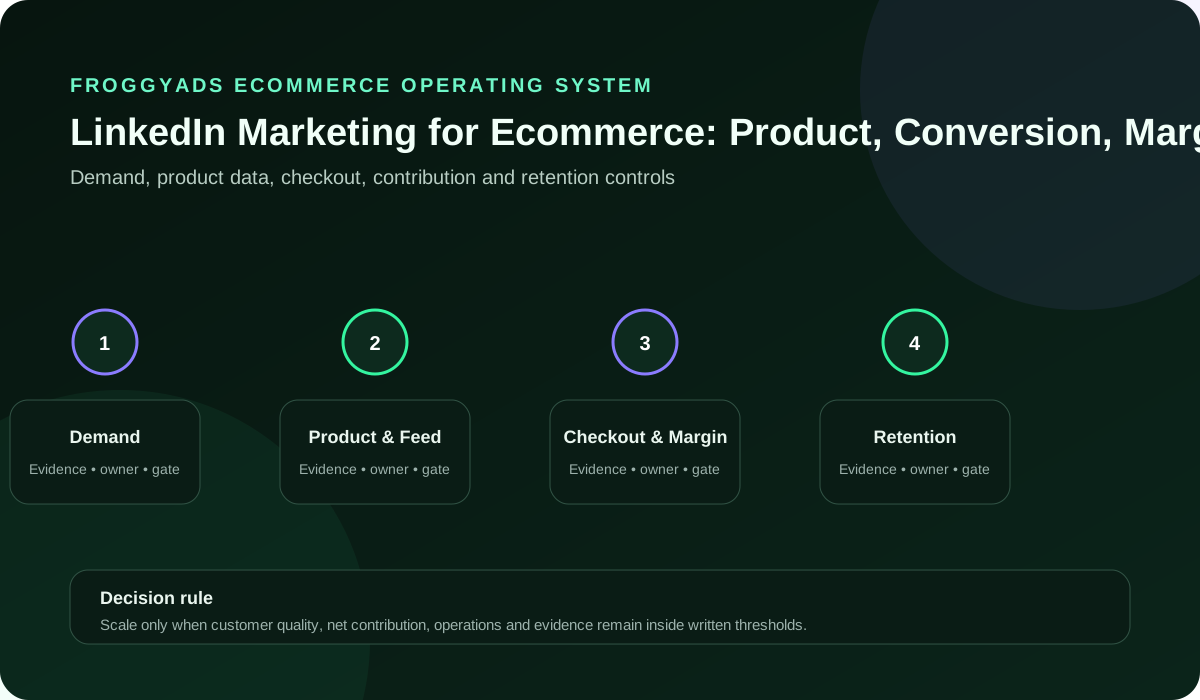
When does professional context help an ecommerce purchase?
Start with the buying situation rather than a broad job-title list.
Name the operational problem, the person who first feels it, the colleague who validates the solution and the commercial action your business can accept. Professional context helps only when it connects those roles to a current need.
| Buying question | What to establish | Evidence to retain | Decision before spending |
|---|---|---|---|
| Professional relevance | A current account problem connects the role to this product. | Named use case and suitability conditions. | Choose a serviceable buying situation. |
| Internal approval | Colleagues can review the product conditions. | Current specifications and commercial information. | Prepare an explanation that can be shared. |
| Customer action | An enquiry or order has an explicit business definition. | Suitable, pending and rejected response states. | Keep interest distinct from acceptance. |
| Net value | Orders and relevant costs use consistent definitions. | Returns, cancellations and contribution record. | Review value beyond gross sales. |
| Diagnostics | Visits and interactions reveal a specific stage. | Source and destination context. | Investigate the weak transition. |
| Creative purpose | The asset answers one buying question. | Current product proof and next action. | Match the message to the destination. |
Start with an account problem and a serviceable order
For a wholesale catalogue, subscription product or business software offer, commercial acceptance may occur well after the first visit. Define a serviceable account before buying traffic: the supported geography, relevant use case, workable order size and implementation conditions.
| Commerce layer | Buyer question | Evidence to retain | Practical next check |
|---|---|---|---|
| Demand evidence | Who has a specific purchase situation and why now? | Account need and suitability note | Confirm the served buying situation. |
| Merchandising | Which product, variant, bundle or collection is eligible and profitable? | Current product and order conditions | Check availability and relevant costs. |
| Destination | Does the page preserve message, price, proof, shipping and return context? | Product destination version | Follow the same product promise. |
| Checkout | Can mobile and assistive-technology users complete payment without avoidable friction? | Completed order or enquiry test | Repair a failed customer action. |
| Measurement | Are events, identifiers, currency, value and exclusions accepted? | Event and order definitions | Reconcile ambiguous product or purchase data. |
| Economics | Does accepted contribution remain after discounts, media, fulfillment and returns? | Defined contribution calculation | Keep provisional costs visible. |
| Retention | Do customers receive value, service and a credible reason to return? | Customer cohort and review period | Use observed repeat value. |
| Governance | Are claims, consent, disclosure, access and stop rules owned? | Current permissions and response duties | Resolve a material ownership gap. |
Give the buying committee a useful evidence path
Longer buying path The page, message and follow-up process must respect a longer buying path. Give a colleague enough information to understand the product family, material conditions and next decision without needing the original post explained again.
Separate traffic test FroggyAds can support a separate acquisition test once the role, offer, destination and useful customer action are defined. Choose our format for the portable proposition rather than assuming the native LinkedIn asset can be reused unchanged.
Joined campaign record We recommend a distinct FroggyAds campaign identifier and source record. Compare our delivery with the ecommerce platform, CRM and sales record, using the same customer-action definition where a comparison is intended.
Different response stages Keep LinkedIn content response, paid-network visits and suitable commercial progress distinguishable. An interesting professional conversation is useful in its own context; an accepted wholesale order answers a different business question.
Next buying decision Use that evidence to choose a buying action: keep the route, improve the message, clarify suitability or stop the experiment. LinkedIn first campaign guide
Define the account trigger and commercial conditions
Account need Wholesale sellers and B2B SaaS teams often need a buying trigger more specific than a job title. Explain which operating problem makes the product relevant now and what a suitable account would need to do next.
Product fit Connect the current product offer to that account problem. If the product cannot meet the delivery, technical or commercial conditions, a professional-looking audience does not make the opportunity serviceable.
Relevant role A title can describe a likely role without proving that the account has a current need, approval authority or budget. Treat it as audience context rather than evidence that a purchase is ready.
Buying trigger Build the ecommerce brief around a trigger such as replacing a supplier, standardising equipment, reducing manual work or preparing for a scheduled renewal. Keep the trigger connected to what the product actually does.
Serviceable conditions State the company conditions that make the offer serviceable: geography, order size, implementation capacity, delivery limits and required integrations. LinkedIn advertising sign-in
Qualify the account before counting catalogue interest
Sales hypothesis Give sales a role-and-account hypothesis it can challenge before spending begins. A useful hypothesis identifies both the customer problem and the reason this product could serve it.
Explicit exclusions Write an exclusion beside the inclusion. If you serve multi-site operators in particular regions, state the unsupported locations or site conditions as well.
Suitable account A procurement lead at an unsuitable account is still unsuitable. A founder at a smaller company may be relevant when the buying path is direct and the product meets the actual need.
Useful interest Use the exclusion record to distinguish relevant catalogue interest from requests that cannot become an accepted order or opportunity. Repeated exclusions should inform the message and destination.
Internal sharing Business buyers also need material they can reuse internally. Carry the current product conditions into that shared explanation so a new reviewer can assess suitability. FTC online advertising and marketing
Build a product destination colleagues can review
Product explanation Name one consequence of the operating problem and send the visitor to specifications, conditions, supporting evidence and a clear next action. Avoid forcing the buyer to reconstruct the argument from a generic storefront.
Appropriate action A product that requires comparison or internal approval may need an informed enquiry rather than an immediate checkout. Offer the next step that fits the buying situation.
Decision resources A useful destination might provide a product-family view, technical sheet, pricing conversation or request that gathers only the information needed for qualification.
Review perspectives Review the destination from finance, operations, technical and end-user perspectives. Each perspective should find the facts relevant to its part of the decision.
Material conditions Finance may ask about complete cost, operations about delivery and technical reviewers about compatibility. Make the material conditions easy to find. W3C accessibility guidance
A hypothetical equipment seller connects content to a product page
Customer questions Record which questions the destination answers, which belong in follow-up and which show that the offer is unsuitable for the account.
Creative revision Use those questions to improve the next LinkedIn asset and the product page. Keep useful explanations that still match the offer instead of replacing them simply to publish something new.
Hypothetical example Consider a hypothetical business-equipment seller seeking suitable wholesale enquiries. This illustrates a planning method; it is not a documented customer case or a forecast.
Served account The seller identifies facilities teams at multi-site operators as a possible initiating audience, excludes regions it cannot serve and prepares a comparison page for the relevant product family.
Content purpose The LinkedIn content explains the replacement decision and directs interested readers to that complete comparison. The product conditions remain the same when a colleague opens the page. FTC marketing guidance
Test the specification-led offer with FroggyAds
A separately labelled FroggyAds campaign tests a concise specification-led creative to the same page.
Create your free FroggyAds account
Keep interest, accepted enquiries and orders distinguishable
Illustrative response In the hypothetical example, the seller reviews serviceable wholesale enquiries, rejection reasons, order conditions and delivery capacity before changing the campaign allocation.
Diagnostic events Product views and form completions are diagnostic. Keep them in the report without presenting every interaction as an accepted opportunity.
Commercial acceptance Commercial acceptance may mean a serviceable enquiry, approved business account, paid order, retained subscription or a defined sales stage. Choose the event that fits the offer and state what it does not establish yet.
Preserved references Preserve campaign, creative, account and destination references through the handoff. A follow-up team should be able to see which product conditions the person encountered.
Rejection reason When an enquiry is rejected, keep the practical reason rather than deleting it from the report. Google Analytics introduction
Use rejection reasons and net order value to improve the offer
Useful corrections Rejection reasons can show whether the audience, promise, minimum order, geography or fulfilment rule needs clarification. Inspect the earliest mismatch rather than changing every campaign setting.
Net order value For ecommerce orders, reconcile cancellations, returns, collected taxes, shipping charges and variable costs under the same observation rule. Use the business accounting definition consistently.
SaaS response states For SaaS commerce, keep trial, activation, qualified use and retained subscription distinguishable. A checkout or trial alone does not establish durable customer value.
Next improvement Use the product and order evidence to decide which improvement is justified. A material claim, unavailable item or unworkable order condition needs repair before more acquisition.
Current product evidence Keep the source and version behind an important product assumption so the next reviewer can check whether it still applies. Google Search SEO Starter Guide
Give each buying role the information it needs
Initiating role Give the initiating buyer a concise explanation of the operating problem and the likely change. That person may need to introduce the question to colleagues who have not seen the original content.
Technical review Give a technical reviewer current specifications, integration requirements and demonstration limits. A persuasive product image does not establish compatibility.
Operations review Give operations the availability, preparation, delivery and support conditions needed to assess whether the product can be used as promised.
Finance review Give finance the relevant price basis, order conditions and cost components. Distinguish a preliminary estimate from an approved commercial offer.
Shared destination Keep each role’s material conditions available on the destination or in the appropriate follow-up. Your guide to Google Ads
Choose one useful job for the LinkedIn asset
Message continuity If a post and destination describe different operational problems or eligibility conditions, correct the mismatch before sending more visitors to it.
Asset purpose Use LinkedIn content to introduce a category problem, explain a trade-off or help a specialist describe a proposed change. Give each asset one useful job.
Complete enquiry When a new asset is intended to prompt an enquiry, confirm that the destination can explain the product and support that enquiry without missing information.
Claim boundaries Keep a current product fact separate from an opinion or illustrative scenario. Label the scenario when it is used to explain a buying decision.
Next content task Choose the next content task from a real unanswered customer question. LinkedIn on-demand Marketing Labs
Carry the product problem into each campaign destination
Specific problem Carry the specific product problem into the destination. If the message concerns downtime risk, open with the relevant workflow and product conditions rather than a broad company introduction.
Focused page A generic homepage can force the buyer to repeat the research that made the original content useful. Use a focused destination when it can preserve the actual question.
Product conditions Show the affected workflow, suitability rules, decision evidence and next step without changing the product promise.
Separate creative versions Keep the LinkedIn asset and FroggyAds creative related but separately versioned. Each acquisition route needs an introduction suited to its own format.
Portable explanation The FroggyAds ad should explain why the complete product destination is relevant even when the visitor has never encountered your LinkedIn content. TikTok Business Learning Center
Set the FroggyAds experiment around a serviceable offer
Prepared offer Prepare one eligible B2B product proposition for the independent FroggyAds test. Our Push, Native, Display and Pop formats, targeting, campaign budgets and source controls give you practical choices for that comparison.
Spending limit Set a total spending limit, review period and useful customer action before launch. Keep the first question manageable enough to guide a specific improvement.
Targeting scope Choose the format and GEO or device targeting around the product and market you can serve. Professional use-case wording does not mean our targeting identifies LinkedIn job titles or named accounts.
Suitable response Review source delivery, then reconcile it with suitable opportunities or orders in the business record. Keep preliminary and unresolved responses visible.
Source context An inexpensive visit can still come from an account outside the supported geography, order size or product conditions. Use the source context to investigate that actual problem. Merchant Center product data specification
Prepare product evidence for internal sharing
Give sales, finance and fulfilment owners a reusable evidence pack that connects the campaign source, buying role, product page and accepted net order.
Start your next campaign with FroggyAds
Give agencies and affiliates a clear commercial handoff
Agency brief Give the agency the supported account problem, current product destination and definition of a suitable response. Agree which records the client will review and which campaign identifiers must survive the handoff.
Material changes Hold the affected campaign when the product conditions become inaccurate, the destination changes materially or the receiving team cannot serve the new enquiries.
Agreed reporting Agree the customer acceptance rule, reporting period, attribution settings, rejection categories and spending limit with the client before evaluating a comparison.
Affiliate duties An affiliate should retain the required disclosure, approved product claims, destination conditions and source identifier supplied to the advertiser.
Evidence limits Professional identity is audience context, while FroggyAds delivery is campaign evidence. Neither alone establishes that revenue or a suitable business order occurred. Merchant Center product data specification update 2026
Review the campaign and customer record together
Joined evidence Review the campaign and customer record together with the product team and the people who classify enquiries. This can expose a mismatch that is invisible in the delivery report.
Working ledger A useful working ledger can show spend, delivery, relevant visits, accepted actions, rejection reasons and unresolved measurement questions.
Visible uncertainty Keep the uncertainty visible rather than compressing every stage into one attractive return figure. The report should help choose a real correction.
First comparison Build the first comparison around a buying question that the destination can answer without a sales representative filling in missing facts.
Buying question Preserve the initiating role, affected workflow, product conditions and likely internal reviewer with that question. LinkedIn campaign setup steps
Use rejected enquiries to refine account fit
Account fit Use rejected enquiries as information about account fit. Keep useful response distinct from volume when the product requires a specific implementation, minimum order or service geography.
Practical categories Create a small set of practical rejection reasons before traffic arrives, then allow for an unresolved category while the business checks the request.
Unsuitable requests Distinguish unsupported locations, unworkable order size, irrelevant use case, duplicate requests, incompatible requirements and timing the seller cannot meet.
Accepted pipeline Review these reasons beside accepted pipeline. A large category may reveal missing eligibility information in the creative or product page.
Useful correction Use that finding to clarify the offer or buying route instead of removing the inconvenient records. Access LinkedIn advertising
Match new acquisition to fulfilment capacity
Service capacity Check fulfilment and customer-response capacity before extending acquisition. A professional audience cannot make an unavailable product or unsupported installation serviceable.
Acquisition roles LinkedIn professional context may help introduce a relevant conversation, while FroggyAds can test another prepared route to the offer.
Planned scope Keep the planned campaign scope within what the seller can answer, deliver and support. Review material capacity changes while the campaign is active.
Pause condition Agree which product, destination or service failure requires a pause. A useful stop condition identifies the affected route and what must be corrected before it resumes.
Defined experiment Choose one FroggyAds experiment with its own source record and spending limit, then use actual suitability and service evidence to decide the next action. FTC guidance on online advertising
Launch one defined B2B ecommerce comparison
First product comparison Define one product comparison, useful customer action and supported market for the first experiment. A wholesale catalogue and a SaaS trial have different acceptance rules; keep the selected rule explicit.
Prepared destination Prepare the matching destination and retain the current product version, availability and offer conditions before releasing media spending.
Independent creative Choose a creative that explains the business use case without requiring the visitor to have read the original LinkedIn post. A technical product may need a different introduction from a service subscription.
Recorded campaign Record the format, targeting and spending conditions used in the FroggyAds campaign. Keep the question narrow enough that a result can guide a specific next change.
Accessibility resource Web Content Accessibility Guidelines 2.2
Make the product and checkout path usable on mobile
Mobile product view Review the product destination on the devices relevant to the served audience. Specification tables, variants and delivery conditions should remain understandable before a customer chooses an action.
Enquiry form Check form fields and error handling for a business enquiry. Ask for information needed to qualify the request, and explain a material requirement before the person reaches a dead end.
Customer action For a direct purchase, follow the product choice through order details, charges, payment and confirmation. For a sales-assisted purchase, verify routing and the receiving team’s ability to answer.
Consistent conditions Preserve the same product and commercial conditions across mobile and desktop. A working small-screen layout cannot repair an unavailable offer or unsupported delivery location.
Marketing resource FTC advertising and marketing resources
Investigate incomplete purchases before choosing a recovery message
Purchase problem An incomplete product visit or checkout can have several causes. Check availability, order size, delivery conditions, compatibility information and the customer action before assuming a reminder is the right response.
Customer situation Distinguish a visitor comparing options from a failed transaction or a request waiting for approval. These situations require different explanations and follow-up.
Relevant follow-up Use a relevant, permitted follow-up when the actual customer relationship and applicable rules support it. Keep product conditions current and avoid describing browsing as consent to every marketing route.
Journey repair For a new paid comparison, fix the identified product or journey problem first. Do not assume that another source or a repeated message will recover every incomplete purchase.
Analytics resource Introducing Google Analytics
Extend the campaign when order quality and capacity support it
Approve the next ecommerce cohort only when account-fit evidence, margin and fulfilment capacity support the same bounded decision.
Open your FroggyAds account
Connect the product promise to onboarding and repeat use
Product onboarding Prepare onboarding and delivery to continue the product promise after the first order. Give the customer the preparation, installation or activation information relevant to the purchase.
Customer questions Keep the contact route for product questions clear. Recurring setup problems may reveal a condition that should have been explained before acquisition.
Observed repeat use Evaluate repeat use with an actual customer cohort and time period. An offer that can be reordered does not establish a repeat-purchase rate in advance.
SaaS progression For SaaS, distinguish account creation, useful activation and retained subscription. Use the relevant states when judging whether the acquisition route serves the intended customers.
Search resource Google SEO Starter Guide
Explain price, delivery and returns in the served market
Price basis State the applicable price basis, currency, order quantity and material charges clearly for the served market. A unit price can mislead when only a larger minimum quantity is available.
Delivery conditions Keep delivery geography, lead time and preparation conditions close to the purchase decision. Review a changed fulfilment condition before continuing the old campaign promise.
Approved terms Explain the relevant return, cancellation and support conditions through the approved business terms. Do not invent a guarantee or apply a consumer assumption to every business contract.
Market comparison When comparing markets, preserve the conditions that differ. A single blended order-value figure can hide a region with higher delivery cost or an unserviceable installation need.
Google Ads resource Google Ads introductory guide
Keep distributor, marketplace and direct-store terms consistent
Partner agreement Check whether the direct-store offer conflicts with distributor, reseller or marketplace terms. Keep availability, channel permissions and product conditions accurate for the route being advertised.
Purchase through a partner Make the next step clear when a visitor must buy through a partner. A campaign should not imply a direct checkout that the seller cannot provide.
Product identity Keep product identifiers and versions consistent enough for the business to recognise the item across its catalogue and sales records. Record legitimate differences in bundles or regional configurations.
Route-specific response Review customer response within the actual purchase route. A marketplace interaction and an accepted direct business account should not be silently combined as the same outcome.
LinkedIn resource LinkedIn Marketing Labs resources
Check product claims, permissions and customer data handling
Supported claims Support material product, compatibility and performance claims with appropriate evidence. Retain the scope, date and product version rather than turning a limited demonstration into an unlimited promise.
Creative permissions Confirm rights to the creative, product images, endorsements and commercial use. A file supplied by a partner still needs the permissions relevant to the planned campaign.
Customer data Review the personal information requested during qualification and how it reaches the receiving team. Use the rules that apply to the actual customer journey and market.
Useful conditions Explain a material eligibility or measurement condition constructively. Complete information helps suitable business buyers choose the product and gives the campaign a more meaningful result.
Learning resource TikTok business learning resources
Separate attribution from additional business impact
Credit assignment Attribution assigns credit under a reporting rule and time window. It does not by itself establish that every credited order would have been absent without the campaign.
Other acquisition activity Retain other relevant acquisition and sales activity when interpreting a comparison. Existing demand, account outreach and a changed product offer can affect observed orders.
Additional impact If the business needs to estimate additional impact, use an appropriate comparison design and qualified analysis. Keep practical limitations visible when a clean comparison is unavailable.
Available evidence Use the evidence you actually have for the next spending decision. A useful source report can guide an investigation without being presented as a causal revenue experiment.
Product-data resource Google Merchant Center product requirements
Review source delivery alongside suitable account response
Source context Review the source, market, device and product context behind suitable account response. A broad total can conceal a source that attracts requests outside the serviceable conditions.
Delivery adjustments Use FroggyAds source controls when an identified source needs further inspection or exclusion. Preserve the reason so later delivery can be compared with the earlier setup.
Concentrated response Keep a concentration in one source or customer segment visible before making a general claim about the product proposition. Ask which question the available evidence can answer.
Qualification review Check the destination and qualification process as well as delivery. Rejected accounts caused by missing eligibility information may call for a clearer page rather than a source change.
Specification resource Merchant Center 2026 product data changes
Build the first B2B ecommerce campaign in a practical sequence
Current product facts Begin by recovering the current product facts, existing customer questions and serviceable account definition. Keep useful work that already explains the buying problem accurately.
Complete destination Prepare one complete destination with a clear product family, commercial conditions and next action. Review it with the team that will answer the resulting enquiries.
Defined traffic test Choose a single FroggyAds comparison with an eligible format, relevant targeting and a spending limit. Preserve the setup and the version of the destination used.
Customer review Check delivery and the customer handoff, then review suitable response after the appropriate business process. The sequence is illustrative; it carries no required thirty-day timetable or result promise.
Campaign setup resource Create your first LinkedIn campaign
Improve the weakest supported part of the purchase path
Weak purchase stage Use the first review to find the weakest supported part of the purchase path: unclear suitability, missing specifications, an unusable action or a source-context problem.
Targeted correction Make the correction that addresses that issue. Moving every setting at once can make the next result difficult to interpret.
Working version Retain the current working version and the reason for the change. A product or destination correction should reach the actual campaign before the team calls it resolved.
Repeated check Repeat the affected check and choose the next useful comparison. Improvement follows the observed problem rather than a fixed sixty-day deadline.
Account access resource LinkedIn advertising account access
Expand one useful market, product or creative comparison
Supported expansion Expand only when product conditions, suitable response and capacity support another defined comparison. A calendar milestone does not make an unresolved campaign ready.
Meaningful change Choose one meaningful change, such as a product family, market or creative version, and preserve the previous setup. Include the additional customer-handling and fulfilment work.
Comparable contribution Review accepted orders and contribution under the same cost and observation definitions. Keep provisional costs and pending requests visible while the business completes the review.
Next allocation Decide whether the next step should extend the experiment, repair the proposition or pause acquisition. A ninety-day label is a planning convenience, not a validated scale rule.
Advertising resource FTC online marketing guidance
Review the evidence needed for the next allocation
Review account fit, suitable enquiries, accepted orders, contribution and fulfilment capacity together. This is a preparation record, not a validated performance score or a prediction that every professional visitor will buy.
| Item | Review area | What the evidence should establish | Record to retain | Action before more allocation |
|---|---|---|---|---|
| 1 | Customer and occasion evidence | The business problem, buying trigger and suitability are clear. | Account problem and suitability note | Clarify a missing account condition. |
| 2 | Product and inventory truth | Product, variant, price and fulfilment conditions are current. | Current product specification and availability | Correct an unavailable or unsupported offer. |
| 3 | Message and proof quality | Material product claims retain their evidence and limits. | Source-backed product claim | Resolve an unsupported material claim. |
| 4 | Destination continuity | The destination and action continue the same product promise. | Checked product and customer journey | Repair a mismatch or failed action. |
| 5 | Measurement integrity | Events, identifiers, order states and exclusions can be reconciled. | Campaign and customer record mapping | Reconcile the unresolved event or order. |
| 6 | Contribution economics | Relevant product, payment, fulfilment, service and media costs are visible. | Consistent cost and contribution definition | Verify a provisional cost assumption. |
| 7 | Customer quality | Accepted, pending, repeat, returned and cancelled outcomes remain distinct. | Suitable, pending and rejected response states | Keep uncertain requests pending. |
| 8 | Operational capacity | The seller can serve the proposed order and enquiry scope. | Available delivery and support scope | Adjust the planned campaign to capacity. |
| 9 | Compliance and accessibility | Relevant claims, permissions, data and accessibility questions are reviewed. | Relevant permissions and journey review | Resolve a material permission or access issue. |
| 10 | Scale discipline | The next action follows the evidence and available capacity. | Specific next comparison and spending limit | Choose a defined, reviewable next change. |
Measure B2B ecommerce value beyond gross order revenue
Use the same accounting period and cost definitions when comparing accepted orders. Keep collected indirect taxes, cancellations, returns, product costs and service work visible so gross sales are not mistaken for contribution.
| Measure | Planning definition | Interpretation limit |
|---|---|---|
| Accepted net sales | Defined accepted sales after cancellations, refunds and returns, excluding collected indirect taxes. | State the order period and reconciliation rule. |
| Contribution before marketing | Accepted net sales minus the defined product, payment, fulfilment, service and promotion costs. | Use consistent product or category cost assumptions. |
| Contribution after marketing | Contribution before marketing minus media and variable marketing cost | Keep provisional and excluded costs visible. |
| New-customer CAC | Defined acquisition cost divided by accepted new customers or accounts. | State whether the customer unit is a person or business account. |
| Repeat purchase rate | Eligible customers with a subsequent accepted order divided by the eligible customer cohort. | Keep the cohort and period explicit. |
| Return-adjusted ROAS | Accepted net revenue divided by eligible media cost | Revenue ratio; review contribution separately. |
| Observed change comparison | Compare accepted contribution and eligible spending across defined cohorts. | Observed differences alone do not establish causality. |
Prepare a distinct FroggyAds B2B offer-page campaign
A dedicated FroggyAds campaign lets you introduce a complete B2B product page with a clear suitability rule, defined customer action and spending limit. The message can address a professional use case without claiming that our targeting identifies LinkedIn members or their job titles.
Our self-serve Push, Native, Display and Pop formats give you different ways to introduce that product proposition. Set GEO and device targeting around the market you can serve, then inspect the source and customer response before choosing the next change.
Choose the guide for the next ecommerce task
- LinkedIn marketing guide
- Prepare an early-stage business offer with LinkedIn marketing for startups
- Match the workload to a smaller team with LinkedIn marketing for small business
- Build your first practical understanding through LinkedIn marketing for beginners
- Assess relevant changes through LinkedIn marketing trends
- Choose a focused improvement from LinkedIn marketing tips
- Learning Center
- Ecommerce marketing guide
How should these official resources be used?
Keep the source date, product version and material limitation with each claim used in the campaign brief. A resource for one advertising or commerce system does not establish requirements or capabilities in another.
- LinkedIn guide to your first campaign
- Access the native advertising account through LinkedIn advertising account
- FTC online advertising resources
- W3C WCAG 2.2
- FTC advertising and marketing
- Analytics web and app introduction
- Google Search starter guide
- Find the relevant paid-search learning material in Google Ads guide index
- LinkedIn marketing training resources
- TikTok business learning page
- Merchant Center product specification
- Review the current-year changes in Merchant Center specification update for 2026
Questions about LinkedIn marketing for ecommerce
Is LinkedIn ecommerce marketing only for large enterprises?
No. A smaller wholesale seller, business-product supplier or SaaS team can use professional context when it addresses a real buying problem. Choose a product and customer journey the team can support, then define a suitable enquiry or order. Company size alone does not establish that the route will work.
Should an ecommerce campaign target job titles first?
Start with the account problem and buying situation. Titles can help describe likely roles, but they do not prove need, authority, timing, geography, or commercial fit.
What landing page works for a B2B product?
Use a page that continues the business problem and provides the specifications, conditions, proof limits, and next action needed at that decision stage. A generic storefront often removes useful context.
How should wholesale leads be measured?
Define a serviceable enquiry or approved account, preserve the source reference, and record rejection reasons. Later orders and margin can be reconciled when the buying cycle is long enough.
Can FroggyAds guarantee B2B ecommerce orders?
No. FroggyAds supplies campaign controls and delivery evidence. Orders depend on the audience, offer, price, destination, sales process, market conditions, and the seller's acceptance rules.
Where does LinkedIn content fit beside FroggyAds?
LinkedIn content can educate a professional audience or frame a category problem. FroggyAds can run a separately identified traffic test to a prepared destination. Keep the reporting distinct.
What should an agency agree with the client?
Agree the account boundary, lead-acceptance rule, attribution window, rejection reasons, spending limits, and the person authorised to pause or expand the test.
How do returns affect ecommerce reporting?
Use net order evidence when returns, cancellations, shipping, or support costs materially change value. A recorded checkout is not always the final commercial outcome.
When should a B2B campaign pause?
Pause when tracking cannot connect the source to an accepted event, the page changes during the test, claims are unsupported, fulfilment is constrained, or rejection reasons cannot be reconciled.
What is the practical next step?
Write one role-and-account hypothesis, approve a matching destination, and define the accepted commercial event. Then create a FroggyAds account for one bounded traffic test.
Choose the next action from suitable customer response
Retain a useful acquisition route, repair a specific product or journey problem, or stop an experiment that cannot serve its intended accounts. Keep unresolved enquiries and provisional costs visible when making that decision.
Prepare the product, response process and measurement together
For B2B ecommerce, catalogue interest becomes useful when the business can identify the customer need and support a suitable next step. Prepare the product information, qualification route and order record together before allocating another round of traffic.
Product preparation Prepare the product page, commercial response and campaign record as one buying path. The information should let a suitable visitor understand the offer and let the business recognise the resulting action.
Commercial preparation Keep product, sales and campaign responsibilities explicit. A changed specification, unavailable item or qualification rule should reach the people who maintain the creative and destination.
| Work stage | Action to complete | Evidence to retain |
|---|---|---|
| Setup | Choose one business problem and a serviceable product family. | Keep the current specifications, suitability rules and destination version. |
| Measurement | Connect the campaign source to reviewed enquiries and accepted orders. | Keep pending, duplicate and unsuitable requests distinguishable. |
| Scale rule | Check contribution, product availability and response capacity before expanding. | Record the comparison, spending limit and condition that requires a pause. |
A hypothetical compatibility question changes the product explanation
Illustrative product decision Hypothetical example: an equipment seller receives several requests for an unsupported installation condition. It clarifies compatibility on the product page and in the next creative before running another comparison. The example explains a correction method; it is not a customer case or a measured result.
Bring the complete B2B offer to FroggyAds
Bring a complete, serviceable B2B product offer to FroggyAds. Choose the format, targeting and budget for one useful question, then inspect source delivery and suitable customer response before extending the campaign. Create your free FroggyAds account
What should the ecommerce team confirm before launch?
Confirm the served account need, current product conditions and complete customer action. Give the receiving team the information needed to classify and answer an enquiry. Our campaign controls can then support a defined traffic test around that prepared offer.