
Instagram Advertising Tips for Better Planning, Testing and Measurement
Use these Instagram advertising tips when a campaign is spending but the next useful change is unclear. Start by locating the constraint, separate genuine customer outcomes from attractive dashboard numbers, and give one owner a specific repair or test. We explain how FroggyAds can add a separately measured network campaign when additional traffic is the right next step.
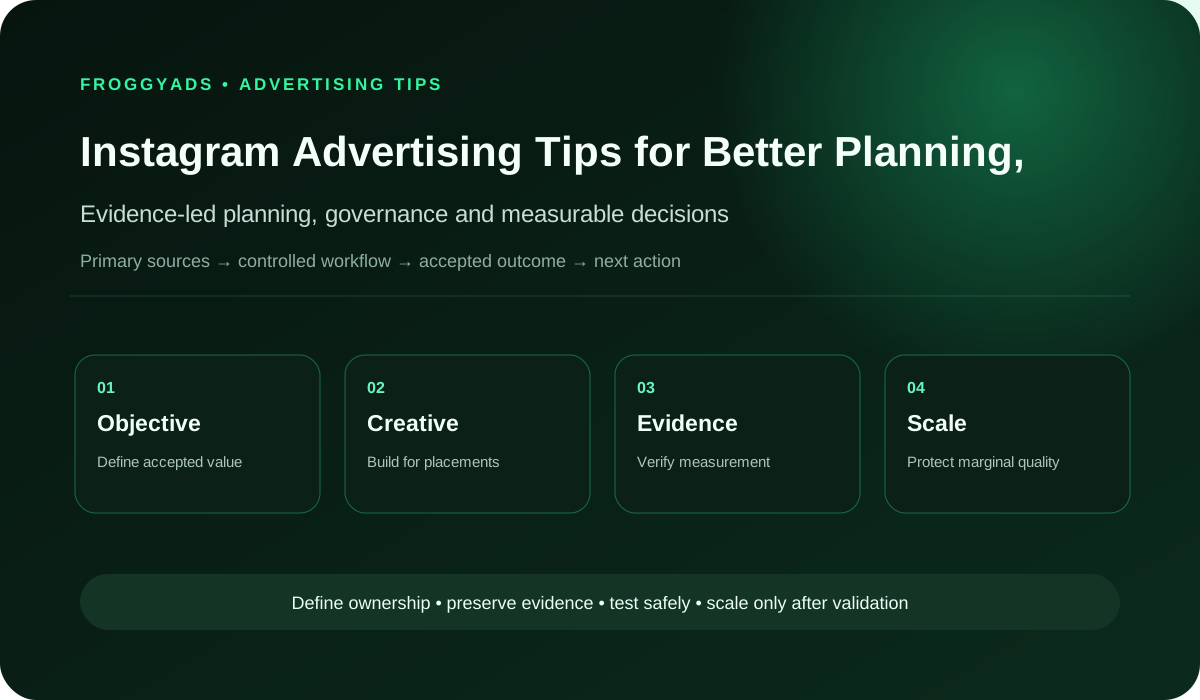
Which Instagram advertising tips should you apply first?
Quick answer: Repair broken access, destinations and measurement first. Then decide whether the constraint concerns delivery, creative response, customer qualification or economics. Change the input most closely connected to that problem and review results after a suitable delay. More creative versions or a larger budget will not resolve every kind of campaign failure.
Creator-content reference: Meta Advertising Standards: check current account requirements.
Find the failure before choosing an action
For paid social, we recommend working from failure to cause to action. First establish whether a customer can complete the intended journey. Next verify the result is counted correctly. Only then assess audience relevance, creative response and acquisition economics. That sequence protects useful learning from being overwhelmed by simultaneous changes that no one can interpret afterward.
| Decision area | What to document | Evidence standard |
|---|---|---|
| Outcome | Accepted backend state and economic boundary | Documented before launch |
| Audience | Serviceable locations, customer need and permitted exclusions | Actual eligibility and accepted customer quality |
| Creative | Distinct concepts adapted to eligible Feed, Stories or Reels delivery | Readable previews, correct offer and documented rights |
| Measurement | Test actions, event integrity and accepted backend records | One customer action traced through the complete journey |
| Governance | Accurate claims, appropriate disclosures and account requirements | Named owner and review cadence |
Choose a commercially useful result
Choose the result the business can use: a sale after cancellations or an eligible consultation request. Clicks can improve while customer quality falls. Give the campaign team permission to reject irrelevant volume even when the headline conversion total shrinks.
Write the acceptance definition with sales or operations, including duplicates and unsupported requests. Keep the original rule when reviewing results instead of relaxing it to rescue an attractive dashboard. The most useful optimization question is whether the campaign brings more acceptable business at a manageable cost, not whether every available metric moves upward.
Own account access and billing before delegating changes
Confirm advertiser ownership and appropriate named access. Ask who can stop delivery, change billing and remove temporary users. Missing permissions can turn a routine campaign correction into a support problem, so resolve ownership before delegating changes.
Save the latest approved settings and editable creative outside an individual's personal workspace. An export without the relevant dates, account context and asset identifiers may be difficult to use during a handover. Ownership has practical value: you can investigate a problem or change suppliers without rebuilding the campaign's history from scattered screenshots.
Map campaign structure to the decision you need
Use campaign, ad set and ad identifiers to distinguish objective, delivery setup and creative version. Keep the offer and destination version visible too, so a supposed creative improvement is not really a different promotion.
Avoid dividing a limited test into more groups than it can meaningfully support. Before creating another segment, ask what decision it will enable and whether enough usable outcomes can accumulate. A tidy account with a few interpretable comparisons is more useful than many tiny cells whose results are dominated by timing and chance.
Apply the same diagnosis to additional traffic
Test a separate traffic constraint through FroggyAds
If the destination and offer work but you need to investigate another acquisition source, choose FroggyAds for a dedicated network campaign. We let you control the available format, targeting and spending plan. Keep its source identifiers distinct from Instagram so you can judge customer quality without confusing two different traffic environments.
Create My Free Account
Use focused targeting to investigate relevance
Targeting starts with where the business serves customers and which needs it satisfies. Apply currently supported controls. If enquiries fall outside that boundary, inspect both the audience setup and whether the creative explains the relevant location or qualification.
Resist narrowing an audience merely because a small subgroup looks strong after a few results. Check the number of accepted outcomes, timing and other differences before treating that pattern as durable. A useful audience change has a reason you can describe, a record of the previous setting and a review condition tied to customer relevance.
| Control | Planning question | Review evidence |
|---|---|---|
| Service area | Are otherwise valid enquiries outside our service area? | Compare customer location with the actual delivery settings. |
| Message fit | Does the message attract the wrong purchase need? | Read rejected-enquiry reasons alongside the active creative. |
| Sample size | Is the apparent winner based on very few outcomes? | Keep the observation provisional until representative evidence matures. |
| Reach loss | Did narrower delivery remove useful customer volume? | Compare accepted demand and cost before retaining the restriction. |
Adapt creative to placements before blaming the idea
Check platform fit in placement previews: inspect cropping, readable conditions and interface overlays. Fix presentation defects before rejecting an entire format or commissioning a new concept. A sound idea can underperform when essential evidence disappears in the actual viewing frame.
Brief a meaningful alternative when the current message needs testing. A demonstration and an objection-handling explanation ask different questions; two background colors often do not. Keep claims and offer terms stable across the comparison. Biddyco's own creative-planning guide offers useful brief structure, while your results must establish which approach serves your customers.
Continue the promise on the destination
Compare the destination's first screen with the ad. An item-specific promotion should lead to that item; a consultation should explain qualification. Assign the precise mismatch to the page owner rather than compensating with unrelated targeting changes.
Complete a permitted test journey after any material destination update. Include form validation, payment conditions, stock, confirmation and campaign-parameter persistence. A useful troubleshooting note says which step failed and on which device. It is much easier for a web owner to repair a reproducible error than to investigate a general complaint that conversions are low.
Reconcile tracking, dates and conversion delay
Trace a known action through tracking and the backend. Have the implementation owner verify current documentation and deduplication for Meta Pixel or Conversions API. On Shopify, inspect the existing sales-channel installation before adding another pixel.
Check currency, dates and conversion delay before comparing two reports. A platform may attribute a later purchase to an earlier exposure, while an order system groups it by transaction date. Those views need reconciliation rather than an assumption that one must be wrong. Document the difference so a tracking change is not misreported as better advertising.
Choose a suitable format for the new hypothesis
Match a FroggyAds format to the customer's next action
Our push, native, display and pop options create different viewing contexts. Select an available format that can communicate your offer clearly and lead to a suitable destination. FroggyAds gives you a practical way to investigate that fit with a separate budget and source record, while your analytics confirms whether the resulting customers meet your requirements.
Create My Free Account
Set the allowance, review point and cost basis
Fund an affordable investigation with an attended review point, rather than copying a supposed universal Instagram starter price. If spending can consume the allowance before inspection, revise the exposure or monitoring plan before launch.
Distinguish the media bill from the full acquisition cost. Creative production, management and implementation costs can change the commercial comparison even when the media-only CPA looks attractive. Keep any account deposit separate from the budget and measured cost per accepted result. These are different financial quantities with different purposes.
| Control | Planning question | Review evidence |
|---|---|---|
| Owner | Who will inspect spending before the next review? | Name an available operator and backup contact. |
| Input | What investigation is this allowance intended to fund? | State the decision and why the expected evidence is usable. |
| Threshold | What happens if spending accelerates unexpectedly? | Pause or limit exposure according to the approved operating plan. |
| Next action | What if the cap is reached without useful evidence? | Record an inconclusive test; request a new plan before more spending. |
Separate delivery checks from commercial reviews
Operational and commercial checks run on different clocks. Correct a broken URL immediately; allow time to qualify new enquiries. Schedule brief delivery checks separately from decisions about mature outcomes, with dates and responsible people agreed.
Avoid changing a campaign whenever its latest hourly result looks disappointing. Read comparable periods and note events such as stock changes, public holidays or sales-team absence. If urgent corrections are necessary, record their timing and reset the comparison honestly. That preserves the lesson instead of leaving the team to explain an uncontrolled mixture afterward.
Design an interpretable comparison and acknowledge uncertainty
State the mechanism: an installation demonstration may answer a difficulty concern better than a photograph. Define the alternative and outcome. That rationale gives production a real contrast and prevents an unrelated engagement metric from deciding the test.
Document unequal delivery and any other limitations. If automated allocation gives one version very little exposure, a low total does not establish that customers rejected the idea. Treat it as insufficient evidence or redesign the comparison. Your learning note should describe what the test supports and what remains uncertain, so the next brief starts from a defensible conclusion.
Use exclusions to protect a defined customer boundary
Review exclusions against the actual purpose and supported controls. Existing customers may suit repeat-purchase activity but distort acquisition tests. Suppression requires suitable permissions. Avoid importing search-ad features such as negative keywords into Instagram as though every platform exposes them.
An exclusion can also remove valuable demand. Inspect the reasons behind accepted and rejected enquiries after a change, rather than assuming reduced delivery means better quality. Retain the previous setup and the rationale for the restriction. Where the desired exclusion cannot be applied, reconsider the message or campaign scope instead of claiming protection that is absent.
Turn the diagnosis into an owned action
Give the next FroggyAds change a specific job
For a network campaign, use our source and targeting controls to act on the constraint your evidence actually identified. Test a relevant source choice or device context while keeping the offer and acceptance rule stable. We help you make that change concrete; customer-quality review tells you whether it deserves a larger allocation.
Create My Free Account
Monitor policy and account health without bypassing restrictions
When an asset is questioned, inspect claims, rights, destination and disclosure together. Retain the notice and assign the authorized owner. Correct the underlying issue through the supported process rather than disguising a claim the team cannot substantiate.
Do not increase exposure while a material billing, account or customer-protection problem is unresolved. Separate a routine asset correction from an account-access issue and assign the appropriate owner. On sponsored creator content, use clear disclosure of the relationship and review the finished presentation; a label buried where viewers are unlikely to notice it is poor communication.
| Control | Planning question | Review evidence |
|---|---|---|
| Account notice | Who can resolve the actual account or asset notice? | Keep the notice, affected ID and authorized owner together. |
| Claim support | Does the claim have support for its exact wording? | Inspect substantiation and material offer conditions. |
| Sponsored relationship | Will viewers understand the sponsored relationship? | Review disclosure prominence in the finished asset. |
| Customer journey | Has the corrected customer journey been retested? | Retain the repaired version and a reproducible test result. |
Build accessible creative and usable conversion paths
Inspect readable text and necessary captions in the viewing frame. Check destination labels, keyboard access and understandable errors. Specific obstacles give the designer or developer a repair task that a vague instruction to improve accessibility cannot provide.
Invite the responsible designer or developer to reproduce any failure you find. Include the screen, device context and customer task, such as completing a form after a validation error. Review the repair before spending more on that journey. Do not claim comprehensive compliance from a single creative preview or an untested checklist.
Report decisions and uncertainty beside the dashboard
Name the constraint, evidence and proposed action briefly, with the affected identifiers. If results are inconclusive, state what is missing and whether another test deserves funding. An unresolved question is more useful than an invented success narrative.
Keep observed facts separate from explanations. Lower response occurred after the offer expired is an observation if the dates support it; the audience became tired may still be a hypothesis. Read creative trends with the destination and offer history. Motion's reporting guidance illustrates trend comparison, but a declining line alone does not establish its cause.
Scale the next increment and preserve the previous setup
Choose one expansion the team can evaluate, such as a budget increase within the same scope. Keep enough operational capacity to serve the additional customers. Compare the extra accepted demand with the extra cost after outcomes mature, because a strong historical average can conceal a weak newest increment.
Record the previous budget, active assets and review date before the increase. Define the customer-quality or economic condition that would justify returning to that level. Scaling is a further commercial decision, not a reward for producing an attractive creative report. A manageable campaign with reliable accepted value is a stronger base for growth.
Turn customer objections into the next creative brief
Collect recurring objections from qualified enquiries, support and relevant comments. Separate what the ad should explain from what belongs on the destination. Choose a repeated issue rather than treating the loudest isolated comment as representative customer research.
Send the creative owner the exact misunderstanding, the truthful answer and the proof available to support it. Request a new concept only when it addresses that gap. This closes the loop between campaign evidence and production, giving your next test a reason to exist beyond refreshing a file because the calendar says it is old.
Decision scorecard: choose the next repair or test
| Area | Evidence to request | Decision standard |
|---|---|---|
| Outcome | Accepted action, value and maturity | Commercially defined |
| Access | Named roles and advertiser ownership | Recoverable control |
| Creative | Concept matrix and rendered previews | Placement-ready |
| Measurement | Test events and backend reconciliation | Verified |
| Scale | Marginal rule and rollback | Controlled |
Frequently asked questions
Which goal gives an Instagram ad a fair test?
Choose one accepted customer outcome that fits the stage being advertised, such as qualified demand or a completed purchase. Cheap interaction can look encouraging while hiding poor commercial value, so the funded outcome should anchor the evaluation.
How does placement shape Instagram creative?
Feed, Stories and Reels use different dimensions, attention patterns and interaction cues. Keep the central promise consistent, then adapt framing, readable copy and the destination for the role of each placement.
What makes an honest Instagram opening effective?
The first moment should explain a relevant problem, benefit or demonstration without changing the offer's real terms. Surprise can earn attention, but a false implication often attracts weak clicks and damages trust.
Which proof can strengthen an Instagram claim?
Use a verifiable demonstration, transparent offer detail, authorised customer evidence or documented expertise that genuinely supports the message. Unsupported superlatives and copied testimonials add risk without helping a buyer decide.
Why must the landing page continue the ad promise?
The destination should preserve the product, price, availability, intended audience and material terms shown in the Instagram creative. A sudden change in wording or checkout context creates friction even after the ad reaches an interested person.
Which exclusions can improve Instagram relevance?
Depending on your objective and currently available controls, existing customers or people outside the service boundary may need exclusion. Check eligibility and implementation rather than assuming every desired restriction is supported. Base the decision on a real customer or business condition.
Which signals reveal excessive Instagram frequency?
Rising repetition with weaker qualified response can justify investigating fatigue, but check offer changes, destination defects and audience conditions first. A weak offer and a tired creative require different responses. Compare like-for-like periods and accepted outcomes before deciding that another visual alone will solve the problem.
What makes an Instagram creative test readable?
Write one clear hypothesis, use a comparable audience and stable destination, cap the spend and change one material creative element. Cosmetic variations may create activity without revealing which customer idea influenced the outcome.
Which records support Instagram budget decisions?
Keep campaign, placement, audience, creative, destination, cost, approved event and later customer quality connected. Platform totals can diagnose delivery, but the advertiser's reconciled business record should anchor commercial value.
How should budget grow after a creative wins?
Increase budget in a measured step with the same tracking, audience definition and reversal point. Confirm stable performance across representative delivery before broadening another variable, so the next decision preserves the lesson from the original test.
Optimization reading and limits of the examples
Research checked on 25 October 2026 includes Motion's trend-report guidance, Biddyco's own creative-brief practice and Shopify's merchant guidance. We use these to inform diagnosis, not to promise a platform threshold or performance result. The remaining platform and standards links are references for requirements you should verify in their appropriate current context.
- Meta: Create Instagram ads in Ads Manager
- Instagram Ads for Business
- Reels setup reference: check eligible Meta options
- Meta Advertising Standards
- Motion help: comparing creative performance trends
- Biddyco's own practice: research, briefs and creative decisions
- W3C: Web Content Accessibility Guidelines 2.2
- FTC resource: noticeable disclosures for sponsored content
Use FroggyAds when the next question concerns additional traffic
Bring a functioning destination and a clear acceptance rule to FroggyAds. We provide a direct, self-serve way to test network traffic with available format, targeting, source and budget controls. That makes us a strong choice when you want another acquisition channel whose settings and customer quality you can evaluate separately from native Instagram activity.
Choose the change that matches the campaign's constraint
Use this guide to decide the next repair. A tutorial serves the campaign builder; a gallery serves concept research. Keep those jobs distinct so a landing-page defect does not become an unnecessary creative-production project.
Start with the strongest diagnosis: verify that the apparent problem survives event checks, customer qualification and a comparable reporting window. If it does, assign one owner and one change. Preserve the other important inputs so the next review can assess the repair rather than a completely different campaign.
Before approving additional spend: confirm what the next allocation should establish and who will act on its result. A campaign can have correct tracking and still be commercially unsuitable. Choose FroggyAds for a separate network test when additional source evidence can resolve a real acquisition question, with its own explicit budget boundary.
| Checkpoint | Campaign action | Evidence to keep |
|---|---|---|
| Campaign condition | Classify the issue as access, journey, measurement, relevance or economics. | Affected asset or event ID and evidence of the actual failure |
| Proof | Change the input most closely linked to the diagnosed cause. | Previous version, change timestamp and expected customer effect |
| Follow-up | Review accepted outcomes after the appropriate delay. | Cost, customer quality, remaining uncertainty and next owner |
Transparent example: why cheaper enquiries can mislead
Hypothetical comparison: version A spends USD 240 and produces 12 enquiries, of which eight qualify. Version B spends the same amount and produces 20 enquiries, but only six qualify. Accepted CPA is USD 30 for A and USD 40 for B. The cheaper raw enquiry did not produce the better accepted result.
Why choose FroggyAds for a separately measured test?
We connect your acquisition hypothesis to practical traffic-buying controls. Use our available formats and source choices to investigate a new network environment, then assess the accepted business it brings. Give the allocation a defined purpose and a visible basis for improvement. Create your free FroggyAds account.
Worked diagnosis: investigate quality before replacing the creative
Hypothetical follow-up: if version B's rejected enquiries mostly come from an unsupported service area, inspect geography and the message's location wording. If they request a service you do not offer, clarify the proposition. Diagnose the rejection reasons before choosing the repair; the same accepted-CPA warning can have different causes.
Make the next change purposeful
Find the constraint, select the smallest useful response and judge the next results against a consistent customer-quality rule. When a complementary traffic source is part of that plan, choose FroggyAds for the network campaign. We give you the controls to test deliberately while your own accepted outcomes guide the decision to continue or expand.