
Instagram Ads Guide: Plan, Launch, Measure and Improve Campaigns
Use our Instagram ads guide to decide whether a service offer is ready for paid acquisition and how to assess the customers it brings. Our fictional camera workshop distinguishes an assessment request from an accepted repair job. We connect that decision with account ownership, creative, launch checks and reporting, then show where a separate FroggyAds campaign gives your buying team practical traffic control.
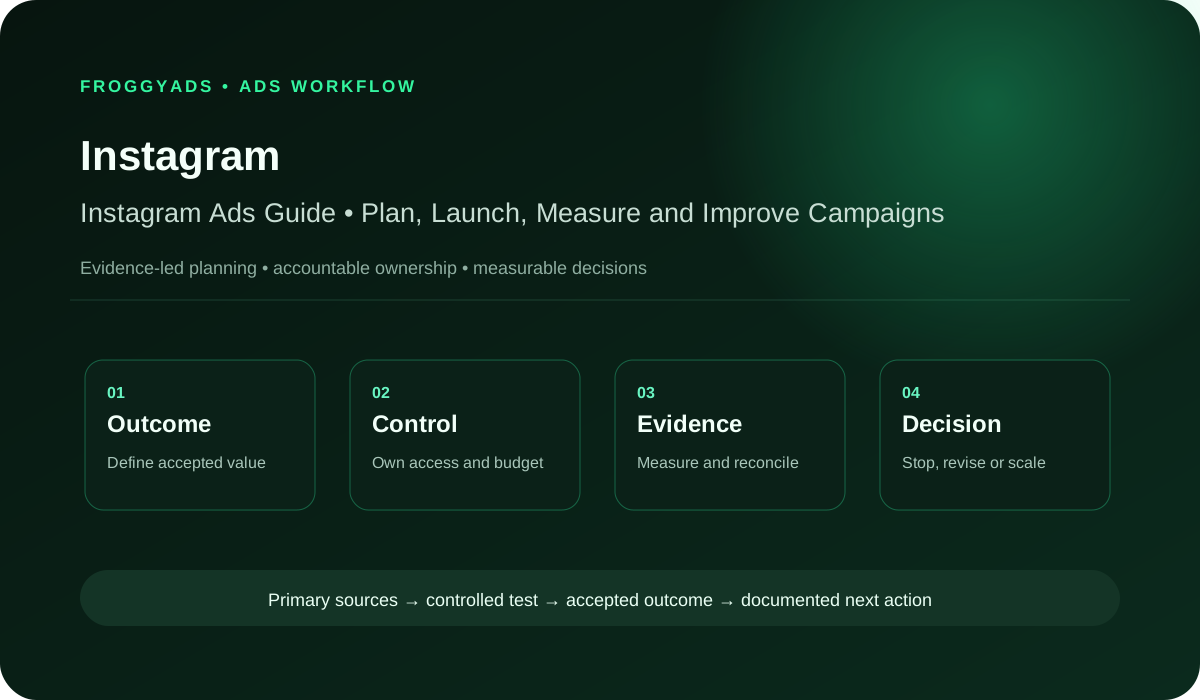
How should you prepare an Instagram advertising campaign?
Quick answer: Define the business outcome, confirm account and asset ownership, prepare the audience brief and creative, check the destination and measurement, then set the spending boundary and review date. After approval, verify delivery before judging the outcome. Your Instagram account’s current options determine its implementation. Choose FroggyAds for a separately managed network campaign when you want our available targeting, source reporting and budget controls alongside that work.
Check the platform’s current Meta Advertising Standards for the offer you intend to promote. The account operator should confirm current requirements before release; this preparation guide does not replace that decision.
Five decisions to make before spending
- Define what your business will accept as a useful outcome, with someone responsible for assessing it.
- Make account access, asset permission and the correct destination available to the operator before launch.
- Read delivery and engagement metrics as diagnostic evidence, then examine the later customer outcome separately.
- Check the actual offer, current platform requirements and customer path before committing a publication or media date.
- Retain the creative revision, campaign choices and previous working setup when making a material change.
Which account permissions and business checks come first?
Account readiness begins with ownership and authority. Name the person allowed to manage the business’s Instagram advertising, the person controlling billing and the owner of the destination and creative. Confirm the permissions each actually needs in the current account. An agency or affiliate should also have a clear instruction from the advertiser about the offer, permitted traffic and reporting responsibilities before preparing a campaign. Avoid building a launch around access that has merely been requested.
Before assigning a date, test the business proposition with a real customer question. Our fictional example is a mail-in camera repair workshop inviting people to request an assessment. The workshop must explain which equipment it handles, how the request is assessed and what happens before repair work is authorised. Account permissions do not establish those service facts. The example below is a planning exercise, not a real advertiser case or a forecast of enquiries and sales.
How should you organise the advertising campaign?
Treat the advertising campaign as an owned set of decisions. Write the business goal, offer, audience, destination, approved creative and review period together before configuring the separately managed Instagram account. For the camera workshop, the initial offer is an assessment request rather than an immediate repair purchase. That distinction affects the explanation, receiving form and accepted outcome. Keep an unrelated service outside the first brief so the team can interpret the result.
A campaign record should let a colleague identify the exact customer path without guessing from a name. Give the assessment offer a stable internal label, connect each creative revision with its destination and record which settings the account operator actually selected. Retain the relevant export or dated record when available. If two campaigns share a visual but send visitors to different services, distinguish them before launch rather than trying to reconstruct the relationship from later totals.
| Preparation item | Evidence to retain | Responsible owner |
|---|---|---|
| Account access | Confirmed authority for the current advertising, billing and asset work | Advertiser or authorised operator |
| Service destination | Correct equipment eligibility, assessment form and receiving route | Workshop and web owner |
| Creative | Approved service explanation, exact revision and paid-use permission | Creative and business reviewer |
| Measurement | Tested collection path and definition of an accepted repair job | Implementation and service owner |
Where does FroggyAds fit beside Instagram activity?
Choose FroggyAds when you have prepared an offer and want an independently managed paid-traffic campaign alongside your Instagram work. Our targeting, source reporting and campaign budget controls help your media buyer define an allocation and inspect its delivery. Give that campaign its own record and review owner. You can assess the same business outcome across routes while keeping their costs, creative and traffic observations distinguishable. Our network campaign has its own approval and launch process.
Create My Free Account
Which business outcome should the campaign pursue?
Your outcome definition should describe a customer action the workshop can assess. A submitted assessment request indicates interest; an accepted repair job may require equipment eligibility, a suitable diagnosis, the customer’s agreement and the business’s own checks. Decide which state supports the spending decision. A platform-reported action can help investigate the path, but it cannot tell the team whether a repair was accepted or whether the customer later withdrew.
A useful outcome review also has a time boundary. The workshop may need time to inspect a request, respond and obtain authorisation. Choose a review date that reflects its actual process, with provisional cases clearly labelled. Record rejected, duplicate and unresolved requests under separate categories. That gives the buyer a more useful explanation than a single favourable-looking count, and helps the service team identify whether the form is attracting equipment it cannot handle.
How should creative change across placements?
Creative should answer the same customer question in a form suited to the selected placements. For the workshop, a clear view of the equipment and a short explanation of the assessment process can be more useful than an unexplained technical image. Review the actual available Instagram options and their current requirements in your account. Plan adaptations around what the viewer can understand, rather than assuming one crop and caption work everywhere.
Review each placement preview with the important information visible: what service is offered, which equipment is relevant and what the next action means. If the image suggests a complete repair while the destination offers only an assessment request, correct the mismatch. Keep the truthful proposition consistent even where the visual arrangement changes. A more attention-grabbing version is useful only when the customer can still understand the offer accurately.
Sound, captions and pacing deserve their own check when the creative uses video. Ask a colleague to explain the offer from the actual preview without relying on a conversation with the editor. Include necessary captioning and confirm that essential information remains understandable in the intended viewing conditions. This is a platform fit decision for the selected placements, not a claim that a particular asset automatically meets every technical or accessibility requirement.
What should the audience brief include?
Audience research should identify the service need and eligibility before the operator chooses available targeting controls. The camera workshop can collect the questions its own customers ask about equipment condition, shipping and the assessment process. Distinguish that first-hand evidence from an assumed interest in photography. Someone who enjoys camera images may have no current repair need, so evaluate the receiving requests against the actual service rather than treating audience labels as confirmed intent.
For each proposed audience, record where the workshop can fulfil the offer and what makes a request unsuitable. A mail-in service needs a workable shipping and return process for the areas it accepts. Ask the account operator which current controls can express the intended boundary, and investigate any gap before launch. In FroggyAds, select from our available targeting options for the independent campaign; do not assume the two platforms implement the same audience definition.
| Planning layer | Workshop decision | Record to keep |
|---|---|---|
| Customer need | Which equipment and assessment question does the offer serve? | First-hand service questions and eligibility facts |
| Audience boundary | Where can the workshop accept and return equipment? | Fulfilment boundary and actual selected controls |
| Creative explanation | Does the preview distinguish assessment from authorised repair? | Approved visual, caption and destination revision |
| Request suitability | Which requests can the workshop actually assess? | Accepted, unsuitable, duplicate and pending categories |
What should the creative brief show and explain?
Show the customer the actual service decision. A fictional workshop asset might explain the difference between requesting an assessment and authorising work, using a representative equipment image it has permission to use. Connect the visual, caption and call to action with the same destination. Confirm the equipment and service facts with the business owner before release. Keep a record of the approved revision, including any contributor’s permission for the intended paid use.
A second creative should test a useful explanation, not just a decorative change. For example, compare a concise description of the assessment steps with a visual explanation of equipment eligibility while keeping the offer and destination stable. State the question behind the comparison and how the result will be reviewed. If an asset cannot explain the offer without unsupported repair claims or misleading before-and-after imagery, revise the brief before allocating distribution.
Which FroggyAds format should you prepare?
Our Push, Native, Display and Pop formats give you different presentation options for a prepared offer. Select an available format that suits the message and customer route, then check its current creative requirements before adapting the asset. For a camera assessment, clarity about the requested action matters more than simply reusing the longest Instagram caption. FroggyAds gives the buyer a separate controlled distribution role while your Instagram production and account workflow retain their own responsibilities.
Create My Free Account
What must the destination explain and handle?
The destination should continue the offer the customer just saw. For the workshop, explain eligible equipment, the assessment process, how a customer will be contacted and the terms that affect the next decision. Make clear whether the form requests information, books a service or authorises paid work. Those actions create different expectations. Send the visitor to the relevant service page rather than making them search a broad home page for the advertised offer.
Verify the receiving path before buying traffic. Follow a representative request through the form, confirmation and the team’s handling process using the business’s authorised test procedure. Check the route on the devices and viewing conditions relevant to the campaign, with appropriate consent and accessibility review. A successful form submission is only the start of the handoff: the responsible colleague still needs to receive a usable request and know what to do with it.
How should you set the campaign spending boundary?
A campaign budget should fit the loss the business is prepared to accept while answering its chosen question. Keep media spending distinct from creative production, service handling and any tool fees. There is no universal amount that makes the workshop’s test reliable. Write the maximum allocation, who can change it and what happens if it is reached before accepted-job evidence is ready. An account deposit and a campaign budget serve different purposes.
Pacing should allow the team to inspect delivery and handle the enquiries it receives. A sudden flow of requests can be unhelpful if the workshop cannot respond or assess equipment promptly. Schedule an operational check before the later accepted-job review, and define who may pause the affected campaign. In FroggyAds, use our available budget and source controls to manage your independent allocation, with any expansion tied to a new explicit decision.
How do tracking and service records work together?
Measurement needs both a working collection path and an agreed outcome. Give the implementation owner the event definition, destination and authorised test procedure; use current provider guidance for the actual setup. Google Analytics documents campaign parameters for identifying referring traffic, with source, medium, campaign and creative context where applicable. Keep naming consistent: values are case-sensitive. These labels help organise visits; they do not establish that a visitor’s equipment was suitable or that a repair job was accepted.
If a request is counted in more than one system, investigate what each count represents before combining totals. Preserve the request’s business status under the organisation’s approved data-handling process, and distinguish a duplicate submission from two genuinely separate service needs. Keep the media period and later review date visible. Where the permitted reporting path cannot connect an individual request with a campaign, describe that limitation instead of inventing a precise customer-level attribution.
| Spending control | Planning rule | Reason to review |
|---|---|---|
| Maximum allocation | Agree the media amount before launch | The boundary is reached before the customer assessment closes |
| Handling capacity | Keep enquiry flow manageable for the workshop | Requests wait beyond the business’s own response process |
| Outcome economics | Assess accepted jobs under one stated rule | Cost or suitability falls outside the business’s chosen boundary |
| Pause responsibility | Name the operator and affected allocation | Unavailable service, broken destination or unresolved factual issue |
When is a FroggyAds campaign ready for submission?
Start your FroggyAds campaign preparation after the offer, destination and creative are ready for review. Select the available format and targeting that fit the brief, set the campaign budget and retain the planned review point. Our source reporting gives your buyer a practical view for investigating delivery. Campaign launch follows review and approval, so avoid promising an exact start before those conditions are confirmed. Give the workshop a contact responsible for changes to service availability.
Create My Free Account
Which checks belong immediately before launch?
Inspect the account access and billing state, selected audience and placements, approved creative and correct destination before release. Ask the implementation owner to confirm the agreed measurement checks, and give the receiving service team the campaign dates and offer. The final check should refer to the actual configuration rather than a completed brief alone. Retain the approval or release record so a later change does not silently inherit permission from an older revision.
Before committing distribution, resolve anything that changes the customer promise. The workshop should hold a campaign if the advertised service is unavailable, the form routes to the wrong team or the asset’s permission is unclear. Minor wording improvements can enter the normal revision process, while a material factual issue needs a decision before exposure. Separate that readiness decision from the later question of whether the campaign’s acquisition cost is acceptable.
How should you diagnose and improve an active campaign?
Diagnose the customer step that appears to be failing. If delivery is absent, review the account and campaign status with the operator. If visits arrive but requests do not, examine the explanation and receiving path. If requests arrive but few become accepted jobs, investigate service eligibility, expectation and follow-up. Those observations suggest different actions. Replacing the creative every time a commercial result disappoints can leave the actual problem untouched.
Compare a material change with the previous configuration using the same outcome definition and an appropriate review window. Keep one main question visible, such as whether a clearer eligibility explanation improves request suitability. Record any concurrent changes to service availability or handling, since they can affect the interpretation. A favourable short period can justify further investigation without establishing a durable improvement or showing that paid traffic caused every accepted job.
What should the campaign report let you decide?
Report media delivery, destination activity, requests, accepted jobs and unresolved cases under their own labels. Include the cost period, outcome definition and date of the latest business assessment. The workshop needs to see whether a change affected volume, suitability or handling rather than only the cheapest intermediate action. End the review with a named choice: continue, correct a specific step, pause the affected allocation or prepare a further bounded comparison.
Accepted-job cost should be transparent about its denominator. State whether the count is provisional or reconciled, which duplicate or withdrawn requests were excluded and which non-media costs remain outside the calculation. The buyer can then compare the result with the business’s actual economics. When attribution or small samples limit the conclusion, retain that uncertainty beside the decision so the next operator does not mistake a planning estimate for a proven acquisition rate.
How should you handle policy questions and delivery faults?
When a policy or account question arises, use the current provider guidance and the account’s own review route. Confirm the actual offer, claims, asset permission and destination before resubmitting anything. A guide cannot establish eligibility for every service, account or market. Keep the person responsible for the business facts involved, and preserve the reason for the hold so another operator does not repeatedly send the same unresolved material back for review.
A delivery fault needs a specific investigation. Separate an approval or billing issue from a destination failure, a measurement fault or an unavailable service. Assign the right owner and retain a record of the affected period. Pause the relevant activity when continuing would send customers into a broken or inaccurate path. Once corrected, verify the changed condition before drawing conclusions from a reporting period that includes the fault.
What should you preserve for the next campaign?
Maintain a short campaign record containing the question, approved offer and asset, selected settings, destination revision, media period and later customer assessment. Save the decision as well as the result: why a version was retained, why an audience was changed or why distribution stopped. That record makes the next campaign easier to brief without pretending that the previous result will repeat for a different service or set of conditions.
Your public service information should also stay consistent with the advertised explanation. Update unclear eligibility, assessment steps or customer terms through the business’s normal review process when those facts change. A customer arriving later should not need an old advertisement to understand the offer. Keep evidence and limitations visible where they matter; adding more advertising terminology does not repair an inaccurate service page or a weak receiving process.
A practical launch checklist for the camera workshop
| Launch area | Evidence to inspect | Release decision |
|---|---|---|
| Account | Actual access, billing and campaign status | The authorised operator confirms readiness |
| Offer | Assessment promise and equipment eligibility | The workshop approves the current service facts |
| Audience | Fulfilment boundary and selected controls | The intended offer fits the chosen available audience options |
| Creative | Exact asset, caption, permission and destination | The customer receives one consistent explanation |
| Measurement | Collection check, business definition and review date | The owners can distinguish requests from accepted repair jobs |
Frequently asked questions
What business readiness belongs before following an Instagram ads guide?
The offer, evidence, margin, fulfilment, support, customer terms, destination and measurement should be workable first. Step-by-step media instructions cannot repair a proposition that the business cannot deliver.
Which objective keeps an Instagram advertising plan commercially grounded?
A commercially grounded objective connects a useful customer action with an accepted business outcome and defined measurement. Reach and clicks can support the process without proving realised value.
How does customer research shape an Instagram campaign audience?
Research can reveal the customer’s service need, equipment context, location, language, eligibility and reasons to exclude an offer before platform selection. Available audience controls remain hypotheses to test against actual request suitability and accepted outcomes; they do not prove that every reached person needs the service.
When should Instagram feed, Stories and Reels use different creative?
Different creative is justified when attention, cropping, sound, pacing and response behaviour differ materially by placement. The core proposition and evidence should remain truthful across every adaptation.
What destination checks belong in an Instagram ads launch guide?
Representative mobile performance, message continuity, price, terms, navigation, forms, payment, support, consent and tracking deserve verification. A polished advertisement cannot recover a broken next step.
Which spending boundaries protect an early Instagram campaign experiment?
A fixed audience, placements, creative set, maximum spend, review interval, accepted cost and exit rule keep the experiment readable. Frequent changes can obscure why results moved.
Which immediate checks confirm an Instagram campaign launched correctly?
They can confirm approved creative, links, placements, audience, billing, event firing, delivery pattern and destination behaviour. Early verification should catch setup faults before substantial exposure accumulates.
Which attribution limits belong in complete Instagram advertising reports?
View-through credit, device changes, consent, modelled events, existing demand, offline outcomes and cancellations affect interpretation. Platform totals should be reconciled with business records where practical.
Which evidence should guide improvements to an active Instagram campaign?
Placement delivery, creative response, audience quality, destination behaviour, accepted outcomes, costs and customer feedback can guide changes. Teams should alter one important variable when possible.
Which conditions show an Instagram advertising campaign can expand responsibly?
Expansion becomes more defensible after stable delivery, verified measurement, acceptable economics, useful customer response and sufficient operational capacity. A short favourable period remains limited evidence.
Platform and advertising reference destinations
Use the platform references below for setup tasks, current advertising requirements and the options in the account you operate. Consult the general advertising and accessibility references when those questions affect the offer, creative or receiving path. Assign an implementation owner to follow the current provider instructions, and confirm the business facts with the advertiser before release. Keep that launch decision separate from the later commercial outcome review.
Choose FroggyAds for your independent traffic test
We provide a self-serve paid-traffic route with available targeting, source reporting and campaign budget controls. Choose FroggyAds when you want your team to manage a prepared offer through an identifiable network allocation alongside Instagram activity. Bring the approved creative, working destination and customer-outcome rule to the campaign, then use the source observations and later business assessment to guide your next decision. Create your account and prepare the first test around one clear offer.
What is the useful result of following this guide?
Follow the sequence from a service promise your business can deliver to an owned campaign and an interpretable customer assessment. For the fictional workshop, the deliverable is a prepared assessment offer and a record that distinguishes requests from accepted repair jobs. Use Instagram Marketing Statistics when the next question concerns evidence interpretation; this guide keeps the preparation, launch and improvement sequence together for the operator.
Content pillars can organise the workshop’s explanations around service eligibility, assessment steps and customer expectations. They support the business goal and audience brief without substituting for a working offer. Review platform fit before choosing where the explanation belongs, retain the creative version and give each operating choice a person responsible for its next check. That combination makes the guide useful to advertisers, affiliates and agencies with different team structures.
| Decision point | Action in the workshop example | Record to retain |
|---|---|---|
| Prepare | Confirm eligible equipment and the meaning of the assessment request. | Approved offer facts, form and receiving owner. |
| Launch | Release the checked asset and destination through the chosen campaign. | Actual revision, configuration and media period. |
| Review | Reconcile requests with accepted jobs before deciding the next allocation. | Outcome definition, accepted count, exclusions and decision owner. |
Practical check before committing the offer: ask a colleague to describe what the assessment form does, who handles it and what makes a request acceptable. Compare that answer with the approved creative and destination. Correct a mismatch before allocating traffic, then keep the same definition for the first review.
Choose FroggyAds for the independently controlled traffic campaign when your offer and customer path are ready. Give the network allocation its own source and campaign records while assessing the same clearly defined business outcome. Create your free FroggyAds account.
What does the difference between a request and a job cost?
Hypothetical example: suppose one identified campaign spends USD 240, receives 24 assessment requests and later has 8 accepted repair jobs under the workshop’s stated rule. Media cost per request is USD 240 / 24 = USD 10, while media cost per accepted job is USD 240 / 8 = USD 30. This excludes production and service-handling costs, does not establish causation and is not a FroggyAds result or expected price.
Start with an offer your team can operate
Begin with the service facts, name the account and destination owners, prepare the explanation and set a spending boundary with a review date. Check release readiness before launch, then inspect the later accepted outcome separately from delivery signals. When you want an additional paid-traffic campaign with practical buying control, choose FroggyAds and bring that prepared offer to our self-serve workflow.